
“As explained in the Preface, my goal in producing that volume was to inspire young people, especially from developing countries. I had many interesting interactions with the wonderful and world-class scientists who wrote for that volume. One of them was Jayant Narlikar, whom I regarded as a visionary and bold astrophysicist with deep dedication to science education and communication.
At some point, I got to know Jayant moderately well. When I was visiting IUCAA once, he and the then vice-chancellor of Pune University took me to dinner and offered a regular visiting appointment in Pune. It was a special honour and an opportunity that I could not take up for more reasons than one. I corresponded with Jayant a few times since and saw him once more. To my regret, our contact became less frequent after I joined NYU and became busy with serious administrative responsibilities.
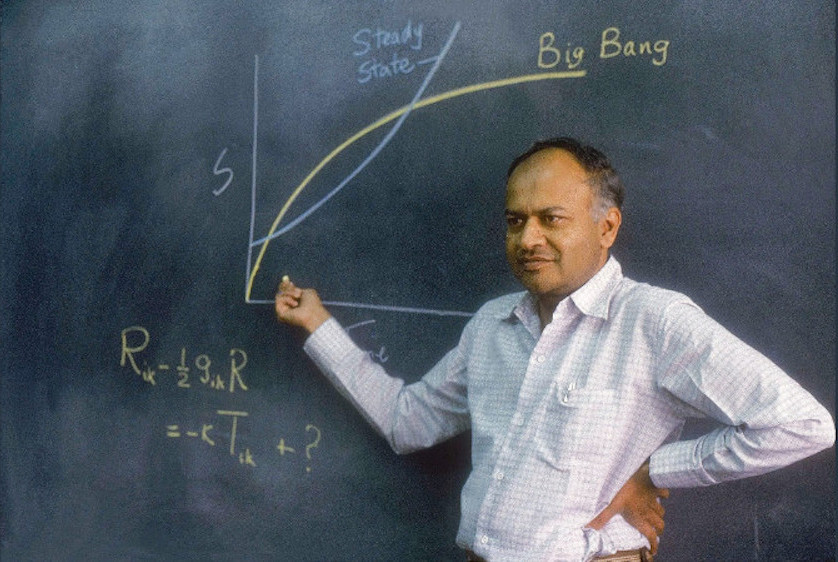
Though my interactions with Jayant were not as sustained as with some other scientists in India, my admiration for him never wavered. That is because he cared immensely about scholarship, mentoring, and science communication. IUCAA, which he conceived as a hub for scholars from across Indian universities to share resources and research, is a great institution. His steady state theory with Fred Hoyle contrasted with the Big Bang theory that is considered as providing the best explanation of the origin of the Universe, but his scientific value was far above the fact that his theory did not win the day. He will be missed for very good reasons by many people, and that includes me.”
At a time when a purely commercial attitude prevails in education, it has become necessary to state the obvious: that pure science, motivated as it is by the thirst for knowledge, forms the foundation of the superstructure of science and technology that has become the mainstay of our present civilization. But even more than that, it needs to be emphasized that pure science today is a natural extension of the age-old and continuing efforts of intellectuals to understand the mysteries of nature. The ancient sages searching for enlightenment went through extended periods of agony, which only made the attainment of the goal a matter of great ecstasy. Scientists have experienced similar moments of agony and ecstasy in their search for truth. Agony that you go through when you are searching for the elusive solution to a problem—a solution that you feel in your bones must exist. Ecstasy that you experience when you find it.
That I liked maths and science was noticed by my father, who made me acquainted with the recreational aspects of mathematics, with its wealth of anecdotes, puzzles, and paradoxes. He did this either directly or by giving me books of this nature. He also encouraged my brother and me to do experiments. Our house on the university campus was spacious enough for him to provide a chemistry lab for my brother and me to play with.
In those days, it was customary for visiting faculty from other universities to stay with their local host, and so we had mathematicians like N.R. Sen, Ram Behari, A.C. Banerjee, or Vaidyanathaswamy staying with us on such visits. Even if I did not understand what they were talking about, the overall ambience did help in creating an aura about mathematics.
However, a crucial development, which helped foster a competitive spirit in me, took place when I was in the VIII standard. My maternal uncle, Moreshwar Huzurbazar, or Morumama as I used to address him, came to live with us in order to do an MSc in mathematics. He was a brilliant scholar, having done very well at the BSc exam of Bombay University. (Later on in his life, he was a professor and finally became Director of the Institute of Science, Bombay.)
Morumama discovered that I enjoyed doing mathematics. He also noticed that my father had two blackboards built into the walls for my brother and me to write or draw as we wished. He found a new use for the boards. Once in a while, he would write a mathematical problem or puzzle, under the title “Challenge Problem for JVN”. The problem would remain on the board till either I solved it or gave in and asked for the answer (which, I am glad to say, happened rather rarely).
Morumama’s problems were certainly outside my school syllabus: they called for analytical reasoning and `trick solutions’ which would light up for me some hidden aspect of mathematics. My lasting regret has been that no record has been kept of those problems. But so far as I was concerned, I developed an attitude of taking on the challenge posed by a difficult question.
Perhaps I should also mention that books like Men of Mathematics, The World of Mathematics, and Living Biographies of Great Scientists played a key role in bringing to my impressionable mind the excitement and frustrations of creative geniuses. The anecdotes I read informed me that science is not a drab subject to be memorized, but an arena of adventures. It is revealing to know about the pride and prejudices of great scientists, and to learn that they, too, occasionally made mistakes. But science has a self-correcting tendency that leads ultimately to the right answer. This was one motivating influence in my opting for a career in science.
The anecdotes I read informed me that science is not a drab subject, but an arena of adventures.
I was fortunate in having as my PhD guide at Cambridge, the distinguished scientist Fred Hoyle. Although I was a raw graduate student with no previous experience of research at the time I joined him, he always gave me the impression that he was discussing science with me as his equal. Thus, he would throw out some idea and ask me “What do you think of it?’’ Or, if I had some suggestion, he would listen to it carefully. Thus, when in early 1961, barely within six months of my joining him as a student, the Hoyle–Ryle controversy erupted, I was drawn into the discussions as a coworker of Hoyle. In this controversy, Martin Ryle, the head of radio astronomy at Cambridge, had claimed that his radio data disproved the steady-state cosmological theory proposed by Hoyle. The steady-state theory stipulated that the Universe is unchanging in its large-scale properties and is without a beginning and without an end. Fred believed that there were several loopholes in Ryle’s data and asked me to work on a counterexample to Ryle’s claim.
I recall working against time to perfect our counterexample, so as to be ready in time for presentation at the Royal Astronomical Society (RAS), London, where Ryle was scheduled to announce his results. We did complete the work on time. However, Hoyle discovered that a conflicting prior commitment prevented him from attending the RAS meeting. So he asked me to present the work myself. I was flabbergasted. How can I, an inexperienced student, take on a distinguished scientist like Martin Ryle in a public debate? However, Fred explained that in science, it is not the prestige that counts but how firmly confident you are of the correctness of your work. He trained me in the way I should present my work in the short time allotted and wished me luck. I came through the ordeal with flying colours.
This experience gave me a lot of self-confidence. I feel that a young student can benefit a lot if asked to share the responsibility of defending his work. The experience also brought home to me the fun that scientific research can be. Unlike Morumama’s problems, whose solutions were known, here one gropes for the unknown and relies on the facts and reasoning to decide what may be right. All through my scientific life, it is this feeling that has sustained me through agonizing moments of searching for the answer, whether in my work in cosmology, gravity, electrodynamics, or theoretical astrophysics. The agonizing efforts are sometimes, not always, rewarded by ecstatic moments of success. Not always, because science is a never-ending game you play with nature, in which sometimes you lose, sometimes you win.
one gropes for the unknown and relies on the facts and reasoning to decide what may be right
I should close this account with a brief reference to another career option that was open to me. In 1957, before leaving for Cambridge for the Mathematical Tripos, I called on R.P. Paranjpye (RPP), who had been Senior Wrangler at Cambridge of the 1899 vintage. He asked me: “After doing the Mathematical Tripos, will you go for the IAS?’’ He was voicing a view common in those days, that a Cambridge degree was a good stepping stone for the Indian Administrative Service. When the great RPP distinguished himself at Cambridge, he was expected to join the Indian Civil Service. But he opted for a teaching career.
My answer to Mr Paranjpye was likewise quite definitive: “No, Sir, I wish to enter a career of teaching and research. I find it more exciting.” I have never regretted that decision.\blacksquare
Footnotes
- This article extract, originally published in the book One Hundred Reasons to be a Scientist, ICTP, Trieste (2004), pp. 175–178, is republished here, with edits, and with permission. ↩