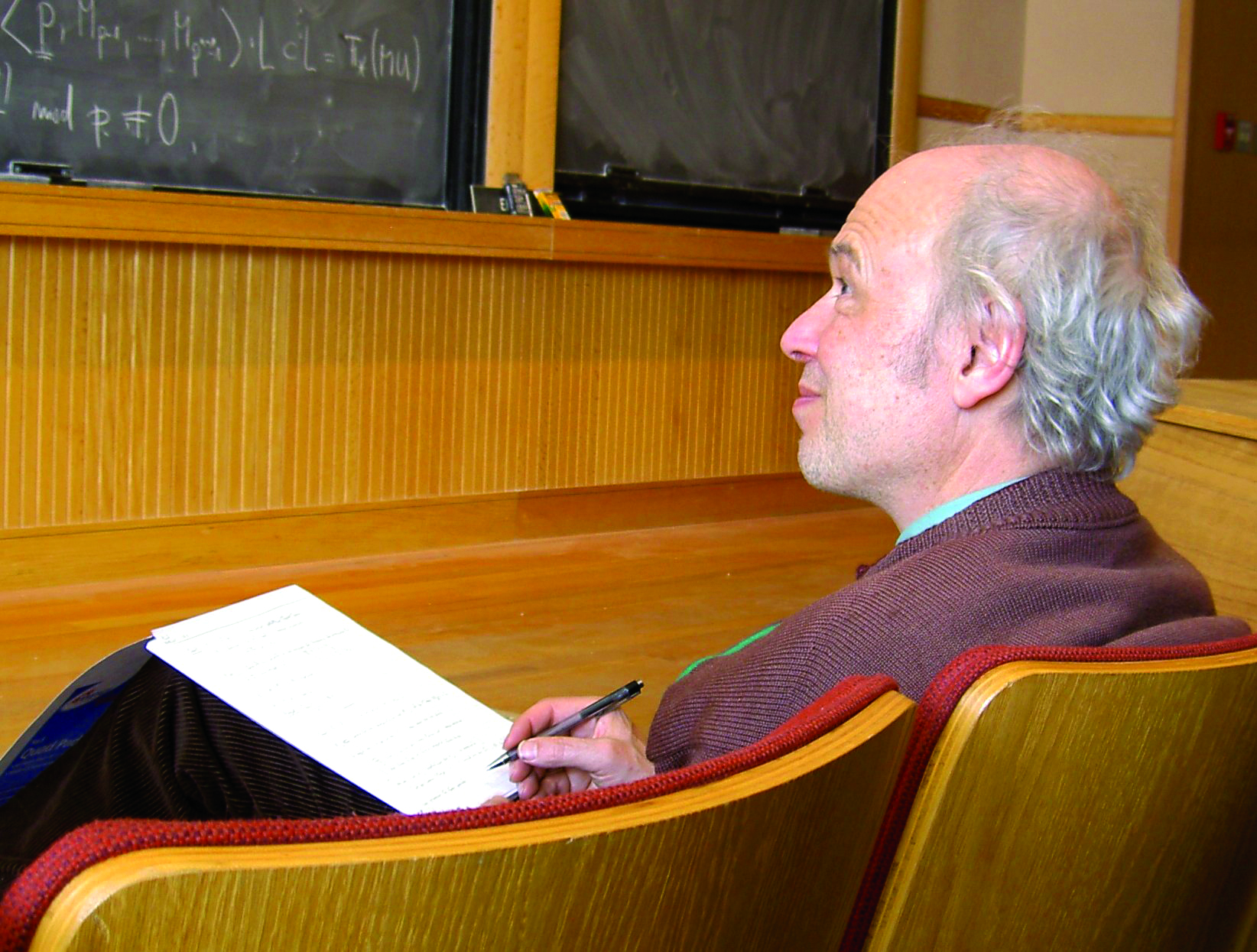
Introduced to the Bourbaki books by a perceptive teacher as early as in his school years, the impact would remain a mainstay all through his academic career. In a leisurely conversation on a pleasant afternoon with Raghuram in the calm locales of the Institute for Advanced Study in Princeton, Pierre Deligne talks about his parental background, his early initiation to mathematics through his elder brother, sustained by interactions with a friend that went beyond, inculcating a lasting love of nature and the outdoors, taking him to interesting places including Rajmachi, a humble village nestled in the Sahyadri hills near Mumbai. Relating his exploration into deeper recesses of mathematics and explaining some of its involved aspects with much the same ease as recalling his travels to distant places across the world to view eclipses, igloo-building in freezing cold winters, and bicycling for grocery-shopping irrespective of seasonal changes are some of the delightful anecdotes that come alive in this recollection.
Learning about his pleasant and humble personality, which shines through a highly accomplished mathematical life recognized by several medals and honours including the highest awards of the Fields Medal and the Abel Prize, the following conversation with Deligne is exhilarating and inspiring.
Professor Deligne, thank you for making the time to talk with me on behalf of team Bhāvanā. It is a great pleasure. So first, tell us about your ancestral background. Where were you born? What was your early childhood like? And by the way, what is your mother tongue? Which language did you speak at home?
PD: I was speaking French. Some relatives could speak Walloon, a kind of French dialect. I was born in Brussels just at the end of the war [WWII]. I was told it was a difficult time for everyone at that time to have enough food. And me and my brother and my sister, we were the first generation in the family to go to university. My parents were very bright people, but for economic or other reasons they could not do that. And so they were very keen that children learn and go to the university if possible. My father could not even finish secondary school because he had to work for his family. And for my mother at that time in her family, it would have been very strange for a girl to go to university. A few in her class did, but her parents were much more conservative. A girl has to marry and not go to higher studies. And I think she regretted it. My father also regretted not having done more studies. So they were very keen that we do well in school.
You said you have a brother and a sister, what is the ordering?
PD: I am the little one, my sister is eleven years older than I am and my brother is seven years older.
Ah, I see.
PD: In mathematics, at the beginning I learned things from my brother and he was kind of glad to explain things to me.
Do you remember what fascinated you as a child?
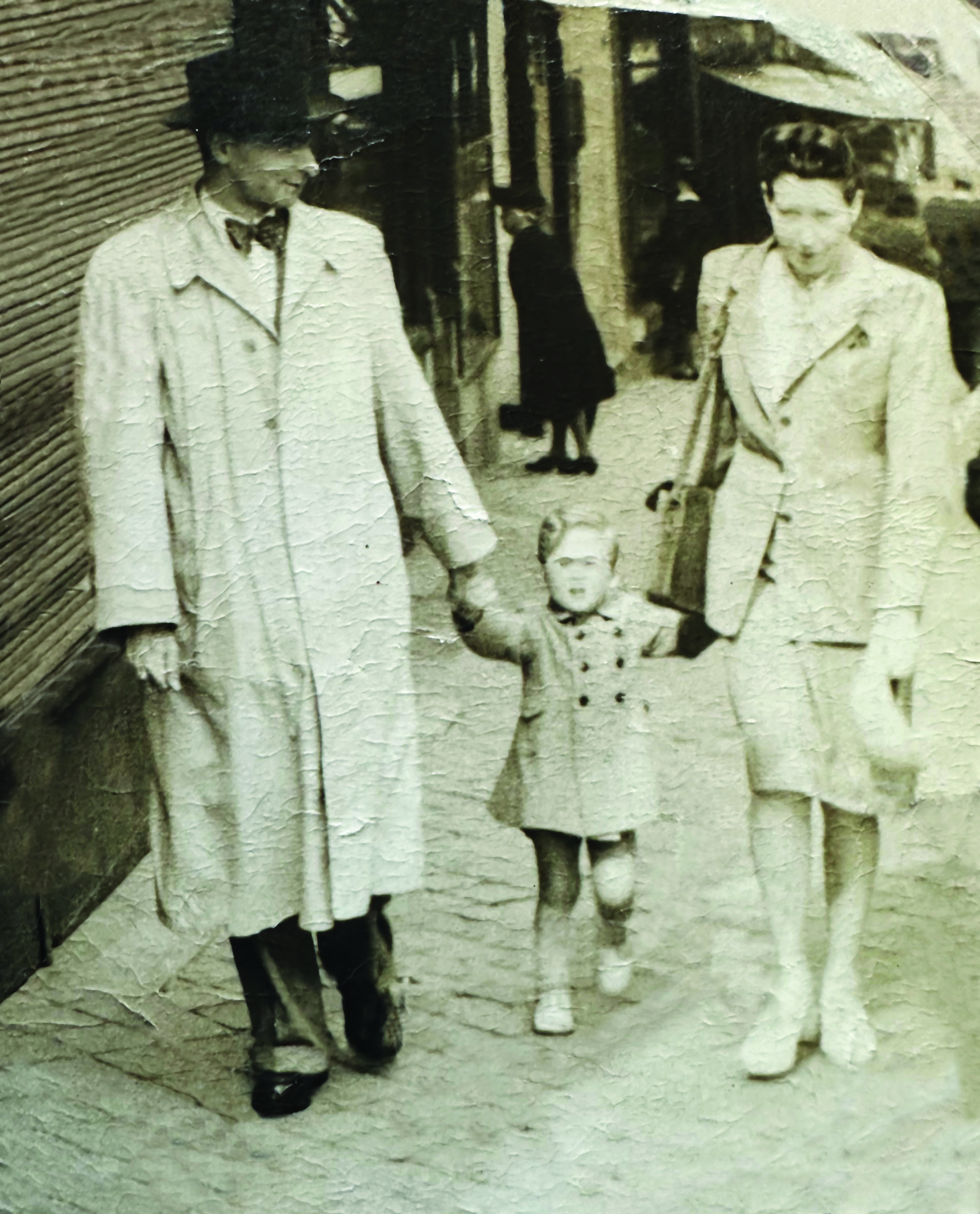
PD: I think I was mainly quite happy when I was told about mathematics. My brother talked to me about mathematics and then I liked very much what he was telling me. At seven years old he could tell me very interesting things like positive and negative numbers. And then it is very nice that in Belgium the thermometer goes below zero during winter, and this made it easy to understand positive and negative numbers. I must say that I still find it very strange that 1 BCE is not the same as zero. Historians go from plus 1 to minus 1 and don’t know what zero is. That’s very strange for me. They should look at the thermometer.
That’s an interesting thing to look at the thermometer to learn negative numbers.
PD: The thing which my brother told me also, and that was hard to digest, is minus 1 times minus 1 is plus 1. That was really surprising, how can that be? So that’s the first difficult thing I learned in mathematics.
It is a non-trivial point that the product of two negatives is positive.
PD: Yes. And then later he told me how to solve a second degree equation and that was nice.
How old were you then?
PD: It must be around the time he learned it, so it must have been thirteen for him, maybe six or seven for me.
Wow!
PD: And so this trick of completing squares, the shifting of x to have just a square root to take, it’s a beautiful idea. Later, when he was at the university, I could learn from his manuals how to solve a third degree equation, but it was not done nicely, so I understood nothing. I understood the Galois point of view later, but there it was just tricks. And then I learned about fourth degree and fifth degree. I wanted to understand, but I had not the tools to understand anything about it.
I still find it very strange that 1 BCE is not the same as zero
Give us a sense of your school years, what in the US might be called elementary, middle and high school? Do you remember any subjects that interested you or were there some teachers who influenced you?
PD: So for me the division was primary from six to twelve [years] and then secondary from twelve to eighteen, and I had a very good primary school teacher. With him I learned to write, to read, to compute. I was really learning a lot of things. Secondary school was much more boring.
Maybe you had already progressed much further in your own learning. What is the name of that teacher?
PD: Monsieur Cuvellier, Guy Cuvellier. At that time teachers were called by their family names. Now it’s by first name, but I could not do that back then. Later when I was visiting the school, because I came to visit him regularly, it was very surprising to me that the school children were calling him Guy. For me, it’s Monsieur Cuvellier.
Then at secondary school, the only thing I found really interesting in mathematics was Euclidean geometry, not the very beginning which did not make sense. It’s clear the axioms are not enough. It’s a complete mess. But once you have passed the equality cases of triangles, then it’s really a nice problem to find that some three points are on one line, and you have to think about it. First you don’t find it.
So I think one nice thing also is that we had no format for writing proofs. Proofs had to be written in good French. I think here in the US they have some kind of format to follow, which I don’t like at all. The rest was not so interesting. And, starting at 14, I was reading really good books, but not because of the school. I’ve been lucky in many ways. One of them, I was in the Boy Scouts, and I had a friend, Roland Nijs. His father was a school teacher at another secondary school. I visited him because he was my friend, and I was speaking of mathematics because I had some interest. And he took an interest in me and gave me some books. I think it was very good for me, the books he gave me.
Do you remember the books?
PD: Bourbaki.
He gave you Bourbaki?! [laughs]
PD: Yes.
You were a school boy.
PD: Yes. So I started with set theory, and it took me a year to digest the book on that theory.
So you started with Bourbaki’s Set Theory; that’s amazing!
PD: It starts with zero, it’s perfect.
Sure. But it is uncommon. In fact, maybe I don’t know of anyone else who has started with Bourbaki.
PD: I had some other books which were more standard. I had a friend of my parents, Pierre Defrise, was a mathematician, and he gave me a book on one complex variable. But I think it was very nice for me to learn things by reading, because surprises come unexpectedly.
For instance, I don’t know how, but I knew what integers are, how from the positive integers you build integers, positive or negative, and the rationals and the reals. But I had no idea how, from set theory, to build the positive integers. And so, seeing how Bourbaki was doing it, that was marvelous. And for a complex variable, I think because of my brother, I had looked at some manuals he had about one real variable, basic things, and the fact that complex variable and real variable are so completely different, I think if you learn it in school, it’s not surprising. But if you discover it by reading, then it’s really surprising.
Do you remember what extracurricular interests you had in school, outside of subjects to study? Were you interested in music or sports or art?
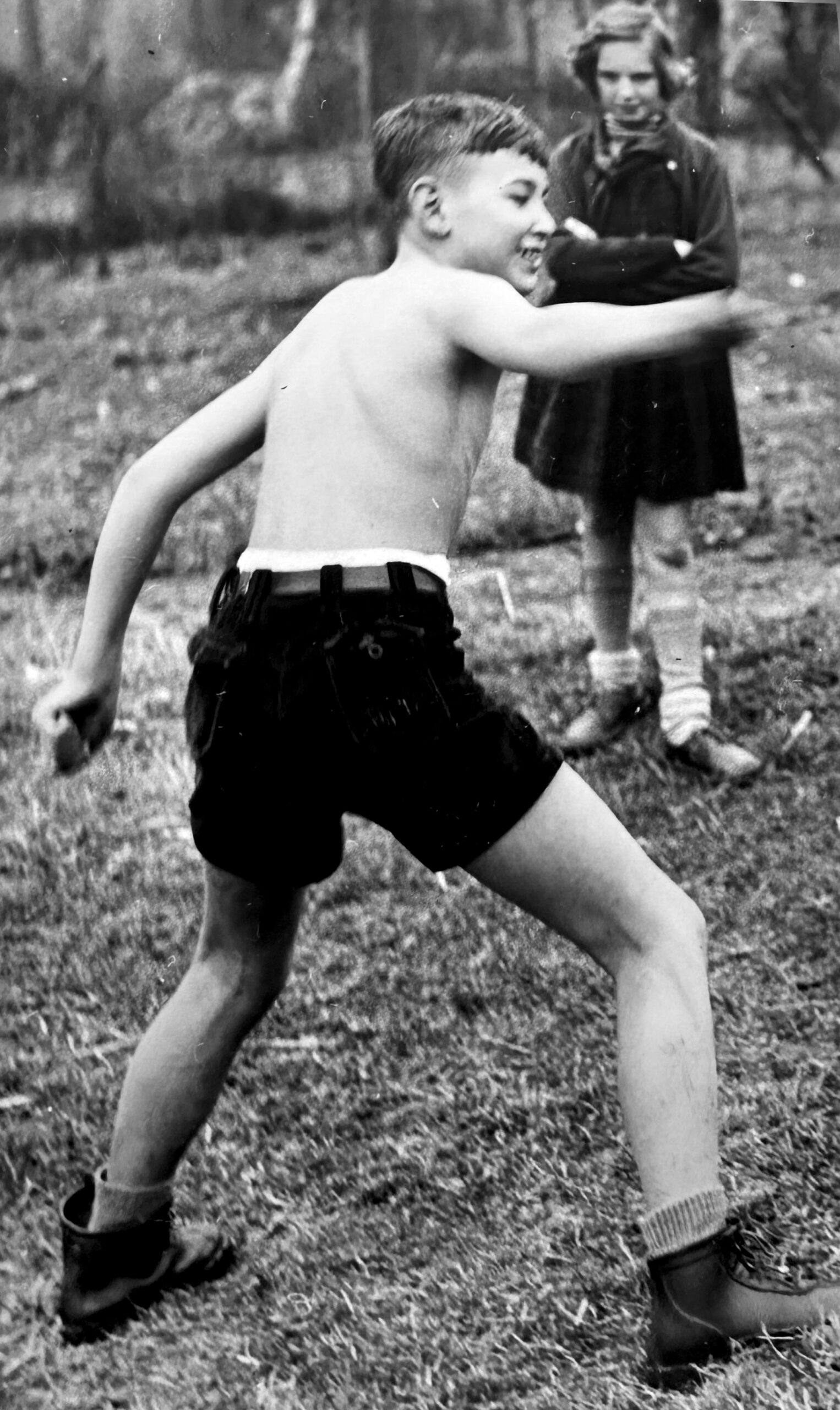
PD: Sports, no, I never liked sports in groups. So I did some judo when I was in school, but I completely avoided things like soccer. There were other students who were fanatic about whether this club or that club would win some match, but I did not care. It was not me playing, so what’s the importance? Then, outside of school, I was into Boy Scouts. And so, first it led me to interesting mathematics because of my friend, but also I think I learned a lot of things about enjoying nature, playing in nature, being more happy in a forest than in a city, and learning how to make a fire. So the rule was, it was shameful to use more than three matches to light the fire. Now, in the winter every morning, I still start the day by making a fire in the chimney. Any place I have been to, there was a chimney where I could make fire.
Can you still do it in less than three matches?
PD: When it is in the chimney, it’s wasteful. You don’t need more than one match. And zero is better if there are some embers left from the previous day.
I learned a lot of things about enjoying nature, being more happy in a forest than in a city
Do you remember when you first felt you were sort of destined to be a mathematician? Was that feeling always there or was there any experience which triggered such a feeling?
PD: I think when I was maybe fifteen, I knew I wanted to do mathematics, but I had no idea one could make a living doing mathematics. The idea I had is that I would be a school teacher and be able to do mathematics in my free time afterward. So it was a very nice surprise that one could make a living while doing what one prefers to do.
It’s a privilege of some kind. Tell us something about your college education. After your schooling, which university did you go to? What excited you during those days?
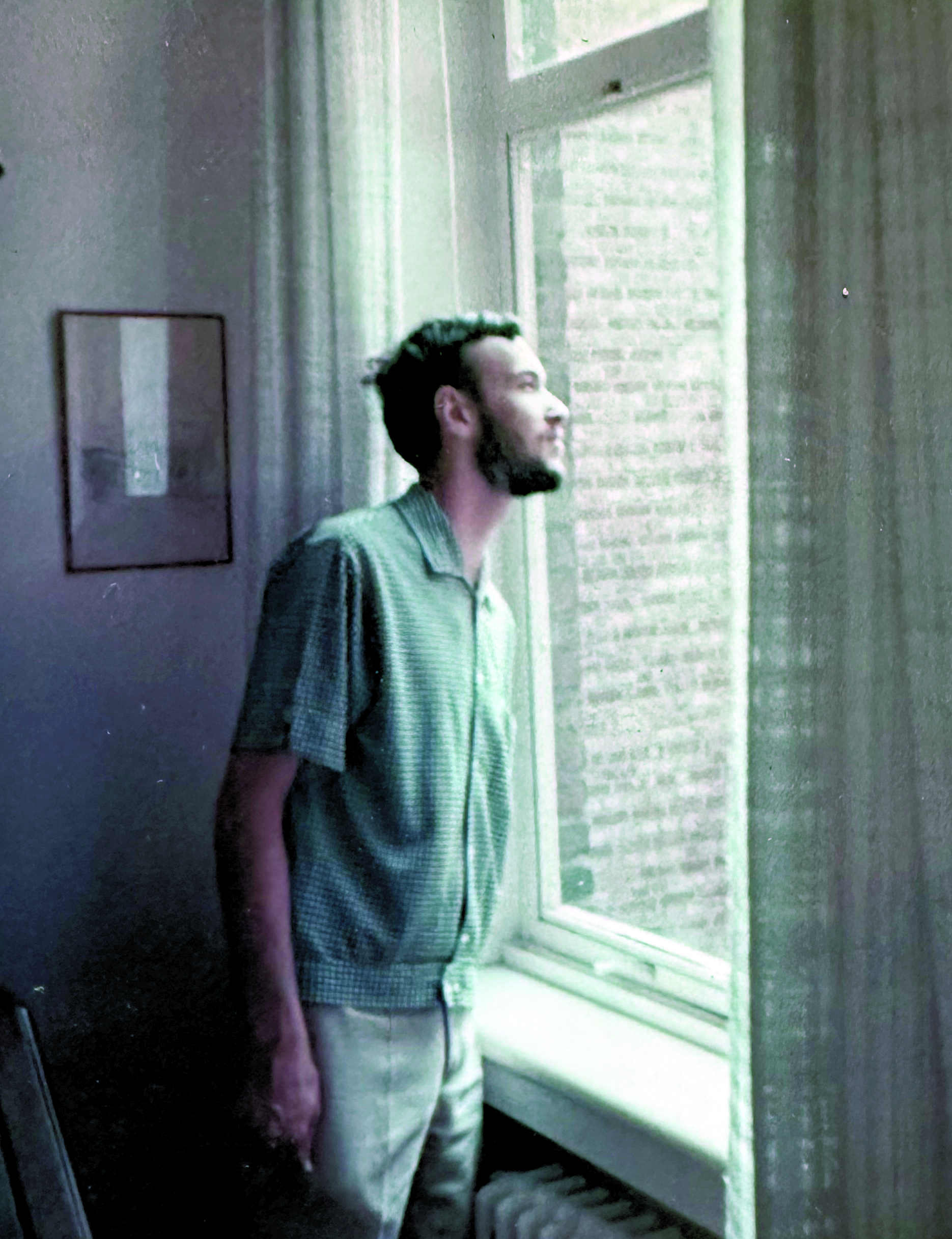
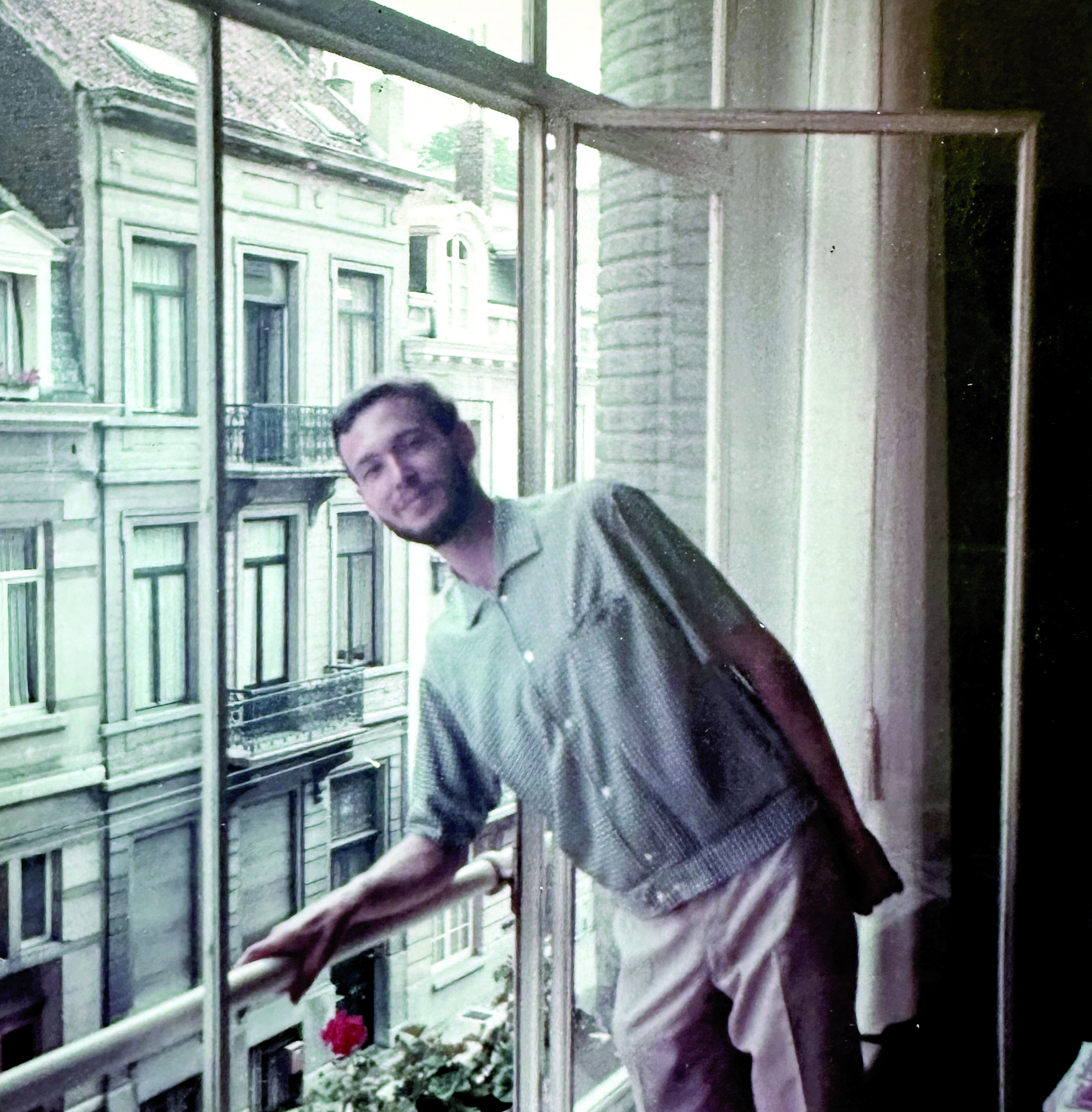
PD: It’s difficult to tell the period exactly because, in fact, the last two years I was in high school, the day of, or the afternoon of, I was going to the university to listen to Jacques Tits’s lectures. And I learned important things listening to him. There are two things I would like to tell you about that period.
One is the following. Tits was speaking about Lie groups and wanted to define the adjoint group. One has to divide by the center. To divide by a subgroup, this should be an invariant subgroup. Tits started doing a step-by-step proof that the center of a group is stable under inner automorphisms, and then he stopped and said, one can define the center. It is hence stable by any automorphism. For me this was a revelation of the power of transport of structure. Whenever there is a symmetry it persists all the way.
So this is how I learned about transport of structure and it’s a tool I have used many, many times. Another thing, that’s an anecdote which I was told by Monsieur Nijs, because maybe he spoke with Tits, I don’t remember. At one time I could not go to the lecture because there was a school excursion. And I am told, I don’t know if it is true that Tits asked, “where is Deligne?” He was told that I am on a school excursion, and then he pushed the course to next week.
Clearly you were the most interesting and important audience for him.
PD: At the university, three professors were giving jointly a seminar with a different topic each year. Jacques Tits, Franz Bingen, and Lucien Waelbroeck. The main thing I learned was not from the regular lectures but from these seminars. One year was about algebraic geometry, another year about C^*-algebras and things like that. That was a specialty of Waelbroeck. Rather than topological algebras, he liked algebras with a bornology, and working with things like that. Still it was interesting to follow.
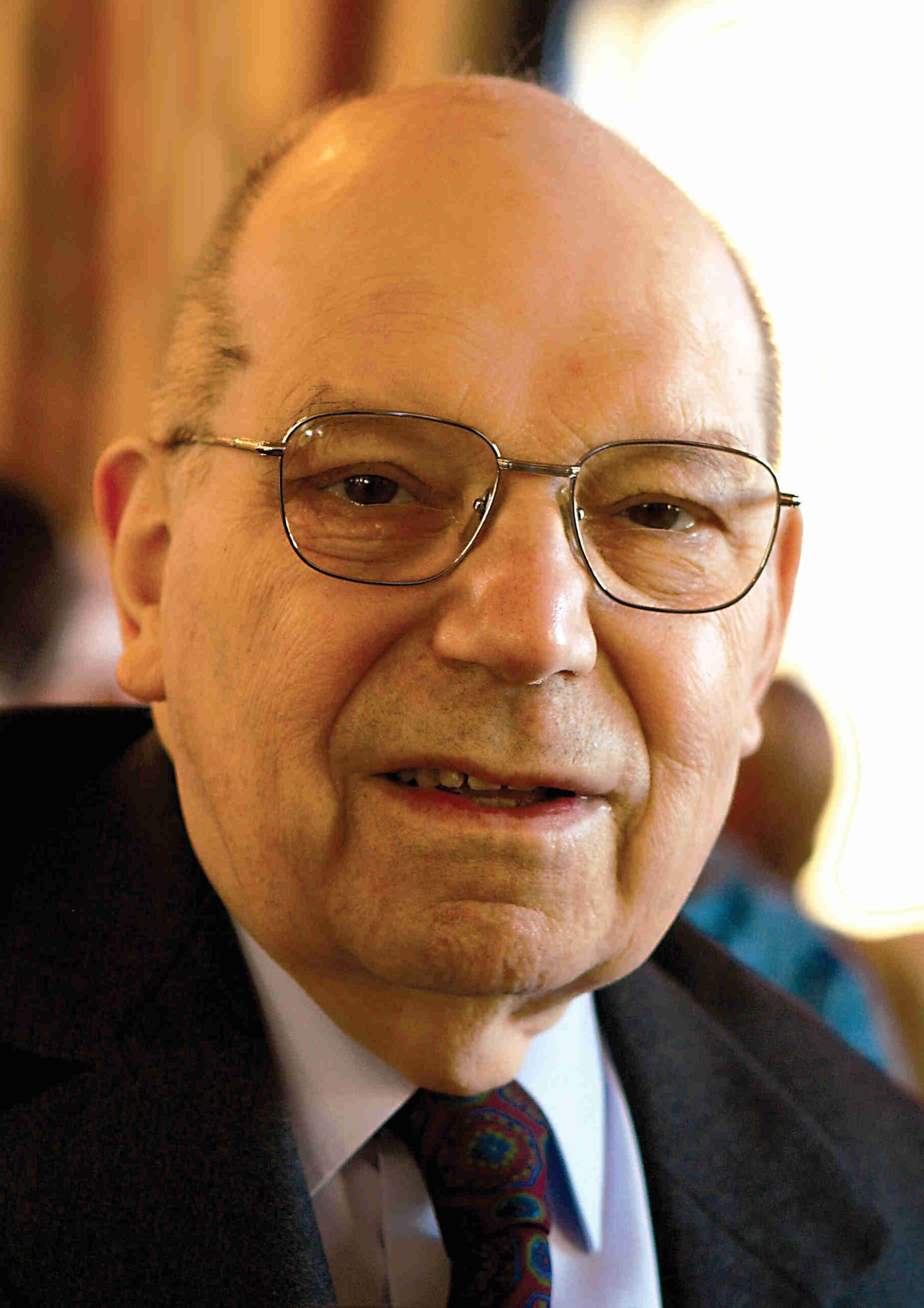
Photo: Harald Hanche-Olsen Wikimedia Commons
But mainly I was learning from the seminars, and reading some books as well. For books there were two things which were very good for me. One, there was the library of the university, and a very good thing was that the library was arranged in alphabetical order and not by subject. So when you were picking books, it was kind of random, and so that’s how I looked at von Neumann’s continuous geometry, a notion of continuous dimension. So I think this randomness is very good, and when a library is organized by subjects, you don’t have this kind of surprise.
The other thing is, there was a very good scientific library. It no longer exists now in Brussels, where Monsieur Nijs had found a Bourbaki to give me, and I continued. I came across some other books, somewhat randomly, but they proved very useful for me later. There was Godement’s Sheaf Theory, and de Rham’s Varietés Différentiables.
So those were the books which I took a lot of time reading, but I understood reasonably well. Godement’s book was particularly difficult, especially the part on simplicial sets.
How old were you at this time?
PD: About nineteen. And then, after two years, Tits told me that I should go to Paris, and introduced me to Grothendieck. He told me that I should go to the Bourbaki seminar. I went, and understood almost nothing at the seminar, of course. He just showed me Grothendieck, who was somewhat strange, with no hair, but very kind. And then, I spent the second part of the year in Paris, coming back for the exam in Brussels.
I think randomness is very good, and when a library is organized by subjects, you don’t have this kind of surprise
So you were still a student in Brussels, but you were going to Paris for the Bourbaki seminars…
PD: I was staying in Paris. I was in Cité Universitaire, Biermans-Lapôtre, the Belgium place.1
The next year was the same, I was in Paris, coming back to Brussels for the exams for the last year. I was pensionnaire étranger2 at École Normale Supérieure [ENS]. Not only with this, but all through this period, many people in Brussels helped me a lot to make things possible. First, I would not have thought about it. I was completely ignorant of which were the good places, where to go and what to do. It was Tits who told me that I had to do it. Then, for École Normale Supérieure, one of the professors knew the director of École Normale Supérieure and told him that this is a good idea, so I could be a pensionnaire étranger.
My parents supported me for doing all of that. As I may have said before, my father was at first not so happy that I wanted to be a mathematician. That’s not serious. But he wanted me to be an engineer, something real. So I had to fight, but even if he did not think it was the best of all ideas, he was very supportive and provided money for going to Paris.
I see. So when you went to stay in Paris for the ENS, your parents gave you the money?
PD: Yes, yes. Yes, pensionnaire étranger. The ordinary student of École Normale gets some stipends, but not a pensionnaire étranger. I was just allowed to have a room there. And during that time, essentially, I was following the Grothendieck Seminar and Serre’s lectures at Collège de France.
That’s an amazing education.
PD: Yes. And there was something I had learned randomly from books that was extremely useful. For instance, I had read this good book by Godement on Sheaf Theory, which prepared me very well for Grothendieck lectures. Of course, Grothendieck was talking about étale topology, so a different notion of sheaves, but it’s almost the same, so that’s not a real problem.
Do you remember what was the topic of Serre’s lectures?
PD: The first one was about elliptic curves. I don’t remember what he did exactly. I still have my notes of the course. I think that’s where I must have learned about automorphic forms also. I think he spoke about complex multiplication, but I don’t remember what the course was about. And I must say that I knew almost nothing about elliptic curves, except that the cubic curves have a group law.
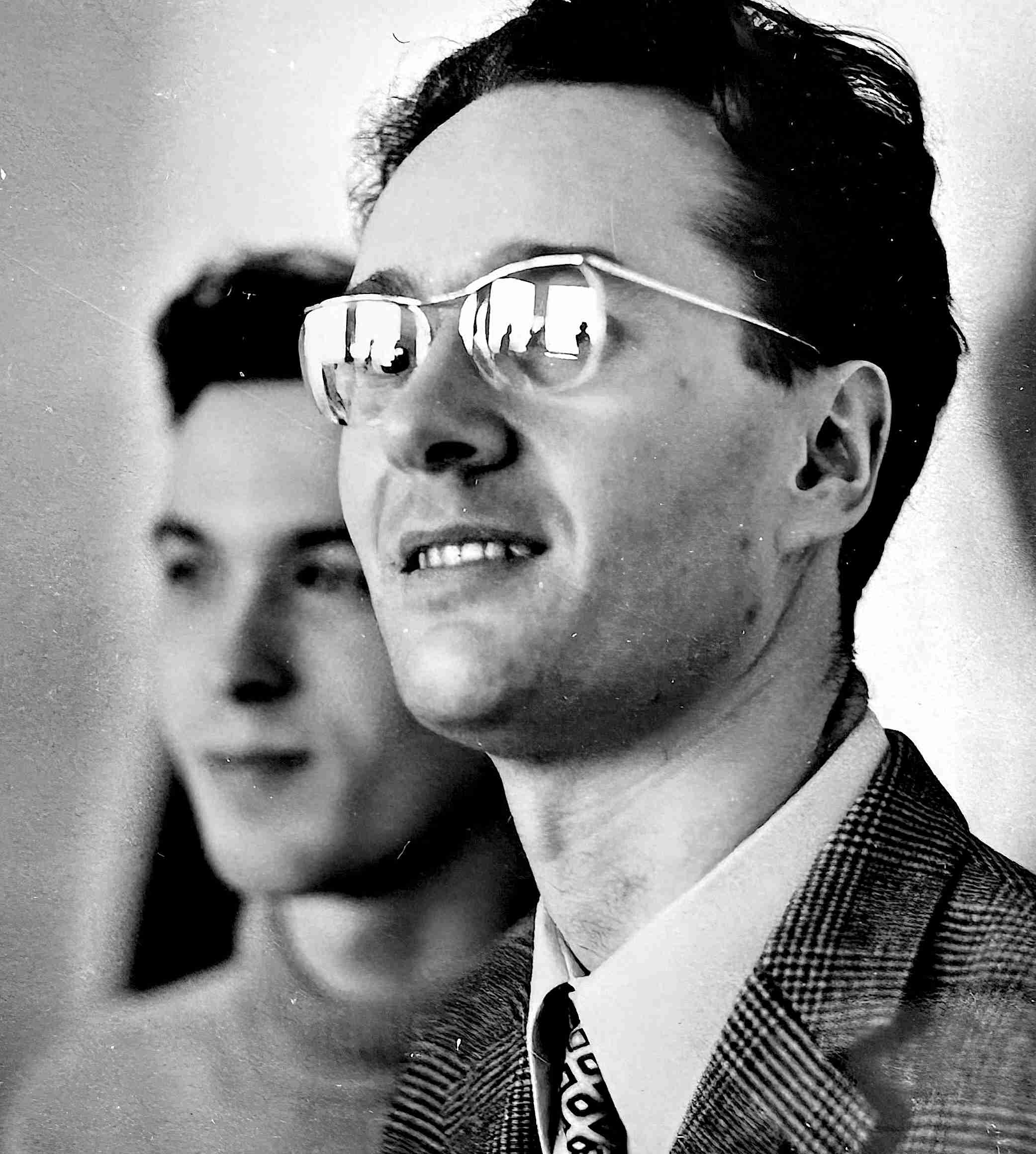
Do you remember other people around you at that time, during Grothendieck seminars and in the course of Serre?
PD: I had some contact with people at École Normale, but not so much. But I had more contact with people following Grothendieck seminars, in particular Luc Illusie. He invited me to where he was staying with his mother. His mother was an excellent cook, and we were speaking of mathematics, about the seminar and other things also. So that’s one of the persons I have known since the longest time.
So in that circle of Grothendieck, the Weil conjectures were already in the air at that time. How did you get on to thinking and proving the Weil conjectures?
PD: That comes somewhat later. At that time, when I was twenty one, my last year of university, the seminar was on \ell-adic cohomology, proving the rationality of L-functions, and the more general story of \ell-adic sheaves, the Lefschetz trace formula and so on. I guess that’s how I learned about that part \break of the conjecture while it was being proved. Afterwards, I learnt a lot about Grothendieck’s theory of motives, and that was very influential. That was his way of wanting to prove the Weil conjecture.
 |
 |
 |
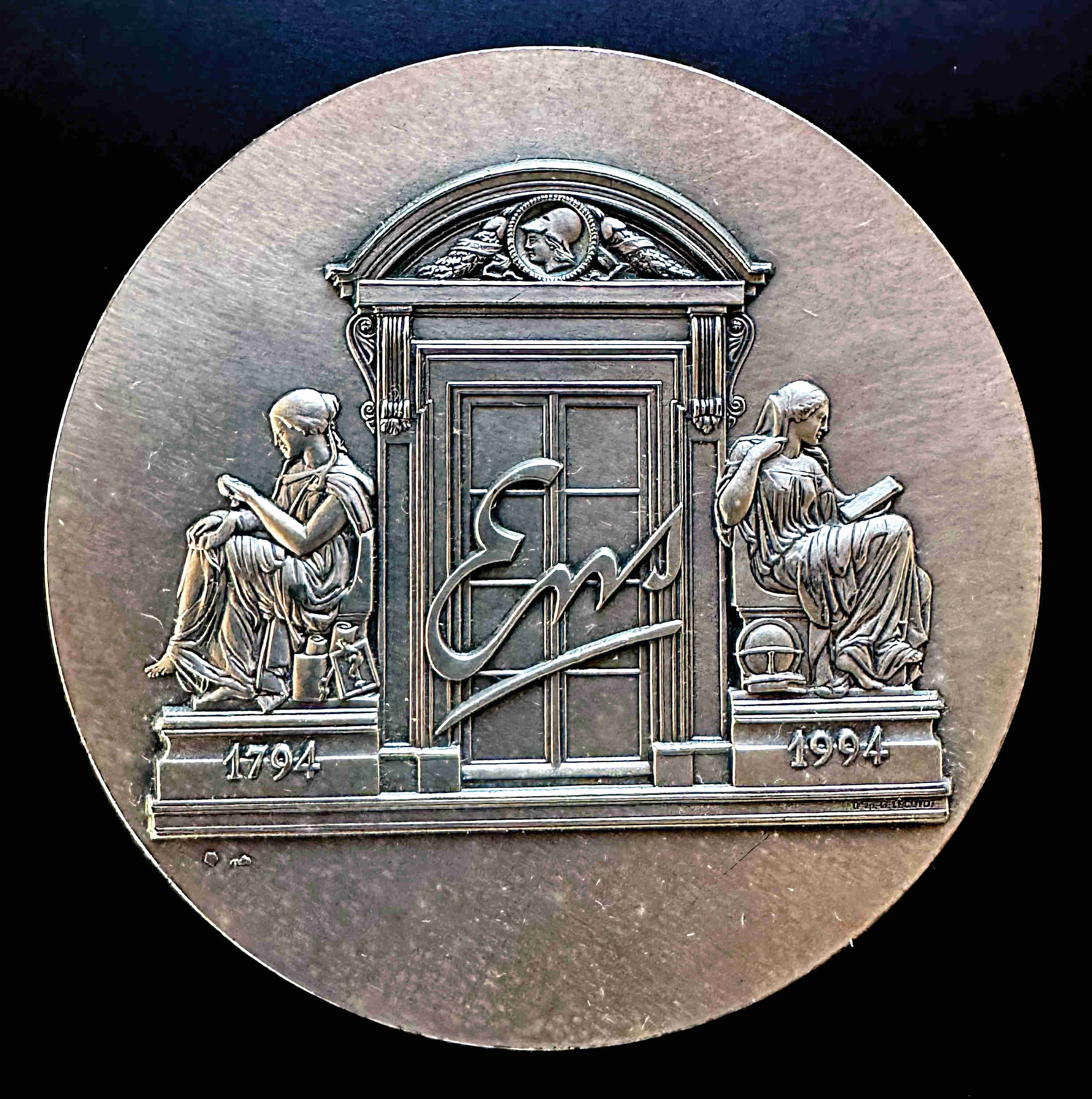 |
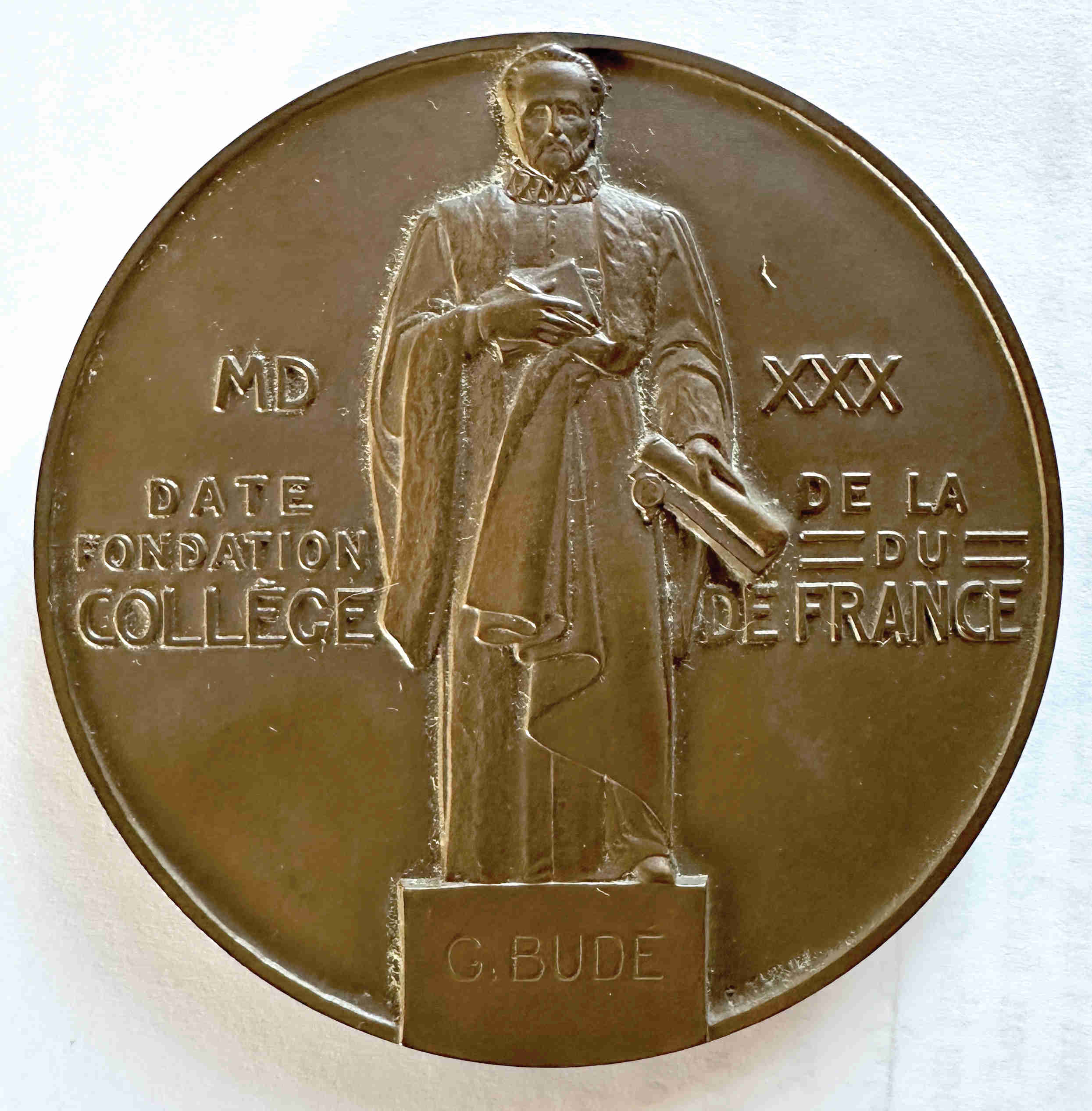
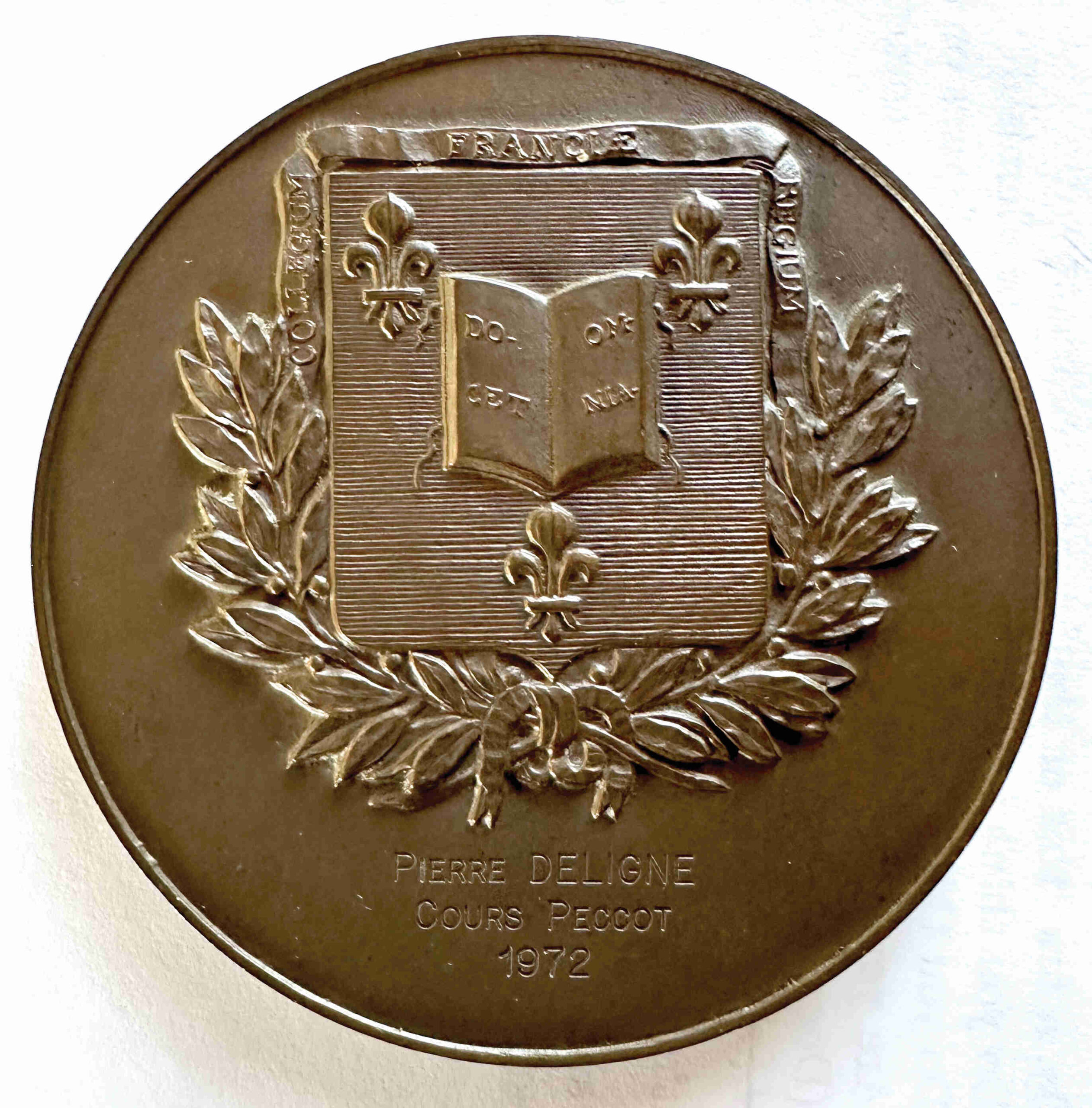
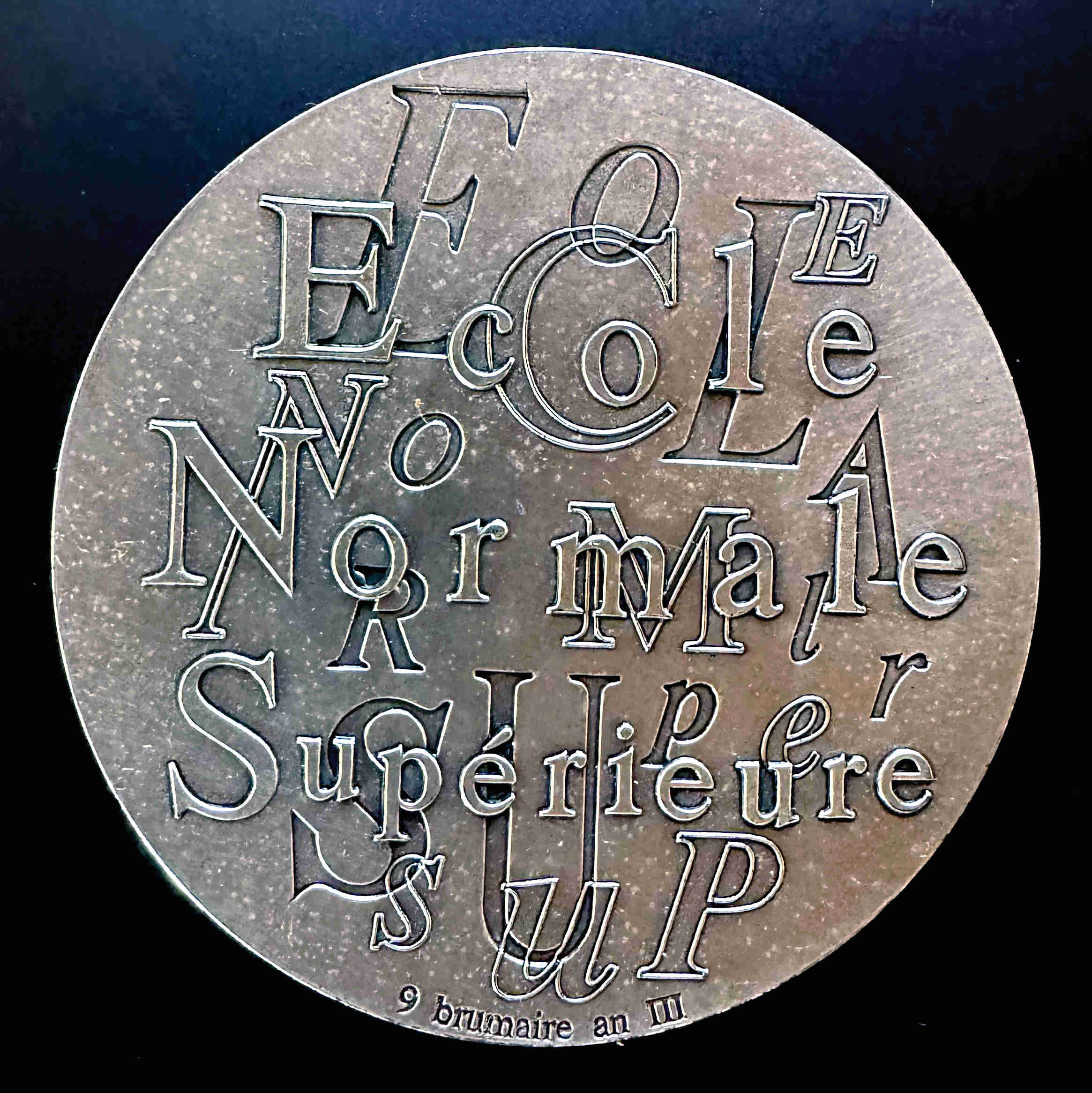
| Deligne’s Cours Peccot memorabilia of College de France.4 Pierre Deligne | ENS Medal to Deligne at its bicentennial in 1994. Pierre Deligne | ||
The basic idea of the theory of motives has been very important for me. One has those invariants of spaces, the cohomology groups, and for algebraic varieties, they come in many different flavours. So it seemed like we had the same story spoken in a number of different languages. Motive was a way to try to make sense that one has all those different flavours, that there should be some reality underlying them all. That was crucial for many things I did. I was never really interested in how Grothendieck wanted to formalize the story and make a number of conjectures which would lead to the Weil conjecture, because I did not see any tool available, and there still are no tools. I was told that he was somewhat disappointed when I proved the last of the Weil conjectures, that his conjectures implying it were not proved, but it’s still the situation now. We cannot build algebraic cycles, which are needed for his approach.
So I started getting interested only after there was this point of view of Motive, which would explain things. For instance, that one has some analogues which are true, like one thinks that Hodge theory is an analogue for one version of cohomology of the Weil conjecture. One has pure structures on cohomology groups. So that was one side of the story.
 |
 |
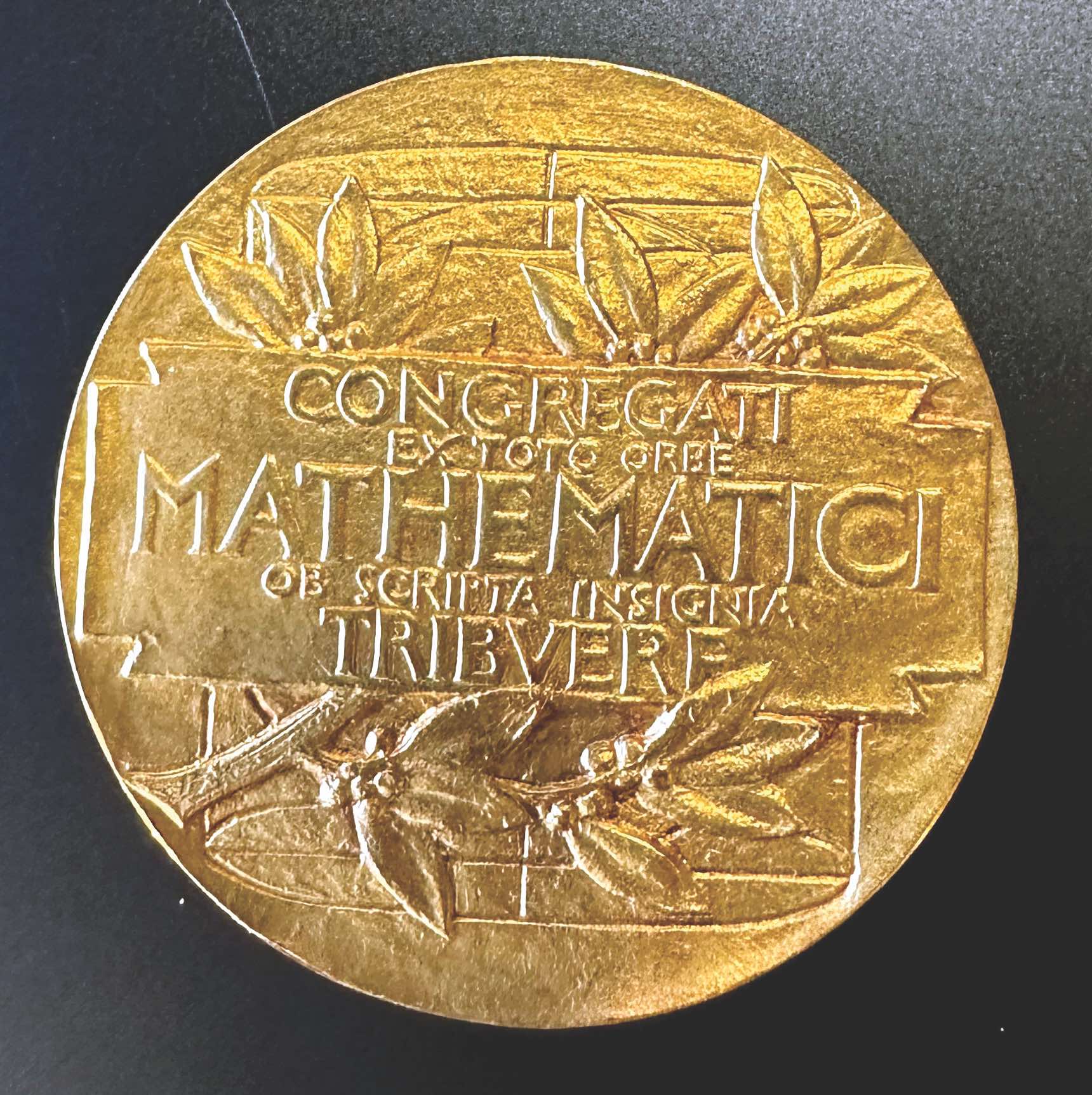 |
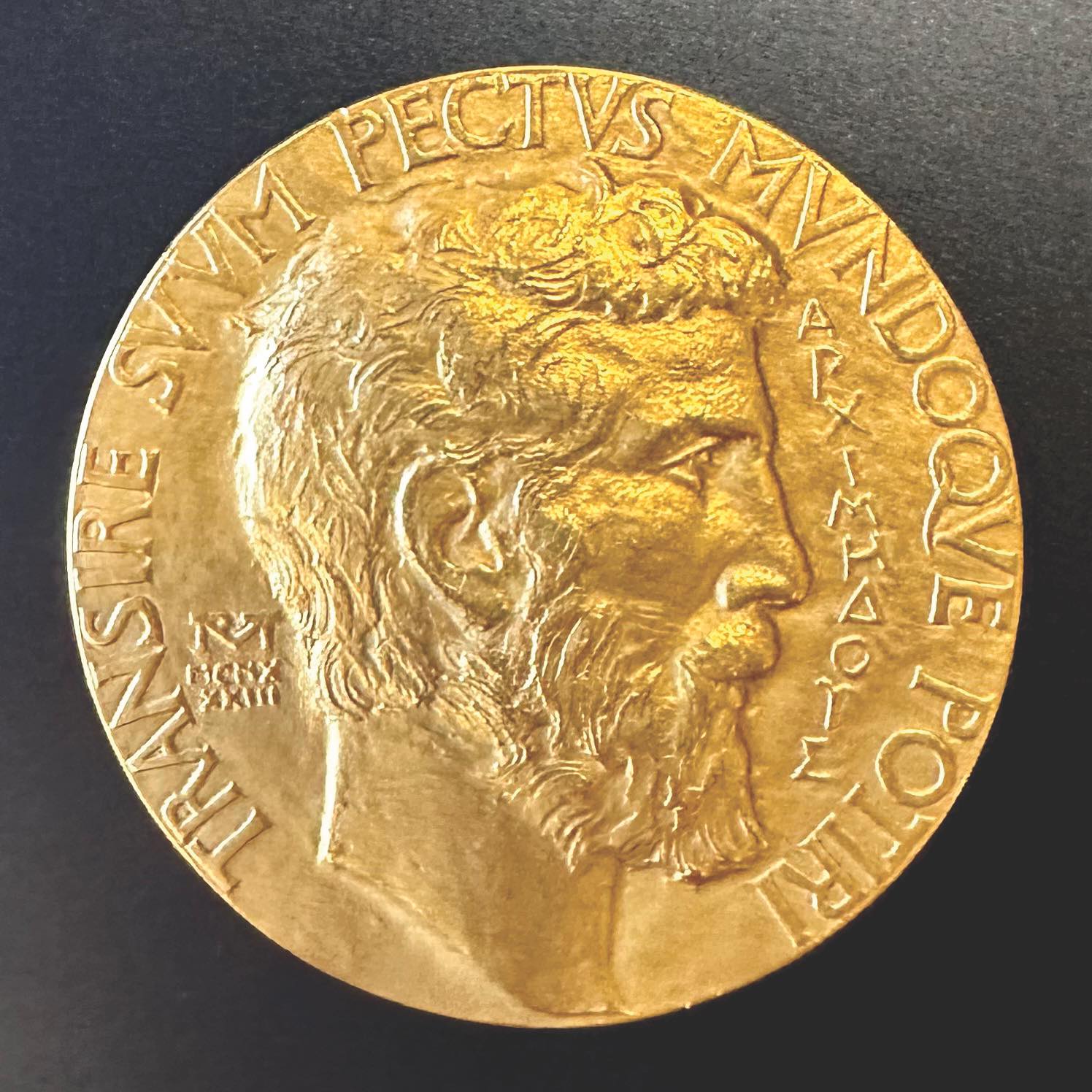
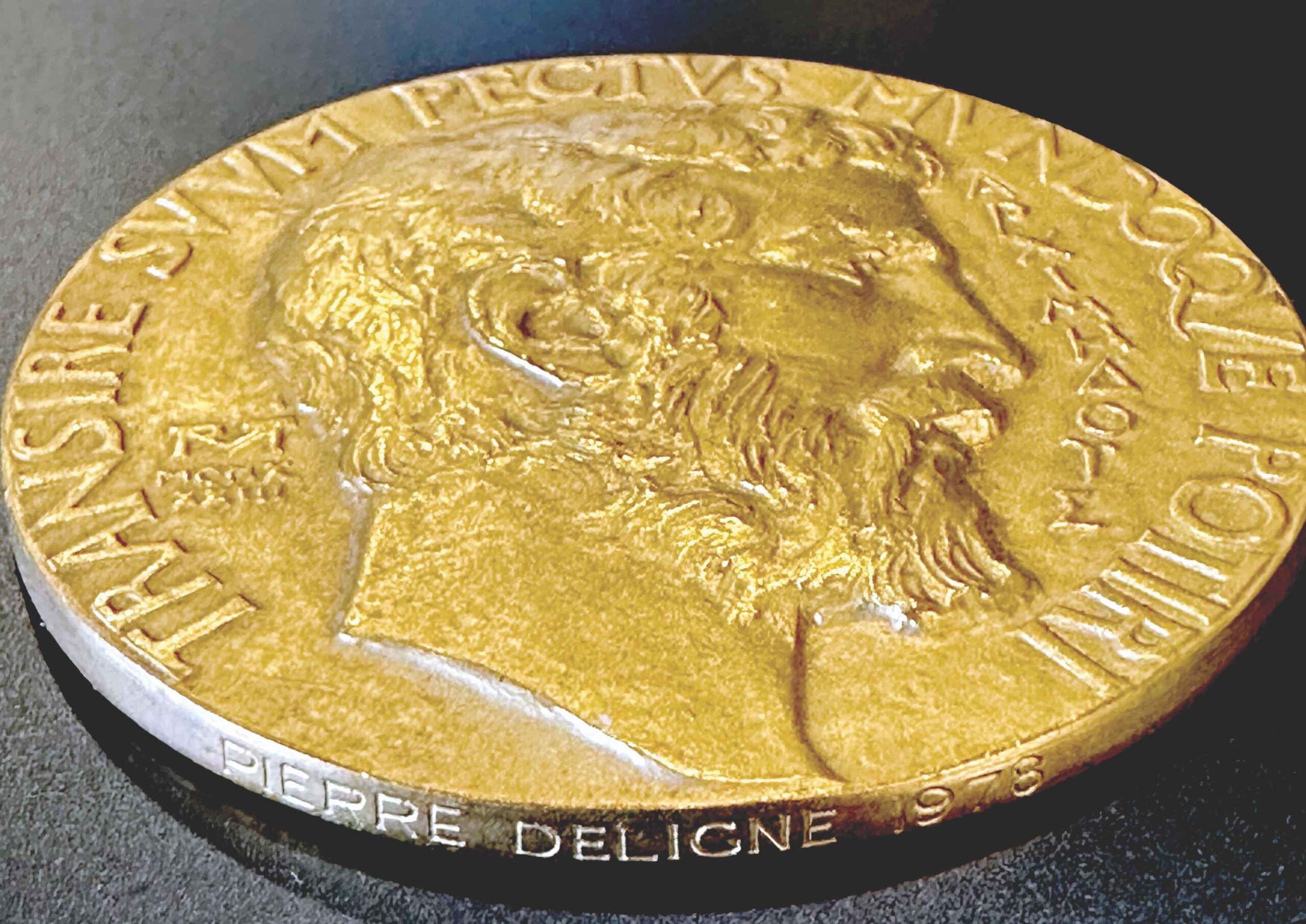
| Coveted Fields Medal awarded in 1978. Pierre Deligne | ||
The other thing, thanks to Serre, is that I got interested in modular forms. And I attended a seminar by Godement. I don’t remember what it was exactly but I think a part of the seminar was about the Hecke operators for general groups.
Do you remember roughly which year is this?
PD: About ’71.
This is just after Jacquet–Langlands, and Godement’s notes on Jacquet–Langlands had already come out.
PD: Yes, I think that’s about that time, yes. And another interest I had, and that’s again thanks to Serre, is Shimura varieties.
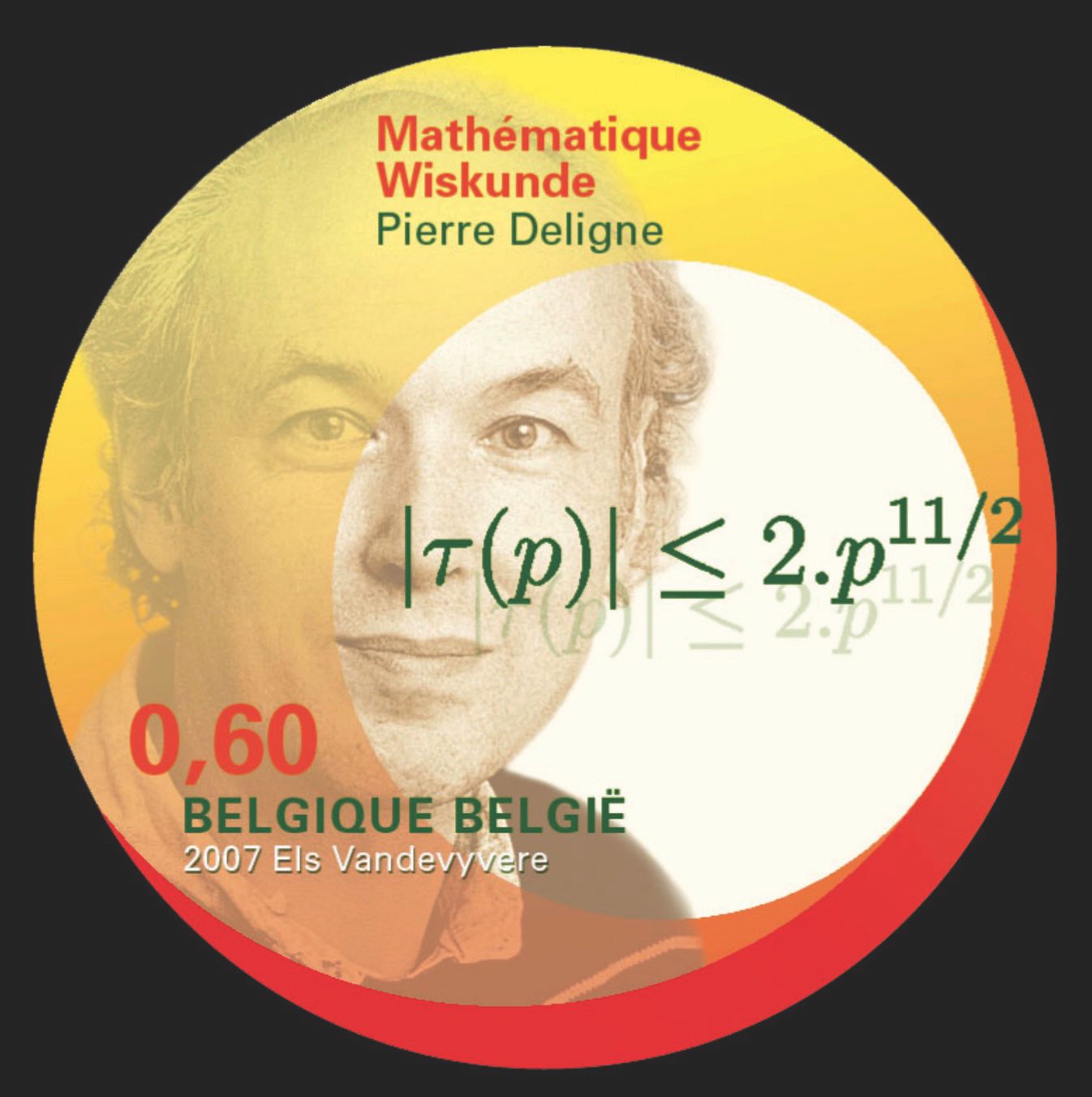
I see, so Serre got you interested in Shimura varieties?
PD: Yes, in particular, I had some interest, thanks to Serre.
But then he asked me to give a talk at the Bourbaki seminar. The Bourbaki seminar was taking place three times a year, over a weekend, with six talks each time. There was this whole mass of papers of Shimura, various cases, all expressed in terms of semi-simple algebra with involution. So I did not prove anything new, but I put some order in what Shimura was doing, expressing his results in terms of a reductive group with some additional data. And that also was influenced by motives, one views Shimura varieties as a moduli space of motives of some kind, and then it was clear how one had to formulate things.
And then there was this interest in modular forms. At that time, I was interested in the Weil conjectures, but not knowing what to do. A few cases were suggested by the philosophy of motives. If one could reduce the cohomology of some variety to curves, in some motivic sense, then automatically one could prove the Weil conjecture in that case. For instance, I could handle the case of hypersurfaces of small degree whose cohomology, in the Hodge flavor, looked like the one of an abelian variety. This shows I had Weil conjecture in the back of my mind. But the crucial thing is, I read that Rankin could prove some non-trivial estimates. He wanted to move something from one to one-half. One was trivial, and he could reach three quarters. So it was a really non-trivial thing.
So this is about the Fourier coefficients of some modular form? From the trivial estimate going to, well, the Ramanujan tau conjecture eventually.
PD: Yes, and also thanks to Serre, I knew the relation between cohomology and automorphic form in the classical case. I knew that this theorem of Rankin was a step toward the Weil conjecture in some particular case. One wants to prove that some zeros have some given real part. I knew the relation between having those estimates for L-functions, local factor of L-functions in the case of holomorphic modular form, and the Weil-conjecture in some special cases. So when I saw that Rankin was able to do something non-trivial, this made me want to look why. And his argument was really beautiful. He was using some theorem of Landau, from which if one had some information on a L-function, one could get some information on the local factors. And also he was using some trick to go from tau to tau squared, this Rankin product of L-functions.
So now it’s called the Rankin-Selberg L-function. If you look at the L-function for f cross g, and maybe you do \tau cross \tau.
PD: It was \tau cross \tau, yes. And then I realized that one could try to do such things in the function field case, because sometimes one had good information on the poles of L-functions. I managed to use this idea to handle one non-trivial case, which was the case of hypersurfaces of odd dimensions, and then it was clear that one could do something. How much was not clear, but it was this idea of Rankin, and knowing how it could be translated in the setting of algebraic geometry over a finite field.
So Rankin was purely in the world of analytic number theory, just complex analysis if you will, and one was translating it to algebraic geometry.
PD: And then using that with the work of Grothendick, from which one had a good understanding of poles of L-functions. There were a number of tricks needed, but Rankin was really the new ingredient. And I think one thing which was very helpful for me is that I did not believe in the path Grothendieck was suggesting, so I did not direct any energy in that direction. But it was more curiosity and seeing something which could be applied otherwise.
At what stage did you get a PhD and from which university, was it Paris or was it Brussels?
PD: I got it from both in fact.
Oh, you have two PhDs!
PD: Yes, first from Orsay because I was working nearby, at IHES, but then the people in Brussels told me they would like me to have one in Brussels too. So I went to Brussels and got another one.
At that time, to get a PhD, you had to have done some interesting work and find a jury who was of the same opinion as you, and then you just had to defend your thesis. There was no need to follow any formal procedure or make any preliminary submission, it was simpler.
Do you remember which work did you submit for Orsay, and what did you use for Brussels?
PD: For Orsay, I think it was Hodge Theory. For Brussels, I have forgotten, maybe Lefschetz theorem and the degeneracy of spectral sequence.
I know that that is one of your earliest papers, so it makes sense. Let me come back to where we were, around the mid-70s, when you were working on Weil conjecture. How long do you think you worked on this idea of pushing Weil conjectures and trying to get this bound on the Fourier coefficient, the non-trivial bound?
PD: Once I had the idea, it was not very long, but only because I knew a number of different things which I could put together, not knowing it would have such consequences. So, I guess two or three months, not more.
Wow, that’s quite fast!
PD: The first step was to see if the idea of Rankin was useful. That is, if one could apply it to a hypersurface of odd dimension. Odd dimension, because it makes it easier to understand the monodromy for a family of hypersurfaces.
Then Serre told me something amusing. When I could handle this case I wrote him a letter explaining the same. Just at that time, Serre had an unfortunate accident. He was doing gymnastics at École Normale, and his Achilles tendon broke. So, he had to go to the hospital. But he got my letter just before. He told me that he had a big smile, because it was clear to him that Weil conjecture was proved. It was not completely clear for me, but it was clear that something could be done.
Then it took a few months to see what else one needed, and which tricks to use. I had to use some understanding of the classical theorem that for the ordinary zeta function there is nothing on the line where the real part equals one, so the Hadamard and de la Vallee Poussin trick, I could use it because I had my understanding of what they were doing. So not more than a few months, but there was a few years of preparation.
 |
 |
 |
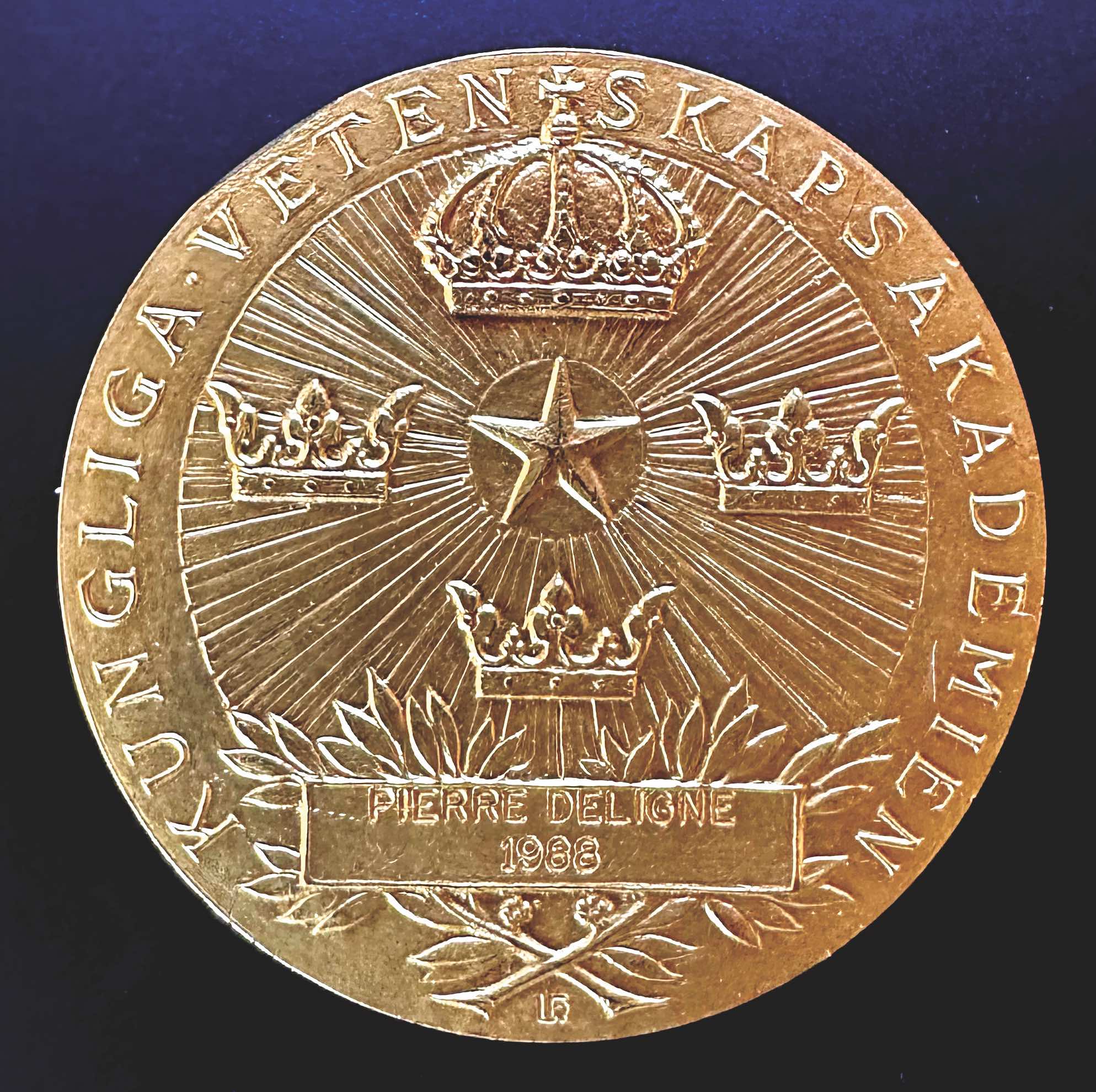 |
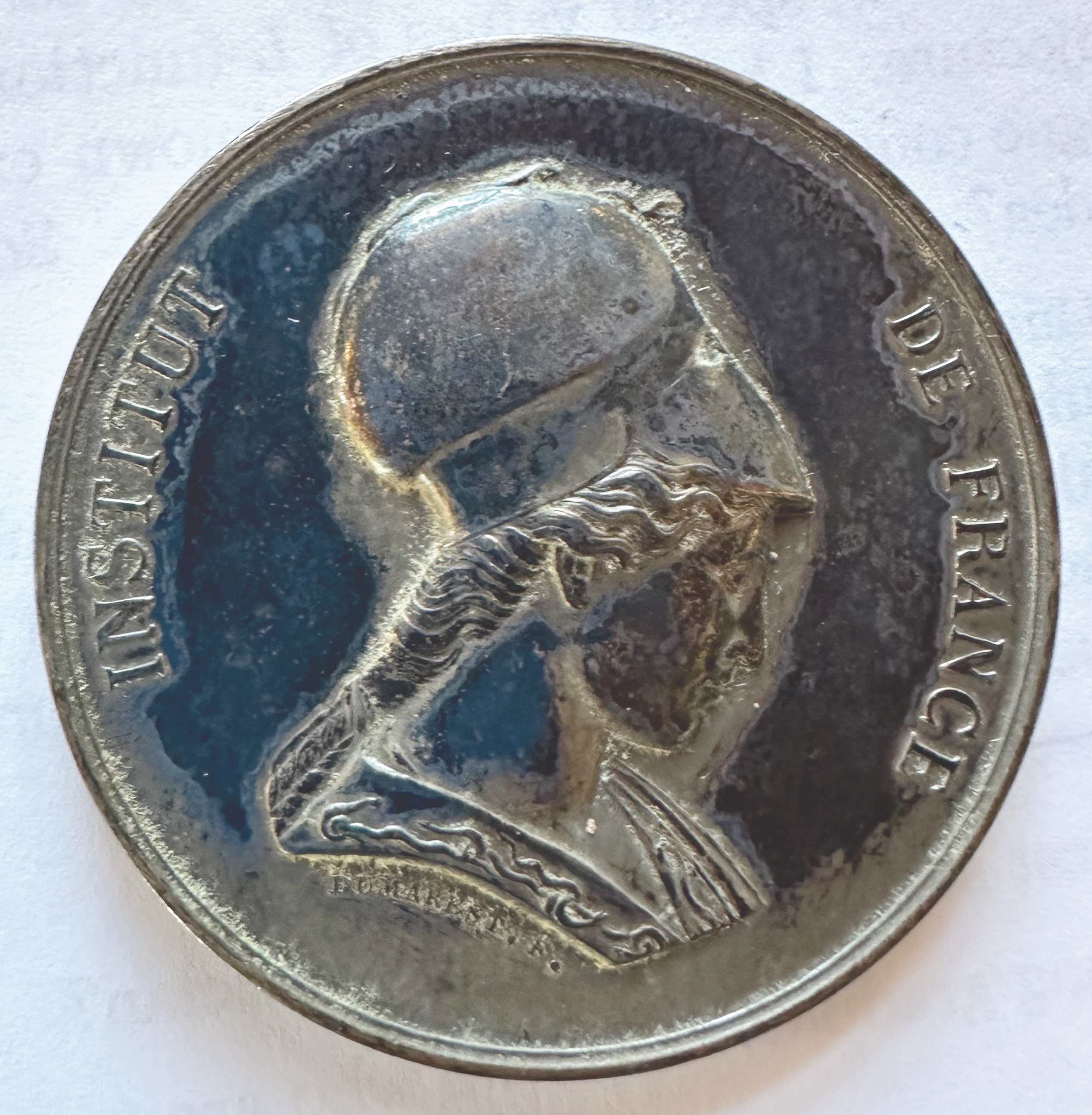
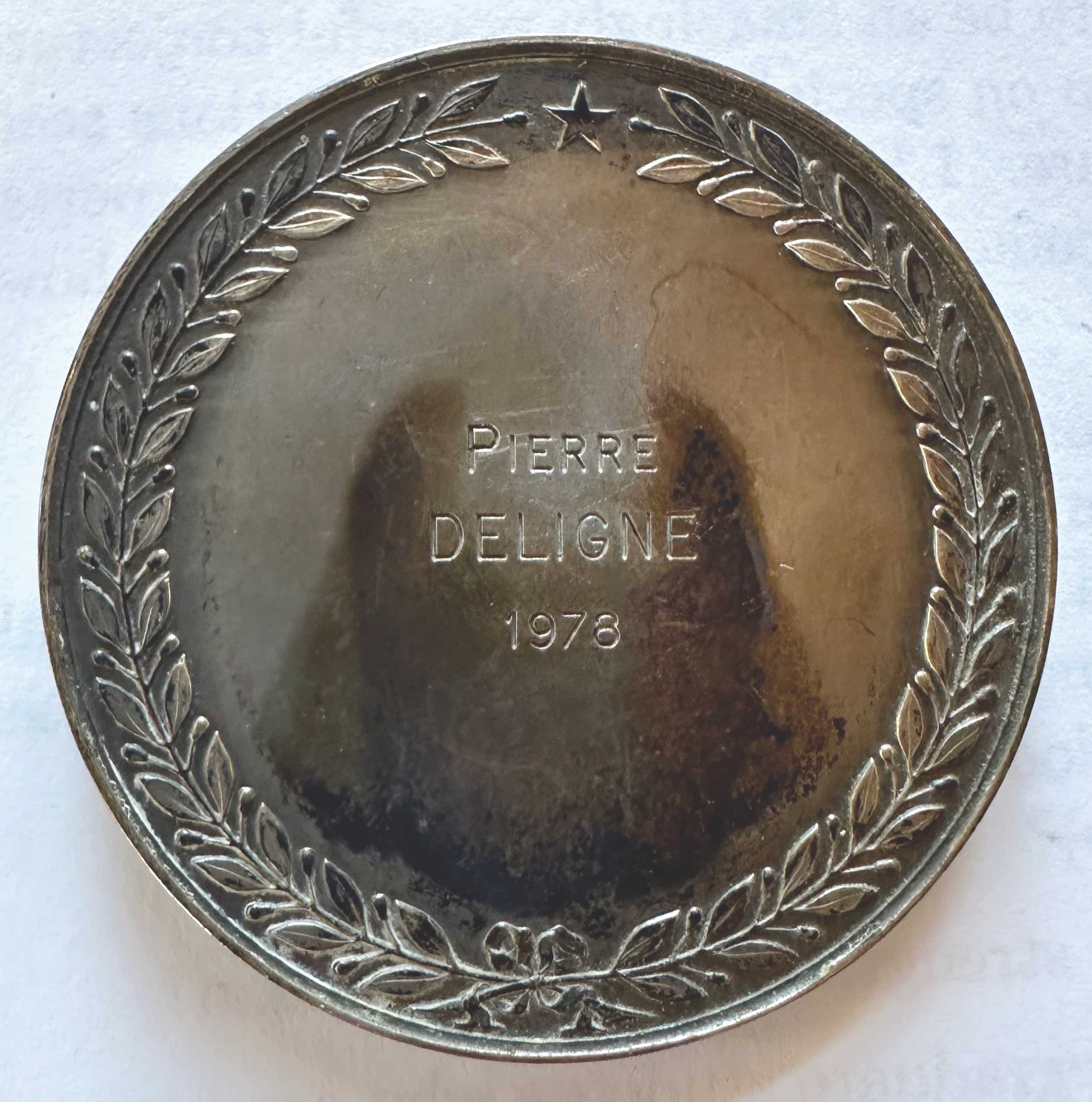
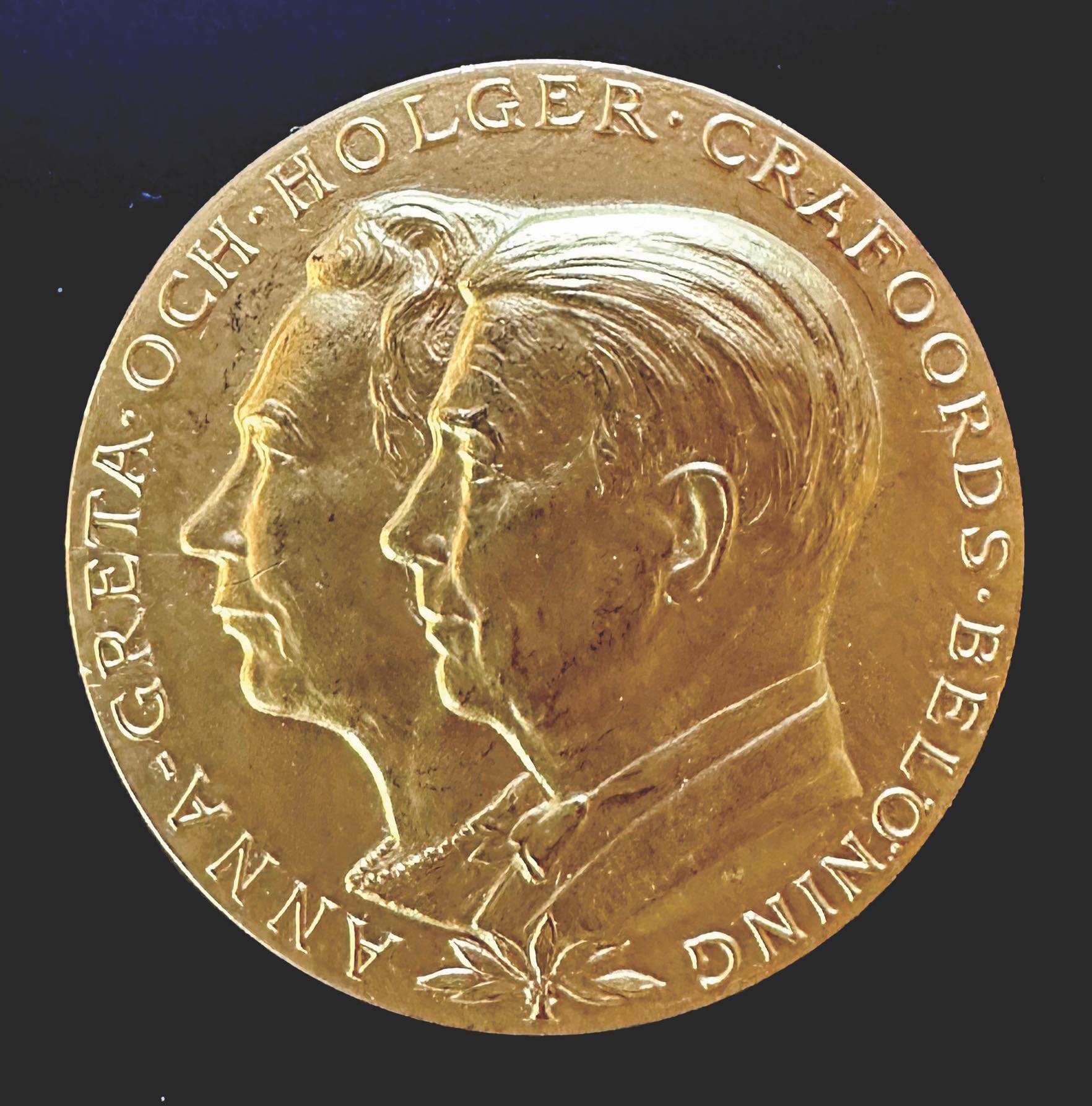
| Institute de France medal awarded to Deligne in 1978. Pierre Deligne | Deligne received the Crafoord Medal in 1988. Pierre Deligne | ||
Do you remember which mathematician or group of mathematicians were checking your proofs at that time to see if all is good, and all is correct?
PD: I gave a seminar. Just after that, there was a conference for Hodge’s birthday in Cambridge. I was asked to give four or six lectures. Not everybody was happy about it. I explained the proof. Katz took notes, and I used those notes for the proof in the conjecture in Weil-I.3 Then, I gave a seminar in Bures-sur-Yvette. There were quite a number of people who knew different aspects very well. I don’t think there was one person who checked all, but quite a number of people did partial checks.
Could you tell me something about your various collaborations? For example, what immediately comes to my mind, things like Deligne-Serre on Galois representations for weight-one modular forms, or Deligne-Mumford on irreducibility of moduli space of curves of genus g, or Deligne-Lusztig on irreducible representations of finite groups of Lie type, which came maybe a little later. How did these collaborations come about? Can you reflect a little on them?
PD: Often, it was doing things which are complementary, realizing they were complementary, and then having a joint paper. I would not say it was collaboration with exchanging letters or things like that.
For Serre, he had given a proof, making certain assumptions about the size of Fourier coefficients. I realized that one could use a weaker assumption, which could be proved. It was Serre’s idea with a little complement of mine, so it was natural to put it together.
For Mumford, I think we had this idea of stable curves from different perspectives. Maybe the stable curve idea was more Mumford’s, but I had the idea that one should express things in terms of stacks. We wanted to prove that the moduli space of curves of genus g is irreducible, even in characteristic p. In characteristic 0, it is a consequence of Teichmüller theory. For complete spaces with no singularities, it was known that irreducibility in characteristic 0 implied the same in characteristic p. But these moduli spaces have singularities, because some curves have extra symmetries. The formalism of stacks was used to prove that singularities due to extra symmetries were not a problem. That was more my contribution to the story. I think Mumford was more inspired by the point of view of geometric invariant theory, and I was more inspired by the work of Artin, about how to prove the existence of moduli space and this could be extended to the existence of moduli stack. So, it was again two different things which were complementing each other and so it was natural to have one paper in common.
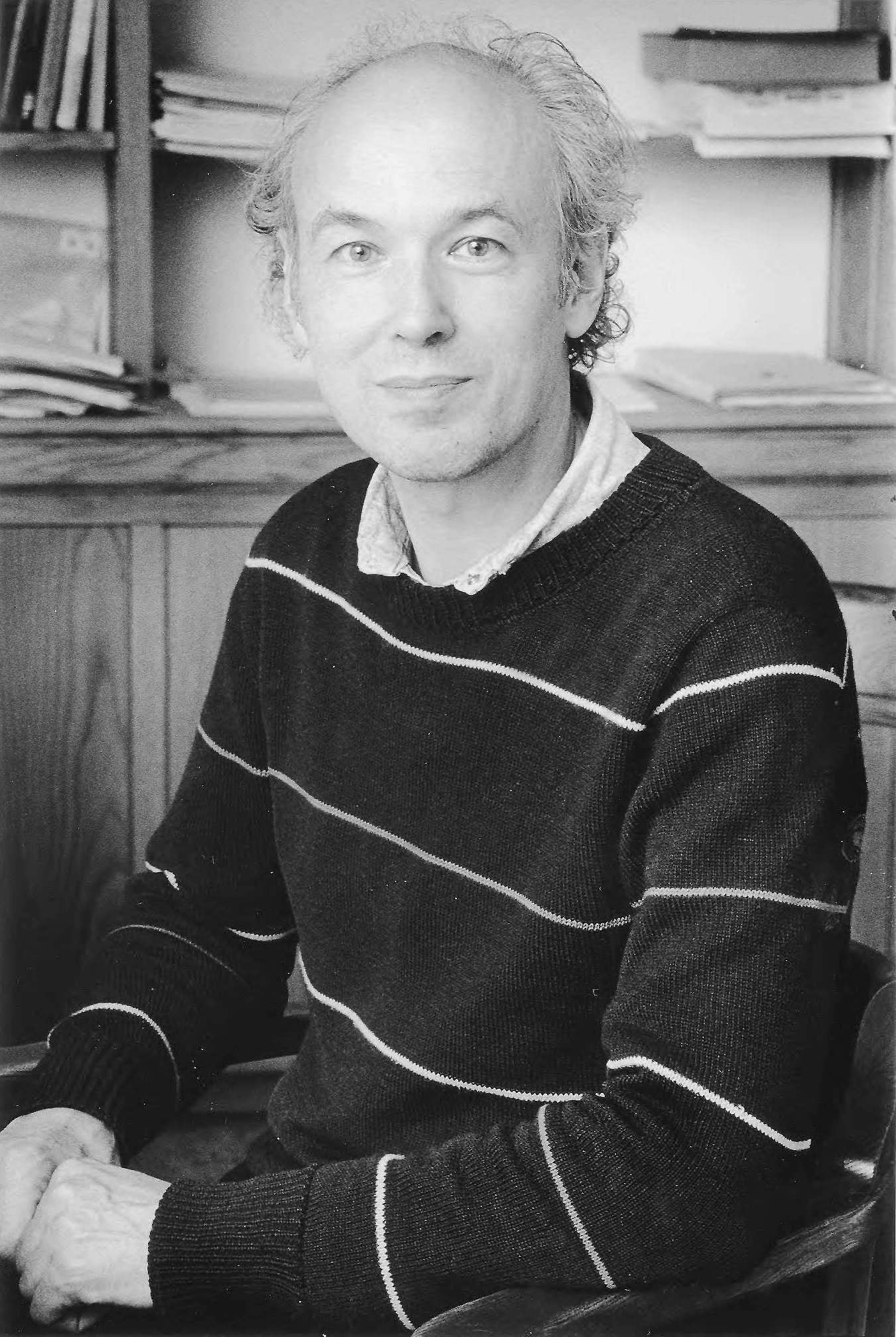
So, where did you and Mumford meet? Was it in the Grothendieck seminars?
PD: Yes, he was coming regularly to Bures-sur-Yvette. Possibly we had some correspondence also about it before, independently.
For Deligne–Lusztig, it’s Lusztig who had the crucial idea that one has this notion of induction which could be done using cohomology and I had the technique of \ell-adic cohomology to make it work. So, that was the collaboration. He knew what he wanted, he knew the example of GL(n), what had to be true, and I knew how to prove basic statements.
Sounds like a perfect collaboration. I would like to ask you, generally, about the sort of people you met and interacted with as you also made the transition to the IAS. You know, for example, the previous generation of mathematicians like Harish-Chandra or Selberg or André Weil or Borel.
PD: I was always a little afraid of André Weil. He was very sharp-tongued.
[Laughs] He was well-known to have a sharp tongue, is what I’ve read.
PD: Yes. I think the main interaction I had was that he had proved this beautiful fact that for an elliptic curve, over \mathbb{Q}, say, if you knew a lot about L-functions and also twisting by character, then you knew there was a modular form giving rise to it.
Converse theorem.
PD: Converse theorem, yes. I found it extremely interesting. In the function field case, if one has an elliptic curve over a function field over a finite field, then the theory of the L-function is well-developed, and so I said to him that I guess one could prove that the epsilon factor behaves as it should. He told me, prove it. And I did. [Laughs]
With Selberg, I had no relation. Langlands, yes, and with the Langlands program, and I still wish I understood more about it. He gave me the understanding of what kind of L-function should be attached to Shimura varieties.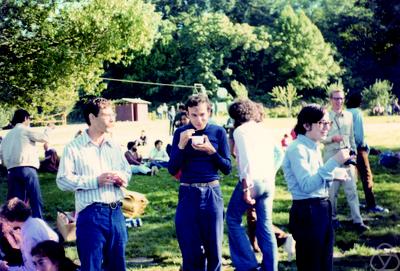
So one has Shimura varieties, sheaves over it, and the corresponding L-functions. In Langlands L-functions, a representation of the dual group occurs. For him it was obvious, but for me it was a surprise that there was a simple rule for the case of a Shimura variety to determine the relevant representation of the dual group: a basic data is one parameter subgroup for the complexification and then this could be dualized to a representation of the dual group and that was what one needed. So I learned things like that from Langlands.
Harish-Chandra, I tried to learn a number of things he did because it was on automorphic forms, and I wanted to learn from him. When coming here to the IAS, I had hoped that I would speak with him but he died just before.
He passed away in 83…
PD: And I came in 84 or 85. I accepted the invite in 84, I think. Whenever I had a question about reductive groups I could ask Borel and he would give me the answer.
So your interaction with the Langlands program was happening already in the 70s, I mean by the time of the Corvallis conference.
PD: Yes, so this was happening, and what I was telling you about as to which representation of the dual group occurred, it was in the 70s that Langlands told me and it was very surprising for me.
I want to ask you about the Corvallis conference. There is this story I’ve heard that Zagier showed you some calculations of the special values of some low symmetric power L-functions of the Ramanujan \Delta-function and they somehow seem to be monomial expressions of the L-values for \Delta itself. The story I’ve heard is that he showed this to you some afternoon, and then you disappeared for that afternoon and evening, and by the next morning you had this conjecture on the special values of motivic L-functions.
PD: I don’t remember the details but indeed it was relatively fast. You could add that I made a stupid mistake giving him a wrong exponent, and then he told me that he was looking at small exponents. Then I told him it was something like 33. 33 did not work but he looked for 31, 33, 34 and he saw it worked for one of those exponents and then of course I thought I had made a mistake and I corrected the conjecture. Again it was the influence of motives.
I think Zagier was thinking about what kind of integral could be used. My point of view is that there was a motive and what one wants is to express the conjecture in terms of this motive. If one forced oneself to do it like this, there is not much choice. You want to have numbers, so if you want to relate the integral lattice on Betti cohomology with the lattice on de Rham cohomology from the filtration, there is almost no choice of what you can do. So you do it this way and it works. I think it’s sometimes very useful to impose oneself to use little information to try to make a conjecture. If there is very little information that one is able to use, one has not much choice and one gets something reasonable.
This conjecture of yours on special values of motivic functions is so amazingly powerful, and I’ve heard from well-known experts ask how did Deligne come up with this idea, it seems to be completely out of the blue!
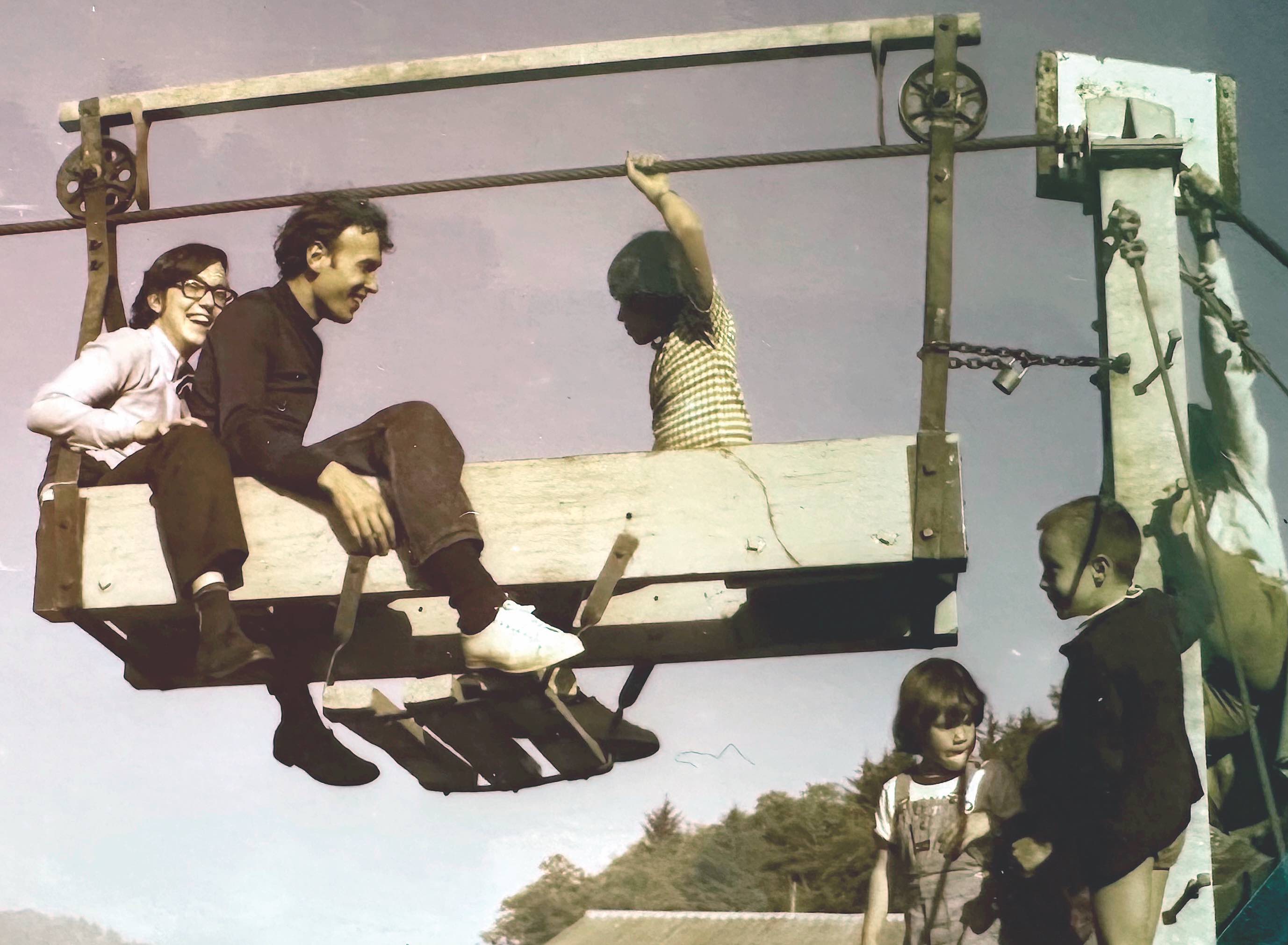
PD: Motives have been really crucial for me in ways which are not obvious. For instance, to develop this story of mixed Hodge structure. Again it’s because of motives, because when one looks at \ell-adic cohomology, it makes sense not only for a projective non-singular variety but for any variety. And one thing you have to understand is that, there has to be a weight filtration in the \ell-adic case where successive quotients are somewhat like the cohomology of projective non-singular variety. And then the idea is that whatever you do in one cohomology theory, you should be able to do in another. So the obvious question is what to do in the Hodge setting? You want to take a variety which may be singular, or open because it’s possible in the \ell-adic case, then you want to have a filtration, you want the successive quotients to be as in the cohomology of projective non-singular variety. So you want pure Hodge structure on the successive quotients. There is one more ingredient, which is, I don’t know if it is due to Griffiths or Grothendieck, that what is really natural is not the Hodge bi-grading but the Hodge filtration. So for mixed Hodge structure this idea is that you want on each level to have this Hodge structure but it’s interpolated by a Hodge filtration on the whole thing. So this led to the definition and then it was easy to prove that for curves it worked. Then one has to prove it in general but at least Motives was telling what was true.
Motives have been really crucial for me in ways which are not obvious
Beautiful! I wanted to ask you about some of the students you have had. Miles Reid and Rapoport were your students, I believe…
PD: Yes, Miles Reid and Rapoport to some extent, and I played some role.
To Miles Reid, I think I had proposed something that we still don’t know much. When I had looked at the Braid group I found that something nice was happening when you have a configuration of hyperplanes in a real vector space which cut it into simplicity cones. I asked Miles Reid to classify all such configurations. We still don’t know, but he did something else much better.
It’s a bit of a cliche that somehow every successful person has faced and had to overcome some kind of challenges. Could you share something of what has challenged you personally and mathematically?
PD: I have always been extremely lucky. The only real challenge I had was convincing my father that I wanted to be a mathematician. That was not easy. Otherwise, I have been very lucky that Tits was in Brussels in my early years, that the kind of mathematics Grothendieck was doing was really to my taste. And Serre as a complement also. That by accident, I had learned things which helped me to understand Grothendieck and Serre. Lucky also that at that time jobs were plentiful so I had no worry, no pressure to publish to be able to get a job. Lucky that IHES existed and that they took me at the insistence of Grothendieck, with some reluctance from Thom.
So you became a permanent member of IHES pretty much after your PhD…
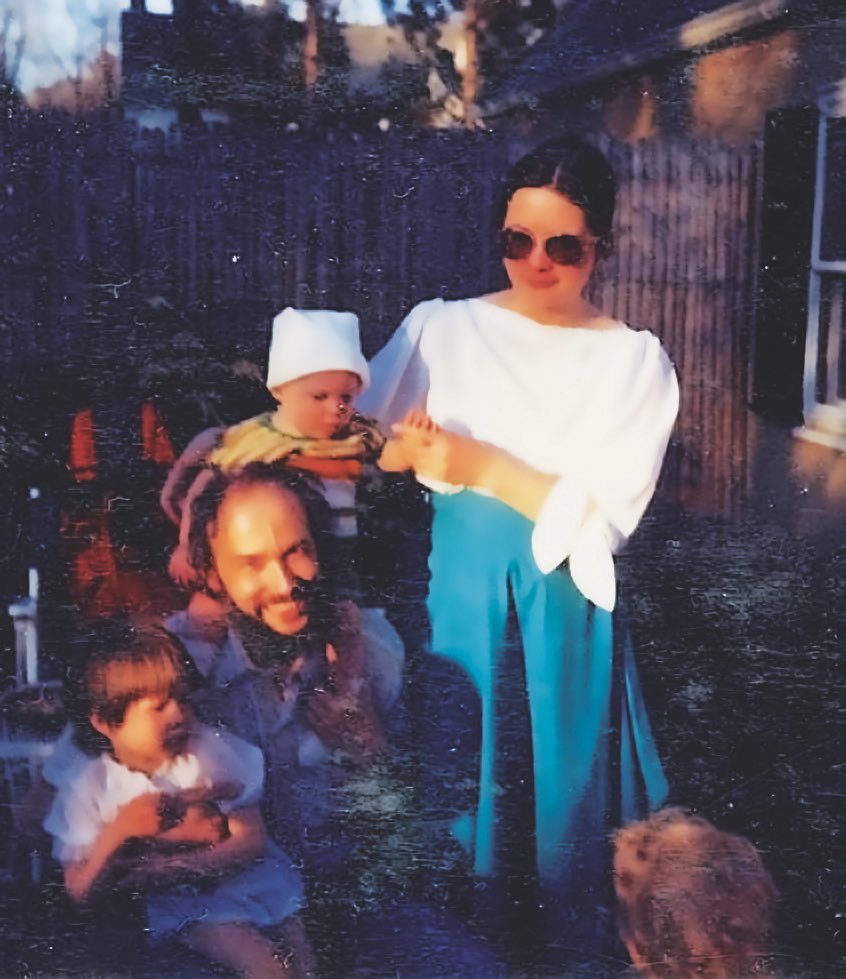
PD: Yes. Thom insisted that I should at least spend some time elsewhere. So I spent a semester in Harvard where I spoke about differential equations with regular singular points and then I became professor.
I understand you met your wife Elena Vladimirovna Alexeeva in Russia, I believe.
Could you recall some moments from that time, your shared interests, and you also have some connections with Russian mathematics?
PD: Yes, I had first some correspondence, I think mainly with Manin. He had visited the IHES, and I met him there. The first invitation I had was when they invited a number of people for some anniversary of Vinogradov. The conference was not so interesting to me, but meeting Russian mathematicians was. I was completely ignorant of the situation. I remember I was meeting Piatetski-Shapiro, and there was some dinner for Vinogradov and I was expecting he would be at the dinner. I had no idea that Vinogradov was so anti-Jewish that of course Piatetski-Shapiro would not be invited. And I also remember some meeting in the building of the academy where there were rows of academicians sitting, it was like a collection of Egyptian mummies, I would say.
Was this in Moscow?
PD: Yes, Moscow. I think that’s the time I met Beilinson and Bernstein, with whom I had a lot of contact afterwards. I made a number of subsequent visits. I also gave some lectures at the Gelfand Seminar.
What time are we talking about?
PD: Between 70 and 80s, but I think Vinogradov, that was ’71 or ’72, I cannot tell. There were very nice things to see in Moscow, going outside of the city, taking the electric train and then, if in winter, going by skis for some long walk. I was not very good at it though. Elena had an uncle who was very good for the outdoors. So for the new year we were going into the woods and he had constructed a big tent with the possibility to have a little chimney. There was a fire, and we also had a big fire outside. That was one of the big attractions for me to go every year on Christmas to spend the New Year in the woods.
You’re one of the few mathematicians with a rare distinction of getting the top awards in mathematics, like the Fields Medal and the Abel Prize, just to name two of them. Can you share some experience of winning such awards? What did you feel when you first heard the news? What was it like actually receiving the award? How did your life change after getting the award?
 |
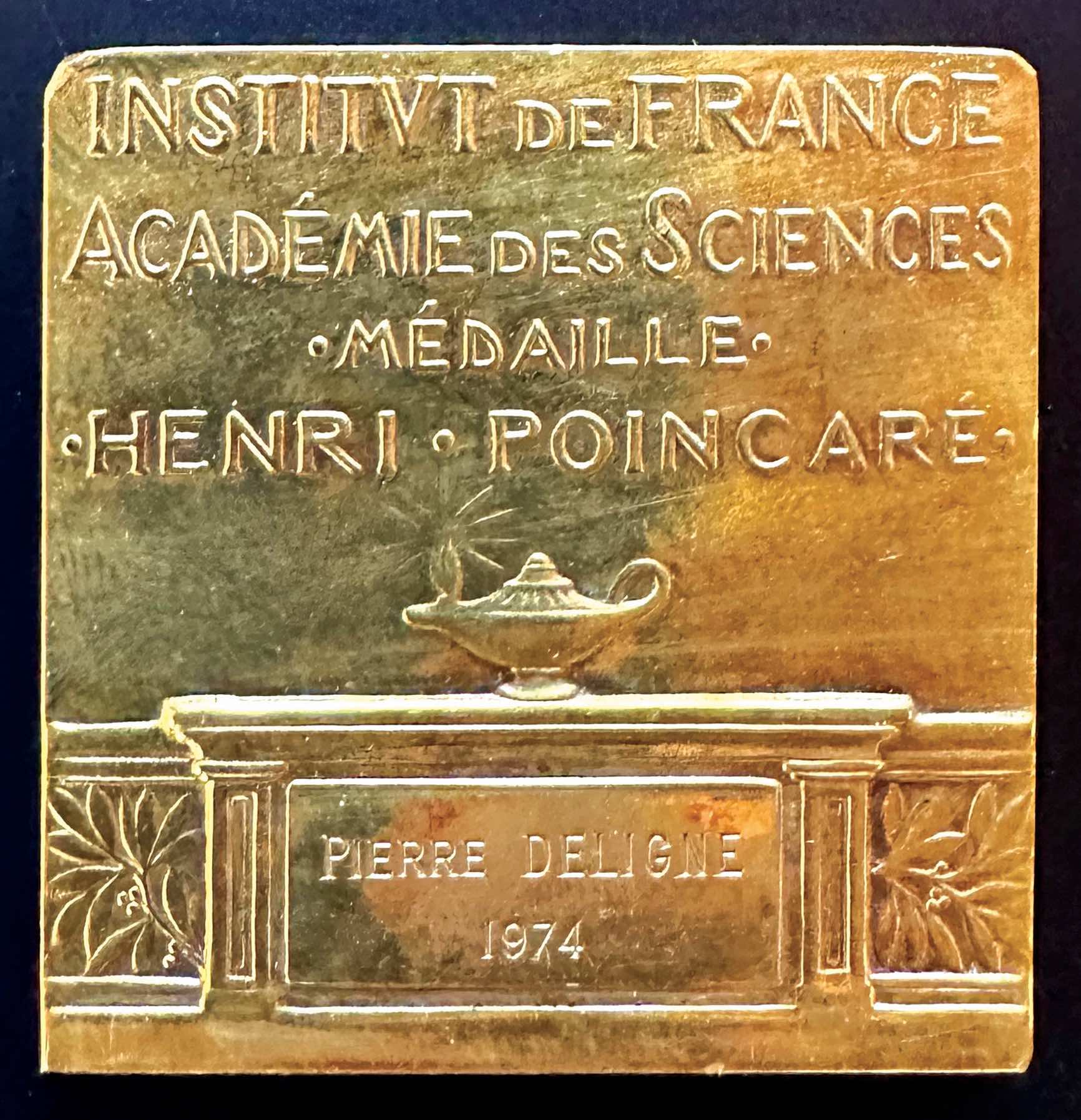 |
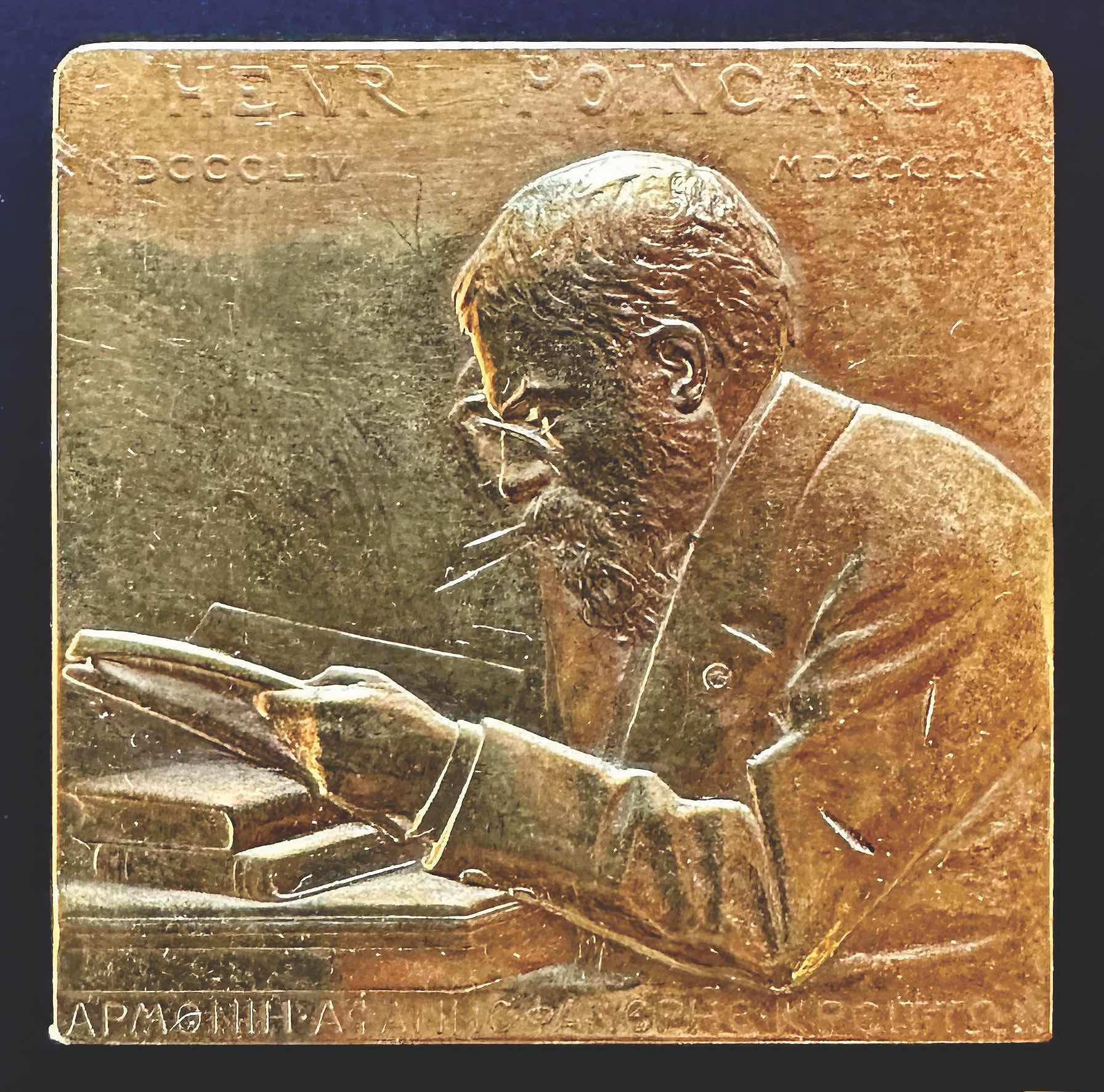
| Henri Poincaré medal awarded to Deligne in 1974. Pierre Deligne | |
PD: It did not change. Essentially, it’s nice to be told that people like the work you have done. And I must also say, one has to remember that for those big prizes there is randomness. In each case, there are other people who could have gotten it as well, so one should not attach too much importance to it. It means one has done good work, but it does not mean it’s the best in any sense.
Some luck goes one’s way.
PD: Yes, a lot of luck. Knowing the right thing at the right time. And another aspect of luck also is that various times are good for different kinds of mathematics. I like basic things and in some sense, basic building blocks. And the 60s and 70s were times for doing such things.
In algebraic geometry, and in automorphic forms.
PD: Yes.
Did these awards and honours come with some kind of explicit or maybe even a moral obligation that as an awardee you are now expected to be doing something?
PD: At least, for a Fields medal, that’s clear. It’s for young people and it’s an encouragement to continue doing nice things. But that’s something one wants to do anyway. The Abel prize is different. It’s kind of telling that in the past, collectively, one has done something good.
Like a lifetime achievement award.
PD: Yes.
I want to ask you about your positions at IHES and IAS, and the sort of responsibilities you might have had, or what kind of experience you had serving on committees?
PD: I don’t like committees. IHES was very simple, but it is smaller. There were one or two meetings of the scientific committee each year and that was about it. A number of people were coming regularly.
Here at IAS, at the beginning it was still manageable, maybe 200 applicants for 60 positions next year, but even that, I found, was taking too much time.
I’ve heard through the grapevine that you actually took an early retirement from the IAS to be spared the effort of reading so many proposals, many of which are fantastic. Each one has a lot of interesting ideas and you would be spending too much time thinking about this proposal. Is this true?
PD: Yes. First I find that it’s very difficult to rely on letters of recommendation. At least one has to know the author of the letter. Some people, if they say this person is reasonable, it’s very laudative. Some people, if they say it’s excellent, one has to take it with a grain of salt. So, the only way is to look at the papers, but this takes time. The best and worst candidates are often easy to recognize, but for the middle, the only way to do a good job is look at the papers, and this was taking too much time.
another aspect of luck also is that various times are good for different kinds of mathematics.
And there was another reason for retiring, I think at 63 or 64, I don’t remember, instead of the canonical age of 70. I think it’s greedy to want to stay until 70. One has to liberate jobs for younger people and especially here one keeps an office, one can still ask for help, so nothing changes except one gets retirement money instead of a salary. So, there is really no reason not to make room for younger people. At other places it’s different, like in Paris, in Orsay, you keep your office for only five years. But here nothing changes except the money coming from another source, so there is no reason to linger.
I understand you participate regularly in the meetings of the American Philosophical Society. Could you tell us something more? Are you interested in any particular school of philosophy?
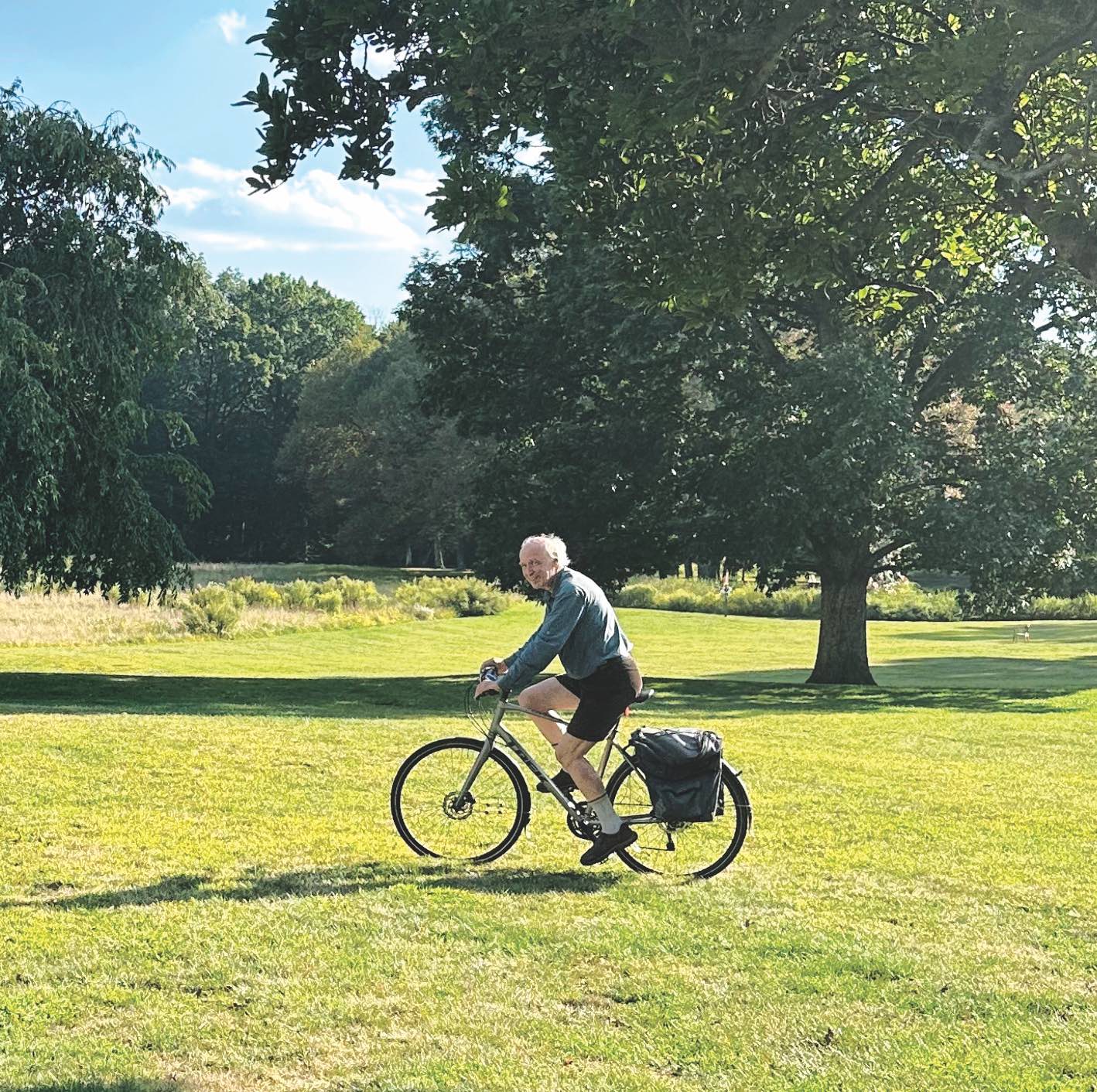
PD: Philosophical means, as in the meaning of the 18th century, natural sciences. So it has nothing to do with philosophy in the present sense. Twice a year they have a series of lectures, of which half are very good, a few are terrible. It’s on very different subjects. So it’s both for learning about completely new things I had no idea of, and also meeting interesting people who come to attend those lectures. It’s the only academy of which I am a member, for which I think it’s really nice to participate, because they have those nice conferences. The American Philosophical Society does many things. They have a library with a large collection about American Indians, and also a small museum.
I know from just having known you now for the last maybe five or six years, that you are physically very active. You are an avid bicyclist.
PD: Yes.
And you are busy doing some gardening pretty much all the time.
PD: I am a bad gardener. If you look at my garden, you will see there are a lot of weeds. The trouble is, to do gardening well, you need to do it regularly, but when I have something that I want to do in mathematics, I forget about the garden, and when I come back, it’s a mess.
However, I find it very relaxing. When it’s hot, like it has been, then one can do it only early in the morning. Already in Bures-sur-Yvette, I had a small garden. Each time, it has been a piece of land which does not belong to me, but which I use. Here, the first year was a little difficult. First, the earth was terrible, and then the deer ate everything. So each year, I had to put a fence a little higher than the previous year. Now, usually the deer don’t come. The groundhogs also don’t come either, because I have a separate metal low for them, a tall fence for the deer, but it’s still a mess. I have a few things, but it’s more for the pleasure of working outside.
I never really liked cities. I like to be in a green place. As for bicycling, I don’t like to be in a metal box (a car). It’s so much nicer to be higher up on the bicycle.
I understand you and your wife sold off your car, and you even go grocery shopping on your bicycle?
PD: Yes, I have my backpack, I have bags on my bicycle, so I can carry quite a lot, maybe once a week.
But the thing is, you do it also during peak winter.
PD: That’s nice.
Not many other people do that here.
PD: When there is a little snow, it’s very nice, because the cars go slowly. Also, bicycling is easier than walking, because when you walk, you only have two feet. When you bicycle, you have two wheels and a foot on each side. And roads get clear quite soon. It’s a pleasure, because in normal times, you bicycle without thinking. When there is snow, you have to think. That’s a pleasure, to be agile and not to fall.
Talking about winter time, I’m sure you’ve been asked this many times, about this almost unique hobby that you have, of building igloos when it snows.
PD: Yes, the past year, there was not enough snow. And the snow has to be deep and not too powdery, because you have to be able to compact it to make blocks.
How did you even think of making an igloo? It’s not common. In fact, I don’t know of anybody else who makes igloos.
PD: I think it started when I was quite small. I, along with my brother and my sister, was spending Christmas by the sea shore in Belgium, and there was a lot of snow. And I don’t know why, they had the idea of making an igloo. And they thought they could use me. The way to use me is to take me by the shoulder and by the feet, tapping the snow to compact it, and then you could build things. So that’s how I learned one could make an igloo.
I don’t like to be in a metal box (a car). It’s so much nicer to be higher up on the bicycle.
So they used you to make those snow bricks to bang you into the snow.
PD: Yes. [laughs] An igloo is quite comfortable. It’s important that at the bottom you have a layer of something, because the cold comes from the ground. You leave a little snow well tapped on the ground, but still you need an additional layer.
What do you put, like some straw and a sleeping bag?
PD: Before I had some animal skins, I don’t remember which one. Now they have disappeared. I have some air mattress, and I have good sleeping bags.
You actually sleep in the igloo?
PD: Yes, that’s the aim. Of course.
Yeah, sure. How long does this igloo stay? Of course, it depends on the weather.
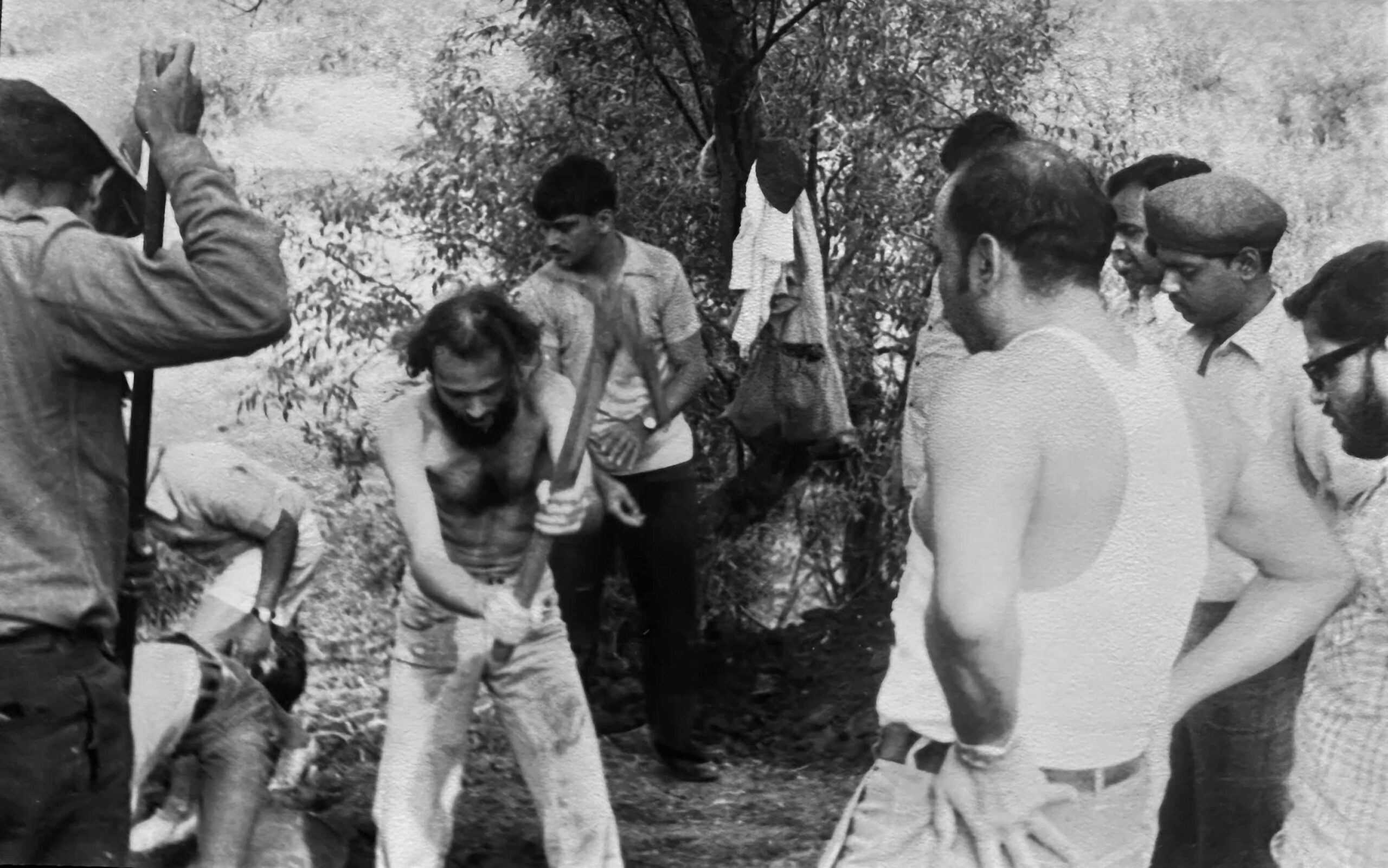
PD: So first it’s built, and then each day it gets a little less good. One thing to do in the morning is to pour some, almost freezing water on it, so that it will transform the snow into ice, provided it’s below freezing.
You don’t want it to sink and collapse.
PD: Yes, yes. And then one day it collapses.
You’re not afraid when you’re sleeping in it that it’s going to collapse on you?
PD: No, no, because the night is colder than the day. It will collapse during the day.
[Laughs] Of course. A different hobby of yours, I understand is that you follow eclipses, and celestial phenomena. You go, maybe even across the world to watch an eclipse.
PD: It’s worth it, yes.
Do you have any memorable trips that you can recall?
PD: I think the best eclipse we saw was in Libya. It was when Gaddafi was still the dictator of Libya. So, for tourists it was safe, and it was in the desert. And we were with a group, and there was a city of beautiful tents for all of us, and it was really spectacular to be in the desert, to see it.
The first one I saw with Elena was in Siberia. So we tried to see a number of them, and I think about half of the time we succeeded, the other half there were some clouds.
Yeah, there is always that luck factor. You need good viewing, the sky needs to be clear.
PD: Yes, so this first one in Siberia, we were not very optimistic. We were in a city maybe 50 miles from the airport where we were to see the eclipse. I remember being in a bus going to this airport, and things were all cloudy, and then it got blue and then everyone was excited… Hoo haaaa…![Laughs]
Talking about traveling, I know you have visited India, twice. What do you remember? What are your impressions? What did you enjoy? Did you like the food? Did you have any stomach troubles, as such are some of the things people worry about when they travel to India.
PD: I liked both times, but for me there was a big difference between the first and the second visit. There was a gap of about 25 years between the two. The second visit was in 2004. I found it so much more crowded the second time. I did not remember seeing so many people sleeping on the sidewalk the first time I was in Bombay.
So were both your visits to Bombay (now Mumbai)?
PD: Yes. During the first visit, the plane arrived in New Delhi and then I took a train.
Ah, I see. You have taken a Delhi to Bombay train. That would have been some experience.
PD: That was very nice.
Did you visit the Tata Institute of Fundamental Research in Bombay?
PD: In both times, yes. I was invited. Cities I don’t really like, especially when it is crowded like Bombay. Of course, Tata Institute is in a little remote place by itself. And the first time, there were good relations with the military base on the other side of the street. I could meet some people there. Also, there were some little markets where one could go. I had no stomach trouble at all. I liked vegetarian food. But I was very careful. Each morning I was boiling water and then drinking only that water. At least for the first ten days. Then I was a little more relaxed. If in the city I was thirsty there were those people selling coconuts.They cut it and you can drink the coconut water. That’s safe. But the part I liked very much was the countryside around Bombay.
Do you remember where you went?
PD: A small village called Rajmachi. I think it’s northeast of Bombay. I found it a beautiful place. Somewhat poor though. People of Tata Institute were trying to get some help for them. There were some ruins of some fort just next to it. So, I remember I went to sleep there. People were a little worried. They were staying in their homes. But I found it nicer to be outside.
People might have worried that there might be snakes around.
PD: That’s what they were telling, yes.
I want to now ask you about this honour that you’ve been bestowed by the Belgian king, that you are a Viscount of Belgium. Can you tell us something about that? Was there a ceremony?
PD: Yes, first, I think, about a year before that, I was asked if I would accept and I said yes. It gave me the occasion to meet a very interesting person who was writing the document on some parchment and drawing the coat of arms. So there was some discussion about the coat of arms also.
I like this little song that refers to the depiction of the three hens in the coat of arms. I like this because in a way it’s a tautology, the first one is the first one. One can view mathematics as a sequence of tautologies. And so I wanted to have three hens. And there I was lucky because hen is not a heraldic animal, but three of anything, that was fine. So three hens were all right, and that was in the middle. Then on the side I wanted to have some artichoke. They did not accept that. I very much like the flower of the artichoke, and also the sunflower. When we got married I made a bouquet of flowers with artichoke and sunflower. So for the viscount document that did not work. The best accepted option was birch trees. That’s a sign of Russia also. And they accepted, it was not very much like a birch tree, but it was all right. Then one needed something at the top. I was first thinking of something related to a paper with Mostow, but they did not like it. Then I got an idea.
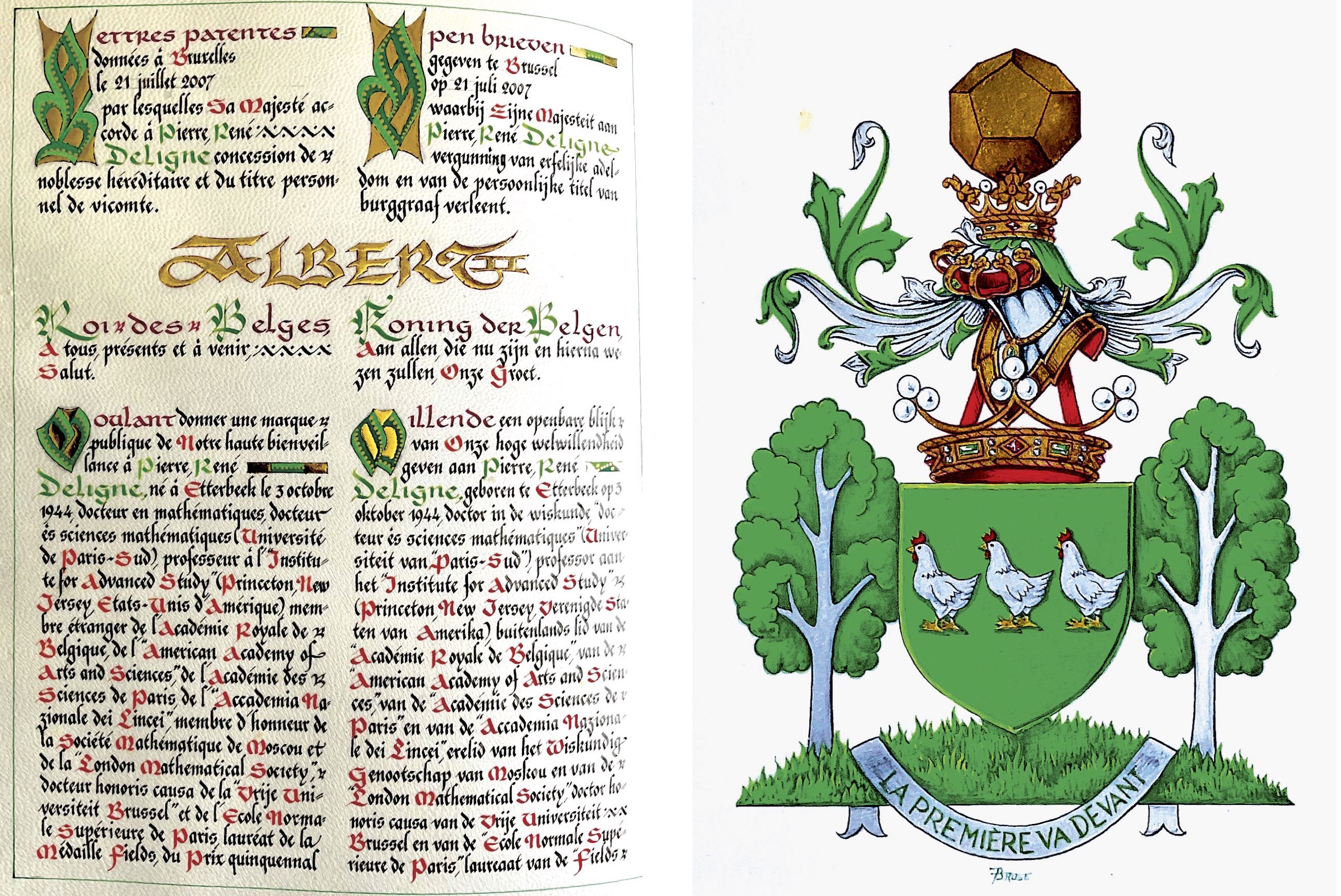 |
Quand trois poules vont aux champs, In English translation: As three hens head for the fields, |
To convince them I said that in Plato there are the five regular solids which are for the air, water, fire, earth and universe. The dodecahedron represents the universe. Then we met this person who made a nice drawing adding all the things.
There was a ceremony at the Palace of the King in Brussels. My sister brought me by car there, and it was a little like primary school. We were in a row two by two, and then one by one we had to shake hands with the king, and then we were receiving what had been written. And then we could go away. I think all the other people had a car waiting for them. I was to take the tram, so I walked. A policeman showed me the way , and then I went back home by tram. [Laughs]
Do you have any photograph or the coat of arms or something?
PD: I have it at home, yes.
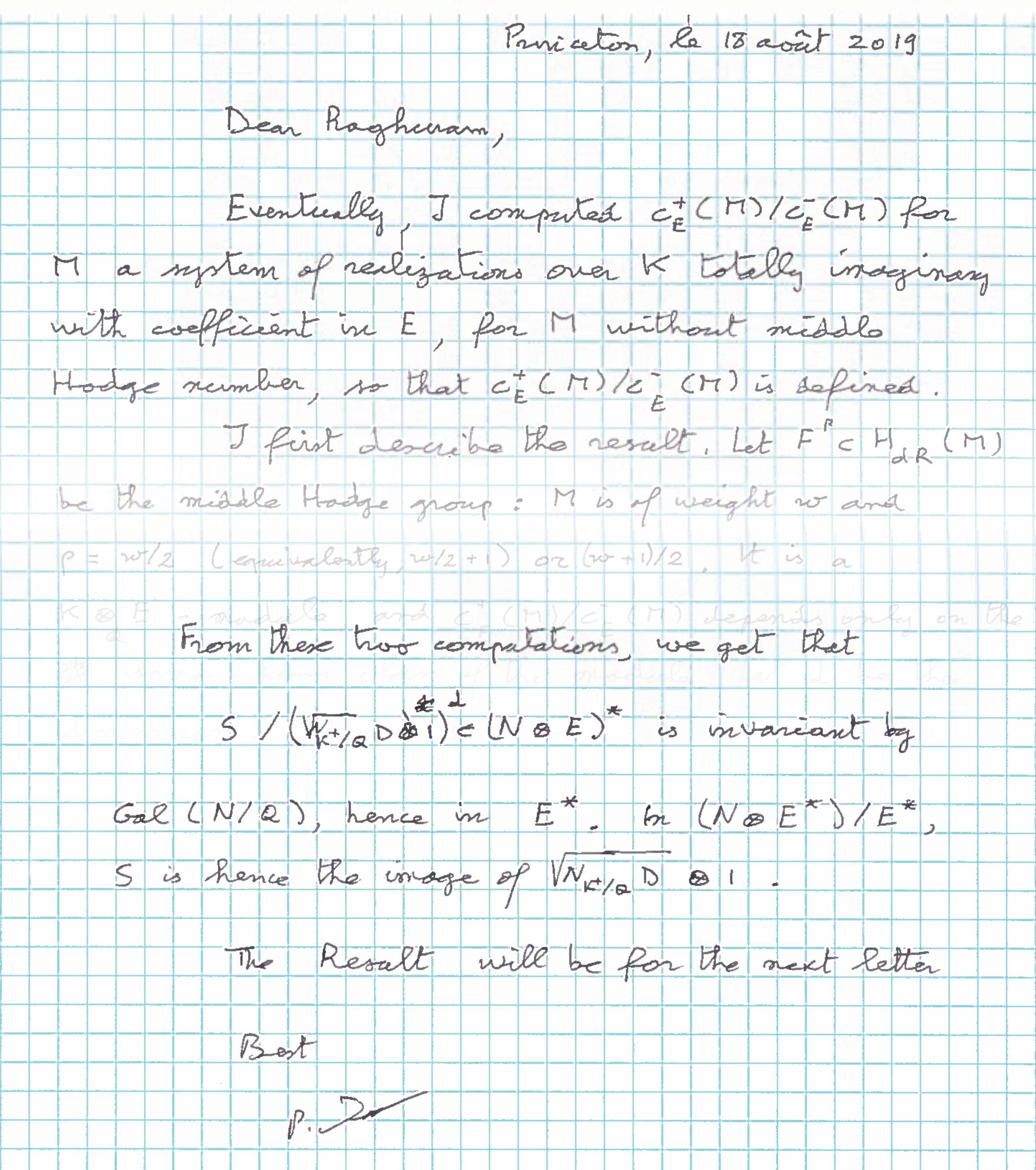
Going back to mathematics, I know from our own little collaboration that you write by hand a lot of mathematics. I actually have a folder in my office full of the letters that you have written to me, which I go back to every now and then to gain some clarity. And I have heard that many mathematicians receive such letters from you. Could you share something about your working habits? What role has writing played for you as a mathematician? When did this start?
PD: From the beginning, I cannot think and type at the same time, but I can write and think at the same time. I find writing letters very convenient to clear my mind, essentially because you write to a particular person, you guess what this person knows, and so you need not tell many things, just tell what is needed. Quite often the letter later becomes the basis for an article.
Sometimes also if I just find something interesting, I can add something to what people are doing. But sometimes it’s the prefiguration of a paper where it helps me to see what the ideas are.
So, is it also like a meditative process for you?
PD: Yes. Writing helps me to think, like when I attend the seminar, I always take notes. Sometimes I throw\break them away afterwards, but just writing helps me to understand. And I think it was already like that in high school, we did not have many manuals, we had to take notes of what the teacher was saying, and so it was ingrained in me that to understand, one had to see what was important and what was not, and take notes of only the important things while listening. But writing a letter is kind of different, though it’s still writing, there is a connection between the mind and the hand. There are people who can think and type like Serre or Borel. When I get a letter from Serre, it’s always typed.
For me, language is just an expression of something preexisting. I think in pictures
Well, what I do is I write by hand. A long time ago, there was a very good secretary here, Dottie Phares. So I was writing and giving it to her, she was typing it, I was correcting mistakes, maybe once or twice, and then sending it. Now, Dottie Phares is no longer there, so I will wait one day before sending the letter, but I scan it and send.
Sometimes I see from what you have written to me, there are several iterations, and you might have cut and paste physically, from a previous version.
PD: Yes, I read, when I see something is not clear, I change it. It is the same thing when I write an article, in the end, each page will be two or three pieces of paper glued together. Then I give it to be typed up.
For most people, cut and paste means something else on a laptop, but for you it literally means cut and paste.
PD: Yes, I like doing it like this. With computers, I think there is a tendency of not rewriting, but cutting and pasting happens too often. Here oftentimes, I cut something and I write it, and I replace it by something different.
I want to ask you, when you think mathematics, what language are you thinking in? Are you thinking in English? Or are you thinking in French? Or is it like a mathematical thought directly forming in your mind?
 |
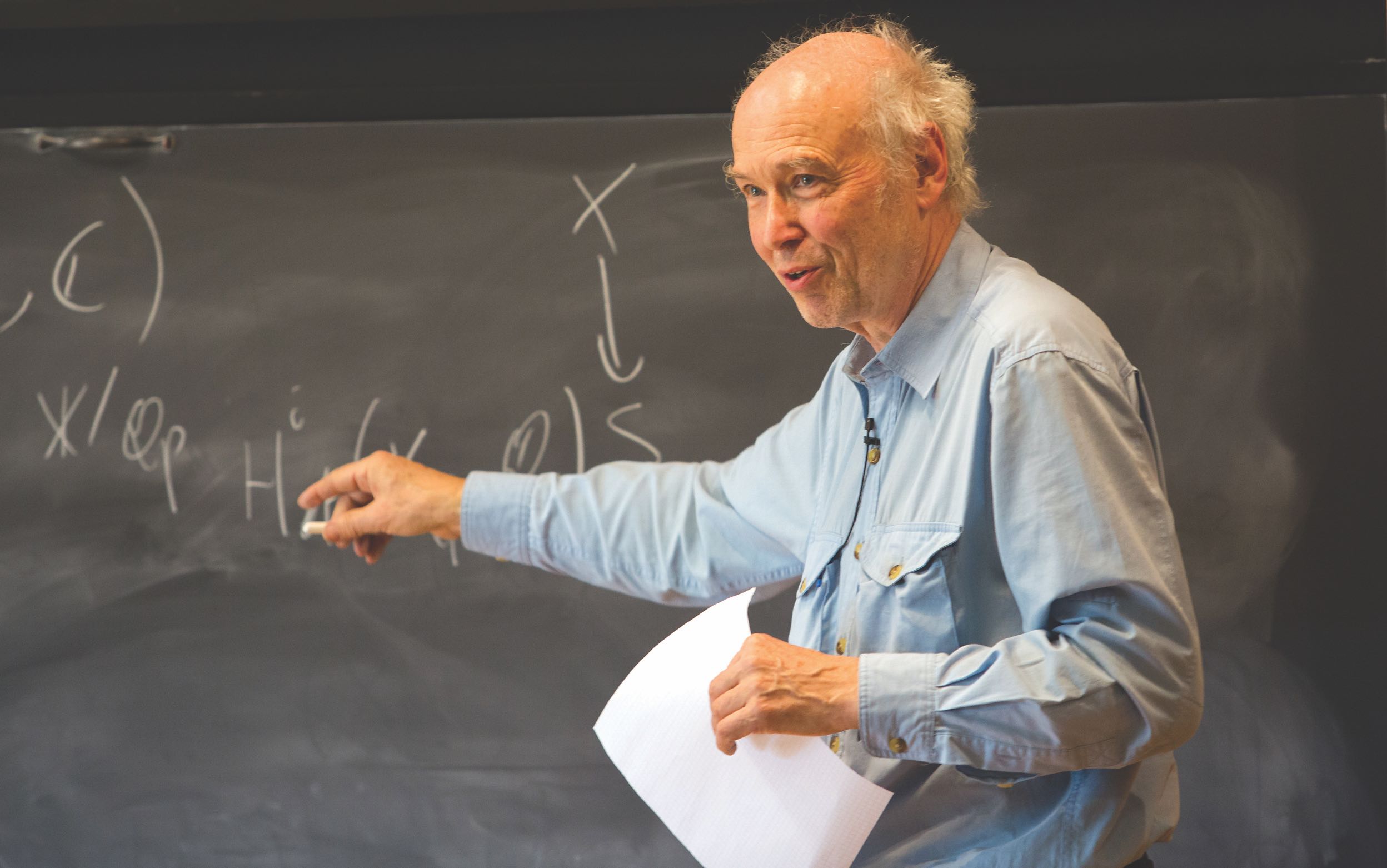 |
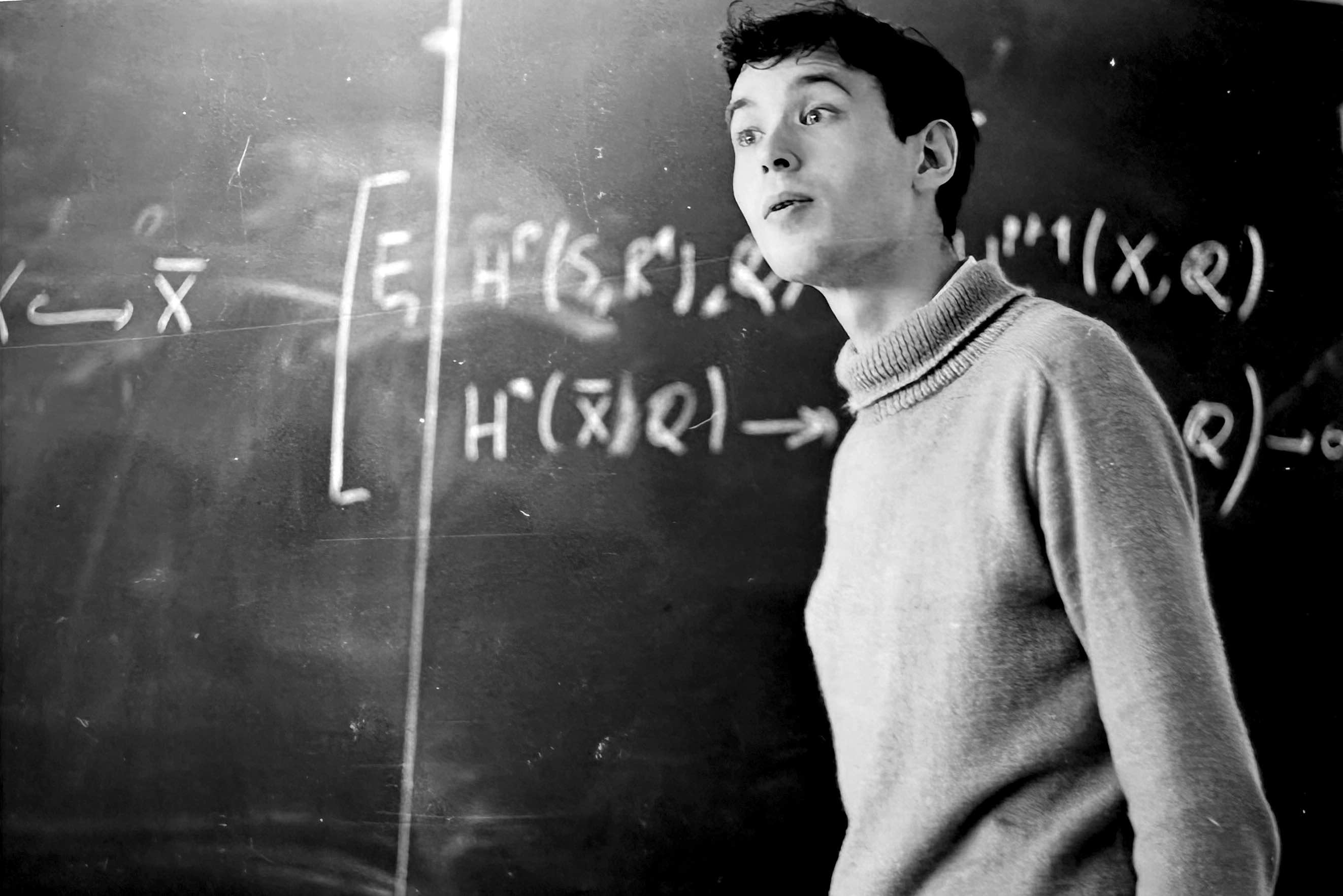
Young Deligne delivering his thesis defense talk in Orsay (left) and the energetic Deligne giving a talk at IAS Princeton, with the timeless mathematical sentiment in the background. Pierre Deligne |
|
PD: For some things it’s French. If I have to make a referees report, then it depends. If the text I have to refer to is in English, I kind of think in English. For me, the expression in a language is just an expression of something pre-existing. I think in pictures. I learned how to speak quite late. I think I could be understood only when I was four or five. And so, I think this forced me not to rely on words to think. I have no statistics, but I think for a number of mathematicians, it’s the same, that they learned to speak relatively late. Not all of them, surely.
That’s an interesting question, perhaps some social scientist should investigate it. You said something about thinking in pictures. Let me ask a question about that. When you’re thinking, say, algebraic geometry, or something about algebra, are you thinking in some kind of pictures, or geometric figures, or are they algebraic expressions?
PD: Usually, it’s pictures. I have a picture of what is a smooth morphism, what is an \’etale morphism. Sometimes when I have to speak with people who think algebraically, it’s very painful. A basic notion is localization. This implies that I have trouble working with non-commutative objects, where localization does not work so well. Like in quantum mechanics, localization is somewhat on the phase space, but not really, and that’s a little difficult to picture.
This actually leads to a related question I have. Would you consider yourself fundamentally to be an algebraist, or a geometer, or an arithmetician, or do you prefer not to bracket yourself this way?
PD: I see that different people think differently. So, the question makes sense. I am clearly a geometer, and Zagier, for instance, is clearly an algebraist. I don’t know what being a number theorist would mean. Probably more like between geometry, algebra, and analysis. I am not an analyst. I am able to use the words `big’ and `small’, but I am not completely comfortable in doing so. Neither is Serre. When I wrote the paper with him, he was a little worried, because in my first letter I was using those words, big and small, so I was very careful in the final version not to use any such word, but rather say that 485 or something is bigger than 60, or this kind of argument.
And when I speak with Zagier, I am amazed how he can see formulae, do things with them. It’s completely foreign to what I can do.
This nicely leads me to the next question I have. For you, what is your greatest strength as a mathematician? You know, what makes you Deligne, in some sense?
PD: I try to be interested in different things, not to be too specialized, and I try to express things in an invariant way. Keeping all symmetries which can exist in a problem can make computation difficult, because usually when you compute you break some symmetry to be able to do it. I go to great lengths of keeping all symmetries and using transport of structure for arguments. I try to formulate problems in ways that limit the tools which seem natural. If you are constrained in the kind of arguments you are willing to use, if a solution remains, it is easier to find.
Grothendieck had a lot of influence on me, more through his philosophy of motives
Are you influenced by Grothendieck in this matter…?
PD: By Tits, I think. Tits is really a geometer, and symmetry is very important for him. Maybe Grothendieck for trying to get to looking at simple things; of course, Grothendieck had a lot of influence on me, but maybe more through his philosophy of motives. Then he had a way of looking at problems which I admire very much, but I can rarely do as well. In his words when a proof is complicated, it means you have not understood. So one has to try to make the proof obvious. I remember one seminar, it was SGA 5, I think, where he was proving the base-change theorem for a proper map, which clearly was a crucial result. The proof was one devissage after another until nothing difficult remained and then the result was there at the end. A few non-trivial things for curves were needed. For me that’s an ideal, but difficult to achieve.
I have a last question. Do you have any advice for young graduate students who might be just starting out on a career in mathematics? Let’s say a person has just come to the IAS, a young member, who comes and talks to you, what might you tell such a person to keep in mind?
PD: I would not give advice, I would try to answer questions. I remember the advice Tits gave me: “do what you like.” But I’m not sure if it’s good advice for everyone. In a way the reason to do mathematics is to do what one likes. In general, I would advise learning more than one thing, but I think it was much easier in my time. Now, so much more is known. So many problems which were completely inaccessible are solved now. I think it must be difficult for young people to understand enough to do real work. But I would always be hesitant to give advice, because people are very different, one from the other.
Well, this was wonderful. Thank you so much!
PD: Welcome.
Acknowledgement We thank Shilpa Gondhali for her kind help with transcribing the recorded interview.
\blacksquare
Footnotes
- Biermans-Lapôtre is a student residence in Paris, as part of the Cité Internationale Universitaire de Paris (CIUP) campus. It is a meeting point for students and researchers from Belgium and Luxembourg, offering accommodations and hosting academic and cultural activities. ↩
- Pensionnaires étrangers are students from outside of France who are enrolled at their home university, and stay at ENS for up to a year. ↩
- La conjecture de Weil-I, Publications Mathématiques de l’IHÉS, 43 (1974) pp. 273–307. ↩
- Cours Peccot is a semester-long mathematics course given at the Collège de France, by mathematicians under 30 years who have distinguished themselves by their promising work. The course consists of a series of lectures by the laureates to explain their recent research works. ↩