

Astronomical concepts find mention in Vedic samhitās and Brāhmaṇas, which belong to a period earlier than 1500 BCE ([6], [7], [37], [39], [63]). Passages describing the sky, the Sun, Moon, stars and the planets, day and night, seasons and months, eclipses, spherical nature of the Earth etc., occur at many places. These are neither `systematic’, nor `mathematical’, astronomy not being their exclusive concern. However, many of the concepts in Indian astronomy, especially related to the calendar can be traced to them.
Indian astronomy in the Vedic Period and Vedāṅga Jyotiṣa
There are three clear time-markers as even casual observations of the sky reveal. These are: (1) a `Day’, which is the time interval between successive sunrises, (2) a `lunar Month’, which is the time interval between successive new Moons or full Moons, and (3) a `Year’, which is the time required for the Sun to complete one circuit around the Earth in the background of stars. All major civilisations grappled with the problem of how these time-units are related to each other.
We have the following description in a verse in Ṛgveda:
So, according to this verse, a year has 12 months and 360 days. 5 or even 5.25 days were added later.
The names of the twelve months and six seasons are given in Taittirīya saṁhitā:
“madhu, mādhava (vasanta), śukra, śuci (grīṣma), nabha, nabhasy (varṣā), īśa, ūrja (śarad), sahas, sahasya (hemanta), tapas, tapasya (śiśira)” (Tait.saṁ. 1.4.14; 4.4.11.)
Now, a solar year has nearly 365 days, and a lunar month has nearly 29.5 days. So 12 lunar months would have only 354 days. To align the lunar year with a solar year which is connected with the seasons, an additional lunar month has to be introduced in some years. This concept of an `adhikamāsa‘ or an additional month in some years is already there in Taittirīya saṁhitā. It is called saṃsarpa, and also as aṃhaspati, at times.
Ecliptic
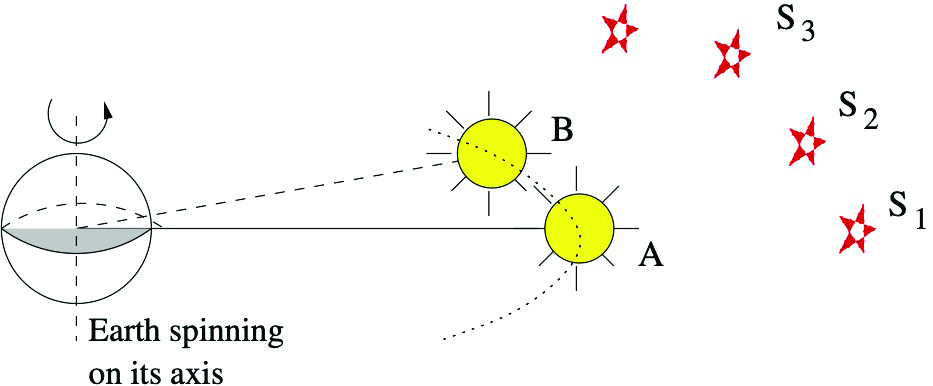
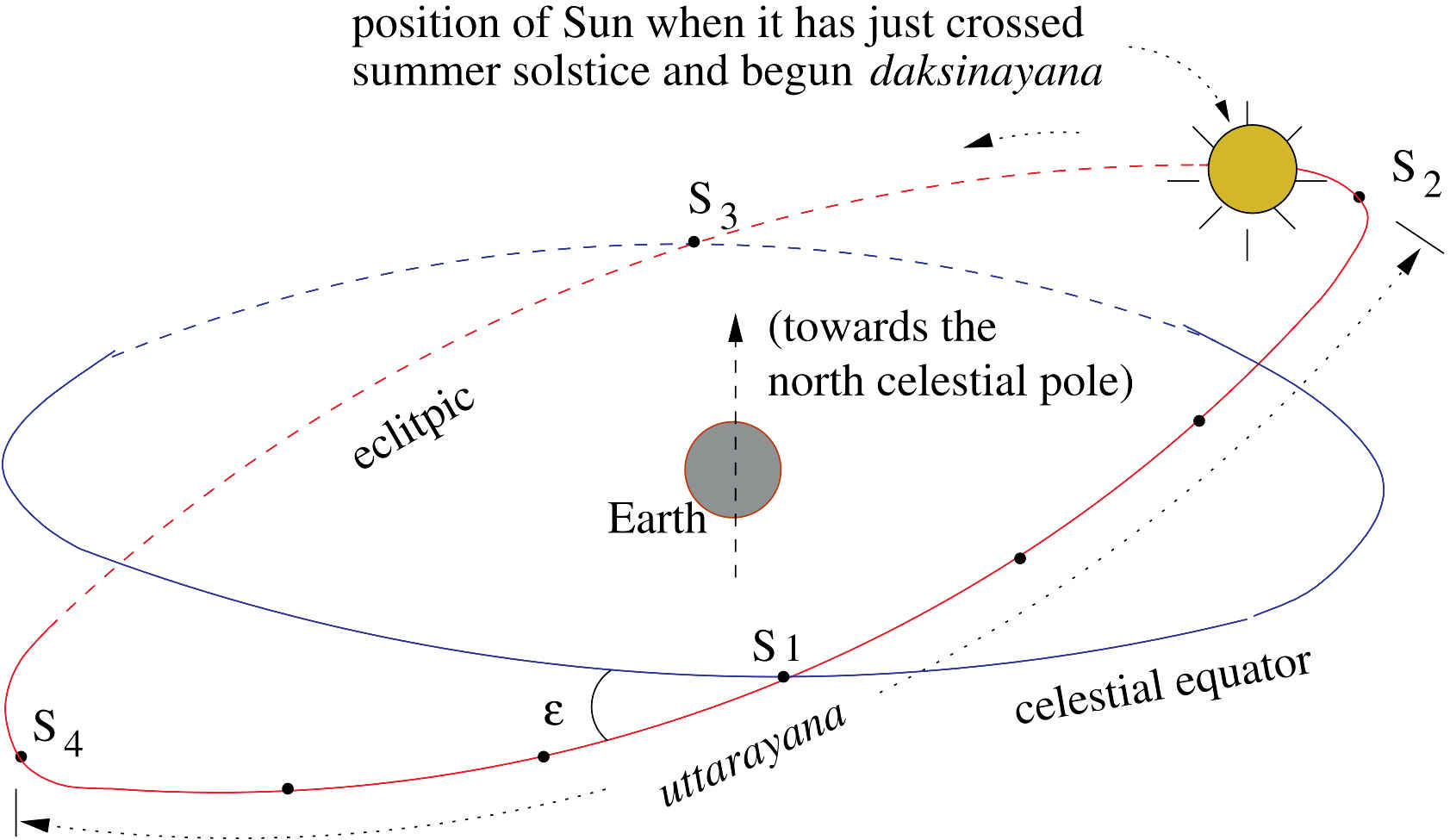
When the Sun is at S_4, it is at the southernmost point with respect to the equator. This is known as the `winter solstice’. Similarly, when the Sun is at S_2, it is at the northernmost point with respect to the equator. That point is known as the `summer solstice’. At S_1 and S_3, the ecliptic intersects the equator, and these points are known as the equinoxes. When the Sun is at an equinox, it is an equinoctial day. When the Sun is at S_1 or S_3, it is the `viṣuvat‘ (`equinox’).
Between S_4 and S_2, the Sun moves northwards, and between S_2 and S_4, the Sun moves southwards. Taittirīya saṁhita observes it thus ( [6], p.24; 39, p.47):
Tasmādādityaḥ ṣaṇmāso dakṣiṇenaiti ṣaḍuttareṇa|
Thus the Sun moves southwards for six months and northwards for six months. (Tait.saṁ. 6.5.3)
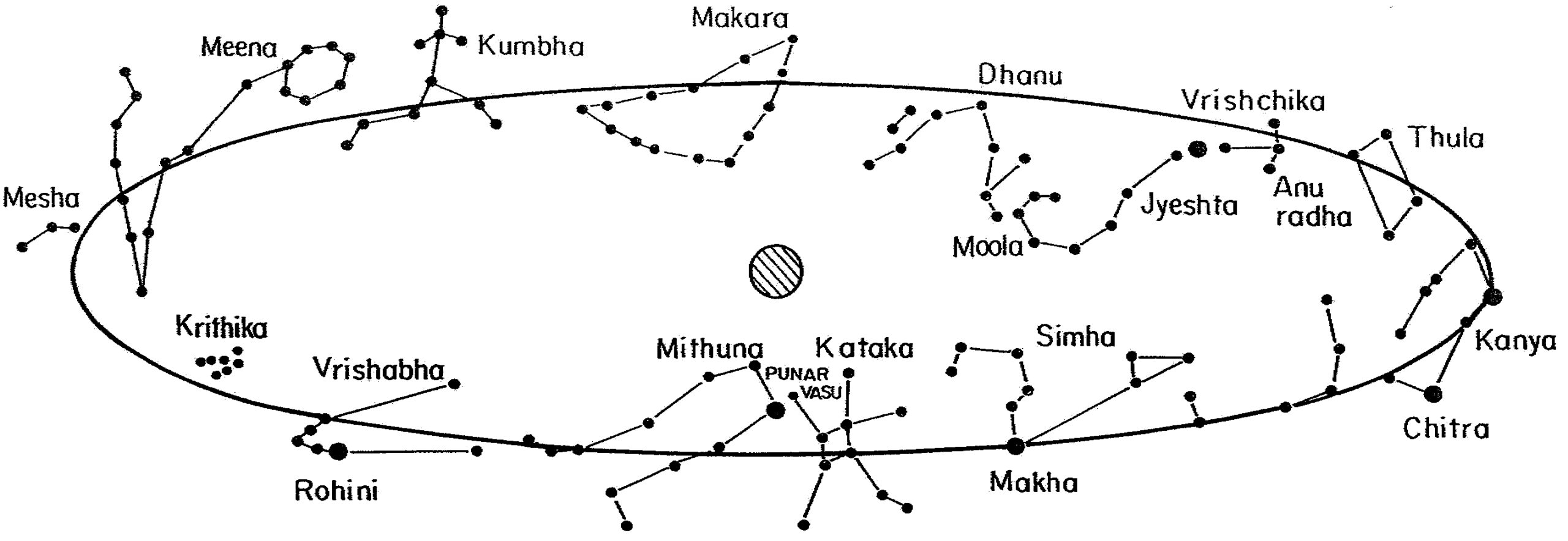
The 27 nakṣatras
The `sidereal period’ of an object is the time taken by it to complete revolution in the background of stars. The Sun’s sidereal period is nearly 365.25 days. The Moon moves in an orbit around the Earth, which is slightly inclined to the ecliptic. The Moon’s sidereal period is close to 27.3 days, that is, the Moon covers nearly \frac{1}{27} th part of the ecliptic per day. It is natural to divide the ecliptic into 27 equal divisions also, called nakṣatras. Each day would be associated with a nakṣatra.
One finds a list of all the 27 nakṣatras in the Vedas. In fact, in the Taittirīya Saṁhitā of Yajurveda, as also Atharvaveda, there are 28 stars. These are Kṛttikā, Rohiṇi, Mṛgaśiras, Ārdrā, Punarvasu, Puṣya, Āśleṣa, Māgha, (Pūrva) Phalgunī, (Uttara) Phalgunī, Hasta, Citrā, Svāti, Viśākhā, Anurādhā, Jyeṣṭha, Mūla, Pūrvāṣāḍhā, Uttarāṣāḍhā, Abhijit, Śravaṇa, Śravisthā, Śatabhiṣak, (Pūrva) Proṣṭhapada, (Uttara) Proṣṭhapada, Revatī, Aśvayujas (Aśvinī) and Bharaṇī. At some later point in time, Abhijit (which is far from the ecliptic anyway) was dropped and a 27–Nakṣatra system was adopted. It is significant that Kṛttikā is the first nakṣatra. It is mentioned in Śatapatha Brāhmaṇa that Kṛttikā does not deviate from the east when it rises. From this it would follow that it was at the vernal equinox then, which would imply that the date of composition of the text would be around 2300 BCE.
Vedāṅga Jyotiṣa
It had been noticed that the Sun and the Moon return together at nearly the same position in the framework of stars, after five years. A 5-year yuga cycle is mentioned in Taittirīya and Vājasaneyi saṁhitas. As we saw, there are rudiments of a calendar with `adhikamāsas (intercalary months), and 27 nakṣatras as markers of Moon’s movement. However, the descriptions in these saṁhitas are qualitative.
A definite quantitative calendrical system is described in a short text called Vedāṅga Jyotiṣa (VJ) ascribed to sage Lagadha [45]. It is available in Ṛgvedic and Yajurvedic versions.1 In one of the verses, it says ([45], pp.23, 28.):
स्यात्तदादि युगं माघस्तपश्शुक्लोऽयनं ह्युदक् ||
svarākramete somārkau yadā sārkaṃ savāsavau |
syāttadādi yugaṃ māghastapaśśukloýanaṃ hyudak ||
When the Sun and Moon occupy the same region of the zodiac together with the asterism of Vāsava (Śraviṣṭhā) at that time begins the yuga, and the synodic month of Māgha, the solar month called Tapas, the bright fortnight (of Māgha) and their northward course (Uttarāyana). (ṚVJ , 5; YVJ , 6)
So, at the time of the composition of the text, the winter solstice was at the beginning of the asterism Śraviṣṭhā (Delfini) segment. Now, the solstices and equinoxes keep moving `westward’ due to the `precession of equinoxes’. Winter solstice at Delfini would correspond to some time between 1370 BCE and 1150 BCE. So, the text was probably composed around 1250 BCE.
The Sun and the Moon move along the ecliptic uniformly, in Vedāṅga Jyotiṣa. A yuga consists of 5 years (number of revolutions of the Sun) with each year having 12 solar months (so 60 solar months in a yuga), 67 sidereal months (number of revolutions of the Moon), 62 lunar months (number of Pūrṇimās or amāvāsyās), and 60 \times 30 \frac{1}{2} = 1830 civil days.
There are 60 solar months and 62 lunar months in 5 years. So, there are two intercalary months (adhikamāsas) in this period. Hence, we would have three lunar years with 12 months, and two lunar years with 13 months in a yuga. According to the text:
A sidereal year = \frac{1830}{5} = 366 days (actual: 365.2564 days).
A lunar month = \frac{1830}{62}\vphantom{\sum_M^2} = 29.516 days (actual: 29.5306 days).
A sidereal month = \frac{1830}{67}\vphantom{\sum_M^2} = 27.313 days (actual: 27.321 days).
A sidereal year2 of 366 days is too long. In Vedic literature, there is a mention of a cycle of 4 years with 1461 days, implying a sidereal year of 365.25 years. Also, simple observations would reveal that the Sun and the Moon would not come back to the same point at the same time after 1830 days. Then, why does Vedāṅga Jyotiṣa have a 366 day-sidereal year?
According to some scholars, the text was meant primarily to provide a civil calendar, where convenience of division and ease of calculation are important. There is a departure from actuality anyway, because only `mean’ or `average’ motions of the Sun and the Moon are considered. Probably, corrections would be introduced to obtain positions of the Sun and the Moon, more accurately.3
The concept of `tithi‘ is mentioned in the text, perhaps for the first time. A tithi is \frac{1}{30} of a lunar month.4 There are 15 tithis in each parva (half of a lunar month). There are short algorithms (sūtras) for finding the tithi, nakṣatra, Sun’s position in the sky, etc. The sūtra for finding the variation of the day-time over the year is particularly remarkable.
Variation of the Day-time over the year
An hour is a time-unit which is \frac{1}{24}th of a civil day. In India a time unit called muhūrta which is \frac{1}{30}th of a civil day was used. Now, the day-time is the time-interval between the sunrise and the sunset. It is common knowledge that the day-time does not have the constant value of 12 hours, or 15 muhūrtas throughout the year. It depends upon the observer’s latitude, and also upon the position of the Sun on the ecliptic (specifically, its declination which is its angular separation from the equator).
Vedāṅga Jyotiṣa gives a simple arithmetical rule for the duration of the day-time ([43], pp.25,30.):
Hence, the duration of day-time, D_t is given by
D_t = (12 + \frac{2n}{61}) \;\; muhūrtas,where n denotes the number of days elapsed after the winter solstice when the Sun’s course is northward, and the number of days yet to elapse before the winter solstice when the Sun’s course is southward. On the winter solstice day, n=0, and D_t = 12 muhūrtas; at the equinox (viṣuvat), n=91.5, and D_t = 15 muhūrtas; and at the summer solstice, n=183, and D_t = 18 muhūrtas.
In modern spherical astronomy, D_t can be calculated for any day for any location. The Vedāṅga Jyotiṣa formula agrees with the modern formula for most days for a latitude close to 28^\circ North5. This was pointed out first by the Japanese historian of astronomy, Y. Ohashi ([20], p.206.).
The Siddhāntic tradition in India and Āryabhaṭīya
The Vedāṅga Jyotiṣa has a sūtra format (like Pāṇini’s Aṣtādhyāyi, or Piṇgala’s Chandah-sūtra), and is the first text in India to give mathematical algorithms in astronomy. The motions of the Sun and the Moon in the stellar background are uniform here, and there are only simple arithmetical algorithms. In reality the motions are non-uniform. There is nothing on the motion of the actual planets (Mercury, Venus, Mars, Jupiter and Saturn), nor much on the diurnal motions of even the Sun and the Moon or eclipses. For discussing all these, trigonometry is essential. In fact, trigonometry was invented to describe the non-uniform motion of planets accurately.
There is a long gap between Vedāṅga Jyotiṣa and Āryabhaṭīya which was composed in 499 CE [55]. There were some Bauddha and Jaina texts, in the intervening period. According to tradition, there were 18 siddhāntas before Āryabhaṭīya: Five of them, namely, Paitāmaha, Vāsiṣṭha, Romaka, Pauliśa and Saura siddhāntas are summarized in Pañcasiddhāntikā of Varāhamihira (around 530 CE) [46]. These deal with the various astronomical problems associated with the motion of the Sun and the Moon including their true motion, diurnal problems, lunar and solar eclipses, as also the motion of the tāragrahas, namely, Mercury, Venus, Mars, Jupiter and Saturn.
Āryabhaṭīya is the earliest available text, which contains a systematic treatment of all the traditional astronomical problems. It is mentioned in the text itself that it was composed 3600 years after the beginning of Kaliyuga. This corresponds to 499 CE. Further it is stated that Āryabhaṭa was 23 at the time of composition. He composed this work in Kusumapura which is the same as Pāṭalīputra (essentially modern Patna).
Āryabhaṭīya has only 121 stanzas, and has 4 parts, namely: Gītikāpāda, Gaṇitapāda, Kālakriyāpāda and Golapāda.
The Gītikāpāda which has only 13 stanzas, introduces the concepts of Kalpa and Mahāyuga and gives the revolution numbers of planets and parameters associated with them. The Gaṇitapāda in 33 stanzas deals with a wide variety of mathematical problems including arithmetic, geometry, solutions of linear indeterminate equations, relative velocities of moving objects, etc., and remarkably computation of sines geometrically, and construction of a sine table. The Kālakriyāpāda in 25 stanzas deals with reckoning of time, calendrical concepts, planetary models (epicycle and eccentric circle theories), and explicit procedures for calculation of planetary positions, etc. The Golapāda in 50 stanzas deals with the problems of spherical astronomy such as bhagola (celestial sphere) as seen at different latitudes, diurnal problems associated with the motion of the Sun, Moon and planets on the celestial sphere, situation of the earth and its shape, brightness/darkness of planets, parallax, lunar eclipses, solar eclipses and so on.
The Indian jyā
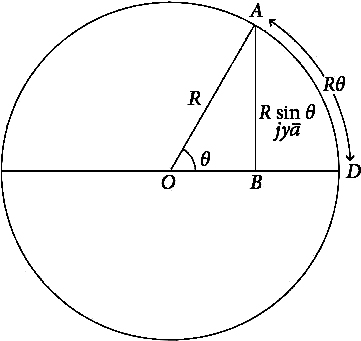
The Indian jyā is defined as follows.
Consider a circle of radius R=OA=OD, as shown in Fig.4. AD =R\theta is an arc of the circle, corresponding to an angle, \theta. Draw AB perpendicular to OD. Then,
| jyā, or jīvā, or the Rsine corresponding to arc \, R \theta | =AB =R \sin \theta, |
| koṭijyā, or the Rcosine corresponding to arc\, R \theta | = OB = R \cos \theta, |
| utkramajyā or the Rversine corresponding to arc \, R \theta | =BD =R(1-\cos \theta). |
Normally the circumference of the circle is taken to be 21600 units (the number of minutes in 360^\circ) so that an angle of 1' corresponds to an arc length of 1 unit. Hence, the radius R = \frac{21600}{2\pi} \approx 3437.7468, which is approximately 3438 minutes. The radius of the circle R is referred to as the trijyā, as it is the jyā of the arc corresponding to three rāśis (5400'). Sometimes a smaller value of R is used for computational convenience.
The Greek chord and the Indian jyā
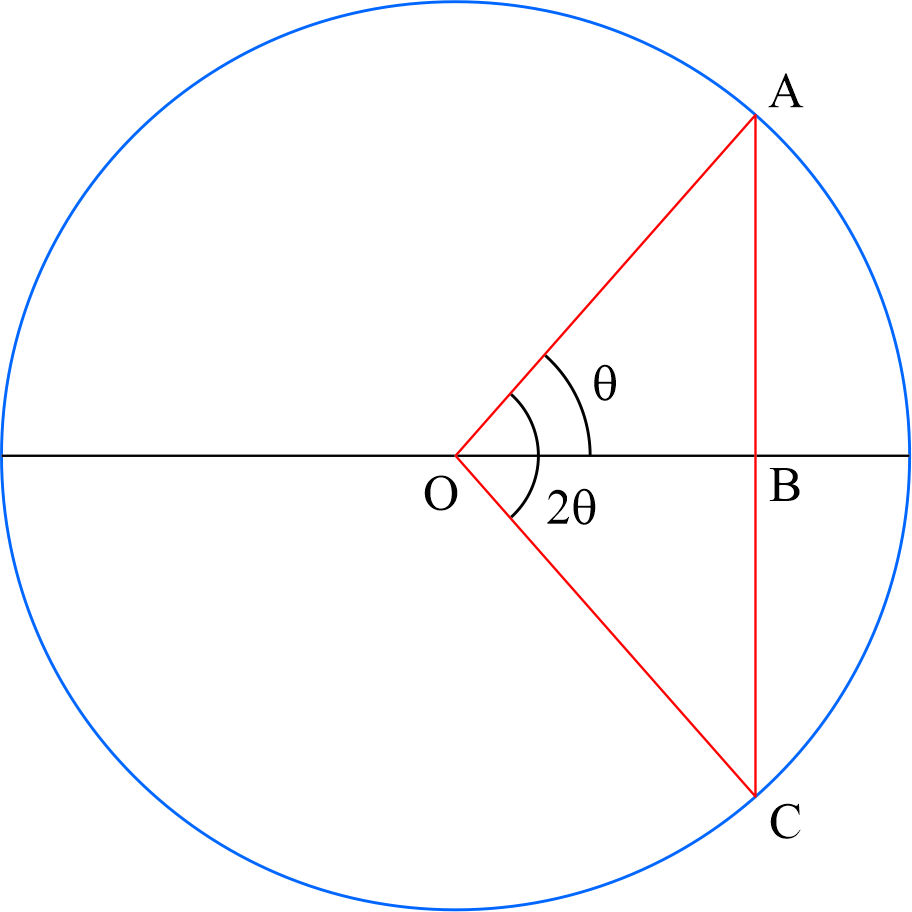
\[AC = Chord (2 \theta) = 2AB = 2 R \sin (\theta). \]
Note that there is no right-angled triangle associated with the Greek chord, and there is no equivalent of the cosine. In all calculations, it is the sine that appears. In fact, the terms `sine’ and `cosine’, can be traced to India. The Indian sine is perfectly suited for writing formulae and performing calculations. The chord is far less so. The Indian sine is considered as a function. That is why we have formulae for various astronomical quantities in Indian texts, whereas in Greek astronomy, one has to use various tables for converting arcs to chords and vice versa for calculating anything.
Computation of accurate values of Sines
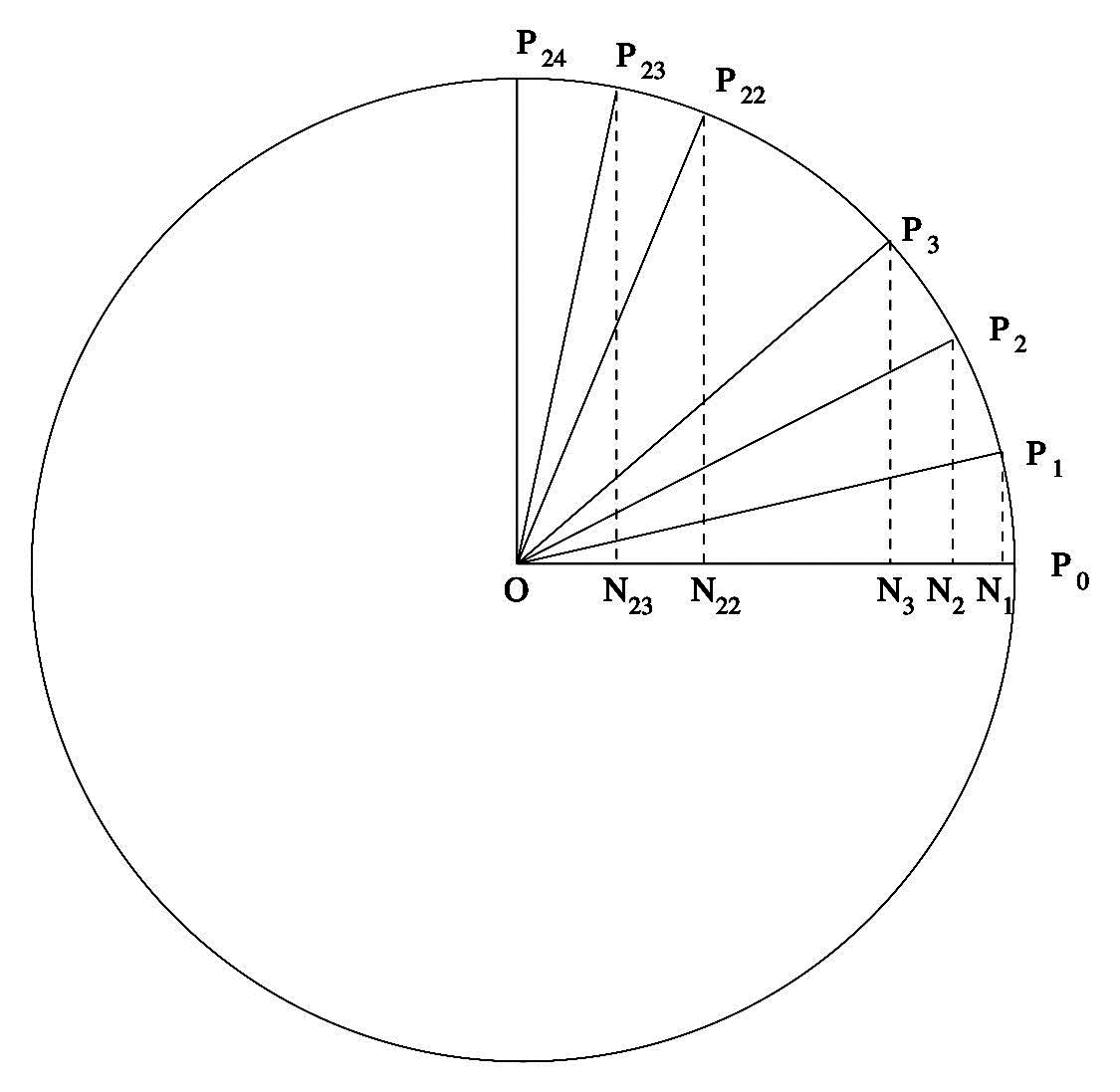
Normally a quadrant is divided into 24 equal parts as in Fig.6., so that each of these 24 arcs subtends an angle \alpha = \frac{90}{24} = 3^{\circ} 45' = 225' at the centre. Then the procedure for finding P_iN_i = R\sin i\alpha, \; i = 1,2,… 24 is explicitly given (R = 3438). The Rsines of the intermediate angles are to be determined by interpolation.
The text Āryabhaṭīya discusses a geometrical method to find the 24 Rsines. More importantly, it gives an explicit algorithm for constructing the sine-table (Gaṇitapāda, verse 12):
This tells us that
\[R \sin 2\alpha – R \sin \alpha = R \sin \alpha
– \frac{R \sin \alpha}{R \sin \alpha}, (\alpha = 225′)\]
\[\begin{align*} R \sin (i+1)\alpha – R \sin i\alpha
= R \sin \alpha –
\frac{R \sin \alpha + R \sin 2\alpha +\cdots + R \sin i\alpha}{R \sin \alpha}.\end{align*}\]
The second equation is equivalent to the relation:
\[\begin{align*} R \sin (i+1)\alpha – R \sin i\alpha
&= R \sin i\alpha – R \sin
(i-1)\alpha – \frac{R \sin i\alpha}{R \sin \alpha}.\end{align*}\]
Āryabhaṭa’s method of generating the sine table by using the second differences of the sines is highly ingenious, and is a more suited method for the purpose. As \alpha is small, it is closely equivalent to the differential equation:
\frac{d^2}{dx^2} \sin(x) = -\sin(x).
In fact, the values of the 24 Rsines themselves are explicitly noted in another verse, and the first Rsine is given by R \sin \alpha = 225', which obviously uses \sin \alpha \approx \alpha, when \alpha is small. The exact recursion relation for the Rsine differences is:
\[\begin{align*} R \sin (i+1)\alpha – R \sin i\alpha
&= R \sin i\alpha – R \sin (i-1)\alpha – R \sin i\alpha \;
\;2(1-\cos\alpha). \end{align*}\]The above exact recursion relation for the successive Rsine differences is stated explicitly in a verse in Tantrasaṅgraha [26]. Now, 2(1-\cos\alpha) = 0.0042822. While this is approximated in Āryabhaṭīya to be \frac{1}{R \sin\alpha}=\frac{1}{225} = 0.00444444, in Tantrasaṅgraha it is approximated by Nilakaṇṭha to be \frac{1}{233 \frac{1}{2}} = 0.0042827.
Far more accurate values for the sines have actually been mentioned in Yukti-dīpikā (c.1530) [36]. This is based on the series expansion for \sin\theta, which we write in the following form:
\[\begin{align*} R \sin \theta &
= R \theta – \frac{(R \theta)^{3}}{3! R^{2}} +
\frac{(R \theta)^{5}}{5! R^{4}} – \frac{(R \theta)^{7}}{7! R^{6}} +
\frac{(R \theta)^{9}}{9! R^{8}}-\frac{(R \theta)^{11}}{11! R^{10}} + \cdots,\end{align*}\]where R \theta is the arc in minutes, and terms up to O(\theta^{11}) are considered.
The 24 Rsines corresponding to R \theta = 225', 450', 675',… were also explicitly stated by Mādhava in the kaṭapayādi (a letter-numeral system) notation which are to be found in the Laghuvivṛti of Śaṅkara Varier [36]. Mādhava’s values of sines coincide with the modern values up to the seventh decimal place.
Some significant features of Āryabhaṭīya
Spherical nature of the Earth:
According to Āryabhaṭa, the Earth is a sphere at the centre of the framework in which stars and planets move. A verse in Āryabhaṭīya says:
Rotation of the Earth:
According to the earlier astronomical works in India and elsewhere, the Earth was stationary and all the celestial objects rotated in the sky, completing one rotation in one day. They rise in the eastern part of the sky, and set in the western part, and are visible when they are above the horizon. However, Āryabhaṭīya has a different view. This is what a verse in the text says about the diurnal motion of the celestial objects:
In the above verse, Āryabhaṭa is stating that though it appears that objects in the sky are moving from east to west, they are actually stationary, and it is actually the Earth which is moving (rotating) along with men situated on it.
Value of \pi
The ratio of the circumference and the diameter of a circle, denoted by \pi in modern times, is an extremely important quantity in the history of mathematics. A verse in the text states:
\[ \mbox{So,} \;\; \pi = \frac{\mbox{Circumference}}{\mbox{Diameter}} = \frac{62832}{20000} = 3.1416. \]
This value, correct to four decimal places, does not occur in any earlier work on mathematics, and is a very important contribution of Āryabahaṭa. It is noteworthy that he has remarked that the value is approximate.
Mathematical theory of motion of planets
Above all, Āryabhaṭīya is the first extant (discovered and available) text on mathematical astronomy in India. It describes the procedures for calculating the positions of the Sun, the Moon and the planets, astronomical variables associated with the daily paths of these objects in the sky, especially the Sun, and the important phenomena of eclipses. In all these calculations, trigonometry plays a crucial role.
Mahāyuga, Revolution numbers of planets in siddhāntas, and the true longitudes
As we had seen earlier, a yuga of five years only was in vogue at the time of Vedāṅga Jyotiśa. In smṛtis, as also the old Sūryasiddhānta before Āryabhaṭīya, we have the concept of a mahāyuga of 43,20,000 years. We have this in Āryabhaṭīya also. In this mahāyuga, all the planets and the auxiliary quantities associated with them make integral numbers of revolutions. Moreover, a mahāyuga is taken to be composed of 4 smaller yugas, namely Kṛta, Tretā, Dvāpara and Kali. In other texts, the durations of these smaller yugas are in the ratio, 4{:}3{:}2{:}1. In Āryabhaṭīya they are all of equal duration, namely, 10,80,000 years. It can be inferred that the beginning of the current kaliyuga is on February 18, 3102 BCE, which was a Friday.
The number of revolutions in the stellar background made by the planets6 in a mahāyuga are given in the texts. For Āryabhaṭīya, these are given in Table 1. The number of civil days in a mahāyuga known as the Yugasāvanadina (D_Y) is also specified. In Āryabhaṭīya D_Y = 1577917500.
| Planet | No. of Revolutions | Sidereal period | Modern value |
| Sun | 43,20,000 | 365.25868 | 365. 25636 |
| Moon | 5,77,53, 336 | 27.32167 | 27.32166 |
| Moon’s apogee | 4,88,219 | 3231.98708 | 3232.37543 |
| Moon’s nodes | 2,32,226 | 6794.74951 | 6793.39108 |
| Mecury* | 1,79,37,020 | 87.96988 | 87.96930 |
| Venus* | 70,22,388 | 224.69814 | 224.70080 |
| Mars | 22,96,824 | 686.99974 | 686.97970 |
| Jupiter | 3,64,224 | 4332.27217 | 4332.58870 |
| Saturn | 1,46,564 | 10766.06465 | 10759.20100 |
Table 1: Planetary revolutions in a mahāyuga and the inferred sidereal periods in Āryabhaṭīya. *For Mercury and Venus: Śīghroccas (Heliocentric revolution numbers). Yugasāvanadina (D_Y) = 1577917500.
From this, the mean longitudes of planets can be calculated at any time. Normally, it is assumed that the mean longitudes are zero at the beginning of the kaliyuga. In Āryabhaṭīya, this is taken to be the mean sunrise at Ujjain of February 18, 3102 BCE.
Now, the apparent motion of the Sun, Moon and planets in the background of stars is not uniform. Two corrections are needed to obtain the `true’ (geocentric) longitudes. These are:
(1) Mandasaṃskāra. This is due to the non-uniformity of motion due to the eccentricity of the planet’s orbit. This is the only correction to the Sun, and the Moon (for Moon, there are some other minor corrections specified in later texts). In the case of the actual planets called tarāgrahas in India (traditionally, only Mercury, Venus, Mars, Jupiter and Saturn), we obtain the true heliocentric longitude after mandasaṃskāra.
(2) Śīghrasaṃskāra. This converts the heliocentric longitude of the tārāgrahas to geocentric longitudes.
It is in Āryabhaṭīya that the above two corrections are discussed clearly for the first time in the Indian tradition. This planetary model described by Āryabhaṭa `roughly’ amounts to the planets orbiting around the Sun in eccentric orbits, with the Sun itself orbiting around the earth. But Āryabhaṭa does not state it. We discuss the planetary models in Indian astronomy in a little more detail, later. Significantly, the procedure for the calculation of latitudes of planets is broadly correct in Āryabhaṭīya.
Major Indian Astronomers and Texts after Āryabhaṭīya
We may mention here some of the later astronomers and their major works. Varāhamihira (b.505 CE) and his Pañcasiddhāntikā have already been mentioned. Āryabhaṭīya is very cryptic and it was Bhāskara-I (seventh century) who wrote a commentary on it called Āryabhaṭīya-bhāṣya which explains its mathematics and astronomy in detail [56]. His other important work is Mahābhāskarīya ([44], [53]). Brahmagupta’s (seventh century) Brāhma-sphuṭa-siddhānta is a very detailed treatise on astronomy which includes many new algorithms and explanations in astronomy [51]. It also includes path-breaking results in mathematics like vargaprakṛti (quadratic indeterminate equations), and cyclic quadrilaterals. His khaṇḍakhādyaka is an extremely useful and practical manual of Indian astronomy of the karaṇa category ([49], [4]). It contains the second order interpolation formula for tabulated variables. Lalla’s (eighth to ninth century) Śiṣyadhīvṛddhida-tantra (Treatise which expands the intellect of students) is a textbook which expounds the Āryabhaṭan system, with new algorithms too [5]. In his Laghumānasa, Mañjulācārya (tenth century) gives the explicit expression for the `second correction’ to the longitude of the Moon (apart from the `manda‘ correction) for the first time in the Indian tradition [58]. His expression for the rate of motion of a planet implies that he knew that the derivative of the sine function is the cosine function. Siddhāntaśekhara of Śrīpati (eleventh century) is another important text quoted by the later astronomers ([17], [52]).
Siddhāntaśiromaṇi of Bhāskarācārya, or Bhāskara-II (b.1114 CE) is one of the most comprehensive treatises on Indian astronomy ([42], [62], [68]). In this work, most of the standard calculations and algorithms in Indian astronomy of his times are included, mistakes in many of them are rectified, generalisations are made where necessary, and many new results are presented. All these are explained in detail in his own commentary on the text called Vāsanābhāṣya. Bhāskara-II has also written a calculation-manual called Karaṇakutūhala, using which astronomical calculations can be performed by even non-experts using ready-made tables and arithmetical simplifications [29].
There were many innovations in techniques and evolution of ideas in this tradition.
After Bhāskara-II, a distinctive school of astronomy and mathematics emerged in Kerala during the fourteenth to nineteenth centuries [34]. Mādhava of Sangamagrama (1340–1425) (Veṇvāroha, Sphuṭacandrāpti) was the pioneering figure in this development ([32], [35]). Parameśvara of Vaṭasseri (c.1360-1455) (Dṛggaṇita, Bhaṭadīpikā, Siddhāntadīpikā) ([33], [16], [44]), Nīlakaṇṭha Somayājī or Somasutvan of Trikkantiyur (c.1444–1550) (Tantrasaṅgraha, Aryabhaṭīya-bhāṣya) and Jyeṣṭhadeva (c.1500–1610) (Gaṇita-yuktibhāṣā) are some of the major figures of this school ([26], [43], [23], [40]). This school made important contributions to mathematical analysis like the derivation of infinite series for \pi, sine and cosine functions, much before the subject developed in Europe. Nīlakaṇṭha Somayājī also made a major revision of the traditional planetary theory in 1500 CE. According to this, the planets move in eccentric orbits (close to elliptic orbits) around the Sun, which in turn goes around the Earth. This is essentially the same as the Tycho Brahe model (around 1580), and was before the famous heliocentric model of Copernicus (1542 CE).
Gaṇeśa Daivajña (b. 1507 CE) (Grahalāghava) [30], Kamalākara (b. 1616 CE) (Siddhāntatattvaviveka) [8], and Candrasekhara Sāmanta (b. 1835 CE) (Siddhāntadarpaṇa, pub. 1897) ([31], [66]) are some of the other remarkable astronomers after Bhāskara-II. Grahalāghava gives simplified procedures for calculation of planetary positions and is used for preparing almanacs, or pancāṅgas even now. Siddhāntatattvaviveka is an elaborate work which is mostly based on Indian concepts and parameters, but incorporates elements of the Greek astronomer Ptolemy’s system. The Orissa astronomer Candraśekhara Sāmanta made many important modifications in planetary parameters, and also revised the lunar theory, based on extensive observations using simple instruments designed by himself. These were incorporated in his magnum opus Siddhāntadarpaṇa which has nearly 2500 verses. He reformed the traditional calendar of Orissa, based on his work.
Sūryasiddhānta is an important text which is not included above, as its author is not known [3]. It appears that there are several versions of it. An ancient version is summarised in Varāhamihira’s Pañcasiddhāntikā. A modern version which is very popular even now among the traditional scholars and the calendar makers was probably composed in the tenth/eleventh century AD.\\
Contents of Indian Astronomy Texts
We list the chapters contained in a typical Indian text. In Sanskrit, the word for a chapter is adhikāra or adhyāya.
Madhyamādhikāra (Mean longitudes): This gives the procedure for finding the ahargaṇa, which is the count of days from a given epoch. The revolution number of each planet in a mahāyuga would also be given. From this, the mean longitude of the planet or the madhyamagraha at any instant can be calculated, as described earlier.
Spaṣtādhikāra (True longitudes): Spaṣṭa means clear or true. In this chapter, the procedure to obtain the true longitude or the sphuṭa from the mean longitude would be elaborated. This would involve two corrections, namely, mandasaṃskāra and śighrasaṃskāra. We have briefly discussed these two corrections, earlier.
Tripraśnādhikāra (Three problems): Here tripraśna refers to the three problems of direction (dik), place (deśa) and time (kāla). Various diurnal problems such as finding the north-south directions, latitude of a place, Sun’s diurnal path, its declination, Sunrise/Sunset times, measurement of time (from shadow), relations among various celestial coordinates, calculation of lagna (point on the ecliptic which is on the horizon) at any time, etc. are discussed in this chapter.
Candragrahaṇādhikāra and Sūryagrahaṇādhikāra (Lunar and Solar eclipses): These deal with lunar and solar eclipses. These include timings, durations of eclipses, duration of totality, magnitude of the eclipses, etc. All these depend very sensitively on the parameters associated with the Sun and the Moon. Indian astronomers periodically revised these after observing eclipses.
There would be chapters or parts of chapters on visibility of eclipses, heliacal rising and setting of planets, the elevation of Moon’s cusps, and so on. In many works there would be separate chapters on instruments for measuring time, illustrating the celestial globe, etc. There would be expositions on the mathematics used in the text, especially, spherical trigonometry. As a matter of fact, Golādhyāya on spherical trigonometry problems would be a major separate part of a text.
Indian astronomy texts are algorithmic. Commentaries of the texts give detailed explanations, and are very important to understand the verses. There has been a continuous tradition of astronomy in India from the Vedic times. There have been many innovations in techniques and evolution of ideas in this tradition, over centuries.
Traditional Indian planetary model and Nīlakaṇṭha Somayājī’s revised model around 1500 CE
This section is based on the Appendix F of [26] and [61].
Mandasaṃskāra: Correction due to the eccentricity of the orbit
We have already mentioned the two corrections that have to be applied to the mean longitude to obtain the true longitude of a planet. The first of these is the mandasaṁskāra, which is a small correction, which takes into account the `eccentricity’ of the orbit of the planet.
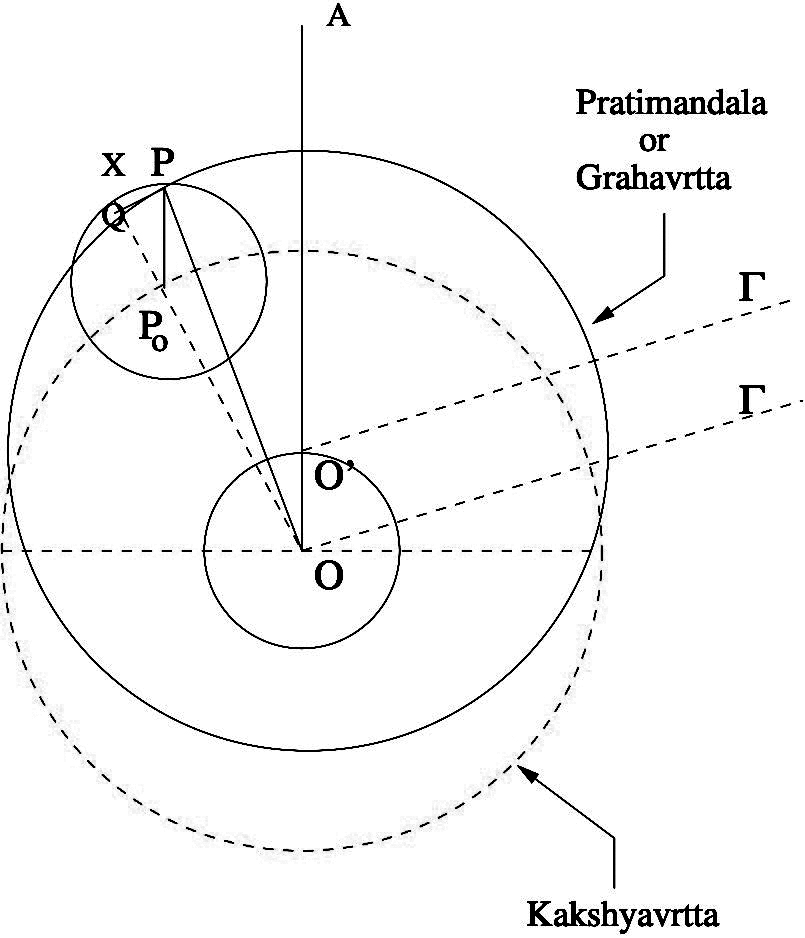
In an alternate picture called the `Eccentric circle model’, O' is a point at a distance of r from O, in the direction of OA. Then, the mandasphuṭa, P moves uniformly around O' at the same rate as P_0 around O in a circle of radius R (solid circle in the figure), known as the `pratimaṇdala‘ (eccentric circle), or the grahavṛtta. The motion of P around O would not be uniform. The two models are equivalent.
\[\begin{align*}
\mbox{Mean longitude of the planet,} \; \theta_0 &= \Gamma\hat{O}P_0 \\
&= \Gamma\hat{O’}P,\\
\mbox{Longitude of the apside} \ (mandocca), \; \theta_A &= \Gamma\hat{O}A,\\
\mbox{Mean anomaly}\ (mandakendra), \; M = A\hat{O}P_0 &= P \hat{P_O} Q\\ & =\theta_0 – \theta_A ,\\
\mbox{Mandasphuṭa,} \; \theta_{ms}&= \Gamma\hat{O}P.
\end{align*}\]K=OP is the distance between the planet (P) and the center of deferent circle (O) and called the `mandakarṇa‘. Draw PQ perpendicular to extended OP_0. Now PQ = PP_0 \sin(P\hat{P_O}Q) = r \sin M, P_0Q = PP_0 \cos(P\hat{P_O}Q) = r \cos M, OQ= OP_0 + P_0Q= R + r \cos M. Then,
\[\begin{align*}K = OP &= [OQ^2 + PQ^2]^{\frac{1}{2}}\\
&= \left[(R + r \cos M)^{2} + (r \sin M)^{2}\right]^{\frac{1}{2}}. \end{align*}\]The difference between the mean planet and the mandasphuṭa is P\hat{O}P_{0} = \theta_{0}-\theta_{ms}. Apart from the sign, this is the ‘equation of centre’. Now,\[\begin{align*}
PQ = OP \sin (P\hat{O}P_0) &= K \sin (\theta_{0}-\theta_{ms}) \\
&= PP_0 \sin (P\hat{P_0}Q) = r \sin (\theta_0 – \theta_A). \\
\mbox{So,} \;\; \sin (\theta_0 – \theta_{ms}) &= \frac{r}{K} \sin (\theta_0 – \theta_A).
\end{align*}\]
In most Indian texts, r is not a constant but varies such that \frac{r}{K} = \frac{r_0}{R}, where r_0 is a constant, and is the mean radius of the manda-epicycle, specified in the text for each planet. Then, \theta_{ms} - \theta_0 = - \sin^{-1} (\frac{r_0}{R} \times \sin(\theta_0 - \theta_A)). When \frac{r_0}{R} is small, the equation of centre, \theta_{ms} - \theta_0 is given by
\[ \theta_{ms} – \theta_0 \approx – \frac{r_0}{R} \sin (\theta_0 – \theta_A). \]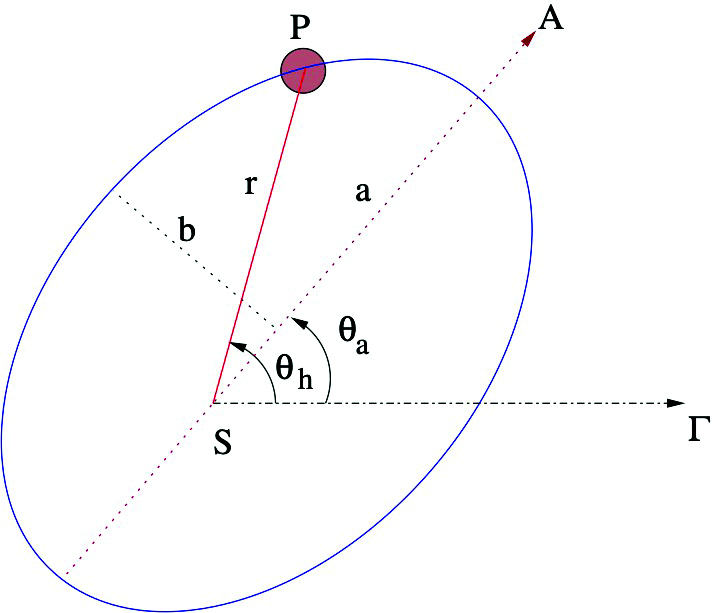
\[ \theta_{h} – \theta_0 \approx – 2e \sin (\theta_0 – \theta_a), \]where \theta_h is the longitude of the actual planet which is moving on the ellipse, \theta_0 is the mean planet, which moves at a uniform rate on the ellipse, \theta_a is the longitude of the apogee which is along the major axis of the ellipse, and e is the eccentricity of the ellipse. On the RHS (Right Hand Side) of the equation, we have included only the first-order term in eccentricity.
The expressions for the equation of centre in the Indian eccentric/epicycle model and the
Kepler’s model are identical, if we identify \theta_{ms}, \theta_A and \frac{r_0}{R} in the Indian model with \theta_h, \theta_a, and 2e respectively, in the Kepler model. So the non-uniform motion of the planet is described reasonably accurately in the ancient model, with the device of the epicycle or the eccentric cycle simulating the effect of an ellipse. Ptolemy’s model is more complicated, but it is also equivalent to Kepler’s model, to the first order in eccentricity.
\begin{center} Manda-corrected planet, \theta_{ms} = \theta_0 + (\theta_{ms} - \theta_0). \end{center}
This is the True longitude, or the `sphuṭagraha‘ for the Sun and essentially so also for the Moon (which has other corrections). For the actual planets (Mars, Mercury, Jupiter, Venus and Saturn), \theta_{ms} is the true heliocentric longitude (that is, the longitude as perceived at the Sun). In the traditional model, there was a problem with the interior planets, Mercury and Venus: the procedure for the application of the equation of centre to them was wrong. This was resolved by Nīlakaṇṭha Somayājī in 1500 CE in his Tantrasaṅgraha, where the procedure for obtaining the true heliocentric longitudes, \theta_{ms} of Mercury and Venus was correct.
Śīghra-saṃskāra for the planets: Conversion of the true heliocentric longitudes to geocentric longitudes
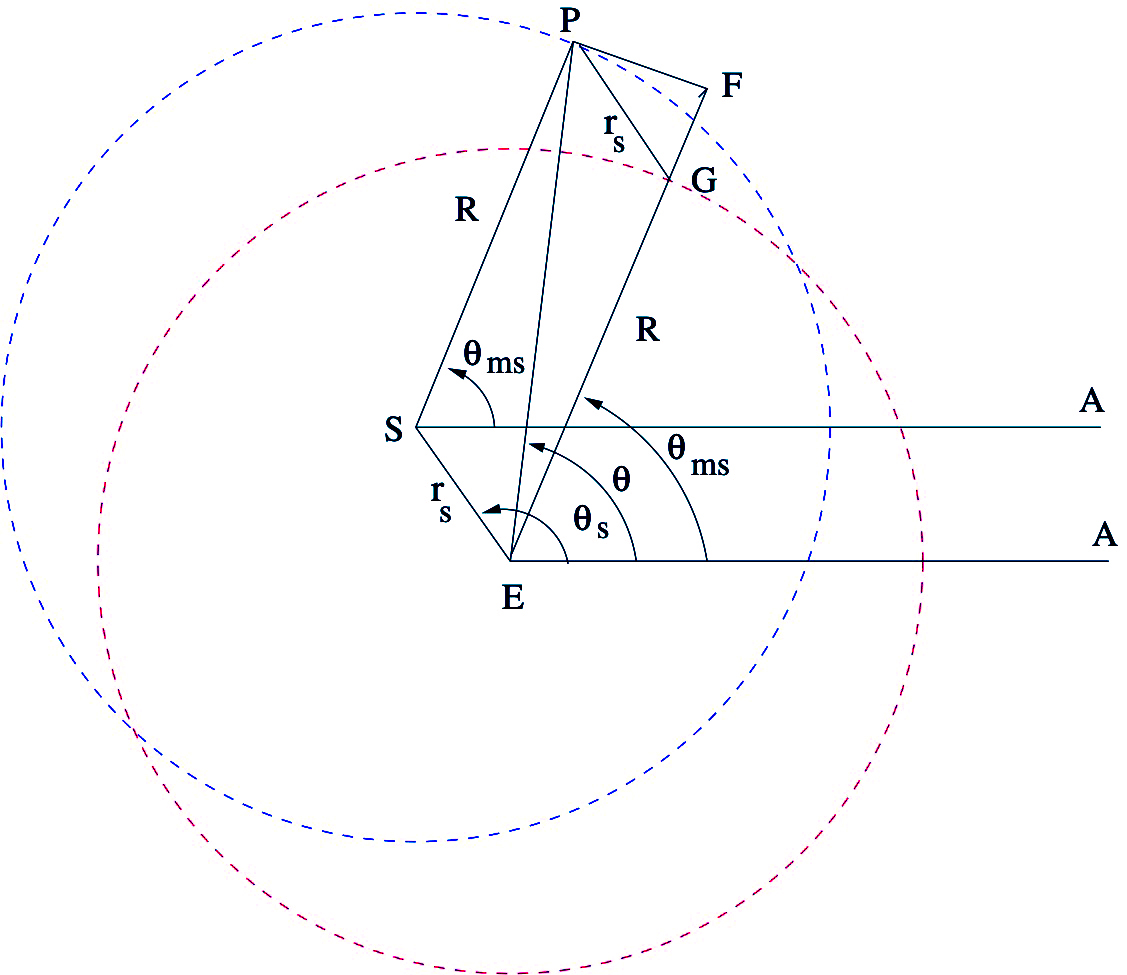
The `śīghrocca‘, S is located on this circle. It is actually the mean Sun. Its longitude is \theta_S = A \hat{E} S. The planet P is located on a circle of radius R with S as the centre, such that \theta_{MS}= A \hat{S} P is the mandasphuṭa, or the manda-corrected planet. It is essentially the true heliocentric longitude. \theta = A \hat{E} P is the geocentric longitude of the planet with respect to the earth, E. We have,
\[\begin{align*}
P\hat{G}F &= S\hat{E}G = \theta_S-\theta_{ms}, \\
P\hat{E}G &= \theta – \theta_{ms}, \\
PF &= PG \sin (P\hat{G}F) \\ &= r_s \sin (\theta_S-\theta_{ms}), \\
GF& = PG \cos (P\hat{G}F)=r_s \cos (\theta_S-\theta_{ms}),\\
EF &=EG +GF = R + r_s \cos (\theta_S-\theta_{ms}).
\end{align*}\]
EP is the distance between the planet and the Earth, called `Śīghra-karṇa‘. We have
\[\begin{align*}
EP &= [EF^2 + PF^2]^{\frac{1}{2}}\\
&=[(R+r_s \cos (\theta_{S} – \theta_{ms}))^2
+r_{s}^2 \sin^2 (\theta_S-\theta_{ms})]^{1/2}.\\
PF &= PG \sin (P\hat{G}F) \\
&= r_s \sin(\theta_S-\theta_{ms})\\
&= EP \sin (P\hat{E}G) \\
&= EP \sin (\theta – \theta_{ms}).\\
\mbox{So,} &\\
&\hskip-14pt \sin(\theta – \theta_{ms})
\\
& \hskip -14pt= \frac{\frac{r_s}{R} \sin( \theta_S – \theta_{ms})}{[(1 + \frac{r_s}{R} \cos(\theta_{ms}- \theta_S))^2 +
(\frac{r_s}{R}) ^2 \sin^2 (\theta_{ms} – \theta_S)]^{1/2}} .\end{align*}\]
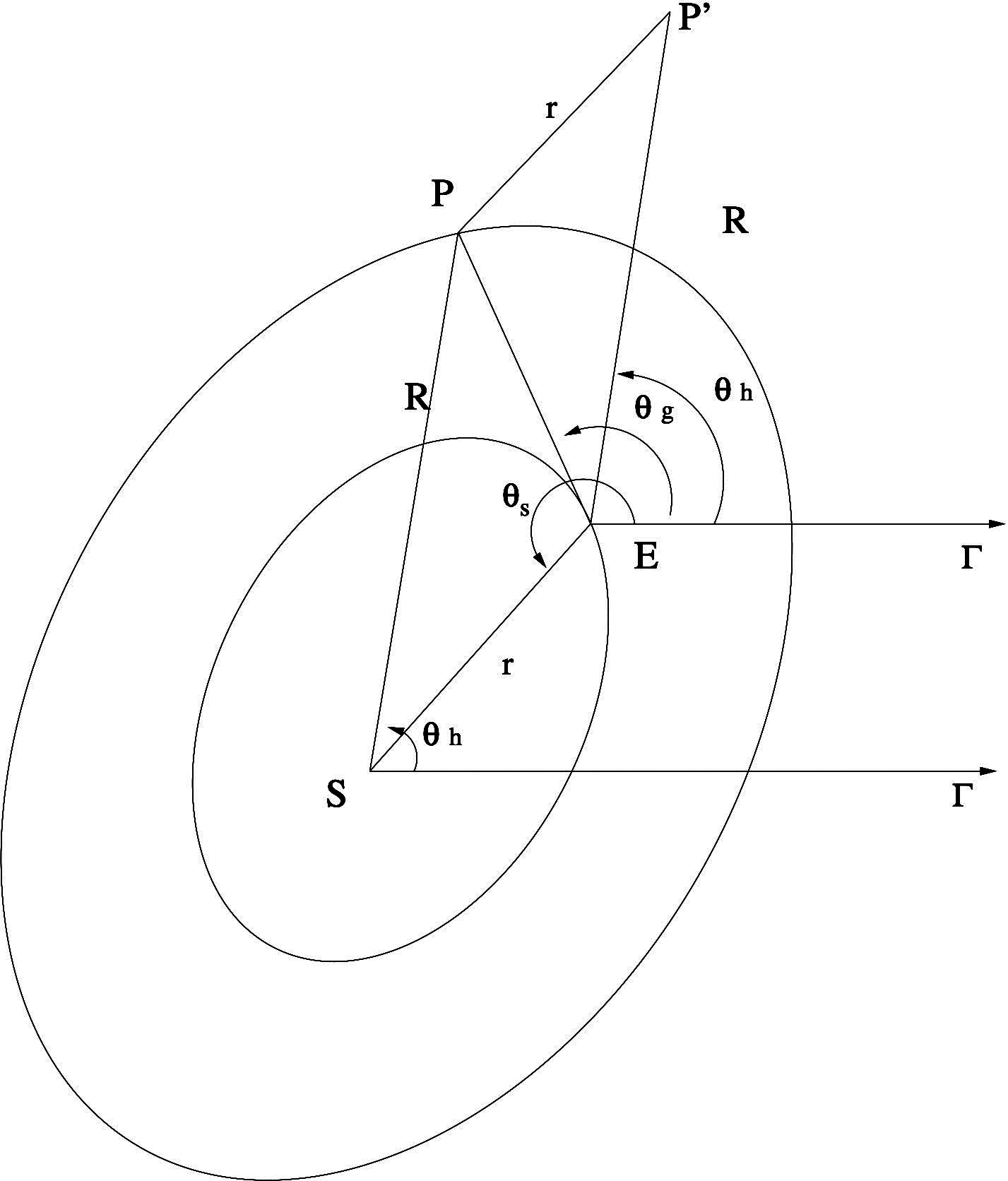
In the Kepler model, the geocentric longitude, \theta_g can be obtained from the following equation which can be derived easily from the diagram.
\[\begin{align*}
\sin(\theta_g – \theta_h)
&=
\frac{\frac{r}{R}\sin( \theta_S – \theta_h)}
{[(1+ \frac{r}{R} \cos(\theta_h – \theta_S))^2 + (\frac{r}{R})^2 \sin^2 (\theta_h – \theta_S)]^{1/2}} .\end{align*}\]
The formula for \theta in the Indian texts as given, is exactly the same as the formula for the geocentric longitude of the planet, \theta_g in the Keplerian model for an exterior planet, when the manda-sphuṭa in the former (\theta_{ms}) is identified with the true heliocentric longitude in the latter (\theta_h), and \frac{r_s}{R} in the former is identified with \frac{r}{R} in the latter. The identification of \theta_{ms} with \theta_h is clear enough, as \theta_{ms} is the heliocentric mean planet to which the correction due to eccentricity has been added. The śīghra-saṃskāra transforms the true heliocentric longitude into the geocentric longitude only if \frac{r_s}{R}, which is the ratio of the radii of the epicycle and the deferent circle in the Indian texts is equal to \frac{r}{R} in the Kepler model, which is the ratio of the Earth-Sun and planet-Sun distances in the model.
For the interior planets Mercury and Venus also, we can derive similar formulae in the Indian models and the Kepler model (after obtaining \theta_{ms} correctly, following Nīlakaṇṭha Somayājī). Here also, the formulae have identical structures, just as in the case of exterior planets. In this case, the planet-Sun distance is less than the Earth-Sun distance. Here also, the śīghra-saṃskāra transforms the true heliocentric longitude into the geocentric longitude if \frac{SP}{ES} has the same value in the Indian and Kepler models.
In Table 2, we compare the ratios of the relevant distances in Āryabhaṭīya with the modern values.
| Planet | Āryabhaṭīya value | Modern value |
| Mercury | 0.375 | 0.387 |
| Venus | 0.725 | 0.723 |
| Mars | 0.650 | 0.656 |
| Jupiter | 0.194 | 0.192 |
| Saturn | 0.106 | 0.105 |
Table 2: Comparison of \frac{r_s}{R} in Āryabhaṭīya for śīghra-saṃskāra with the modern values of the mean ratio of Earth-Sun (r) and Planet-Sun distance (R) for exterior planets and mean ratio of Planet-Sun (r) and Earth-Sun (R) distances for interior planets.
From the table, it is clear that there is very good agreement between the two sets. So, for planetary computations, Indian models are close to the Kepler model and give the same results as the modern methods, broadly.
Nīlakaṇṭha Somayājī’s quasi-heliocentric model
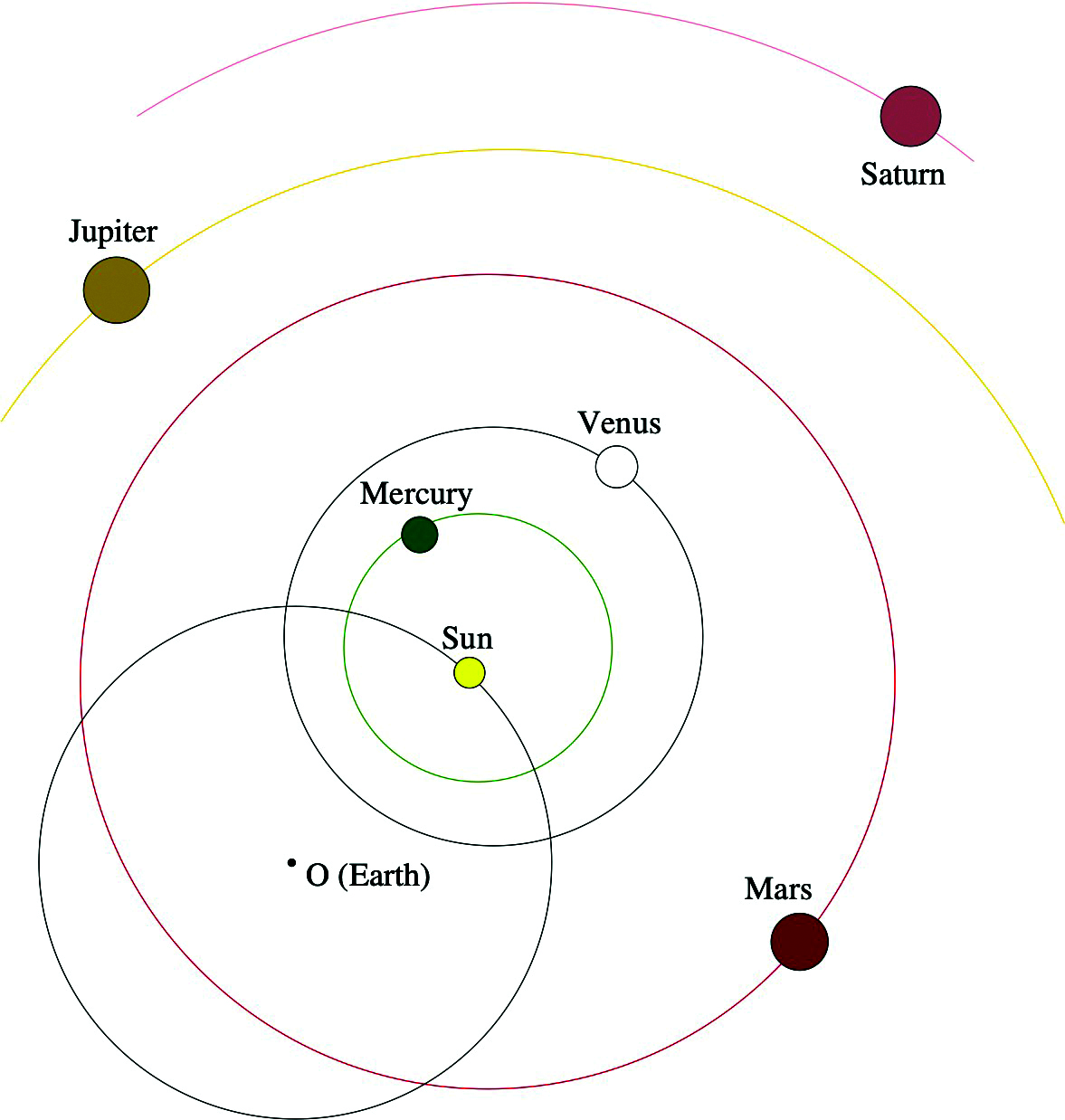
According to his model, depicted in Fig.11, the planets move in eccentric orbits around the Sun, which itself orbits around the Earth. This was before the famous heliocentric model of Copernicus in 1542 CE. The Copernican model had one defect: it did not have the correct procedure for the application of the `equation of centre’ to the interior planets. Nīlakaṇṭha formulated this correctly in his revised model. His model is essentially the same as Tycho Brahe’s model for planetary motion proposed around 1580 CE, where the planets move around the Sun, and the Sun orbits the Earth, though the two models were formulated in different contexts.
Indian astronomical literature: its rediscovery and study in the `modern’ period
In this section, we give a brief account of the work done on the Indian astronomical tradition (editions, translations and explanatory notes) from the nineteenth century onwards (`modern period’). For a comprehensive account of the scholarly work on Indian astronomy and mathematics as well as detailed references, the reader is directed to a recent article by M.D. Srinivas [59].
Work done up to 1902
The Vedāṅga Jyotiṣa of Lagadha, which is the earliest systematic Indian text on astronomy was translated into English by Jervis in 1832 [13], and into German, with notes by Albrecht Weber in 1862 [67]. Scholars would have noted that Sūryasiddhānta was a very popular treatise among the traditional jyotiṣis in the nineteenth century (and even now, for that matter), with all the relevant calculation procedures and some relevant theory. The available manuscripts are believed to be from the tenth century onwards. It is not surprising that it was the first siddhānta text to be translated with explanatory notes by Burgess in 1860 [3] and Bāpūdeva Śāstri in 1861 [41]. Bhāskarācārya’s astronomy and mathematics would have also been popular, and learnt in traditional centres of learning. Bhāskara himself had written a detailed commentary, Vāsanābhāṣya on both the parts of his magnum opus, Siddhāntaśiromaṇi, namely Grahagaṇitādhyāya (planetary computations) and Golādhyāya (Spherics). The two parts with the vāsanābhāṣya were edited by Bāpūdeva Śāstri in 1861 [42], and the Golādhyāya was translated by L. Wilkinson with notes by Wilkinson and Bāpūdeva Śāstri [68]. The pioneering text of Indian astronomy, the Āryabhaṭīya, along with the commentary Bhaṭadīpikā of the Kerala astronomer Parameśvara was published by H. Kern in 1874 [16].
We have already noted that there was a significant siddhānta tradition even before the Āryabhaṭīya, and five earlier siddhāntas were summarised in the Pañcasiddhāntikā of Varāhamihira. This text was edited and translated by G. Thibaut and Sudhakar Dvivedi in 1889 [65]. The Grahalāghava of Gaṇeśa Daivajña (c.1520) is an important text from the calculational point of view which can be used by almanac makers without the knowledge of trigonometry, as it uses an accurate approximation to the sine function (due to Āryabhaṭa/Bhāskara-I). This was translated into Marathi, Bengali and Hindi in the late eighteenth century. Cūḍāmaṇi Uḷḷamuḍaiyān of Tirukkoṭṭiyūr Nambi (c. 1234 CE) is a Tamil text in the `vākya‘ tradition of astronomy which was translated into English with notes by H.R. Hoisington in 1848 [10].
The two chapters on mathematics in Brahamgupta’s Brāhma-sphuṭa-siddhānta, namely Gaṇitādhyāya and Kuṭṭakādhyāya had been translated by T. Colebrooke in 1817. The whole text was edited by Sudhakar Dvivedi in 1902, with his (Dvivedi’s) own Sanskrit commentary in 1902 [9].
The publication of Siddhāntadarpaṇa of Sāmanta Candraśekhara Siṃha towards the end of the nineteenth century was a unique event in that it was an original siddhānta (perhaps the last great one in that tradition!) [31]. The work itself had been composed about 40 years earlier. There are many important modifications of planetary parameters and also a revised lunar theory, based on extensive observations using simple instruments designed by Siṃha himself, in this very detailed treatise with 2500 verses.
Bharatiya Jyotisha Sastra in two parts is a very significant and detailed historical account of Indian astronomy by Sankar Balakrishna Dikshit in Marathi, which was published in 1892, and translated later into English in 1969 by R.V. Vaidya (cf. [6],[7]). The first part is on the Vedic and Vedāṅga periods, and the second part is on the siddhāntic and modern periods. The author has been meticulous in studying a vast range of manuscripts and other sources, and has also strived to make this comprehensive work as non-technical as possible. It discusses many controversies at the time of its writing in detail, and the conclusions are the results of in-depth scholarship and sound reasoning.
In the early stages, the western scholars worked on the subject with the help of pundits, who then worked independently. This was a period of rediscovery. Initially, the western scholars viewed the Indian tradition (in all the sciences and technologies, for that matter) with awe and admiration. Later, it transformed into denigration of the Indian traditions for reasons which are beyond the scope of this article.7
Work on Indian astronomy from 1902 up to the present times
After the nineteenth century, a significant number of Indian astronomy works have been edited or translated. The Vedāṅga Jyotiṣa of Lagadha was translated into English by T.S. Kuppanna Sastry and K.V. Sarma [45] and also by others. This text has also been translated into Marathi, Bengali, Hindi and Kannada. We have already noted the significance of Pañcasiddhāntikā in throwing light on the siddhāntas before Āryabhaṭīya. The topics on trigonometry in the text, planetary models, relation between the time and the shadow, discussion on instruments etc. in the Saura-siddhānta of the text are quite valuable. The text was translated into English by O. Neugebauer and D. Pingree [19] and also by T.S. Kuppanna Sastri and K.V. Sarma [46].
Though the Bṛhatsaṃhitā of Varāhamihira is mainly on astrology and omens, it has plenty of information on other topics, including astronomy-proper. In particular, the quoted verses ascribed to Parāśara and Garga pertain to the Vedāṅga period. R.N. Iyengar has reconstructed a Parāśaratantra based on the verses ascribed to Parāśara [11]. This gives valuable information on the motions of the planets in the stellar background and the various time-cycles associated with them. Iyengar has also discussed astronomical concepts including precession of equinoxes, eclipse cycles, comets etc. in Vedic and post-Vedic literature in an article published in 2016 [12].
The Āryabhaṭīya with English translation and notes by K.S. Shukla and K.V. Sarma gives a lucid account of the contents of the text, as well as the literature on it [55]. It is significant that Āryabhaṭīya has also been translated into Telugu, Marathi, Hindi, Kannada, Malayalam, German, French (Gaṇitapāda part) and Japanese over the course of the twentieth century and beyond. The Āryabhaṭīya with the commentary of Bhāskara-I and Someśvara has also been edited by K.S. Shukla [56]. The Mahābhāskarīya and Laghubhāskarīya of Bhāskara-I, Laghumānasa of Mañjula, and Vaṭesvarasiddhānta with the Gola have also been edited and translated by K.S. Shukla ([53], [54], [57], [58]).
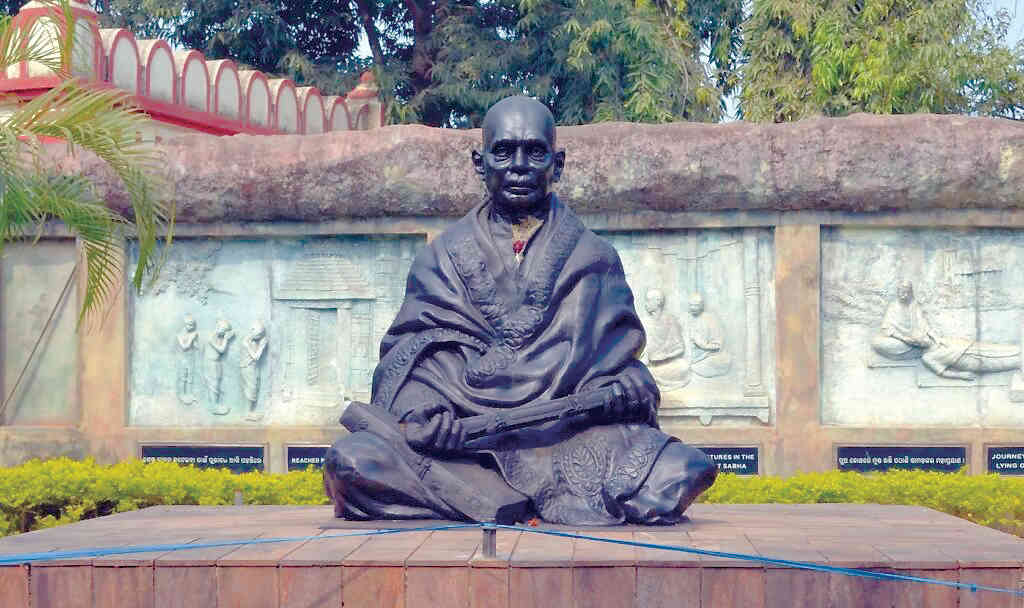
The Śiṣyadhīvṛddhida by Lalla (eighth to ninth century) is a text mainly in the Āryabhaṭan tradition which was very popular for many centuries after its composition. This was translated with the commentary of Mallikarjuna Suri by Bina Chatterjee [5]. Siddhāntaśekhara of Śrīpati (eleventh century) is another important text which influenced Bhāskarācārya among others. Babuāji Miśra has edited this text (excepting chapters 11 and 12) in two parts; part 1, with the commentary of Makkhibhaṭṭa for the first four chapters and a commentary by himself (Miśra) for chapters 4–10 and, in part 2, a commentary by himself for chapters 13–20 [17]. It has also been published with a Hindi commentary and explanatory notes by Satyadev Sharma [52]. Bhāsvati of Śatānanda is an important karaṇa text which has been edited and supplemented with Sanskrit and Hindi commentaries by Matruprasad Pandeya and Acharya Ram Janma Mishra [22].
There have been several publications on the Siddhāntaśiromaṇi of Bhāskarācārya (either of the two parts or both of them), with editions including commentaries by Nṛsiṃha Daivajña, Munīśvara and by Bhāskara himself; and translations into Hindi, Bengali, Marathi, Latin, and English with notes. Notable among them are the English translation of the Grahagaṇitādhyāya with notes by Arkasomayaji [1], and the Hindi translation of both the parts by Kedar Datta Joshi with a commentary in Sanskrit apart from the commentary of Munīśvara, and notes ([14], [15]). Very recently, M.S. Sriram, Sita Sundar Ram and Venketeswara Pai have translated the Grahagaṇitādhyāya with the Vāsanābhāṣya of Bhāskara, with the explanatory notes based on the bhāṣya [62]. This is very significant, as one can clearly comprehend the computational procedures, various approximations, derivations, demonstrations, and the scientific nature of Bhāskara’s work only if one goes through the Vāsanābhāṣya also, apart from the verses. Bhāskara’s karaṇa text, Karaṇakutūhala has simplified computational procedures, and many innovations, and has been been translated with notes by S. Balachandra Rao and S.K. Uma [29]. Clemency Montelle and Kim Plofker have translated the texts Karaṇakesarī of a later Bhāskara, and Brahmatulyasāraṇī of Malūkacandra (both of seventeenth century) with notes, and explored the relations between these texts and Siddhāntaśiromaṇi [18]. The Siddhānta-tattva-viveka of Kamalākara, an elaborate treatise which incorporates elements of Ptolemy’s system has been edited by K.C. Dvivedi [8]. Siddhānta-darpaṇa of Chandraśekhara Sāmanta has been translated into English and Hindi by Arun Upadhyaya [66].
We have referred to the distinctive school of astronomy and mathematics that developed in Kerala during the fourteenth to nineteenth centuries, earlier. K.V. Sarma played a major role in locating the manuscripts related to this school, editing and publishing them, with translations and explanatory notes also in some cases. Some of the major source-works (not necessarily in the chronological order of the publication year) brought out by him are: Sphuṭacandrāpti and Veṇvāroha of Mādhava, Goladīpikā, Dṛggaṇita, Grahaṇamaṇḍana and Grahaṇanyāyadīpikā of Parameśvara, Tantrasaṅgraha, Candracchāyāgaṇita, Golasāra, Siddhāntadarpaṇa, Grahasphuṭānayane vikṣepavāsānā (in a work Gaṇitayuktayaḥ) and Jyotirmīmāṃsa of Nīlakaṇṭha Somayājī, Gaṇitayuktibhāṣā of Jyeṣṭhadeva, Sphuṭanirṇayatantra and Rāśigolasphuṭanīti of Acyuta Piśāraṭi, and others.8 K.V. Sarma has also written a comprehensive history of the Kerala school of astronomy [34]. Gaṇitayuktibhāṣā9 (in two volumes on mathematics and astronomy) has been edited and translated by K.V. Sarma with detailed explanatory notes by K. Ramasubramanian, M.D. Srinivas and M.S. Sriram [40]. Tantrasaṅgraha has been translated with explanatory notes by K. Ramasubramanian and M.S. Sriram [26]. Some other significant Kerala-related publications are: Āryabhaṭīya of Āryabhaṭācārya with the Mahābhāṣya of Nīlakaṇṭha Somasutvan in three parts by Sāmbaśiva Śāstri and Śūranād Kuñjan Pillai ([43], [23]). Karaṇapaddhati of Putumana Somayājī edited by K. Sāmbaśiva Śāstri with explanatory notes in Malayalam by P.K. Koru, Karaṇāmṛta of Citrabhānu by Narayanan Nambudiri, Sadratnamālā of Śaṅkaravarman with translation and notes by S. Madhavan, and Karaṇottama of Acyuta Piṣāraṭi by Raghavan Pillai have also been brought out.10 Karaṇapaddhati of Putumana Soamayājī has been translated into English with detailed mathematical notes by Venketeswara R. Pai, K. Ramasubramanian, M.S. Sriram and M.D. Srinivas [21].
There was a need for a source book which would present the basic concepts of Indian astronomy and their evolution, methods of observation etc. with passages from the important texts and commentaries. Indian Astronomy – A Source-book compiled by B.V. Subbarayappa and K.V. Sarma, and published in 1985, fulfilled such a need [63]. We will discuss this important source-book in a little more detail in the next section. Subbarayappa has also written a general book on Indian astronomy, namely, `The tradition of astronomy in India: Jyotiḥśśāstra‘ (2008) [64].
There have been various edited volumes on Indian astronomy (sometimes on Indian sciences with chapters on astronomy) containing articles on specific aspects or the texts and presenting different points of view. Some of these are: A Concise history of Science in India by D.M. Bose, S.N. Sen and B.V. Subbarayappa [2], A History of Indian astronomy, edited by S.N. Sen and K.S. Shukla [48], 500 years of \textit{Tantrasaṅgraha: A landmark in the history of astronomy} by M.S. Sriram, K. Ramasubramanian and M.D. Srinivas [60], History of Indian astronomy – A handbook edited by K. Ramasubramanian, Aniket Sule and Mayank Vahia [27], and Bhāskara-prabhā, edited by K. Ramasubramanian, T. Hayashi and Clemency Montelle [28].
The Indian Journal of History of Science is being published by the Indian National Science Academy for more than 55 years. A significant number of articles in this journal are in the area of traditional Indian astronomy and mathematics, and bring to light its unknown or partially understood aspects. Gaṇita Bhāratī, which is the bulletin of the Indian Society for History of Mathematics, is devoted to the history of mathematics in general, where Indian mathematics and astronomy constitute a major part. It has been running for over 45 years.
There have been surveys of manuscripts and source-works on Indian sciences in general, and Indian mathematics and astronomy in particular. Prominent among them is the Census of exact sciences in Sanskrit by D. Pingree. Five volumes of them have come out [24]. According to Pingree, there are 100,000 manuscripts on jyotiśśāstra out of which 30,000 are on Indian astronomy and mathematics associated with around 9000 source-works of the subject ([24], [59]). Apart from the above census, there is a A bibliography of Sanskrit works on astronomy and mathematics by S.N. Sen, A.K. Bag and S.R. Sarma [47], and Science texts in Sanskrit in the manuscript repositories of Kerala and Tamil Nadu by K.V. Sarma (2002) [38].
`Indian Astronomy: A Source-book’ compiled by B.V. Subbarayappa and K.V. Sarma
The preface to the book published in 1985 [63] describes the objectives of their work clearly. We summarise these in their own words in the following:
For quite some time, however, a need for a source-book has been felt not only by those interested in traditional Indian astronomy but, more important, by a number of modern astronomers in order to have a scientific insight into the main characteristics of Indian astronomy, the methodologies developed, instruments used, the manner of documentation of astronomical data and the like, authentically in original source-forms. Most of these scholars have been finding it difficult to get at desired sources and to understand them, partly because of their inadequate or limited linguistic expertise and partly because of the fact that such sources are not easily available to them in one place, and when desired.
The present compilation: Indian Astronomy: A Source-book, is aimed at providing, as far as possible, the important sources, mainly based on Sanskrit works, with their translations in English, and with the necessary notes and references. […]
After going through a large number of sources, we have selected about three thousand verses for inclusion in this volume.
About 3000 verses from about 90 source-works on astronomy have been used in this volume. These pertain to texts like Taittirīya Saṃhitā of the Vedic period, right down to Sadratnamālā, an important work of the Kerala school in the early nineteenth century. The quoted verses have been translated by various scholars who have published these source works. In cases where translations were not available, K.V. Sarma himself has translated the verses. The selected verses have been classified under five major divisions: I. General ideas and concepts, II. Astronomical instruments, III. Computations, IV. Occultations, and V. Innovative trends, each divided into several sections, subsections and topics.
In the first chapter, we have an overview of astronomy including their general contents, the methodology of revision adopted by astronomers, their expected qualifications, cosmogony, views and concepts related to the Earth, Sun, Moon and the planets, how unscientific views were refuted, decimal place-value system, kaṭapayādi notation, general time measures, the yuga system, various eras, namely, Kali, Śaka, Vikrama-saṃvat, Kollam and Jovian, sine-tables and computation of sines, and other topics.
The second chapter deals with the armillary sphere, various instruments described in the texts like yamyottara, nāḍīmaṇḍala, cakra, digaṃṣa, sāmrāṭ yantras etc. associated with observatories, and also other instruments like shadow and water instruments, clepsydra, bhagaṇa, nalaka, phalaka yantras, etc. and methods of observation.
The third chapter is a long one, dealing with computations of various kinds associated with the calendar, stars and asterisms, planets, precession of equinoxes, and the gnomonic shadow. It includes the mean and true motions of planets, various corrections to obtain the true positions of planets at any instant, and the versatility of the gnomon from the shadow of which, the time at any instant, the latitude of a location, the declination and longitude of the Sun can be measured.
The fourth chapter on occultations deals with eclipses, phases of the Moon, heliacal rising and setting of planets, conjunctions of planets, and conjunctions of stars and planets. Predictably, the section on eclipses is detailed and describes the historical evolution of the descriptions and computations of eclipses from the Vedic times up to the late medieval period.
The fifth chapter on innovative trends has two sections on novel innovations and rationales of astronomy. In the section on novel innovations, relatively advanced computations pertaining to the eclipses and conjunctions are described. The section on the rationales of astronomy is a unique one in this book. It describes the computations of the longitudes of the Sun, Moon and the planets in some texts (mainly, Śiṣyadhīvṛddhida of Lalla) in detail, and derives the expressions for them using diagrams.
We give a few examples of the quoted verses in this source-book. In the Śiṣyadhīvṛddhida of Lalla, we have the following verse for finding the declination of the Sun at any time using the shadow of a gnomon at that time, whose translation is given below ([63], p.187):
The explanation of this is given in the edited and translated work on Śiṣyadhīvṛddhida, from which this verse is taken [5].
Again, the following verse in Āryabhaṭīya gives the procedure for finding the half-duration of an eclipse ([63], p.200):
This procedure has a problem. Actually one should know the Moon’s latitude at the beginning of the eclipse, which is to be found! Later texts give an iterative procedure to find the half-duration. The approximate half-duration is found first using the Moon’s latitude at the middle of the eclipse (which is determined earlier). Then the approximate beginning of the eclipse is found using the procedure in the text, and the Moon’s latitude is computed at this instant. The half-duration is now found in the next approximation. Again, the latitude is found at the new value of the beginning and the process is repeated till the successive values converge. This is described in a quoted verse from Laghubhāskarīya in the source book ([63], p.204):
In general, one has to go to the publication from which the verse is quoted to understand it. That is of course understandable. If one wants to know what the Indian astronomical tradition has to say about any astronomical fact or computations, one can look up the relevant section in this source-book and find out what any text says about that aspect. Obviously, one has to go to the particular texts to understand the quoted verses.
There is a select bibliography of over 300 important texts on Indian astronomy and also a general bibliography, both of which are very useful. There is also a glossary of technical terms and also an appendix on the bhūtasaṅkhyā (word-numeral) notation.
Scholars would surely find this source-book very useful. Additionally, even an educated lay person with a little familiarity with Indian astronomy would also be able to use this book profitably.
There is a need to update this source-book. During the 40 years after its publication, several important texts have been edited, with many of them translated with explanatory notes too. Important verses from these texts need to be incorporated. Also, the organization of the topics can be improved, as one gets a feeling that it is a little haphazard currently. The Indian sines are introduced in section 7 on measures of time, various eras and other measures, and again in the last section. The sines deserved a separate section as they play an important role in most computations. \blacksquare
References
- [1] Arkasomayaji, Siddhāntaśiromaṇi of Bhāskarācārya-II, Grahagaṇitādhyāya, Revised second edition, Rashtriya Sanskrit Vidyapeetha, Tirupati, 2000.
- [2] Bose, D.M., Sen, S.N. and Subbarayappa, B.V., A Concise History of Science in India, Second edition, Universities Press, Hyderabad, 2009.
- [3] Burgess, E., Sūryasiddhānta, A Text Book of Hindu Astronomy,
- [4] Chatterjee, Bina, Khaṇḍakhādyaka of Brahmagupta with the commentary of Bhaṭṭotpala, ed. and tr. with notes, 2 vols., Indian National Science Academy, New Delhi, 1970.
- [5] Chatterjee, Bina, Śiṣyadhīvṛddhida Tantra of Lalla with the commentary of Mallikārjuna Sūri, ed. and tr. with notes, 2 vols., Indian National Science Academy, New Delhi, 1981.
- [6] Dikshit, Sankar Balakrishna, Bharatiya Jyotish Sastra (History of Indian Astronomy) original in Marathi, translated into English by R.V. Vaidya, Part-I Vedic and Vedanga periods, Govt. of India, Manager of Publications, Delhi, 1969.
- [7] Dikshit, Sankar Balakrishna, Bharatiya Jyotish Sastra (History of Indian Astronomy) original in Marathi, translated into English by R.V. Vaidya, Part-II Siddhantic and Modern periods, Govt. of India, Manager of Publications, Delhi, 1982.
- [8] Dvivedi, Krishna Candra, Siddhāntatattvaviveka of Śri Kamalākara Bhatta with the Vāsanābhāṣya of Śri Gangādhara Śarma , ed. in three parts, Sampurnanand Sanskrit University, Varanasi, 1993, 1997, 1998.
- [9] Dvivedi, Sudhakara, Brāhma-sphuṭa-siddhānta of Brahmagupta ed. with his own (Dvivedi’s) commentary, Benares, 1902.
- [10] Hoisington, H.R., Jotisāttiram: The Oriental Astronomer, American Mission Press, Jaffna, 1848.
- [11] Iyengar, R.N., Parāśaratantra, Ramanagara: Jain University Press, 2013.
- [12] Iyengar, R.N., Astronomy in Vedic texts in `History of Indian Astronomy – A Handbook‘, eds. Ramasubramanian, K., Sule, Aniket and Vahia, Mayank, SandHI, IIT Bombay and TIFR, Mumbai, 2016.
- [13] Jervis, Captain H., Lagadha Jyotisha (Ṛg Vedāṅga Jyotiṣa only), ed., at the end of his Indian Metrology, 1834.
- [14] Joshi, Kedara Datta, Siddhāntaśiromaṇi of Bhāskarācārya: Grahagaṇitādhyāya, with Vāsanābhāṣya, Mārīci of Munīśvara, Dīpikā in Sanskrit, Śikhā in Hindi and explanations in Hindi, from spaṣṭa to pāta adhikāras in two volumes, Benares Hindu University, Varanasi, 1964.
- [15] Joshi, Kedara Datta, Siddhāntaśiromaṇi of Bhāskarācārya: Golādhyāya with Vāsanābhāṣya, Mārīci of Munīśvara and Hindi commentary, Motilal Banarsidass, Varanasi, 1988.
- [16] Kern, B., Āryabhaṭīya of Āryabhaṭa with the commentary Bhaṭadīpikā of Parameśvara, ed., Leiden, 1874; repr. 1906, 1973.
- [17] Miśra, Babuāji (Śrīkṛṣṇa), Siddhāntaśekhara of Śrīpati, ed. part 1, chapter 1–10, University of Calcutta, 1932; part 2, chapter 13–20, University of Calcutta, 1947.
- [18] Montelle, Clemency and Plofker, Kim, Karaṇakesarī of Bhāskara: a 17th century table text for computing eclipses, History of Science in South Asia, 2, 1–62, 2014.
- [19] Neugebauer, O. and Pingree, D., Pañcasiddhāntikā of Varāhamihira, Part 1, Text and Translation, Part 2, Commentary, Copenhagen, 1970, 1971.
- [20] Ohashi, Y., ‘Development of Astronomical Observations in Vedic and Post-Vedic India’, Indian Journal of History of Science, 28.3, pp.185–251, 1993.
- [21] Pai, Venketeswara R., Ramasubramanian, K., Sriram, M.S. and Srinivas, M.D.,
- [22] Pandeya, Matruprasada and Mishra, Acharya Ramajanma, Bhāsvati of Śrī Śatānanda, with ed. with Sanskrit and Hindi commentaries, and notes, Chowkhambha Sanskrit Sansthan, Varanasi, 1985.
- [23] Pillai, Suranad Kunjan, Āryabhaṭīya of Āryabhaṭācārya with the Mahābhāṣya of Nīlakaṇṭha Somasutvan, Part III, Golapāda, no. 185, Trivandrum Sanskrit Series, Trivandrum, 1957.
- [24] Pingree D., Census of Exact Sciences in Sanskrit, Series A, volumes I-V, American Philosophical Society, Philadelphia, 1970, 1971, 1976, 1981 and 1994.
- [25] Ramasubramanian, K., Srinivas, M.D. and Sriram, M.S., Modification of the earlier Indian planetary theory by the Kerala astronomers (c. 1500 AD) and the implied heliocentric picture of the planetary motion, Current Science, 66, 784–790, 1994.
- [26] Ramasubramanian, K. and Sriram, M.S., Tantrasaṅgraha of Nīlakaṇṭha Somayājī, Translation with mathematical notes, Hindustan Book Agency, Delhi, 2011; revised edition 2025; Springer, London, 2011.
- [27] Ramasubramanian, K., Sule, Aniket and Vahia, Mayank (eds), History of Indian Astronomy – A Handbook, eds. IIT Bombay and TIFR, Mumbai, 2016.
- [28] Ramasubramanian K., Hayashi Takao and Montelle Clemency (eds), Bhāskara-prabhā, Hindustan Book Agency, New Delhi, 2019.
- [29] Rao, Balachandra and Uma, S.K., Karaṇakutūhala of Bhāskarācārya-II. tr. with notes, Indian Nationsl Science Academy, New Delhi, 2008.
- [30] Rao, Balachandra and Uma, S.K., Grahalāghavaṃ of Gaṇeśa Daivajña. tr. with notes, Indian National Science Academy, New Delhi, 2006.
- [31] Ray, Joges Candra, Siddhāntadarpaṇa of Sāmanta Candraśekhara Siṃha, ed. with an introduction, Indian Depository, Calcutta, 1897.
- [32] Sarma, K.V., Veṇvāroha of Mādhava with a Malayalam commentary of Acyuta Piṣāraṭi, Sanskrit College, Tripunithura, 1956.
- [33] Sarma, K.V., Dṛggaṇita of Parameśvara, Hoshiarpur, 1963.
- [34] Sarma K.V., A History of the Kerala School of Astronomy, Hoshiarpur, 1972.
- [35] Sarma, K.V., Sphuṭacandrāpti of Mādhava, tr. with notes, Hoshiarpur, 1973.
- [36] Sarma, K.V., Tantrasaṅgraha of Nīlakaṇṭha Somayājī,ed. with Yukti-dīpikā (for chapters I-IV) and Laghuvivṛti of Śaṅkara Variyar, Hoshiarpur, 1977.
- [37] Sarma, K.V., `Observational astronomy in India‘, Department of Sanskrit, University of Calicut, 1990.
- [38] Sarma K.V., Science Texts in Sanskrit in the Manuscript Repositories of Kerala and Tamil Nadu, Rashtriya Sanskrit sansthan, New Delhi, 2002.
- [39] Sarma, K.V., `Indian Astronomy in the Vedic Age’, in Facets of Indian astronomy‘, Ed. by Siniruddha Dash, Rashtriya Sanskrit University, Tirupati, pp.33–56, 2009.
- [40] Sarma, K.V., Ramasubramanian, K., Srinivas, M.D. and Sriram, M.S., Gaṇita-yuktibhāṣā of Jyeṣṭhadeva, ed. with tr. and notes, Vol.1. Mathematics, Vol.2. Astronomy, Hindustan Book Agency, New Delhi, 2008, 2009; repr. Springer 2009.
- [41] Sastri, Bapu Deva, Sūryasiddhānta, ed. and translation, Calcutta, 1861.
- [42] Sastri, Bapu Deva, Siddhāntaśiromaṇi of Bhāskarācārya with his Vāsanābhāṣya, ed., Calcutta 1861; revised by Ganapati Sastri, fourth edition, Chaukhambha Sanskrit Sansthan, Varanasi, 2005.
- [43] Sastri, Sambasiva, Āryabhaṭīya of Āryabhaṭācārya with the Mahābhāṣya of Nīlakaṇṭha Somasutvan, Part I, Gaṇitapāda, no. 101, 1930; Part II, Kālakriyāpāda, no. 110, 1931, Trivandrum Sanskrit Series, Trivandrum.
- [44] Sastry, T.S. Kuppanna, Siddhāntadīpikā on Mahābhāskarīyabhāṣya of Govindasvāmi by Parameśvara, Govt. Oriental Manuscripts Library, Madras, 1957.
- [45] Sastry, T.S. Kuppanna and Sarma, K.V., Vedāṅga Jyotiṣa of Lagadha, Ed. with translation and notes, Indian National Science Academy, New Delhi, 1985.
- [46] Sastry, T.S. Kuppana and Sarma, K.V., Pañcasiddhāntikā of Varāhamihira, ed. with translation and notes, PPST Foundation, Chennai, 1993.
- [47] Sen, S.N., Bag, A.K. and Sarma, S.R., A Bibliography of Sanskrit Works on Astronomy and Mathematics, National Institute of Sciences India, Delhi, 1966.
- [48] Sen, S.N. and Shukla, K.S. (eds), History of Indian Astronomy, Indian National Science Academy, New Delhi, 1985.
- [49] Sengupta, P.C., Khaṇḍakhādyaka of Brahmagupta ed. with tr. and notes, University of Calcutta, 1934.
- [50] Sengupta, P.C., Ancient Indian Chronology, University of Calcutta, 1947.
- [51] Sharma, Ram Swarup, Brāhma-sphuṭa-siddhānta of Brahmagupta, ed. with the Vāsanā of Pṛthūdakasvāmin, 4 vols., New Delhi, 1966.
- [52] Sharma, Satyadeva, Siddhāntaśekhara of Bhaṭṭa Śrīpati, with a Hindi commentary `Bṛhaspati‘ and explanatory notes, Chowkhambha Krishnadas academy, Varanasi, 2015.
- [53] Shukla, K.S., Mahābhāskarīya of Bhāskara-I, ed. with tr. and notes, Lucknow, 1960.
- [54] Shukla, K.S., Laghubhāskarīya of Bhāskara-I, ed. with tr. and notes, Lucknow, 1963.
- [55] Shukla, K.S. and Sarma, K.V., Āryabhaṭīya, ed. with translation and notes, Indian National Science Academy, New Delhi, 1976.
- [56] Shukla, K.S., Āryabhaṭīya of Āryabhaṭa with the commentary of Bhāskara-I and Someśvara, Ed., Indian National Science Academy, New Delhi, 1976.
- [57] Shukla, K.S., Vaṭeśvarasiddhānta and Gola of Vaṭeśvara, ed. and tr., 2 vols., Indian National Science Academy, New Delhi, 1985, 1986.
- [58] Shukla, K.S., Laghumānasa of Mañjula, ed. with tr. and notes, Indian National Science Academy, New Delhi, 1990.
- [59] Srinivas, M.D., The Untapped Wealth of Manuscripts on Indian Astronomy and Mathematics, Indian Journal of History of Science, 54.3, pp.243–268, 2019.
- [60] Sriram, M.S., Ramasubramanian, K. and Srinivas, M.D. (eds), 500 Years of Tantrasangraha: A Landmark in the History of Astronomy, Indian Institute of Advanced Studies, Shimla, 2002.
- [61] Sriram, M.S., Srinivas, M.D. and Ramasubramanian, K., The traditional Indian planetary model and its revision by Nīlakaṇṭha Somayājī in
- [62] Sriram, M.S., Sita, Sundar Ram., Pai, R. Venketeswara, Bhāskarācārya’s Siddhāntaśiromaṇi – Grahagaṇita with the Vāsanābhāṣya, tr. with explanatory notes, 2 vols., Hindustan Book Agency, New Delhi, 2025.
- [63] Subbarayappa, B.V. and Sarma K.V., Indian Astronomy: A Source-Book, Nehru Centre, Bombay, 1985.
- [64] Subbarayappa, B.V., The Tradition of Astronomy in India: Jyotiśśāstra, PHISPC vol. IV, part 4, Centre for Studies in Civilizations, New Delhi, 2008.
- [65] Thibaut, G. and Dvivedi, Sudhakara, Pañcasiddhāntikā of Varāhamihira, ed. and tr. with notes, Varanasi, 1889.
- [66] Upadhayay, Arun Kumar, Siddhānta-darpaṇa of Sāmanta Candraśekhara Siṃha, Part 1: tr. into Hindi, Part 2: tr. into English with explanatory notes, Nag Publishers, Delhi, 1996 and 1998.
- [67] Weber, von A., Über den Veda-kalendar, namens Jyotisam (text in Roman of Yājusa-Jyotoiṣa with Somākara’s commentary), German tr. and notes, Abh der Konig. Akademie der Wiss zu Berlin, 1862.
- [68] Wilkinson L, Golādhyāya of Siddhāntaśiromaṇi, revised by Bapu Deva Sastri, Calcutta, 1861.
tr. into English, American Oriental Society, New Haven, 1860; repr. with ed. by
Phanindranath Gangooly and an Introduction by P.C. Sengupta, Motilal Banarasidass, Delhi, 2000.
Karaṇapaddhati of Putumana Somayājī, Hindustan Book Agency, New Delhi, and Springer, 2017.
History of Indian Astronomy – A Handbook ed. by Ramasubramanian, K.,, Sule, Aniket and Vahia, Mayank, SandHI, IIT Bombay and TIFR, Mumbai, pp. 308–348, 2016.
Footnotes
- Many of the verses in the two versions have different words but have the same meaning. When we quote such a verse, we give the Yajurvedic version. ↩
- This is the time taken by the Sun to complete one full revolution along the ecliptic (360^\circ), in contrast with the tropical year which is the time interval corresponding to successive transits of the Sun across the vernal equinox, which has a tiny westward motion. ↩
- See for instance, the suggestion of T.S. Kuppanna Sastry in ([45], p.17). ↩
- It is the time interval during which the angular separation between the Moon and the Sun, as observed from the Earth, increases by 12^\circ. ↩
- As a reference, the latitude of Delhi is about 28.7^\circ North. ↩
- In ancient India, as elsewhere, the Sun and the Moon were also considered as planets, apart from the actual planets, Mercury, Venus, Mars, Jupiter and Saturn. ↩
- Admiration of the Indian sciences would not likely have served the imperial project!. ↩
- The publication details of these can be found in references [26], [59], and [62]. ↩
- The mathematics part of this work had been edited with notes in Malayalam by Ramavarma maru Tampuran and A.R. Akileswara Aiyar in 1948. See [40] for the reference. ↩
- The publication details of these can be found in reference [62]. ↩