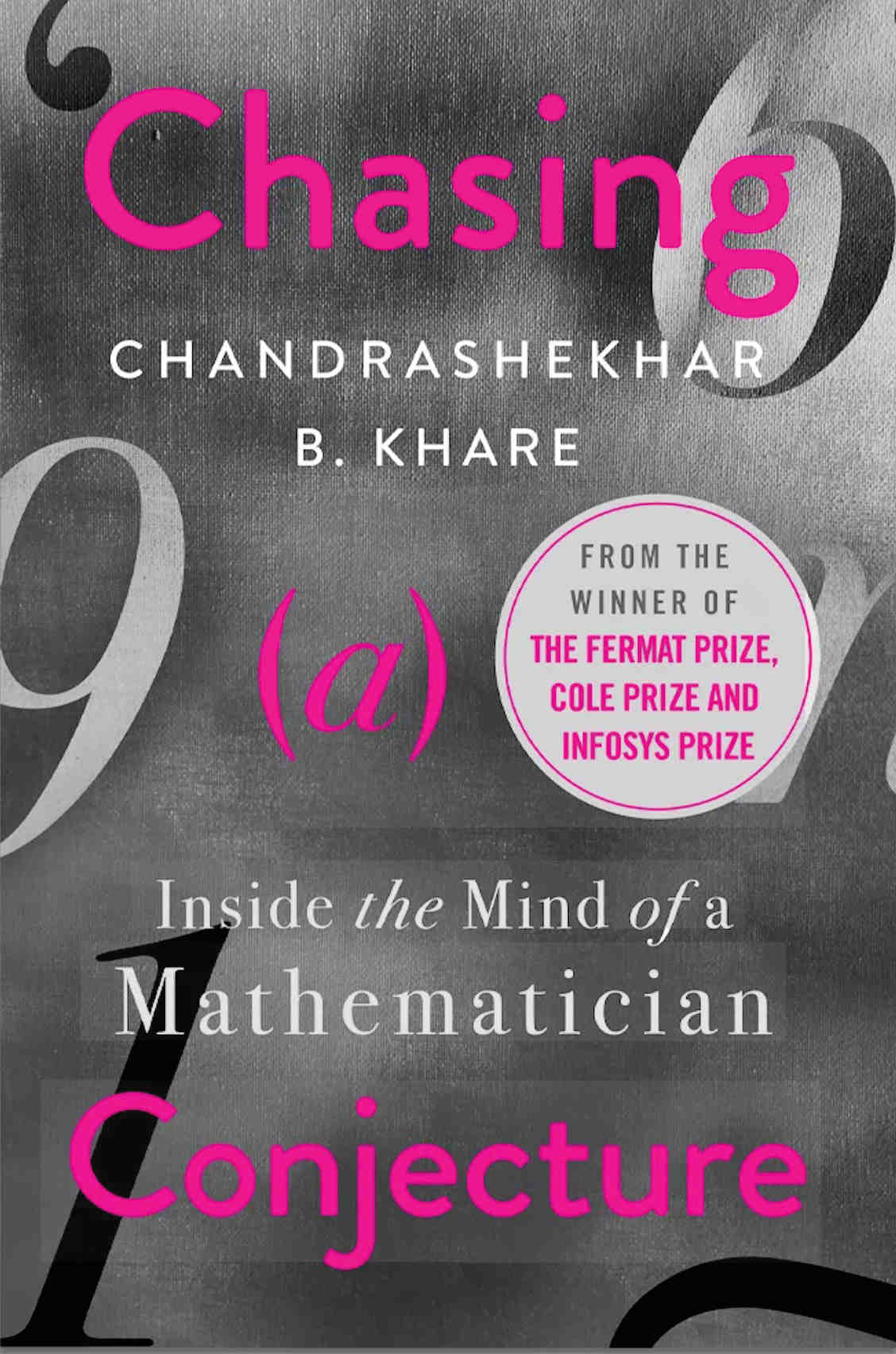
Author: Chandrashekhar B. Khare
Publisher: Juggernaut
ISBN: 978-9353452537 (hardbound)
As a postdoc I shared an apartment with a friend who worked in marketing. He observed me wake up every morning, sit around drinking coffee, and when it pleased me, I would pick up my bicycle and wander off to the “department”. There was not much to show in terms of concrete activity. “What do you actually do in there?”, he would ask me. I once remember trying to explain that “I think about symmetries of equations”.
At a visible level, I would stand in front of a blackboard scribbling equations or sitting in front of a computer, typing up a proof. Sometimes I would read books or research papers, and at other times I would be sitting in a seminar room listening to people talk about their work, sometimes discussing with them over a lot of coffee. Periodically, I would pack my bags and wander off to another town to attend gatherings of kindred spirits. Teaching undergraduates useful mathematics seemed to be the only activity with a tangible outcome. How could I explain the drama and excitement that was hidden behind this outwardly uneventful life?
Chandrashekhar Khare’s autobiographical account Chasing a Conjecture: Inside the Mind of a Mathematician eloquently describes this excitement and the human aspect of being a mathematician. Mathematics is a domain of abstraction. Essential structure is extracted from questions that arise from our experiences in life. These abstractions are studied in a formal and systematic manner to help us better understand the world that we live in. It builds on generations upon generations of tradition, spanning all major human civilizations. And yet, despite the formal nature of proofs in mathematics, despite the eternal nature of mathematical truth, every new achievement in mathematics is the work of mortal humans and a product of relentless human endeavour.
Many aspects of Khare’s account apply to the lives of all mathematicians. But Khare is no ordinary mathematician. Few of us rise to the level of success that he has reached. A large part of the book is devoted to describing his struggle towards his greatest achievement—his 2008 proof (along with the French mathematician J.-P. Wintenberger) of the modularity conjecture of J.-P.~Serre from 1987. Sadly, Wintenberger passed away in 2019, a few years after his breakthrough with Khare. To mathematicians, Wintenberger is immortalized by his proof with Khare of Serre’s conjecture.
Serre’s conjecture is a subtle but precise correspondence between Galois representations (in this book, Khare calls them Galois symmetries) and modular forms (Ramanujan symmetries). Fermat’s last theorem (conjectured in 1637 and proved by Andrew Wiles more than 350 years later) is a consequence of a very special case of this conjecture. Serre’s modularity conjecture has reshaped modern number theory by turning a deep philosophical expectation about reciprocity into a precise, provable, and widely useful statement; Fermat’s last theorem is a trifling curiosity in this context.
A recurring theme in the book is the interaction between mathematics and the person thinking about it. “[I]t unfolds almost like a dance”, says Khare in the introduction. Khare plays the roles of a son, a brother, a husband, and a father, as mathematical drama unfolds in the other dimension of his life. A meeting with his father’s guest, the mathematician Shreeram Abhyankar may have been the catalyst for his interest in mathematics. Discussions with the algebraist M.S.~Huzurbazar may have honed his skills. By the time he was admitted to Cambridge for an undergraduate program, he knew his vocation. Of embarking to Cambridge, he says “All I wanted was to become a mathematician”, dismissing the social prestige of studying at Cambridge.
It was at Cambridge that he was first exposed to group theory (from J.G.~Thompson) and Galois theory. Amidst concerns about his mother’s failing health, he enrolled in the PhD program at Oxford. He found that he was in over his head, unable to find within himself the means to work on the problems that his advisor was suggesting to him. He did, however, make his first encounter with Serre’s modularity conjecture (but it was too early for him to grasp its importance). With the help of Dinakar Ramakrishnan, he was able to get a new start in the PhD program at Caltech.
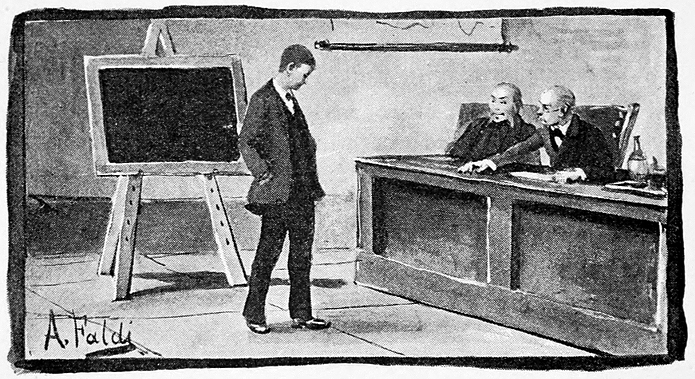
Khare would eventually complete his PhD at Caltech, supervised by Haruzo Hida of UCLA. But the process was not smooth-sailing at all. Khare’s description of a traumatic episode from this phase of life is also the most memorable passage from this book. The episode bears an uncanny resemblance to the short story “The Theorem of Pythagoras” by Enrico Castelnuovo (reproduced in Bhāvanā, vol.2, Issue 1, 2018). It was an oral exam in topology at the end of Khare’s first year of doctoral studies.
Khare vividly describes the setting, “I am led into the room where the exam is going to be conducted. In my fevered state, it feels like a monk’s cell[…]. I imagine a crucifix set on a wooden table, a candle stand beside it, and a bed which could double up as a wrack: a space of torture and repose’’.
The cast of characters in this episode consists of a rubicund topologist, a gaunt topologist, and the to-be-eventually-famous young Mr. Khare. It ends with a brutal demolition of Mr. Khare by the gaunt topologist:
Trying to get by, coast through a course
I want you to remember this humiliation
Learn a lesson here today right now
That will teach you not to get by with half-knowledge.
Reading about Khare’s struggle with his PhD, I could relate to my own. A PhD in mathematics affects a transition from being a student of mathematics to becoming a mathematician. There is no step-by-step process to do this. You are presented with a period of five years during which you have to produce original research. Nobody tells you what you should do today, or this month, or this year. There may be days and months that pass by with nothing tangible to show.
“The experience of being a graduate student, given five years to write a thesis, seems oftentimes, like being given enough rope to hang.’’
Mathematics may be abstract, but mathematicians are human, and research in mathematics is ultimately a social activity
The transformative experience for Khare was—alongside his desultory discussions with his advisor Hida—the reading of Serre’s papers, trying to better understand the precise form of his conjecture. He also got obsessed with Ken Ribet’s subsequent work—which established that Fermat’s last theorem would follow from a special case of Serre’s modularity conjecture. Corresponding with Ribet and then meeting him personally when he visited Caltech helped Khare get a better feel for mathematics. Mathematics may be abstract, but mathematicians, after all, are human, and research in mathematics is ultimately a social activity.
A visit to the Mehta Research Institute, Allahabad (now the Harish-Chandra Research Institute) hosted by Dipendra Prasad, and a visit to Sapporo hosted by Hida played a decisive role in getting “unstuck” on research.
The story of the bicycle in Sapporo is a parable. When Khare visited Hida in Sapporo, he was given a bicycle to commute from the guest house to the department. Almost immediately, the bicycle was stolen. During his three-month stay in Sapporo, Khare had to walk for two hours each way.
“There was a certain unboundedness in thinking as I walked… I felt that I had found a way to do mathematics: it was just to walk and let the mind think… The feet made progress even if my mind hit a brick wall. By the time I reached the university I was pleasantly tired, and I would waste my time there till it was time to walk back again.”
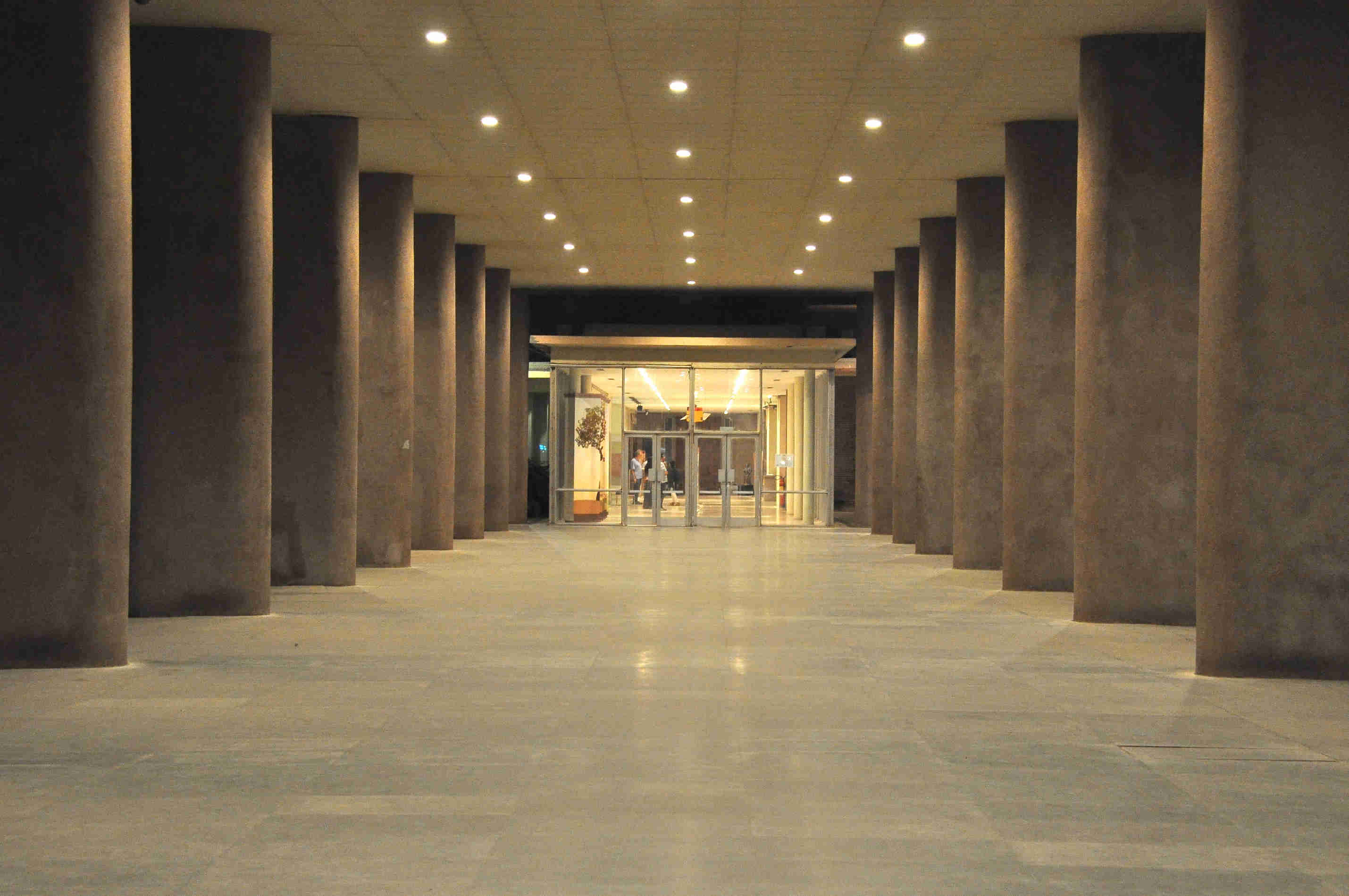
The thesis itself turned out quite well, thanks to a last-minute epiphany that came to Khare as he stepped off a bus in Pasadena. He defended the thesis in the same room where he had failed the topology exam.
Khare moved to the Tata Institute of Fundamental Research in Mumbai after his PhD. The constant gravitational pull of Serre’s conjecture became stronger here. Being a little removed from the strident pressures of American academia helped. He describes beautifully the setting of TIFR, an institution that has a singular character and personality that cannot be replicated anywhere else in the world. It brought him back into the fold of his family. He could indulge in his love of Hindustani classical music. It was also in this phase of his life that he married Rajani. An endearing passage in the story describes how Khare took Rajani—who was not a classical music buff—to an 4:30am concert of the vocalist Kishori Amonkar. Kishoritai, as Khare affectionately calls her, began her concert two hours late. But Rajani made the best of the situation by sketching audience members at the concert. The newly-wed couple honeymooned in Paris, where he also had a chance to make personal acquaintance with his mathematical hero, Serre, whose generosity and warmth as a mathematician he describes with great gratitude.
At TIFR, Khare established himself as a mathematician, and the insecurities of his earlier days had lifted. A trip to Brandeis University in Boston upon the invitation of Fred Diamond convinced him that he would prefer not to settle down in India, but work closer to the action, in the USA. He took up a tenure-track position at the University of Utah in Salt Lake City. His daughter was born in Utah. Back in Mumbai with his family on a sabbatical, Khare describes preparing to visit Wintenberger in Strasbourg as he watched test cricket at the Brabourne stadium.
It is the collaboration with Wintenberger that eventually leads to the solution of Serre’s conjecture. This story, spread over Strasbourg, Mumbai and Salt Lake City is not without drama. Even as he is preparing to go to Toulouse to receive the Fermat prize “for the proof in collaboration with Jean-Pierre Wintenberger of Serre’s modularity conjecture in number theory”, a referee spots a gap in their proof, which they then manage to fix days before the prize ceremony.
Khare says, “I view this book as the literary memoir of a mathematician who happens to be me.” His motivation in the book was not so much to tell his own story, but to communicate to a larger audience what it means to be a mathematician. So what do mathematicians actually do in there? They chase conjectures—and sometimes, if they are lucky, after years of patient pursuit, the conjectures yield.\blacksquare