
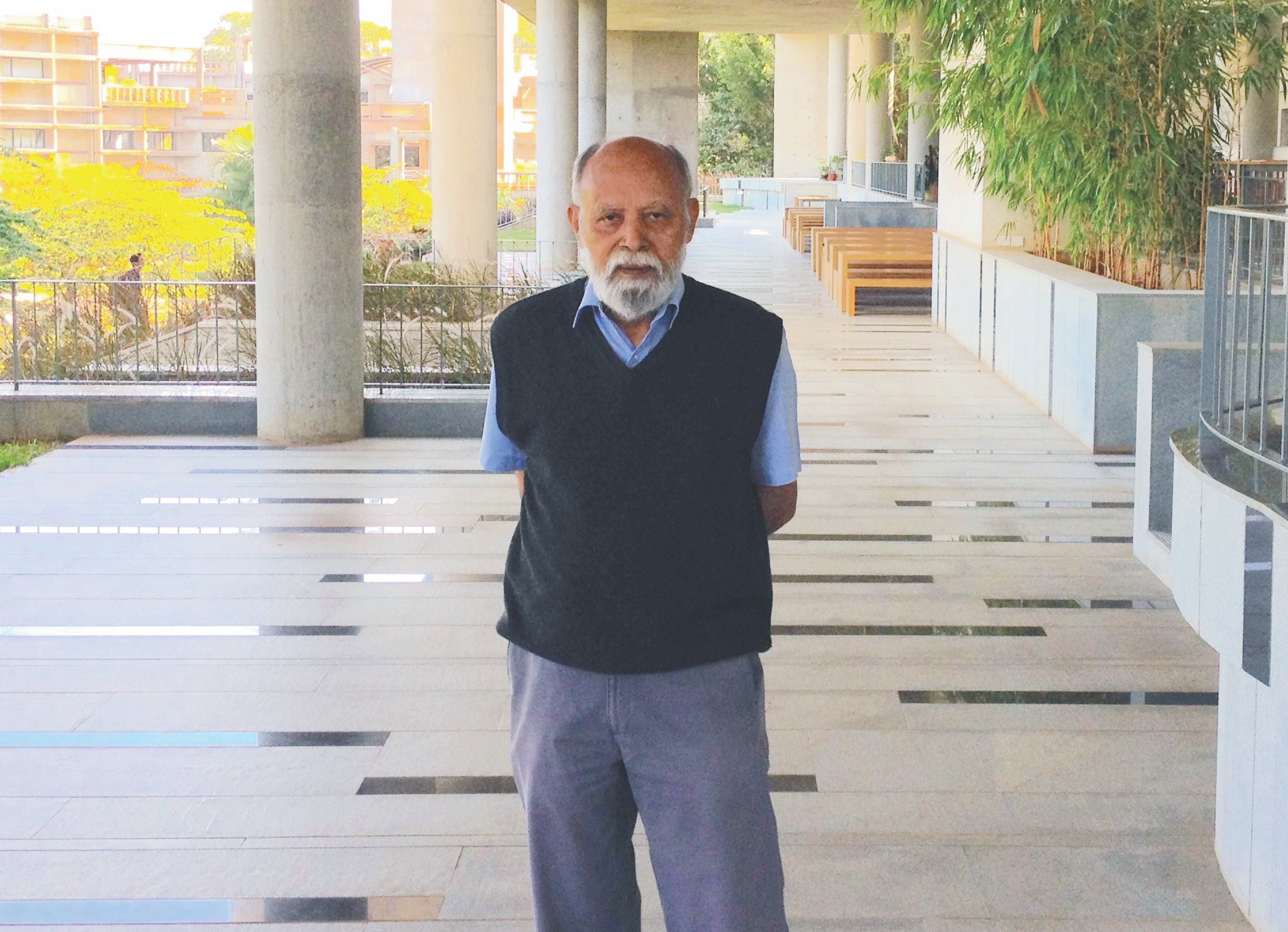
In the passing of Puthan Purayil Divakaran (1936–2025) on 23rd August, the worlds of theoretical physics, the history of mathematics, and a much wider circle of friends, students, and interlocutors across disciplines lost a presence that was at once incisive and expansive. To those who encountered him—whether as a sharp-minded physicist at TIFR, a passionate chronicler of the Kerala (Nila) school of mathematics, a tireless conversationalist who ranged effortlessly across music, ritual, language, politics, and art, or simply as a generous mentor and friend—Divakaran was never confined to a single identity. What united these many facets was a distinctive intellectual temperament: a refusal to accept received wisdom without probing its foundations, a delight in deep structure tempered by aesthetic judgement, and an abiding commitment to shared scientific honesty, even when it demanded dissent. His later turn to the history of Indian mathematics, pursued with youthful intensity well past conventional retirement, exemplified this spirit, bringing to the field not only technical acuity and linguistic sensitivity, but also a physicist’s instinct for synthesis and first principles. The recollections gathered here reflect the breadth of his influence and the warmth of his presence, offering glimpses of a life lived in vigorous dialogue with ideas, people, and the unfinished questions that mattered most to him.
P.P. Sudhakaran
My brother I could never know enough
First, a caveat. Most probably, I knew much less about my brother as a person than many of his friends, colleagues, and other acquaintances. But we had loved each other in our own ways. Reason enough to write about him? Maybe!
Ettan1(as I called him) and I were together for only a short while, and I, being younger by about two years, he, perhaps, thought that I was not ready to share his personal experiences, thoughts, or feelings. Unfortunately, that age difference stuck with us as a constant!
I, on my part, had accepted him as a radiant star moving in a distant orbit, though gravitationally we were in equilibrium. He was my shining model; my hero.
I had never seen him smoking before he left for the US, and thought he would never. He became a chain-smoker, and I, a non-smoker. He used to send home books, an assortment, after his reading, among them of philosophers like Toynbee and Russell. I thought they were the books I also should read, but about the good to me from reading them, there isn’t much to say. Later on, whenever I think about the differences between us, our parents’ choice of our names would appear as truly prescient. He was named after the Sun, I after the Moon!
We were four siblings altogether, Leelavathi, Gomathi, brother, and I, in that order. Father, Damodaran, and mother, Devaki, made up our family that was well-educated and matrilineal; and financially secure until the partition of properties when we had to move out from the ancestral home.
The first sister got married immediately after passing the SSLC examination and left home, but before we moved out. The second sister, about eight years older than my brother, left after completing her Intermediate at the Government Brennen College, Tellicherry, for Madras to pursue BA Hons in English Literature. A cousin of ours, late P.V. Bhaskaran, an IPS recruit of the second batch and the brother-in-law of Justice Koman of the Madras High Court, supported her study at the Presidency College. That year, Ettan was in the Second Form in St. Joseph’s Boys High School, Tellicherry, and I, one class below him. Later, Ettan also was supported by the same cousin.
In High School, Ettan was a wunderkind. He excelled both in studies and in all competitions except sports and games. Proficiency prizes were always his. All non-sports competition prizes were also his. His answer papers were shown to his classmates by his teachers as models. That became the given in the school as long as he was there. Only when he answered a question wrong would it become a buzz. The teachers wouldn’t believe that he could make a mistake. I will mention one instance.
One of the objective-type questions for Physics terminal examination for the VI Form was: What makes water in the throat of a person lying on their back go into the stomach? Two among the four choices offered were swallowing and gravity. Ettan chose gravity. His teachers, including Kanari Master, were shocked. This mistake became a topic of discussion among the serious students of the school for quite some time.
Kanari Master, the legendary teacher at St. Joseph’s, and very close to our family, was my brother’s earliest and, perhaps, the most important mentor. A lifelong bachelor, he used to tell his students that he was living on the Bhagavad Gita and ghee. He died at the age of 98. Whenever Ettan came home, visiting Kanari Master was a ritual he never missed.
Our school was about three km away from home. Mother would pack our lunch separately and give it to us. Ettan would get out of the house first. His walk was always brisk.
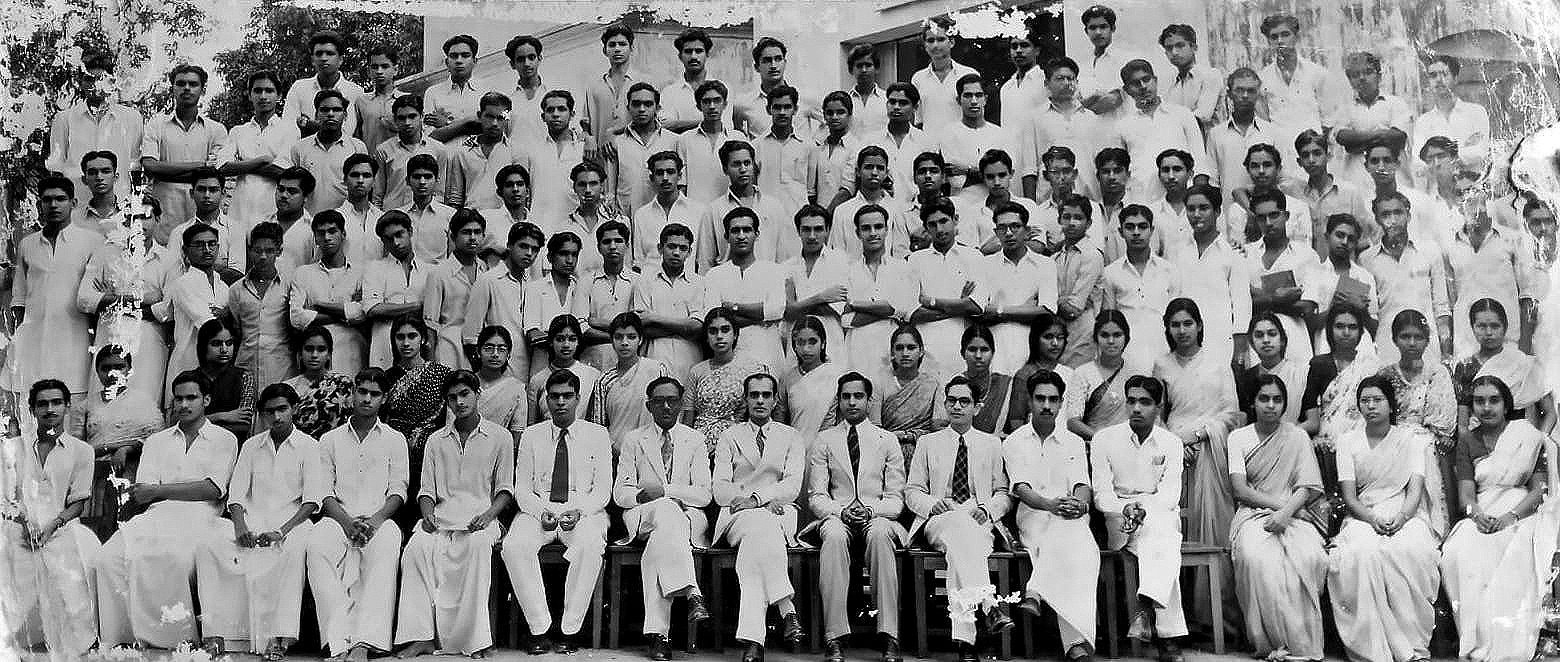
I would follow a little behind. No talk between us till we reached the school. Occasionally, someone might join us on the way. Again, there won’t be any talking. It was a lonely trek, together but alone, as if it was a pilgrimage with a vow not to speak. It was my brother’s choice.
The return journey was a different beast. After the class, I would wait at the school gate. Ettan would come later, usually in a loud and boisterous group of close friends. The journey would start when the group filled up, and move very slowly. I would follow a little behind as I was outside that group. Their talk would mostly be about things that happened in their class that day.
The group that started from the school would shrink along the way as its members would leave at the nearest points to their homes. Finally, it would be Ettan and I walking the last lap, silently, alone though together. It would be a repeat of the morning’s walk, this time only for a shorter duration.
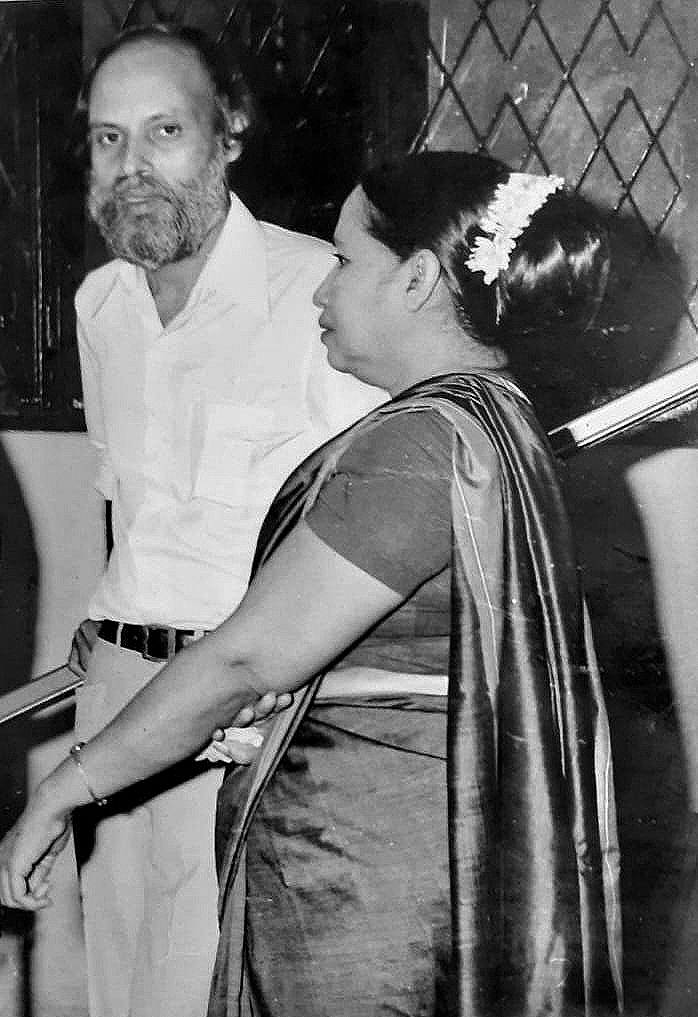
He would get angry with me, very rarely though. Mostly, it would be over some work mother would want us to do. If Ettan was reading a book, he wouldn’t even hear mother’s call, and wouldn’t respond or get up. Then, as I had to go, I would call him nicknames, mostly connected with his bristle-like hair. He would lunge at me, shouting, `I would give you a kick’, but raising only his hand. I knew he wouldn’t. He had never laid his hand on me in my life.
After passing the SSLC examination with record marks, he joined the Brennen College, taking Maths, Physics, and Chemistry, and continued with his brilliant performance in studies, debates, and annual competitions during both years. There, he would win all the prizes he could compete for, except one. If I remember the name correctly, it was the M.A. Candeth Prize, awarded for best handwriting. Ettan’s hand was very good, and he had also competed, but it was not good enough for the prize. It was the most glamorous prize, for, while the other prizes were books worth only rupees 2 or 3, this was worth Rs. 15.
Incidentally, eight years earlier, our sister Gomathi had won that prize for both years when she was doing the Intermediate. “Since they have already brought home all the prizes Brennen College had to offer, you needn’t have to”, uncle Kesavan would tease me. For me, however, his tease was a great relief! I took it to heart as a good reason for not even trying. I had known that I was made of a different stuff. The highest prize I ever got in a literary competition was for short story writing! Sports and games were, however, different.
The College and the School were situated very close to each other. So, our journey to and fro, even after Ettan joined the college, followed the same pattern. Since almost all his school-group members had joined the college, there was hardly any change of members in the college group.
One steadfast member in both the groups was our cousin, P.V. Karunakaran, now residing at Salem after retiring as Professor of English from the Tamil Nadu government service. He is younger than Ettan by about eleven months and was an affectionate admirer of him.
Our cousin would share his personal problems with me. But I had never seen or heard Ettan sharing such talks with him. It was from their friendly but formal behavior that I began to feel that Ettan was uncomfortable with showing emotions and sentiments to others, especially to family members.
Ettan was, of course, different from many other children of his age I knew. Sometimes this difference had appeared to be very extreme. I remember a few instances.
When Ettan passed the SSLC examination with distinction, sister Leelavathi got him a wrist watch through her husband and asked him to wear it, and also thank him for the gift. Ettan refused to do both. He said he didn’t need one. As our sister was terribly hurt, she mercilessly thrashed him. Still, he refused. Finally, she withdrew, taking the watch back, and crying hysterically.
Our uncle, Kesavan, was Sheristadar in the District and Sessions Court, Tellicherry. He was well-read and well-informed. I had witnessed many discussions among him, sister Gomathi, and Ettan. The topics would range from the attempts to climb Mt. Everest to whether the Earth was flat, and P.G. Wodehouse to Emden, the German submarine that was rumored to have visited the Malabar Coast during the First World War. But never had I seen them discussing any family matters with Ettan joining.
Incidentally, Ettan and I also never had any such discussions between us.
For a long time, I used to think that he was intimately attached to sister Gomathi. But now, I am not sure about that either.
Ettathi, too, was very bright in studies. She had her higher education in the same institutions as my brother, and had joined collegiate education service in the erstwhile Madras Presidency after doing Hons., and L.T. (Licentiate in Teaching). She did not marry. She was intensely proud of Ettan and used to dote on him. To her he was, deservedly, a special brother.
Initially, when she was at Govt. College, Mangalore, he had visited her twice or thrice, and had constant communication with her. She was the only one from among us to visit him and Odile, his wife, at Bombay. After retiring as Principal, Besant College for Women, Mangalore, she settled down there only. After that, Ettan had never visited her. Even telephonic contacts had dried up.
However, after a long gap, they met at Calicut for my wedding, and that was, incidentally, their last meeting.
Still later, when she learnt about Ettan occasionally meeting me in Bangalore, she would ask me to arrange a talk with him over the phone. It was on one such visit that Ettan had talked to her last. I asked him first whether he would like to talk, and he appeared to be very excited. He even agreed to visit her at Mangalore. But his excitement lasted only till the call lasted.
Did he come to believe by then that showing affection for one’s blood relations was only for the fainthearted? If he did, was it a conditioning he knowingly cultivated? Or, was it an ‘out of sight, out of mind’ kind of attitude he allowed himself to develop for reasons I couldn’t even guess? For, earlier his attitude was quite different.
Our father had passed away when Ettan was in the Third Form. He had Tuberculosis. Since Calicut had better treatment facilities compared to Tellicherry, he had to be taken there frequently. During those days, almost like a grown-up man, Ettan would look after father’s needs, even accompanying him whenever he was taken to Calicut, missing classes, something he hated doing viscerally. He also did perform father’s last rites as the elder of the two sons without showing any discomfort.
Did he start changing after leaving home, first for Madras, then Bombay, Chicago, and Oxford? Or, it may be that I had never known him fully! Coincidentally, during that period, he had no compelling reason to visit home as there was a drought of important events in our family.
He was very fond of my wife, Zarina, a Muslim by birth and not his kin by any stretch of the word. And he would openly show his affection for her. The only family function other than our father’s last rites that he attended was our wedding.
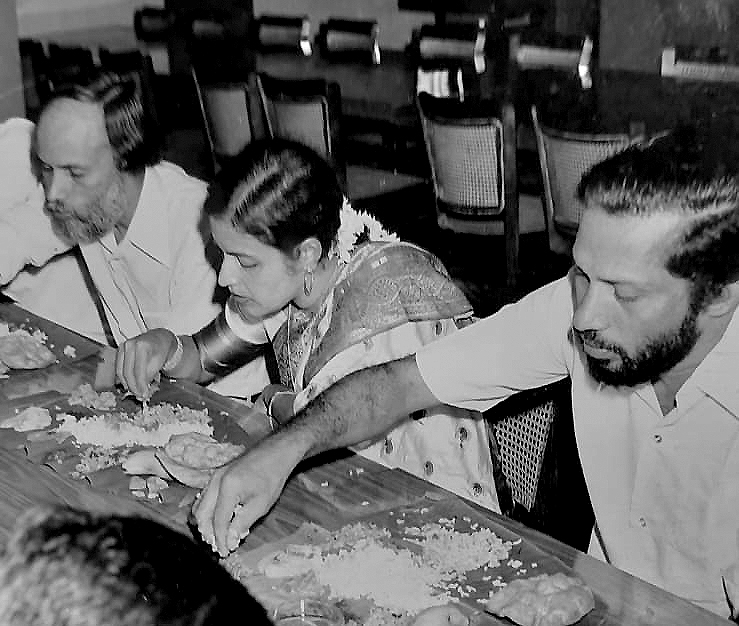
Interestingly, the locket on the chain he gave had the shape of the Star of David. I asked him its significance. He said, let there be a representation of the oldest of Abrahamic religions also so that the union will become still more cosmopolitan.
After the ceremony, he told me he had never attended in his life such a simple, elegant wedding. He was happy and did not conceal it. I would like to remember all my life that Ettan, fleetingly open, loving, and caring, whom I had never fully understood but is exclusively mine, for ever and ever.
Our last meeting too was, fittingly, a bit surreal.
Some months before breathing his last, I had called to congratulate him for winning the `Kairali Lifetime Achievement in Science’ award for 2024. After a few customary words, he asked me what I was doing after Zarina’s demise. I told him about the Trust I was running at Calicut in her memory, which conducts monthly lectures on various subjects. Immediately he said, that was the best tribute to Zarina, and offered me half of the award money he received as a gift.
After that talk, there was no communication. Then, Dr. Rajan Gurukkal, the Vice Chairman of Kerala State Higher Education Council, called me in distress one day to inform me about Ettan’s hospitalization in Cochin. When I called him from Calicut, he sounded excited as usual. I said I wanted to see him. First he said, Don’t come. When I insisted, he said, OK, but don’t bring Zarina. He had forgotten that she had passed away three years earlier.
The next day I reached his hospital. When I entered his room, he called out my name loudly and started talking nonstop. He introduced me to the doctor there as a brilliant historian who wouldn’t write much. It was the only compliment I had ever heard from him in my life. It was, therefore, precious, though I didn’t deserve it.
I remembered I had told him on an earlier occasion that I used to be called Lord InActon by some of my associates. When he asked why, I said: Lord Acton hadn’t written a single book himself. The comparison ends there. But he had students who wrote down his lectures and published them later in his name. I had none. Hence, ‘InActon’! He laughed heartily.
We were together in the hospital for barely fifteen minutes, he talking most of the time, and his consciousness ebbing intermittently. Then, abruptly, he folded his hands and bid me farewell. Though I offered to stay there and be with him, he did not respond as he had already slipped into a coma.
I came away. A few days later, after his cremation and all other related formalities, I was informed about his death. I still don’t know what was done with his ashes.
But I keep wondering: Was there a poetic justice in the way we finally parted?
P.P. Sudhakaran is the younger brother of Divakaran. He was a professor of History and principal at Government Brennen College, Tellicherry. Retired as Dy. Director of Collegiate Education. Now lives in Calicut.
Ashok Divakaran
My dad had an innately architectural mind and brought a structural sensibility to everything he did, even if he sometimes lacked the formal terminology to express it. A great example is western classical music. He was first exposed to this sort of music as a student in New York in the mid 60s. In spite of the newness of this genre of music for him, his architectural, systems-oriented sensibility quickly expressed itself and led him to very defined tastes. For example, he immediately gravitated to Bach – considered perhaps the greatest composer of all time, but not one that is easy to immediately appreciate because of the layered, almost algorithmic nature of much of his work. My dad immediately detected this mathematical complexity but also the innate beauty and depth of Bach’s melodies and harmonies that require no formal deconstruction to appreciate. As a fundamentally non-sentimental person, he formed a visceral dislike for the romantic period, which was a perfect inversion of the conceptual values of Bach: non-linear and sometimes disorganized structures, overt and often self-indulgent emotion. But, he viewed purely abstract structure also as a dead end, which is why he had no fondness for the twelve-tone, serial music of the 20th century that was purely conceptual and mathematical and ditched all melody and harmony (Schoenberg, Webern, etc). He needed both deep structure and deep but subtly expressed emotion. And he had a deep ear for symmetry. This is why he could recognize Bach as a great composer. Truly, one could decipher the brain of my dad in all its forms from the music he liked and didn’t like. It was a very fine-tuned and internally coherent aesthetic and artistic sensibility, and one that left a deep impression on me.
My dad and I were not emotionally close – I think he had difficulty expressing emotion, and we were quite distant growing up. But there were a few spheres that brought us close together, and where he left a profound impact on me, although it was more about the intellectual archetype and role model that he represented for me – an abstract concept to be emulated, rather than a traditional father-son relationship. I’ve already talked about music, which has always played and continues to play a hugely important role in my life. Another was tennis. And this was another instance in which you could deduce my dad’s personality and mind from his game. He played to win, but not excessively so; the process and journey were more important than the outcome. And here, again, one sees his affinity for structure and parsimony clearly expressed. He deeply studied the technique of classical players like Rod Laver who played in what one could consider a highly disciplined, high-leverage style: economy of form, maximum result for minimal effort (in a good way), emphasis on agility and “right place, right time” rather than brute force. For a self-taught player, he had a first serve that was near-lethal – a kick serve that aggressively swings in the air towards the body and bounces high, making it very hard to return. We played regularly at the Bombay Gym and there wasn’t a single club-level player that could hit a serve like this—it took mathematical precision in preparation, stance, weight transfer, acceleration, etc—a true multi-dimensional, kinetic, complex human system operating under tight constraints and error tolerances. My own personality being even less inclined to winning and far more impulsive, I would generally botch my returns of this serve because I’d try and hit winners, which is essentially impossible. But it’s another example of how his conceptual mind and values even shaped his tennis game.
One final anecdote that again illustrates my dad’s mind and values. As a kid, I of course had to take physics and math classes. I have always been a bit impatient and impulsive, and if there was one type of exercise I detested, it was mathematical proofs. My dad, conversely, relished these, and to a fault. When I’d get stuck on a piece of physics homework, I (in the early days, and before I learned better!) would seek his help. But what I was hoping would be a ten-minute conversation that applied whatever law was relevant to the specifics of the problem, would turn into an hour-long digression to attempt to prove the law itself from scratch. At that moment, I found this tendency incredibly annoying and frustrating because of my low attention span, and I stopped going to him for help. But this mindset so powerfully and subliminally seeped its way into my consciousness, that as an adult, I now find myself with exactly the same orientation: to try and tear everything down to first principles and not take any received wisdom for granted. And the roots of this are constant observation and internalization of how my dad thought.
In this respect, our relationship was very different from a typical father-son relationship because we didn’t “do stuff together”. But what he did do was deeply influence my intellectual water supply that I drank every day, and this shaped me much more powerfully than simply “hanging out” might have done, because it was a continual gravitational force that bent my development towards the way he thought.
Ashok Divakaran is the elder son of Divakaran. He lives in the US, where he is an AI product leader in New York.
S. Ramanan
Divakaran was one of my closest friends. I knew him for over sixty years, initially at the Tata Institute of Fundamental Research (TIFR), and later, at the Chennai Mathematical Institute (CMI). Our families were also close to each other. His passing away is, to me, a matter of deep sorrow, but I must console myself that he did not suffer much before the end. In fact, when I called him a couple of days before his passing away, he said, “things are not very bad right now!”
When we were mates at the Old Yacht Club hostel, we used to have numerous discussions about music, arts, economy, politics, and literally everything under the sun. Divakaran, originally from the coastal state of Kerala, was a good friend of Frits Staal’s, a Dutch Indologist who had married a Keralite. He had met Frits during his college days in Madras. Frits was interested in the Vedas and the Upanishads, particularly in the `Namboodri versions’ as he used to say. Once when Frits visited Bombay, Divakaran introduced me to him, saying, “Ramanan is the only individual I know who has actually attended a Soma Yāga”. I later took Frits to Matunga to meet my father’s maternal uncle who was the Adhvaryu (priest-in-charge) of that Yaga, conducted by his brother’s son (Yajamāna) . Like many from the southern part of India in Mumbai those days, he was living in Matunga.
When I visited Oxford as a post-doctoral fellow in 1965, a couple of residents of the Queen Elizabeth House where I stayed, recalled with pleasure their acquaintance with Divakaran (who had been there the previous year) and his friend Odile, an affluent French lady interested in oriental history. Soon after I returned to India, my family and that of Divakaran who had by then married Odile, lived in the same building in the TIFR colony and we became close family friends. Odile was an expert on Indian temple architecture in addition to Hindu philosophy. She would advise us on our travels, particularly in South India, pointing out what to look for in each temple, which we loved greatly.
One day, during my walk in the garden of our premises, I looked up at their third-floor balcony and thought I saw a big wooden cross. This puzzled me since Divakaran had told me that Odile was not a practising Christian. When I asked him why then was this cross there, he took me to the balcony of his apartment, and I realized that what I had seen was their TV antenna!
Given their interest in Indian history, it is no wonder that they named their two sons Ashok and Rajen. Ashok used to come over to our home once in a while as a playmate of my daughter Kavita. He was studying in a Christian missionary school. One day he was asked if he believed in God. I still remember his straight-forward answer: “I believe in God at school, but don’t at home”!
Back then, they were one of the few on campus who owned a car. They had imported Odile’s Renault from France. Several years later, when I bought myself a car, Divakaran accompanied me to the shop in Chembur many miles away, drove the car back and taught me the do’s and don’ts of maintaining a car.
He was interested in theoretical aspects of physics and so he inducted one of his students, Ramadas—who later became a student of M.S. Narasimhan—into mathematics. After his retirement from TIFR, Divakaran joined the fledgling CMI, which I had also joined as a Visiting Professor post-retirement. During this period, he got interested in the traditional mathematics of ancient India, particularly that of the Kerala school.
To David Mumford, one of the top mathematicians of the United States (a Fields medalist at that), India has been a favourite. He is eclectic in nature and despite his great contribution to algebraic geometry, he later diversified into various other areas of mathematics. One of them was ancient India’s contribution to mathematics. When he came to know that our friend, Divakaran, was an expert on the subject, he began detailed discussions with him. During one of his visits to Chennai in this regard, I took both him and Divakaran to a restaurant called `Ente Keralam’ (My Kerala). At the end, David thanked me and remarked, “the prawns here are the best I have ever eaten”. Divakaran remarked that it was natural that Keralite food is particularly known for seafood since the state is mostly coastal.
After his stint at CMI, Divakaran retired to Cochin in his home state, Kerala. There, he started to work on a book on the ancient Indian contribution to mathematics, published by the Hindustan Book Agency. Our common friend, M.S. Narasimhan, told me, “Divakaran has written a remarkable and readable book on the subject. You will enjoy it”. Divakaran sent me the online book, and I realized the truth of Narasimhan’s assertion.
I will cherish his memory till my turn comes!
S. Ramanan is an eminent mathematician of the famed algebraic geometry school of TIFR. A close contemporary and a longtime friend of Divakaran, their academic careers overlapped at TIFR Mumbai. After a post-retirement stint at Chennai Mathematical Institute, Ramanan now lives in Chennai.
M.S. Raghunathan
P.P. Divakaran, who passed away recently (at the age of 89), had established himself as a leading expert in the history of Indian mathematics over the last two decades.
Divakaran was born in Tellicherry (now Thalassery) and had his schooling there. After a brilliant career at school, he went on to join the Intermediate class of the Madras University at the Government Brennen College in Tellicherry. He passed his Intermediate with flying colours, which enabled him to secure admission to the prestigious BSc (Honours) course in Physics at Presidency College, Madras. After securing the degree (with first class), he got into the Training School of the Bhabha Atomic Research Centre, and the next year(1959), he joined the Tata Institute of Fundamental Research (TIFR) as a Research Scholar. In 1962, he was deputed to the University of Chicago to work for a PhD under the guidance of Professor Dalitz (who had visited TIFR in 1961). When he got back to Bombay (now Mumbai) with his PhD (after a stint in Oxford, where he met and married Odile, a French art historian), he was absorbed into the Physics Faculty at TIFR.
During the years at TIFR, he made several significant contributions, mostly to particle physics. He retired from TIFR in 1996 and during the next two decades, was a visitor at several institutions: Institute of Mathematical Sciences (IMSc) and Chennai Mathematics Institute (CMI) in Chennai, National Centre for Biological Sciences (NCBS) in Bangalore, Inter-University Centre for Astronomy and Astrophysics (IUCAA) in Pune, Harish-Chandra Research Institute (HRI) in Prayagraj. He was awarded a Homi Bhabha Fellowship specifically to work on the history of mathematics, and IUCAA hosted him during that fellowship.
A chance meeting he had with K.V. Sarma, a historian, triggered in him an interest in the history of Indian mathematics, especially in mathematics that emanated from Kerala during the 13th to 16th century. If my memory serves me right, I was with him at this meeting with K.V. Sarma. It was somewhat late in life (he was past 60) that he developed this interest, but he showed a youthful passion in pursuing it. He continued thinking of problems in physics, and as late as early this year, he spoke to me excitedly about some ideas he had, connected to relativity.
I joined TIFR in 1960 as a Research Scholar in mathematics and got to know him within a few weeks of my joining there. Our first meeting turned out to be somewhat amusing. When I learnt that he was a Malayalee, I asked him where in Kerala he was from. He said, “Oh, it is a small town, you wouldn’t have heard of. It is called Tellicherry’’. As it turned out, I knew of Tellicherry and had in fact spent a few months there as a 6-year-old! My maternal grandfather, P.R. Krishnaswamy, was the principal of the Government Brennen College in Tellicherry during 1946–49. Divakaran himself was a student of the College, but that was after my grandfather’s time; an elder sister of his studied at the college during my grandfather’s tenure, and so he had heard my grandfather’s name.
Later, thanks to his French wife, he got to know a Frenchman by name Ravel who had settled in Tellicherry. I happened to know the name: he was a timber merchant who was known to my grandfather and had interacted professionally with my father (who too was a timber merchant). I have some vague memory of having met him when I was ten or eleven.
Divakran’s was an incisive mind, and his intellectual interests were wide and well beyond his primary preoccupation, theoretical physics. He was a brilliant conversationalist with a lively sense of humour that made his company most enjoyable. He was a bon vivant with a refined taste in anything that interested him. He did not suffer fools gladly. He hung out with mathematics students more often than other physics students. He counted among his close friends two mathematics students, Ramanan and Raghavan Narasimhan. I was the third one to get close to him. Once during our hostel days, Frits Staal, a Dutch student of Philosophy working in Madras University, specialising in Vedic rituals (who became a well-known philosopher later) came visiting Divakaran. Divakaran had known him in his Madras days. I once ran into Divakaran, Staal, and Ramanan engaged in an animated discussion about Vedic rituals. I knew that Divakaran had a wide range of interests, but was surprised to find that it included Vedic studies. Ramanan came from a Tamil Brahmin family that was aware of Vedic religious practices.
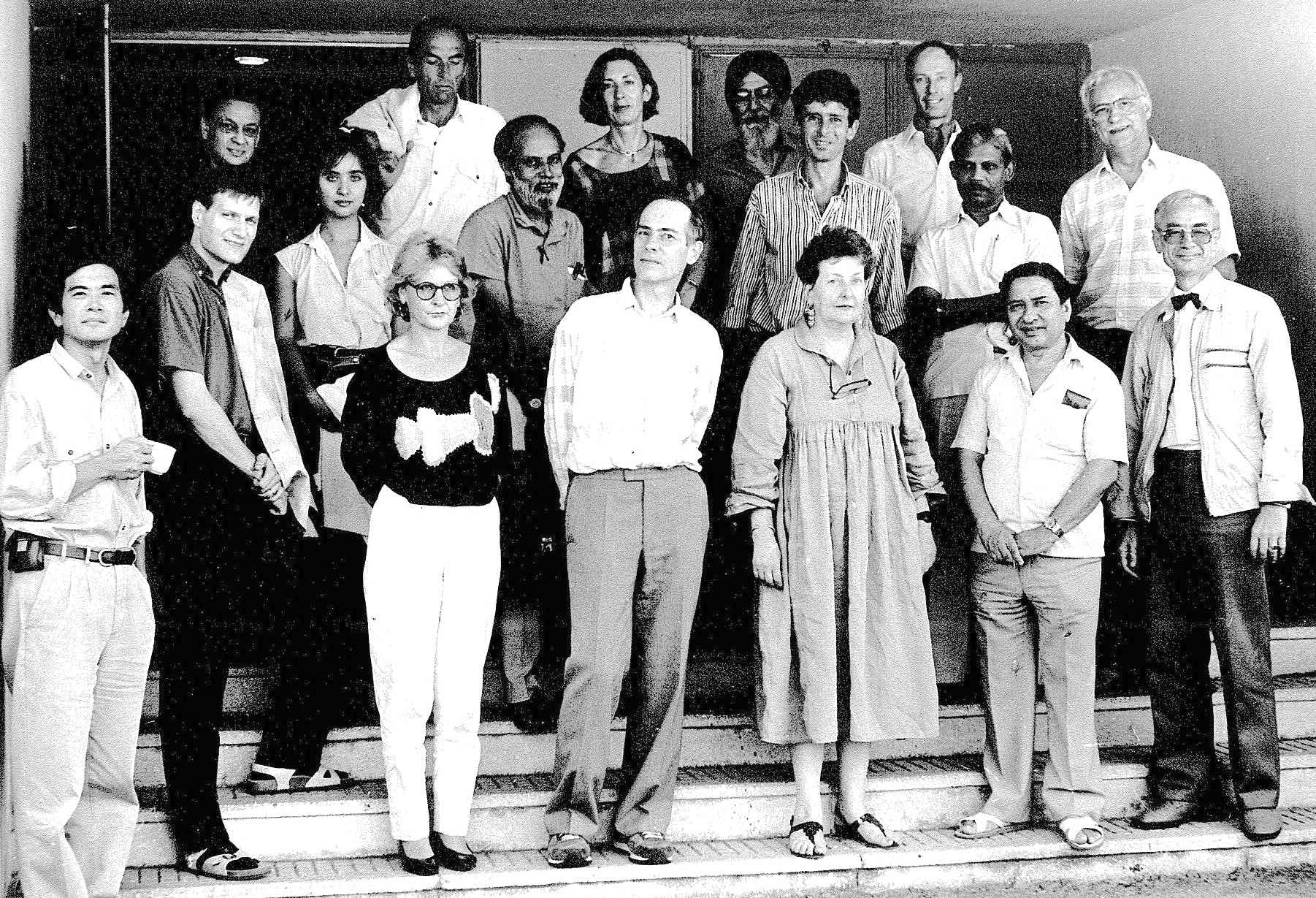
Raghavan Narasimhan, in those student days, would often articulate misogynistic views, referring to women almost always as “beezels’’ – a Broadway slang. He would, among other things, express an abhorrence of the idea of marriage. Divakaran would join in enthusiastically. But in both their cases, it proved to be no more than an affectation, or maybe they gauged their wives as exceptions to their idea of the common run of women!
Divakaran’s work in Physics tended to be mathematical, and he was one of the few physicists at TIFR who had serious interactions with mathematicians. I happen to be one of those mathematicians. I was greatly impressed with his grasp of mathematical concepts that he put to use in his work. Our collaboration resulted in my writing an Appendix to a paper of his in Communications in Physics. While I could see that he grasped the mathematical concepts I talked about to him, I am afraid that I had, even at that time, at best, a hazy idea of the physics he applied them to in that paper; now, after three decades, I can recall nothing about it. He had much more intensive interactions with my colleague M.S. Narasimhan.
Here is an anecdote that gives an inkling of his sense of humour. Sometime in the early seventies, Rangaswamy Narasimhan, the then head of the computer science group at TIFR organized a conference on Artificial Intelligence. Those were times when AI was practically unknown to the public, so a clear indication that TIFR – Narasimhan, in particular – was prescient of things to come. Narasimhan hosted a party for the participants in the conference, to which some members of TIFR faculty outside the computer science group, Divakaran among them, were invited. At some point, Divakaran told Narasimhan that he had initially wondered what the conference was all about till he realized that the old adage that “Necessity is the mother of invention’’ was the answer!
Divakaran was pretty good at Tennis and, along with Obaid Siddiqi, was one of the two best Tennis players at TIFR. I was not a particularly good player, but Divakaran was nice enough to me to play with me often. His proficiency in Tennis, perhaps, helped him to become a member of Bombay Gymkhana, admission to which was far from easy. Divakaran’s wife, Odile, was an art historian, and he travelled a great deal with her on her professional trips to visit sites of ancient sculptures all over India. His travels with Odile and the membership of Bombay Gymkhana led to his acquiring a wide circle of friends well beyond academia: the painter Jehangir Sabahwala and his wife were, for example, family friends of his. My wife and I got to know the Sabahwalas when we met them at a dinner hosted by the Divakarans at their home.
After he retired from TIFR in 1996, he was much sought after as a visiting professor, thanks to his wide scholarship. In about a decade or so following his retirement from TIFR, he got interested seriously in the history of mathematics and set about researching the subject. He became a well-recognized scholar-researcher in the area, bringing new insights to it.
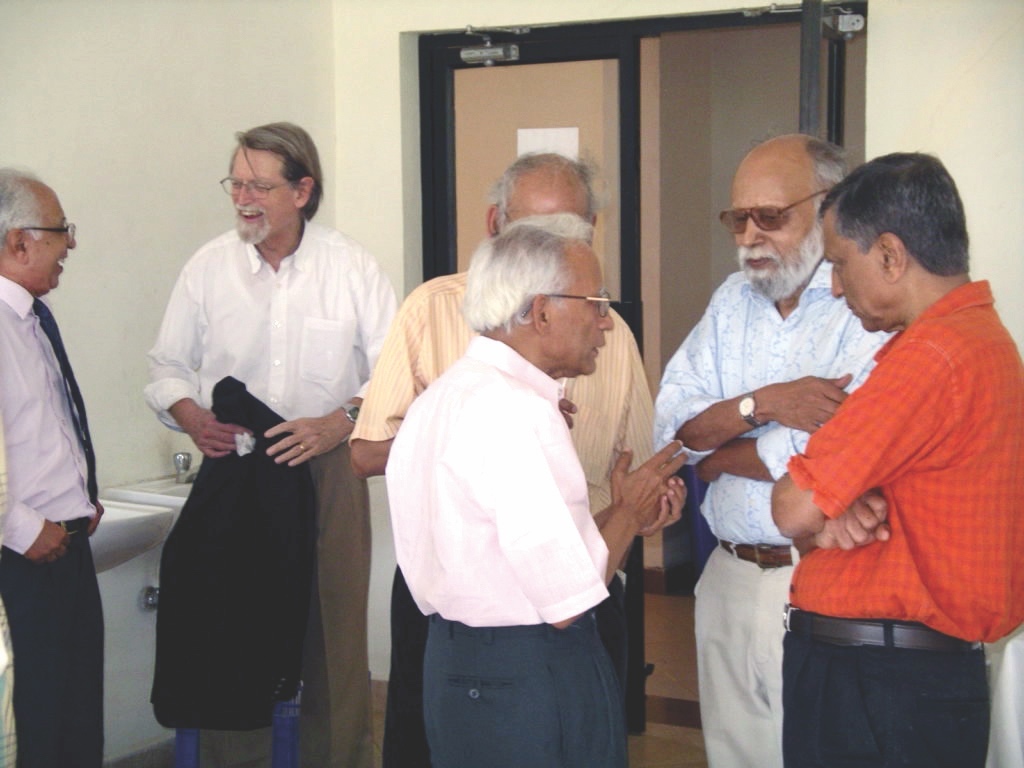
His scholarship on Indian mathematics did not remain limited to Kerala mathematics, however. Interestingly, during his IUCAA years he collaborated with a young student of Vedic Sanskrit, Bhagyashree Bavare, in analysing the numbers appearing in the Ṛgveda, producing an incisive analysis of how they were composed and its significance in the development of the decimal system of number representation.3 Another of his important papers4 brings out the unique features of Indian mathematics and how it differs from the mathematics of other cultures.
With the background of the wide range of papers, writing a book was in order, and in 2018, he published one titled The Mathematics of India,5 which is an outstanding work encompassing the history of mathematics in India from the Indus Valley Civilisation days to the beginnings of British rule. It is less comprehensive than Kim Plofker’s work, one of the standard references in the area, but it has many new insights, insights that are perhaps the result of Divakaran’s greater familiarity with Indian culture and his knowledge of his mother tongue, Malayalam (the language of the important work Yuktibhāṣā), as well as a deeper knowledge of mathematics itself. The book may well be considered a worthy successor of the pioneering work of Datta and Singh; the same may be said of Plofker’s book, but Divakaran’s book is better able to trace the continuities in the Indian mathematical tradition. The chapters of the book devoted to Mādhava and his school are a veritable treat. The book received adulatory reviews from, among others, eminent mathematicians M.S. Narasimhan6 and Avinash Sathaye.7 Divakaran’s command of English is indeed superb.
A satellite conference on History of Mathematics was held following the International Congress of Mathematicians 2010, at the Kerala School of Mathematics, Calicut. Divakaran served as a member of the Organizing Committee. Among other things in that role he relished guiding a tour of interested delegates, which included many foreigners, to the neighbourhood where the mathematics of the Kerala school of Mādhava flourished, including a visit to a family of descendants of Parameswara, one of the renowned exponents from the School.
Divakaran held strong views on many issues. While he had great admiration for the mathematics of our ancestors, he rubbished the exaggerated chauvinistic claims about India’s mathematics made by some of our compatriots. He was a liberal in politics with a strong commitment to human rights and was much distressed by the developments in recent years that, in his view, curtailed them. Even as he devoted much time to researching the history of mathematics, he continued to think about problems in physics. As late as early this year, he spoke to me excitedly about some ideas he had connected with relativity.
His work in physics as well as in the history of mathematics won him the Kairali Global Lifetime Achievement Award (2022–23).
In his passing away, we have lost an outstanding scholar-researcher of the history of mathematics, who was very active in the field despite his advanced age. Personally, I have lost a good friend of many decades.
Acknowledgement: I am grateful to S.G. Dani for some important inputs used above.
M.S. Raghunathan is a Distinguished Professor of Mathematics at the Centre for Excellence in Basic Sciences in Mumbai. A longtime colleague and friend of Divakaran, during the time of their decades of overlap at TIFR Mumbai, they enjoyed sharing their perspectives on many topics of common interest.
M.S. Sriram
I was a PhD student working in the area of theoretical high energy physics at IIT Kanpur (IITK) during 1971–78. Divakaran made several visits there in this period. He would invariably give a few talks to the high energy group at IITK, which was one of the very few places in India with research interests in theoretical high energy physics at that time. His interests in this field were in areas which were more mathematical and abstract. I recall that he gave a series of talks on axiomatic field theory on one of his visits. It was a little too abstract for me. He was, however, quite friendly with the research scholars.
TIFR used to organize summer schools in high energy physics in the 1970s (and perhaps even earlier and later as well), attended—after a selection procedure—by PhD students, post-doctoral fellows, and faculty members working in the area from across India. One such summer school, which ran for about three weeks, was held in Ooty in the summer of 1975, for which Divakaran was the main organizer. Both the academic aspects—lectures and seminars, including a visit to the TIFR radio telescope near Ooty—and the non-academic aspects—food, accommodation, excursions, and a social event—were organized very well by Divakaran. He had also arranged for the transport of many books, journals, and preprints relevant to the school, all the way from Mumbai to Ooty, so that speakers and participants would have the major references readily at hand.
I know that Divakaran was very kind and helpful to students and postdocs facing some problems in their work. He was certainly encouraging to a senior colleague of mine at IITK who went to TIFR for his post-doctoral work. He was very encouraging to me at a conference where I had presented a paper.
Divakaran was an intense person. It is well known that he was deeply involved with the history of Indian mathematics in his later years, and here too his engagement was marked by the same distinctive intensity. During early 2008, there was a series of seminars at the Chennai Mathematical Institute (CMI) on the development of calculus in India and Europe, when the American mathematician David Mumford was visiting CMI. Divakaran was one of the main driving forces in the early stages of the organization of the series of seminars. He encouraged me to give a talk on Indian planetary models in the series, which turned out to be the only talk on astronomy in the series. The proceedings of the seminar-series were published in the book Studies in the History of Indian Mathematics, edited by C.S. Seshadri, which has an article titled `Notes on Yuktibhāṣā: Recursive Methods in Indian Mathematics’ by Divakaran.
As he was from Kerala, Divakaran had a very good knowledge of Malayalam. He studied the mathematics part of Yuktibhāṣā in Malayalam itself, in all its minutiae. He was perhaps the first scholar to boldly state that Yuktibhāṣā is the first text book of calculus. He also studied the English translations of many ancient and medieval Indian texts on mathematics, which resulted in the publication of his book The Mathematics of India – Concepts, Methods, Connections by Hindustan Book Agency in 2018.
I did not have much discussions with him on Indian mathematics, but I could discern that his thinking and emphasis were somewhat different from those of my collaborators and myself. Much of his book is on historiography and general discussion of various topics, except the sections on the infinite series for \pi, and for the sine and cosine functions, which involve a considerable amount of technical details. He once told me that he had very little interest in Indian astronomy, apart from Indian trigonometry, which forms only a part of astronomical texts. Since astronomy and mathematics were intimately related in the Indian tradition, he would likely have missed certain aspects of Indian mathematics on account of this.
For instance, he was of the view that Bhāskarācārya, when discussing tatkāla or tātkālikī, was not referring to instantaneous velocity but to average velocity over a small time interval. This, however, is not correct. When one examines later verses on the rates of motion of planets such as Venus and Mars, together with Bhāskara’s own commentary in the Siddhānta-śiromaṇi, it becomes clear that he was indeed referring to instantaneous velocity, and he even gives the correct expression for it within the framework of his planetary model. Later still, the Kerala astronomer Nīlakaṇṭha Somayājī discusses the true rates of motion of the Sun and the Moon in his Tantrasa\dot{n}graha (1500 CE), where again it is evident that instantaneous velocity is intended.
Referring to Bhāskara’s use of symbols in the Bījagaṇita, Divakaran states that “there is not one proposition or illustrative example (of which there are plenty in his book) that is stated or solved symbolically, though there are allusions to equations and their manipulation; it is all words”. In fact, however, Bhāskara solves the problem of finding the zenith distance corresponding to an arbitrary azimuth using symbols alone in the Siddhānta-śiromaṇi. There are several other such instances in this work.
There are many interesting discussions in Divakaran’s book which are valuable. Though one may not be in agreement with everything that he says in his book, it is well worth pondering over many issues raised by him and discussing them in detail.
Divakaran was eclectic in his interests and engaging in conversations. The scientific community is certainly poorer in his absence.
M.S. Sriram is the President of Prof. K.V. Sarma Research Foundation in Chennai. His acquaintance with Divakaran dates back to his PhD days as a student of high energy physics at IIT Kanpur. History of maths in India being an abiding interest, another trait shared with Divakaran, he has a number significant publications on the subject.
T.R. Ramadas
I first met P.P. Divakaran when I was an undergraduate at IIT Kanpur. He was visiting H.S. Mani. I do not recall much about the brief meeting, except that Divakaran was friendly, matter-of-fact, bearded, lean and athletic, forward-leaning, and in motion. Later, Mani told me that he was at Kanpur to lecture on the Spin-Statistics theorem. In fact, these formal aspects of quantum field theory (and the books of Streater–Wightman and Bogoliubov–Shirkov) were close to his heart.
In 1977, I joined TIFR as a research scholar in theoretical physics, and it was natural that I started interacting with Divakaran. These were the early days of the renewed interactions between physics and geometry, and he asked his friend, M.S. Narasimhan, to give a set of introductory lectures on vector bundles and connections. I was asked to write the notes, and I ended up writing my thesis in mathematics with Narasimhan, with Divakaran’s blessings. (It might seem miraculous that I encountered no problems with TIFR, nor with the University of Bombay – which was the degree-awarding body – although my basic degree was in physics.)
In my subsequent two decades at TIFR, Divakaran remained a mentor and friend. My wife and I also got to know his wife, Odile. They were very kind to both of us – we benefited from their deep knowledge and passion for Indian history, archaeology and art.
Divakaran had an extraordinary range of friends within and outside the scientific community, though I only became aware of the latter cohort much later. I should mention biologist Pabitra Kumar Maitra, with whom he shared a relationship of easy banter accompanied by coffee, cigarettes, and, when occasion permitted, beer.
Narasimhan was one of a select group of mathematicians who were close friends. This also included S. Ramanan and M.S. Raghunathan. Divakaran often spoke fondly about Raghavan Narasimhan (who had moved to Chicago) and his knowledge of and hospitality with fine wines.
It is not given to many of us to have a successful second innings in our work-life. It was remarkable to see how Divakaran’s far-flung interests in Indian history, mathematics, and possibly, the social evolution of Kerala came together in his works on the Kerala school of Mathematics, which he wrote about with such elegance and passion. It speaks to the virtues of Indian academia and scholarly tradition that institutions such as the Homi Bhabha Fellowship Council, NCBS, and IUCAA supported him in this endeavour.
T.R. Ramadas is a mathematician with a career spent at TIFR, the University of Montpellier, ICTP (Trieste) and Chennai Mathematical Institute, where he is now Emeritus Professor. His interests include differential/algebraic geometry, mathematical physics, and more recently, large language models.
Vidyanand Nanjundiah
All through the fifty years of acquaintance that developed into friendship, one thing that characterized P.P. Divakaran—Diva to me—was his readiness to discuss anything under the sun. Discussions with him were exuberant affairs – except during the last few weeks, when he was subdued by illness. He was warm, hearty, and as direct and forceful in writing as in speech. He was knowledgeable about a host of fields, and was acquainted with experts in several. Most of what I learnt about how mathematics developed in India, as well as a great deal about the genesis of quantum mechanics, came from him. His opinions extended from views of science and scientists to comments on politics and politicians. They were always unequivocal. So too were his observations on academic institutions, art, history, people’s behaviour, culture, or music. That trenchant style reflected an application to specific cases of a few broad criteria on which he relied.
He was one of the teachers at a summer school in TIFR that I attended in 1968. But in a real sense our first encounter took place eight years later when he and his wife Odile came as visitors to the Centre for Theoretical Studies in the Indian Institute of Science. We hit it off at once and remained in touch ever since. Meetings were frequent during 1980 to 1988, when I lived in campus housing in TIFR, less so after he retired and spent some time in Bangalore; we got together twice at his home in Kochi. On the last occasion, in early 2024, in spite of looking rundown, he was as spirited as ever. During the Bangalore phase he was immersed in the history of mathematics in India and, separately, on the role it played as a cultural unifier in the subcontinent. He wrote a highly acclaimed book on the first theme and often spoke on aspects related to it. Among them, he discussed variously the development of calculus by the Kerala school – or as he termed it, the Nila school – and on Pi\dot{n}gala’s contribution, via the rules of grammar and prosody, to combinatorics. He emphasized that in India, numbers in their spoken form were used for doing arithmetic much before they came to be represented by the symbols that later became the standard tools for manipulating them. For that, careful adherence to the rules of grammar sufficed. Related to the second theme, his Sabavala memorial lecture “Journeys: Episodes in the making of a pan-Indian cultural identity’’ called out for a book-length exploration, as did the discussion on Pi\dot{n}gala. Unless Diva left behind unpublished material, neither task was carried out.
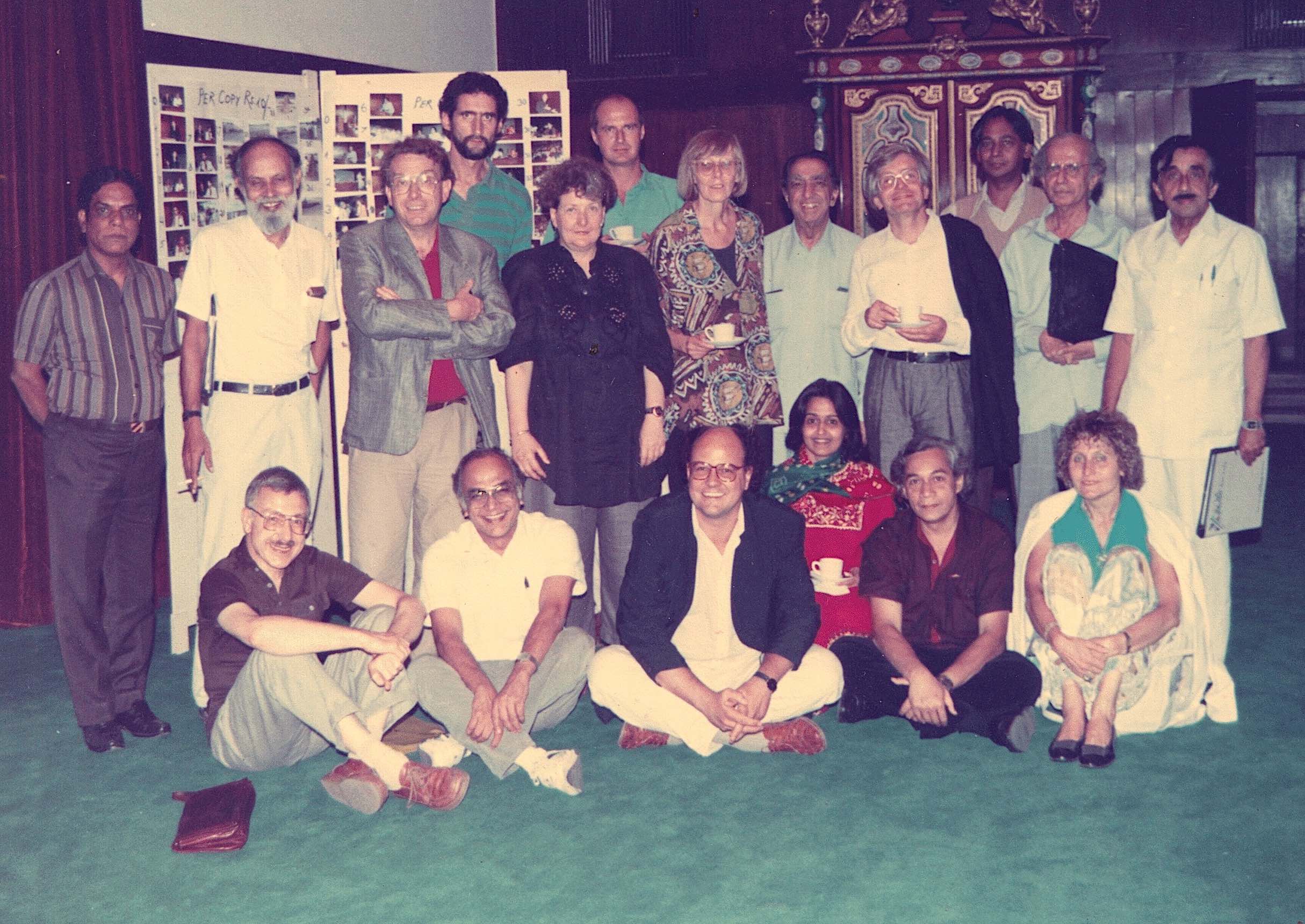
He spent years thinking about what he was convinced was a unique niche occupied by c, the speed of light in vacuum, and h, Planck’s constant. It resulted in a sketch circulated in mid-2024 that was titled “On universal constants’’, in which he argued that the two were, in essence, units of a discrete space-time. (I am not aware whether this work went further either. For what it is worth, a query put to AI yielded the following response: “His insights into this area were part of a long, unfinished draft at the time of his death. His close friends and colleagues view this pursuit of finding a unified relationship among fundamental constants as a treasured part of his legacy.’’). Another paper, “Matter in Discrete Space-Times’’, is available online.8 His emails were peppered with thoughts about whatever he was working on, and he used me as a sounding board – if nothing else, the basic questions prompted by my ignorance forced him to re-examine his logic. In the course of writing those two physics papers he made two characteristic remarks. One was that if humans had been atom-sized, quantum mechanics would not have provided any surprises; and that general relativists should remember that special relativity came first.
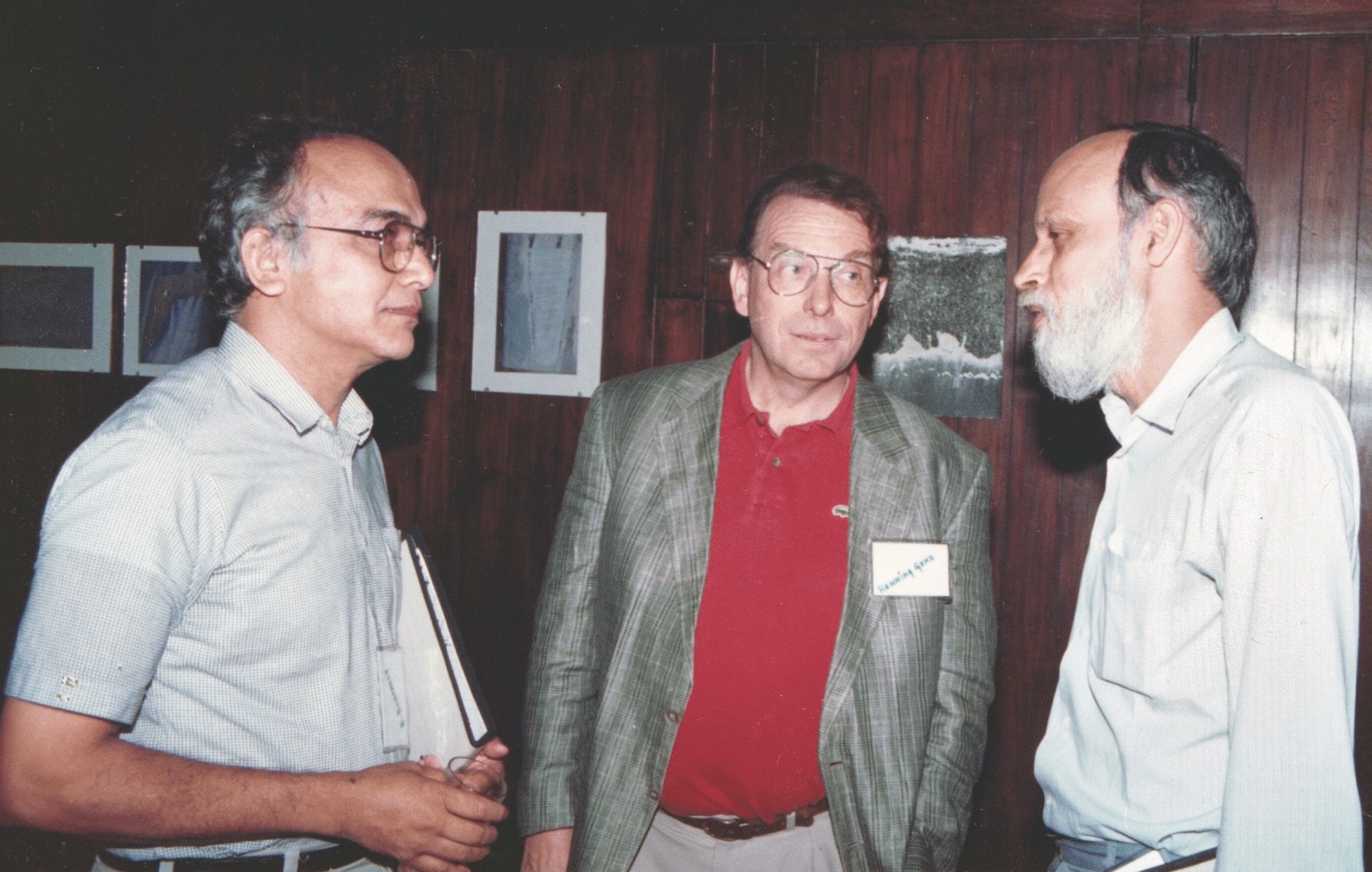
The fascination for mythology and temple art was undoubtedly moulded by Odile, who predeceased him by some months. She was well known for her contributions to the study of Chalukyan temples and to representations of the Mother Goddess in aspects such as Devi or Durga. By accompanying her on field trips, Diva travelled extensively in India. That meant not just where the major temples were, but also to poorly accessible rural locations with sculptures or carvings of unusual quality that were not generally known even to people living in the area. You only had to say you were going to a particular place for him to mention an artefact in the neighbourhood that one simply had to view.
Like many others, Diva was dismayed at the growing hold of bureaucracy over our universities and research institutions, the whittling away at their autonomy, and, in the country as a whole, the tendency to encourage uniformity and discourage dissent. Most of all he was angry at what he saw as the complicity of academics themselves in these developments. He frequently worried that his work on the great achievements of Indian mathematicians of the past could be misused by advocates of the “we knew it all” school. There were two answers to that, he thought. One was to make his findings, and how he came by them, publicly known; and the other was to speak out forcefully about the importance of adopting a scientific approach to history. He did not lose any opportunity to do either.
Vidyanand Nanjundiah is Honorary Professor at the Center for Human Genetics in Bengaluru. Divakaran and he were close friends who exchanged thoughts and writings over the course of four decades. Among many other things, Vidyanand is grateful to Divakaran for having exposed him to glimpses of the beauty, elegance and depth of thinking that physicists strive for.
David Mumford
Although I visited the TIFR for an academic year in 1967–68 and 1978–79, to my loss, I was only occupied with algebraic geometry. I did not know any of the physicists nor historians.
But sometime around 2002, my colleague at Brown, Basilis Gidas, told me about Otto Neugebauer and his decoding of the cuneiform mathematical tablets from ancient Mesopotamia. This pulled me into the history of maths, and I dove into this new area. At that time, I met Neugebauer’s successor, David Pingree, and began to broaden my historical horizons by reading Indian and Chinese sources and pursuing the complex origins of the Pythagorean Rule for right triangles. I was in touch with Seshadri about the creation of CMI, so when Pingree died in 2005, leaving an extraordinary collection of books and manuscripts, Seshadri and I tried to see if we might buy this collection from his estate for the new CMI campus. Unfortunately, that purchase fell through.
But Seshadri was in contact with the thriving group of maths historians in Chennai and, together with Srinivas, Sridharan, Ramasubramanian, and others, Seshadri proposed a seminar on the history of maths in the winter of 2008. That was when I met Divakaran. It was an immensely stimulating seminar and, for me, a wonderful opportunity to deepen my knowledge of ancient Indian maths. From Divakaran, I first learned about the amazing burst of mathematical work in Kerala and the genius of its founder, Mādhava, as well as [Frits] Staal’s work on fire rituals (built using the Pythagorean Rule centuries before the Greeks wrote about it).
One of the topics that Divakaran and I discussed at length was the issue of whether the Vedic peoples merged with the Indus valley peoples to form a new synthesis, forming what Wendy Doniger called a “bricolage” of cultures. Furthermore, we discussed whether, in fact, Dravidian languages are descended from the lost language of the Indus Valley people. As a physicist, Divakaran wanted to go for the big picture, not the careful small steps that most historians deem appropriate. He enjoyed speculations like this, assembling bits of evidence for it. I unearthed a forgotten 1974 paper by Hyla Converse9 that claimed the Agnicayana Rite might be traced to the Indus Valley people. She used pottery and bricks to buttress her theory, which seemed a fascinating and even likely synthesis to us.
Divakaran went on to write his magisterial book entitled The Mathematics of India, focusing on first the early BCE work, then Āryabhaṭa’s work, and finally Mādhava’s work. We discussed by many emails the issue of the invention of decimal notation, which he traced to the Vedas and the naming of huge powers of ten, which is not very different from place value notation. And then we discussed the much-disputed issue of the invention of trigonometry and its astronomical applications, noting how, compared with Ptolemy’s methods, the Indian methods were a much more modern approach to spherical geometry.
Some years later, I began again, after several unsuccessful tries, to master quantum field theory, and this led to another topic in our email friendship – quantum mechanics (QM). Divakaran became a go-to guy when I had questions and found QM daunting. Again, we converged on one radical point of view. We both felt that assuming all physical events took place at points in a 4-dimensional space-time manifold might not be the right way to model tiny scales. In other words, extrapolating the clear structure of our macroscopic world to the atomic scale might not fit with uncertainty and ultraviolet divergence. Divakaran played with discrete space-time. I wondered if a topos might better model the bizarre features of the atomic scale.
I strongly miss not having the opportunity to see him again face-to-face. He had many insights that he would have pursued. The world is poorer without him.
David Mumford, is a distinguished American mathematician whose fundamental work in algebraic geometry largely overlapped with that of the contemporary forerunners of the field in India. History of mathematics in India being another of his major interests, his discussions with Divakaran were frequent and expansive.
S.G. Dani
In my student days at TIFR, in the seventies, we had our offices on the third floor of the A Block, towards the south, and the Theoretical Physics group had their offices at the northern end of the floor. We shared with them the lift landing, and the lobby space in front of it, which often served as a place for gossip, both idle as well as intellectually engaging. They were thus the most visible “others” at the Institute. Another contact point was the West Canteen, which in those days was not so overcrowded as it became later. One of the figures from the group that had made a particular impression on my mind was of Divakaran, this notwithstanding the fact that I never developed a serious contact with him until long after he retired from TIFR in 1996. Even with the casual acquaintance I could feel his engaging personality with a dedicated mind and ready wit. He had a serious approach with regard to scientific thinking and scientific temper. He would often emphasize in conversations that the job of the physicist is to fit theories to facts, with an unmistakable subtext `and not the other way’. His enthusiasm and commitment for science, and the ethos of TIFR that time sustaining it, is best reflected in the following quote from him,10 which I chanced upon recently, in the context of J.B.S. Haldane’s talk at the Indian Science Congress of 1960, held in the Oval Maidan, Bombay:
Quite early on, I was also aware that he had varied interests and had friends in various social spheres, which was also a source of my admiration for him.
One of my first interactions with him that I remember was in the early nineties. I was at that time reading the book The Crest of the Peacock by George Gheverghese Joseph, and conveyed to some people around my disapproval of it—while I could not appreciate the overall tenor of the book, my particular grudge was that the book lent needless credibility to the so-called “Vedic Mathematics (VM)” of Bharati Krishna Tirthaji, which I had been critical of, and wrote articles around that time debunking its claims.11 Divakaran came to know about it, from Raghunathan I think, and made it a point to discuss it with me in some detail.
On the whole, however, I did not have the benefit of close contact with him, especially the proximity having been lost due to his retirement in 1996, which was still an early phase of our personal acquaintance. The main anchor of our later contacts, which perhaps is the basis of being invited to write this piece, was the interest we both developed, independently, in the history of mathematics, sometime following the turn of the millennium. As is well-known, he pursued the topic with full vigour and made contributions in the area which are nothing short of amazing, given especially that he had entered the arena quite late in his life. He is widely known for his writings on the Kerala School of mathematics (which he preferred to call the Nila School) with which he had personal affinity. He also had a direct feel for it, on account of being a Malayalee himself, and being well aware of the history of the region, in the socio-political context. However, his oeuvre in the subject goes well beyond that, covering a broad spectrum of topics and historical periods, on which he has contributed fresh insights: the Ṛgveda and its decimal system, the works of Āryabhaṭa for whom he shows special fondness, Brahmagupta… and much else, have come under new light in his writings. While it is normal in such a situation that one would take up writing a book on the subject, it is highly creditable, and fortunate, that he actually took it up while he was nearly 80 years of age. He once told me it took five years of effort, but he enjoyed it. After the manuscript was ready and reviewed, there was some inexplicable delay in the final version being prepared, and it gives me some personal delight to have given the process a push, through some correspondence with the editor Rajendra Bhatia and him.
Along the way I was also dabbling with some topics in the history of Indian mathematics, while minding my other responsibilities. During this period he would visit TIFR once in a while and on such occasions would make it a point to drop in at my office, and tell me various things from his latest pursuits and ideas – sometimes there would also be an advance email alert. I doubt if I served as a sounding board for him, though it would be a comforting thought to think I had been one(!) – he was usually clear and firm on his ideas and inferences, and hardly needed a sounding board. It was however a pleasure, and inspirational, to listen to him and to learn many new, unexpected, things.
Later, in 2009, when he was affiliated with IUCAA, Pune, he organized a two-day conference there, on November 17–18. By this time I was involved with the Indian Society for History of Mathematics (ISHM), and had been serving as President of the Society since the previous year. Apart from giving a talk myself, I was also able to suggest from my contacts from ISHM a speaker, Madhukar Mallayya, for the conference. The conference was organized immaculately, keeping to scholarly norms, and featured among others a talk by Roddam Narasimha.
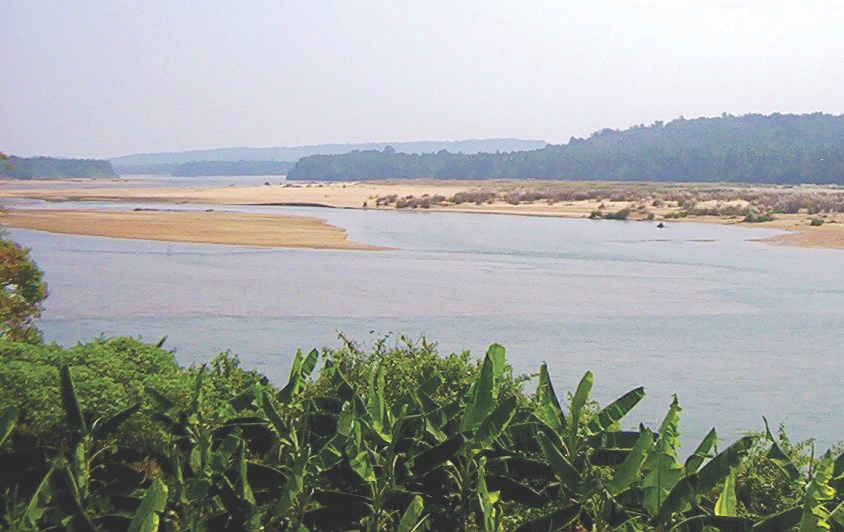
2010 was the year of the International Congress of Mathematicians (ICM), held in India, in August, at Hyderabad. A satellite conference, following the ICM, on history of mathematics was organized at the (modern) Kerala School of Mathematics, Calicut, spearheaded by NBHM (National Board for Higher Mathematics), of which I was then the Chairman. It was but natural to enlist Divakaran as a member of the Organizing Committee for the conference, and he played an active role in the planning of the conference. At his initiative a tour was arranged for the interested delegates, which included many foreigners, to visit the neighbourhood where the older Kerala School of Mādhava had flourished, some centuries ago. It included a visit to the banks of river Nila, and to a family of descendants of Parameśvara, one of the major exponents from the Kerala School. With his enthusiastic commentary, based on his deep knowledge, Divakaran could make the idyllic surroundings come alive in a historical perspective.
The same year, in December 2010, I took over as Editor of Gaṇita Bhāratī, the bulletin of the Indian Society for History of Mathematics. I tried to get Divakaran involved with the endeavor, but somehow it did not work, until later, which I will come to shortly. He somehow had apprehensions about the funding of the journal and the people associated with it. Though at some stage I convinced him, I think, that his concerns were unfounded, and in principle he concurred with it, saying something like “good, I am relieved”, materially the status did not change much. Interestingly, apparently as a concession, he did let his younger collaborator Bhagyashree Bavare publish a preliminary paper on their joint project on the numbers in Ṛgveda in Gaṇita Bhāratī, without lending his name; the final report, in joint name, however, appeared in the Indian Journal of History of Science. It is a matter of great regret for me that I could not get him involved in Gaṇita Bhāratī, though I am convinced it would have served a larger interest.
After several years, after the dust had settled so to speak, on one occasion it occurred to me that I could invite him to write for Gaṇita Bhāratī on a topic he would not refuse. This was the occasion of the centenary anniversary of the celebrated historian of Indian mathematics, T.A. Sarasvati Amma, during 2018–19. I knew of his fondness, and respect, for her as a historian, and though I still had some trepidation while approaching him for it, as I had surmised, not only did he not decline, he wrote enthusiastically and in a timely fashion. The paper, which runs into 16 pages in print, gives a detailed account of her life (to the extent that it is known – clarifying what is not known, without fudging the details), an appreciation of her work, especially her ground-breaking book Geometry in Ancient and Medieval India. The article unfolds her persona, with her likes and dislikes, and the pleasures and pains she encountered at various stages. Let me conclude this write-up with a quotation from the article12 – parenthetic reference details are omitted.
Some parallels with the present subject come to mind – along with obvious differences in the context; they hardly need elaboration.
S.G. Dani is Distinguished Professor and Chair of the School of Mathematical Sciences at the Centre for Excellence in Basic Sciences, Mumbai. His years at TIFR Mumbai overlapped with those of Divakaran, and his interest in the history of mathematics brought him close to the latter.
Bhagyashree Bavare
My acquaintance with Divakaran happened through the project at TIFR where I was working as a research assistant for the span of 2007 to 2009. I was a fresher and had just completed my studies in the field of Sanskrit and accidentally came across this opportunity to work at the place which in no way I could have even dreamt of.
At TIFR, a project titled `Archaeo-Astronomy in Indian Context’ was underway. The team required a research assistant with good hold over Sanskrit as several ancient literary sources for mathematics or astronomy were composed in Sanskrit. This two year span, where I had landed unexpectedly and even hesitantly, turned out to be the most insightful and meaningful part of my life. It opened my eyes allowing me to see an entirely different world, different people and different knowledge areas. Even at the mess or at the cafeteria, on the beautiful sea shores behind the TIFR building, in the corridors or in the bus, the talks and discussions that took place were making me feel alien to that planet and my nervousness increased by the day.
I was exploring different Sanskrit texts and my teachers and colleagues from the team were also helping me to come up with some good research. During this phase Divakaran gave multiple suggestions in one of the experts committee meetings, paving a way for my research career. He himself was researching and working on some ancient Indian texts of mathematics. He handed over a copy of one of the Sanskrit commentaries to me, asked me to study it and come prepared with some notes. I was completely unaware at that point, how this book can actually bring out a strong article with a multidisciplinary approach. As we began working in a team and exploring the text under his guidance, I was gaining practical training on research methodology.
What I admired the most was his humorous nature which allowed a young researcher like me to establish a dialogue with him and learn at each step some nuances of carrying out a research. As this was my first research article I was not acquainted with the scientific terminology or techniques required in a research article. Writing this first article was a learning experience for a lifetime. As we proceeded I gradually realized the depth of his scholarship, versatility, curious mind and a keen interest he took in all the fields of knowledge. Preparing a research article is a skill in itself. He indirectly taught me how to frame a research question and justify it with ample examples.
Most of the time, in our meetings he made the situation lighter with his laughs and jokes but I always found him to be a man of principles and discipline. His passion towards his research was incomparable and there were times when we experienced his anger and scoldings as well. Especially if a silly error is repeated in a work he would get utterly upset and would say “make a new mistake every time to learn something new but don’t repeat it”. A life lesson which I still treasure.
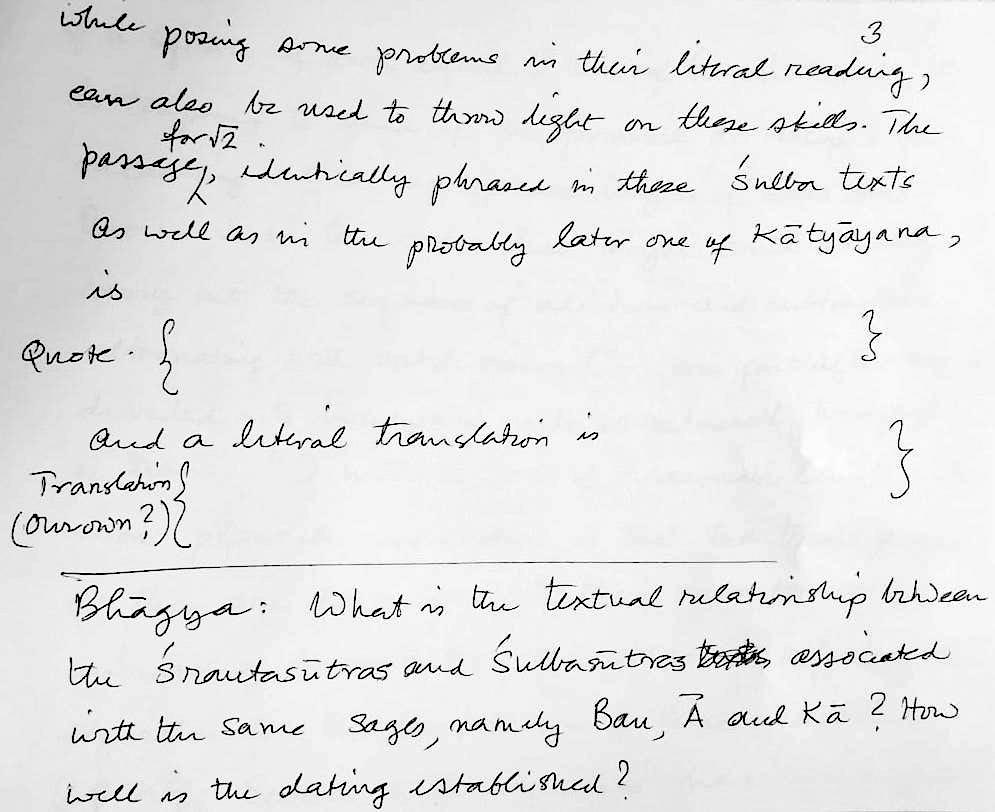
With regard to the second research article that we jointly prepared, and for which I got an opportunity to present a talk at the Conference on History of Mathematics in Calicut and also at IUCAA, it was another learning experience. As a student of Sanskrit language we had opened the pages of the Veda Saṃhitās quite a few times but the kind of questions he asked made me search the texts deeper and deeper. We literally tried to study almost all instances of the number names that we were able to locate in the Ṛgveda Saṃhitā. He used to discuss the meaning of the words, the padapāṭha (the traditional method of splitting the words in a vedic mantra) along with the commentary over it. He wanted to understand the precise positions of the number name and each and every possible interpretation of it. He urged me to find out the grammatical sūtras of Paṇini which can explain and justify the best possible meaning of the word. I used to be amazed by his understanding of the rules while he actually didn’t have a formal education in this language. When he would realize that the ideas in his mind can really be justified with examples his eyes used to light up. I think what fascinated him the most was the reasoning applied in the traditional techniques of grammar and linguistics.
His persistent follow ups over these examples made it possible to complete the article which gave me a sense of accomplishment. Even though I moved on to explore an entirely different career path, he always had some advice and insights to share.
I shall always be indebted to him for all the learnings I received from him, either directly or indirectly. His cheerful, jovial nature and his smiling face will always be in my memory.
Bhagyashree Bavare is a faculty member at the Somaiya Vidyavihar University. Her informed background of Sanskrit got her an opportunity to work with Divakaran, resulting in an insightful research and the oft-cited jointly written article with him, giving her the distinction as his only collaborator on the topic.
Amartya Kumar Dutta
Among the many correspondences I had with him, there is one particular email which I would like to share as I feel that it best captures the quintessential Divakaran. The context: I had received a published article talking about the area of cyclic quadrilaterals from Brahmagupta to Euler, which I had sent to Divakaran for his views since he had been making a serious study of Brahmagupta’s geometry verses. Prompt came his following response (23.3.2015, quoted almost entirely):
The real problem with much Western writing on Indian math history is that they really have nothing interesting to say. They have read (some of) the relevant literature (all meticulously referenced, but not all meticulously read) and just regurgitate the material in modern notation. Even the mistakes they make are not original, just repetitions of earlier, sometimes much earlier, ones. This article is very much in that modern tradition of scholarship.[…]
As far as the Indian part of the article is concerned, it is pretty depressing to read. There are very many inaccuracies, both historical and textual. Sarasvati Amma has something to answer for (though I admire her work greatly): the perpetuation of Colebrooke’s mistake in reading `tricaturbhuja’ as both a triangle and a rectangle.
On the whole an ignorable piece of work. But I was interested to read Euler’s proof of the area theorem which I did not know. Mixes geometry and algebra in pretty much the same way as Indian geometry has always done.
Divakaran
On another occasion, I sent him a letter-to-the-editor about E.C.G. Sudarshan and S.N. Bose, to check the accuracy of its content. He promptly wrote back (2.6.2018):
Divakaran often expressed his anguish at the tendency of some of the modern authors to attribute defects in the works of ancient Indian stalwarts like Brahmagupta without going deep into their works. He once wrote to me (8.3.2016):
In November 2014, we had a long conversation during the International Conference on History of Mathematics at Pune, where Divakaran had been ruing superficiality even among well-established scholars and authors. I was reminded of an observation of Sri Aurobindo on Vedic studies, and could not help sharing it with him:
Divakaran’s eyes lit up with childlike surprise and thrill: “Sri Aurobindo said this?” It was as if he was filled with the joy of coming across a thinker with whom he could feel affinity!
Divakaran had retired from TIFR in 1996 and I was at TIFR School of Mathematics during 1988–96 before joining ISI Kolkata as a faculty member. During those days, I didn’t have any discussions with him. But Divakaran would often join my teacher Amit Roy (1940–2010) at the TIFR canteens and I would silently observe with amazement the two polymaths discuss a wide range of subjects from the world of mathematics and physics to Italian art and architecture. The no-nonsense Divakaran used to be all focussed and absorbed in his conversations with Amit Roy and I do not think he had taken any notice of the quiet, shy and docile youngster in the same table.
It was only sometime in April-May 2002, when we were both visiting TIFR, that we had our first conversations. They centred around an overview article of mine summarising some of the well-established facts about ancient Indian mathematics that had just appeared in Resonance.
While we were both in an elevator I had told Divakaran, somewhat impulsively, about my Resonance article. I believe Divakaran hardly knew me then. However, he promptly said that he’ll look at it. And, to my pleasant surprise, he did, and in no time! For, I heard from some of my friends, probably the very next day, that he was discussing the article at length and was appreciative of it. This incident is an indicator of his Energy: within a short time, he had gone to the TIFR library, located the article by a relatively unknown youngster, read it, and was soon discussing its content with distinguished mathematicians in the magnificent “West Canteen” of TIFR! One can only imagine how encouraging a beginner like me would have felt. As M.D. Srinivas remarked,
When we conversed in the TIFR canteen, I could feel that he was touched by the article, particularly the references to the Kerala School of Mathematics. He specifically lauded my highlighting of the fact that in the series expansion of the Mādhava school:
\[\begin{align*} \theta = \tan {\theta} –
\frac{(\tan {\theta})^3}{3} + \frac{(\tan {\theta})^5}{5} –
\frac{(\tan {\theta})^7}{7}
+ \cdots\quad \hfill{(|\tan {\theta}| \leq 1)},\end{align*}\]
the explicit statement that (|\tan {\theta}| \leq 1) reveals the level of sophistication in their understanding of the infinite series, including an awareness of convergence.
This brings me to a vital contribution of Divakaran for ancient Indian mathematics that goes beyond his valuable published articles in the subject: through his vigorous personal interactions with many mathematicians and scientists, Divakaran had made them aware, and convinced them, that there was something seriously non-trivial in ancient Indian mathematics and this ensured that at least some of them became receptive to the glorious achievements of Indian mathematics.
Divakaran was particularly mesmerized by the calculus of the Kerala school of Mādhava which once flourished near the banks of the river Nila. He fondly referred to the river Nila as the “River of Calculus”. As M.S. Sriram observed about Divakaran,
The occurrence of calculus and analysis in Indian treatises had been pointed out by several scholars on Indian mathematics well before Divakaran. But those had remained almost confidential utterances in the realm of specialists. With his bold title “First Textbook of Calculus: Yuktibhāṣā” and forceful expositions, Divakaran hammered home the calculus aspects in our mathematics research institutes.
Divakaran was touchy about the theme of calculus in India. During the inaugural session of a conference in November 2014, one of the speakers used the phrase “akin to calculus”, while referring to the work of the Kerala school. The 78-year old Divakaran checked with me whether he heard him right. With a stern face, he asked me “What did he say?”
I had no words of comfort for him and meekly confirmed what I had heard. I could feel that he had gone into a rage. Whenever he would see me in the conference, he would murmur “akin to calculus?” At an opportunity, he made long reminiscences on how the mathematician M.S. Narasimhan, who was extremely rigorous about mathematics, too had readily agreed “yes, this was calculus”; and how David Mumford had shown keen interest when Divakaran revealed the calculus-intricacies of the work—all the time fuming, “akin to calculus?” Consequently, whenever I come across the word “akin”, I get reminded of my kinship with Divakaran on the calculus in India issue.
I may mention that Divakaran’s drawing the attention of Mumford to the history of Indian mathematics had significant consequences in the historiography of Indian mathematics. Readers of Bhāvanā may recall that my article on the Foundations of Algebra in India in the April 2023 issue was an elaboration of a succinct remark of Mumford.
When Mumford visited CMI around January 2008, Divakaran was among the CMI faculty members who organized a series of seminars on Indian mathematics culminating in the volume Studies in the History of Indian Mathematics, edited by C.S. Seshadri, containing valuable articles. It is from Divakaran’s paper on “Recursive Methods in Indian Mathematics” in this volume (p. 296) that I first came to know of Newton’s statement connecting the Indian decimal system and arithmetic operations with the algebra of polynomials. Since then Newton’s quote has been a cornerstone of my own expositions on the algebraic significance of the Decimal System, including my article on Computational Mathematics in Vedic and Sūtra Literature in the April 2022 issue (see p. 48) of the Bhāvanā.
I was happy to see that in p. 186 of his book The Mathematics in India: Concepts, Methods, Connections, Divakaran had referred to my article on Kuṭṭaka, Bhāvanā and Cakravāla in the aforementioned volume for further details on the unifying thread connecting the works of the individual mathematicians.
After I got a copy of Divakaran’s book, I showed it to my mother who was increasingly getting invalid due to bone cancer. She had no knowledge of, or interest in, mathematics. And yet, lying in her bed, she used to read the book regularly, with visible interest! The history and cultural content of the book, and the author’s style, must have fascinated her.
During the process of writing the book, Divakaran would send me drafts and share his thoughts. An example (20.4.2015):
Amartya Kumar Dutta has been at the Indian Statistical Institute for three decades. Prior to that, he was at TIFR Mumbai where, as a PhD student, he would often see Divakaran in delightful conversations with colleagues. Later, as his interests in the history of mathematics grew stronger, his interactions with Divakaran became intense and lively and he enjoyed a warm bond of friendship.
C.S. Rajan
Divakaran was a universalist, a mathematical physicist with a deep interest in history, especially Indian history; an avid tennis player and a sports enthusiast. A charming conversationalist, his membership in a prestigious South Mumbai Club gave him a window to life outside of the scientific world, which he shared with us. Although he held definite opinions, life for him was still a game not to get worked up about, but to observe and enjoy the follies of humankind.
In mathematics, we shared a common interest in projective representations. It was fascinating to hear his interpretation of a result of mine on the unique factorization of tensor products of irreducible representations of a connected compact group in the language of particle physics: elementary particles are to be thought of as irreducible representations of a compact simple group and interactions among them is encoded in the tensor product of the representations. Thus when you know the outcome of an interaction, then the unique factorization theorem implies that the original particles are uniquely determined!
He was greatly interested in the TIFR library acquiring a copy of Hortus Malabaricus,14 the encyclopedic collection of plant life compiled by Dutch scientists on the basis of knowledge gleaned from Ayurvedic physicians in the seventeenth century. These volumes are pre-Linnaean,15 written in Latin and supposed to have influenced the modern classification of plants. Due to the efforts of K.S. Manilal, they were later updated and translated to Malayalam and English. Unfortunately, Hortus Malabaricus was out of print by then. Divakaran was keen that these volumes be reprinted, possibly in the style of the original volumes, and that these volumes be accessible to the Indian community. Unfortunately, this remained only a dream on the part of Divakaran.
A tribute to Divakaran and ancient Indian knowledge systems, will be to get a print of Hortus Malabaricus or at least make available high fidelity images of it accessible online to one and all.
C.S. Rajan is presently a professor of mathematics at the Ashoka University in Sonipat. His acquaintance with Divakaran, going back to his PhD days at TIFR Mumbai, was marked by exciting discussions on topics mathematical and otherwise.
K. VijayRaghavan
Divakaran had a mind of his own. Politely, and firmly, he could—if you engaged with him—let you know where you, and he, stood. To drive in a dagger without your knowing it is an art form requiring sophistication in language and argument with an anchoring in fact and logic. Frankness and honesty also requires a disregard for consequences, and therefore is rare. For most of us, niceties clothe disagreements, and conversations about trivia is what the cloth is made of. Divakaran chose his friends, argued and jousted with them, and in doing so always raised the quality of conversation away from inanities.
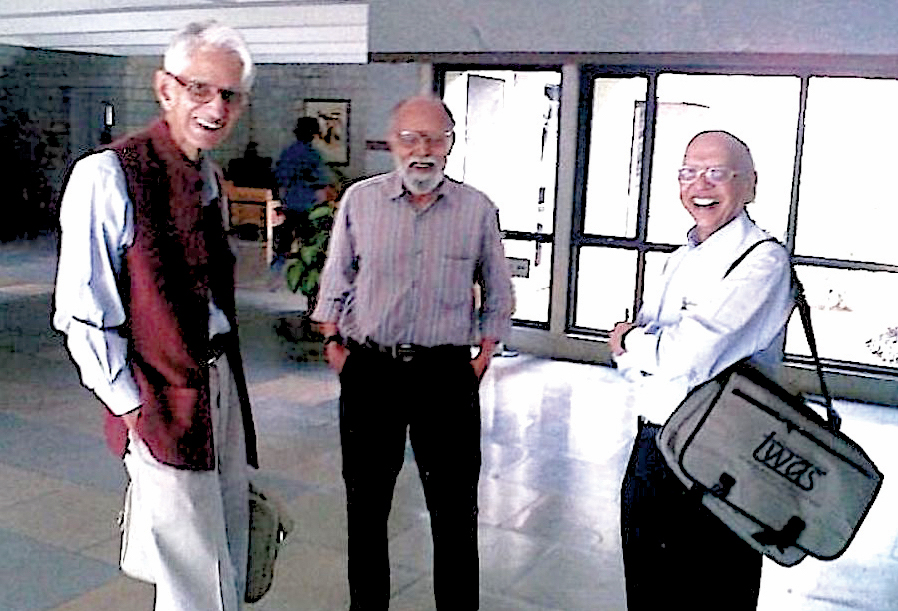
It was in this ambience that many of us became friends with Divakaran. With Obaid, Divakaran discussed temple art and architecture, an area where his wife Odile was an expert. He also played tennis regularly with Obaid and M.S. Raghunathan. With Pabitra Maitra (PKM), he shared cigarettes (then allowed in the West Canteen, with the butts and ash deposited on now invaluable ceramic ashtrays each crafted by Badri Narayan) interspersed with heated discussions on everything. Divakaran was provocative to the easily provoked Maitra, making for stimulating theatre. With P. Babu, who, like Divakaran, belonged to one of the first batches of the Atomic Energy `Training School’, he shared experiences of the early days of TIFR. Both TIFR and its hostels were for a while at the Old Yacht Club (now home of the Department of Atomic Energy, and a beautiful heritage building). We heard about courses, science, visitors and rats scurrying over humans in their bedrooms. We, philistines, were initially silent gawkers at this intellectual feast, but over the years took courage and added our naive questions. Through Divakaran, we got to know many mathematicians, such as M.S. Raghunathan, M.S. Narasimhan, C.S. Seshadri, S. Ramanan, and T.R. Ramadas and others. What started as a nodding acknowledgement of our presence developed into a friendship.
Walking from the residential area to the labs, we often bumped into Divakaran. Indeed this happened at such an unnatural frequency that some of us biologists surmised that he must always be going or coming, and we often joked about this. It was only slowly that it dawned on us that as a deeply affectionate and responsible father of a differently abled child, Divakaran had to make frequent visits to his apartment and back. In the event, encounters during his trips also allowed many stimulating conversations and banter.
From these conversations, we got a non-canonical, underground, history of the TIFR, particularly of the growth of physics and mathematics. Why and how, for example, did Jayant Narlikar leave TIFR and what did it take to establish the Inter-University Centre for Astronomy and Astrophysics? Another topic that he went thorough in detail was the birth and growth of what is now the Institute of Mathematical Sciences (IMSc) in Chennai. From Divakaran, we learned about how it was founded, how it grew, how the Department of Atomic Energy eventually took it over. There was metaphorical blood-letting at IMSc in the early 1990s, and Divakaran gave us an annotated blow-by-blow account, as all the protagonists were close to him. We also learned about how C.S. Seshadri went about establishing what is now the Chennai Mathematical Institute. What was the background to the formation of the TIFR-Centre for Applicable (not Applied!) mathematics? How did Govind Swarup succeed in establishing the Ooty Radio Telescope, and then the National Centre for Radio-Astrophysics and then the Giant Metrewave Radio Telescope?
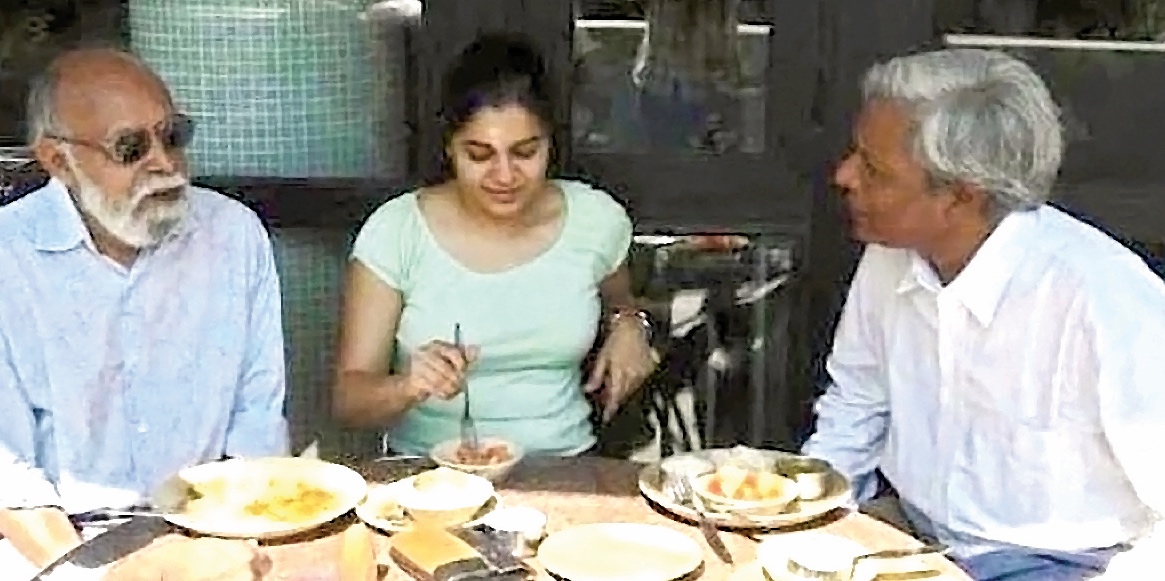
Post TIFR, Divakaran went to IMSc, and the CMI and then to the Inter-University Centre for Astronomy and Astrophysics (IUCAA). We—those at the NCBS-TIFR—used to run into him occasionally in Pune or Mumbai. To us he was no different, but his research interests had shifted to a scholarly study of the history of science in India. In 2010, on a visit to TIFR Mumbai, Obaid ran into him and discussed his work on Āryabhaṭa. Returning to Bangalore, Obaid urged us—and no persuasion was needed—to invite Divakaran for a talk on Āryabhaṭa. The talk, “On reading Aryabhata” was a draw. Divakaran enjoyed his visit to NCBS very much. This was in 2010, about the time when his Homi Bhabha Senior Fellowship term at IUCAA was running out. When asked about the possibility of moving to NCBS from IUCAA, Divakaran wrote that he would consider it. A draft offer letter followed, which he happily approved. Divakaran was a true intellectual who, it could be surmised, would bristle at being asked what he planned to do at NCBS. Nevertheless, he responded to a gentle request with a CV and plans. The excerpts, below, illustrate a great mind.
This was very comprehensible to our administration and our biologists.
If there is interest, I will be happy to give an informal course/seminar at NCBS on an overview of Indian mathematical culture. I look forward to interacting with the students in particular and to sharing my enthusiasm with them (Italics mine)
NCBS is already involved in the encouragement and support of a deeper understanding of Indian scientific traditions, notably herbal and botanical science. There are points of commonality between that and the tradition in mathematics and astronomy. It will be fun to explore these parallels more thoroughly.
On re-reading the above, it is not only impressive what Divakaran did in physics and in the history of science in India, but his clarity of thought comes through. He was a constant presence with our students and faculty talking about all of the above and much more, while pursuing his scholarly work, all of which is not published. In 2013, after I had moved to Delhi, I heard that Divakaran had moved to Cochin. This was without doubt something that we should not have let happen. In facilitating a scholar with interests outside our own narrow ones, it is we who benefited the most and his absence was our deep loss.
Divakaran kept in touch periodically by email and phone, we discussed the Bakhshali manuscript, his book, and so on. With his loss another great scientist-scholar has passed. It will be appropriate to organize an exhibition of his work in a form that is accessible to school and college children. A task for the willing, for which there will be many.
K. VijayRaghavan is an emeritus professor and former director of the National Centre for Biological Sciences of TIFR. A graduate student and faculty member in the Molecular Biology group of TIFR Mumbai during his early career, he had a longstanding friendship with Divakaran, and a deep admiration.\blacksquare
Footnotes
- In Malayalam, `Ettan’ means elder brother – it is a North Malabar variant of Chettan – Jyeshthan; and `Ettathi’ means elder sister – a variant of Chettathi. ↩
- P. P. Divakaran, Notes on Yuktibhāṣā: recursive methods in Indian mathematics. Studies in the history of Indian mathematics, 287–351, Cult. Hist. Math., 5, Hindustan Book Agency, New Delhi, 2010. ↩
- Bhagyashree Bavare; P. P. Divakaran, Genesis and early evolution of decimal enumeration: evidence from number names in Ṛgveda. Indian J. Hist. Sci. 48 (2013), no. 4, 535–581. ↩
- P. P. Divakaran, “What is Indian about Indian mathematics?” Indian J. Hist. Sci. 51 (2016), no. 1, 56–82. ↩
- P. P. Divakaran, The mathematics of India: Concepts, methods, connections, Hindustan Book Agency, New Delhi, 2018. ↩
- M.S. Narasimhan, Review of the Book The mathematics of India. Concepts, methods, connections, Current Science Vol. 117 (2019), pp. 309 -311. ↩
- Avinash Sathaye, Review of the Book The mathematics of India. Concepts, methods, connections, Bhāvanā, Vol. 3, Issue 1, January 2019. ↩
- https://arxiv.org/abs/2404.04548. ↩
- History of Religions, Vol.14, 1974, pp.81–95. ↩
- From J.B.S. Haldane: an isolated souvenir, by P.P Divakaran, Journal of Genetics, Vol. 96, No. 5, November 2017, page 733. ↩
- I should clarify here that later I came in personal contact with G.G. Joseph and understood his perspective better, and on the other hand, he relented on the matter of VM, and made amends in later editions, which he confided was owing to my criticism. ↩
- T.A. Sarasvati Amma: A Centennial Tribute, by P.P. Divakaran, Gaṇita Bhāratī Vol. 40 (2018), 83–98. ↩
- In one of his early writings, Sri Aurobindo discusses the Isha Upanishad in the form of a dialogue between the Guru and his student. He puts the quoted passage as the utterance of the Guru. ↩
- Hortus Malabaricus, or the garden of Malabar, is a twelve volume compendium published in Amsterdam between 1678 and 1693. This monumental work, representing a harmonious fusion of Indian traditions and European science, is possibly one of the earliest collaborative efforts in botanical history. ↩
- Pre-Linnaean refers to the systems of biological classification and scientific literature that existed before Carl Linnaeus established his standardized system, particularly the introduction of binomial nomenclature (two-part scientific names) in the mid-18th century. ↩