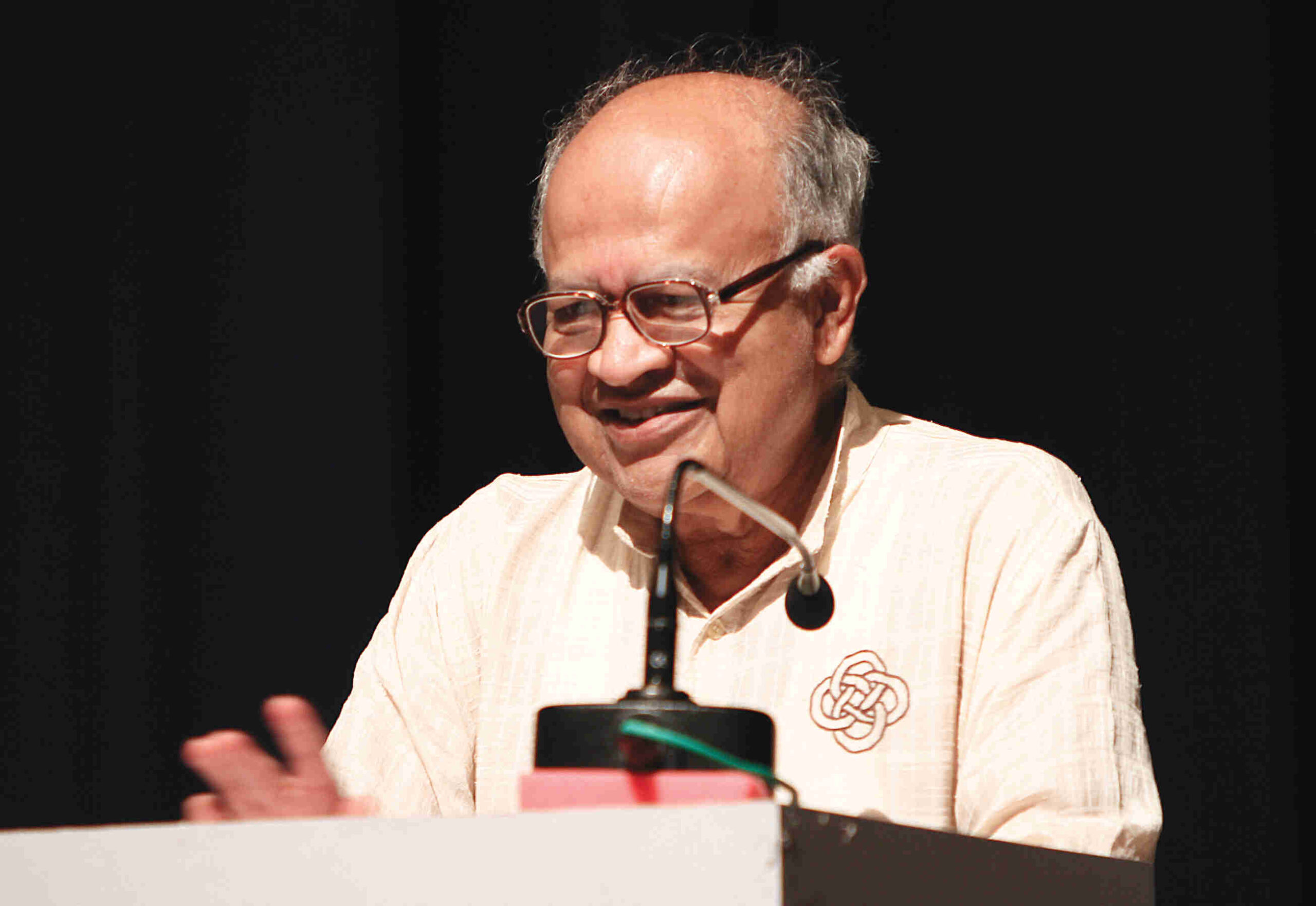
In the demise of Jayant Vishnu Narlikar on the 20th of May, all who knew him – from a remote school student familiar with the name reading his engaging science stories, to an accomplished scientist who worked alongside him for decades – felt a deep personal void, that someone who was so accessible until that moment moved to a world forever out of reach. The way in which he bonded with each individual who came in contact with him through a science story or a letter, or an email in recent years, or in person in any which way, was unique. His accessibility was not just about himself or his work alone but to a broader world of science, scientists and establishments across time and geographies, that an excited student could himself aspire to be one of the scientist installations standing tall in the campus of IUCAA (Inter-University Centre for Astronomy and Astrophysics). The ability of JVN, as he is often referred to, to connect with unmistakable spontaneity, sense of purpose, palpable warmth, and equanimity all along endeared him to a whole range of admirers. All of this and more, come alive in the fond recollections we sought to put together in this humble tribute to a kind and gentle soul whose giant strides of exploration enabled our understanding of a myriad things.
Geeta, Girija and Leelavati Narlikar
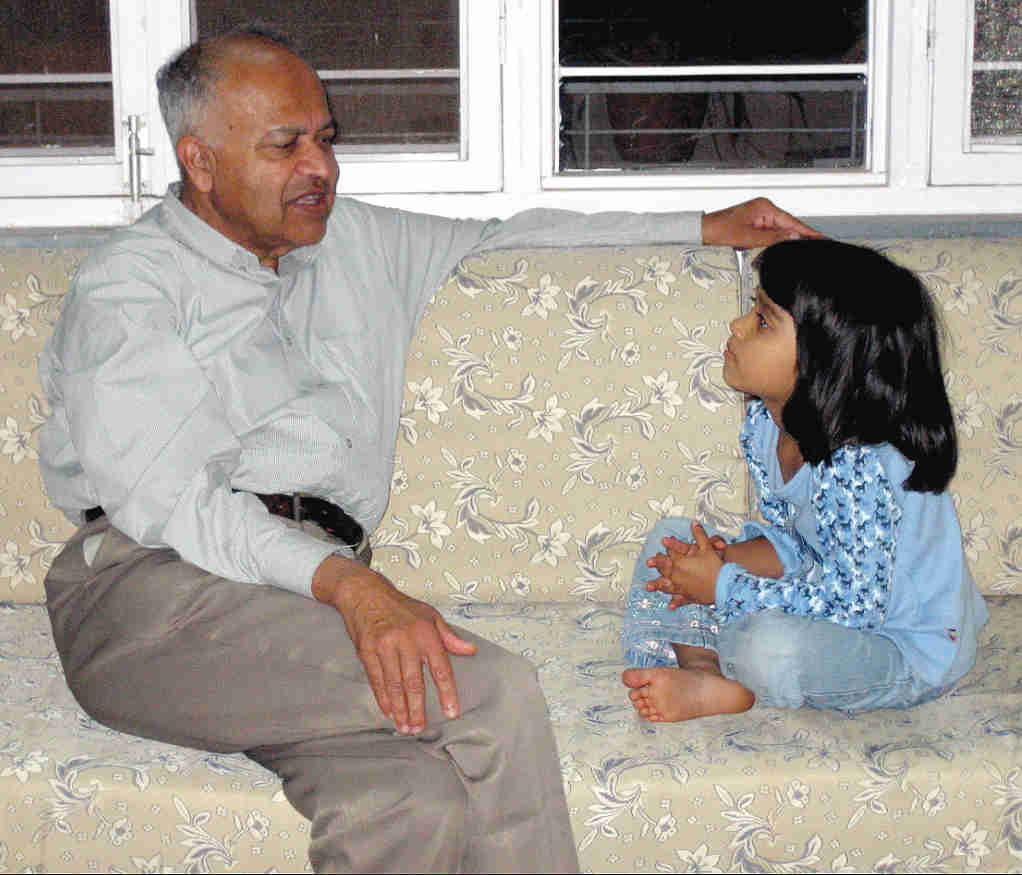
“A wicked princess with green hair, a kind magician, a forgetful witch, and a talking horse’’-–imagine that you have five minutes to spin a fun story with these four characters! Some of our early memories of our father, Jayant Narlikar (“Baba’’ to us three sisters), are of the bedtime stories he would tell us every night. He would read us tales of characters such as A.A. Milne’s Winnie-the-Pooh and later Sapper’s Bulldog Drummond. Over time, however, he would invent new stories on the spot, incorporating characters from each of us sisters. Naturally, we would try to concoct the most unusual combinations, giving him mere minutes to weave a captivating new narrative featuring them all! Baba would rise to this creative challenge, much to our wonder and delight. We like to think we gave him plenty of practice to become a celebrated science fiction writer shortly thereafter!
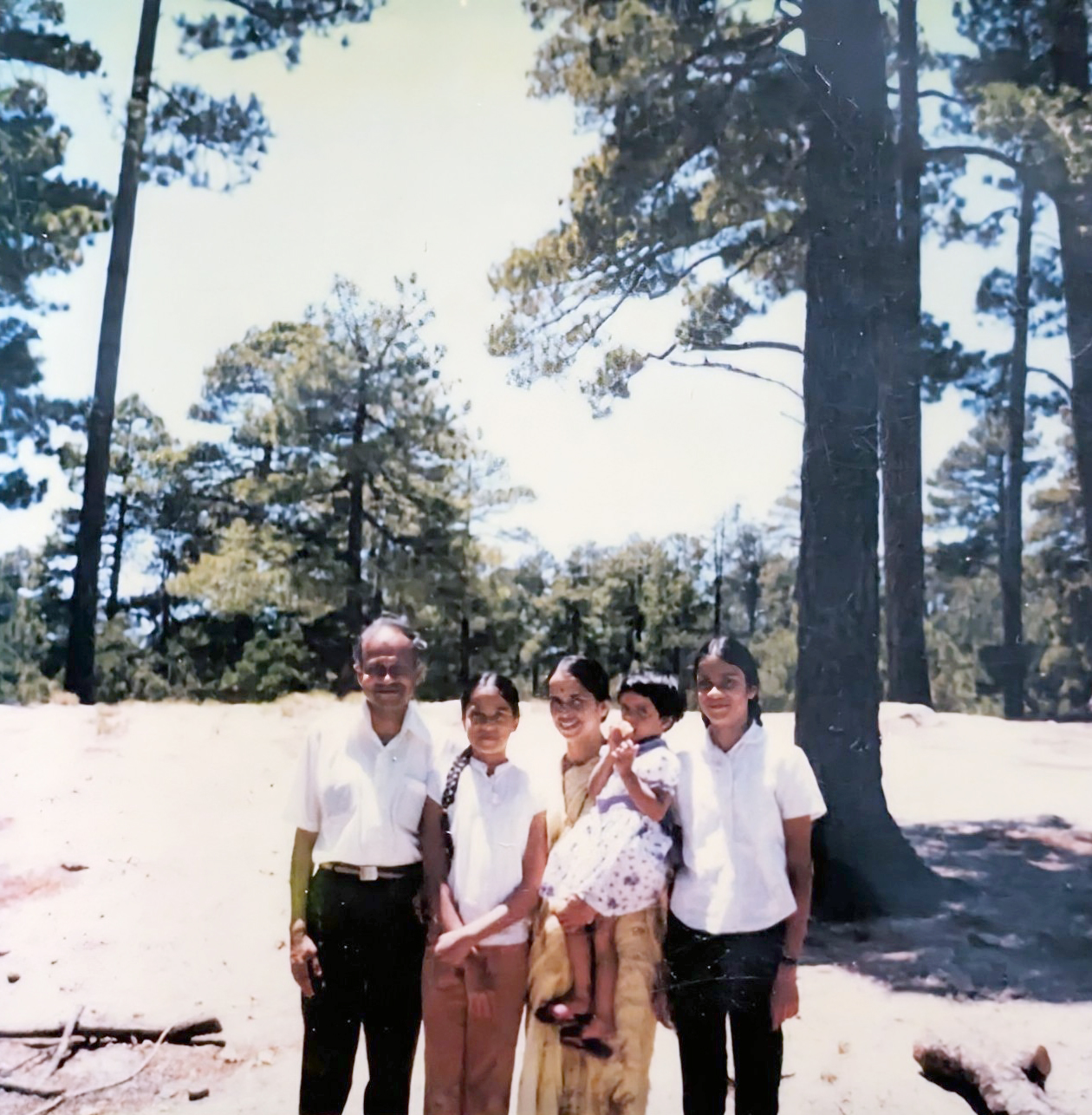
Aai was a brilliant mathematician herself, and our parents would discuss unfathomable mathematics problems on the blackboard they had set up for us sisters. They would also often give us puzzles or brain teasers for fun, which we greatly enjoyed as a challenge. We fondly recall spending hours poring over Martin Gardner’s Aha! books on brain teasers and paradoxes that our parents had purchased for us. Our parents later went on to write books on mathematics and logic puzzles themselves, realizing this was a great way to make mathematics accessible to all. While our parents were both mathematicians, they made a wide range of literature and experiences available to us sisters, as well as to our children, and fostered an atmosphere that promoted freedom of thought and choice.
Another enduring memory from our early childhood is of Baba sitting at the dining table between meals with a stack of postcards. These would be from people (often children) asking him questions on science. He would frequently be asked for autographs wherever he went. Instead of signing autographs, he would ask folks to send him a question on science. Baba would meticulously reply to each such postcard in his incredibly beautiful handwriting and include his signature. Since this was before the Internet, he would sometimes have to consult other sources to find the correct answers. Regardless, he somehow found the time to reply to each sender. All this while conducting research and teaching at TIFR, writing astrophysics and science fiction books, and spending quality time with his family. Looking back, it seems like an almost miraculous feat of time management! To this day, we encounter folks who have cherished a postcard reply from our father.
 |
|
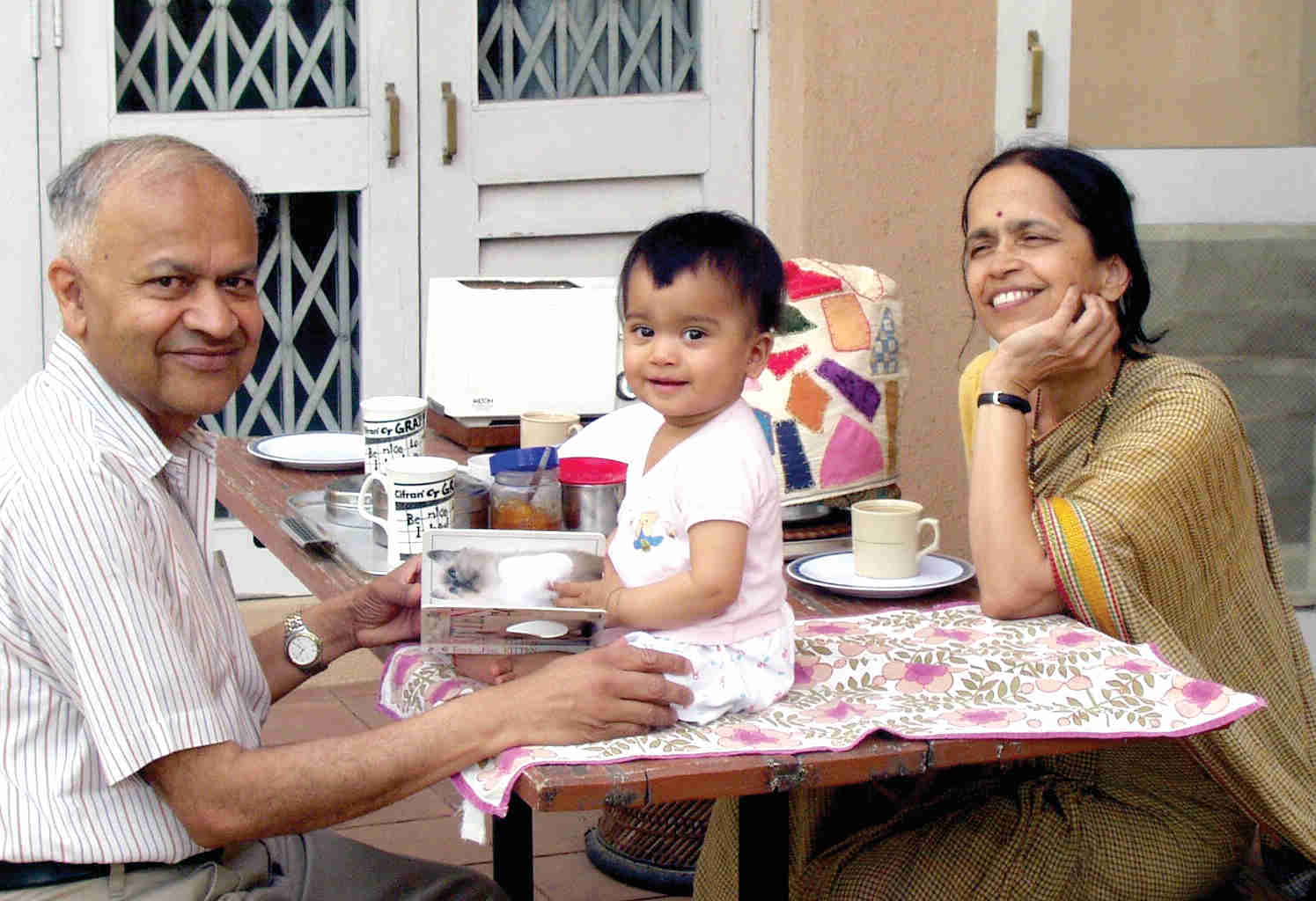
| Aai and Baba enjoyed the company of their grandchildren immensely and would say that Diwali is best celebrated on any day that their grandchildren were visiting. Girija Narlikar | |
Returning to India from Cambridge, in the midst of a thriving career in astrophysics, was a bold decision our parents made when we were very young. While wanting to return to their home country was a driving force, so was the need to eventually care for our grandparents. Our paternal grandparents moved in with us soon after Baba joined TIFR. We have fond memories of playing simple card games with our grandfather after school, or listening to stories or enjoying special treats from our grandmother. As they aged and developed various complications, their care fell upon our parents’ shoulders. When our mother herself went through treatment for cancer in our school years, our maternal grandmother would also come and stay with us to help. All within the confines of the two-bedroom flat allotted by TIFR. Through these trying times, both Aai and Baba managed to shield us sisters from much of the stress and toil that they navigated with incredible grace. In our grandmother’s final years, when she could no longer walk, our father, who was then the director of IUCAA, made time every evening to take her out for a drive. This outing with her son was clearly a special treat for our grandmother.
Our father’s fondness for travel and good food made for many wonderful childhood memories. He would be excited to explore new cities and countries during research engagements or conferences. We were fortunate to tag along on many of these visits, experiencing the culture, the sights, and, of course, the cuisine. Growing up in Mumbai (and later Pune), celebrating family birthdays at fancy restaurants was always an eagerly anticipated gastronomic delight. Baba had very recently expressed an interest in traveling to California, to his birthplace (Kolhapur), and to Benaras, to meet the cook from his childhood years! Even in his last few days, homebound while recovering from surgery, Baba enjoyed eating a variety of treats, from Biryani and Bacon to Basundi and ice cream.
|
|
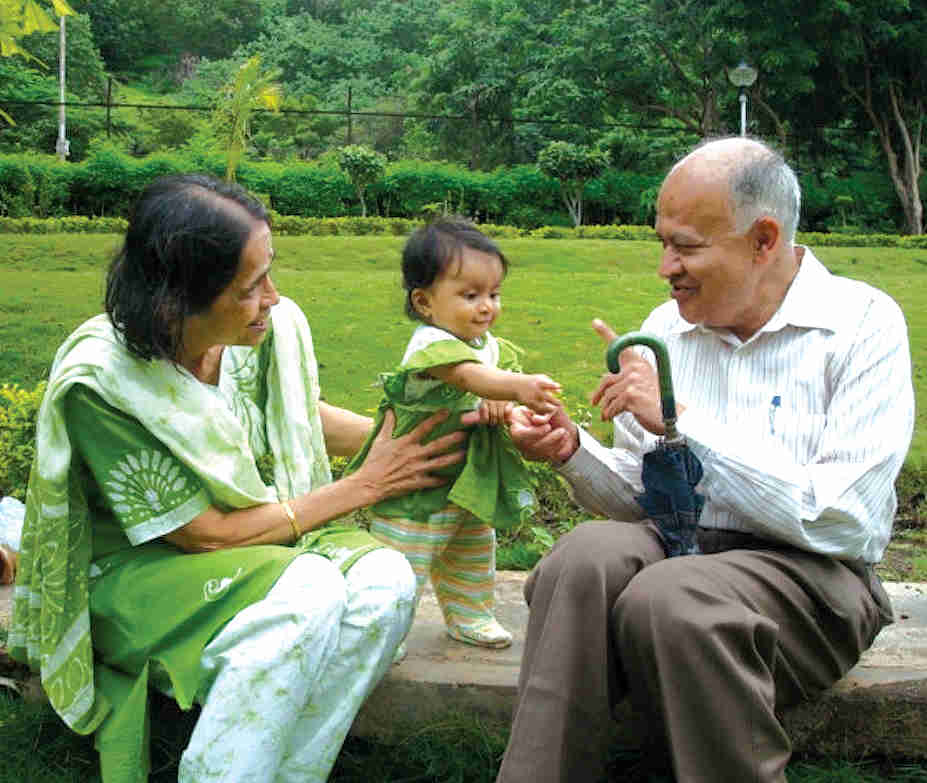
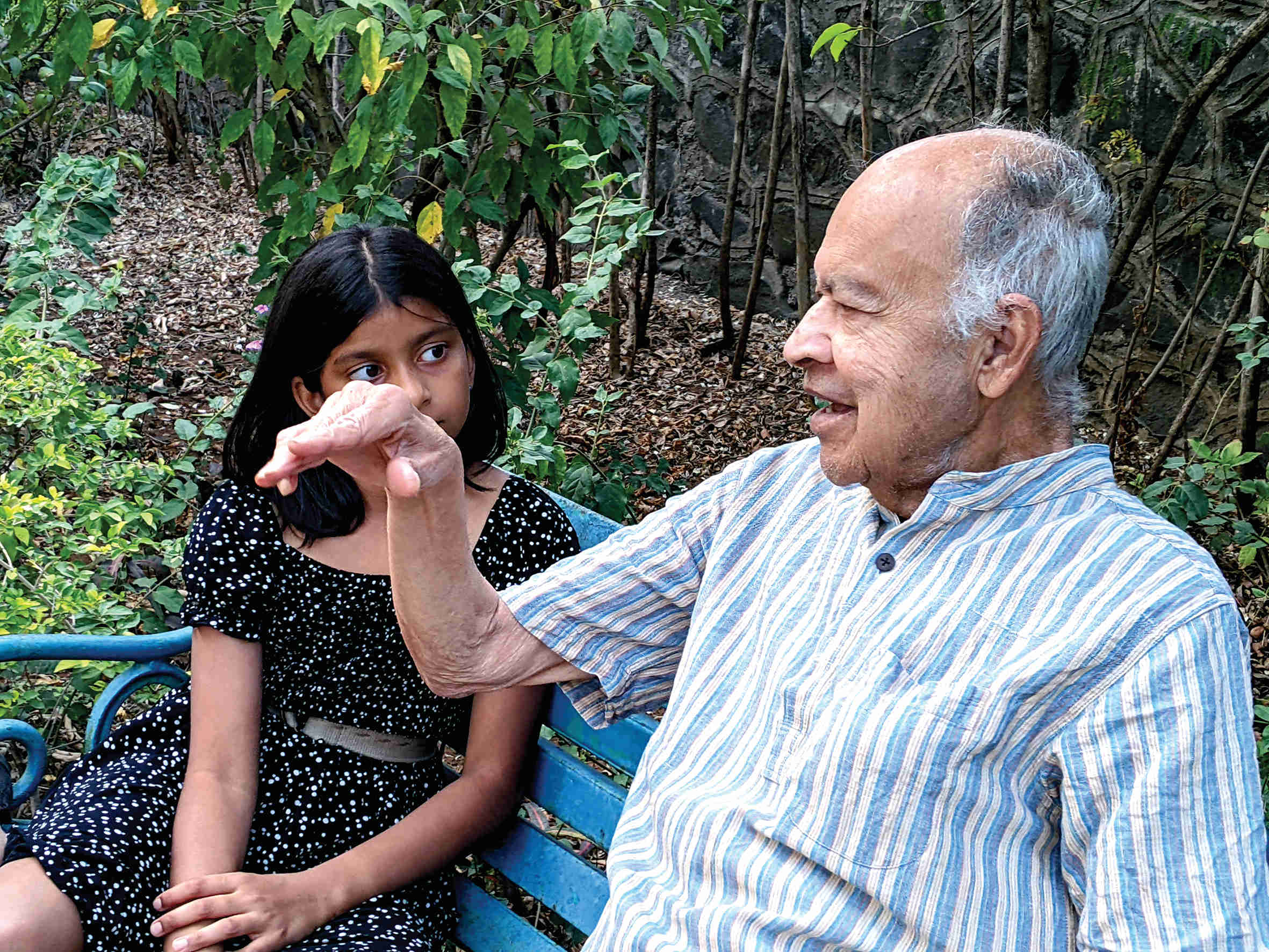
| Over the last 20 years, Baba captivated his grandchildren with enchanting stories and anecdotes. Girija Narlikar | |
Many people are familiar with the public side of our father and his contributions, which range from astrophysics research to science communication, superstition eradication, and the establishment of IUCAA (which we affectionately refer to as his favourite baby!). We hope our personal memories of Aai and Baba will illuminate their many inspiring qualities – generosity, sense of duty, joy of life, exceptional storytelling, and creativity.
Geeta Narlikar is Professor of Biochemistry and Biophysics at University of California, San Francisco. Girija Narlikar did her PhD in Computer Science from Carnegie Mellon University and is now a Director of Engineering at Google. Leelavati Narlikar is an Associate Professor in the Data Science Department at IISER Pune.
Geeta Narlikar
“Your father had a major influence on me when I was growing up’’, “What is it like to have a famous father?’’ All three of us have heard variations of this many times. The truth is if it weren’t for these questions, the newspaper articles that we came across or Baba’s travels for accepting an award, we would not have known the huge impact Baba was having on the world of Astrophysics or the scientific consciousness of Marathi and Indian society more broadly. This is because his behavior at home was that of a deeply engaged family man, not of someone flaunting his fame. So let us rephrase the question a bit to: “What was it like to have Jayant Narlikar as a father?’’
Looking back, when it came to raising daughters, our father, indeed together with our mother, were both ahead of their time. We were influenced by his actions more than his words. Initially unconsciously, and then consciously, we internalized the deep respect Baba showed for Aai, we internalized the freedom to make our own choices in our careers and life partners that was implicit in how Baba and Aai fostered our independence of thought and action. Never once did we hear “you should consider this this career’’…. What all three of us did see (then unconsciously and now in reflection) is how much Baba (and Aai) enjoyed the work they did. Doing research or teaching was not a chore; it was energizing to them.
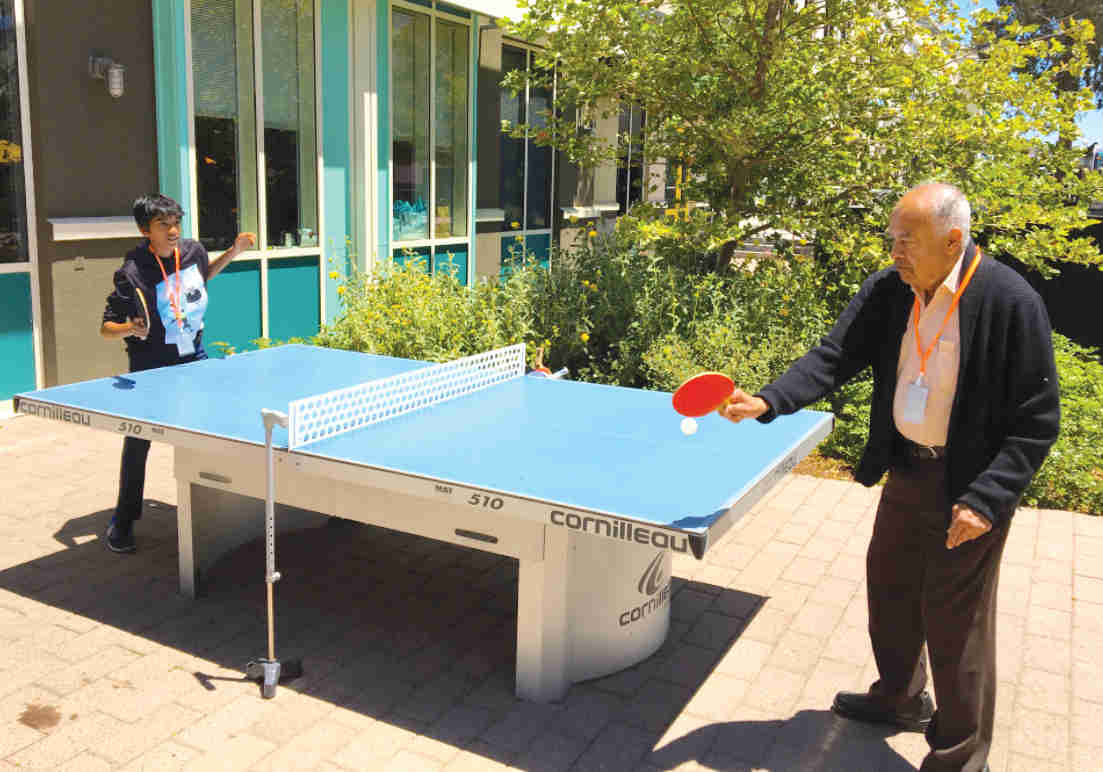
Of course, he also got angry, but this was particularly rooted in certain natural expectations of being responsible. Leelavati remembers how strongly Baba encouraged all sports activities, and yet, when he learnt that she and her friend were skipping college to play tennis, both got a taste of his wrath. The friend was especially taken aback, since she had till then only experienced his cheery hellos and his extreme patience with the increased decibels during the other times that she had visited our home at 1, Akashganga on the IUCAA campus.
Some of you are probably familiar with how much of a foodie Baba was. Every trip with him to another city or country invariably involved us savouring local delicacies – be it street food or gourmet meals. Girija recalls Baba enthusiastically introducing her children to the iconic Britannia café for an authentic Parsi meal when they lived in South Mumbai. Even in his last few days, he made a “farmaish’’ for a complete English breakfast, a pot of Biryani and, of course, his all time favourite – chocolates and ice cream with mango.
Overall, living with Baba (and Aai) gave us an unimaginable education. Their parenting prepared us to meet the challenges of life and career, with courage and an open mind, to take pleasure and seek joy in the little things in life, and to never take oneself too seriously.
That would be a glimpse into what it was like to have Jayant Narlikar as a father!
This is a text of the speech delivered by Geeta Narlikar, on behalf of the three sisters, at the event held at IUCAA on June 3, 2025 celebrating the life of Jayant Narlikar.
Ajit Kembhavi
I first heard of Jayant Narlikar through an article in the newspaper Deccan Herald published from Bengaluru, when I was in high school in Hubli, Karnataka in the mid-sixties. The article mentioned some new discoveries he had made in England. I was able to answer questions about the contents of the article in class the next morning, and it was prophesied by my science teacher, Naicker, that I would be a scientist. That is how Narlikar shaped my life from a great distance, without even knowing that I existed.
I took a course on the general theory of relativity by Narlikar in 1973, while I was a graduate student in the Tata Institute of Fundamental Research (TIFR), Mumbai. Soon after that he agreed to be my PhD supervisor. Since I had no specific problem of my own already identified, he suggested that I work on the avoidance of space-time singularities in the conformal theory of gravity that Fred Hoyle and he had developed. In the 1960s, Roger Penrose, Stephen Hawking, Robert Geroch and others had proved a series of theorems which showed that space-time singularities were inevitable in the general theory of relativity. I showed in my thesis how cosmological singularities could be avoided in the conformal theory for a series of cosmological models of increasing complexity.
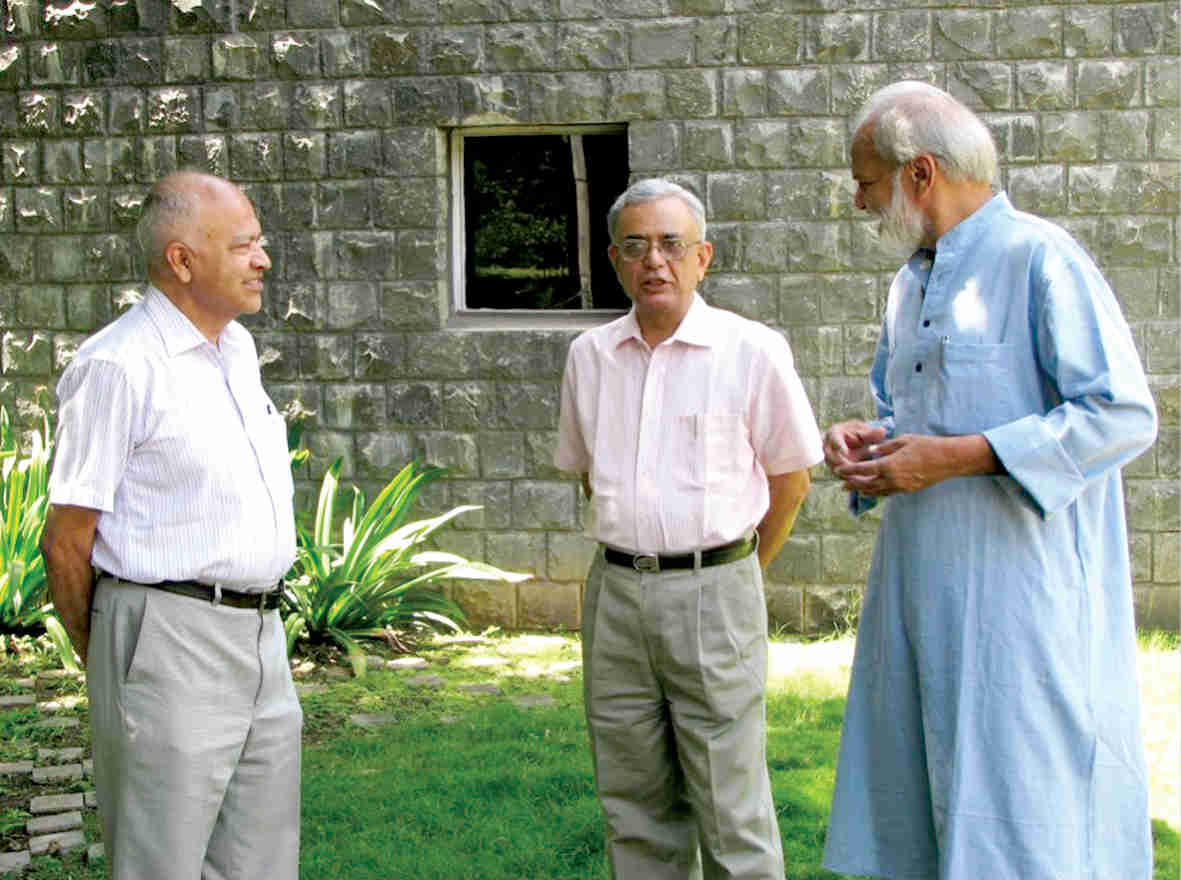
In the nearly seventeen years of my association with Narlikar in TIFR, I knew him first as a teacher, then as a thesis supervisor, and later as a senior colleague and mentor. I interacted closely with him, observed him in a whole range of situations, and learned much from him.
First, I found Narlikar to be the ideal teacher and thesis supervisor: he conveyed a great deal without saying much, converted the most difficult ideas to simple calculations, suggested but never insisted, helped just as much as I required, and got angry exactly when that was needed. I believe that through his gentle guidance he made me a much better person. I found that Narlikar was very democratic in his dealings with research students. He let them choose their own problems, or if a student so wanted, he provided a well defined topic for the thesis. The student could solve the problem in his or her own way, or could closely follow a path set by the supervisor. If a student chose to work on a problem quite outside Narlikar’s domain, that was allowed too, so long as the student had the ability to work independently. Narlikar’s democratic attitude worked very well, because the students were all happy with their doctoral thesis work and they did very well in their research careers, with several of them rising to positions of eminence in India and abroad.
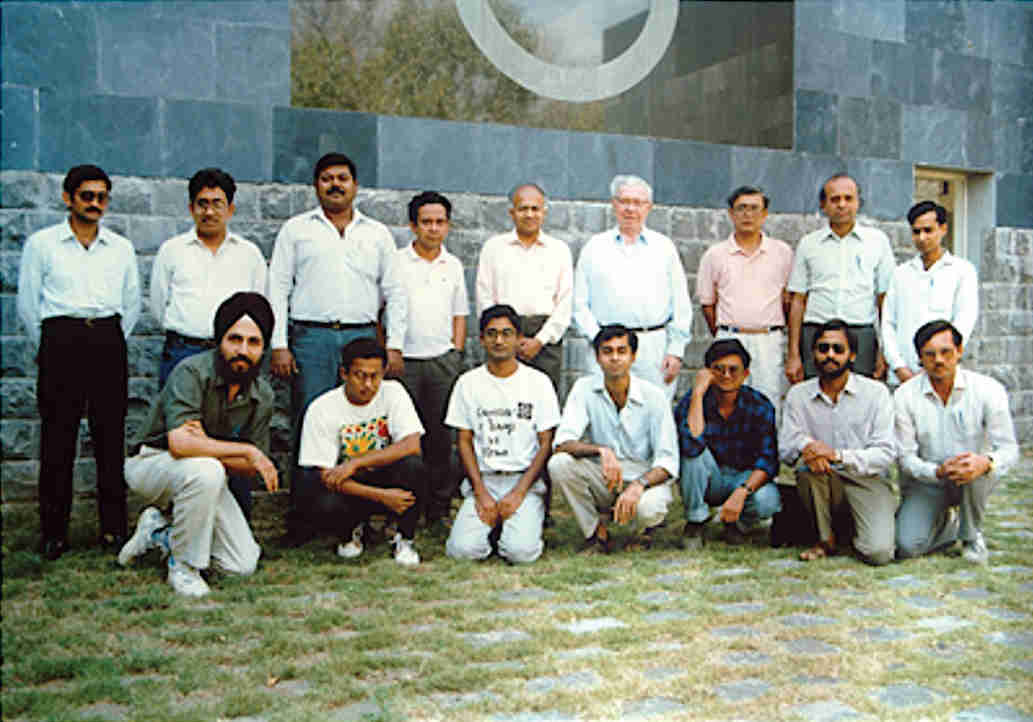
At IUCAA I saw a different side of Narlikar, as an institution builder. He was invited to set up a new institute by Yash Pal, who was then the Chairman of the University Grants Commission. The aim was to develop a centre of excellence in astronomy and astrophysics at the international level, and to offer all facilities at and expert guidance, to faculty and students from the universities and colleges. The development of IUCAA was a complex undertaking, mainly because of the novelty of the proposed institute, the need to work from scratch, and most importantly the need to instill confidence in the university community that IUCAA was meant for them. They had to be convinced that it would create completely new opportunities for everyone who had interest in astronomy. A beginning was made by Narlikar, Naresh Dadhich and me, and a few university teachers who came to the small shed called Aditi that constituted IUCAA in the first few years of its existence. Jayant interacted personally with the visitors, guiding and counseling them, and made sure that all their academic needs were satisfied. The research and other facilities provided to the visitors were world class, and soon visitor numbers increased greatly, making IUCAA a vibrant place. Narlikar also visited departments all over the country lecturing and introducing teachers and students to IUCAA, and providing basic email and other then emerging facilities at IUCAA’s cost.
As the Director of IUCAA, Narlikar was again completely democratic, taking into consideration the opinions and suggestions of the young faculty and the visitors, taking decisions by consensus, and delegating important responsibilities to his colleagues, even though they had little experience. He believed that we would all learn on the job and do well if he placed full trust in us. That has proved largely to be true, with excellent research being done in IUCAA, and more importantly, in many university departments and colleges spread all over the country. The university sector is now in the forefront in using Indian space observatories like AstroSat and Aditya L1, and could very well lead future ISRO scientific missions. The creation of IUCAA by Narlikar has been an immensely important contribution.
Like so many others, I have a profound sense of loss at Jayant Narlikar’s passing. This sense of loss of course goes with a sense of gratitude for all that has been gained from this very humble and great man.
Ajit Kembhavi is an emeritus professor at IUCAA. He has been associated with it as its founding member and served as its Director between 2009 and 2014.
Naresh Dadhich
Jayant Vishnu Narlikar passing away in sleep in the early hours of the morning of 20th May, just two months short of his 87th birthday on 19th July, marks the end of an era. He doesn’t leave behind a vacuum but a world class institute in IUCAA, a thriving school of cosmology and astrophysics in the country, generations of students and scholars as well as laypersons inspired through his works and books, and millions of admirers across the globe. He was a household name in the country through his delightful story-telling and innumerable public lectures – both in English and in his mother tongue Marathi – that got translated into several Indian languages drawing a wider audience.
It would be a fitting tribute to celebrate the life of this great human being, committed to science and its propagation, and who personified excellence in whatever he happened to indulge in. It was a matter of great privilege and fortune for those of us who had the opportunity to work with him at various levels. He had the uncanny knack of getting the best out of everyone by sharing and involving.
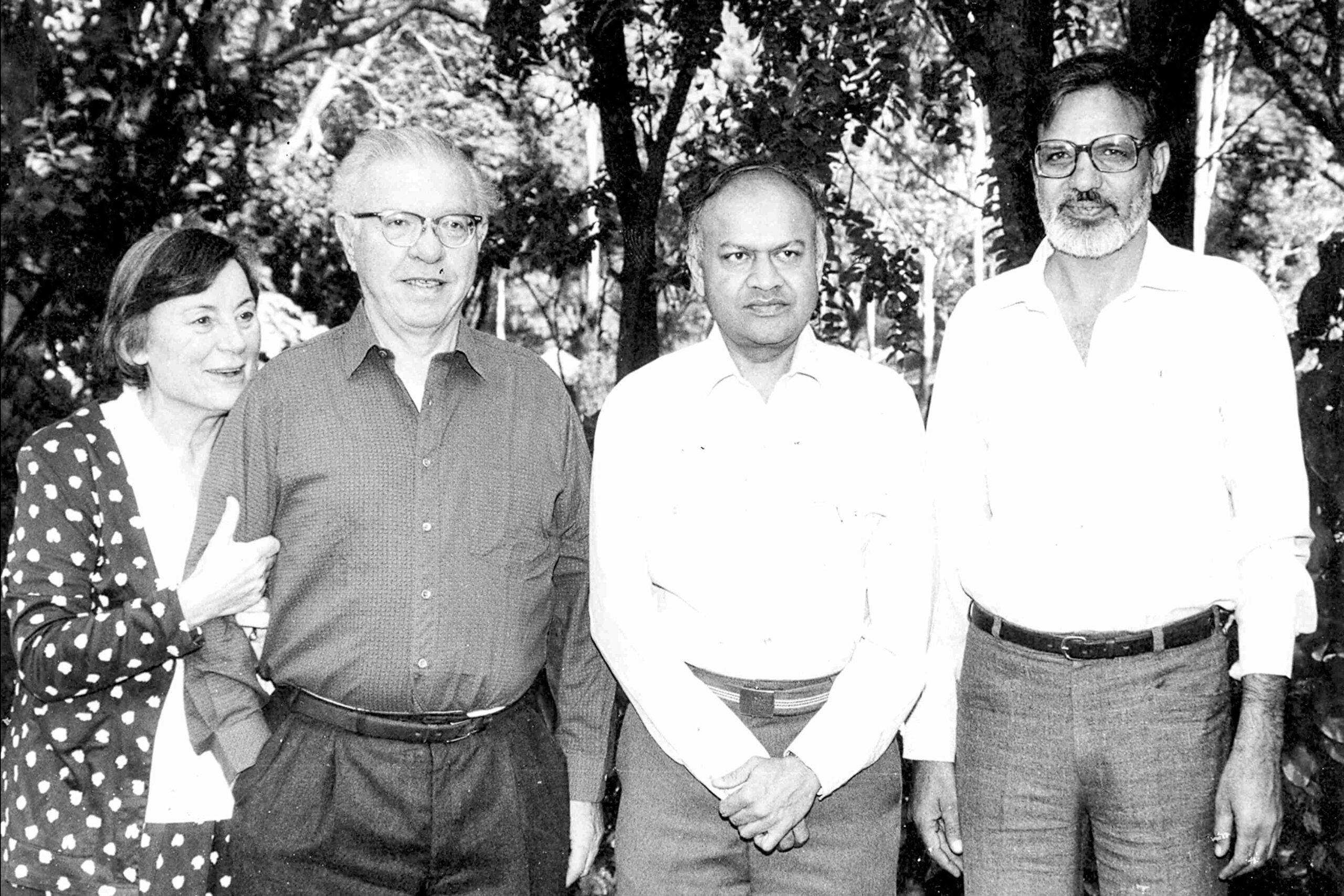
He was an exceptionally talented student at the prestigious University of Cambridge and had won laurels including the coveted Adams Prize which he shared with Roger Penrose.1 The Hoyle-Narlikar theory accorded to the steady state theory of cosmology – the Universe looks the same from anywhere in space and time, and has no beginning and end – unfortunately did not find favour with the astronomical observations which conclusively showed that the Universe began in a big explosion famously called Big-Bang – so christened by Fred Hoyle himself who was one of the proponents of the steady state theory. Jayant was the last of the steady state adherents. Notwithstanding the unfavourable reception, he was a brilliant researcher who had the conviction and courage to ride against the tide, yet being held in the highest esteem even by his academic opponents. The distinguished visitors to IUCAA, including several Nobel Laureates, bear testimony to this fact.
IUCAA was his greatest gift to science and nation, and more importantly to the university students as well as the faculty. Its main objective was to facilitate publishing their findings, and encouraging research in astronomy conducted in the Indian universities. Here was a common facility for them to visit for work and interact with active researchers. It is gratifying to see that those who benefitted thus are doing path-breaking research and publishing in front-ranking journals. This would have pleased him the most.
Although his physical presence will be sorely missed, the legacy he has left behind will survive for a long time to come.
Let me end on a personal note. In 1965, some three of us travelled from Vallabh Vidyanagar to Ahmedabad to listen to a lecture by Jayant Narlikar in the Atira hall. Little did I know then that I would end up spending over half a century, intimately interacting and working with him. I will always treasure this.
Naresh Dadhich received his doctoral degree under the guidance of JVN’s father V.V. Narlikar. He has been associated with IUCAA from the beginning and was the Director of IUCAA between 2003 and 2009.
B.S. Sathyaprakash
When I first met Jayant Vishnu Narlikar, I was still a graduate student at the Indian Institute of Science, Bangalore. He had come to deliver a colloquium on his reformulation of the Steady State theory—a bold and controversial idea at the time. His cosmological vision went beyond the well-accepted Big Bang model. Jayant proposed a “super-cosmological principle’’: not only is the universe the same everywhere, but it is also the same at all times. To me, this was aesthetically beautiful, though I found certain aspects, such as quasars being hosts to “creation fields’’, rather peculiar.
What left a lasting impression on me was not just the content of his talk, but the man himself. I had been asked to receive him at the airport—a customary student duty in those days. Unlike any visiting professor before him, Jayant insisted I sit beside him in the back seat. He spoke to me with genuine interest and warmth. The following day, buoyed by that interaction, I dared to raise a question during his lecture—an unusual move for a student at the time. Jayant considered my question seriously, responding with thoughtful honesty and a clarity that showed his integrity. Later on, seemingly strange as this may sound, a senior scientist from another institute implied that my question had been staged to favour Jayant Narlikar, since I had applied for a postdoctoral fellowship at IUCAA. Jayant believed in his ideas, yes, but also acknowledged how observations could ultimately disprove them—a rare balance in any scientist.
In January 1989, I joined IUCAA as its first postdoctoral fellow, however my fellowship was funded by the Council of Scientific and Industrial Research. IUCAA was still in its formative phase—no building, only a project manager (Naresh Dadhich, who would later become its faculty and second director), and a part-time secretary. In those early days, Jayant involved me in everything—from appointing the first graduate students and staff to choosing desktop computers for the institute. Though world-renowned, he was refreshingly down-to-earth. Jayant treated every individual—regardless of their role or background—with dignity and respect. From him, I learned that true leadership is not hierarchical but human. That lesson, sadly, still eludes much of our academic and institutional culture.
Jayant trusted people deeply. One example I cherish is my experience as IUCAA’s informal “digital postmaster’’. With no internet at the time, I had set up a rudimentary email system. Every day, I dialed a server in Bombay over a modem connected to a telephone line and downloaded emails for the institute using the SMTP (Simple Mail Transfer Protocol). All messages were plain text, unencrypted. Despite the potential sensitivity of the content, Jayant never doubted my integrity. His quiet affirmation of trust became one of the most empowering moments in my early career.
But perhaps Jayant’s most profound impact on my life came later in 1989. Sanjeev Dhurandhar had just returned from Bernard Schutz’s group in Cardiff and mentioned the possibility of postdoctoral training in gravitational wave data analysis. Jayant, along with Naresh and Sanjeev, saw this as a golden opportunity to start a gravitational wave program at IUCAA. Patrick Das Gupta and I were chosen as the first to go. But securing travel funds in those days was nearly impossible. It was Jayant who encouraged us to apply to the International Astronomical Union. Despite the prevailing skepticism (and even hostility) toward gravitational wave research, the grant came through—thanks, no doubt, to Jayant’s persuasive influence behind the scenes.
Jayant extended my postdoctoral fellowship to five years—a gesture that brought immense stability
That trip to Cardiff defined the trajectory of my career for the next 35 years. Upon my return in March 1990, Jayant extended my postdoctoral fellowship at IUCAA to five years—a gesture that brought immense stability. With that foundation, I married Uma in the summer of 1991.
Jayant also had a quiet sense of humor. A week after my wedding, I was scheduled to lecture at a school in Srinagar, Uttarakhand. Uma came along, and we had planned to explore the region afterward. During one lunch, some IUCAA colleagues jokingly began “warning’’ Uma about my alleged colorful past. Things were getting awkward, until Jayant stepped in and said, “Don’t believe them… not everything they’re saying is true.” The punchline came a second too late—and delivered maximum embarrassment (and laughter) at my expense.
Later, after a postdoctoral fellowship at ICTP in Italy, it was again Jayant who gave me my first faculty position at IUCAA. My family and I returned to Pune in early 1993 for three deeply fulfilling years. Jayant continued to support me unstintingly—with computing resources, travel grants, and mentorship. Those three wonderful years in Pune were made even more memorable by the kindness of Mangala Narlikar, Jayant’s wife. She was immensely generous to our young family—offering thoughtful advice during moments of worry, especially when our daughter fell ill, and never hesitating to lend a hand, whether it was a much-needed ride into town or help with day-to-day family matters. Her warmth and quiet support meant a great deal to us.
Those three wonderful years in Pune were made even more memorable by the kindness of Mangala Narlikar
In late 1995, I received a faculty offer from Cardiff University when I was on an extended visit to Europe and the US. I intended to speak with Jayant personally after my return, but the word leaked. He was furious—disappointed that IUCAA might lose a young researcher in a fledgling field. He denied me a leave of absence, and I left with a heavy heart. But when I returned a year later for the GR-17 conference, Jayant quietly pulled me aside and said, “You’ll always have a place here, for as long as I’m the Director’’. I was almost in tears.
Years later, when India was debating whether to fund a LIGO detector to be constructed in Indian soil, Jayant visited me and my family in Cardiff. We talked about the potential of such a major scientific investment. Although I cannot say what specific role he played, I know that he understood the transformative power of such a project. LIGO-India will soon be a reality—a symbol of the visionaries who helped make it happen.
Jayant Narlikar’s influence goes far beyond scientific papers or theories. He inspired tens of thousands to pursue science—not through charisma or ideology, but through decency, brilliance, and an unwavering belief in the potential talent of others. He respected every person and welcomed every idea with open-minded seriousness. Long before “inclusivity, diversity and respect’’ became institutional goals, Jayant practiced them instinctively and daily.
I am deeply grateful to have known him. And I hope to carry forward the principles he lived—quietly, graciously, and with integrity as vast as the cosmos he helped us understand.
B.S. Sathyaprakash is a faculty member at Penn State and fondly recalls his interaction with JVN since his doctoral student days at IISc, Bengaluru and later as a colleague at IUCAA.
Tarun Souradeep
Jayant Narlikar belonged to a rare genre among the post-independence doyens of Indian science. A brilliant, prodigious student growing up to early fame as a globally renowned Indian cosmologist, a distinguished science statesman, institution builder and gifted communicator par excellence with a combined contribution to the nation’s science and scientific temper that is arguably unparalleled. Yet, he remained a very humble, accessible humanist, a fair scientific leader and administrator with a primary goal to spread scientific temper and excellence across the nation.
He gained fame early working out with his mentor, Fred Hoyle, radical and novel physics that would enable an eternal, “Steady State” cosmos, in sharp contrast to the then-nascent evolving model of the universe that implied a moment of creation in the finite past. Perhaps, the philosophically aligned appeal of an “अनन्त-अनादि-स्थिर” (no end, no beginning, still) cosmos presented by a young, brilliant scientist from India absolutely captured the imagination of both the intellectuals and the public of a resurgent, newly independent India. Jayant Narlikar was invited by the President of India to return to India. He set up a very vibrant and freethinking group at the Tata Institute for Fundamental Research in Mumbai on Gravitation and Cosmology. Over the nearly two decades, he mentored a number of excellent scientists, many of whom set off to forge new directions of frontier research in the country IUCAA would stand as a lasting legacy of his commitment to empowering the vast university sector over the decades. Indeed, the university research sector will feel the immense void most dearly. He was instrumental in the setting up of the Indian Association of General Relativity and Gravitation (IAGRG) to bring together the Indian community involved in Gravitation and Cosmology. The first International Conference on Gravitation and Cosmology (ICGC) meeting in Goa in 1987 brought together the foremost researchers in the world in touch with the Indian community. Much like many of his other initiatives, these organizations and scientific forums have sustained and grown over the decades.
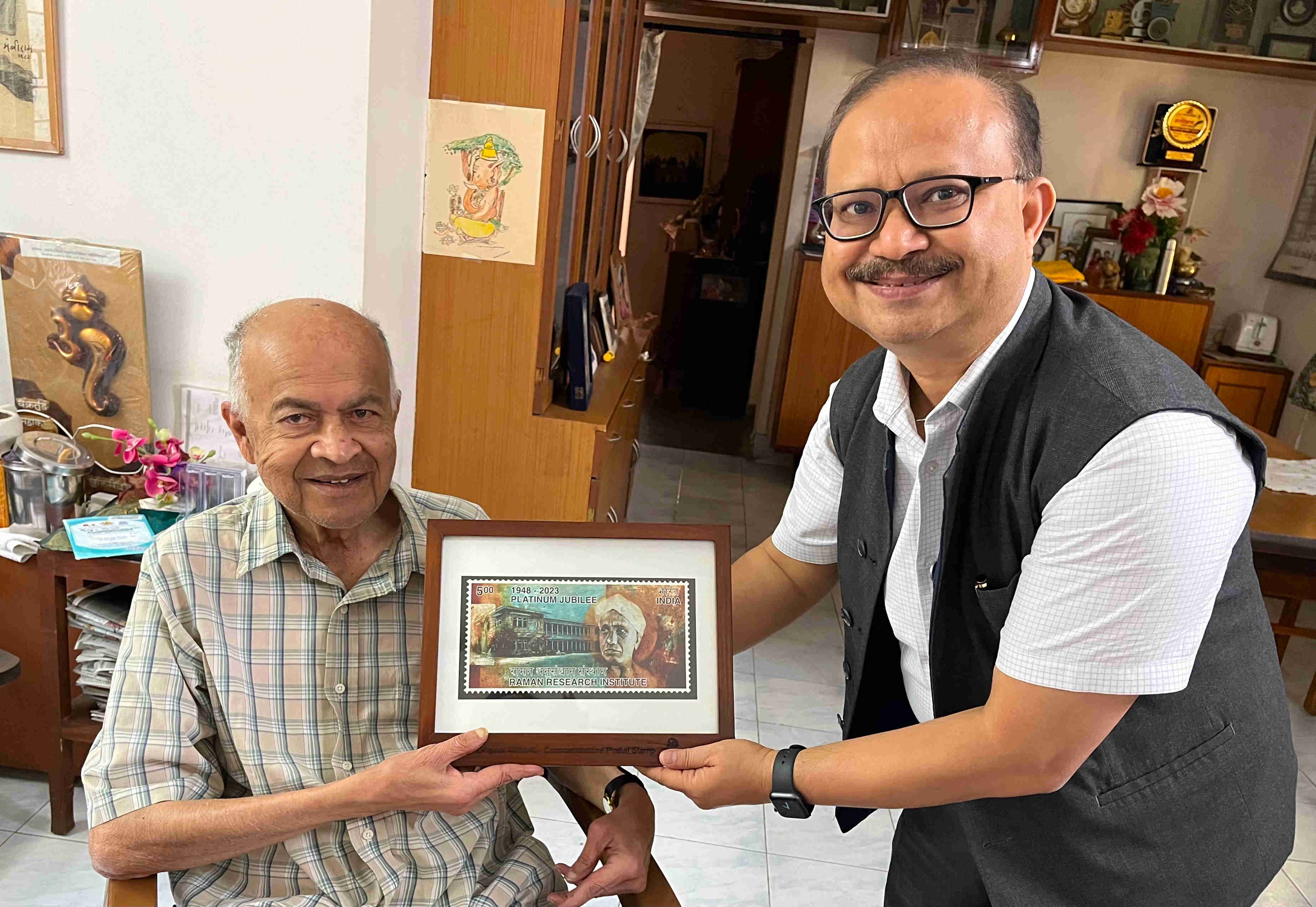
Personally, it is a very deep loss for Sucheta and me since we took our first steps in research in the unique “homely” ambience that he fostered at the then-nascent IUCAA. He mentored my first years of PhD, where I enjoyed his unstinting support for the craziest ideas and complete freedom of thought. I was also fortunate to have him as the Director when I returned to a faculty position at IUCAA. He was always a true well-wisher for all my endeavours. I especially treasure the show of support and commitment when he himself proposed a desire to visit the then newly selected LIGO-India site – by far, not a comfortable endeavour at his age.
His demise is an immeasurable loss to the nation and, in particular, to promotion of science in India. The greatest tribute to him would be to work together, carrying his work forward and realizing his vision of a scientifically informed general populace.
Tarun Souradeep is the Director of Raman Research Institute, Bengaluru. He was the first PhD student at IUCAA and has also been a faculty member at IUCAA since 2000.
V. Samak
For any student remotely informed about astronomy, IUCAA, which does need an introduction here, evokes an instant familiarity. And almost reflexively, it brings to fore the towering figure who personifies the spirit of this institution: Jayant Vishnu Narlikar, a name etched in the annals of scientific movement in India. IUCAA was founded in 1988 under his exemplary leadership. In a very short time, it transformed from an ambitious idea into a widely respected centre for astronomical research. I had the incredible fortune of working under the guidance of this legendary astrophysicist for around 30 years—a very great honour that I look back on it as a real blessing in my life.
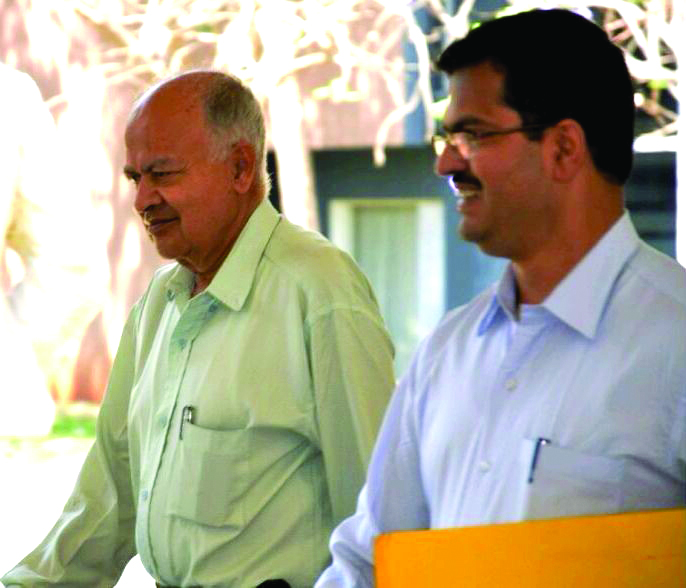
I soon realized that at IUCAA, hierarchy exists in designations but not in disposition of duties. There is no tradition of peons or attendants. Every member—regardless of rank—is expected to carry out their tasks independently. Whether it is administrative work or fetching tea, lunch, or dinner from the canteen, self-reliance is a practice that Narlikar institutionalized.
A few months into my job, as I passed by the pantry, I heard Narlikar call out to me. Calmly, he said, “From tomorrow, you’ll be working as my Assistant.’’ That news filled me with pride—and anxiety. He was deeply respected, and known for his uncompromising discipline and exacting standards. As the Founder-Director of IUCAA, he had already earned reverence within and beyond the scientific community.
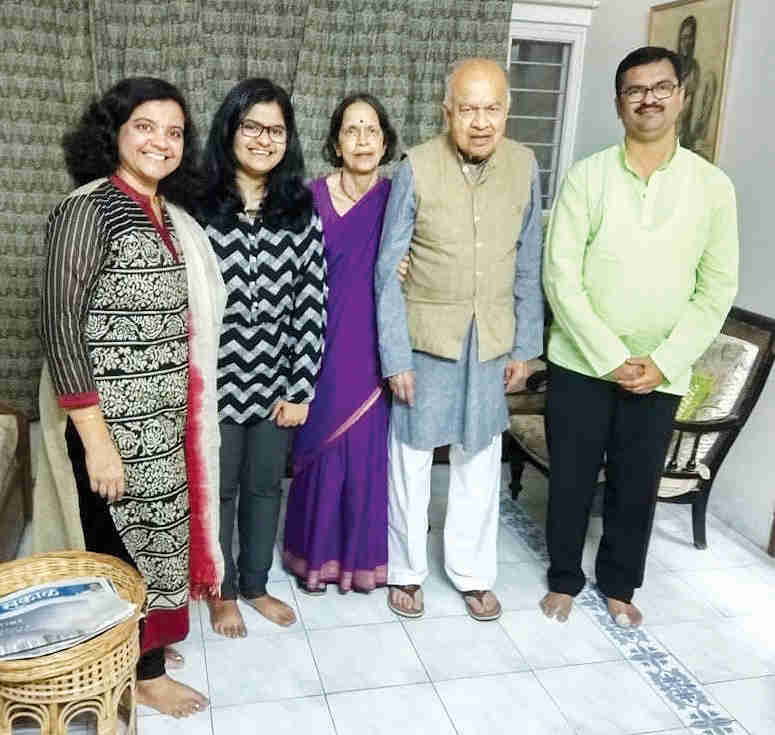
Working with him brought me face-to-face with brilliance every day. Though I am not qualified to speak on the technical aspects of his research, serving as his secretary gave me the opportunity to interact with eminent scientists, scholars, and dignitaries who visited the institute. One of the most memorable of these was meeting A.P.J. Abdul Kalam, then President of India, during a visit of his.
Narlikar’s legendary punctuality was not just admirable, it was inspirational. If he gave someone a time for a meeting, it was honoured without exception, regardless of who they were, be it a student or a dignitary. If a request came up at the same time slot later, from any quarters, Narlikar would politely decline and offer them an alternative. This integrity of commitment reflected his respect for people and time.
I remember the day when I arrived at work to find a small note on my desk that read: “9:01:13 – JVN.” Clearly, I had arrived late – one minute and thirteen seconds late which was not acceptable to him. Such was his attention to detail—firm yet dignified.
He never spent unnecessary time on ceremonial events. His hours were devoted to research, writing, and public science outreach. Whenever schools or colleges invited him to offer guidance to students, he never turned down such requests. Once, when the date of a lecture he had promised coincided with the presentation ceremony of a prestigious award, he requested the award organizers to reschedule but refused to cancel the committed lecture schedule. Such dedication must be rare, almost legendary.
To spark curiosity about science among students, whenever they asked for his autograph, he would insist that they first send him a question related to science on a postcard. In return, he would reply with the answer—along with his autograph. The Marathi Vidnyan Parishad, Mumbai, has published books in both Marathi and English titled पोस्टकार्डातून विज्ञान (Science through Postcards), which include these question-and-answer exchanges.
His daily routine was methodical. He arrived early in the day, completed attending to correspondences, held discussions with senior administrative officers, and then immersed himself in scientific research. Post 3 pm was dedicated to visitors and appointments. Even as a member of several national and international committees, he would make [tentative] draft minutes of meetings prior to attending them, and modify them appropriately afterwards for immediate circulation. His swiftness and efficiency were nothing short of astounding.
Behind every remarkable man stands an equally remarkable woman. His wife Mangala Narlikar shouldered family responsibilities with quiet strength, allowing him to focus fully on his academic pursuits. Even as she was managing home and raising their daughters, she completed her PhD in mathematics, mentored several underprivileged students, and authored her own body of scholarly work in the field.
During a visit to their residence, she shared some cooking tips with my wife, Shephali, and offered valuable career advice to my daughter, Priya. She had also personally prepared a chocolate-walnut cake for Priya. Her thoughtfulness and guidance left a deep impression on us.
I had the privilege of preparing manuscripts for several of Narlikar’s books and articles written in English, Marathi, Hindi, and even Sanskrit. His handwriting was so clear, elegant, and legible that little to no editing was needed. Some of his works could go to print as-is. For me personally, the most cherished moments were seeing my name mentioned in the forewords of some of his books, including his acclaimed autobiography, My Tale of Four Cities. This is not just a memoir but a manual for living a life of integrity, discipline, and passion.
In the realm of science and humility, Jayant Narlikar shines as a rare constellation—guiding, enlightening, and silently shaping generations. To have walked a few steps beside him on his grand journey will remain my life’s greatest privilege. Shephali, with affectionate humour, would often say, “Your world begins and ends with JVN’’. There was one moment that I still carry like a badge of honour: Priya once said to me, “Whenever I Google your name, it always appears alongside Professor Narlikar’s. That makes me so proud, Baba.’’
As a father, that sentiment surpassed every professional recognition I’ve ever received. It made me realize that my life’s greatest honour wasn’t just working with a legendary scientist, it was becoming part of a legacy which my own child could look up to with pride.
As I reflect on this unforgettable journey, words often fall short of capturing the depth of my gratitude. JVN was not just a remarkable scientist, he was a guiding star in my life with his unwavering discipline, quiet brilliance, and profound humility, leaving an indelible mark on me and my perspective on life and living. Now, in the wake of his passing, there exists a void that words can’t seem to fill. For the past 29 years, being by his side had become second nature, my daily routine. His absence now echoes deeply:
In his shadow, I found light.
In his simplicity, I found strength.
And in the trust he placed in me,
I discovered the highest form of fulfilment.
Vyankatesh Samak served as the long-term secretary to JVN at IUCAA. He is presently the Section Officer in the Director’s Office at IUCAA.
Arvind Paranjpye
On May 20, 2025, India and the world lost one of the highly acclaimed cosmologists, Jayant Vishnu Narlikar. He, along with his PhD supervisor, Fred Hoyle, championed a theory of the Quasi-Steady State Universe, which challenged the prevailing theory about the birth of the universe in the Big Bang.
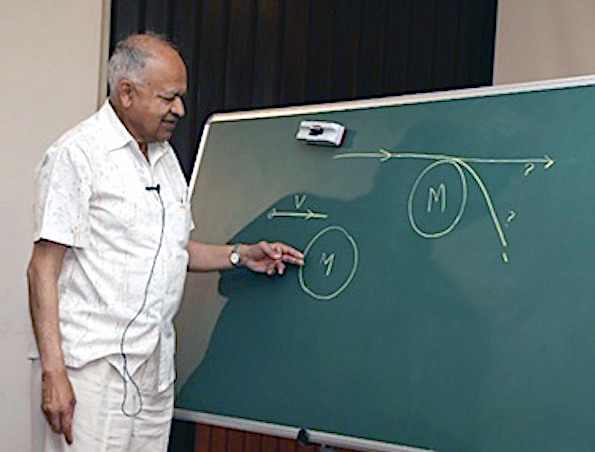
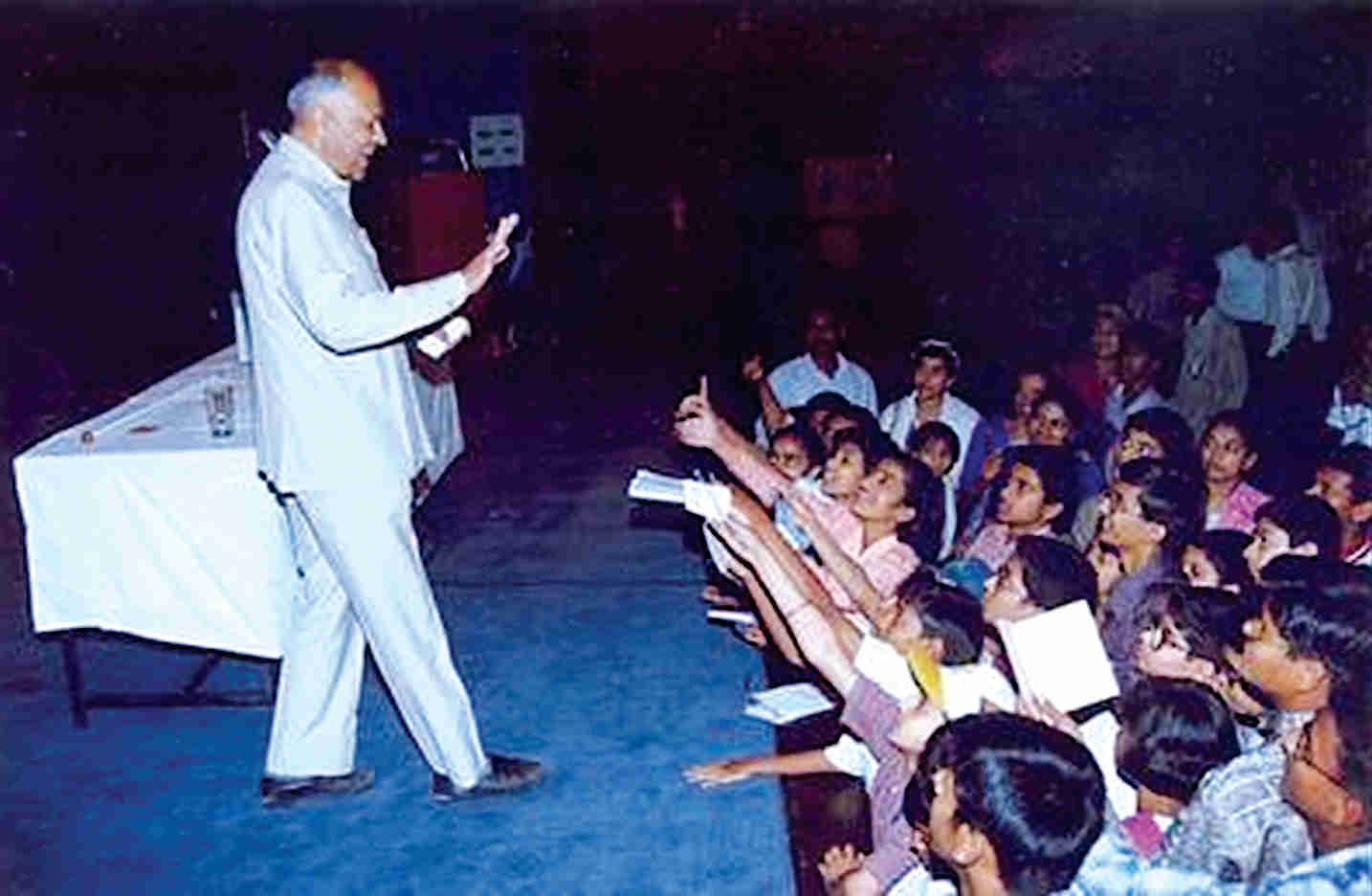
Whenever a renowned astronomer from India or abroad visited TIFR, they would invariably be invited to deliver public lectures at the planetarium, thanks mainly to JVN for facilitating them. This practice continued even after he moved to Pune. Whenever he visited Mumbai, if the time permitted, he would visit the planetarium and deliver a public talk or interact with students. One particularly memorable lecture was on cosmology, which he presented using only chalk and a blackboard, in a traditional classroom setting.
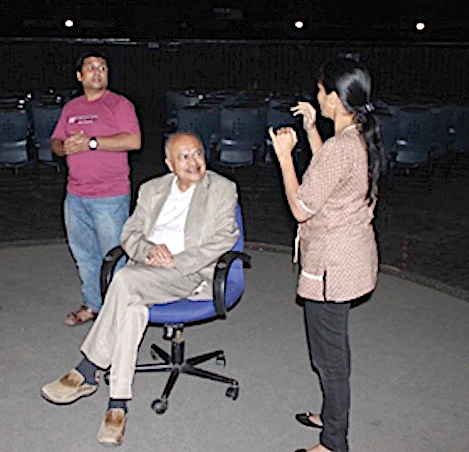
When the Nehru Planetarium modified one of its shows for people with hearing impairments, JVN attended the show and, after the show, took questions from the audience, along with an expert in sign language. People with difficulty hearing do not clap to show their appreciation, but raise their hands overhead and shake them.
 |
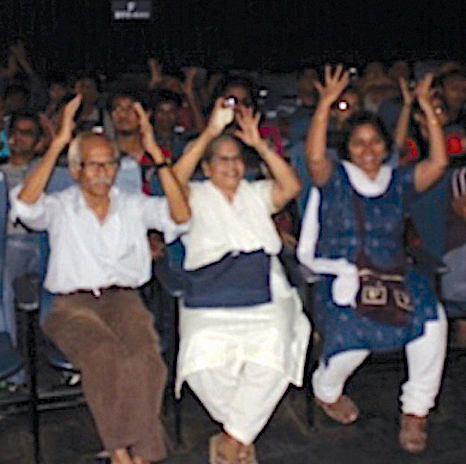 |
| Interacting with hearing-impaired people and their unanimous applaud. Arvind Paranjpye | |
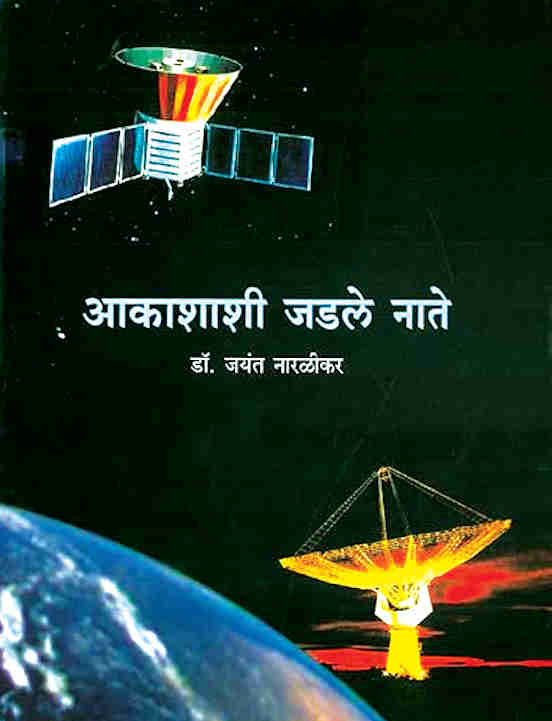
JVN was a prolific writer. His book, Ākāśāśī Jaḍle Nāte, written in Marathi, covered various aspects of astronomical development from prehistoric times to modern days. Noting the educational value of this book, the Chairman of the Nehru Centre, Sharad Pawar, took the initiative to purchase some 1000 copies and distribute them to schools in Maharashtra.
During the upgrade of the Discovery of India Galleries, JVN was requested to review the translations of the Sanskrit text into English, Hindi, and Marathi, as well as select appropriate visuals for the Vedic section of the gallery, which he promptly complied.
In the demise of Jayant Narlikar, Nehru Centre has lost its longtime friend.
Arvind Paranjpye is the Director of Nehru Planetarium, Mumbai. He has known JVN for many years and was associated with IUCAA since 1991.
Vijay M. Patankar
When I heard that Jayant Narlikar is no more, I was deeply saddened and thought to myself, “I wish I had made efforts to meet him and convey my sincere thanks for partly directly, and mostly indirectly, inspiring me into a world of wonder and exploration – initially in physics and then in mathematics.
 |
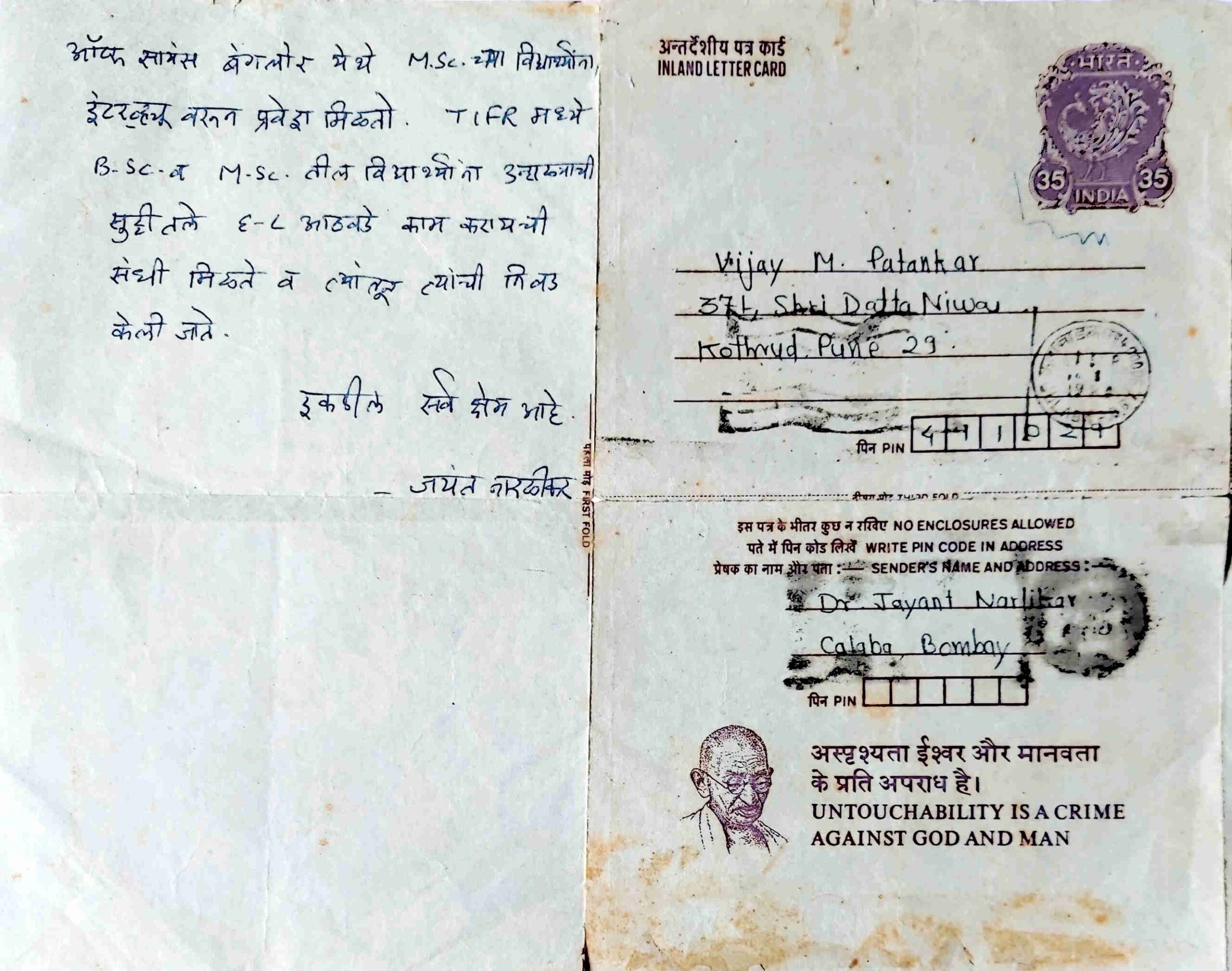 |
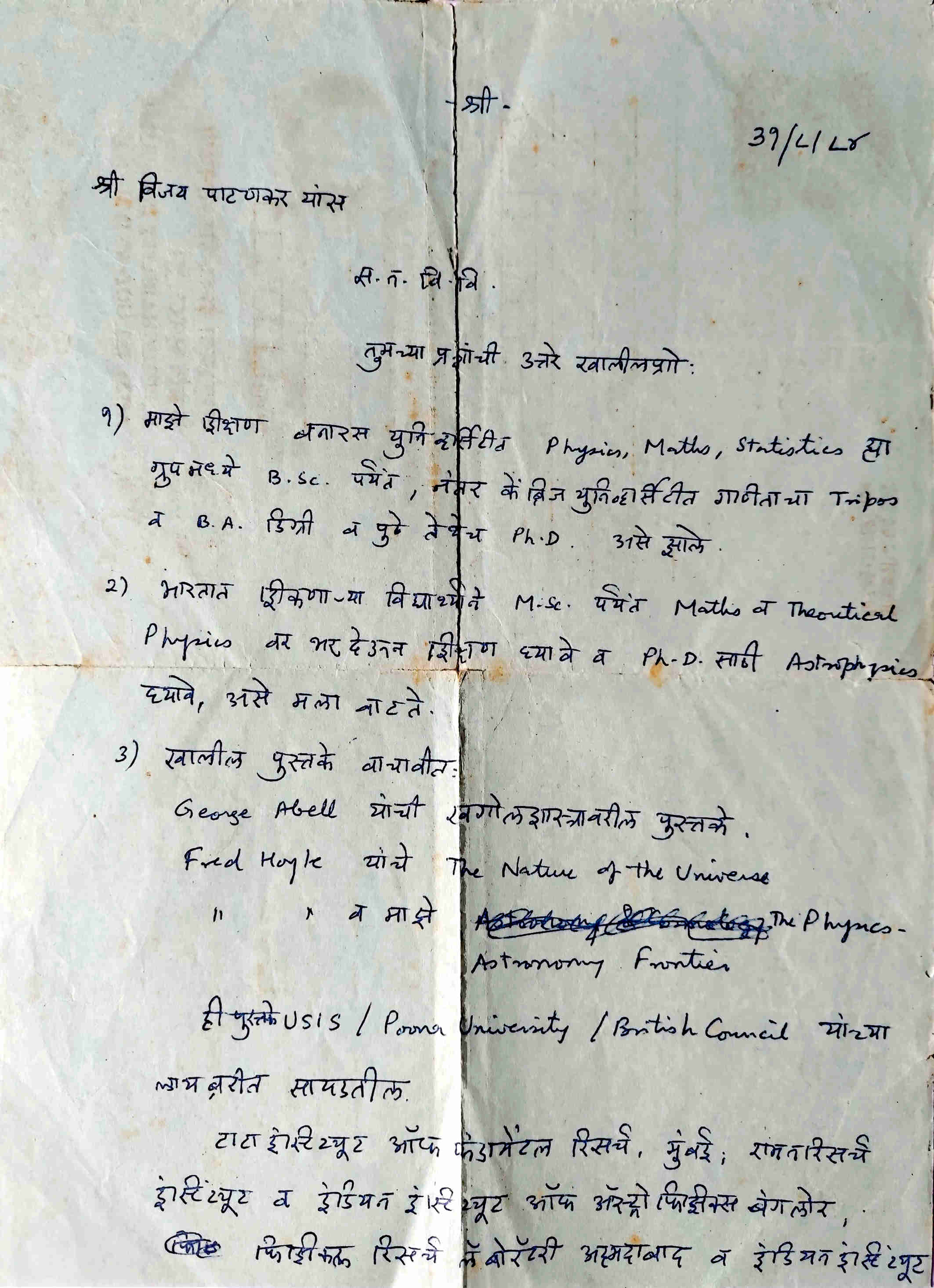
| JVN’s letter in Marathi to Vijay Patankar from 1984. Vijay M. Patankar | |
Reflecting back in time, I vividly recall him explaining the “other’’ geometries where angles of a triangle do not add up to 180 degrees (this is when I didn’t even know what it means to say that \pi radians = 180 degrees). For an 8th grader this was an astounding opener into the world of strange mathematical reality! As he explained and charmed his viewers during the “Pratibhā Āni Pratimā’’ (Sunday mid-morning) one hour-long interview on Mumbai Door-Darshan – the nebulas, stars, galaxies, milky way, blackholes and origins of the universe, as well as the celebrated names of Gauss, Newton, Euclid, Lobachevsky, Einstein,… , such fascinating things that he touched upon, all countless light years away, seemed to appear right in front, beckoning to me!
During the subsequent years around 1985, I met Jayant Narlikar once, and also with youthful zeal wrote to him a couple of times asking for certain advice. His replies – which were very warm and almost immediate – thrilled me then, and thrills me now. It fills me with the thought that besides talent, perhaps discipline and time management play an even larger role to progress further in life. A few years later, I was also smitten by theorems of Fermat and Galois and I pursued mathematics.2
The persona of JVN that shows in this recollection must be very typical of his ways of encouraging a young and aspiring student of any age. I may not be the only one to have had such an impactful association with JVN, and whose life he touched deeply. There definitely are students aplenty who derived similar motivation, energy and inspiration from his ever gentle and friendly guidance. His contribution to making the main ideas and concepts in science and maths not only just accessible but wondrous are aspects of his personality that must have been so palpably inspiring and infectious for all those who were in direct contact with him.
Even a somewhat distant student like me is simply overcome with deep gratitude, as the memories rushed all at once hearing the sad news of his demise.
Vijay M. Patankar is a long time admirer of Jayant Narlikar and his expository works. He presently teaches at FLAME University, Pune.\blacksquare