
The lifetime of Ganesh Prasad overlapped with a period of strong resurgent nationalism in India of the time. It was an intense phase of nationalist awakening, the Freedom Movement, and the Swadeshi era. His life and work mirrored the nation’s resolve for self-reliance and cultural revival in several specific ways. This article about him marks his 150th birth anniversary.
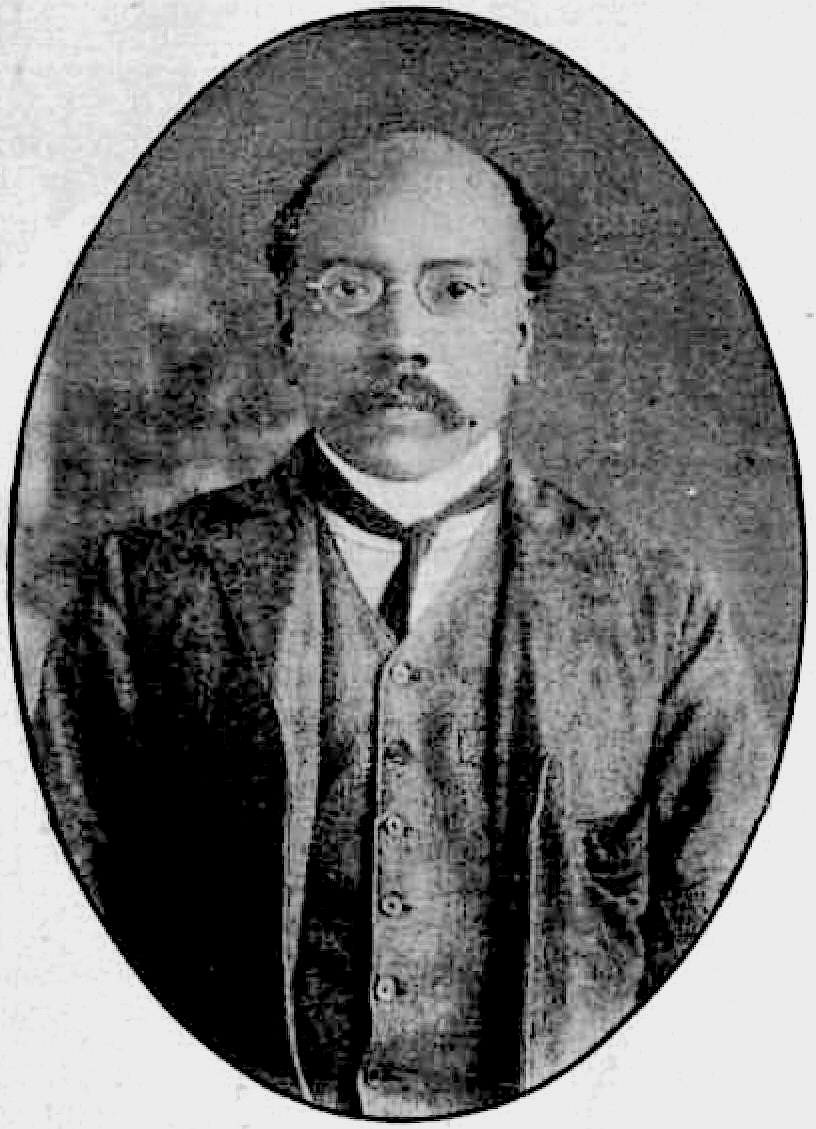
Fuelled by a sense of inspired patriotism, a desire to learn, possessing a talent for mathematics, and a love for teaching, Ganesh Prasad became a true pioneer of Indian mathematics during the early 1900s. At a time when research in modern mathematics was beginning to take root in institutions in India, Ganesh Prasad strongly advocated that India needed its own research culture. He played a significant role in laying the foundation for organized mathematical research in India, and is often referred to as the “Father of Mathematical Research in India”.
Ganesh Prasad was born on November 15, 1876 in Ballia, Uttar Pradesh, to the Ramgopal Singh and Juthan Debi couple, hailing from a Srivastava Kayastha family. After his early education in Government High School in Ballia from where he completed his matriculation in First Division in 1891, he pursued his higher education at Muir Central College in Allahabad, earning first-class honours in mathematics in 1895, which prepared the groundwork for his future endeavours. He earned his Master of Arts degree from both Allahabad and Calcutta Universities, demonstrating his quest for knowledge. In 1898, he received a Doctor of Science (DSc) degree from the University of Allahabad.
He began his academic career as a lecturer at Kayastha Pathshala and Muir Central College, Allahabad in 1898–99, where he inspired students to pursue mathematics. He was awarded a Government of India Scholarship in 1899, using which he travelled to Cambridge for higher studies. He studied at Cambridge University, earning a Bachelor of Arts degree. In 1904, he also obtained a DSc degree from there. While at Cambridge, he wrote a significant paper on the constitution of matter and analytical theories of heat, and submitted it to the Adams Prize competition. However no one was awarded the prize then. So he went to the University of Göttingen and showed this paper to Felix Klein. This paper was very much appreciated by Klein and was published in the Göttinger Abhandlungen. While at Göttingen, Ganesh Prasad interacted with legendary scholars like David Hilbert and George Cantor, who profoundly influenced his academic perspective.
During his five years of stay in Europe, Ganesh Prasad had come into contact with many leading mathematicians of the time, like Ernest Hobson, Andrew Forsyth, Henry Baker, Joseph Larmor, David Hilbert, Georg Cantor, and the famous physicist Arnold Sommerfeld. This was an experience that connected him directly to the latest research and theories of that time. So when Ganesh Prasad came back to India, he was not just a scholar with a foreign degree, he was an accomplished academic with a broad vision. A person who had a clear mission to give a new direction to mathematical research in India. He brought back not just knowledge, but the very culture of research.
After his return to India in 1904, he was appointed as an additional professor of mathematics at the Muir Central College, Allahabad. Thereafter he served as a professor of mathematics at Queen’s College, Banaras, introducing innovative teaching methods and bringing changes in the curriculum.
In 1914, Sir Asutosh Mookerjee invited Ganesh Prasad to occupy the Ras Behari Ghosh Chair of Applied Mathematics.1 Ganesh Prasad was the first person to occupy this Chair, holding the prestigious position from 1914 to 1917, during which he spearheaded research in applied mathematics. He later served as a professor of mathematics at the Banaras Hindu University and the honorary principal of Central Hindu College in Banaras.
From 1923 till his death in 1935, he served as Hardinge Professor of Mathematics at Calcutta University, mentoring many prominent scholars. Besides being an excellent researcher, Ganesh Prasad was also an excellent teacher. He knew that the real heritage was not just confined to research papers, but was instilled in the minds of the next generation. He inspired countless students and helped them to make their way in the world of mathematics. Some of his distinguished students include names like A.N. Singh, Gorakh Prasad, R.S. Verma, B.N. Prasad, N.G. Shabde and R.D. Misra. They helped build strong centres for mathematical research across the country.
Ganesh Prasad was elected president of the Calcutta Mathematical Society in 1924 and the vice president of the Indian Association for the Advancement of Science, Calcutta, and held both these offices till his end.
He published more than fifty research papers and authored many notable books which became foundational texts for students and future researchers. His research encompassed diverse topics such as potential theory, functions of a real variable, Fourier series and the theory of surfaces. His book, A Treatise on Spherical Harmonics and the Functions of Bessel and Lamé became an essential reference. Some of his other prominent works are, The Place of Partial Differential Equations in Mathematical Physics, Some Great Mathematicians of the Nineteenth Century, Six Lectures on Recent Researches in the Theory of Fourier Series, Mathematical Research in the last 20 years, A Text-book of Differential Calculus and An Introduction to the Theory of Elliptic Functions and Higher Transcendentals.
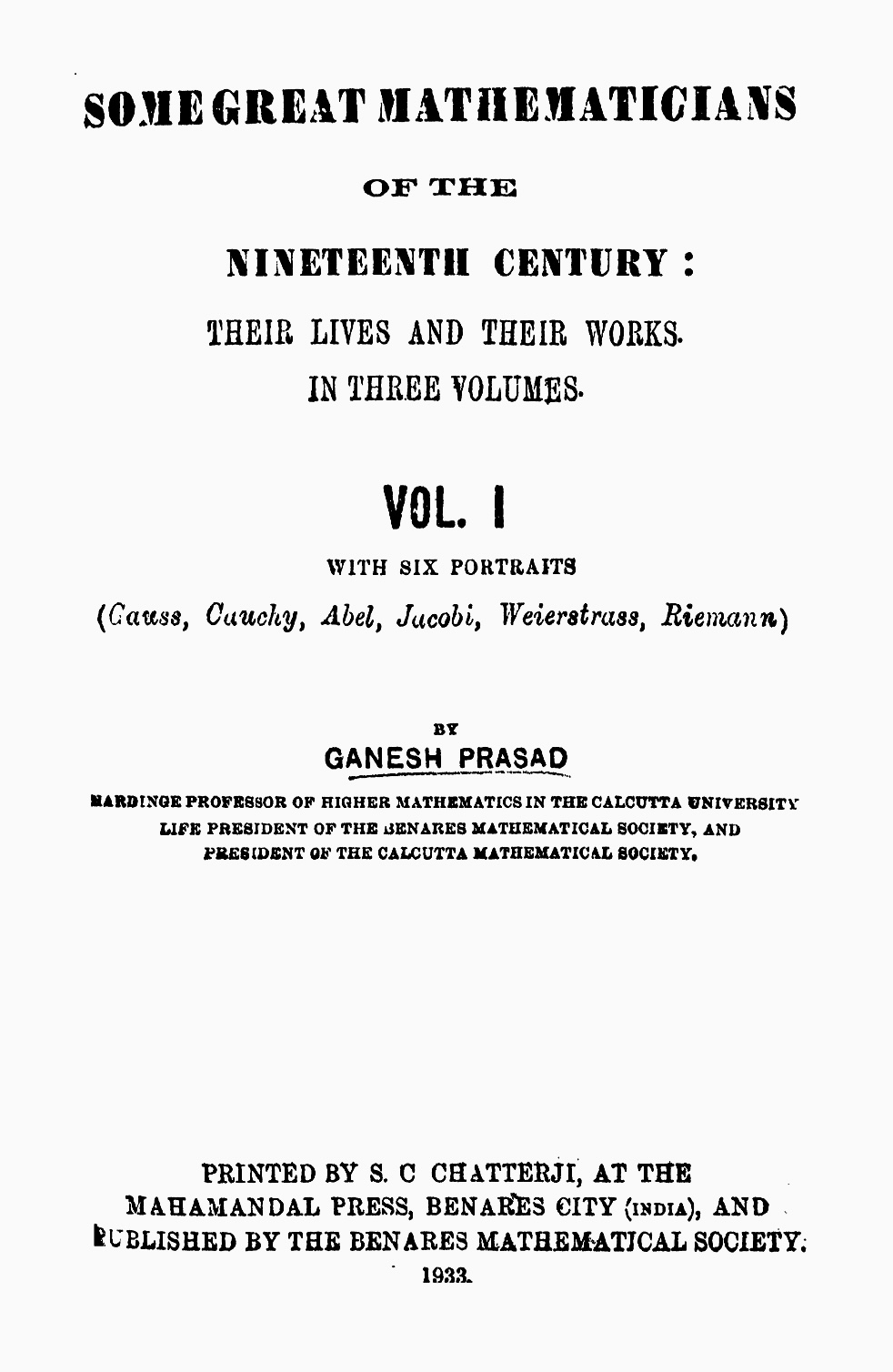
In his book Some Great Mathematicians of the Nineteenth Century, Ganesh Prasad introduces the lives and works of Gauss, Cauchy, Abel, Jacobi, Weierstrass, and Riemann. His focus on inspiring young scholars is reflected in the preface to this book:
His essays on each of the mathematicians featured in the book provide a comprehensive account of their life and work. Incidentally, the current year 2026 is being celebrated as the 200th birth anniversary of the far-sighted mathematician Georg Bernhard Riemann. A major part of Ganesh Prasad’s particular essay focussing on Riemann in this book, written about a hundred years back, is reproduced as an appendix to a companion article in this issue.2 It exemplifies Ganesh Prasad’s breadth of knowledge and reverential admiration towards each of the mathematicians he discusses in this book.
The passion for introducing the latest research progress to young research students can be seen in his Presidential Address delivered on the 31st January, 1921, before the Benares Mathematical Society. This was later published in 1923 as a book, Mathematical Research in the last 20 years. In its preface, he says
By writing in both English and Hindi, he endeavoured to make mathematics accessible to a broader audience. His works also tried to bridge Indian and Western mathematical traditions, enriching the global mathematical discourse.
Each of his lectures expounded contemporary themes, contemplated over a period of time. Besides being well-studied, his presentations were necessarily very informed while being grounded, and, at the same time, also created a sense of excitement among his audience to explore on their own. One sampling of this sentiment that gives a glimpse of the vigour and depth of his research can be seen in this introductory part of his book Six Lectures on Recent Research in the Theory of Fourier Series:
The fact that his extensive lectures appeared in book form is an eloquent testimony to the influence he had on his students, and the goodwill he drew from his peers and contemporaries. This is evident from his preface notes, in one of which3 his acknowledgement reads:
Of the student Badrinath Prasad, more commonly known as B.N. Prasad, that he mentions here, Raghavan Narasimhan, in his “Coming of age of mathematics in India” article writes:
The other notable name – Bibhutibhushan Datta – mentioned in the aforementioned preface is none other than B.B. Datta, the author, along with A.N. Singh, of the widely referred two volume classic titled History of Hindu Mathematics. Datta was a student during the time Ganesh Prasad headed the mathematics department of the University of Calcutta, from 1914 to 1917. When he returned to Calcutta in 1923, as Hardinge Professor, he appears to have left a deep influence on Datta, marking a significant change in Datta’s career. Besides his expertise in potential theory and analysis, Ganesh Prasad had an abiding interest in the history of mathematics. This led Datta’s research interests to decidedly shift from hydrodynamics propulsion to undertake a deeper exploration of the history of mathematics in India. Ganesh Prasad and Datta were in close contact with each other. It is very interesting to read the following excerpt, from the preface of Ganesh Prasad’s already mentioned book in which his article on Riemann appeared:
Datta’s coauthor Avadhesh Narayan Singh, who received his DSc in mathematics from the University of Calcutta for his dissertation titled “Derivation and Non-Differentiable functions”, was a masters student of Ganesh Prasad while he taught at the Banaras Hindu University.
Ganesh Prasad was known for his phenomenal memory. His student Gorakh Prasad, in his obituary note, recalls:4 “When he was a principal—to mention but one example—he recognized all the students (more than one thousand in number) and remembered not only their names but also numerous details about them.”
Ganesh Prasad was instrumental in building strong centres of mathematical research both at Banaras and at Calcutta. From the founding member of the Indian National Science Academy to the President of Calcutta and Benares Mathematical Societies,5 he played a major role in making the scientific community at the ground level in India.
Ganesh Prasad also pushed for primary education in villages. He donated large sums of money for encouraging primary education as well as higher studies during his time. His legacy is still alive in the form of the `Ganesh Prasad Memorial Award’ bestowed by the Indian National Science Academy to young mathematicians for the last 25 years. This award is given every year to the country’s most talented young mathematicians for their significant work.
Ganesh Prasad dedicated his career to nurturing a strong mathematical culture and inspiring the younger generation. He passed away in Agra on March 9, 1935, at the age of 58.\blacksquare
Footnotes
- This chair was established at the University of Calcutta in 1913. It was created using a ₹10 lakh endowment by eminent jurist Sir Ras Behari Ghosh, with further support from Sir Taraknath Palit. ↩
- See Riemann and defining moments in mathematical history by Devadatta G. Hegde. ↩
- This appears in his preface to the book published in 1924 titled The place of partial differential equations in mathematical physics. ↩
- PRASAD, Gorakh, `Prof. Ganesh Prasad’ Nature 135, 644 (1935). https://doi.org/10.1038/135644a0. ↩
- This was renamed Bharata Ganita Parishad in 1950 when its office was shifted to Lucknow, which is where it is presently situated. ↩