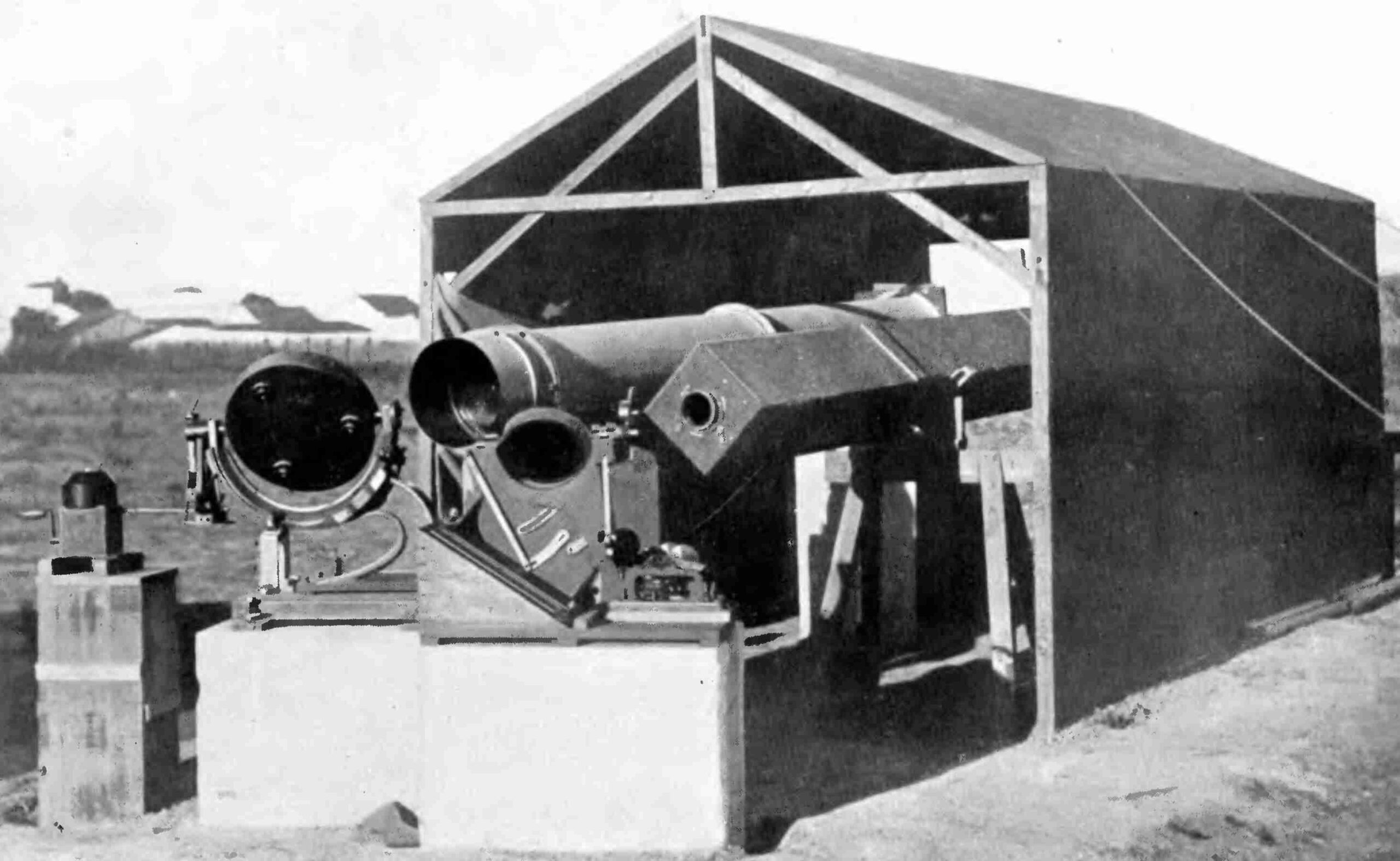
[The fundamental physical insight that would lead to] the general theory of relativity [came to me in] 1908. Why were another seven years required for the construction of the general theory of relativity? The main reason lies in the fact that it is not so easy to free oneself from the idea that coordinates must have a direct metric significance…. Thanks to Riemann’s investigation of n-dimensional metric spaces [the necessary tools were available].
— Albert Einstein.1
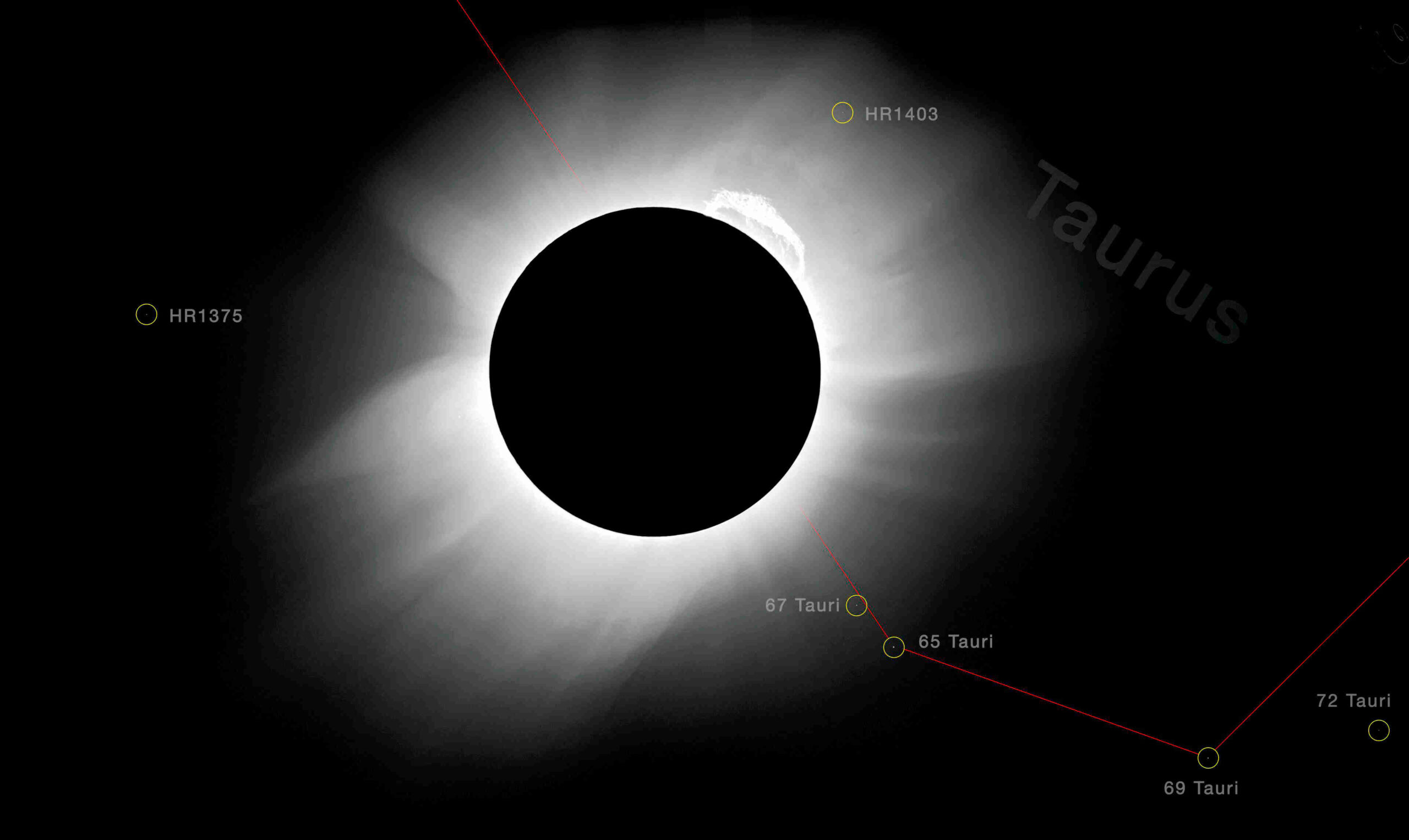
After a group of British astronomers announced that experiments had affirmed Einstein’s general theory of relativity, The Times of London ran the headline
REVOLUTION IN SCIENCE
NEW THEORY OF THE UNIVERSE
NEWTONIAN IDEAS OVERTHROWN
on Friday, November 7, 1919. As Einstein notes in his autobiographical notes, the mathematical foundation for his theory had been initiated fifty years earlier by the extraordinary mathematician Georg Friedrich Bernhard Riemann.
This year, 2026, marks the two-hundredth anniversary of Riemann’s birth. It is a fitting moment to ask: who was this man, and how did he transform the mathematics of later generations?
A pastor’s son
Riemann was an introverted boy, finding it difficult to form close attachments. Until the age of fourteen, he was educated at home and in the village school in Quickborn, where his family had moved. His teacher, Schulz, gave the boy a good grounding in arithmetic and geometry. We know very little about his education in these early years.
In September 1846, Riemann enrolled at the University of Göttingen to study theology, in accordance with his father’s wishes, but quickly transferred to mathematics. Göttingen was home to the greatest mathematician of the age, Carl Friedrich Gauss, who at the time taught only elementary statistics.
Riemann took advantage of a distinctive feature of the German university system of that era: students were free to move between universities at will, attending lectures wherever the best teaching was to be found. In Easter of 1847, Riemann moved to the University of Berlin, where he attended lectures by Jacobi, Dirichlet, and Eisenstein.
Riemann returned to Göttingen in 1848—the year of revolutions across Europe—combining his mathematical studies with readings in philosophy, especially the work of Johann Friedrich Herbart, and attending an experimental physics course given by Wilhelm Weber, a colleague of Gauss. Riemann obtained his doctorate in 1851 at the age of twenty-five—quite late by the standards of his time.
Riemann and complex analysis
An ambitious inaugural dissertation
Very few mathematical papers have exercised an influence on the later development of mathematics comparable to the stimulus received from Riemann’s dissertation. It contains the germ of a major part of the modern theory of analytic functions, it initiated the systematic study of topology, it revolutionized algebraic geometry, and it paved the way for Riemann’s own approach to differential geometry.
—Lars V. Ahlfors[1].
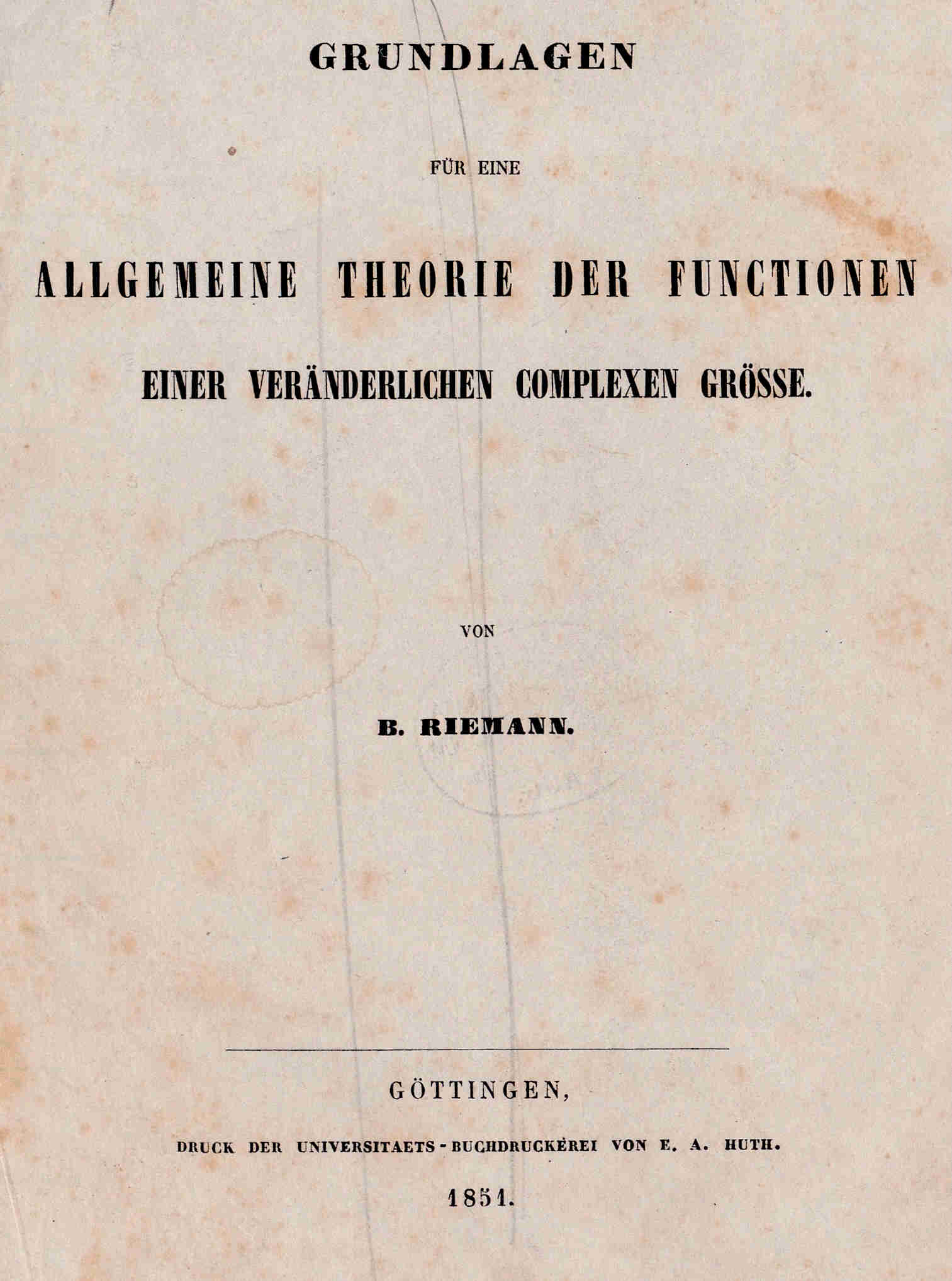
The very title of Riemann’s doctoral thesis, Foundations for a General Theory of Functions of a Complex Variable, announces the ambition of his project. To Riemann, the heart of the matter lay not in formulas but in certain partial differential equations that a complex function must satisfy. This conviction would become the seed of the most important ideas in his doctoral thesis, submitted in 1851.
A geometric view of complex functions
The objects of Riemann’s investigation are functions of a complex variable z = x + iy. He writes\[ w = f(z), \qquad w = u(x,y) + iv(x,y),\]and takes a thoroughly geometric view:
If to every value of z there corresponds a definite value of w which changes continuously with z, in other words, if u and v are continuous functions of x and y, then to every point in the plane A will correspond a point in the plane B, to every line (generally speaking) will correspond a line and to every connected piece of area will correspond a connected piece of area. Thus one can imagine this dependence of the magnitude w on z as a mapping of the plane A on the plane B.
— Riemann, in his thesis [12].
Gauss had already recognized this property of complex differentiable functions in 1825 in a prize-winning essay on the mapping of surfaces.2 Conformal maps had been of practical interest long before Riemann. A ship’s navigator needs a map that preserves the compass bearings – the angles between routes and lines of longitude. Such a map must be conformal. It was in the course of his geodetic survey of Hanover that Gauss had thought most carefully about it. Riemann studied this work of Gauss closely as a student.
To Riemann, the conformality of complex differentiable functions needed to be at the very foundations of the theory of functions of a complex variable. Angle-preserving mappings play no role at all in the work of two of his contemporaries, Cauchy and Weierstrass.
The Riemann mapping theorem
Two given simply connected planar surfaces can always be related to each other in such a way that every point of one corresponds to one point of the other, which varies continuously with it, and their corresponding smallest parts are similar.
— Riemann’s thesis [12].
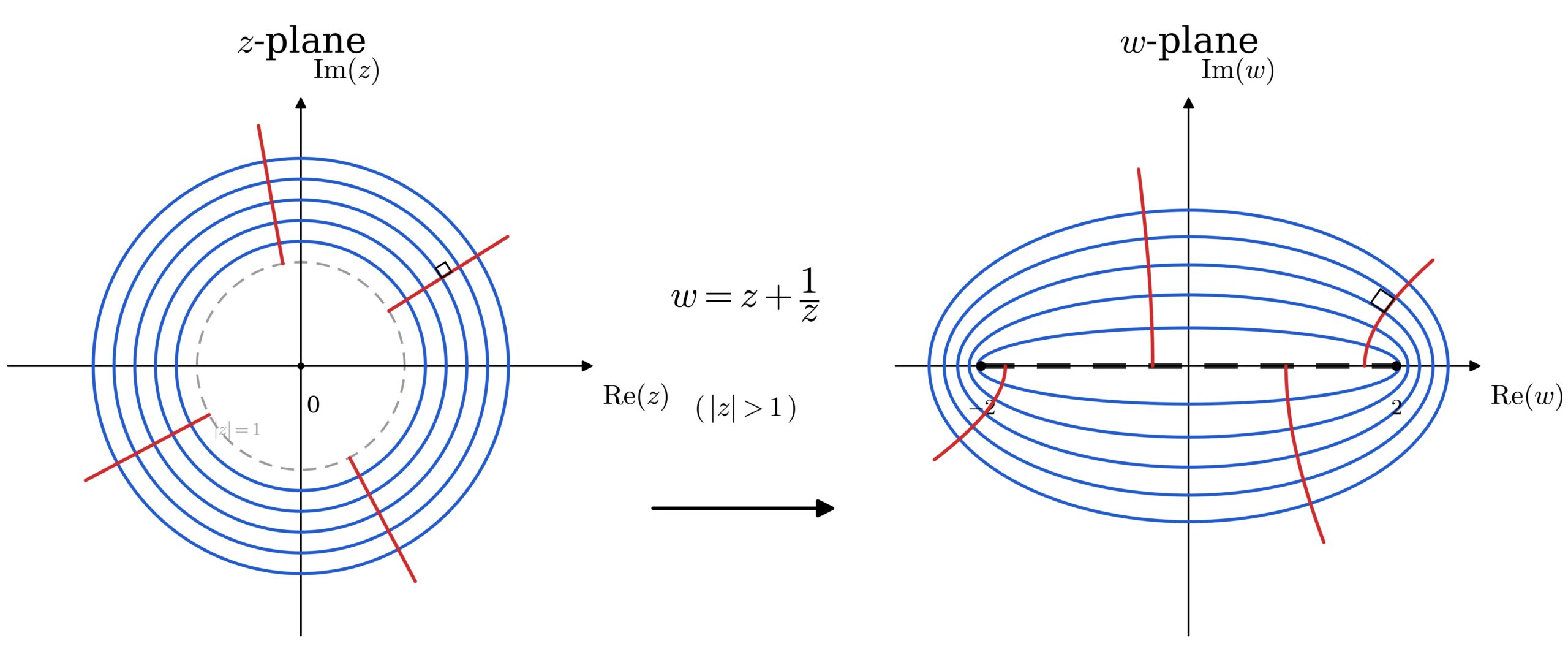
Riemann’s proof rested on what he called the Dirichlet principle, an argument with roots in physics. His proof does not provide any explicit formula for such a conformal map, but shows its existence. Several aspects of the thesis were thus controversial back then.
This concisely written paper [Riemann's thesis], one of the great pioneering achievements of modern mathematics, was so completely unorthodox in its approach to the subject that many people would have liked to ignore it.
— Richard Courant and Herbert Robbins [2].
Half a century later, David Hilbert put the Dirichlet principle on rigorous ground and rescued Riemann’s argument. This project led to a whole new area of analysis: the infinite-dimensional geometry of what are now called Hilbert spaces.3
Riemann surfaces and facets of topology
Although Riemann’s pioneering ideas have influenced all subsequent work in this area [topology of two-dimensional manifolds], his writing gave few details, and is not always easy to follow.
— John Milnor [10].
The generality of Riemann’s approach and the paucity of examples possibly led to an opaque writing. Despite the influence, Milnor may have been justified in his assessment. One such decidedly involved concept was the notion of a Riemann surface, which took half a century to clarify. Riemann introduced this notion in his inaugural dissertation and developed it further in his 1857 paper on Abelian functions. We try to explain one facet of it here.
A basic question: How does one draw the graph of P(z,w) = 0 for a polynomial P, that is, the set of all pairs (z,w) satisfying this equation?
If z and w were real numbers, it would be a curve in the two-dimensional plane \mathbb{R}^2. However, if z and w are allowed to be complex numbers, the resulting figure is a two-dimensional surface sitting in four-dimensional space. It is not possible to imagine four spatial dimensions, and hence the shapes of these figures are hard to see even though they are surfaces. Nevertheless, Riemann discovered a way to understand the basic features of these figures using the concept now called a Riemann surface.
As an example, take
\[
P(z,w) = z^2 + w^2 \,\, – 1.
\]In the plane \mathbb{R}^2, this gives a circle. When z and w are allowed to be complex numbers, the resulting surface is topologically a sphere punctured at two points. (The two punctures arise from the two directions in which the complex curve escapes to infinity.)
Riemann showed that every surface given by P(z,w) = 0, after some singular points are removed, looks like a sphere with a number of handles attached, also with a finite number of points removed. A sphere has no handles; a torus has one. The number of handles is called the genus, and it plays an important role in the study of the properties of the polynomial P. These observations of Riemann initiated the systematic study of the subject that we now call topology.
The reshaping of geometry by Riemann
Euclid’s fifth postulate
Although it was not Riemann’s goal, his work in geometry answered a question that had bothered mathematicians since Euclid: is Euclid’s fifth postulate, that through any point there is exactly one line parallel to a given line, derivable from Euclid’s first four postulates (which tell you how to construct lines and circles, and measure angles)?
By the 1830s, Bolyai and Lobachevsky had independently constructed consistent geometries in which the postulate fails: geometries in which through a given point there are infinitely many parallels to a given line. The angle sum of a triangle in such a geometry is always less than 180^{\circ}. There were nice formulas in this geometry, and they were similar to formulas in spherical geometry. However, nothing like a sphere was available for this geometry. The situation was confusing.
It is important to be clear, however—and Gray4 is emphatic on this point—that Riemann’s geometry lecture was not motivated by the problem of the parallel postulate. He regarded the axiomatic approach to geometry as misguided from the outset, and in private notes from the early 1850s called such enquiries “extremely unfruitful.” His starting point was Gauss’s intrinsic geometry of surfaces, and his goal was to generalize it to higher dimensions. The non-Euclidean geometries of Bolyai and Lobachevsky emerged, in Riemann’s framework, as special cases of spaces of constant negative curvature—but they were consequences, not motivations.
Gauss and the geometry of surfaces
The word geometry derives from the Greek for “measuring the earth.” Since antiquity, geometry has concerned the physical world: plane geometry to measure a farmer’s land, spherical geometry for astronomy.
As mentioned earlier, in the 1820s, Gauss was commissioned to carry out a geodetic survey of the Kingdom of Hanover. In those years, Gauss discovered the concept of the intrinsic curvature of a surface—an idea that would completely transform the study of surfaces.
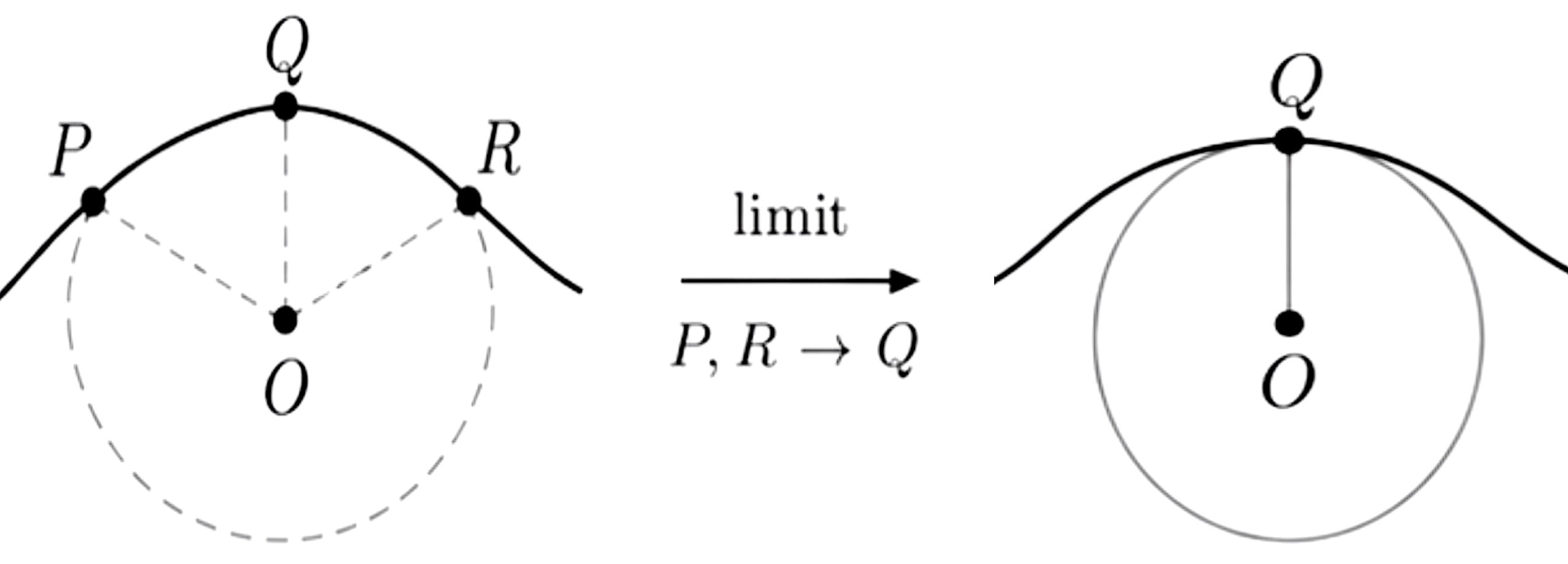 Curvature of plane curves. For a plane curve \mathcal{K} and a point Q on it, one takes the circle passing through three points P, Q, R on \mathcal{K} and lets P, R \to Q; the limiting circle has radius r_Q. The curvature of \mathcal{K} at Q is
\[
\kappa_Q = \frac{1}{r_Q},\]so that a straight line, approximated by a circle of infinite radius, has curvature zero; while a circular path, approximated by itself, has, at each of its points, constant radius r_Q, and hence constant curvature equal to \frac{1}{r_Q}. One can also assign a sign to the curvature depending on the direction of the bending of the curve, say a positive sign if it bends to the right, and negative if the bending is leftwards.
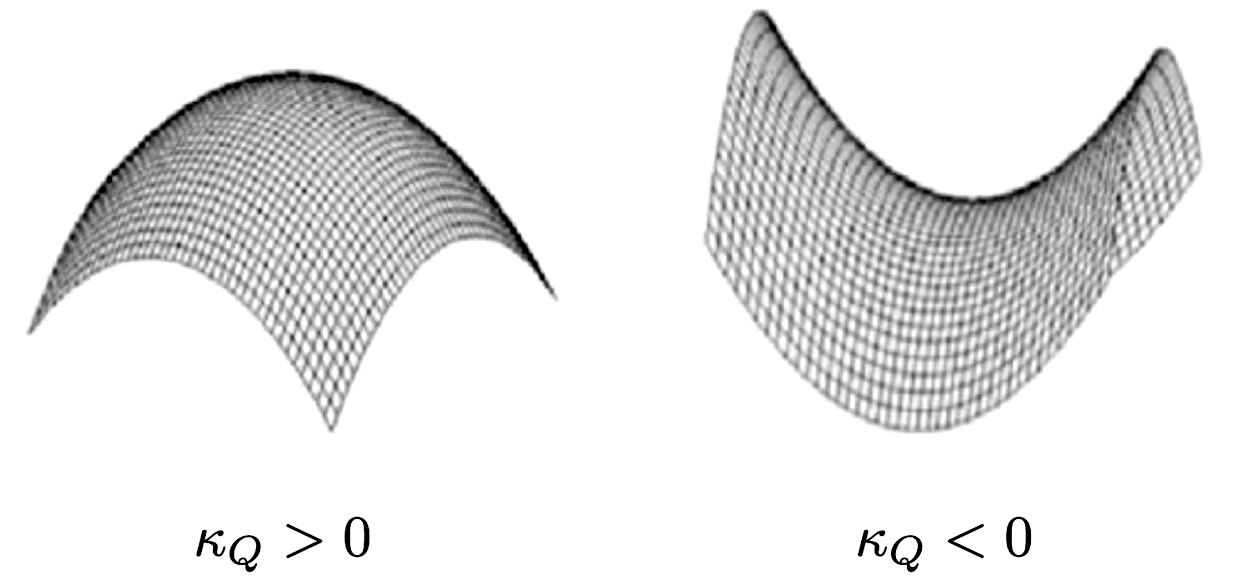 Curvature of a surface. For a surface \mathcal{S} at a point Q, one slices \mathcal{S} with planes containing the normal at Q to obtain curves on \mathcal{S}. The curvature of such a curve varies as the cutting plane rotates. Euler had shown that among all such curves, the one attaining a minimum \kappa_{Q,\min} and the one attaining a maximum \kappa_{Q,\max} occur in two mutually perpendicular directions. Gauss defined the curvature of the surface at Q to be their product:
\[ \kappa_Q = \kappa_{Q,\min} \times \kappa_{Q,\max}.
\]Gauss then proved his Theorema Egregium (Remarkable Theorem): the curvature \kappa_Q can be measured entirely from within the surface, using only distances measured along the surface. It has nothing to do with how the surface happens to sit in three-dimensional space.
The practical illustration is vivid. You can cut a cylinder along a line and unroll it flat onto a table without stretching or tearing—distances are preserved, and indeed its Gaussian curvature is zero. A sphere, however, cannot be flattened without distortion—think of trying to wrap a ball in paper without crumpling it. Its curvature is genuinely non-zero; in fact it is positively curved. Whereas the saddle part of a surface cannot be wrapped without tearing the paper; here the surface is negatively curved.
The halter round his neck
The other morning, Dirichlet was with me for about two hours; he gave me some notes which I needed for my habilitation thesis, which were so comprehensive that they will significantly lighten my work. […]He also went through my dissertation with me and, in general, was extremely friendly towards me, which I scarcely expected because of the great gap in standing. I have hopes that he will not forget me later.
— Riemann’s letter to his family [11].
After his doctorate, Riemann needed one further qualification to teach at a German university: the Habilitation. The process required submitting a thesis, passing an examination, and delivering a public lecture. Riemann had been working towards it for three years, and in his letters home, he called it “a halter round my neck.”
The custom was for the candidate to propose three topics on which he could be examined, with the examiner choosing one. The unspoken convention was that the examiner would choose the first—the topic the candidate had prepared most thoroughly.
Gauss, unconventionally, chose the third topic. Riemann wrote to his brother in some agitation: “The two first ones I had well prepared, but Gauss chose the third one, and now I’m in a tight spot.”
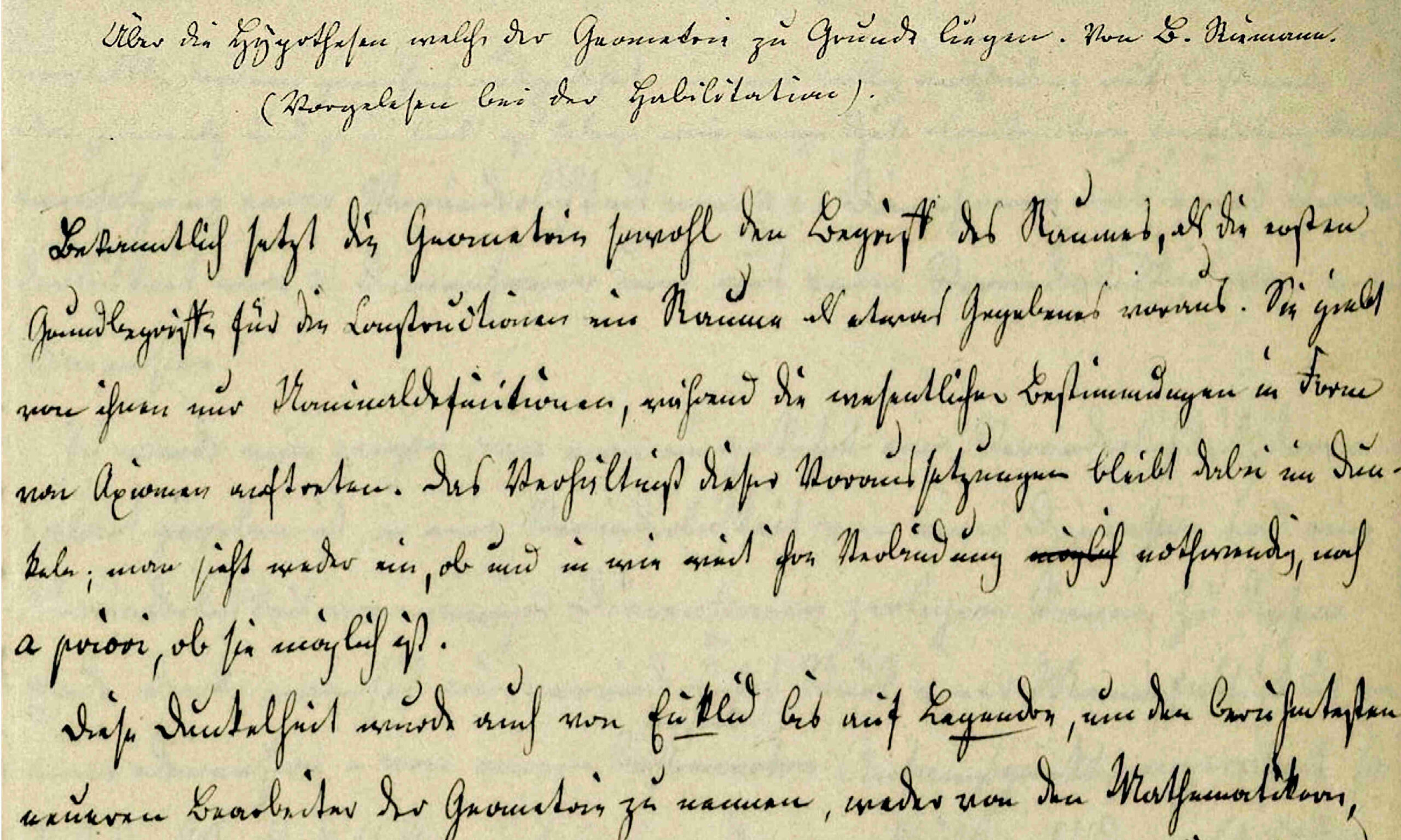
He worked on it with great intensity for several weeks. On June 10, 1854, he delivered the lecture—On the Hypotheses Which Lie at the Foundations of Geometry—before the Philosophy Faculty of Göttingen University, an audience of classicists, historians, and philosophers, and, among the mathematicians, Gauss. After the lecture, Gauss spoke to his colleague Wilhelm Weber with what Gray describes as “uncharacteristic excitement” about the depth of what he had just heard. Riemann had taken Gauss’s own ideas about intrinsic curvature and carried them far beyond anything Gauss had contemplated.
One detail gives this moment its particular poignancy: the lecture was published not in 1854 but in 1867—the year after Riemann died. It is also worth pondering the counterfactual: had Gauss followed convention, would Riemann have ever been compelled to articulate his views on geometry?
Riemann’s reimagining of Gaussian geometry
Riemann took Gaussian curvature as his starting point and reframed the entire problem. His conception marks a turning point in the very purpose of geometry. Until then, geometry bore a direct responsibility: to describe real physical space. Riemann severed this tie.
His central claim was this: a space is parametrized by n coordinates (x_1, …, x_n) around each point and carries no canonical notion of distance. We habitually assume that the distance from (x_1, …, x_n) to (y_1, …, y_n) is
\[ \sqrt{(x_1 – y_1)^2 + \cdots + (x_n – y_n)^2},
\]but Riemann insisted this is a choice, not a necessity.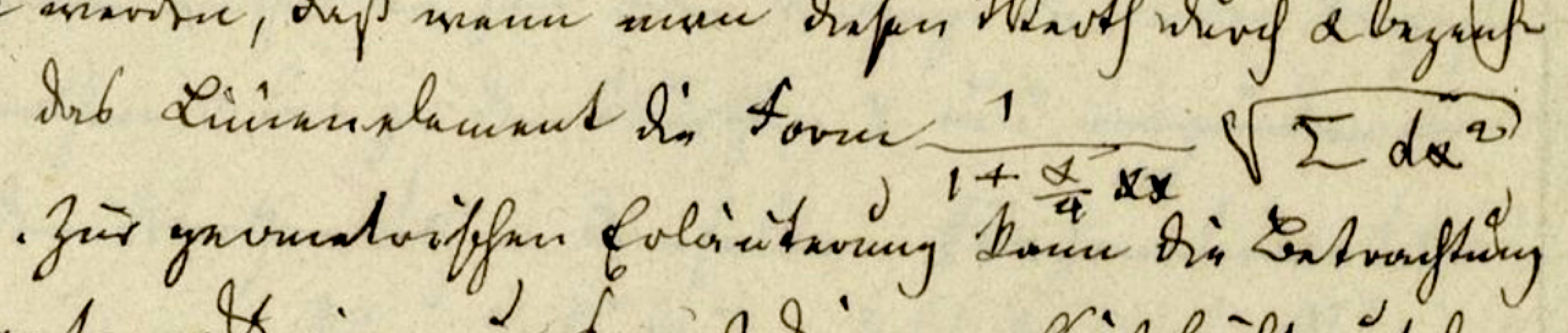
Suppose a surveyor uses a coordinate system \mathbf{x} = (x_1, …, x_n) to locate the various points in a region. In a sharp departure from his predecessors, Riemann insisted that locating two points does not automatically tell us what the distance between them is. With the aid of integration we can measure the distance between two far away points if we know the distance between two infinitesimally close points. Riemann proposed that the infinitesimal distance ds between \mathbf{x} and \mathbf{x} + d\mathbf{x} satisfies
\[ ds^2 = \sum_{i,j} g_{ij}(\mathbf{x}) dx_i dx_j,
\]where g_{ij}(\mathbf{x}) is a collection of smoothly varying coefficients that can differ from point to point. There is freedom in choosing this data, subject to certain necessary restrictions such as insisting that the infinitesimal distance ds^2 is positive. Similarly, one requires that the matrix [g_{ij}(\mathbf{x})] is symmetric. One may think of this data [g_{ij}(\mathbf{x})] as coming from experimental measurements.
A classic example is the upper half-plane, consisting of points (x,y) with y > 0, which admits the following metrics:
\[\begin{align*}
&\text{Euclidean:} &
ds^2 &= dx^2 + dy^2, &
& g_{ij}(x,y) = \begin{pmatrix} 1 & 0 \\ 0 & 1 \end{pmatrix}, \\[6pt]
&\text{Hyperbolic:}
& ds^2 &= \frac{dx^2 + dy^2}{y^2}, &
& g_{ij}(x,y) = \frac{1}{y^2}\begin{pmatrix} 1 & 0 \\ 0 & 1 \end{pmatrix}.
\end{align*}\]
The hyperbolic metric is more natural for this space than the Euclidean one. We shall not elaborate on this here, as it requires considerable background. We mention it only to illustrate that even on familiar spaces, a geometry determined by a non-Euclidean metric can be a better-behaved object than its Euclidean counterpart.
This realization is genuinely hard to absorb, because we are so habituated to the Euclidean choice. That the idea seems opaque to the beginner and invisible to the trained mathematician is itself a measure of how deeply Riemann reshaped the foundations of the subject.
The influence of Herbart and physics
During his years in Göttingen, Riemann studied in depth the work of the philosopher Johann Friedrich Herbart, who had held the chair of philosophy there until his death in 1841. Herbart had argued, against Kant, that space is not an a priori form of intuition given to us before all experience, but a constructed concept—something the mind builds up from experience. Erhard Scholz’s thorough study5 of this influence concluded that Riemann’s views on mathematics “seem to have been deepened and clarified by his extensive studies of Herbart’s philosophy. Moreover, without this orientation, Riemann might never have formulated his profound and innovative concept of a manifold.”
Riemann also worked during this period in the physics laboratory of Wilhelm Weber on questions about the propagation of electricity, light, and magnetism. These physical preoccupations were not separate from his mathematical development. The questions of how forces act through space, and what the nature of space itself might be, fed directly into the habilitation lecture on geometry. As Gray observes, the idea that the local metric of space might vary from point to point—which is the central idea of Riemannian geometry—grew partly out of Riemann’s attempts to think about the ether and gravitational action at a distance.
What Riemann took from Herbart, and then went decisively beyond, was the idea that geometry need not be tied to physical three-dimensional space. This is but one example of an idea of Riemann that has become so commonplace that it is now hard for us to recover its original strangeness in the 1850s. As late as 1892, Poincaré felt it necessary to defend the study of higher-dimensional geometry in public, writing that “those who recoil from geometry of more than three dimensions may believe [his] result to be useless and view it as a futile game, if they have not been informed of their error.”
Geometry meets physics
The mathematical apparatus useful for the general theory of relativity lay already complete in the `Absolute Differential Calculus’, which was based on the researches of Gauss, Riemann and Christoffel on non-Euclidean manifolds, and which had been shaped into a system by Ricci and Levi-Civita, and already applied to the problems of theoretical physics.
— Albert Einstein [4].
Riemann’s lecture freed geometry from its Euclidean obligation to describe the physical world. Paradoxically, this liberation made geometry the ideal mathematical foundation for general relativity—a theory about the very universe it had seemingly turned away from. Let us try to explain briefly how this came about.
According to Einstein’s special relativity, no experiment can tell you whether you are at rest or moving at constant velocity. General relativity goes further: a person in a windowless elevator accelerating upward at 9.8 \text{m} \text{s}^{-2} cannot tell, by any experiment, whether he is on the Earth or being propelled by a rocket in empty space. This is the principle of equivalence—acceleration and gravity are locally indistinguishable.
Einstein then asked: what happens to light in a gravitational field? In an accelerating elevator, a beam of light entering through a small hole in the wall would curve downward—just as a cricket ball curves after being hit. For the ball, gravity acts on its mass. But light has no mass. So what is causing the curvature?
Einstein’s answer was radical: gravity is not a force at all. It is the curvature of spacetime. Massive objects like the Sun curve the four-dimensional spacetime around them, described by a Riemannian-type metric g_{ij}. Light travels along geodesics—the straightest possible paths—in this curved spacetime.
The mathematics for all of this—metrics, curvature, geodesics—had been initiated by Riemann fifty years before Einstein needed it.6
Riemann and number theory
I believe I can best express my gratitude for the honor which the Academy has bestowed on me in naming me as one of its correspondents by immediately availing myself of the privilege this entails to communicate an investigation of the frequency of prime numbers, a subject which because of the interest shown in it by Gauss and Dirichlet over many years seems not wholly unworthy of such a communication.
— Riemann, On the Number of Primes Less Than a Given Magnitude, 1859. Edwards [3].
Riemann’s only published paper in number theory appeared in 1859, the year in which Riemann succeeded both of his teachers at Göttingen. Laugwitz calls it an act of homage to his two role models. It is eight pages long and quite sketchy; Riemann himself wrote to Weierstrass acknowledging its provisional nature, and Laugwitz remarks that “we should regard it as a piece of great good luck that he brought himself to publish the paper in the first place.” Despite these shortcomings, it is one of the most influential papers in the history of number theory.
Distribution of prime numbers
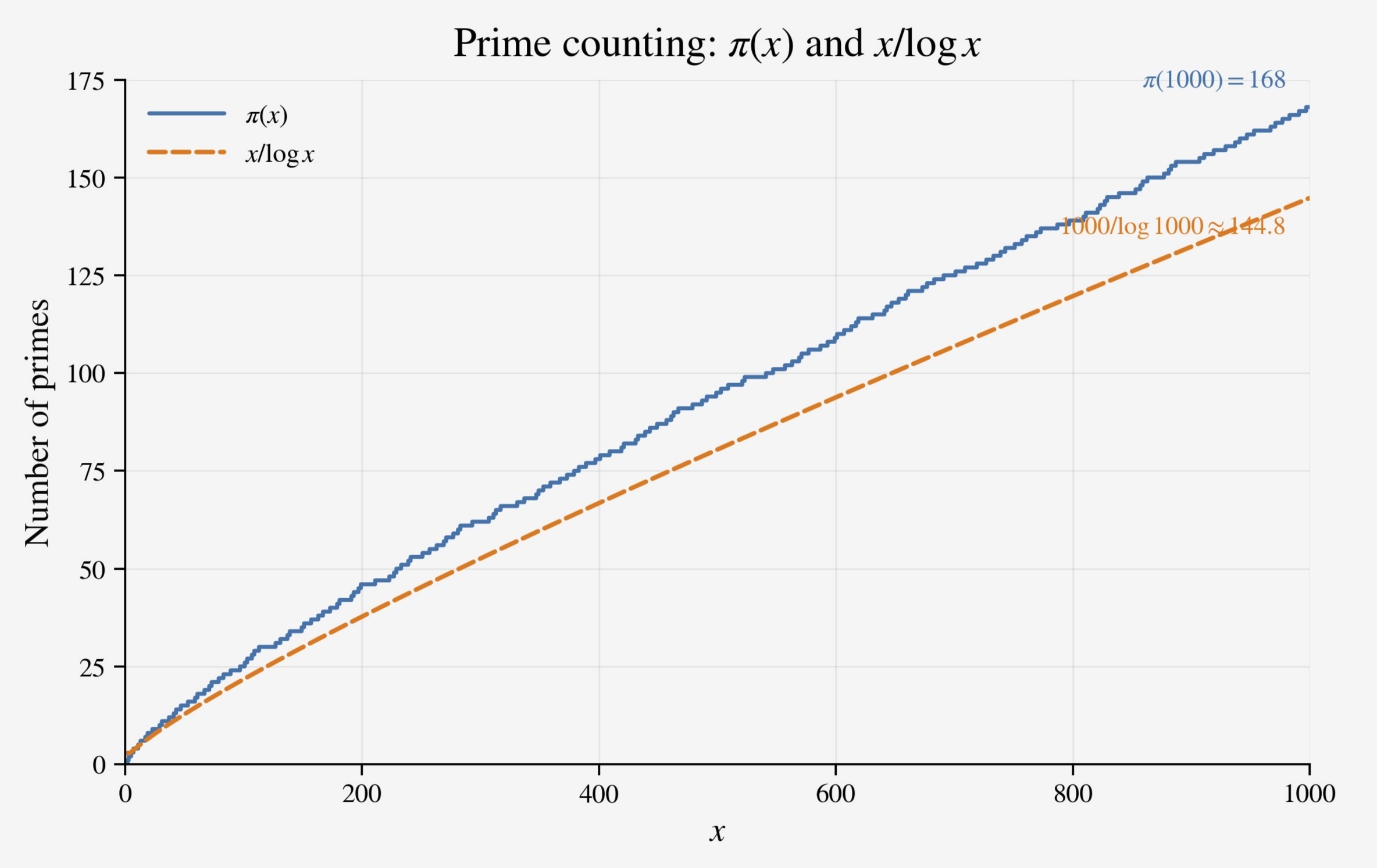
\[
\pi(x) = \text{number of prime numbers between } 0 \text{ and } x.
\](Here \pi(x) denotes the prime-counting function, not the familiar constant 3.14159….) For example,
\[
\pi(2.5) = 1, \quad \pi(4.1) = 2, \quad …, \quad \pi(100) = 25.
\]Gauss discovered empirically that
\[
\frac{x}{\pi(x)} \sim \log x
\qquad \text{equivalently} \qquad
\pi(x) \sim \frac{x}{\log x}.
\]
Today, this result is called the prime number theorem. Gauss discovered the pattern, but a proof remained out of reach until Hadamard and de la Vallée Poussin, building on Riemann’s methods, established it in 1896.
Euler and the zeta function
— Riemann’s paper.
After discovering the beautiful formula
\[
\frac{1}{1^2} + \frac{1}{2^2} + \frac{1}{3^2} + \cdots = \frac{\pi^2}{6},
\]
Euler was led to study a more general object. For a real number s > 1, he introduced the zeta function
\[
\zeta(s)
= \sum_{n \ge 1} \frac{1}{n^s}
= \frac{1}{1^s} + \frac{1}{2^s} + \frac{1}{3^s} + \cdots.
\]
He then made a remarkable observation: this infinite sum over all natural numbers can be rewritten as an infinite product over primes, now called Euler products:7
\[
\zeta(s)
= \prod_{p} \bigl(1 – p^{-s}\bigr)^{-1}
= \frac{1}{1 – 2^{-s}} \cdot \frac{1}{1 – 3^{-s}} \cdot
\frac{1}{1 – 5^{-s}} \cdots.
\]
This identity is an analytic repackaging of the fundamental theorem of arithmetic—the fact that every positive integer factors uniquely into primes. As Riemann remarks, this observation of Euler was his starting point for investigating the distribution of prime numbers.
The insight of Riemann
If s = \sigma + it, Riemann discovered that the zeros of \zeta(s) with 0 \le \sigma \le 1 carry secrets about the distribution of prime numbers. Every such zero has the form \rho = \sigma + it for some real t. The Riemann hypothesis asserts that for every such zero, the real part is exactly \tfrac{1}{2}—that is,
\[
\rho = \tfrac{1}{2} + it \quad \text{for some real } t.
\]This is widely regarded as one of the most important unsolved problems in mathematics. It has been numerically verified for the first ten trillion zeros, all of which have a real part \tfrac{1}{2}.
Ordering these zeros as
\[\begin{align*}
\rho_j = \tfrac{1}{2} + i\theta_j,
\quad \text{with} \quad
0 < \theta_1 < \theta_2 < \cdots\\
\text{for }\ j = 1, 2, …,
\end{align*}\]
the first few values are:
\[\begin{align*}
\theta_1 = 14.134725…, \
\theta_2 = 21.022039…, \\
\theta_3 = 25.010857….
\end{align*}\]
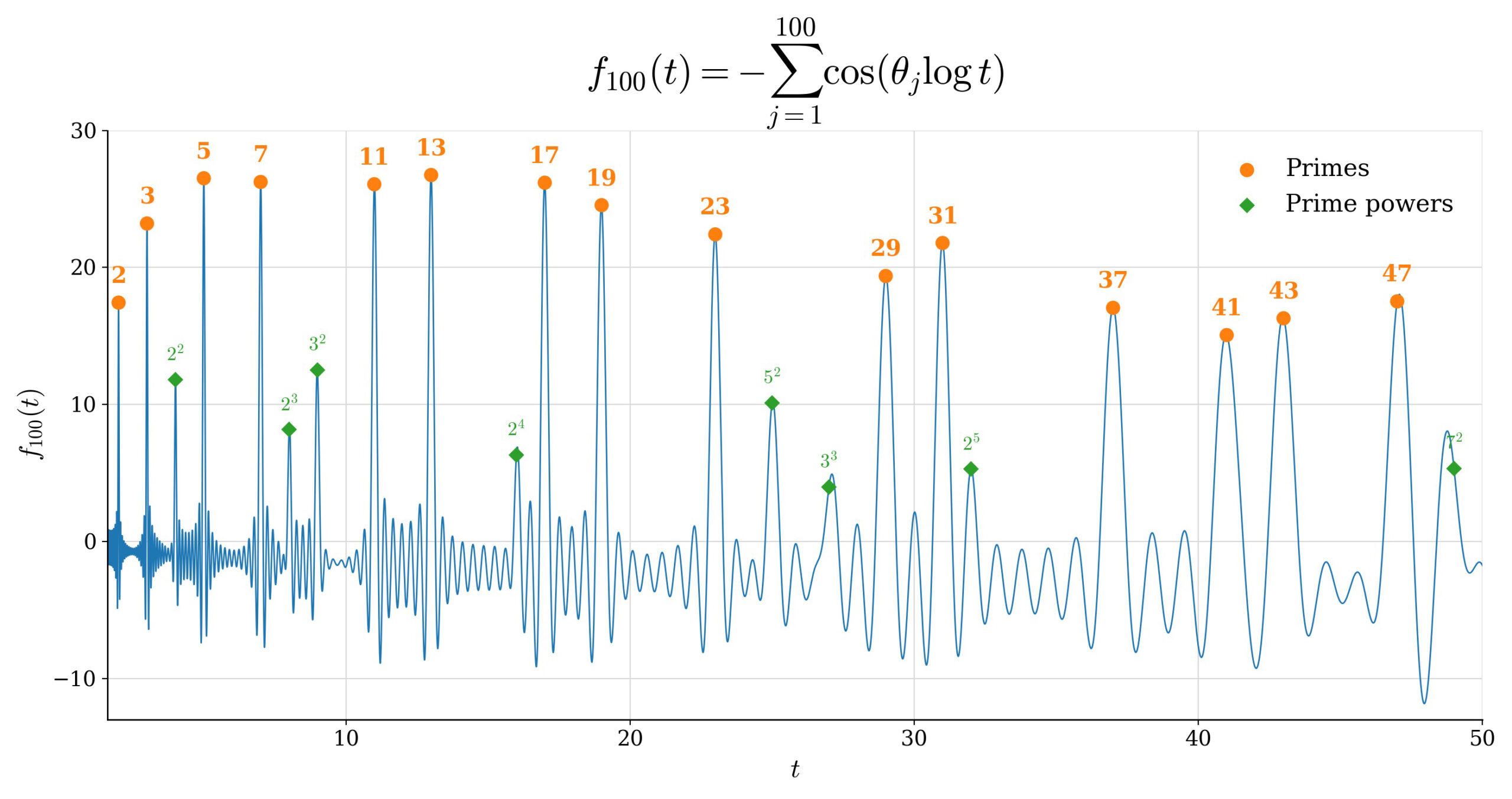
At first glance, these numbers seem to have no connection to the primes. To see that they do, consider the function
\[
f_N(t) = - \sum_{i=1}^{N} \cos(\theta_i \log t).
\]The plot of \(f_N\) for \(N = 100\) reveals sharp peaks precisely at the primes and prime powers.
This connection, uncovered by Riemann, is what ultimately enabled Hadamard and de la Vallée Poussin to prove the prime number theorem in 1896.
Trials and tribulations
For most of his adult life, Riemann struggled financially. In those days, a career in science was not the stable professional path it is today.8 Riemann’s father, a Protestant minister of modest means, supported him well into his late twenties.
The habilitation, which Riemann completed in 1854, gave him the right to teach but no guaranteed income – his earnings came from fees paid directly by students attending his lectures. When Riemann was appointed associate professor in 1857, his initial yearly salary was a modest 300 thalers. It was only after Dirichlet’s unexpected death in 1859 that Riemann was made a full professor—at the age of thirty-three.
The personal losses in Riemann’s life were severe. His mother died when he was young. Tuberculosis swept through his family, taking three sisters and finally Riemann himself. His father died in 1855. The three remaining sisters went to live with his brother Wilhelm, who died in the winter of 1857–58. Riemann then took the whole family into his own home in Göttingen, and almost immediately a second sister died.
He married Elise Koch, a friend of his sister, in 1862. That same year his health collapsed from pleurisy, and he began making extended trips to Italy, where the climate offered some relief. Their daughter Ida was born in Pisa the following year. Two Italian mathematicians Riemann befriended there, Enrico Betti and Eugenio Beltrami, were so inspired by his ideas that they went on to make important contributions to topology and differential geometry.
Legacy
The true measure of Bernhard Riemann’s mathematical legacy lies not only in the groundbreaking results he established, but in his approach to mathematics that have influenced even those areas he had not worked in. With important qualifications, it may be summarized as “concepts over computations”. Until the time of Riemann, a great mathematician displayed his skill with virtuoso calculations. Riemann’s approach insisted on concepts that clarified long and tedious computations. For example, mathematics today is filled with existence-uniqueness theorems of the form “there exists a unique solution to a nice differential equation satisfying these initial or boundary conditions”. Riemann’s thesis showed the power of such theorems. In this context, we may recall that Gauss initially won the respect of European scientists for making a calculation in astronomy that resulted in the rediscovery of the lost “planet” Ceres.
However, this did not please everyone. Carl Ludwig Siegel, one of the most original and iconoclastic mathematicians of the twentieth century, wrote on 1 June 1959 to André Weil:
This is not the place for an extended discussion of Siegel’s critique or its context. But that the influence of Riemann on the further development of mathematics was so great as to overshadow even Euler, Lagrange, and Gauss is simply true. Almost all of the dominant trends in twentieth-century mathematics have been Riemannian.
Riemann reshaped complex analysis, initiated the topological study of surfaces, transformed the study of prime numbers, and began a new chapter in geometry that proved crucial for general relativity. We have touched on these in some detail. But there is much we have not been able to cover: his work on shock waves and the propagation of sound, where he was the first to describe compression waves and rarefaction; his analysis of ordinary differential equations, including the hypergeometric equation that Gauss had studied; and his investigation of trigonometric series, where his careful study of which functions can be integrated opened a line of questions that led eventually to Cantor’s set theory and Lebesgue’s theory of integration. Yet, the architect of this vast mathematical legacy had tragically little time to see its impact.
Death
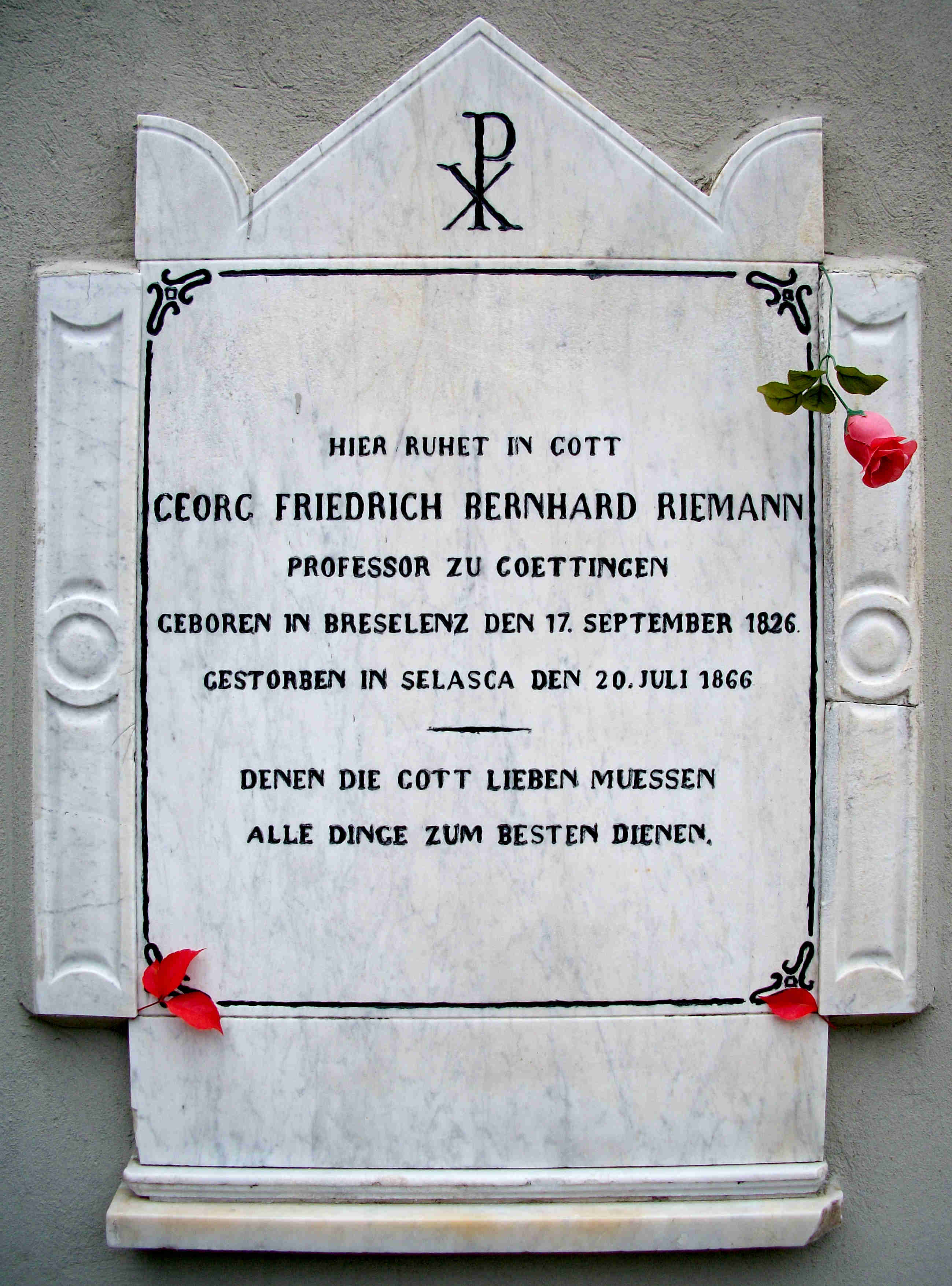
Riemann died on 20 July 1866, beside a lake in northern Italy, still at work on an unfinished manuscript. Dedekind’s account of his last hours is difficult to forget:
Endnote
Our account draws on the excellent and highly recommended biographies listed below:
- Jeremy Gray [7] is written for the general reader
- Detlef Laugwitz [8] requires more mathematical background.
- Dedekind’s biography of Riemann in Riemann’s collected works [12]. This is available in English translation. \blacksquare
References
- [1] L.V. Ahlfors. Development of the theory of conformal mapping and Riemann surfaces through a century, In Contributions to the theory of Riemann surfaces, Ann. of Math. Stud., no. 30, pages 3–13. Princeton Univ. Press, Princeton, NJ, 1953.
- [2] R. Courant and H. Robbins, What Is Mathematics? Oxford University Press, New York, 1941.
- [3] H.M. Edwards, Riemann’s zeta function, Dover Publications, Inc., Mineola, NY, 2001. Reprint of the 1974 original Academic Press, New York.
- [4] A. Einstein, Die grundlage der allgemeinen relativitätstheorie. Annalen der Physik, 354(7) 769–822, 1916.
- [5] A. Einstein, Autobiographical notes, Open Court Publishing Co., La Salle, IL, centennial edition, 1979. Translated from German and edited by Paul Arthur Schilpp.
- [6] L. Gårding, Encounter with mathematics, Springer-Verlag, New York-Heidelberg, 1977.
- [7] J. Gray, Simply Riemann, Great Lives. Simply Charly, New York, 2020.
- [8] D. Laugwitz, Bernhard Riemann 1826–1866, Birkhäuser Boston, 2008. Turning points in the conception of mathematics, Translated from the 1996 German original by Abe Shenitzer with the editorial assistance of the author, Hardy Grant and Sarah Shenitzer.
- [9] J. McCleary, Geometry from a differentiable viewpoint, Cambridge University Press, Cambridge, second edition, 2013.
- [10] John Milnor, Topology through the centuries: low dimensional manifolds, Bull. Amer. Math. Soc. (N.S.), 52(4) 545–584, 2015.
- [11] E. Neuenschwander, Lettres de Bernhard Riemann à sa famille. In Cahiers du Séminaire d’Histoire des Mathématiques, 2 (French), pages 85–131. Inst. Henri Poincaré, Paris, 1981.
- [12] B. Riemann, Collected papers, Kendrick Press, Heber City, UT, 2004. Translated from the 1892 German edition by Roger Baker, Charles Christenson and Henry Orde.
Appendix
Bernhard Riemann (1826 – 1866)
By Ganesh Prasad9
Georg Friedrich Bernhard Riemann was born on the 17th September, 1826, in Breselenz, a village in the Province of Hannover (then a kingdom under Great Britain), near Dannenberg and the Elbe. His father was Friedrich Bernhard Riemann, born in Boitzenburg on the Elbe in Mecklenburg, and his mother was Charlotte, daughter of Court Councillor Ebell of Hannover. There were six children born to the pair and Bernhard was the second of them. He had four sisters and a brother, Wilhelm, who became later Postal Secretary in Bremen.
Riemann’s father, who had fought as a Lieutenant under Wallmoden in the wars against Napoleon, was at the time of Riemann’s birth pastor at Breselenz; later he went with his family to the neighbouring pastorate of Quickborn where much of the early life of Riemann was spent and for which he ever retained the deepest affection. Very early, the desire to learn was stimulated in Riemann by his father who alone taught him almost up to the time of his admission into a Gymnasium. In the excellent biography of Riemann by his dear and intimate friend, Dedekind, we read:
At the age of thirteen and a half years Riemann left his father’s house and came in Easter 1840 to Hannover where his maternal grandmother lived. Riemann was admitted into the third class of the Gymnasium and remained there a student for two years until the death of his grandmother with whom he had resided. In the beginning he had difficulties; but he overcame them and was praised for his quick progress in his various subjects of study. He was always an obedient and diligent student. But his thoughts were centred on his paternal house and whenever a vacation was near he would beg his parents most earnestly to let him spend it at Quickborn and would take great pains to find how at the least expense he would be able to complete the journey. His timidity in relations with strangers was very great and never completely left him as long as he lived. This timidity drove him in his later life to solitude and meditation in which he displayed the greatest boldness of thought and freedom from prejudice.
After his grandmother’s death, at the request of Riemann himself, his father got him admitted in Easter 1842 into the Gymnasium at Lüneburg where he spent two years in the second class and two years in the first class. Riemann found great difficulty in presenting punctually his school compositions in German and Latin. This was due to his habit of not coming quickly to a final decision in his writing: he would write a few lines, then, new thoughts coming to him, he would introduce them in the original draft, and later being dissatisfied would begin a new draft altogether. This defect was a source of great anxiety to the school-committee, and, as in other respects he was a good student, a way was suggested by the director of the school, Schmalfuss, at whose request the teacher of Hebrew, Seffer, took him as a paying guest in his own house so as to be able to look after the boy. Seffer took great pains with Riemann, sometimes sitting up too late in the night. Seffer found him one of his best pupils in Hebrew, which he studied as his father had destined him for a clergyman’s life. In fact Riemann was of great assistance to Seffer when he was writing his Elementary book of the Hebrew language. According to Seffer who was also religious instructor to Riemann, during his days at Lüneburg, Riemann was very orthodox and this orthodoxy he retained all his life. Such was his faith in the Bible that when he was being looked upon as a great mathematician he was engaged in proving, according to Seffer, by starting on a mathematical basis, the truth of the Genesis and other biblical doctrines.
In a letter to Schering sent after Riemann’s death, Schmalfuss reports on Riemann’s mathematical studies at Lüneburg:
Schmalfuss placed at the disposal of Riemann all his mathematical books. He was exempted from attendance at mathematical lectures.
Schmalfuss points out a special peculiarity noticeable in Riemann at the time: “he had an almost incredible gift of perception (Anschaung), of constructive fantasy and of at the same time most abstract generalization”.
At the age of nineteen and a half years, Riemann was admitted into the Göttingen University in Easter 1846 as a student of Philology and Theology in accordance with his father’s wish. But, on account of his attraction towards mathematics and specially his desire to ease the pecuniary circumstances of his father, whose means were limited and who had a large family, by getting a post earlier, Riemann soon gave up, with his father’s consent, his preparation for a pastor’s life. In the summer semester of 1846 he attended the lectures of Stern on the numerical solution of equations and those of Goldschmidt on Earth-magnetism; and in the winter semester of 1846–1847 he attended Gauss’s lectures on the method of least squares and Stern’s lectures on definite integrals. As Gauss’s lectures were in those days restricted to a narrow field allied specially to applied mathematics, Riemann’s desire to enrich his knowledge by new ideas in mathematics took him to the Berlin University in Easter 1847. The Berlin University had attracted at the time numerous mathematical students on account of the brilliance of the discoveries of the three Professors there, viz. Jacobi, Lejeune-Dirichlet and Steiner. Riemann remained at Berlin two years during which he attended the lectures of Jacobi on Analytical Mechanics and Higher Algebra, of Dirichlet on the theory of numbers, the theory of definite integrals and the theory of partial differential-equations. Under Eisenstein he studied the theory of elliptic functions.
During his stay at Berlin, Riemann was much impressed by the events of the year 1848. He was an eye-witness of the March revolution and had been guarding the royal palace from 9 am on the 24th March to 1 pm on the 25th as a member of the corps formed by the students. Before his return to Göttingen, he had been in Berlin at the time when the Frankfurt Kaiser-Deputation arrived there.
After his return to Göttingen, Riemann was full of ideas and was also anxious to have his dissertation for the PhD degree ready as early as possible. But he yielded to temptations with a view to earn money so as to help his father; he joined the newly founded mathematical physical seminar conducted by Weber, Ulrich, Stern and Listing, and was appointed by Weber as an assistant in which capacity he helped in physical demonstrations and also delivered some lectures on Physics to beginners. These distractions were partly responsible for the delay in the presentation of his dissertation. But probably the chief reason was the painful anxiety which Riemann always showed in the writing out of papers meant for being printed.
In November 1851, Riemann sent his dissertation “Foundations of a general theory of functions of a complex variable’’. The dissertation was well received by Gauss who informed Riemann during the course of an interview that he had for years been preparing a memoir on the same subject. The examination was fixed for the 3rd December and the open disputation and the conferment of the doctorate for the 16th December. At about this time he wrote to his father as follows; “By my present completed dissertation I hope to have considerably improved my prospects; also I hope to learn in course of time to write more fluently and rapidly, viz. when I go more into society and have the opportunity to deliver lectures; for that reason I am now more cheerful’’. At the same time he asks his father to excuse him for not having tried more eagerly for the post of observer rendered vacant by the death of Goldschmidt and informs him that his habilitation will follow as soon as his thesis is ready.
The subject chosen in 1851 for his habilitationsschrift was known to be trigonometric series. In the autumn vacation he met Dirichlet at Göttingen where he was staying for a time and Riemann, who looked upon Dirichlet as the greatest living mathematician after Gauss, wrote to his father as follows:
He was in those days writing to his father as if the presentation of his habilitationsschrift and the commencement of his lectures were things which would happen in the nearest future, But the habilitationsschrift was ready only in the beginning of December 1853. As regards the test-lecture, the custom was that out of the three subjects proposed by the candidate one was chosen. Riemann had prepared himself for the first two but it was the third which was chosen by Gauss. This subject was “Ueber die Hypothesen, welche die Geometrie zu Grunde legen’’. Riemann began to work out his test-lecture, and in summer, 1854, he came out with the two incomparable papers, “Ueber die Darstellbarkeit einer Funktion durch eine trigonometrische Reihe’’, and “Uber die Hypothesen, welche die Geometrie zu Grunde legen’’ as his habilitationsschrift and habilitations-lecture.
What was thought at the time by experts about these three productions of Riemann may be briefly indicated here.
(I) Gauss’s verdict10 on the doctor-dissertation was the following:
(II) Schering, who was first a pupil, and later a colleague, of Riemann, seems to have realized the importance of the Habilitationsschrift. He describes11 the original features of that work thus:
(III) The test-lecture produced a great and immediate sensation. According to Dedekind, Riemann had taken special pains to make it as understandable as possible to the non-mathematical members of the Faculty of Philosophy. Gauss, who was present at the lecture, spoke12 to Wilhelm Weber with the highest appreciation of Riemann’s achievement.
As regards the influence of this work, it is no exaggeration to say that by his new notion of a definite integral Riemann enriched analysis by indirectly introducing changes in the minds of mathematicians regarding the fundamental properties of a function of a real variable, e.g. about the possibility of the points of discontinuity or the points of non-differentiability being everywhere dense. The notion itself marked a great advance over the notions of Cauchy and Dirichlet—an advance which had been vainly attempted by mathematicians before Riemann. According to Hobson,13 “the definition given by Riemann leaves nothing to be desired as regards precision. Riemann not only formulated a rigorous arithmetical definition of the integral of a bounded function, but also established a necessary and sufficient condition for the existence of the definite integral of the function. This definition of the definite integral was in the latter part of the 19th century, the one that was employed in all rigorous mathematical analysis.’’
About the part of the Habilitationsschrift dealing with the convergence of trigonometric series, A. Harnack14 says: “Riemann’s proof in Art. 9 of his memoir has remained altogether unalterably the foundation for the theory of trigonometric series, and his theorem in Art. 13 showed the way for finding the limits of representability which Herr Du Bois-Reymond for the first time determined for continuous functions at definite points.”
The Habilitations-Vortrag or Test-Lecture begins with the following:
Plan of the Investigation
It is known that geometry assumes as given the notion of space as also the first fundamental notions for the constructions in space; Geometry gives only nominal definitions of them whilst the essential determinations occur in the form of axioms. The relation of these suppositions remains thereby in the dark; one sees neither, if and to what extent their connection is necessary, nor a priori whether such connection is possible.
This darkness was not removed from the time of Euclid up to Legendre, to mention only the most famous writers of geometry, either by the mathematicians or by the philosophers who engaged themselves with the subject. The reason for this was that the general notion of multiply-extended quantities, amongst which the space quantities are contained, remained completely neglected. I have therefore first placed before myself the problem to construct the notion of a multiply-connected quantity from general quantity-notions. It will follow from that that a multiply-extended quantity is capable of different measure-relations and the space forms therefore a particular case of a triply-extended quantity. From this there is, however, a necessary consequence, that the theorems of geometry do not admit of derivation from general quantities-notions but that those properties by means of which the space is distinguished from other conceivable triply-extended quantities can be taken only from observations. Out of this arises the problem, to seek the simplest facts from which the measure-relations of space admit of determination—a problem which, according to the nature of the thing is not fully definite; for, several systems of simple facts admit of being given, which suffice for the definition of the measure-relations of space; the most important for the present aim is the one laid at the foundation by Euclid. These facts are like all facts not necessary but only of empirical certainty, they are hypotheses; one can, therefore, investigate their probability, which is surely very great inside the limits of observation, and thereafter judge the admissibility of their extension on each side of the limits of observation, on the side of the immeasurably large as well as on the side of the immeasurably small.
To the considerations relating to non-euclidean geometry which his contemporaries, Gauss, Lobachevsky and J. Bolyai, had made familiar to mathematicians, Riemann, by his test-lecture, gave “a new and specific turn in this way, that he placed in the forefront the ideas of analytical Geometry: the space appears to him as a particular case of a triply-extended number-variety, in which the square of the arc-element admits of being expressed by a quadratic form of the differentials of the coordinates.[…] The essential in this connection is that Riemann here also has remained true to his fundamental thoughts: to understand the properties of things from their behaviour in infinitely small. He has thereby laid the foundation of a new chapter of differential calculus: about the theory of the quadratic differential expressions of arbitrary variables and about the theory of the invariants which these differential expressions possess with respect to arbitrary transformations of the variables”.15 The importance of Riemann’s test-lecture may be gauged from the fact that, according to some eminent mathematicians, including Klein, Einstein’s theory of relativity is simply the theory of invariants of the four-dimensional space-time-region x, y, z, t with respect to a definite group of collineations.
In summer 1854, Riemann became Privat-Dozent at Göttingen and in the succeeding winter-semester he delivered his first course of lectures, the subject being the theory of the partial differential equations with application to physical problems. As a model for his lectures, in fact, he used the lectures which Dirichlet had delivered at Berlin on the same subject. At his first lecture there had been present eight persons, which was in excess of his expectations. Writing to his father on the 18th November, 1854, Riemann says:
Dedekind says that there is no doubt that in the early years of the career of Riemann as a teacher the lectures which he had to deliver were a source of great difficulty to him. His brilliant capacity for thought and his phantasy which enabled him to guess things made him take long steps, specially in oral intercourse which one could not easily follow, and when he was asked to explain some of the intermediate links he was apt to become confused; it caused him some trouble to fit himself into the slower course of thought of others and to remove quickly their doubts.
After the death of Gauss on the 23rd February, 1855, Dirichlet came soon from Berlin as his successor; and this opportunity was availed of by Riemann’s friends to try to secure his appointment as Assistant Professor but without success: all that they could obtain for him was a remuneration of 200 thalers16 annually from the government. This, however, gave much relief to Riemann who had begun to look into his future with gloomy eyes. About this time he suffered a number of calamities, one after the other his father and his sister Clara died in 1855, the old beloved house in Quickborn was forsaken and his three sisters went to live at Bremen with his brother, Wilhelm, who was secretary to the post office there.
With the appointment of his friend Dirichlet at Göttingen, it became possible for Riemann to choose himself the subject of his lectures and for the first time the theory of Abelian functions was lectured upon at Göttingen from Michaelmas 1855 to Michaelmas 1856; these lectures were attended by three persons, viz. Schering. Bjerknes, and Riemann’s colleague, Dedekind. In summer 1856, he was appointed to be an assessor of the mathematical class of the Royal Society of sciences of Göttingen and on the 2nd November he communicated his memoir on Gauss’s series. On the same day he wrote to his brother as follows:
Riemann devoted himself now with all his powers to the preparation of his theory so that he sent to Berlin the manuscripts of the first three small memoirs on the 18th May, 1857, and the manuscript of the 4th larger one on the 2nd July. But on account of the great exertion, his health broke down about the end of the summer semester and for recuperating it he went to Harzburg where he stayed for some weeks, taking many walks and making long excursions in the Harz. Soon after his return to Göttingen, he was appointed Assistant Professor on the 9th November, 1857, and his remuneration was raised to 300 thalers from 200 thalers. But about this time he received the greatest shock due to the death of his dearly beloved brother, Wilhelm. This made him insist on his three sisters coming to stay with him but two of his sisters came only in the beginning of March, 1853, after the death of the youngest sister, Marie.
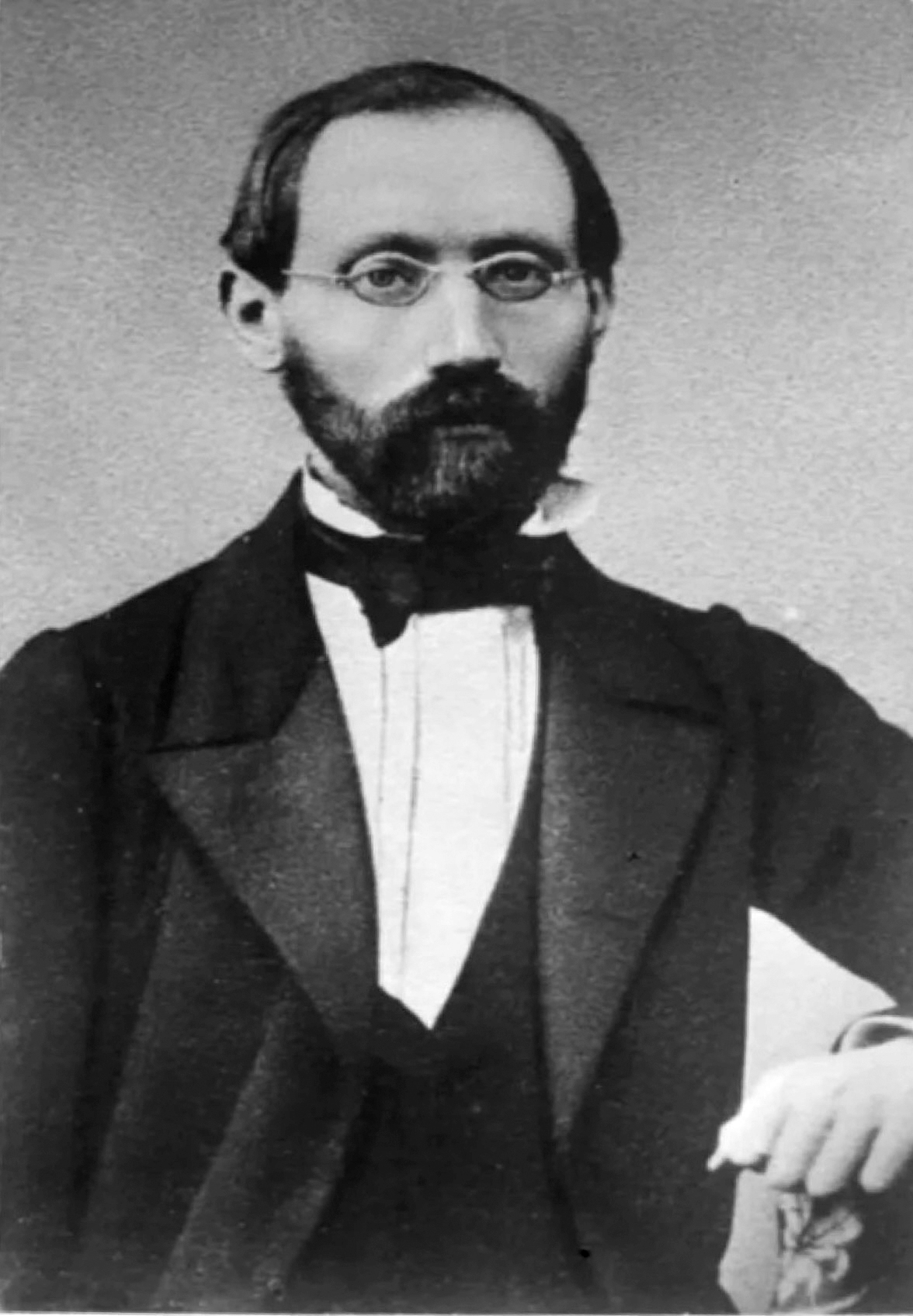
Many honours were conferred on Riemann during the remaining period of his life. He had been elected by the Bavarian Academy of Sciences to be a corresponding member on the 28th November, 1859 and was elected an ordinary member on the 28th November, 1863. The Berlin Academy made him a foreign member in March, 1866 and in the same month he was made a corresponding member of the Academy of Sciences of Paris. Shortly before his death, on the 14th June, 1866 he was made a foreign member by the Royal Society of London. On the 3rd June, 1852, Riemann was married to Fräulein Elise Koch of Körchow in Mecklenburg-Schwerin, a friend of his sisters. But soon after that event, in July he had an inflammation of the skin of the breast which appeared to heal quickly but left the seeds of a lung disease which ultimately brought about his death.
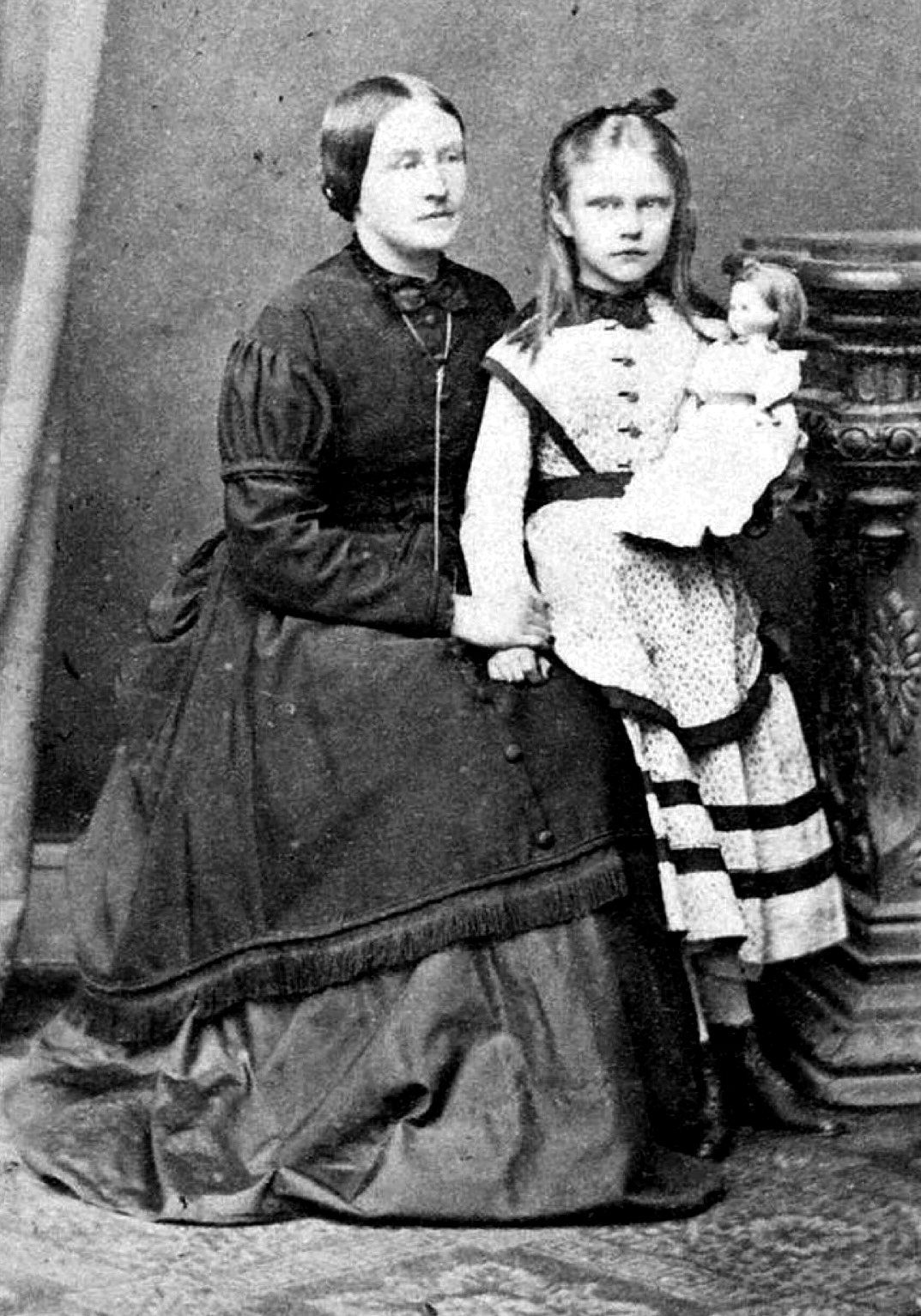
On his arrival at Göttingen on the 2nd October, Riemann lived through the winter with fairly good health so that every day he was able to work for some hours. Here he completed the memoir on the vanishing of the theta-functions and charged his former pupil, Hattendorf, with the editing of the memoir on minimal surfaces. It was his frequently expressed wish to consult Dedekind about some unfinished papers, but on account of great weakness he did not like to trouble Dedekind by asking him to come to Göttingen. In the last months of his stay at Göttingen Riemann was engaged in the editing of his memoir on the mechanic of the ear which unfortunately he left unfinished. He wished at this time to see Lago Maggiore again and stay there for some months so that with improved health he might complete the memoir on the mechanic of the ear and so he started on his third and last journey to Italy on the 15th June, 1865. He arrived at Lago Maggiore on the 28th June. His strength diminished rapidly and he saw fully well that his end was near. But up to a few days before his death he continued to work on his last paper, lying peacefully under a fig tree and fully enjoying the beautiful landscape. He died on the 20th July, 1866, at Selasca, in great peace, and was buried there.
The following glowing tribute to Riemann’s genius as the man who introduced what are called Riemann surfaces into Analysis may be quoted here:
Klein says:17
With reference to the outer activity, it may be noted: After quiet preparation Riemann broke out like a bright meteor to fade away again soon; he limited his activity only to 15 years; 1851 is the year of his dissertation, 1862 of his illness, 1866 of his death.
On the influence of Riemann on modern Mathematics, Klein makes the following interesting observations:18
Riemann’s ideas, which had to influence in such a fundamental manner the development of our modern theory of functions, have spread only slowly and quite gradually. His publications did not, as one would like to believe today, work as revelations and cause a sudden revolution in the mathematical views of his times. That may be due to the fact that Riemann’s own publications were at first very difficult to understand, surely because of their terseness and the introduction of new and quite extraordinary notions.
Professor Castelnuovo has also given expression to a similar opinion about the influence of Riemann. In his lecture at the [1928] Bologna Congress on algebraic geometry, Professor Castelnuovo said: “It is known how this theory which carried a new spark of life into the field of algebraic geometry is due to one of the great mathematical genii of the last century, Bernardo Riemann, whose gigantic figure appeared more and more imposing the remoter one was from the times in which he lived.’’\blacksquare
Footnotes
- Autobiographical Notes [5]. ↩
- In 1822 Gauss won the Copenhagen University Prize with Theoria attractionis. The paper titled “Allgemeine Auflösung der Aufgabe die Teile einer gegebnen Fläche auf einer andern gegebnen Fläche so abzubilden” (General Solution of the Problem of Mapping Parts of a Given Surface onto Another Given Surface) was published in 1825. ↩
- For an excellent account for the general reader, see Chapter 4 of [6]. ↩
- Jeremy Gray in [7]. ↩
- “Herbart’s Influence on Bernhard Riemann”, Historia Mathematica ,Volume 9, Issue 4, pages 413–440), 1982. ↩
- An excellent undergraduate geometry textbook is McCleary [9], which takes a thoroughly historical approach starting with Euclid and ends by introducing Riemann’s ideas. A translation of Riemann’s lecture is also given in the book. ↩
- Editor’s note: For a proof, see the section titled `Zeta functions’ in the article Special values of zeta functions by Arshay Sheth in the October 2023 issue of Bhāvanā (https://bhavana.org.in/special-values-of-zeta-functions/). ↩
- The systematic public funding of scientific research at scale is largely a product of the decisive role the Manhattan Project played in the Second World War. ↩
- This article is an adapted version of the chapter on Riemann by Ganesh Prasad originally published in his book Some great mathematicians of the nineteenth century: Their lives and their works, published by the Benares Mathematical Society (1933), and is republished here. ↩
- Schering’s Math. Werke, Bd, 2, P. 375. ↩
- Schering’s Werke, Bd. 2, pp 378–379. ↩
- See Dedikind’s Riemann’s Lebenslauf, (Riemann’s Math. Werke, p. 57). ↩
- Theory of functions of a real variable, Vol. 1, 3rd edition, p. 459. ↩
- Math. Ann., Bd. 19, 1882, p. 236. ↩
- Klein, Gesammelte Math. Abhandlungen, Bd. 3, p. 45. ↩
- A former German, Austrian, or Swiss currency in the form of a silver coin. ↩
- Klein’s Entwicklung, 1.c., p.246. ↩
- 1. c., pp. 271-272. ↩