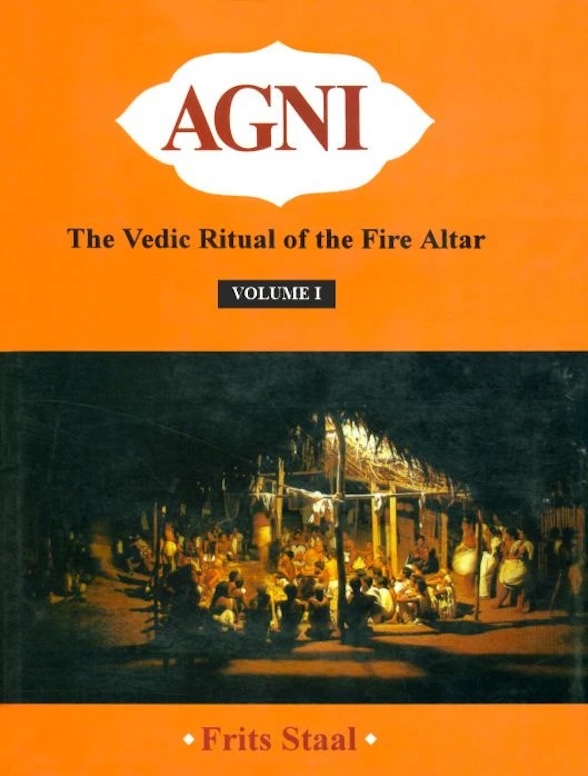
Authors: Frits Staal
Publisher: Motilal Banarsidass1
ISBN: 0-89581-450-1
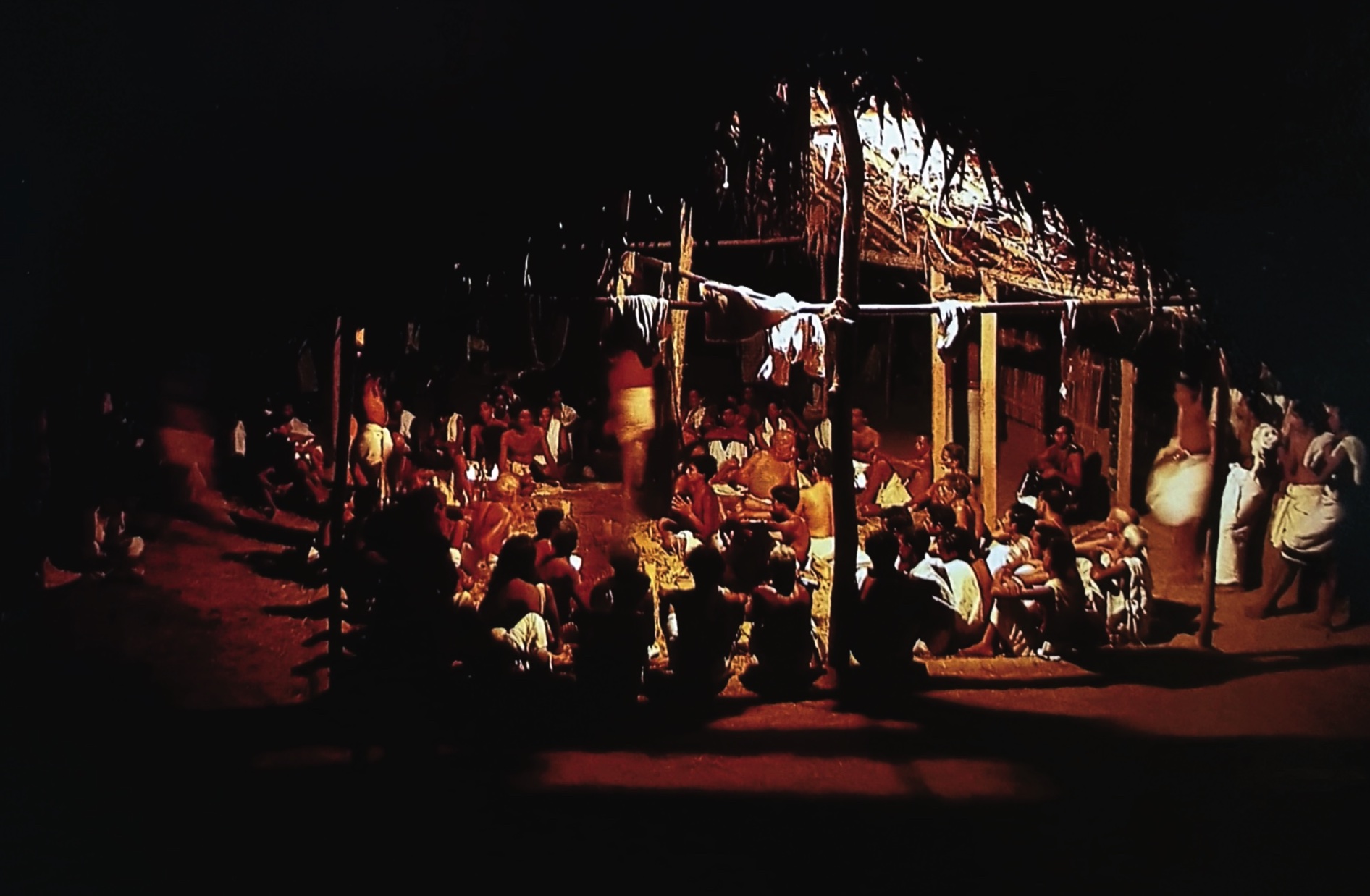
A sentence from the Śatapatha Brāhmaṇa, quoted by Staal in the first volume of Agni, can stand at the head of everything that follows. Of the fire altar, the text declares: this fire altar is knowledge (vidyā), and it is act (karman). The agnicayana is the construction, over twelve days, of a great altar in the shape of a falcon, of a thousand bricks laid in five layers, accompanied by recitation, chant, and oblation. It is an act, regulated rite by rite by the Kalpasūtras.2 It is also knowledge, of a kind that rests on an extensive body of exact reasoning, much of it mathematical, transmitted in the Śulvasūtras3 and in the texts that surround them. Staal’s two volumes record an actual performance of the agnicayana, conducted by Nambudiri brahmins in a Kerala village in April 1975, with the full textual apparatus through which the tradition itself understands the rite. They are a documentary monument to the act side of the altar. They are also, for a mathematical reader, a guide to its knowledge.
The Śatapatha sentence raises, at the outset, a problem the rest of Agni makes vivid for the mathematical reader. The distinction by which our subject is usually organized, the distinction between mathematics done for use and mathematics done for its own sake, between the applied and the pure, does not survive contact with the agnicayana. The geometry of the Śulvasūtras exists because altars must be built. The combinatorial elaboration of the chants exists because the chants must be sung. The internal architecture of the rite, which Staal himself analyses with formal tools, exists because the rite must be performed in a definite order. The mathematics is occasioned by the rite, but it is exact, general, and elaborated well beyond the bare requirement of the occasion. Agni gives the reader an unusual opportunity to look at a body of mathematical knowledge that does not sort itself into the categories with which we approach the subject today.
Of the fire altar, the Śatapatha Brāhmaṇa declares: this fire altar is knowledge (vidyā), and it is act (karman)
 |
 |
Agni itself is not a mathematical treatise. Its explicit mathematics fills perhaps forty pages out of more than twelve hundred. It is a documentary work, comprising the texts of the recitations and their translations, a day-by-day account of the conduct of the rite, photographs on nearly every leaf, and a section of interpretive essays at the close of the second volume, of which two, Seidenberg’s on the geometry of the Śulvasūtras and Staal’s own on ritual structure, are of direct mathematical interest. The remaining mathematical content lies dispersed through the body of the work, in the prescriptions for the consecration of bricks, in the rules for the laying of the layers, in the combinatorial elaboration of the chants. What follows takes up three aspects of what Agni makes available to the mathematical reader: mathematics present in a prescription though not stated as a separate theorem, mathematics understood through what an operation preserves, and mathematics exhibited as a system of rules.
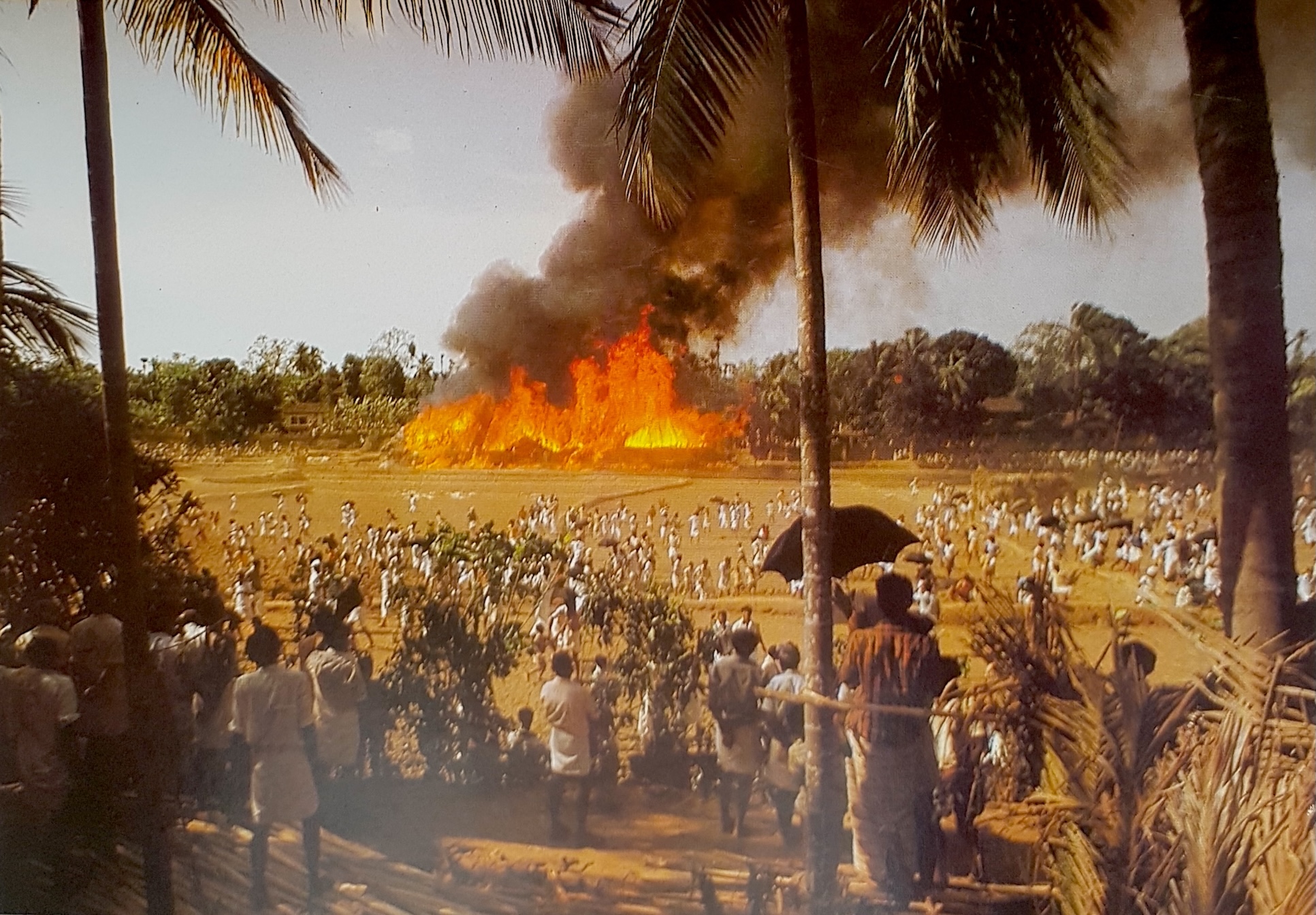
Staal’s two volumes record an actual performance of the agnicayana conducted in a Kerala village in April 1975
Knowledge as latent
The Śulvasātras contain geometrical rules and the constructions that go with them, in the sūtra form: terse, ordered, and general. Each rule is general enough to apply to a whole class of figures, and the construction that accompanies it is the proof for it. Baudhāyana, Āpastamba, and Mānava, for instance, all have the rule of the diagonal of the rectangle, that the square on the diagonal equals the sum of the squares on the two sides, as a general relation that holds among all rectangles. That this rule appears as a stated proposition in texts dated to the first millennium BCE is itself worth noting.
The mahāvedi, the great trapezoidal precinct on which the soma sacrifice is performed, has in the Āpastamba recension a layout that calls upon the integer triples (15, 36, 39), (5, 12, 13), (8, 15, 17), (12, 16, 20), (15, 20, 25), and (12, 35, 37), all of which satisfy the relation of the rule of the diagonal. Seidenberg, in his contribution to Agni, calls the appearance of six such triples in a single figure a “major miracle” relative to the “minor miracle” of finding even one. He treats it as nearly certain on this evidence that the composers of the sutras had the result. The argument is sound. The Śulvasūtras possess the rule; the mahāvedi exhibits its consequences in a configuration too dense to be the work of coincidence.
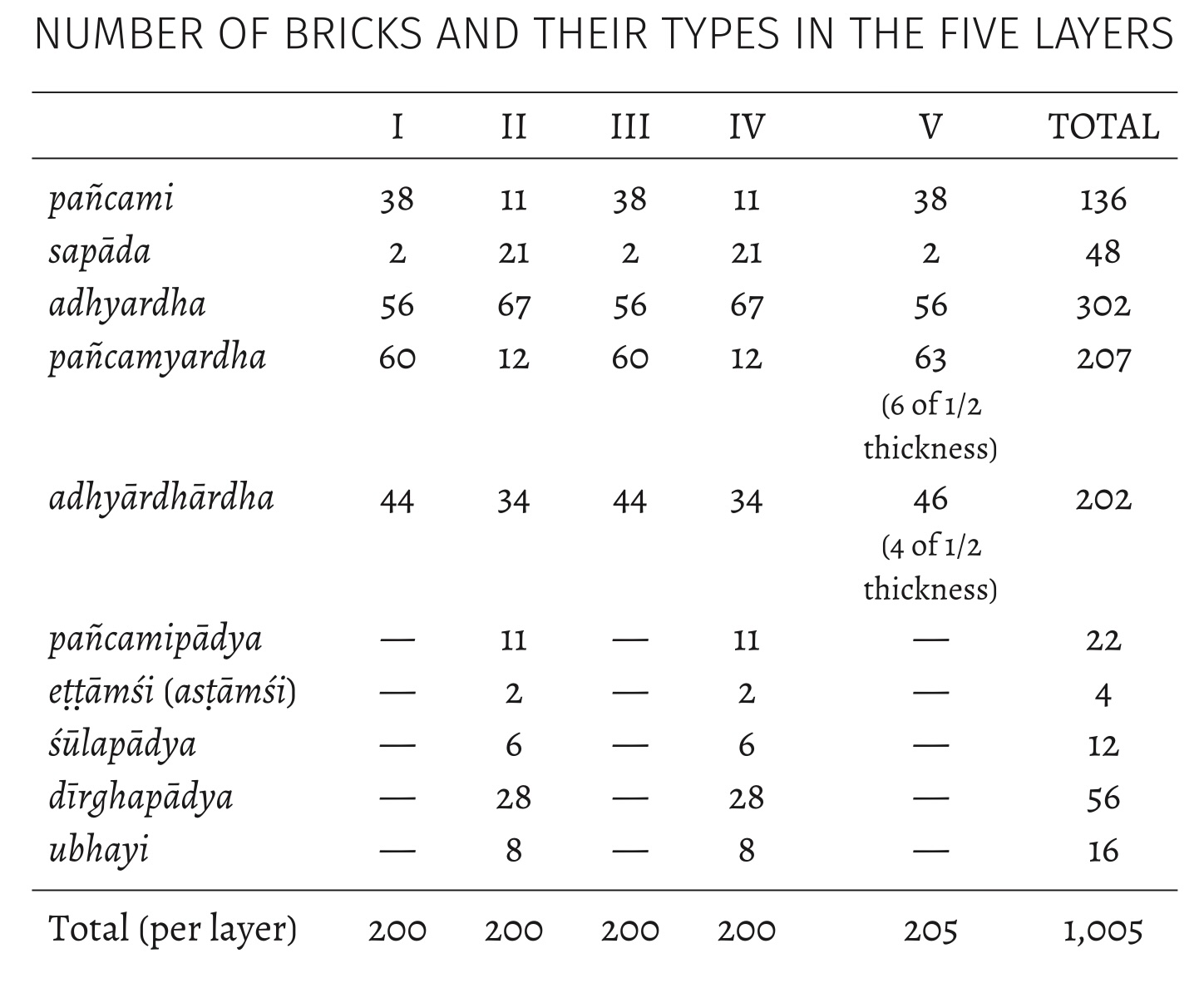
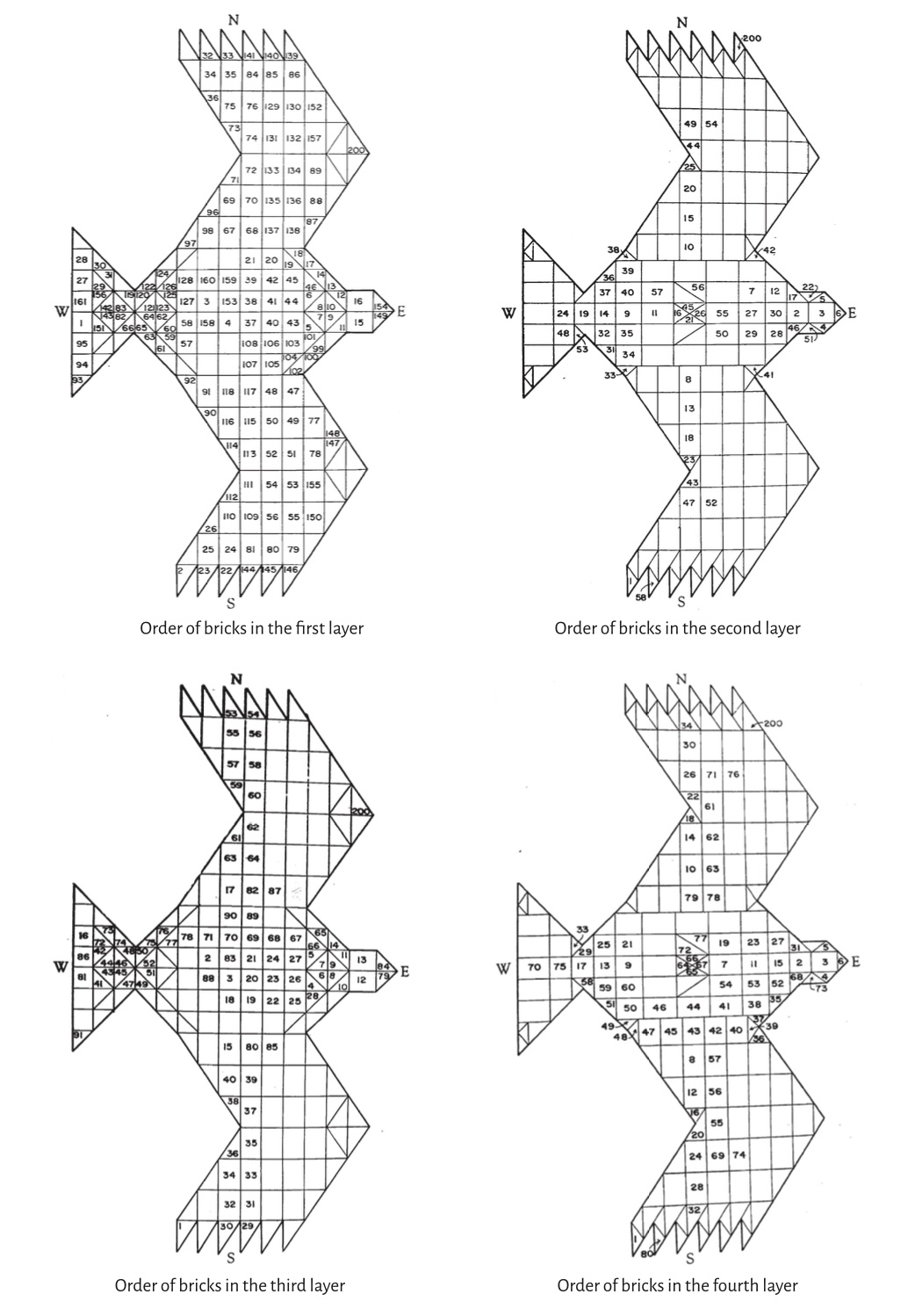
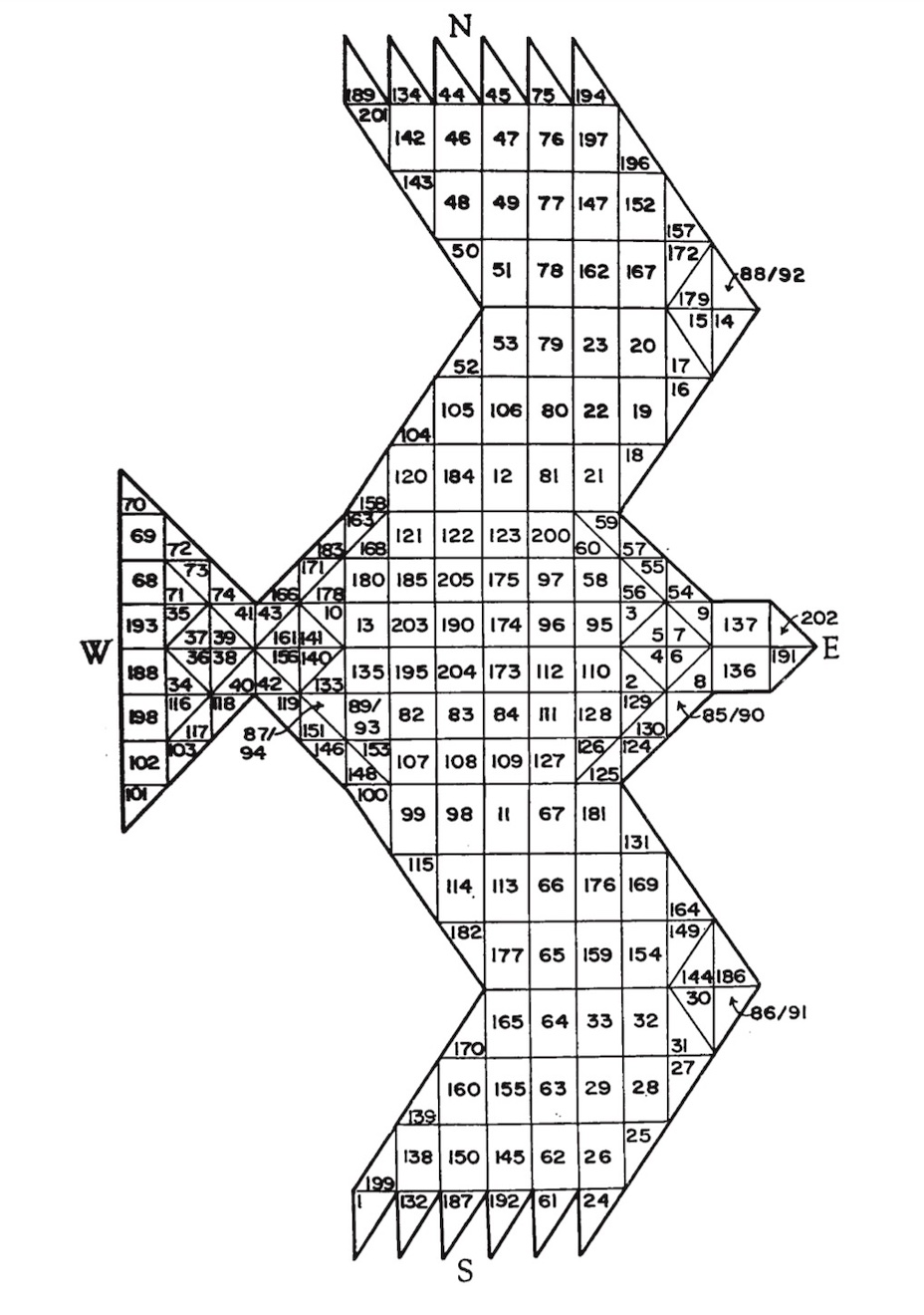
The brick-layout rules of the agnicayana take the same question further. The altar is built in five layers. Each layer has exactly two hundred bricks. The total area of each layer is exactly seven and a half square units of the standard measure. The joints between bricks in successive layers never coincide vertically. The bricks come in fourteen standard shapes, of fixed dimensions. The Śulvasūtras work out, for each layer, the count of each shape needed to meet all three conditions at once. Agni tabulates the answer, layer by layer, and remarks that the pattern “must have been arrived at by trial and error.” A modern reading of the Śulvasūtras suggests otherwise. The conditions are, in modern notation, a system of indeterminate equations in several variables. We discuss a simpler example of the Gārhapatya vedi below:
A gārhapatya vedi has twenty one square bricks (of two different sizes per layer). This can be translated as:
x + y = 21, \quad \frac{x}{m^{2}} + \frac{y}{n^{2}}= 1,with x and y are the numbers of bricks of two sizes and m, n integers as the length of their sides (that is, the area of the bricks are 1/m^{2} and 1/n^{2}). These equations admit precisely two solutions in positive integers, namely (x, y, m, n) = (9, 12, 6, 4) and (16, 5, 6, 3). Both appear in Baudhāyana and Āpastamba.
The point of interest is the form in which the Śulva preserves this material. Case after case, the prescription gives the full set of solutions and no other elements; a modern reader who writes the equations is recovering a relation the prescription already encodes. Mathematical knowledge of this kind sits in the prescription in the way the relations of a geometrical figure sit in the construction that generates it: the construction warrants the relation, even where the relation appears nowhere as a separate theorem. The Indian tradition has a name for this kind of justification. It is upapatti: the demonstration that makes a result evident to a competent reader by exhibiting the procedure that produces it. The upapattis of the later commentarial literature, in Bhāskara’s Bījavāsanā, in Gaṇeśa Daivaj\tilde{\rm n}a’s Buddhivilāsinī, and most fully in Jyeṣṭhadeva’s Yuktibhāṣā of the sixteenth century, are constructive demonstrations in this sense. On a long view, the Śulvasūtras work in the same mode.
Knowledge as invariant
The geometry of the Śulvasūtras is organized around a single recurrent kind of problem. The treatises give construction after construction in which one figure is transformed into another of the same area but a different shape. A square equal to a given rectangle. A square equal to the sum of two given squares. A square equal to the difference of two given squares. A triangle equal to a given square. A circle equal to a given square. The figure changes; the area does not. This is the organizing idea of the entire body of geometrical work in the Śulvasūtras, and the property of every construction in it. The construction is correct because the area is preserved. The recognition that an operation has an invariant, and that the invariant is the criterion of the operation’s correctness, is the structural insight on which the geometrical reasoning of the Śulvasūtras rests. The insight is carried in the practice: case by case, the construction is performed, and the preservation of the area does the work.
The geometrical problems that drive these constructions arise from the requirements of the rite. Altars built for different purposes must be equivalent in a specific sense: they have different shapes, depending on what the rite asks for, but they enclose the same area. To construct a circular altar of the same area as a given square one is, in this setting, not an exercise in approximation. The equivalence is exact, and the geometry of the Śulvasūtras exists to make it exact. The tradition reads the shape and meaning of an altar on more than one level at once. R.N. Iyengar and S.P. Satheeshkumar have argued, with substantial textual and computational evidence, that the darśa-pūrṇamāsa vedi, the altar of the new and full-moon rites, has a shape and an area that correlate precisely with the eighteen-year eclipse cycle and with the motion of the moon over that period. The area is preserved across the constructions of the Śulva because the tradition requires that it be preserved.
Seidenberg, in his contribution to Agni, presses the structural observation hard, and on its strength advances a chronological thesis: that the geometry of the Śulvasūtras and the geometry of Book II of Euclid’s Elements descend from a common ritual source older than 1700 BCE. The chronological argument has been weakened by subsequent work, notably by Eleanor Robson’s dating of the Babylonian tablet Plimpton 322 to around 1800 BCE. The structural observation is independent of the dating and survives. The geometry of the Śulvasūtras is organized around the preservation of area across transformations of shape, and the constructions that exhibit this preservation are the kind of insight a mathematician would call knowledge.
The treatises give construction after construction in which one figure is transformed into another of the same area but a different shape
Knowledge as codification
The Indian tradition is exceptional in the world history of mathematics for the depth and continuity of its enterprise of formal rule-making. The recognition that an unbounded family of well-formed objects, whether sentences of a language, sequences of acts in a rite, or constructions of a geometry, can be specified by a finite system of ordered, recursive rules, is the working assumption of the sūtra literature from the late Vedic period onward, and the operative methodology of the Kalpasūtras, of the school of Pāṇini, and of the linguistic prātiśākhya literature.
The first great monuments of this enterprise are not Pāṇini’s Aṣṭādhyāyī. They are the Kalpasūtras themselves. The Kalpasūtra corpus comprises the Śrautasūtras, on the conduct of the great sacrifices; the Gṛhyasūtras, on the household rites; the Dharmasūtras, on conduct; and the Śulvasūtras, on the geometry of the altars. The construction of these works is careful: vidhi (injunction) and arthavāda (explanatory passage) are kept distinct; paribhāṣā-like meta-rules govern the application of other rules; complex objects, a full sacrifice or a finished altar, are built up from primitive specifications by ordered application of rules. Staal, in Agni and at greater length in The Science of Ritual (1982) and Rules Without Meaning (1989), brings out an important point about this material: the Kalpasūtras are themselves the first sustained exercise in rule-codification in Indian intellectual history. The recursion, the meta-rule, the ordered resolution of conflicts between rules, are all already at work in them. The Pāṇinian achievement extends and refines a methodology of which the Kalpasūtras are the earlier and broader form.
The most original piece of writing in Agni is Staal’s own essay “Ritual Structure,” which follows Seidenberg’s contribution in the second volume. Its subject is the syntax by which the several hundred component rites of the agnicayana are ordered. The formalism by which Staal analyses this syntax is recovered from the Kalpasūtras themselves.
Staal observes that the agnicayana is nested. Many of its smaller units have the form A B A, in which a fixed recitation A frames a variable middle B. At the largest scale, the opening sequence of the sacrifice is mirrored at its close by the corresponding rites in reverse order: the consecration by the final ablution, the entry by the departure, the binding by its dissolution. Every such nested arrangement can be specified by a single rule of the form
B \rightarrow A B A,which, applied recursively to its own output, generates A A B A A, then A A A B A A A, and so on without bound. A finite rule applied to its own output thus specifies an unbounded family of well-formed ritual sequences. Staal further distinguishes phrase-structure rules (B \rightarrow D E F, or the insertion of one rite within another) from transformational rules that substitute one substructure for another in a specified context, and he draws the derivation trees produced by these rules.
What Pāṇini does for the grammar of Sanskrit, the Kalpasūtras had already attempted for the agnicayana and the other rites
Staal does not invoke Chomsky. He invokes Pata\tilde{\rm n}jali. In the Mahābhāṣya of the second century BCE, Pata\tilde{\rm n}jali, defending the description of linguistic forms that are correct but never actually produced in speech, reaches for the very comparison that the structure of the agnicayana invites: such forms, he says, must be laid down by rules, just as the protracted sattras must be. A sattra is a sacrifice that, in its more theoretical forms, was supposed to extend for a thousand years and was therefore never actually performed: a sentence of the rite that one constructs but does not utter. For Pata\tilde{\rm n}jali, the rule-making of the Kalpasūtras and the rule-making of grammar face the same problem, the specification of an unbounded domain by a finite system of rules, and the unperformed sattra and the unspoken sentence are the same kind of object. The comparison is the tradition’s own.
Pāṇini’s Aṣṭādhyāyī is a generative grammar of Sanskrit. Its 3959 rules are ordered by a precise system of precedence and of resolution of conflict between simultaneously applicable rules; they include paribhāṣās that govern the application of other rules; they make use of indicatory phonemes that mark grammatical categories; they generate by combination rather than by enumeration. The technical apparatus of modern formal language theory, the notion of a production rule and its recursive application, has, as one of its identifiable historical sources, the school of Pāṇini.
Pāṇini, however, does not stand at the beginning of the Indian enterprise of formal rule-making. He stands in its middle. What he does for the grammar of Sanskrit, in extraordinary technical detail, the Kalpasūtras had already attempted for the agnicayana and the other rites. The tradition of the great rites discovered, several centuries before Pāṇini, that an unbounded domain of well-formed objects could be specified by a finite, ordered, recursive system of rules. The Kalpasūtras built the apparatus on which Pāṇini, working with a finer-grained domain, erected his definitive work. Agni is one of the few books in modern literature that makes this priority visible. It shows the agnicayana itself, and not merely the language in which it is performed, as a rule-governed generative system, and so it brings into view a substrate of the Pāṇinian achievement that would otherwise be located only in the description of language.
Use and contemplation
The mathematics one finds in Agni exists in three forms: as a structure latent in a prescription, as the invariant that organises a body of geometrical constructions, and as the ordered system of rules by which the agnicayana is specified. None of the three was cultivated for its own sake. The bricks were laid to build an altar; the area was preserved to keep one altar equivalent to another; the rules of the rite were recorded, by Staal, to elucidate the form of the rite. In every case the mathematics was occasioned by something outside mathematics. The question this raises is whether the mathematics therein is therefore less than mathematics, or whether the distinction by which we are taught to separate “applied” mathematics from “pure” is a useful one to bring to the Indian tradition at all.
It is not. The Indian tradition does not partition its mathematical activity in this way. Its mathematics, taken as a whole, has internal divisions, but those divisions cut across the applied-pure axis rather than along it. The infinite-series expansions for the trigonometric functions developed by Mādhava and the Kerala school arose from problems of astronomical computation, but the series themselves are recognisable to any analyst. The combinatorial elaboration of the chants of the agnicayana is set in motion by the requirements of the rite, but it is elaborated beyond what those requirements demand. The applied-pure binary is a category we draw after the fact, for our own convenience.
Agni exhibits the same pattern at greater historical depth than any other documentary work. The Śulvasūtras contain the approximation
\sqrt{2} \approx 1+ \frac{1}{3} + \frac{1}{3 \cdot 4} - \frac{1}{3 \cdot 4 \cdot 34}\,, accurate to five decimal places, used nowhere in the laying out of altars, and more accurate by orders of magnitude than any practical need would require. Seidenberg, who notes this, uses the appropriate word: erudition. The combinatorial elaboration of the chants, in which a small fixed set of verses expands into the long forms of the sung stotras by ordered patterns of repetition, has the same character. The rule B \rightarrow A B A that Staal extracts from the order of the rites extends into a theory of generative systems that has no application within the agnicayana itself. In each case the mathematics, set in motion by a requirement of the rite, has been carried by the tradition past the point at which the requirement is satisfied. The mathematics of the Śulvasūtras, the Kalpasūtras, and the Aṣṭādhyāyī, taken together, is a single body of work whose internal life has outrun its occasions. This is true of three thousand years of Indian intellectual history, to which the present writer belongs by inheritance, and of the contemporary mathematical tradition, to which the same person belongs by training.
Coda
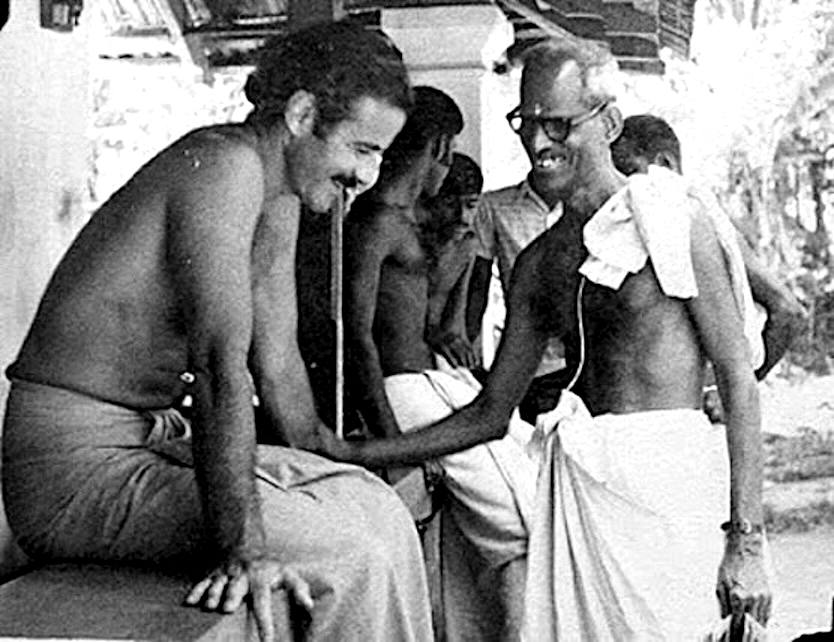
Agni is a remarkable work, and spans about 1,600 pages and over a hundred plates of photographs across two volumes. Staal had the patience to record a twelve-day rite as it was performed, the scholarly judgement to assemble the textual apparatus through which the tradition itself understands the rite, and the editorial taste to commission contributions, of which Seidenberg’s essay is the most fully developed, that connect the rite to bodies of knowledge beyond Vedic studies. The two volumes are expensive and scarce, and most of their content lies in the recitations and photographs of an actual performance. But the questions they raise are general, and one may wish to keep Agni in mind as a source, an authority to be cited, and an occasion for thinking about what mathematical knowledge is and where its forms come from.

Frits Staal (1930–2012) was born in Amsterdam and read mathematics, physics, and philosophy at the University of Amsterdam. He came to India in 1954 on a Government of India scholarship, worked for three years in the Department of Philosophy at the University of Madras under T.M.P. Mahadevan, and took his doctorate in 1957 with a thesis on Advaita and Neoplatonism: A Critical Study in Comparative Philosophy. He subsequently taught in London, Amsterdam, and Pennsylvania, and in 1968 moved to Berkeley, where he founded the Department of South and Southeast Asian Studies. His scholarly range covered the classical Indian and Greek traditions in logic, Sanskrit grammar, and philosophy of language, and his work on Pāṇini brought the technical apparatus of the Aṣṭādhyāyī (its recursion, its meta-rules, its ordered rule application, its indicatory markers) squarely into the modern literature on formal systems.
His long collaboration with the Nambudiri community of central Kerala, which had begun with the fieldwork behind Nambudiri Veda Recitation4 and continued across four decades, made Agni possible.
Agni gives the reader an unusual opportunity to look at a body of mathematical knowledge that does not sort itself into the categories with which we approach the subject today
Pictorial Narrative of Agnicayana
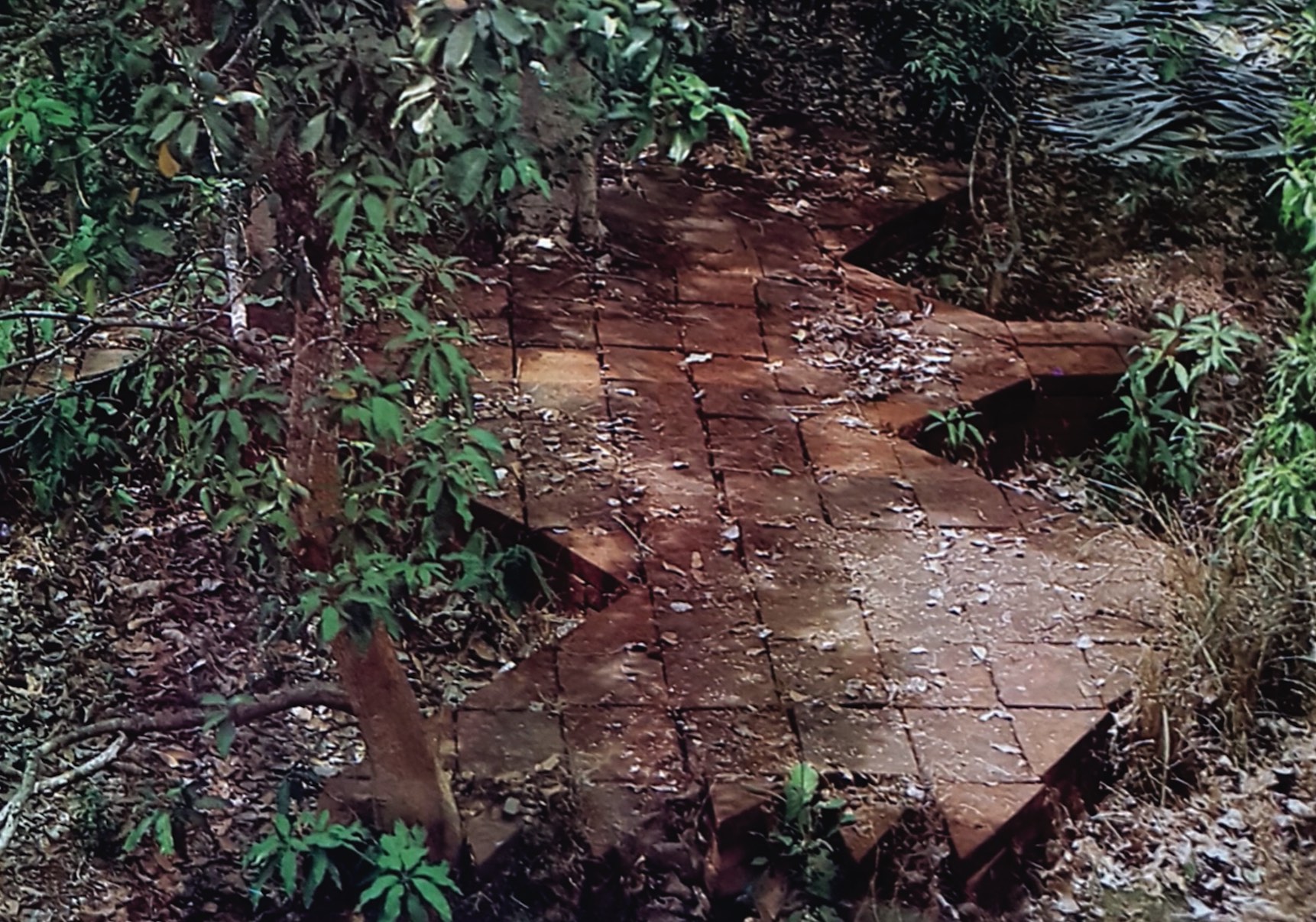
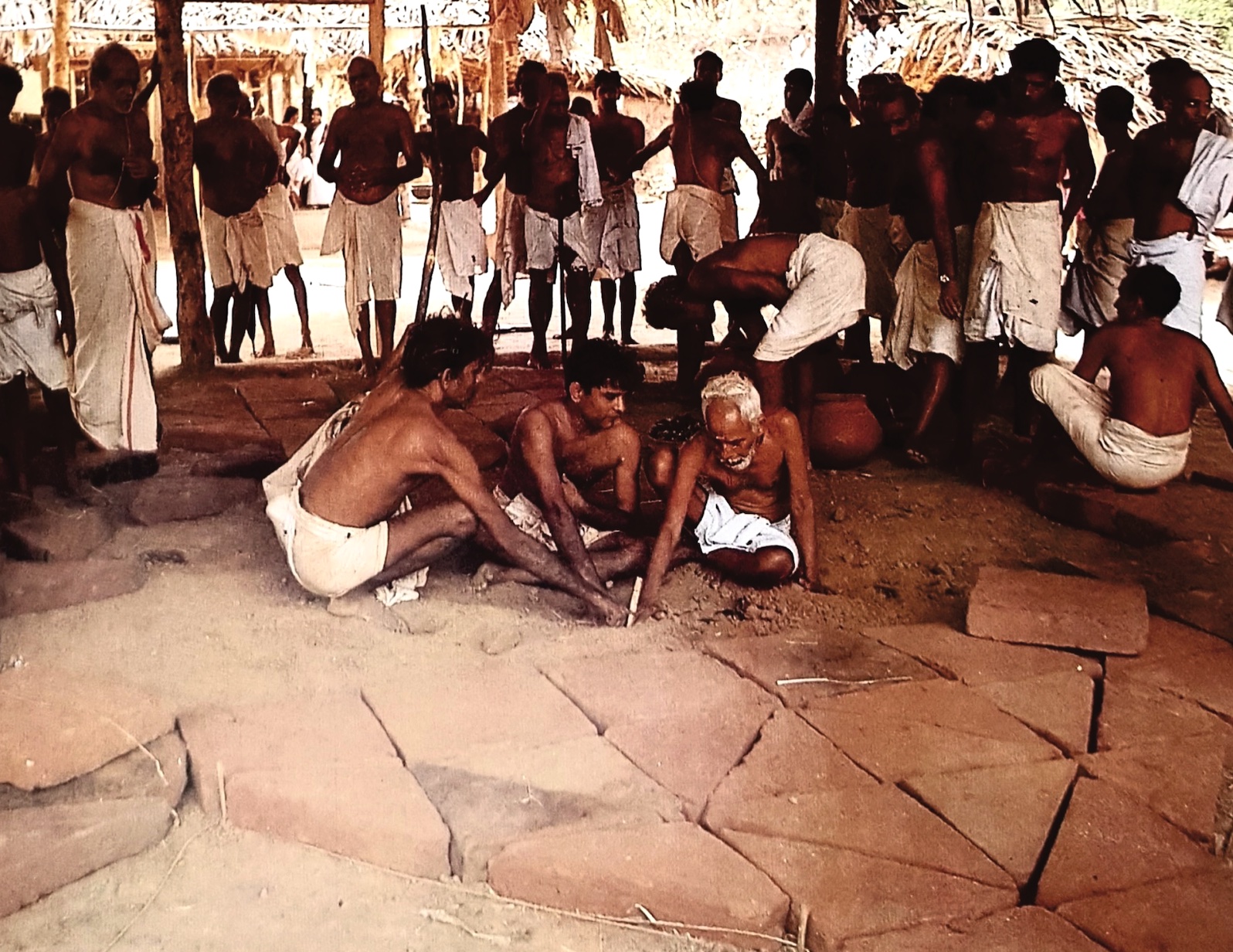
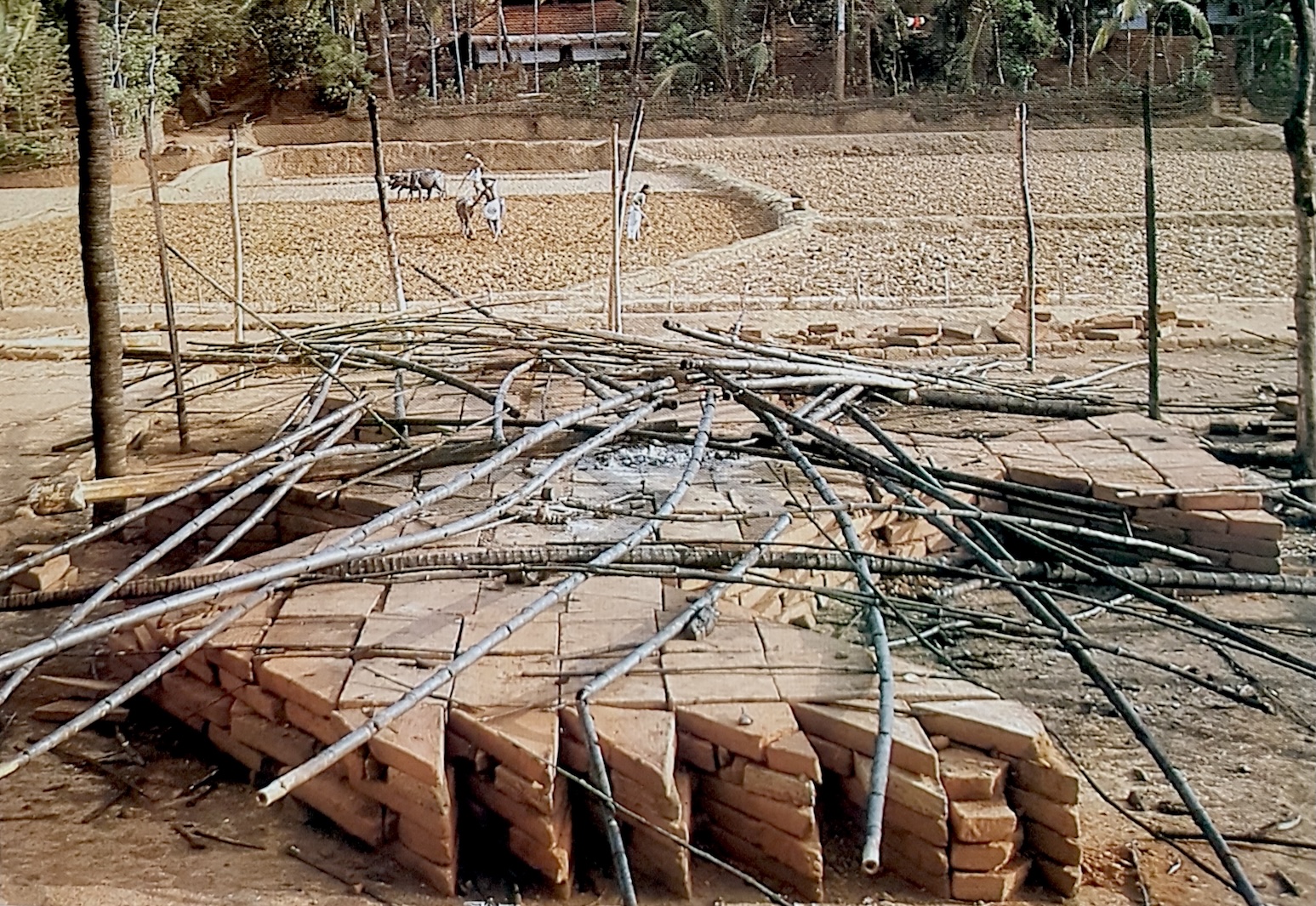
The Atirātra-Agnicayana ritual described in the book under review was performed in 1975. During the past one hundred years it has been performed seventeen times; during the last fifty years, five times. The most recent performances before 1975 took place in 1955 and 1956. The bird-shaped altar of earlier performances has generally disappeared into the soil, which is quick to take over in the jungle of a humid and tropical climate. Sometimes bricks from earlier altars have been put to new uses, and so they are occasionally met with in Nambudiri compounds, for example, in a courtyard or garden path. The picture above shows the altar of the 1956 performance, which was kept intact in the compound of Nellikat Nīlakanthan Akkitiripad, on whose behalf the ceremony was performed. The right wing, which points to the south, is in front; the head, facing east, to the right; and the tail and left wing are visible on the left and in the background, respectively. Later, bricks from the higher layers of this altar were used for the 1975 performance.
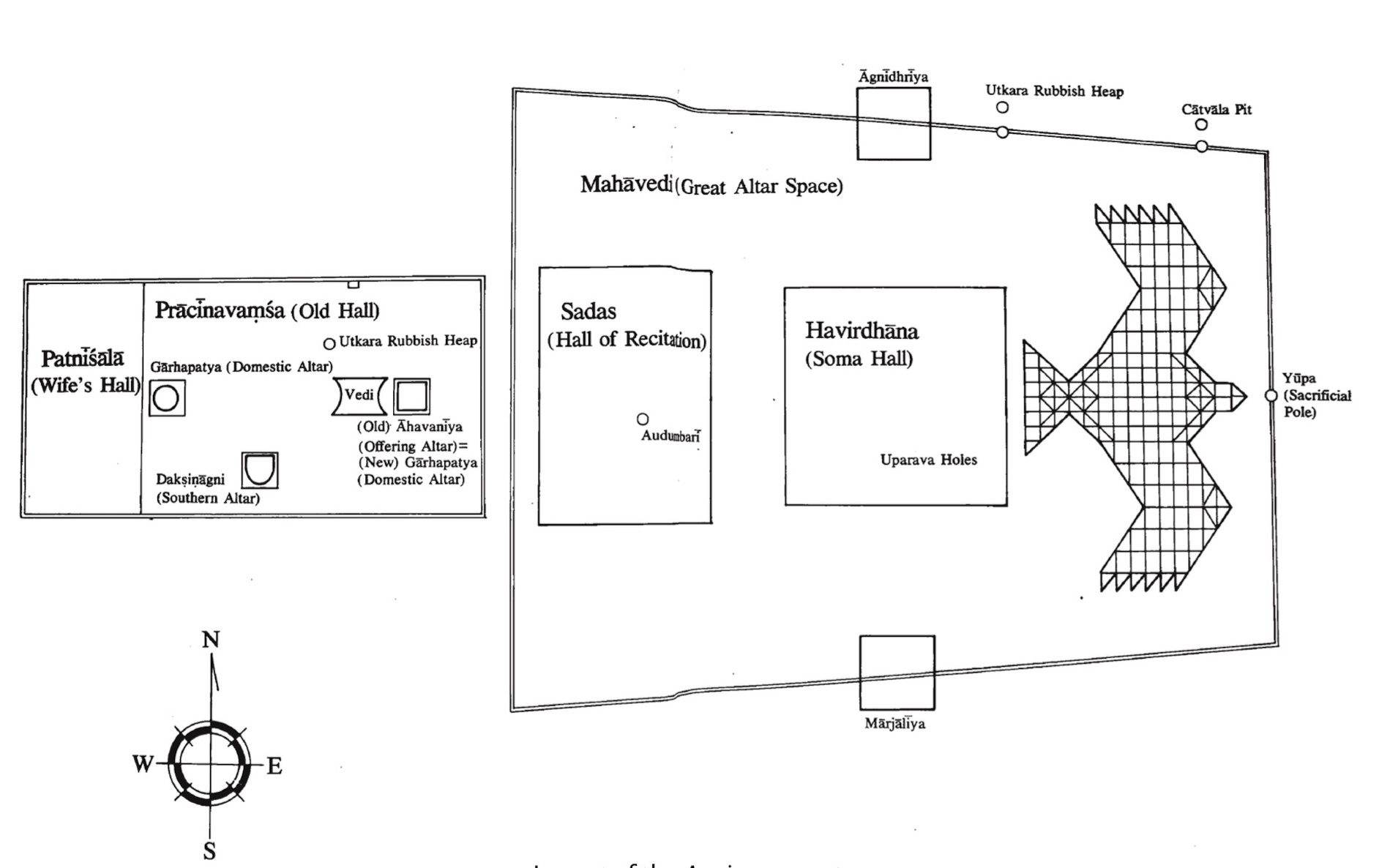
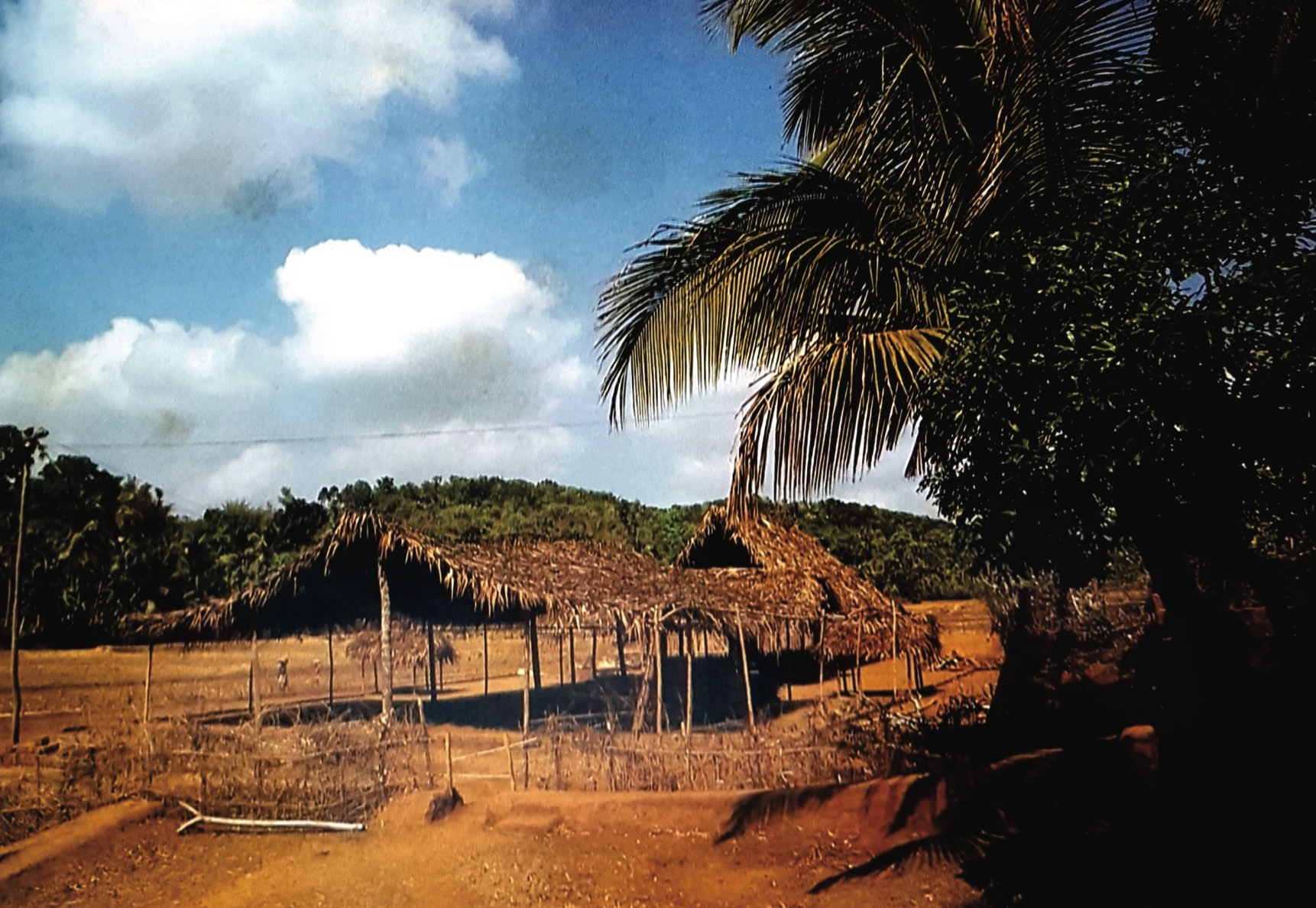
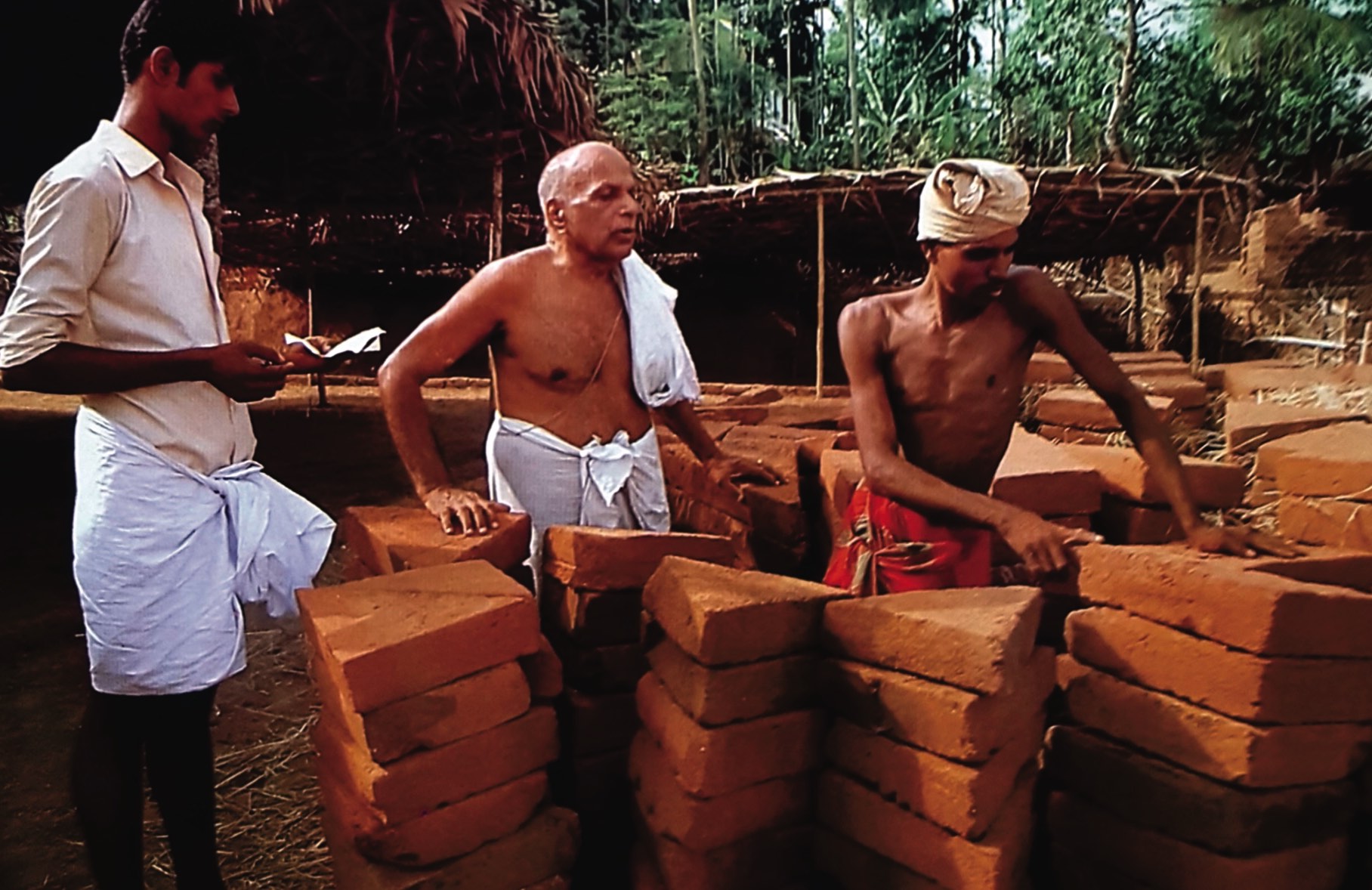
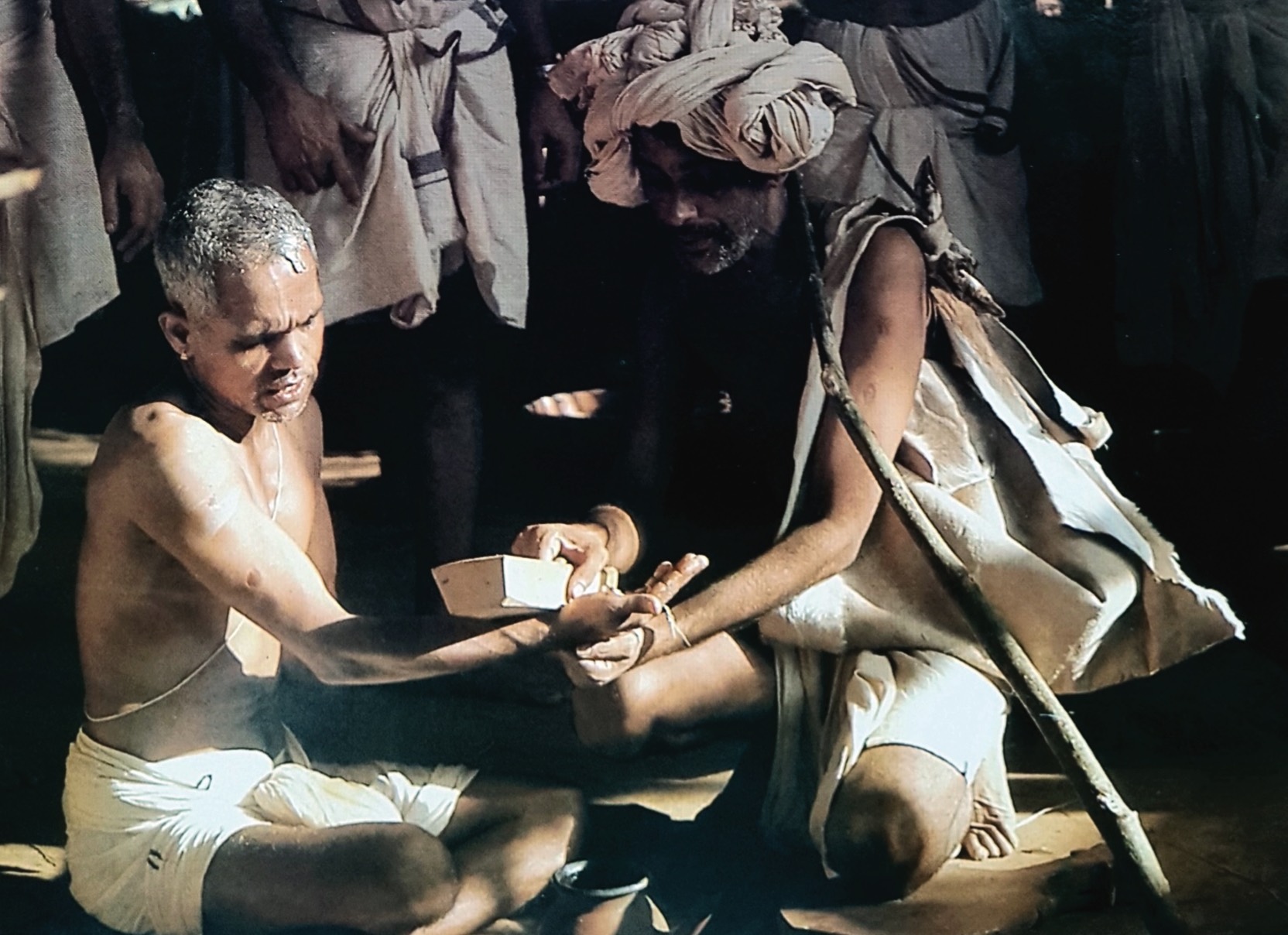
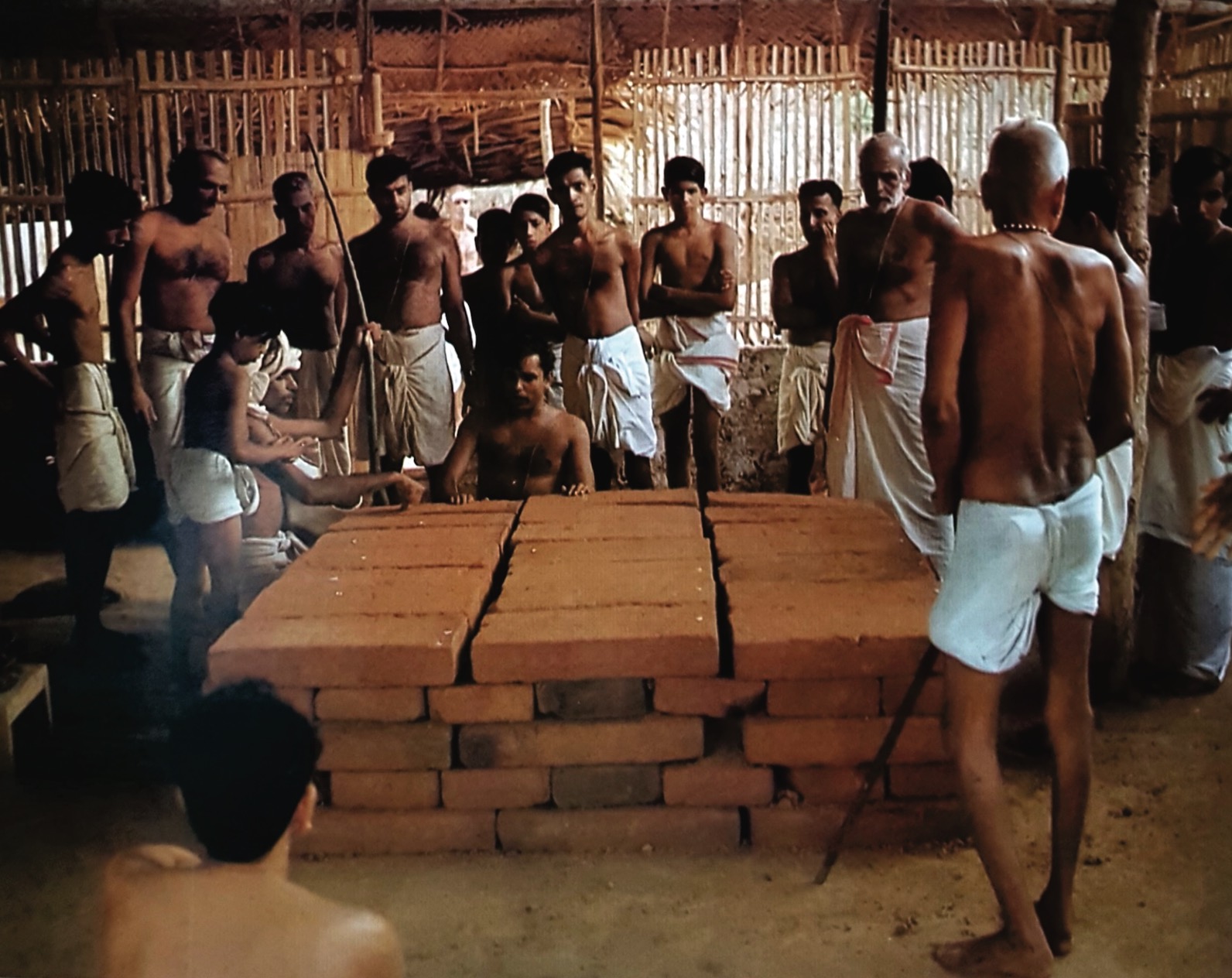
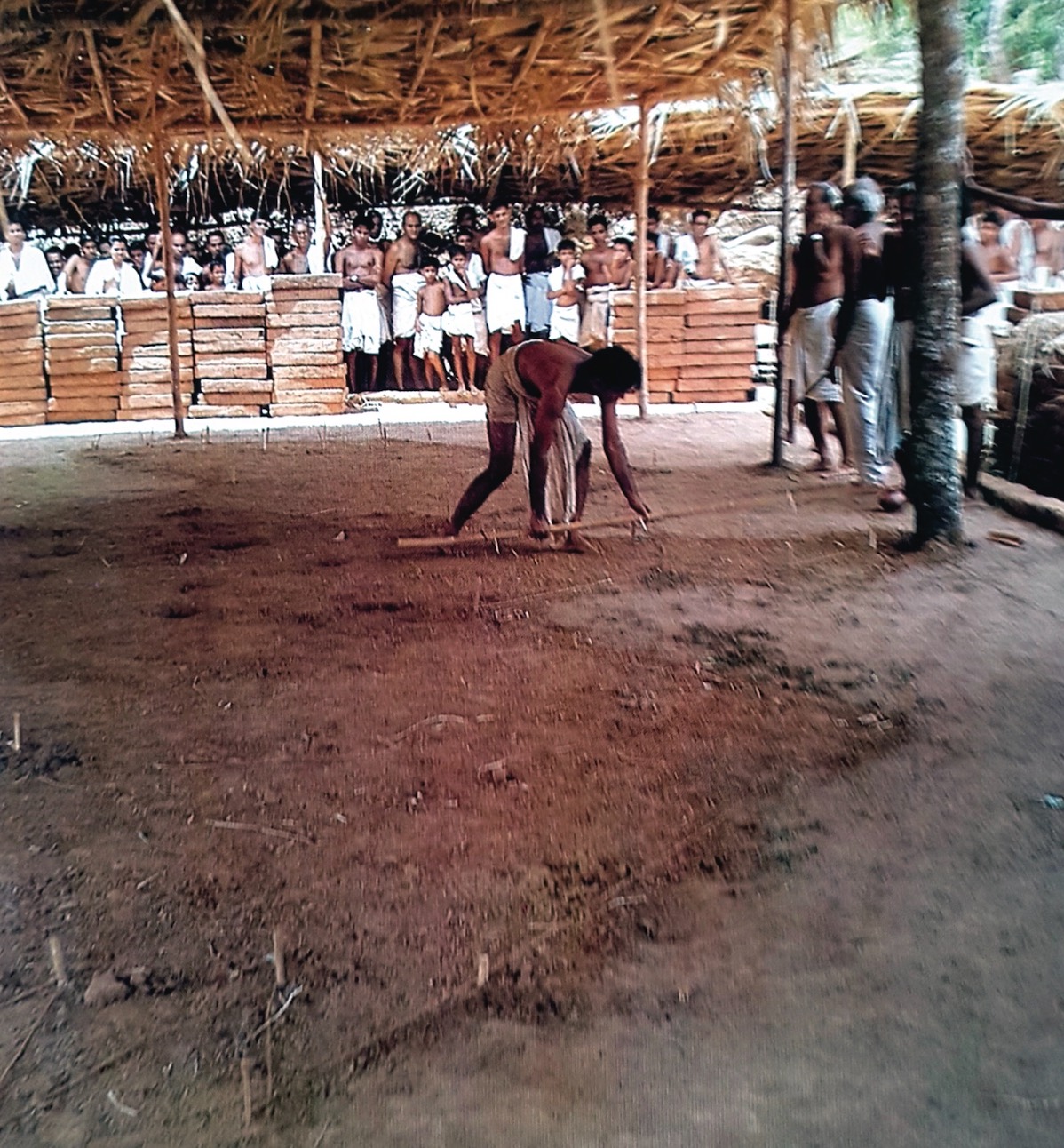
The new domestic altar (gārhapatya vedi) consists of five layers, each consisting of 3 × 7 = 21 rectangular bricks. The first, third and fifth layers have the same pattern. The pattern of the second and fourth is created by turning it 90 degrees. In this way, the interstices between bricks are never immediately below or above those in the next layer. The long side of each rectangular brick is a third, and the short side a seventh of the size of the yajamāna, measured to the top of his head.
Further reading
On the Śulvasūtras, B.B. Datta, The Science of the Śulba (Calcutta University, 1932), remains the standard textual basis, and S.N. Sen and A.K. Bag, The Śulbasūtras (Indian National Science Academy, 1983), the standard critical edition with translation. On Indian mathematics more broadly, Kim Plofker, Mathematics in India (Princeton, 2009), gives a careful and measured modern survey, and P.P. Divakaran, The Mathematics of India (Springer, 2018), takes the story onward from the Śulvasūtras through Āryabhaṭa and the Kerala school.
On the tradition of upapatti in Indian mathematics, M.D. Srinivas, “Proofs in Indian Mathematics,” in C.S. Seshadri (ed.), Studies in the History of Indian Mathematics (Hindustan Book Agency, 2010), is the standard reference, and may be read alongside K. Ramasubramanian, M.D. Srinivas, and M.S. Sriram, Gaṇita-Yukti-Bhāṣā of Jyeṣṭhadeva (Hindustan Book Agency and Springer, 2008), the first complete edition with English translation.
On Pāṇini and the formal apparatus of the Aṣṭādhyāyī, George Cardona, Pāṇini: His Work and Its Traditions (Motilal Banarsidass, 1988), and Paul Kiparsky’s collected essays in Pāṇinian Studies and elsewhere are the standard references. On the Kalpasūtras as a precursor to formalism, the major source is Staal himself: The Science of Ritual (Bhandarkar Oriental Research Institute, 1982), Rules Without Meaning: Ritual, Mantras and the Human Sciences (Peter Lang, 1989), and Discovering the Vedas (Penguin India, 2008).
On the astronomical significance of altar construction, R.N. Iyengar and S.P. Satheeshkumar, “Archaeo-astronomical significance of the Darśa-Pūrṇamāsa Vedic altar,” Indian Journal of History of Science 47.3 (2012) 513–519, is a good entry point.
The fire altar is both knowledge and act. So, on a longer view, it is mathematics. The act, in the Vedic case, is no longer performed except on the rarest of occasions. The knowledge survives in the texts, and in books like Agni that let the texts and well-documented illustrations speak.\blacksquare
Footnotes
- This two volume work originally published by Asian Humanities Press, Berkeley, was later acquired by Motilal Banarasidas. ↩
- Of the six vedāngas, or the limbs of the vedas, the Kalpa texts, succinctly documented in the form of sūtras, mainly deal with the performance of certain ceremonial acts. The Śulvasūtras that deal with the construction of vedic altars, using cords, are a part of Kalpasūtras. ↩
- To know more about sūtra literature, see https://bhavana.org.in/mathematics-in-india/. ↩
- Frits J. Staal, Nambudiri Veda Recitation, Mouton & Co., 1961. ↩