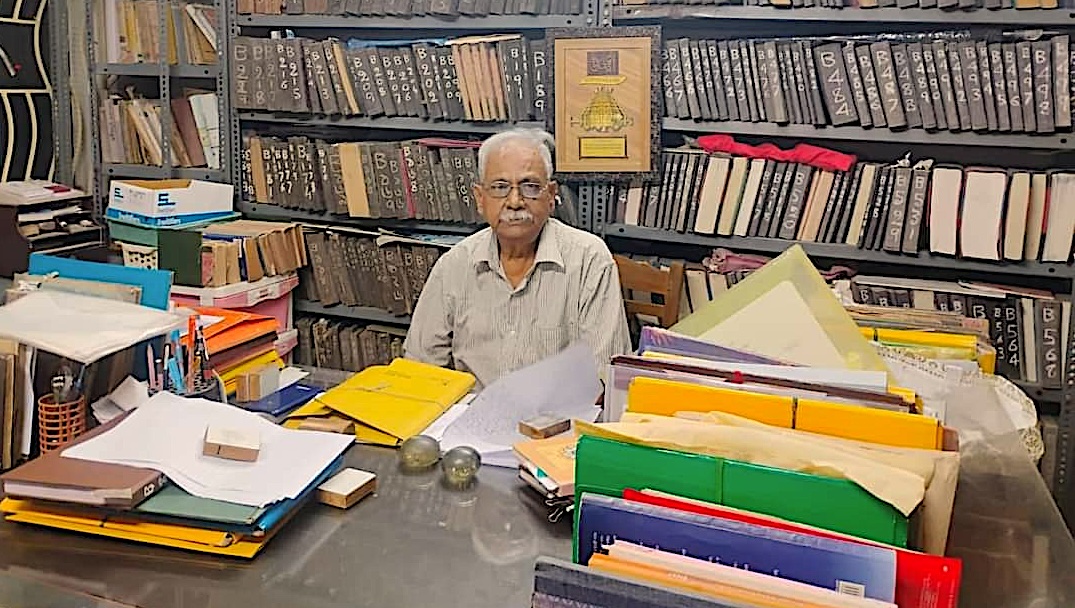
The present article, written by Pradip Kumar Majumdar and originally published in Gaṇita Bhāratī in 1993, traces the development of mathematics in Calcutta, popularly known as the `City of Joy’, from its founding, through three centuries of growth.
Pradip Kumar Majumdar was born on 24 August 1945, into a humble family of a school teacher at Kumilla of Bengal in pre-independence India. Trained in higher mathematics at the Department of Pure Mathematics, University of Calcutta, from where he obtained his PhD, he was later associated with the Mathematics Department at the Kalyani University, West Bengal, for a certain period before joining Bhatpara Boys’ School as a mathematics teacher. After his retirement, he served as a guest lecturer at the Vedic Science Department of Rabindra Bharati University from 2003 to 2006. However, his association with this department continued till his sudden demise on 30 October 2024.
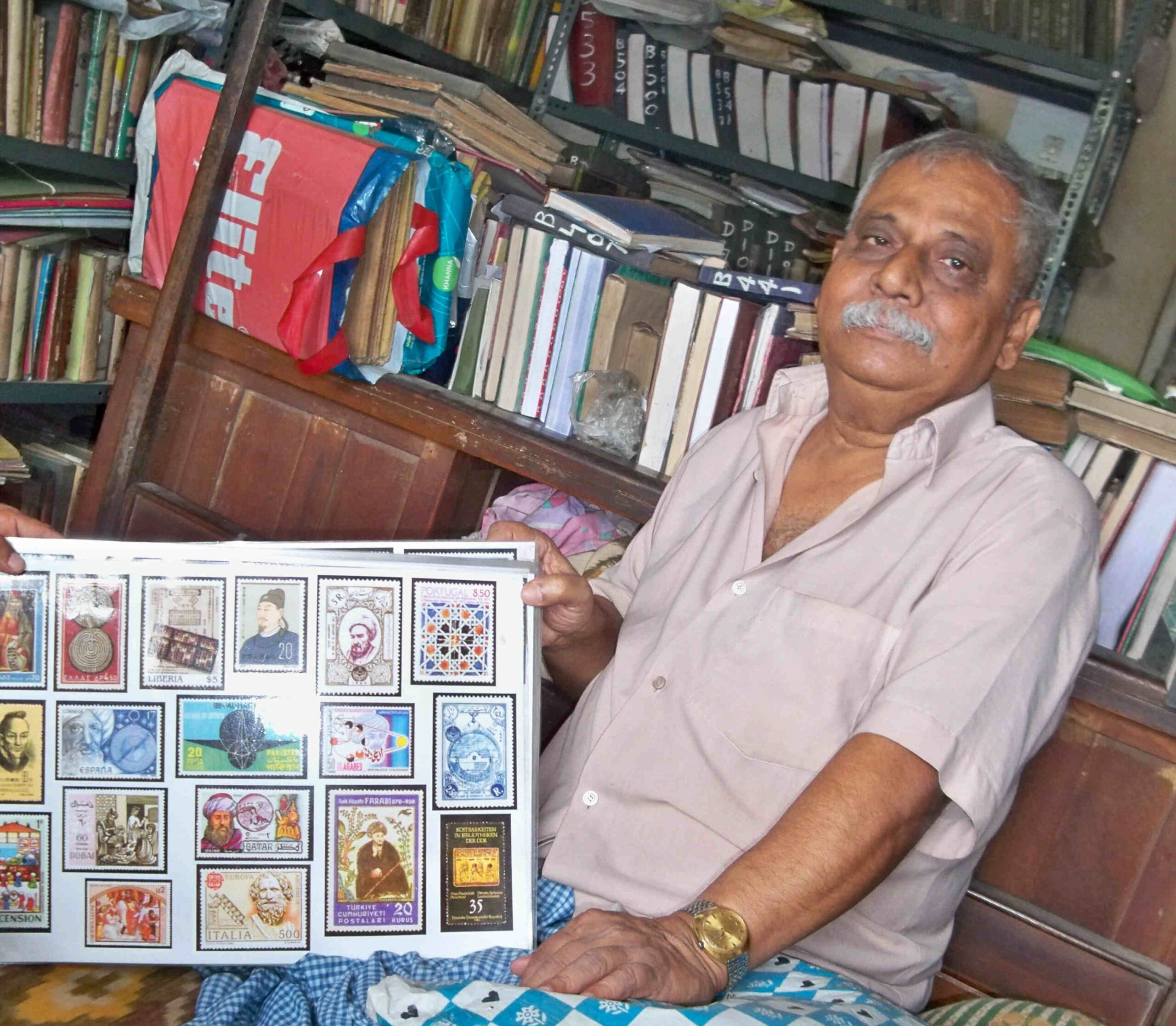
Majumdar was highly regarded as a researcher in the history of mathematics, with a profound knowledge of Sanskrit. He authored numerous scholarly books in Bengali on ancient Indian mathematics. He also wrote popular articles and lectured tirelessly to highlight the contributions of ancient Indian mathematicians. Combining a passionate interest with sharp scholarly acumen to unearth and interpret the mathematics of bygone eras, he served as a fountainhead of inspiration for his students and followers whom he mentored. Through his relentless effort and dedication, he sourced a formidable personal collection of about 1500 ancient texts and valuable manuscripts on ancient mathematics at his residence – a collection which requires careful conservation for future research. In recognition of his work, he was honoured as a Fellow of The Asiatic Society in 2008.
We have no evidence if study of mathematics began right from birth of Calcutta. There might have been some culture of mathematics in Sanskrit in the Brahmin `toles’3 of Calcutta. But the mathematics of the West did not cast any influence on that study. It was during the regime of the Mughals in India, that this discipline began to be influenced by Arabian and Persian mathematics. As a result, Arabic and Persian terms are found to be used in abundance on books of mathematics written in Sanskrit, particularly Ukarā and Hayata [1],[2].
In the year 1813, an order [8] was issued by the British Government “that a sum of not less than a lakh of rupees, in each year, shall be set apart, and applied to the revival and improvement of literature and the encouragement of the learned natives of India and for the introduction and promotion of a knowledge of the science among the British territories of India’’. But in the year 1823 when it was found that the money was being spent mainly for studies of Sanskrit and Arabic, the renowned Rammohan Roy (1772–1833) of Calcutta wrote a letter to the Governor General Lord Amherst: “… As the improvement of the native population is the object of the Government, it will consequently promote a more liberal and enlightened system of instruction, embracing mathematics, natural philosophy, chemistry, anatomy with the useful sciences which may be accomplished with the sum proposed by employing a few gentlemen of talent and learning educated in Europe and providing a college furnished with necessary books, instruments and other apparatus.”
Thus, educational institutions slowly began to come up in this country. A pioneering role was played by Serampore Mission, Hindu College and Calcutta Book Society in this regard. Along with other subjects, arithmetic, astronomy and mathematics were taught in Hindu College. The medium was English. Prof. Tytler used to teach mathematics during the period from 1817 to 1833. From 1828 onwards, Euclidean geometry and algebra used to be taught here in the Western style. The first ever book on mathematics in Bengali Ankapustakam written by Robert May in the Western style was published in 1817. The Calcutta Book Society published Ganitā\dot{n}ka written by John Harle.4 The book is characterised by a good number of mathematical problems and solutions thereof provided in verse.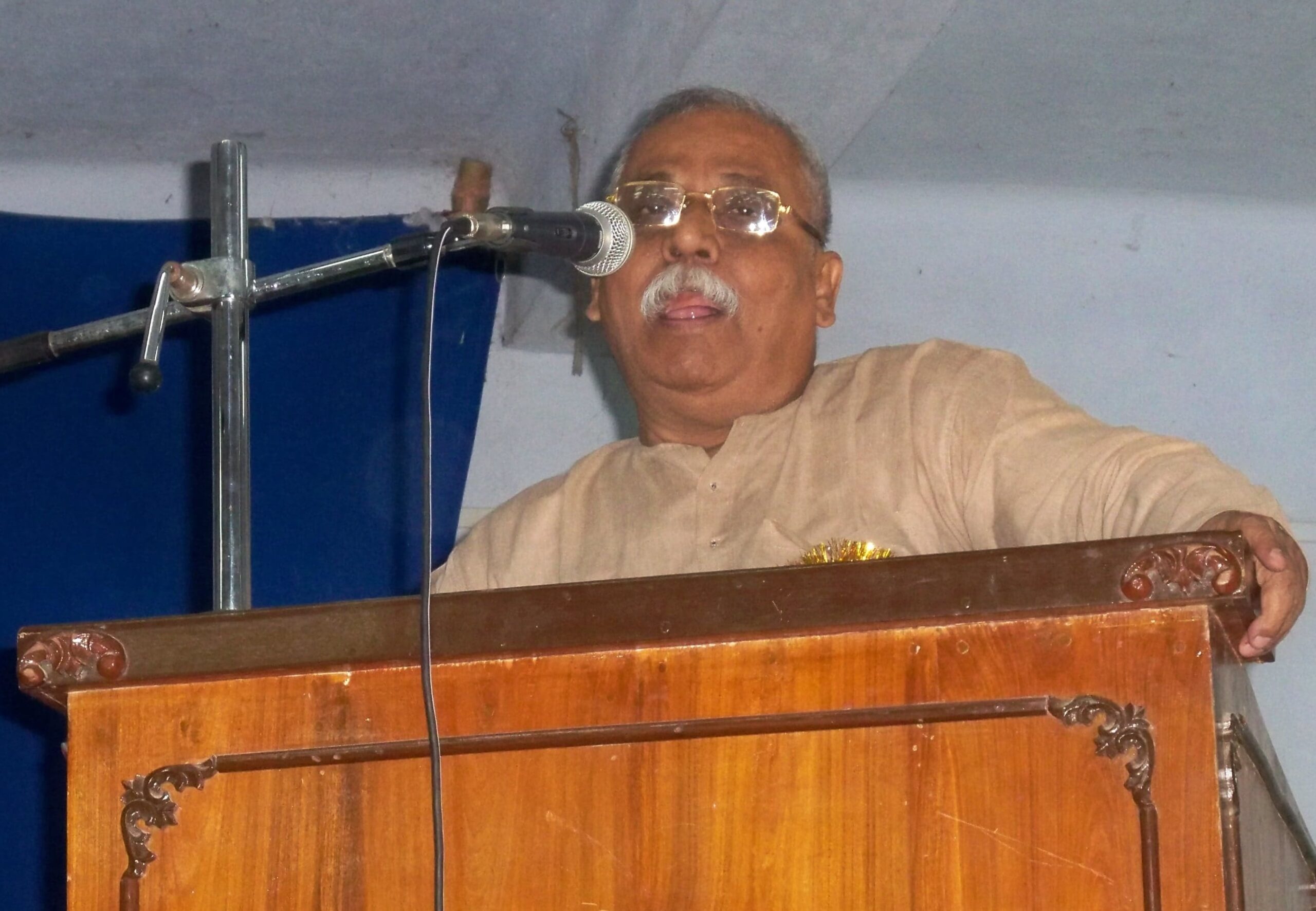
John Clark Marshman (1794–1877) wrote Jyotiṣa O Golādhyāya. The first edition of the book was published under the title “Golādhyāya” by Serampore Mission in 1819. William Yates (1792–1845) wrote Jyotirvidyā in 1834 which was the translation of An Easy Introduction to Astronomy by James Fergusson (1808–1886).
Haladhar Sen was the first among Calcuttians to write a book on mathematics in Bengali. His book was published in 1839. A few of the topics dwelt on were collected from books in English. In 1839, Śiśusebitā\dot{n}ka (1st part) was published by Hindu College. Many think that Rammohan Roy (1772–1833) wrote a book on geometry but no copy of the same is available now. Aksaya Kumar Dutta (1820) also wrote a book on geometry.
Krishnamohan Banerjee (1813–1885) published Kṣetratattva (Theory of Areas) Part I and Part II in 1846 and 1848 respectively. Part I is divided into three chapters dwelling on geometric problems and theorems. He took the help of Rekhāgaṇita of Jagannātha Paṇḍita and H.T. Colebrooke’s Algebra while writing this book. In the margin in the left of the page, the book contains elaboration in English, and that on the right, in Bengali. As interpreted by John Playfair and according to the addendum by William Wallace, this book included the first three chapters of Euclidean geometry. Area, triangle, parabola etc., have been discussed in this chapter. He sought help from the book written on Līlāvati and Siddhānta Śiromaṇi of Bhāskara II (1150) while using terminology. Bapudeva Shastri also helped him in this regard. During later periods, many writers with a view to writing books on geometry, followed the book of geometry written by Krishnamohan Banerjee. For instance, the name of Bhudev Mukherjee (1827–1894) may be cited. In form and style both the books are almost identical.
Articles on mathematics began to appear in different journals published in Calcutta. In the first issue of Vijñāna Sebadhi, a translation of the first and second chapters of Broheim’s book of mathematics was published. Amal Chandra Ganguli and Kaliprasad Ghosh did the job of translation. Articles of superior standard on mathematics appeared in Bhāratī edited by Dwijendranath Thakur. This magazine was first published in June 1877. Later it got associated with Bālak and began to be published in the name of “Bhāratī and Bālak”. The articles on mathematics showed signs of originality in thinking. Kalibar Vedantabagish published excellent serial articles on geometry from the December issue. Besides, many other articles continued being published.
The contribution of Calcutta University in regard to the spread of study of modern mathematics in India is undeniable. Calcutta University was founded on 24th January 1857. The provisional committee included arithmetic, algebra and geometry in the curriculum of the Entrance examination from this year. Different branches of mathematics e.g., algebra, geometry etc., had already been included in the curriculum of BA. The MA curriculum also included mathematics.
After the formation of the Calcutta University, the study of mathematics gradually extended [3]. Prasanna Kumar Sarbadhikari wrote a complete book named Pāṭīgaṇita (arithmetic) in Bengali in 1855. He was a pioneer in writing books on mathematics in Bengali. Topics dealt within the book were collected from the works of eminent mathematicians like Collensa, Numarch, Chambers etc. Kali Prasanna Ganguli wrote a book on arithmetic in 1866. Chandra Kumar Sharma wrote Gaṇitā\dot{n}nkura in 1916. The influence of the writings of De Morgan, Numarch, Prasanna Kumar Sarbadhikari is present in this book. Joygopal Goswami also wrote a book named Gaṇita Bijñāna. The third edition of this book was published in 1870. In 1879, Bhuban Chandra Chatterjee wrote Gaṇitā\dot{n}kura and Uma Charan Chatterjee also wrote a book named Gaṇitasāra in 1855. Calcutta Book Society was its publisher. The influence of Keith, Banicastle, Subhankara etc., is traceable in this book. Bipin Mohan Sengupta wrote a book named Sa\dot{n}khyāsāra in 1861. Shyama Charan Banerjee and Cunilal Seal jointly wrote a book named Gaṇita Darpaṇa in 1870. The first part of A\dot{n}kasāra written by Jadunath Nayapanchanan was published in 1871. In 1881, A\dot{n}kabodhaka written by Suryanarayan Chatterjee was published. Brahmamohan Mallik and Gouri Sankar Dey assisted him in writing the book. Quite a few books written in Bengali on mathematical problems to be worked out mentally were published in the nineteenth century. Among them Mānasā\dot{n}ka (mental arithmetic) written by Raghunath Sarkar in 1862, and Mānasā\dot{n}ka written by Gopal Chandra Banerjee published between 1864 and 1868 are mention worthy. The latter was divided into five chapters. It marked the beginning of writing Algebra in Bengali after the Western style. Prasanna Kumar Sarbadhikari published Bījagaṇita 1st and 2nd part in 1916 and 1917 respectively. The influence of the writings of celebrated mathematicians Leonard Euler (1707–1783) and Joseph Louis Lagrange (1736–1813) is noticeable. Among other topics of algebra, this book included surds and indices. Inspired by Pandit Iswarchandra Vidyasagar, Prasanna Kumar Sarbadhikari wrote this book and he was assisted by Ramakarnal Bhattacharjee. Besides, books on algebra were written by Jadunath Bhattacharyya, Yasodanandan Sarkar, Rajkrishna Mukherjee, Mahendranath Roy etc.
Krishna Mohan Banerjee, Bhudev Mukherjee, Ramkamal Bhattacharjee etc., wrote books on geometry. Ramakamal Bhattacharyya’s Jyāmiti was published in 1862. The basic principles of Euclidean geometry have been discussed in the book. Another remarkable book was Kṣetra-jyāmati edited by Rajmohan Dey in 1870. The book acquired so much popularity that thirteen editions of the book were brought out. Required by the Calcutta Book Society, Nabin Chandra Dutta wrote Vyāvahārika Jyāmiti in 1873. It was more or less a translation of Scott’s Notes on Practical Geometry. Besides, Nabin Chandra Dutta wrote another book on mathematics and geometry.
The first ever book in Bengali on Trigonometry was written by Bholanath Majumdar. After his death, his son Biharilal Majumdar published this book in 1879.
In 1875 the Calcutta Book Society published a catalogue [9] of available Bengali titles in different libraries. It contained 1545 titles of which 112 were on mathematics. The break up of the 112 titles is as follows: 51 on Arithmetic, 17 on Mental Arithmetic, 14 on Accountancy, 5 on Algebra, 12 on Geometry, 12 on Mensuration and, 1 on Trigonometry; a total of 112 books.
Arithmetic written by J. Harle comprised of the five fundamental rules, tables of money, weight measures, reduction, simple rule of three, land measure, etc. It was first published in 1871. There are 11 titles on dhārāpāt or arithmetical tables. One dhārāpāt written by Kaliprasanna Ganguli was first published in 1867 with 30,000 copies. Mental arithmetic contained 17 titles and none of them had any edition below 1000 copies with only one exception. There were only 5 titles under algebra. All authors were Indian. Bījagaṇita, Part I (3rd edition) and Part 2 (2nd edition) were published in 1873.
There were 12 titles under geometry, D. Robert Simon’s text on Euclid’s Elements of Geometry containing six books and 21 propositions of the 11th book with copious notes and exercises was translated into Bengali by Brahmamohan Mallik and published in 1871. Bhudev Mukhopadhyay wrote Kṣetra-tattva in 1875. Prasanna Kumar Tagore wrote a book under the title Bhūmi Parimāṇa in 1875. Brahmamohan Mallik wrote Samatalik Trikoṇamiti (Plain Trigonometry) Part I in 1875.
From the middle of the nineteenth century, Bengali prose began to improve and its reflection can be witnessed in the field of writing books on mathematics. Pancanan Ghosh published Sarala Pāṭīgaṇita in 1893. The book gained so much popularity that the book had its eighteenth edition in 1894. Sir Gurudas Banerjee wrote Sarala Pāṭīgaṇita (3 volumes). The first volume came out in 1913 under the name Pāṭīgaṇita. The second and third volumes were published in 1914 under the name Bījagaṇita and Jyāmiti respectively. Mahendranath Mukherjee wrote a book on algebra in 1914 in the name Asthita Samadhan. Besides, many others also wrote books on mathematics. Among them, Brahmamohan Mallik is noteworthy.
From now onward, articles on mathematics began to be published in different journals. From the first issue of Sāhitya Sa\dot{m}hitā, the mouthpiece of Sahitya Sabha, the article “Sanskrita Bījaganiter Samikarana” (Algebraic equation in Sanskrit) began to be published in serial form. In July 1902, Bhāskarāchārya written by Sakharam Ganesh Deuskar was published. Quite a good number of articles on mathematics, with an original approach, were published in Bangadarshan‘s newly edited issues. In the Āṣāḍha issue of Bangadarshan (1908), an article under the name “Anker Pratimurti O Likhen Pranali” written by Lalmohan Vidhyaanidhi came out. In the July issue (1901) of Balaka, Dwijendranath Thakur wrote a new deduction based on two famous principles of Newton. In 1889 B.S. Kaliprasanna Sen brought out a new monthly dwelling on mathematics and science [4].
Calcutta University: Second phase
Calcutta University Syndicate requested the celebrated French mathematician Gaston Darboux to recommend a competent mathematician for its newly set up Pure Mathematics Department. In compliance, Prof. Darboux recommended the name of W.H. Young, the renowned mathematician. Prof. Young joined as a Hardinge Professor of higher mathematics at the Department of Pure Mathematics, Calcutta University in 1913 and his salary was one thousand pounds per annum. After joining, Prof. Young, on the recommendation of the Senate and Syndicate of the Calcutta University, was sent to Europe to acquire experience in regard to teaching of mathematics and research thereon in different universities. Prof. Young was requested to submit a report on them and to suggest measures needed for the improvement of study of mathematics in Calcutta University. Besides Europe, he visited the U.S.A., Japan and China. After the tour, Prof. Young submitted his report and Calcutta University got it printed for circulation. By the time galley proof was ready, Prof. Young left Calcutta University to accept an assignment in the University of Wales. The proof was sent to him but this matter was not further pursued. Anyway, after a long period Prof. P.K. Bose, the Pro-Vice Chancellor of the Calcutta University, brought it out in 1976. It is really of great value. This may be regarded as a landmark in the field of mathematics in India [5].
Right from the beginning of the study of mathematics in India, `Doctorate’ used to be conferred and Calcutta University pioneered in this regard. If we have a glance at the statistical data of the `Doctorates’ upto 1970, we shall find Calcutta University much ahead of other universities of India, let alone the last two decades. For instance a statistical table is drawn below.
| University | Upto 1920 | 1921–30 | 1931–40 | 1941–50 | 1951–60 | 1961–70 | Total |
|---|---|---|---|---|---|---|---|
| Calcutta | 2 | 10 | 4 | 7 | 20 | 41 | 84 |
| Madras | — | — | 5 | 3 | 8 | 24 | 40 |
| Bombay | — | — | — | 4 | 4 | 14 | 22 |
Obviously Calcutta University was well ahead in this respect. The two who got doctorate in mathematics before 1920 were Syamadas Mukhopadhyay and Haridas Bagchi. The former submitted a thesis under the title “Parametric coefficients in differential geometry of curves” and got doctorate degree in 1910, and the latter submitted a thesis with the title “Curves of the third order, cubics and quartics” and got doctorate degree in 1912.
Since the second half of the nineteenth century, the study of mathematics has spread world wide and has witnessed the highest qualitative improvement till date. The day from when research in pure mathematics began in Calcutta University, it has merited the attention of the world. A little observation of the table will show that at least thirty five students obtained doctorate degrees in pure mathematics upto 1970. A brief statistical analysis of the doctorate degrees in Calcutta University is placed here [6].
| Subject | No. of doctorate degree holders | |
|---|---|---|
| 1. | History of mathematics | 2 |
| 2. | Mathematical logic | 1 |
| 3. | Real variables | 9 |
| 4. | Algebra | 6 |
| 5. | Topology | 1 |
| 6. | Differential equation | 2 |
| 7. | Special function and integral transform | 3 |
| 8. | Modern differential calculus | 2 |
| 9. | Complex variable | 1 |
| 10. | Geometry | 8 |
| Total | 35 |
It is true that after Prof. Young’s joining Calcutta University, a climate for study of mathematics developed there. From then onward, and owing to the leadership of the mathematician Ganesh Prasad, a healthy climate for research work in mathematics could be sustained. It may be noticed that both of the two who got doctorate degrees in mathematics, obtained it in the field of geometry. Perhaps it was possible because of the study of geometry in ancient India. It is clear from Table 2 that the number of doctorates in geometry is only next to the number of that in `Real Variables’.
Mathematics department of Calcutta University was bifurcated into two—Applied Mathematics and Pure Mathematics. The Chair Professor of applied mathematics is called Ghosh Professor. The renowned Indian Mathematician Ganesh Prasad was the first to hold the chair of Ghosh Professor. Some of the persons who held this chair were Dr. Ganesh Prasad (1914–19), Dr. Sudhanshu Kumar Banerjee (1919–22), Dr. Nikhil Ranjan Sen (1924 till death). The Chair Professor of Pure Mathematics was named Hardinge Professor and W.H. Young was the first person to hold this chair. Dr. W.H. Young (1913–16), Dr. C.E. Cullis (1917–22), Dr. Ganesh Prasad (1923–35), Friedrich Wilhelm Levi (1935–48), Dr. Haridas Bagchi (1951–53), Dr. Rabindra Nath Sen (1954–60), Dr. S.K. Bose are among the persons who held the chair of the Hardinge Professor. Later the post of Hardinge Professor was renamed as “Ashutosh Birth Centenary Professor”. Dr. M.C. Chaki (1973–78) and Dr. (Mrs.) Jyoti Das held the Chair of Ashutosh Birth Centenary Professor.
When the department of Pure Mathematics was opened, besides Prof. Young, four other lecturers taught there. They were Syamadas Mukhopadhyay, Indubhusan Brahmachari, Haridas Bagchi, Phanindranath Ganguly. C.E. Cullis became the first Emeritus Professor of the Department of Pure Mathematics in 1922.
Undeniably Sir Ashutosh Mukherjee (1864–1924) was one of the pioneers in the realm of research in modern mathematics in India. Quite a good number of his research papers in mathematics were published in foreign journals. While a student, his highly rated article “Proof of Euclid” came out in 1880–81 in Messenger of Mathematics, published from England. During the period spanning from 1880–1890, he got about twenty research papers published in foreign and Indian journals. Primarily his articles dwelt on modern geometry, differential equations, special function, real variables etc. These articles were published in Messenger of Mathematics (England), Quarterly Journal of Pure and Applied Mathematics (England), Journal of the Asiatic Society (India), Education Times etc.
Development of modern mathematics in Calcutta
The wealth of research is reflected in the number of published research papers. During the last 125 years so much research work has been done that it is not possible to give a detailed, total and critical analysis of the research papers written by the research workers of Calcutta. Therefore, this account does not claim to be exhaustive and no chronological order has been followed. No attempt has been made to give a relative importance of work done, but we have tried to touch upon various aspects of mathematical research done in the city of Calcutta. In this section, we discuss only eight branches of mathematics due to limitations of space and time. The branches are, (1) History and Biography, (2) Geometry, (3) Theory of Numbers, (4) Algebra and Algebraic Equations, (5) Theory of functions and infinite series, (6) Differential and Integral equations, (7), Functional Analysis and Topology, (8) Relativity [10], [11].
(1) History and Biography: Considerable work has been done in the field of history and biography by a group of research workers of Calcutta. B.B. Datta (1920–1938) has traced the history of ancient Indian mathematics with references to Algebra, Geometry, Arithmetic, Trigonometry etc. P.C. Sengupta (1916–41) has studied the development of ancient Indian astronomy. Ataul Hakim studied “The Arabs and Mathematics” in 1943, S.K. Ganguli (1926–1932), Gurugovinda Chakravarty (1932–1934), S.R. Das (1927–1928), N.K. Majumdar (1911–1940). S.N. Sen (1962–1991), of Calcutta have contributed to the history of ancient Indian mathematics. A number of living scholars work in the field.
(2) Geometry: Around 1908 Syamadas Mukhopadhyay showed that every oval possesses at least four cyclic and six sextactic points which he generalised subsequently. In 1910 he mainly studied parametric co-efficients in differential geometry. R.C. Bose in 1908 and 1918 investigated similar problems. In 1921 H.N. Dutta studied an application of Riccatti’s equation to the theory of geodesics. B.M. Sen obtained some properties of unifocal surfaces. In 1950, 53, 55 and onwards R.N. Sen investigated parallel displacement and scalar product of vectors, algebraic system generated by a single element, pairs of tele parallelism and types of vector space. In 1950 M.C. Chaki investigated some tensor formulae in Riemannian geometry. In the year 1951 B. Chatterjee discussed geometrical configurations in Riemannian geometry. H. Bagchi studied cubes, cycloids and hypercycloids in 1948. G. Bandyopadhyay deduced some construction and relations for quantities defined at a point in the same year. In 1951 B. Mukherjee studied normal linear complexes of quadratic surface. Some linear formulae in Riemannian geometry have been deduced by Bandana Gupta (1960–64). Ahindra Roy Chowdhury discussed some types of Riemannian space in 1965. Hrisikesh Sen investigated some properties in Riemannian geometry in 1957–60.
(3) Theory of Numbers: Considerable work has been done in this field by a group of research workers of Calcutta. Among them the names of N.B. Mitra, D.B. Lahiri, S. Sen are noteworthy. In 1924 N.B. Mitra discussed the converse of Fermat’s theorem and related topics. In 1963 Sankar Sen studied the ramification group of local fields. In 1969, D.B. Lahiri investigated restricted partition functions and congruences modulo 3, 5, and 7.
(4) Algebra and Algebraic Equations: This field has attracted an important group of research workers of Calcutta who have made fundamental contributions. S.N. Bose (1939) discussed some properties of Lorentz groups, N.N. Ghosh (1936) studied a class of determinants in the context of geometrical problems, K.S. Banerjee (1949) discussed spring balance designs and variance factors of weighing designs. S.N. Roy (jointly with A.E. Sarman) investigated the inverse of a class of patterned matrices. A. Chatterjee (1948) considered properties of continued fractions. P.K. Ghosh (1957) studied a deduction and evaluation of certain types of complex roots by Graeffe’s root squaring method. G. Bandyopadhyay considered a numerical method which is a mixture of Relaxation method and Horner’s method for solving non-linear algebraic equations. Semi-groups, quasi-groups, semi-rings and filters have been studied by S. Majumdar (1964). U.C. Guha (1965), A. Roy (1965), A.C. Chaudhury (1963). They also studied lattice theory and latticoids. Boolean rings, algebras and functions have been studied by S.P. Bandyopadhyay (1955, 1969). Extension of fields, commutators, linear groups have been studied by S. Sen (1963, 69). S.K. Chatterjee (1968), S.D. Majumdar (1964), M.K. Das (1970) have worked on lie groups, lie algebra. B.C. Roy (1970), A.K. Chaudhury (1970) studied matrices. Kamala Ranjan Roy studied Neumann Algebra and its dual with the geometry over it (1961–64).
(6) Differential and Integral Equations: H.N. Datta (1923–24) discussed the theorem of Lie related to the theory of indeterminate integral of partial differential equations of second order. His investigations also cover the construction of partial differential equations of second order satisfying the given conditions. G. Prasad (1923, 30) discussed the numerical solutions of integral and differential equations. S.C. Dhar (1923) considered the solutions of Mathieu’s differential equation and allied problem. S. Datta Mazumdar (1950) deals with the differential equation of the Clusius column for separation of isotopes. G. Bandyopadhyay (1956) studied a lemma in connection with separable solutions of partial differential equations.
(7) Functional Analysis and Topology: N.K. Chakravarty (1965–68) studied some problems in eigenfunction expansion. Asoke Kumar Ray (1968) has worked on extreme points and linear isometries of Banach space of Lipschitz functions. Rabindra Nath Sen (1969) has used iterative method for solving linear equations with unbounded invertible A operators in separable Hilbert space. A.K. Chaudhury and E. Tarafdar (1965–67) obtained some results on extreme points and properties of mappings. Pullendu Das (1967–70) worked on topological groups. This is now one of the fields which has attracted a number of research workers of Calcutta such as S.K. Ganguli, Manab Mukherjee etc.
(8) Relativity: Prominent research workers of Calcutta in this field are S.N. Bose (1953, 54, 55), N.R. Sen (1924–25), S.R. Roy (1956), S.C. Kar (1926, 27), G. Bandyopadhyay (1951, 52, 53), S. Bhattacharjee (1954), R.L. Brahmachari (1954), N.K. Chatterjee (1932), A. Das (1937), S.C. Dhar (1935), S.N. Gupta (1952), A. Roy Chaudhuri (1952), D.K. Sen (1957), B.K. Datta (1966–69), R. Sarkar.
S.N. Bose studied Einstein’s unified field theory. He considered the problem of the g-1 linear relation and obtained the solution with the aid of matrix methods and also suggested an alternative unified theory wherein the torsion vector \Gamma_m does not vanish.
S. Roy has discussed special metric forms and their gravitation (1956) and a relativistic analogue of simple Newtonian result (1957). N.R. Sen has discussed Einstein’s modified equations with \frac{1}{4}g_{ik}. R.S.C. Kar (1926, 27) has studied a solution of Einstein’s gravitational equation for the field of uniformly charged infinite material plane. B.C. Mukherjee (1936) solved the electro-magnetic wave equation in Friedmann’s space and deduced that the wave propagation takes place with uniform velocity and the wavelength decreases as the wave progresses. In 1921, J. Ghosh studied the gravitational field of heterogeneous fluid sphere in which the density diminishes from the centre outward according to a simple law. S. Dutta Majumdar (1946–47) discussed the relativistic analogue of Earnshaw’s theorem and has also obtained a rigorous solution of general relativity. N.N. Ghosh (1955, 56, 57) discussed rigorous solutions of Einstein’s unified field theory where the field structure is separable. G. Bandyopadhyay studied particular exact solutions of Einstein’s unified field theory and allied topics. S. Bhattacharji studied some applications of general theory of relativity to the cosmological problem. R.L. Brahmachari has derived Friedmann’s solution for a new cosmological model. N.K. Chatterjee (1936) wrote a note on the type of expanding universe proposed by Einstein and De Sitter. A. Das (1977) investigated the effect of central spin in planetary orbit. S.C. Dhar (1955) discussed electromagnetic waves in gravitational fields. D.K. Sen discussed a static cosmological background, B.K. Datta discussed static, stationary and non-static electromagnetic fields in general relativity in a series of papers. R. Ghosh and R. Sengupta have obtained the gravitational field of cylindrically symmetric magnetic field.
Calcutta Mathematical Society
Mathematicians are required to be attached to Universities or Research Societies if they need researches in modern mathematics. It is desirable that theses are published in research journals. Further, one needs to keep abreast of different researches in various fields. Truly speaking, India lacked an adequate communication network about a century ago. During these days those who did research work in various branches of mathematics got their papers published in foreign journals. That apart, the scope of reading these papers was very limited. In 1883, young Ashutosh Mukherjee founded a Mathematical Society, comprising a few graduates. But it wound up due to want of popular support. After twenty-five years, Ashutosh Mukherjee founded the Mathematical Society with renewed vigour. Sir Gurudas Banerjee extended wholehearted co-operation in this regard. This was modelled after the London Mathematical Society and named `Calcutta Mathematical Society’. The Society was born on 6th September 1908 and the founder-president was Sir Ashutosh Mukherjee. The office of the president was subsequently held by Ganesh Prasad, Syamadas Mukhopadhyay, B.M. Sen, F.W. Levi, N.R. Sen, N.M. Basu, A.C. Banerjee, M.R. Siddiqui, H. Bagchi, S.K. Banerjee, S. Ghosh, V.V. Narlikar, S.N. Bose, Ram Behari, R.N. Sen, B.R. Seth, S.K. Chakravarty, P.L. Bhatnagar and others.
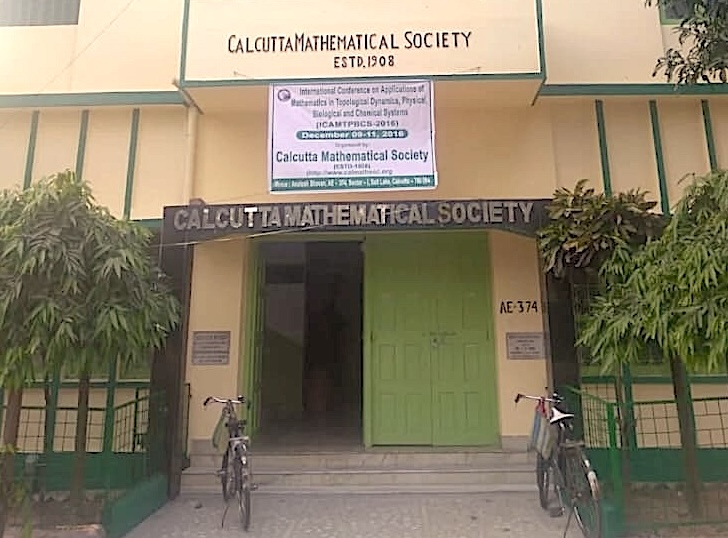
The Calcutta Mathematical Society began its journey with about fifty books and now it possesses more than 3550 books and 8500 journals. It is an invaluable treasure-house to those who intend to undertake research work in the history of mathematics and modern mathematics. Besides these, Sir Ashutosh Mukherjee’s personal collection (not all) enriched the library. Principal S. Bagchi, Prof. S.C. Kar, Prof. N.R. Sen, Prof. N.M. Basu, Principal B.M. Sen, Sisirendu Gupta and Mahadev Dutta had also donated their individual collection to enrich the library. The Society arranges memorial lectures on different celebrities. Among the lectures, N.R. Sen Memorial lecture, C.E. Cullis Memorial lecture, Prof. S.N. Bose Memorial lecture, Golden Jubilee Commemoration lecture etc., are worth mentioning.
Prof. Ganesh Prasad declared `Krishna Kumari Gold Medal’ prize in memory of his daughter. This is awarded to theses relating to the history of Hindu mathematics upto 1600. At present this prize has been renamed as `Krishna Kumari and Ganesh Prasad Prize’ [7].
Asiatic Society of Bengal played a great role for the study of Mathematics in Calcutta but we cannot open this chapter here. It can be considered in a separate article.
I am grateful to the referee for his kind suggestions.
Acknowledgement: The editors of Bhāvanā are grateful to Parthasarathi Mukhopadhyay for providing the author information appearing in the introductory paragraph.\blacksquare
References
- [1] P. Vibhutibhusan Bhattacharjee (Ed.), Ukara, Varanasi, 1978.
- [2] P. Vibhutibhusan Bhattacharjee (Ed.), Hayata, Varanasi, 1967.
- [3] Pradip Kumar Majumdar, “Banga Sahitye Ganit” (Mathematics in Bengali literature), Sahitya Parisad Patrika, 89 (1–2), 80–89.
- [4] Buddhadev Bhattacharaja, Banga Sahitya Bijñān, West Bengal State Book Board, Calcutta, 1981.
- [5] Prof. W.H. Young, Report on the Study of Mathematics on the Continent of Europe, University of Calcutta, 1976.
- [6] Bibliography of Doctoral Dissertations, 1957–1970: Mathematics, Astronomy, Statistics, Inter-University Board of India and Ceylon, New Delhi, 1973.
- [7] Diamond-cum-Platinum Jubilee Commemoration Volume, Part 2: Society (History, Activity and Development), Calcutta Mathematical Society, 1983.
- [8] Gopal Haldar (Chief Editor, Sakscrata Prakashan) (Ed.), “Ramtanu Lahiri O Tatkalin Bangasamaj”, Sibnath Racana Samgraha, Vol. 2, pp. 282, 286, 1976.
- [9] Durgaprasad Bhattacharjee et al., “A survey of Bengali writings on science and technology, 1800–1950”, Indian Journal of History of Science, 24 (1) (1989), 8–66.
- [10] B.R. Seth, Fifty Years of Science in India: Progress of Mathematics, Indian Science Congress Association, Calcutta, 1963.
- [11] R.S. Misra, A Decade (1962–72) of Science in India: Progress of Mathematics, Indian Science Congress Association, Calcutta, 1973.
Footnotes
- This article was originally published in Gaṇita Bhāratī Vol.15 Nos. 1– 4 (1993), with the title `Studies of Mathematics in Three Hundred Years Old Calcutta’, and is republished here, with edits, and with permission. ↩
- See the article titled `Glimpses on the History of Calcutta 1600–1800′ by Rama Deb Roy, Annales de Démographie Historique 1988, Société de Démographie Historique – E.H.E.S.S. Paris, 1989, pp. 243–257. ↩
- Brahmin toles (or tols) were traditional, informal Sanskrit institutions of higher learning in pre-colonial and colonial Calcutta, primarily managed by Brahmin pandits. ↩
- For further details refer to the book Relocating Modern Science by Kapil Raj, Pages 174, 270. ↩