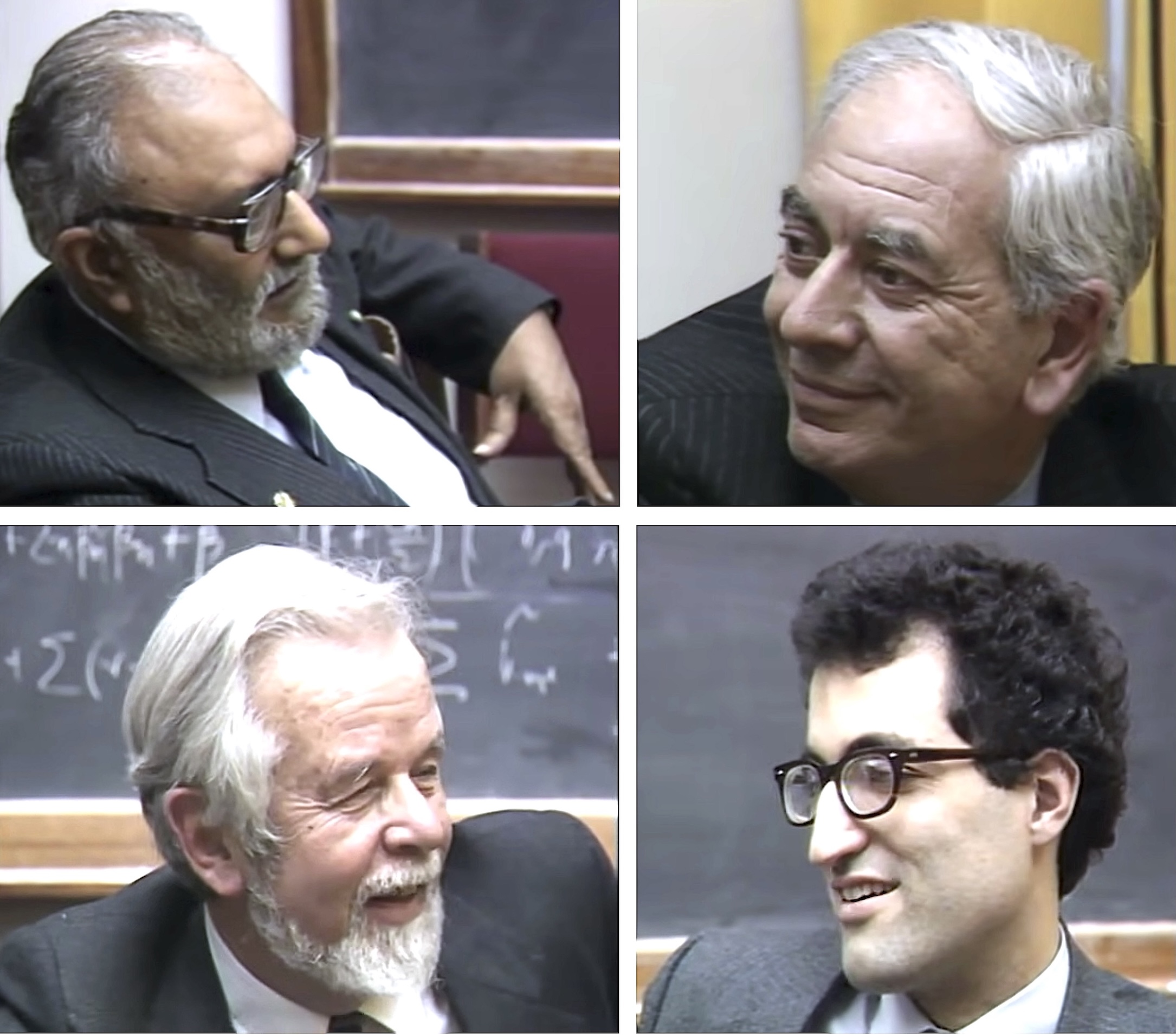
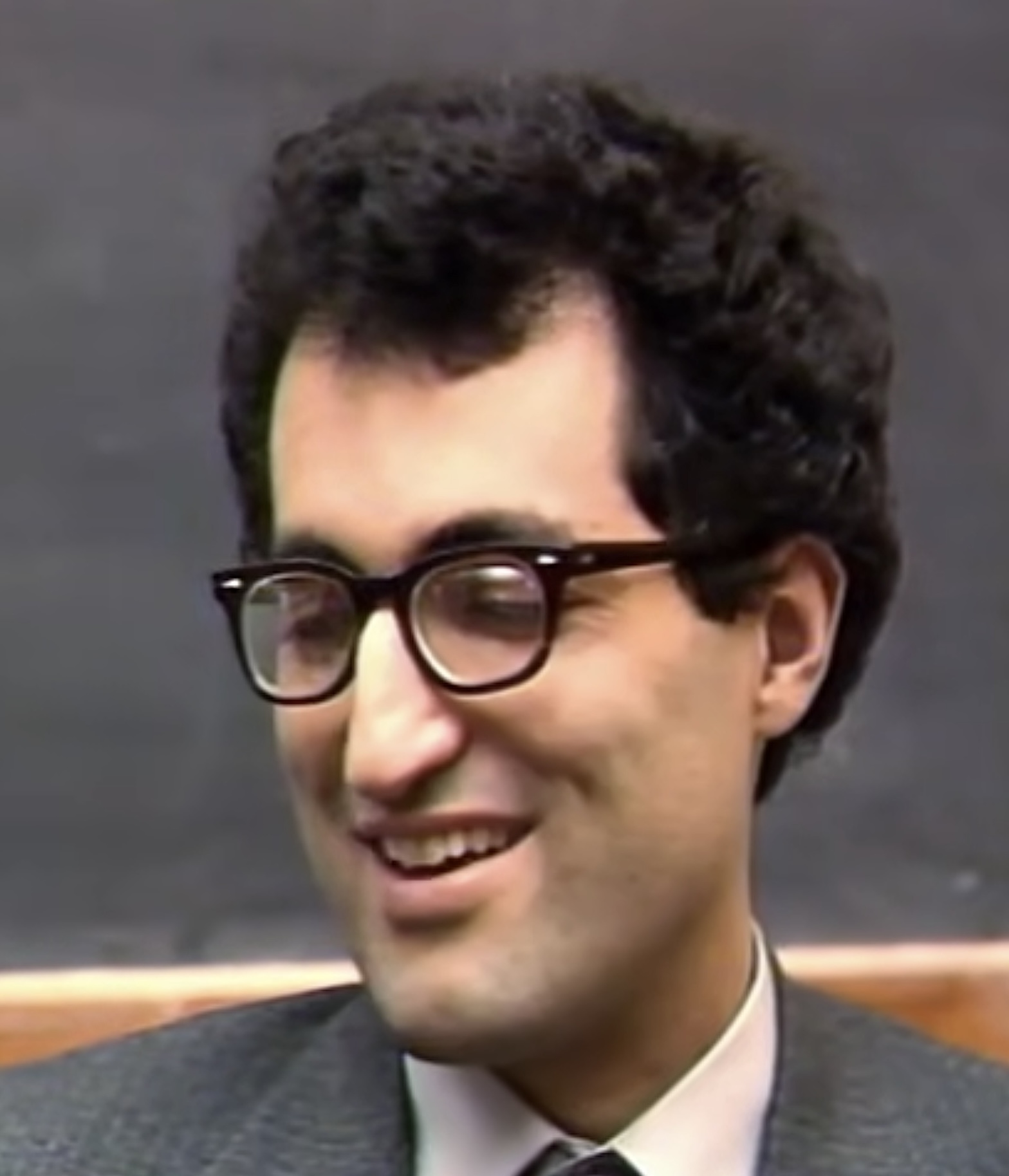
I am very glad that Bhāvanā is publishing a transcript of the video1 of the conversation recorded at ICTP in 1986 between Edward Witten and Abdus Salam, together with Denis Sciama and Paolo Budinich, following Witten’s Dirac Medal lecture.
This is an invaluable historical record—a time capsule capturing the mood of the physics community and its assessment of the state of the field in conversation with one of its leading voices. The discussion later meanders into more general topics, giving a sense also of the political concerns and the experimental and observational situation of the time.
Witten was the first recipient of the Dirac Medal, which he shared with the great Soviet physicist Yakov Zeldovich. This was very much in keeping with the mission of ICTP and its role in promoting international cooperation for and through science, transcending geopolitical barriers.
These were exciting times, just on the heels of what is sometimes called the “first string revolution,” following the discovery of anomaly cancellation and then of the heterotic string. By compactifying the ten-dimensional theory on a Calabi–Yau six-manifold, it seemed possible to obtain semi-realistic models of particle physics in four dimensions, with realistic gauge groups, supersymmetric grand unification, and chiral fermions. There was also the tantalizing possibility that the mystery of family replication might be explained in terms of the topological properties of the Calabi–Yau manifold.
I was a graduate student at Princeton at the time and had the good fortune to learn General Relativity and String Theory from Witten. I recall that during these years there was a palpable sense of optimism in the air. There were reasons to hope that perhaps one could derive the Standard Model of Particle Physics from first principles—and, moreover, within a theory that naturally unifies gravity with the other fundamental interactions while avoiding the short-distance divergences that plagued attempts to quantize gravity within conventional quantum field theory.
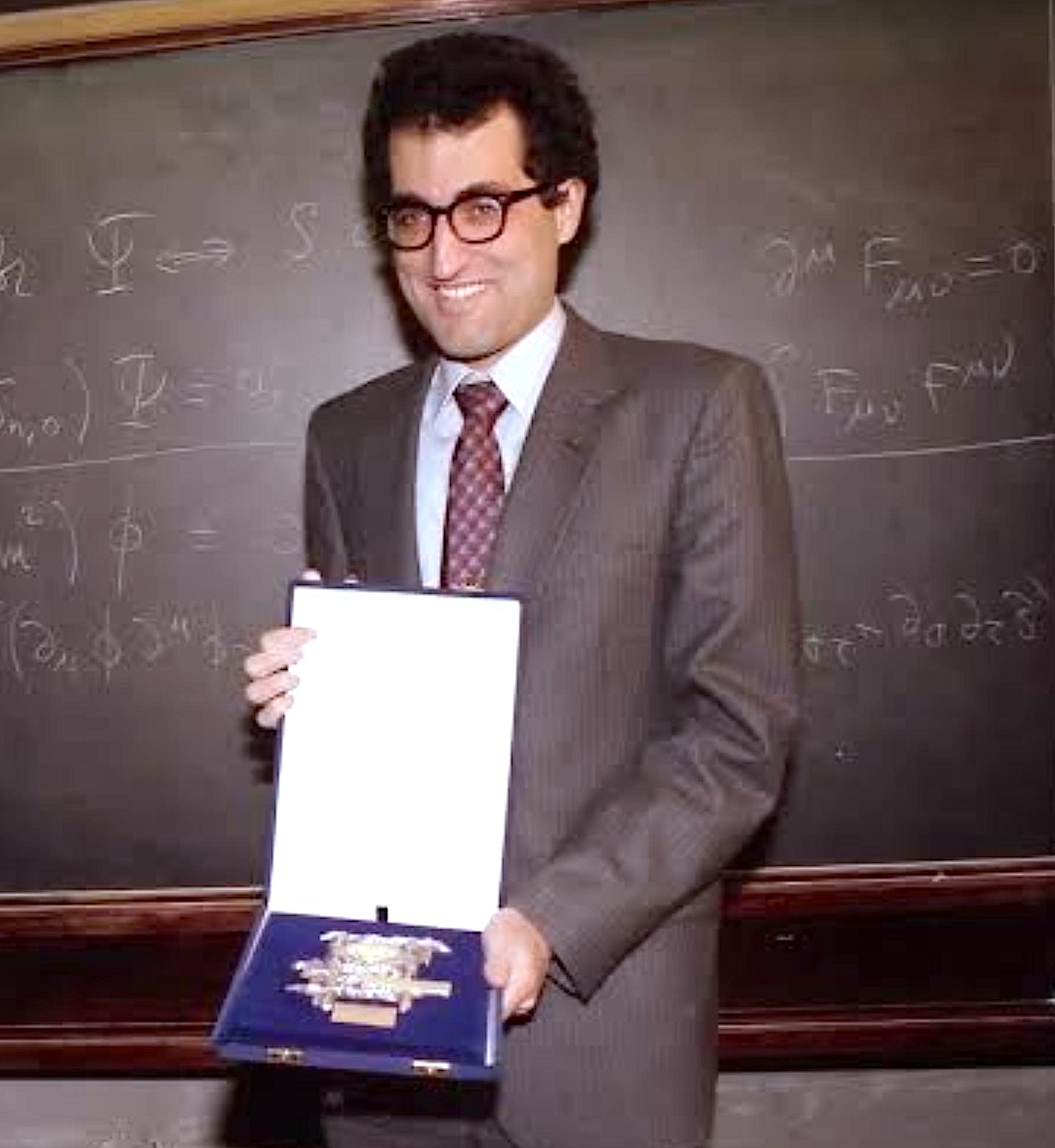
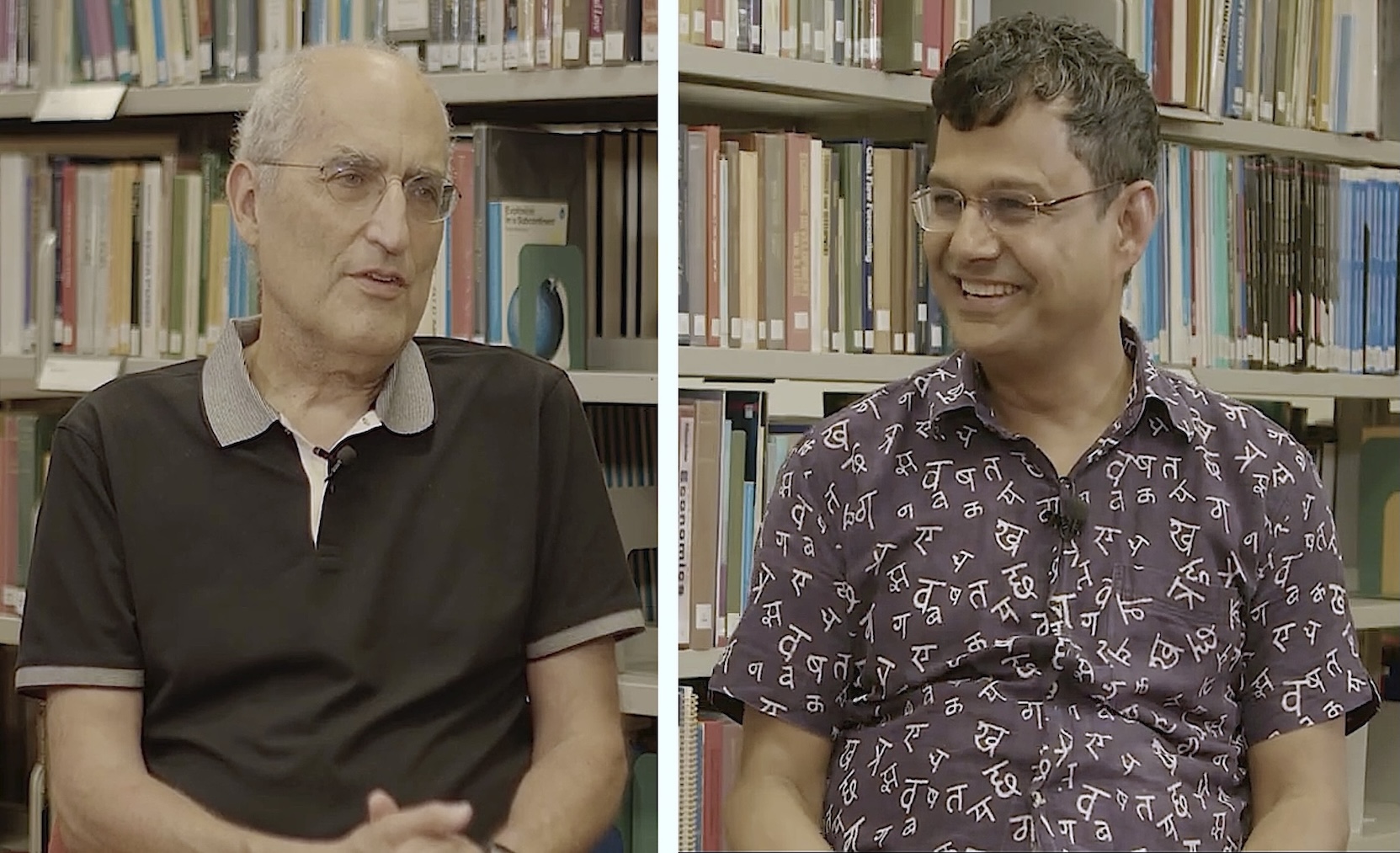
Making direct contact with experiment through models of particle physics of the kind discussed in the 1986 conversation has eluded us. An important conceptual challenge is to understand how the plethora of massless scalars can acquire masses after supersymmetry is broken to obtain a stable ground state. One also lacks a principle for selecting among the multitude of possible solutions of the theory. Witten is cautious even in the 1986 conversation, focusing on predictions such as fractionally charged particles that might be more generic—independent of some of the details that we do not yet fully understand, yet characteristic of higher-dimensional unification.
Even though we are not any closer to deriving the known particle physics from string theory, string theory has continued to blossom in the subsequent decades in unexpected directions. These developments have yielded deep new insights into the nonperturbative structure of the theory, illuminating along the way many aspects of quantum field theory and gravity.
The duality symmetries discovered during the “second string revolution” unified the different string theories into a single framework, usually referred to as M-theory, in which extended objects such as membranes play an essential role. String theory provides a natural mechanism for resolving many timelike singularities of classical gravity, including orbifold and conifold singularities. For important classes of black holes, it provides a statistical interpretation of the Bekenstein–Hawking area formula and, in favorable cases, an exact integral quantum degeneracy in exquisite agreement with the quantum entropy of the black hole. The holographic AdS/CFT correspondence, relating gravitational physics in asymptotically Anti-de Sitter (AdS) spacetimes to nongravitational physics in a boundary conformal field theory (CFT), is another stunning development. Its full consequences are still far from being completely understood. These topics are among the main themes of the 2024 conversation.
It is interesting to see Salam here in his role as a senior statesman of science. He was no longer active at these particular frontiers, and sometimes older physicists tend to repudiate the latest developments more out of inertia than insight. But one sees Salam engaging with his younger colleague with an open mind and a genuine interest in these explorations. He wisely advises against being too dogmatic about how science should proceed, especially when it comes to foundational changes. Historical and scientific contexts vary widely, and the construction of new theories does not follow simple prescriptions.
I am pleased that this important historical record is now available in print. Kudos to Bhāvanā for this initiative.
Budinich: After 65 years of effort to get unified theories, the situation is perhaps reversed. Now, the idea is that, apart from the success of the unification of weak interactions, we still require the same effort as Albert Einstein to try to unify gravitation and all the other interactions. Now, the idea is that you have to change the geometry. The formal part becomes important. Is this right or not? I would like to hear your opinions on this.
Witten: Well, I don’t think it’s really possible to make any theoretical prediction about how a new step in physics will happen. After all, quantum mechanics started in a way that nobody would have guessed. By fitting something that is not even a theoretical fit, but finding an analytical fit to match experimental data on blackbody radiation – that is how quantum mechanics started. That was a pretty weird way for a theory to start.
String theory, though, started with a clever formula written down by [Gabriele] Veneziano in an effort to satisfy certain not so well-motivated phenomenological ideas about strong interaction scattering. That was a way for a theory to start, which was as strange as the way quantum mechanics started.
And the way Einstein happened to have invented a theory in a particularly striking triumph of reason and intuition. But most other physical theories have had more complicated histories, and it’s hard to make theories about them.
Salam: You can’t generalize at all how invention will come. Anybody who makes statements like that is doing it by his own experience. And I think these statements must be modified according to each situation. What would you say?
Sciama: No, it still seems to me, it’s a question of whether you start with a mathematical scheme and then look for a physical interpretation, or start with a physical principle which you guess to be correct, and then on the one hand try and prove it experimentally to be true, and on the other hand codify it into a mathematical form. I must admit I’ve always been so admiring [of] Einstein’s procedure in general relativity of starting with a very simple physical remark based on the Galileo discovery that bodies of different mass fall at the same rate in the gravitational field of the Earth. He made a simple physical hypothesis why that should be true, and that forced all the complications of non-Euclidean geometry and so on to put the physical idea into a proper form.
But if you’d started by saying let me think of a mathematical scheme that might lead to gravity, let’s try non-Euclidean geometry, that would have been to me a very strange way of proceeding.
Salam: Einstein had all the field theoretic theories of gravity, of spin zero and spin one, of course wrong, before he started, and he knew all that. Then he had all the intuition of the non-Riemannian geometry from the work of Gauss and Riemann themselves.
So if Einstein had not started and had not lived even, I’m pretty certain that two or three or four years later somebody may have hit upon the same things. Hilbert nearly did.
Witten: I agree with you except that I think it would have taken longer. You see, Riemann almost did it. Riemann had the conception that gravity was based on curved space.
He didn’t conceive of curved space-time because special relativity hadn’t happened yet, so time and space hadn’t been unified. But if Riemann had lived after special relativity, he might well have…
Salam: Gauss made even these assumptions, you remember. So I don’t think it’s such a cut-and-dried case ever. Let me give you one more example, if I may, about inventions and so on.
Dirac, whom we were celebrating today by giving Ed Witten the first Dirac medal, was a great advocate, you may remember, of pure thought and handsome, beautiful theories and so on and so on.
Budinich: Mathematical beauty.
Salam: Mathematical beauty. If there’s a mathematical beauty in a theory, it must be true, even though experiment didn’t show it. Now, it so happens that supergravity and supersymmetry is a very beautiful theory. There’s no question about it.
I had the privilege of lecturing on this subject in 1974 when Dirac was in the audience at the Miami conference. Dirac, of course, as usual, kept quiet, didn’t say a thing. And I praised its beauty, its renormalizabilities, and all the great points about it in favour of this theory. He didn’t say anything. So after the lecture, I went to him and I said, “Professor Dirac, don’t you think this satisfies all your axioms of very, very beautiful theories? And wouldn’t you like to believe that this is the truth?” And to my amazement, Dirac, of all the people, said to me, “If this theory was true, the truth of supersymmetry would have been discovered long ago.”
If there’s a mathematical beauty in a theory, it must be true, even though experiment didn’t show it
Witten: Experimentally?
Salam: Experimentally. Now, there was the true physicist like us, humble people speaking, not the Dirac which we had learned from. So I would not like to be too dogmatic about any of these axioms, to which Paul [Dirac] has led us to.
Witten: If it turns out that string theory is right, it will extend the historical range of how theories have been discovered in very interesting ways. Because its discovery is as peculiar as the history of any really major discovery. And anybody’s scheme for how major discoveries can happen will have to be very flexible if a pre-existing scheme agrees with this one. [Everyone laughs]
In fact, if there is a pre-existing framework, if someone has a theory of discoveries, pre-existing theory written before string theory, which is flexible enough that it could accommodate this one, then I suspect that’s a little predictive power. [Everyone laughs]
Sciama: But could I defend my position a little bit? I see sitting at the side, as it were, various clever people inventing new mathematical schemes. There’s the scheme we’ve heard from Ed Witten just now, so beautifully expounded in his lectures. We’ve got Roger Penrose with twistors. We have other people saying, let us start with a differentiable manifold, but with some other more primitive topological structure for space-time, and so on. The difficulty is, how do you decide which of these mathematical schemes is on the right lines if you’ve no guidance from a physical principle that I was asking for before? Each of these schemes separately is beautiful, I would say, but there’s no guidance as to which is likely to be right.
Salam: I do not know of any reasons apart from duality, but there’s no test of duality really, is there? Very, very few. So string theory is a good example of your type of worry, where mathematics is driving, or rather the formalism is driving the theory. But I think the uniqueness of this theory is a very appealing thing. Wouldn’t you say so, Ed?
Witten: Yes.
Salam: I think that the mere fact that there are millions of ways of getting to the strings, as we heard from Ed. But apart from that, the fact that in the end there is a string, and so on, which is going to replace space and time in some special way, is, I think, significant, and giving you a unique thing.
What I wanted to ask you was, in the end, you were getting to a phi-cube-like theory. The light-cone-gauge also gives a phi-cube, as the unique theory. But it’s never happened before that the light-cone-gauge has given you the same type of theory, formally, as a non-light-cone-gauge theory. What I mean is, for example, gravity in the light-cone-gauge is horrible. It’s horrible. Wouldn’t you say so?
Witten: This also is horrible in light-cone-gauge, by comparison. Actually, the light-cone-gauge for the open string has a quartic term as well, which [Seif] Randjbar-Daemi was asking about. But the light-cone-gauge for the open string or closed string involves much nastier formulas.
Salam: Well, there are phi-cube or phi-4 with some derivatives and so on.
Witten: Yes, but non-local things. Non-locality.
Salam: You are hoping that when we go to a supersymmetric case, those non-localities will disappear. Is that the point?
Witten: Well, I’m not committed to using a light-cone-gauge for anything.
Salam: No, my fear was that in the end, after the dust is settled, you may come back to the same sort of structures as the light-cone-gauge has already given you. In that case, we shall not have scored a greater triumph this time than we would have had in the past.
Witten: That’s right. The way I would put it is that I think it’s more satisfying to have a gauge-invariant framework from which you can derive the Veneziano model. But to be really true, it would have to lead to other things that would simplify it and explain the logical structure. Right now, it’s nice to have a framework where you can only have one Lagrangian, but it would be even nicer to have some reason that this particular algebra would inevitably appear as the answer to some question. And that’s the kind of thing that has to happen, if what I was lecturing about is on the right track.
Salam: And I think it’s certainly true, but I don’t know.
Budinich: Well, the convergence, I mean, the ultraviolet disappearance of more than the Veneziano. This was the real origin, no? Well, the reason why it becomes so important. The hope.
Salam: Yes. Well, I think it’s certainly true, but I don’t know.
Budinich: Then would it not imply some revision of the conception of space-time, a drastic revision?
Salam: That’s already come, as you heard today.
Budinich: Yes. And it is a drastic revision of our concept of geometry.
Witten: I believe that, like the Bohr atom in its day, string theory has within it the seeds of a real revolution in the way we understand physics. String theory we understand in a very primitive way. But I think, locked in it, there are some amazing things that have to be unlocked.
Salam: The relationship of quantum theory and general covariance and so on. My colleague, Professor Chris Isham at Imperial College, once said to me that he joined the quantum gravity bandwagon in order to get out of space-time, which he loved a lot with all its equivalences and diffeomorphisms and so on in quantum theory. And with strings, the opposite seems to be happening. That’s just the remark which you were making. Is that right?
Witten: Well, I’m just not convinced that we know which of the ingredients that we now know from string theory will prove to be more fundamental.
like the Bohr atom in its day, string theory has within it the seeds of a real revolution
Salam: But didn’t you say that quantum theory is not going to come out of it? That was the question.
Witten: I said that, indeed, string theory might explain quantum mechanics, in the sense that string theory might be, for the first time, a theory which was more natural as a quantum theory. After all, if you take it at face value, it was first discovered as a quantum theory. The first things calculated were scattering amplitudes.
Salam: No, but why would you say the quantization principle is coming in? What do you think, fundamentally, basically?
Witten: Oh, I don’t know.
Salam: When you speak of the structure of space and time, or some revolution thereof, would you not expect that you would get a new structure in which somehow quantization principles, superposition and so on, are inbuilt?
Witten: Well, that would be better. It would be far better if string theory does explain quantum mechanics. But in the spirit of trying to take some steps, since you can’t do everything all at once, I try to take the conservative hypothesis of assuming that we might not explain quantum mechanics, but only a fundamental generalization of the known symmetries.
Salam: Time being, those people who are looking within quantum gravity, the origin of quantum theory from gravity theory have been defeated.
Witten: Well, I think that they should start working on string theory. Because it really has a potential to do what they’ve been dreaming of. You see, I made such a point of saying that I wasn’t going to assume that string theory would explain quantum mechanics, just to plant in people’s mind the fact that there was a question that maybe I am being too conservative.
Sciama: Yes, I took it that way. But quantum mechanics is so weird. I mean, although it’s an old theory, its weirdness is coming out more and more into the open in recent years with various discussions. So it’s not at all clear that just saying matter is made of strings is going to explain this weirdness, which seems on a different level of structure somehow.
Budinich: By which space-time is different than we thought. And by which, I mean, one could go back perhaps to Cartan. He said the same thing in 1937, that the Euclidean geometry is a very complicated geometry, while the geometry of zero vector is the more elementary one. Now, there are a lot of zero vectors in these minimal surfaces. I mean, this was known 150 years ago, that zero vectors generate Weierstrass minimal surfaces. So maybe it is also true that the Euclidean geometry is not the most elementary one.
Salam: You say that Cartan discovered the exceptional groups? Is that true? They were not discovered by Sophus Lie?
Budinich: I mean, the algebra, the groups were first done by…
Witten: No, no, no. E_8 as a group was only done much later. Neither Cartan nor Lie proved that there was an E_8 group. If I’m not mistaken, Cartan discovered the E_8-Lie algebra, which had been unknown to Lie.
What Lie did with Lie algebras, I don’t know. But you could do it. Obviously, he may have perhaps introduced the concept, general concept of Lie algebras, although some special cases have been done before, and proved some basic theorems about them. But he didn’t classify them. I’m pretty certain… You see, it’s difficult, even if you have a Lie algebra, to determine if there is a corresponding group. Not every Lie algebra can be exponentiated to give a Lie group. And you can prove that, let’s say, for the \mathfrak{so}(n) Lie algebra, there is an SO(n) group, by actually describing it as orthogonal motions of space. But to prove that there is an E_8 group was apparently difficult.
Neither Cartan nor Lie proved that there was an E_8 group
Salam: Did you discuss what we expect experimentally today from the string theories?
Witten: I actually think that one of the few predictions that have been made, which haven’t been made in the context of other theories, is the existence of fractional electric charges that aren’t confined.
Salam: Is that a definite prediction that will not be changed?
Witten: Well, I think it has a higher probability of staying than anything else.
Salam: Because you stated it for the first time in a rather small paper.
Witten: No. I wrote a long paper with my student [Xiao-Gang] Wen. I wrote a survey of the theory in which I stated it rather briefly, perhaps.
Salam: Secondly, about their confinement. Now, are you sure that someday you will not want to confine them again?
Witten: I don’t think there’s any reason to do it. They don’t have any real quantum numbers except electricity, or other abelian quantum numbers. You see, the burden of proof is to show that there aren’t fractional charges.
Now, in four dimensions, we prove there aren’t fractional charges in standard unification. Because unification, or symmetry breaking, we do with Higgs expectation values, which we can turn off continuously. And turning them off, the representations must go over to representations of the unified group. And the unified group doesn’t allow fractional charges. But if we’re going to work in string theory, the symmetry breaking has to be something that can’t be smoothly turned off. And that means that there’s no reason there shouldn’t be fractional charges. And I believe that it should be a generic property of models of that kind, even if many ingredients we now think we understand, are actually wrong.
Salam: These fractional charges are not wrong. How did you determine that one-fifth?
Witten: All the states that have one-fifth electric charge are states where a closed string wraps around a non-contractible loop. And if you just calculate the electric charge of such a state, you get one-fifth, or a multiple of one-fifth.
Salam: I see. So that’s quite spectacular.
Witten: Well, the discovery would be. But of course, since the particles have Planckian masses, they wouldn’t sit on the Earth’s surface. Gravity would pull them out. Such a particle with its feeble electric charge, and its heavy mass, wouldn’t be electrically bound in atoms. Gravity of the Earth would pull it right out.
Sciama: Well, I was going to ask you, Ed, actually, following on Abdus’s question, looking for consequences of this new scheme. Would there be either astronomical or cosmological consequences specific to the new scheme?
Witten: 10 to the minus 5 grams.
Budinich: I believe they’re missing mass.
Witten: Well, you know, a question like that is difficult to answer because the interaction of particle physics and cosmology is frequently quite nonlinear and unpredictable.
Salam: What about this lensing effect? And those are things that you talked about in one of your papers. Strings in the cosmic sense.
Witten: Yeah. Okay. The superstring itself could exist as a microscopic string. We usually imagine it as a microscopic string, but if it’s a closed string that can’t break, you could stretch it across the horizon. But it’s actually so fabulously heavy that that kind of a string couldn’t really exist in our world today.
Also, it turns out that they are the boundary of axion domain walls, which would have presumably caused them to disappear. But we can ask whether string theory would give rise to somewhat lighter cosmic strings, like have been discussed by Tom Kibble and Alexander Vilenkin and others. And, well, since I’ve always been a fan of those cosmic strings, I hope that the answer is yes. But you can easily describe many plausible scenarios by which they might arise, but you certainly couldn’t say there’s a prediction.
Salam: You don’t think there’s a QCD-like argument to be made about confining them?
Witten: No. Because they don’t carry non-Abelian quantum numbers.
Salam: They don’t?
Witten: Well, to put it differently, any non-Abelian quantum numbers they carry can be screened by ordinary particles. The only unusual thing they carry is electric charge equal to one-fifth. By adding to them standard quarks and things, you can make a state which is neutral under all non-Abelian quantum numbers and has electric charge one-fifth. So if electricity isn’t confining, they won’t be confined.
Salam: I see. I see. So they are a definite prediction, you think? It will not be arbitrary.
Witten: Not with probability 100, but I think it’s such a natural consequence of a theory that is only unified in higher dimensions that there’s an excellent chance it will survive. I wouldn’t say that. Like, if you ask me, do I think it’s an E_6 or an SO(10) model or a monofilament…
Salam: No, that I think is, as you said yesterday, is really still to be fitted, yeah, fixed.
Witten: Or to ask, are there extra U(1)s, or how many generations?
Salam: How do you think you would eventually get this low mass scales into the picture? Some sort of exponentiation of something or the other?
Witten: I hope it’s an exponentiation of something. Well, of course, it’s not clear why the fine structure constant is small. Microscopically, there’s no dimensionless parameter. But somehow a small parameter has to come out of it anyway. And to get a big number or a very small one by exponentiating it, you already have to have a moderately small number. And even that’s slightly mysterious.
Last summer, I was reading the fascinating book by André Weil on the history of number theory from Hammurapi to Legendre. It’s quite interesting. He discusses Fermat’s adventures with some simple Diophantine equation, where Fermat found that the lowest integer-valued solution was something times 10 to the 15th of some innocent-looking equation.
Well, I don’t know if I’m really suggesting that the world is based on some strange solution to a Diophantine equation. But it’s really interesting that he had a problem that was defined by numbers of order unity, but the solution was some gigantic number.
Sciama: Yes. Going back to the cosmic strings, the very long ones that might occur in astronomy, you were telling me the other day that they may have seen some of these strings coming out from the center of the galaxy. Do you take that seriously?
Witten: [Laughs] Well, I wish I were a radio astronomer and could make a more independent judgment. The majority of astrophysicists that I’ve asked about it express a skepticism or at least caution similar to yours. And I’m not in a position to have an independent judgment.
I hope it’s true because I think it would be a great thing for both astrophysics and particle physics if cosmic strings were discovered. In fact, for particle physics, it would be one of the fundamental measurements. You’d measure at least the mass of the string if you saw it at all. I believe you’d find ways of measuring its mass. And that would be a fundamental measurement of a new scale of symmetry breaking, probably way beyond what’s accessible to accelerators.
Salam: What would a measurement imply? What would one have to do to read a measurement?
Witten: Well, it depends on how heavy it is. Vilenkin pointed out that if it’s heavy enough, you would actually see it as a gravitational lens.
Sciama: But the original idea was that these were the seeds of galaxies. The galaxies fall that way. Yes, but now these are strings you actually see as a string in the sky, you see.
Budinich: That’s the idea.
Witten: Okay, originally, Vilenkin and others investigated ways of observing strings by their gravitational interactions. But there is another possibility for observing strings because under certain conditions, one of these cosmic strings is an electrical conductor, in fact, a superconductor. And as a superconductor moves through the conducting plasma of interstellar or intergalactic space, well, it’s superconducting, and so moving in a magnetic field will push the magnetic field lines upstream.To do that, it has to start carrying the current. So pretty soon, you’ve got a gigantic current wreaking havoc with the magnetic fields and creating all kinds of storms and who knows what. In fact, I think the plasma physics involved would look rather complicated. Complicated enough that I’ve certainly never attempted to understand it myself. But the New York Times on the first page of the science section published a very amusing picture a couple of weeks ago of the galactic center. It’s a radio picture of the galactic center with some threads coming out.
Salam: Really?
Witten: The threads are 100 parsecs long and one parsec across. And George Fields, the astrophysicist, is quoted as making the speculation that these could be cosmic strings, by which I presume he meant superconducting cosmic strings.
Salam: How are these snaps taken in the first place?
Witten: I don’t know the details, but generally speaking, it’s a radio picture of the galactic center made with, I think, the VLA, a very large array baseline. It has a much higher resolution than previously, which you need because the thread which is being detected has a width of order one parsec at a distance of 10 to the 4 parsecs.
Sciama: I think it’s marvellous. I heard it first just yesterday. My immediate reaction was you could find a more conventional explanation, which I’m sure is what your astrophysicist friend said, but who knows? Who knows?
Witten: Oh, the one parsec would arise because no matter how thin it is, as the superconducting wire travels through the plasma, it produces tremendous disturbances, which can easily extend out to a parsec. Terrible magnetic storms and cosmic ray showers.
Really, I think there’s a good chance you’d at least measure its mass. Regrettably, Vilenkin showed, I guess, that it wouldn’t really be a source, that a perfectly straight thing wouldn’t really be a source of Newtonian gravity.
Sciama: But you mean from the bending of light coming past the string?
Witten: If it’s heavy enough, then once you see it in the sky, you definitely can look for things like double images of foreground objects. Although actually, this is thick enough that you’d have to do your observing at some wavelength to which the thing is transparent.
Sciama: Do you mean Cygnus X-3-like objects as we understood them before the suggestions, the muonic showers and so on? Because I think the data there is not accepted as correct.
Salam: The muonic showers, yes. Why not? Two labs out of four, which could have detected it, that’s a good enough statistics, isn’t it?
Sciama: I’m being conservative again. Since analysis shows it would require quite new physics, I mean, objects, particles coming from Cygnus X-3 of a new type to explain the positive data.
Salam: Not a really new type.
Sciama: I mean, that’s what I’m…
Salam: No, I don’t think so.
Budinich: I call that new physics.
Salam: Oh, I see. [Laughter ]
Sciama: Half the observers don’t see any effect, you see. Then it seems to me one should be conservative about it. But to predict how many objects like Cygnus X-3 from an astronomer’s point of view should be present, say, in our own galaxy is too difficult. Until you understand…
Salam: Is Cygnus X-3 in our galaxy? I thought it was outside. Are you sure?
Sciama: No, no. It’s in our galaxy.
Budinich: Because the magnetic field, the higher magnetic field, rotating at such velocity gives a velocity higher than light at a certain distance, which produces this effect according to him. So it’s one of the things that he had foreseen for neutron stars, naturally.
Witten: How about how long they last for?
Salam: Yeah, that’s another question.
Witten: I’ve heard it said that Cygnus X-3 could be producing most of the cosmic rays in the galaxy at high energy.
Salam: 10^5 TeV or whatever it is being produced. What I’m really asking is, could we have some other type of Cygnus X-3 which would produce 10^{16} TeV?
Sciama: Well, it would be nice, wouldn’t it? I don’t know. I don’t know.
Salam: There’s nothing to stop it.
Witten: Incidentally, superconducting cosmic strings, depending on the particle physics, can produce particles of incredibly high energy. Because as it travels through a magnetic field, in displacing the field lines, it has to pick up bigger and bigger currents, which are carried by more and more energetic particles. And eventually, in too strong a field, with too strong a current, any superconducting wire goes normal and will expel all those particles in some dreadful cosmic ray burst.
Sciama: Well, the conventional explanation is that it’s in supernova explosions, at least up to some energy, not perhaps the very highest energies that are detected. This would occur just within our galaxy. But the very highest energies may be made in external, more powerful galaxies, where explosions perhaps occur at the center of the system and those cosmic rays come to us.
Well, there’s no definitive proof that this very favoured view is correct. Energetically, it’s reasonable. We know how much energy supernovae put out in our galaxy. And if, say, a few percent of that went into cosmic rays, then energetically, that’s all right. But that’s not proven.
Witten: A picture of cosmic rays?
Sciama: Well, it could do, certainly at high energies, or even maybe at lower energies. It’s often very difficult to demonstrate that a theory that, on energetic grounds, is adequate enough to do it is actually the dominant source. Because if it happened to be only producing a few percent of what we see, then, of course, most of it is made by some other mechanism. But of course, they do, you see, as they propagate in the galaxy, the galactic magnetic field stirs them all up so that you can’t just tell from the direction of arrival where they came from. That’s one of the fundamental difficulties.
Witten: If it were true that cosmic rays, at least in some energy range, come mostly from Cygnus X-3, it would be a dramatic illustration of the need for experimental science. Because it would have been hard for theorists to guess that, in some energy range, cosmic rays were mostly coming from some weird object.
Sciama: Oh, of course. Oh, yeah, absolutely.
Salam: It really is a fascinating study, how one can spend ages hitting one’s head against something which is experimentally totally irrelevant. Take SU(3). I don’t know how much influence the old-fashioned flavour SU(3) had on your thinking, but for us it was the end-all and be-all. And by God, it’s such a lousy group to deal with. It’s such a lousy group to make into fundamental sense that at least I heaved a sigh of relief when it went away and became SU(4) or SU(2) \times SU(2), or whatever it is.
Witten: Or what became explained as a consequence of quark masses, which we should think about.
Salam: So really, an experiment is such a balm sometimes to theoretical prejudice that it’s a fascinating study if somebody should do it.
Witten: It certainly is sobering to see, also very frequently, how one can be very close to the truth of something, but by making a slight error… Well, consider for instance the Cygnus… Because of some missing ingredient, which for cosmic rays could have been Cygnus X-3, or but for some little fact that you just should know in order to investigate this problem, you could reach completely wrong conclusions.
Sciama: He didn’t know what the sources were. He just said that this was a way to accelerate particles in cosmic conditions.
Witten: Is it still considered a major mechanism?
Sciama: Oh, I think so, yes. Although it doesn’t work quite as effectively as he thought in the interstellar medium, but it may work in the shells of supernovae, for instance. But astronomers suffer from the fact that they can’t do experiments in a systematic way.
They have to wait for messages from outside.
Salam: Like Fermi. Well, I wouldn’t like to say Fermi, but…
Budinich: But he made a theory about clashes with magnetic fields.
Salam: Before that was SU(3), which was a horrible group. I mean, if you had… Well, you didn’t live through that period, you were lucky. But we used to beat our heads against the wall trying to make a fundamental theory out of that SU(3).
Sciama: You could build a machine in the lab systematically to study…
Salam: Yes, you can’t even use that.
Sciama: As long as the energy is within bounds.
Witten: But it’s a little chaotic how long you have to wait before those machines find something.
Salam: That’s right, that’s right!
Sciama: I’m one of those astronomers who prefers to control fantasy with observation.
Salam: … Of the various sorts which will change astronomy completely out of recognition soon. What’s your time scale for changes, big changes?
Sciama: Something like the Space Telescope, which we hope will go up soon. That will extend our powers of observing stars and galaxies tremendously. But it’s the same kind of astronomy as before, just with somewhat more powerful instruments. But we can’t actually go out to Cygnus X-3 and look at it and see what it’s made of, for instance. That’s what we’d like to do.
Witten: Do you think there’s any even imaginable plan for an interstellar space probe? Not manned, of course, instrumented.
Sciama: Any prediction as to the limits of what one can do is bound to be disproved rather rapidly in the future. I would have thought if it’s not against the laws of physics to do it, it can be done. And unless it’s too expensive, it will be done. I don’t see why not. But people like Freeman Dyson have speculated very seriously along those lines. Yes, I think it’s… Maybe not for a couple of centuries, I don’t know. But I don’t see why not.
Witten: A conversation with Dyson that made me think about…
Budinich: Oh yeah, … able to do experiments so you can go farther and farther with your fantasy and make speculations.
an experiment is such a balm sometimes to theoretical prejudice that it’s a fascinating study
Witten: One paper, if you assume it was a major priority for some sufficiently wealthy organization or country, you can use the fuel. And you can have a big ponderous microwave beam in orbit which is accelerating a few tens of grams of instruments with an umbrella behind it. And on paper, highly optimistic assumptions show that if some technologically developed country considered it a major national priority, it could be done in a few decades. And can be done means that once you develop this thing, you could get to interesting astronomical objects in travel times of ten years or so.
Salam: Oh, I see.
Sciama: Ten years.
Witten: Well, another thing I should mention is that Dyson is convinced that within just a few light years of us, there are bound to be interesting objects that haven’t been discovered yet.
Salam: Why does he think that?
Witten: Well, because many astronomical objects are undetectable. For instance, theory says that neutron stars should be almost as numerous as ordinary stars, but only a few hundred are observed. Most of them are too dim. So there should be a lot of dim neutron stars in black holes in our neighbourhood.
Salam: Space stations find similar things… Even though they are not very far off, just because they have no constraints on the atmosphere, the dimness will be reduced.
Sciama: Well, I don’t think a space telescope would be able to see the objects that Ed has just spoken about. It will be able to see fainter objects because there is no scattering from the atmosphere, and it will have much better angular resolution and much wider wavelength coverage. So it will be tremendously important for astronomy.
Something like the Space Telescope will extend our powers of observing stars and galaxies tremendously
Salam: What would the scale of luminosity go up to?
Sciama: Well, it would be able to see galaxies something like… This is not a very accurate answer. Something like ten or a hundred times fainter than we’re now normally used to seeing.
Salam: Yes.
Sciama: But to see objects of the kind we were just speaking of, nobody particularly expects a space telescope to be able to do that. But it will still change astronomy, I think, with its new powers, rather like when Galileo essentially used the first telescope.
Salam: That’s a tremendous change.
Sciama: That’s why the Americans are willing to spend so much money on it, because it will still change astronomy very greatly, but not to the extent we’re now discussing. Well, actually, with European support, Europeans are now involved in the space telescope by building an instrument for it. We buy our way into the space telescope, and we get 15\% of the observing time by spending, I suppose, 15\%, or whatever the fraction is, of the cost. And we do it by building a particular detector.
Salam: What kind of money is involved? Do you have any idea?
Sciama: Gosh, I don’t remember now. This number keeps changing. I don’t want to say a number that’s wrong. But when we say, who in America? Well, NASA, and the American government through NASA.
Salam: No, no. Is it a billion-dollar project, or a half a billion?
Sciama: Not too far off, I should think, yes. So for tens or hundreds of millions, we build this particular detector, we the Europeans. And buy our way into the instrument. So we get 15\% of time on an instrument we could never possibly build ourselves as Europeans.
Salam: Yes. With President Reagan putting an 8\% on taxes for the sake of SDI [Strategic Defense Initiative], maybe the next administration can change the same amount of money into space science.
Budinich: That’s a good job, yes.
Salam: Suppose he gets it through the Congress. The next administration may have an easier job just changing the objectives.
Budinich: Yes, this could be a resolution.
Witten: I wish I could believe that that was likely to happen. Well, unfortunately, I don’t know if the first part will happen, but the second part, unfortunately, if it gets through as Star Wars, to hope that it will be turned into space science seems a little bit optimistic.
To me, it seems like a natural concern that once Star Wars gets rolling, there will come to be a lobby for it of contractors and people working for Star Wars who depend on it for their livelihood, and there will come to be a Star Wars lobby that has nothing to do with any alleged virtues or, for that matter, any faults of Star Wars as a defense system. Why did you say before that cosmic strings are no longer alive for galaxy formation?
Sciama: No, Abdus said it, not me.
Witten: What’s your opinion about it?
Sciama: Well, it’s not something I’ve worked on. I think it’s still taken seriously by a small number of serious people like Tom Kibble, who’s just at the moment writing new papers on the subject.
Salam: Yes.
Sciama: But you said, Abdus, that cosmic strings for making galaxies are now dead. I let it pass, but actually I didn’t quite know what…
Salam: No, no, what I meant by dead was in the sense of doing anything with them experimentally. Dead in the sense that they’ve done their job and that’s the end of it. Galaxies have been made, and now you will not know whether they were at the bottom of the business or not and what more could you do with them? They’ve done their job.
Sciama: No, no more galaxies. No more galactic creation.
Witten: There are predictions, actually. For instance, if you just say that galaxies were made by nucleation around cosmic strings, it turns out that those cosmic strings, in the process of disappearing, would have created a detectable amount of gravitational radiation. So while the theory can’t be proved, it can be disproved by not finding the gravitational radiation.
Salam: I see, I see. Well, that’s good, then.
Sciama: But there’s another example. According to Kibble’s latest work, you can calculate from the string theory of galaxy formation what you’d expect to get for the correlation function of the galaxy distribution. That is, if you know there’s a galaxy here, what greater probability than average is that there’s another galaxy nearby? This is a correlation function which is known observationally very well. The main architect of that work is a colleague of Ed’s at Princeton, Jim Peebles. So observationally, this correlation function is known well and according to Kibble, you can very well get that function out of string theory without any adjustable parameters designed to get it.
Salam: But then, what Ed is saying now, you would also expect some gravitational radiation to be around.
Sciama: Yes, I think so, Ed.
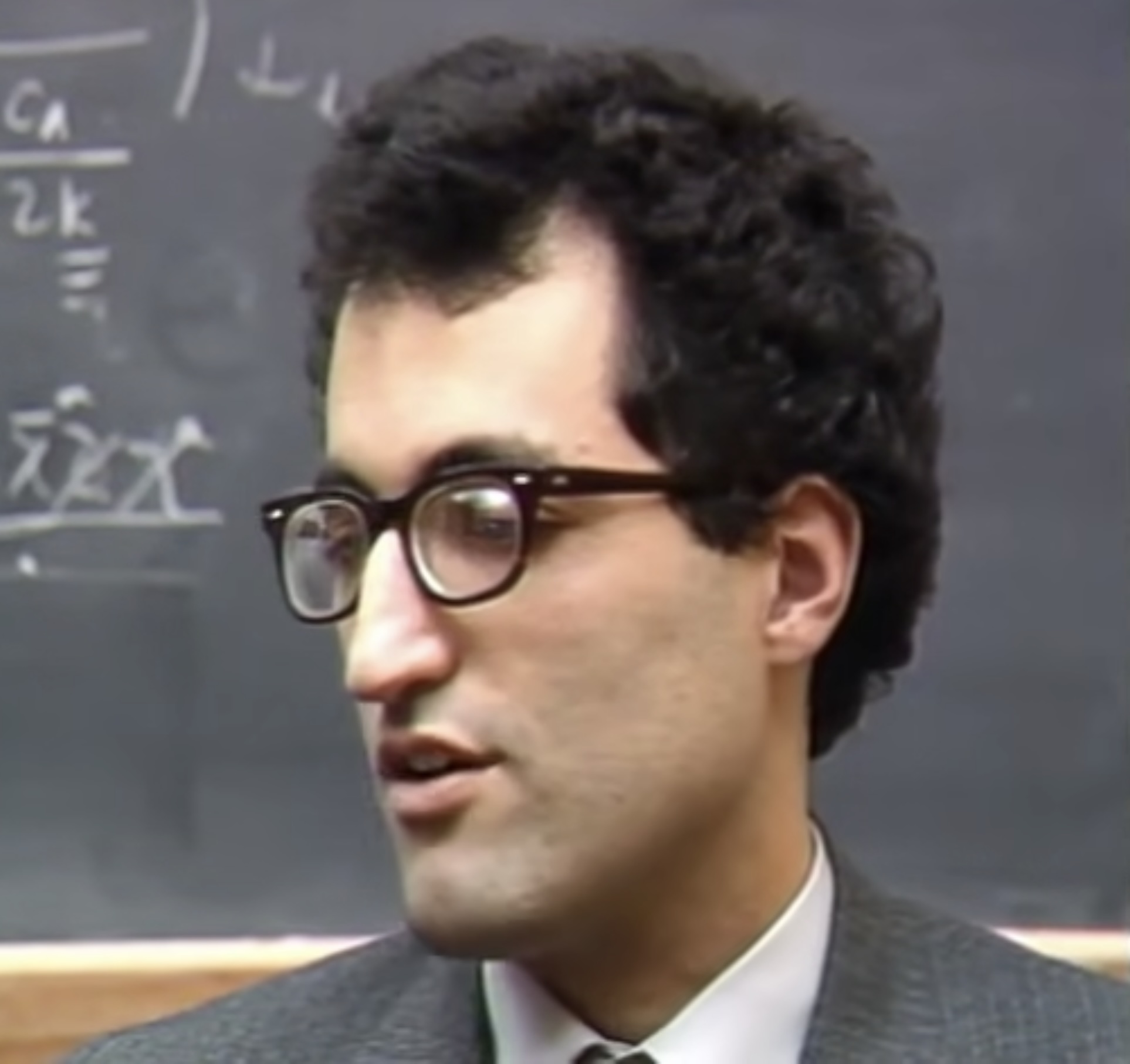
Witten: The chances of detecting it… Well, observations of gravitational radiation are likely to improve significantly in the next ten years and there’s a reasonable chance that this string picture can be disproved or supported in a reasonable time.
Salam: We’ll provide the 21st century equivalent of a new detecting device for particle physics or for other phenomena like the ones we are talking about.
Sciama: Well, it’s a timely moment you ask me this, Abdus, because next week I’m going to England for a conference on gravitational wave detectors. The British group based in Glasgow is attempting to raise money from the Science Research Council for an ambitious detector. And they’re bringing the leading people from California and Italy, I suppose, and Germany too. And the hope is that in the next ten years gravitational wave detectors will become sufficiently sensitive not perhaps to detect these waves we were now speaking of but to detect supernovae — you know, stars collapsing to make supernovae — in the Virgo cluster of galaxies. It’s about one event a month, I suppose. And these can be picked up with detectors, not today, but the sensitivity required is programmed to be achieved in the next ten years.
Salam: With which they will increase their sensitivity?
Sciama: Well, over the present… I’ll know the numbers better next week, but something like a hundred times better than they can do today, I suppose. But the technology needed to do that seems to be now available by using laser methods, and so forth. It’s a fantastic technique. It’s something like getting a ton of material in the form of a bar and detecting a change in the length of that by something like one ten-thousandth of the radius of an electron. And they aim to detect these small length changes. That, in effect, is what the measurement involves. And that’s what’s required to see the gravitational waves from a supernova event in Virgo. Now, these particular things that Ed was talking about might occur at different frequencies and would need different techniques.
Witten: There are more frequencies. And the interesting possibility of detecting them comes from their influence on the timing residuals of pulsar observations.
Budinich: For explaining clusters of galaxies and superclusters, are fractal methods a good candidate?
Salam: What are fractal methods?
Budinich: I mean fractals in the sense of Mandelbrot. I heard this from Ruffini. And there are people also in Copenhagen talking about the possibility of explaining the distribution of clusters of galaxies in the absence of superclusters.
Sciama: But is this a matter of just mapping the distribution with some mathematical technique? Or is it a physical explanation of how these objects form?
Budinich: No, this is more mathematical.
Sciama: It’s more a description of their distribution, then.
Budinich: Yeah, yeah, that’s right.
Sciama: Well, I’m sure more sophisticated methods will be used to specify the distribution you’re trying to explain. But I must admit, as a physicist, my main interest is what physical mechanisms actually occurred. And do you need exotic things like strings? Or can you use more old-fashioned ideas? Although other modern ideas for making galaxies are just as exotic as strings, they don’t happen to involve strings. Things like quantum fluctuations in the very, very early universe near the Big Bang involving the so-called inflation process is a very popular way now of making the initial disturbances that eventually evolved into galaxies. So the link between very large things like galaxies and the sort of things in microphysics we started out talking about with Ed, this is one of the great developments in recent years. This discussion is possible.
Salam: But coming back nearer home, I mean, don’t you find, Sir Dennis, that you and I are old people, and that things have changed so much in our lifetime?
Sciama: They sure have.
Salam: Haven’t they?
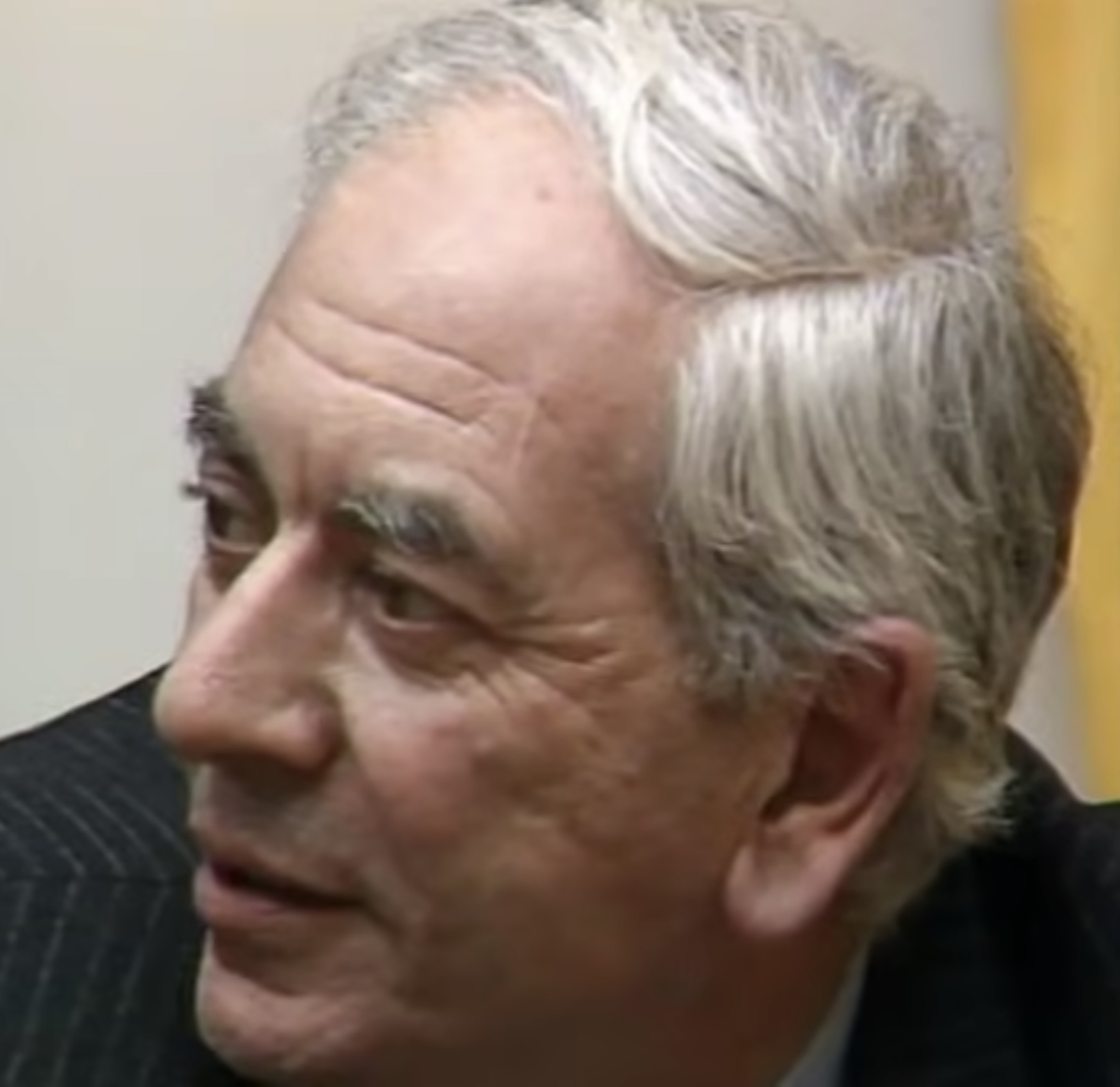
Sciama: I don’t know which change you have in mind now. There have even been so many changes, but…
Salam: Well, for me, certainly the biggest change since I started academic life, is that things were completely chaotic back then. But now there is some sort of a semblance of order, but there’s still some chaos, albeit of a different kind altogether. I mean, the present chaos is ordered chaos, if you like, like finding what the string theories are saying and so on. This is a different thing… because now there’s an objective in sight. But, there was none whatsoever when I started. Now what I wanted to ask you was, is the same thing happening in your subject too?
Sciama: I don’t know which change you have in mind now. There have even been so many changes, but…
Salam: I think when the hydrogen-filling universe was known, Fred Hoyle existed.
Sciama: Oh, Fred Hoyle existed, all right.
Salam: Yes, he was the pioneer of all those things.
Sciama: Well, when I started research, none of the revolution in modern astrophysics had occurred. I’m not saying there was a connection between the two things. Cosmological theory is where I started research around 1949, under Paul Dirac.
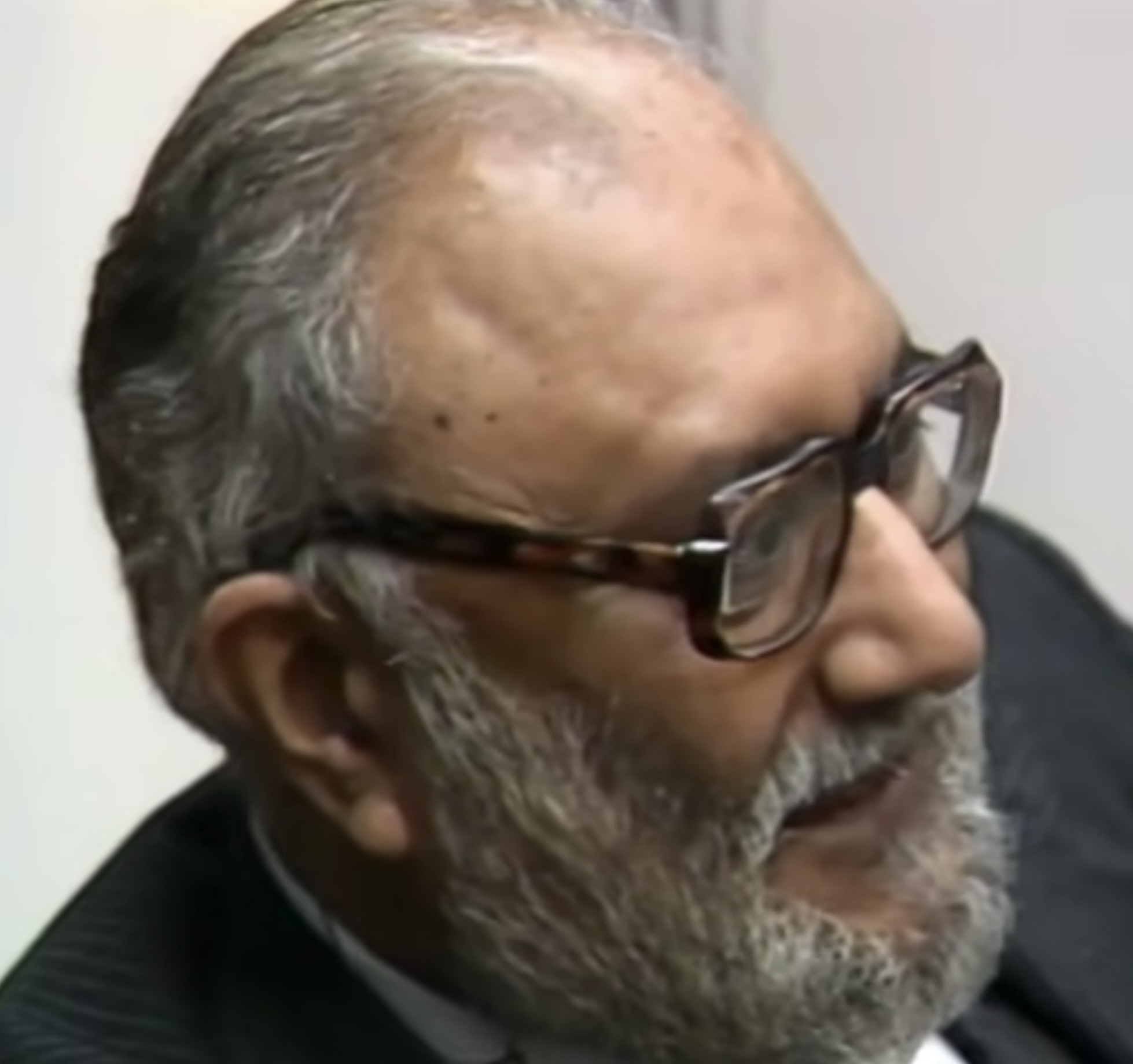
Salam: Paul Dirac? You’re one of the students of Dirac?
Sciama: Yes, whom we are remembering at these times very much.
Salam: Good heavens! What did you do with him?
Sciama: Well, you may well ask. I started research in a different part of physics, and in the middle I changed to relativity in Cambridge. And so they hurriedly gave me Dirac as a supervisor to make up for this rather strange way of life.
Salam: In 1949! I started research in 1949, too.
Sciama: Well, I got my PhD in 1953, and I changed in about 1951. Dirac became my supervisor.
But since I’d worked out my cosmological theory…
Salam: What did Dirac give you as a problem?
Sciama: You see, I’d worked on a problem and told the authorities that I’d changed from statistical mechanics, and they were a bit cross with me about that, and they said, well, we can’t keep you with your old supervisor. And there weren’t many people in relativity in Cambridge at that time, and so they gave me Dirac. But I’d already worked out my theory, you see. It was no fault of his, and he didn’t neglect me or anything. He had no opportunity to look after me, but officially he was my supervisor. And I saw him a few times and got to know him.
Salam: And were you working on the famous Sciama–Kibble something?
Sciama: No, no, no. It wasn’t the stuff on torsion. It was before that. It was about things that had to do with [Ernst] Mach’s principle.
Salam: Hmm! How often did you see Dirac altogether?
Sciama: Oh, four or five times, I suppose. You know my favourite Dirac story? I go up to him once and I say, “Professor Dirac, I’ve just thought of a way of relating the formation of stars to cosmological things. Not galaxies, stars. Shall I tell you about it?” And he said, “no”. So I loved that. [All in loud laughter]
Salam: And then what happened?
Sciama: So I went away, and two days later I realized it was absolute rubbish. But I’m not answering your question. The thing is, the new deal in astrophysics really began in 1952 with the idea that the radio noise from the galaxy was due to synchrotron radiation, that is, relativistic electrons moving in the interstellar magnetic field. Once we understood that, we could understand that one could observe radio sources radiating in the same way from objects much more distant than could be seen by optical telescopes. So when people like Martin Ryle started mapping out the radio sources, some of them were found to be quasars and so on. At the time it was clear that one could see objects in the radio spectrum that would be too far away to be visible optically, and so you could survey the universe out to much greater distances than before.
Salam: So you call this the revolution of the radio sources mapping?
Sciama: Beginning to understand radio sources was the beginning, and then quasars emerged after that, and…
Salam: Quasars are still not understood.
Sciama: No, but it’s an example of the revolution, I mean.
Salam: No, but that’s…
Sciama: Oh, we now understand them, I think.
Salam: In what way?
Sciama: Well, we work on it here very strongly, in fact, that it’s… 
Salam: Black holes.
Sciama: Accretion disk around black holes. It’s not proven yet, but it’s very likely to be correct.
Salam: Well, that’s likely, but anyway, that’s not going to be a revolution, I’m thinking.
Sciama: Well, you say that now, but not only black holes… I can remember a time when even a neutron star was considered not such a respectful thing.
Budinich: Well, gentlemen, I think that we are practically at the end of the allotted time. We have to thank all of you for being so kind.
Salam: It was an amazing and a serious discussion. Thank you all!\blacksquare
Footnotes
- https://www.youtube.com/watch?v=AmUI2qf9uyo. ↩
- ICTP Distinguished Conversation: Edward Witten. https://www.youtube.com/watch?v=PZ_qnBwSejE. ↩