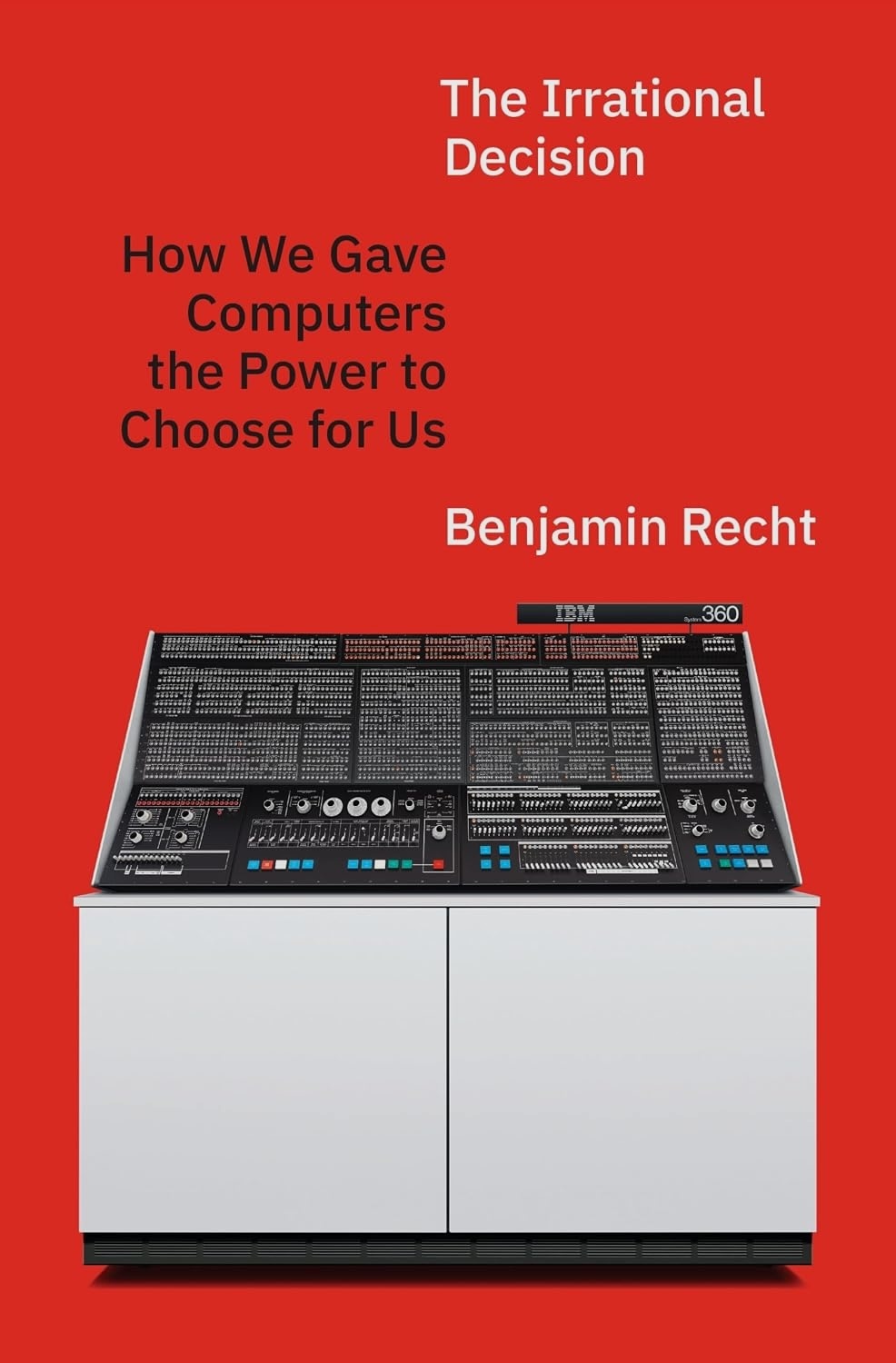
Publisher: Princeton University Press
ISBN: 978-0691272443
The recent turmoil caused by AI in mathematics has forced us to make quick yet rational decisions to preserve the future of human mathematics, while being mindful that any decision will have irreversible, long-term consequences for mathematics education and research. If we must learn from our past at this difficult juncture, there is no better case study than The Irrational Decision: How We Gave Computers the Power to Choose for Us by Benjamin Recht.
Mathematics as a human endeavour starts with the birth of an abstract idea and an often solitary quest. As the idea lives on and interacts with more people and disciplines, its evolution gets naturally intertwined with human progress. Scientific or technological progress and the people driving it can strangely both widen and constrain the future of an idea and its evolution. Benjamin Recht’s book The Irrational Decision presents an evolutionary narrative of human rationality from the viewpoint of an applied mathematician. It attempts to reconstruct the evolutionary history or `phylomemy’1 of human rationality through important historical events in mathematics, science and technology. Popular books on mathematics such as Birth of a Theorem by Villani (2015) or Chasing a Conjecture by Khare (2025) reconstruct the history of a mathematical result through the personal journey of a mathematician and their interactions. When it comes to evolution of ideas, this canvas expands from a personal journey to a social journey, with a vast, multi-disciplinary backdrop. The Irrational Decision by Recht is one such book, exceptionally daring in its scope.
“Mathematics as a human endeavour starts with the birth of an abstract idea
The main thesis of Recht’s book is how historical events fuelled by the information technology revolution played a decisive role in shaping our idea of rationality. They helped rational decision-making to be effectively quantified, algorithmized, and automated, yet at the same time, allowed it to diverge from the human (and humane) aspects of rationality to leave us with irreversible and unforeseen consequences. Tracing the logical dependency of mathematical foundations and the chronology of historical events surrounding them, Recht argues that the advent of information technology and computers dictated the course we have taken to define rationality. However, the irreversible choices we made along the way have caused many harms seen in the present and the future of information technology and artificial intelligence, when critical decisions are delegated from humans to machines. That even the most rational consensus at each intermediate step can eventually converge to an evidently irrational limit, should not come as a complete surprise to a mathematical mind.
Recht’s book attempts to reconstruct the evolutionary history or `phylomemy’ of human rationality through important historical events
A comparison of available alternatives is important for humans to reason and make rational decisions. In the scientific method, a quantitative measurement of outcomes from experimental data enables us to compare our choices of available alternatives and pick the best among them. When the experimental data and the available alternatives become overwhelming, it is not humanly possible to do an exhaustive comparison. Interestingly, the etymological root of `rational’ is the Latin word `ratio’ that stands for both `logical reason’ as well as `calculation’. As we read the first two chapters, we realize how the latter meaning led to a probabilistic interpretation of rationality based on experimental outcomes. When the calculations became overwhelming, we sought the predictive abilities of superhuman calculation machines using a vast amount of data.
The breadth of topics and disciplines covered in Recht’s book is breathtaking. It includes everything from mathematical optimization, hardware design, economics, public policy, natural language processing, psychology, physiology and medicine. Most importantly, Recht connects these topics seamlessly to remind the reader that any research topic or direction does not evolve in isolation. He starts with the familiar example of Dantzig’s work on linear optimization and how it influenced real-world public policy decisions by economists and nutritionists. In another example using the backdrop of the technological advances in computing that needed real-world success stories, we see how the technology tipped the scale in favour of computationally intensive approaches over the others that required laborious human fieldwork and deep intuition. The book enlightens readers about how optimization techniques improved chip design that in turn made optimization faster and more efficient, forming a virtuous cycle and symbiotic relationship between hardware design and mathematical optimization.
The examples and expositions in the book are extremely accessible to the layperson. Anyone who has been through the Covid pandemic would instantly relate to the stories of antibiotics and vaccine trials.Treatment decisions for ourselves and our loved ones in critical illness require complicated comparisons of medical treatments, where randomized controlled trials (RCTs) provide data-based insights. However, translating population-level statistics into decisions for individual patients is not easy, which requires the knowledge of medical history, socio-economic background, and above all, human empathy. Walking through several examples, the book explains statistical problems in RCTs and A/B tests about sample size, selection criteria, statistical significance of experimental observations in a way that is rigorous yet accessible. It gives a balanced view of the mathematical, scientific, technological progress made thus far and its blind spots yet to be addressed.
For a book written from an applied mathematician’s perspective, it unfortunately falls short in a few places on account of insufficient mathematical details or missing explanations. A small detour into discussion of local optimization techniques (Chapter 2) is extremely relevant today but appears out of place in the flow. The book mentions gradient descent, conjugate gradient, Broyden-Fletcher-Goldfarb-Shanno method etc., (page 49) in a single breath without any mathematical details or explanations, only hinting at their profound influence on today’s model training and reinforcement learning. Other reviews too have remarked on its limited mathematical content beyond simple examples or figures.2 Social choice theory is another important topic related to human preferences for model alignment that is not sufficiently discussed in the book.
Recht argues that the advent of information technology and computers dictated the course we have taken to define rationality
The Irrational Decision contains many hidden gems in terms of retrospective, meditative observations. For example, on page 100 in its interlude to game theory, “Game theory works when it is a prescriptive model of behavior, not a descriptive one.’’ Prescient observations can often be seen in a new light as science, technology and society advance further. In the current era of large language models, the book emphasizes an observation made by Shannon in 1940–50s that about 85% of written English is redundant and we should model it as the next character, word or token prediction problem, using conditional entropy to evaluate the quality of approximation! There is a great value in revisiting the history of machine learning, how perceptron and optical character recognition eventually made it possible to train neural network models on large training data, when the technology became ripe.
If instinctive human decisions can be captured precisely using data alone, then automation can outperform humans, as it is not limited by fatigue or access to knowledge or even a long chain of logical reasoning. A long line of work in psychology and behavioural economics by Paul Meehl, Daniel Kahneman, Richard Thaler and others has shown that humans are (as Dan Ariely calls) `predictably irrational’. Unlike the extremely aggressive views we see from technologists and social scientists in today’s debate about AI, Recht’s book brings us to an introspective question of whether it makes sense to organize our society and our actions based on the paradigm of rationality.
There is a need to write more about the social history of mathematical ideas
Recht describes the phylomemy of `How We Gave Computers the Power to Choose for Us?’ but rightfully refrains from giving a silver bullet to answer where we go from here. Even unlimited computational power and data do not seem capable of resolving fundamental human conflicts about politics, values, faiths. Recht proposes a pragmatic, introspective, more expansive approach to rational decision making that should leverage computational tools yet needs to be firmly rooted in human intuition, morality, and judgement.
In conclusion, it is a timely and thought-provoking book that will generate more interest in the evolutionary history of mathematical ideas and the social history of human mathematics. With the current onslaught of AI, it is important to remind ourselves and the future generations that human mathematics has a quintessential social aspect. Our mathematics, starting from primary school arithmetic to advanced algorithms, is the culmination of long journeys and cultural exchanges across cultures, continents, centuries. There is a need to write more about the social history of mathematical ideas and their phylomemy, e.g., another recent example: https://arxiv.org/abs/2412.05250. I wish this develops into a genre of mathematical literature in itself and continues to delight readers and inspire future generations.blacksquare
Footnotes
- Just as `phylogeny’ denotes the evolutionary history of an organism, `phylomemy’ denotes the evolutionary history of an idea, highlighting its adaptation to external factors such as social acceptance, technological advances, world events etc.. ↩
- e.g., review of this book by Adhemar Bultheel, https://maa.org/book-reviews/the-irrational-decision-how-we-gave-computers-the-power-to-choose-for-us/. ↩