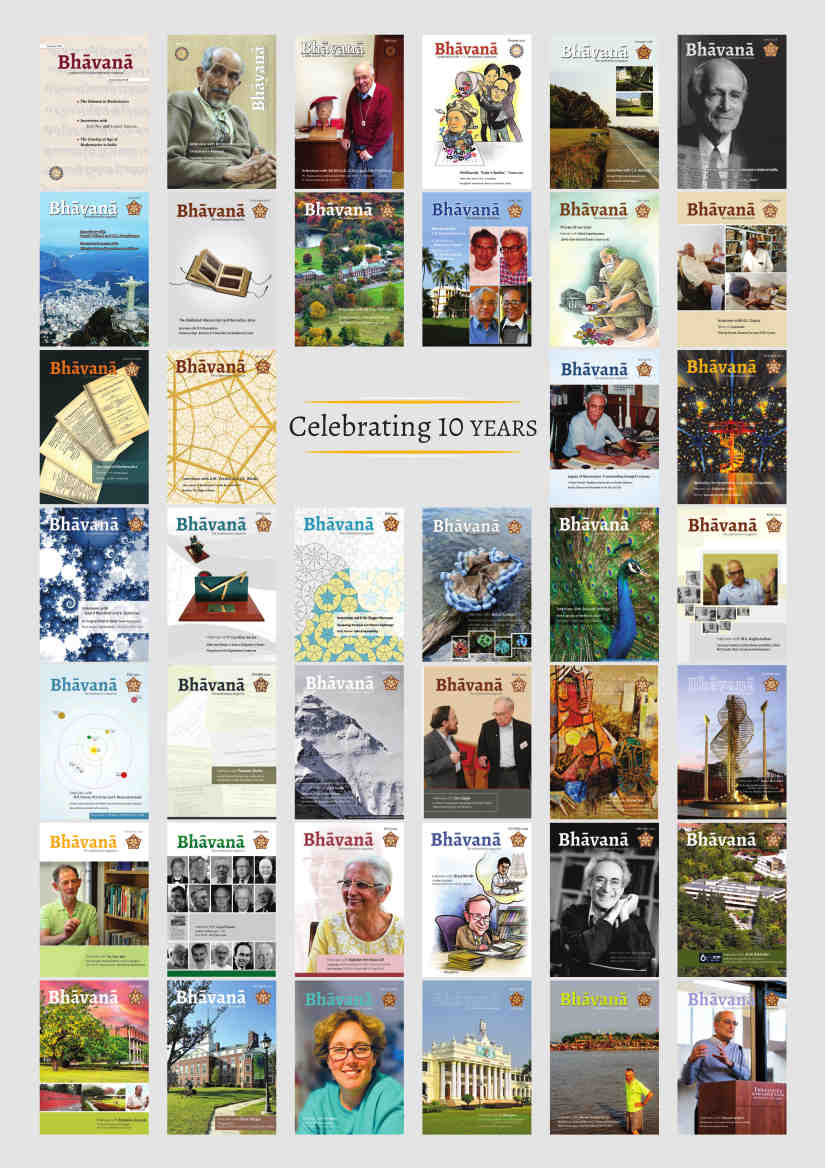
The front cover shows the interviewee of this tenth-anniversary edition of Bhāvanā, Edward Witten, speaking at the IAS, where he has been a permanent member for close to four decades and to which his centenarian father introduced him as a baby 75 years ago. The back cover celebrates the ten-year journey of Bhāvanā, putting together, in order, the front covers of all 40 issues published in the past ten years.
This celebration, however, is not without its touch of sadness. The team lost one of our most dedicated, gentle and soft-spoken colleagues, Aniruddha Naolekar, who was a corresponding editor, and his wife Anita Naolekar on August 20. They are both deeply missed by their surviving family, friends, the Bhāvanā team and a large student community.
 Mathematics is more than the dry textbook exercises students at various levels in India, beginning from school, are made to solve. What is missing in high school and college curricula is the excitement of mathematical research. Students, and the public, interested in mathematics, who wish to read something other than jargon-filled academic material, have nowhere to turn to. Whereas other countries have long had mathematics publications that serve the curious, the interested, and the cognoscenti, Bhāvanā is the first such initiative in India.
Bhāvanā is also the flagship publication of The Indian Mathematics Consortium, or TIMC, and an integral part of TIMC’s goal of bringing the various mathematical societies in India, working towards a common goal, under an overarching umbrella organization. This spirit and vision, we believe, is reflected in the articles in this inaugural issue of Bhāvanā. And the underlying theme of this issue is Srinivasa Ramanujan.
Of the many works on Ramanujan, none is better-known than The Man Who Knew Infinity by Robert Kanigel. It has been translated into more than a dozen, including seven Indian, languages and inspired the recent Hollywood movie of the same title. It also inspired us to talk to Kanigel about his book and the movie.
One of the associate producers of the movie, and its mathematics consultant, was the mathematician Ken Ono. In his recently published autobiography My Search for Ramanujan: How I Learned to Count, Ono recounts how both he and his father, Takashi Ono, have been inspired at crucial points in their lives by Ramanujan. For Ken Ono, Ramanujan has been a guiding influence in his mathematical work too. We talked to him to find out more.
There are many stories about Ramanujan’s powerful intuition, and the deep inspiration provided by his work is very much alive in contemporary research, as Ono’s work shows. But Ramanujan’s presence is felt in unexpected places too. One such thread is the subject of the article “Ramanujan: The Patron Saint of \pi Explorers’’. Another story, appearing in Kanigel’s book, is about an intriguing puzzle that appeared in the December 1914 issue of The Strand Magazine, a popular general magazine in early twentieth century Britain. Ramanujan solved this puzzle using continued fractions, an elegant mathematical tool. This tale, and a solution that uses continued fractions, appears in the article “Timeless Geniuses, Celestial Clocks and Continued Fractions’’.
Such expository articles about exciting and intriguing mathematics, written in a manner accessible to undergraduate or motivated high school students, will be a feature of Bhāvanā. In this, we will draw inspiration from tomes such as The Princeton Companion to Mathematics. As Amritanshu Prasad writes in his review, this book makes a vast body of state-of-the-art mathematical knowledge accessible to a college student interested in mathematics.
In mathematics one proof would perhaps suffice, but we historians prefer to have at least ten proofs
We must remember, however, that there was more to Indian mathematics in the twentieth century than Ramanujan, as the late Raghavan Narasimhan tells us in the article “The Coming of Age of Mathematics in India”, reprinted in Bhāvanā with kind permission from Springer. We will, in future issues, elaborate on some of the leads suggested by this article.
Now, if you’re wondering why this magazine is called Bhāvanā, turn to the article “The Bhāvanā in Mathematics’’. Amartya Kumar Dutta explains the mathematical significance of the word Bhāvanā, a composition law enunciated by Brahmagupta. This article also connects Bhāvanā with a celebrated work of Manjul Bhargava, who was awarded the Fields Medal in 2014.
 Writing on historical aspects, and bringing in new insights, is a delicate path to tread. Even a well-informed mathematician may find writing original mathematical findings an easier task. A story from the life of the Russian mathematician Andrei Kolmogorov would be appropriate to recall in this context. While studying at Moscow University, Kolmogorov was interested in mathematics as well as Russian history. When he presented his first piece of research on Russian history, his teacher is said to have told him: “You have supplied one proof of your thesis, and in the mathematics that you study this would perhaps suffice, but we historians prefer to have at least ten proofs.” This anecdote, notes the obituary1 of Kolmogorov in which this story is recounted, “is usually told as a joke, but to those who know something of the limitations of such archives it will seem a fair comment.”
We do hope, however, that one issue of Bhāvanā will be enough to convince you to keep reading it.
We are excited to place this inaugural issue before you, an effort that has been in the works since August 2015. We are grateful to reviewers from across the world, whose time and expertise we have drawn on. Apart from the print copy you hold in your hands, Bhāvanā is freely available online as well, at https://bhavana.org.in. Please do tell us your impressions by e-mailing us at editor@bhavana.org.in. We welcome your contributions to Bhāvanā, whether as a writer, reviewer, or reader with valuable feedback.
Talking about feedback, let us leave you with a small exercise—after all, what is appreciating mathematics from close without actually engaging with it? The exercise: 2016 is a triangular number. Find the corresponding basic number n. \blacksquare
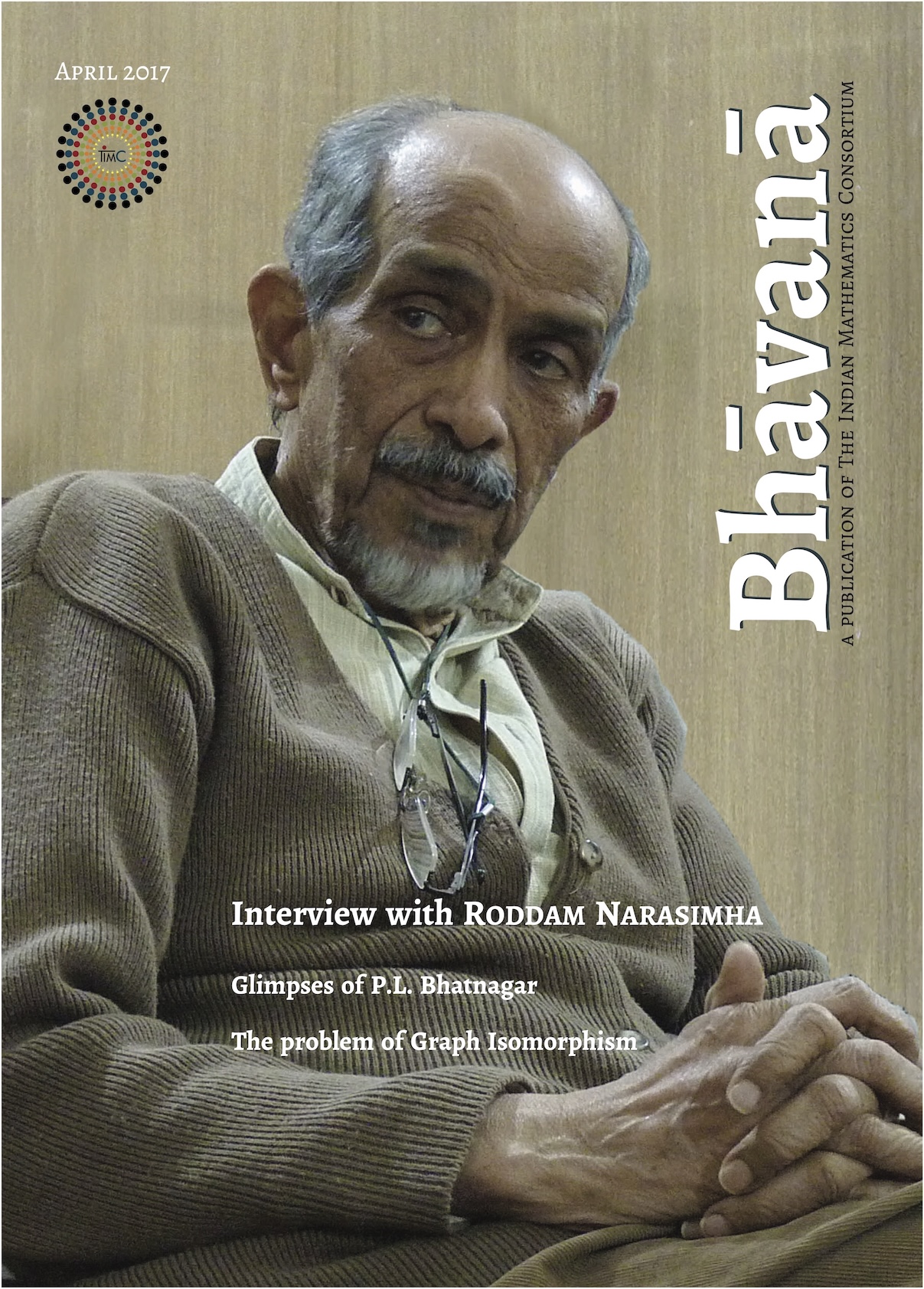 We are happy to bring to you the second issue of Bhāvanā. The articles in this issue weave along the threads of stories begun in the inaugural issue while also starting new ones. We credit much of our enthusiasm for this issue to the warm reception Bhāvanā received at its official release at the meeting of TIMC in cooperation with AMS held during 14–17 December 2016 at BHU, Varanasi. The four-day conference saw over five hundred delegates who attended workshops that covered a wide range of topics.
The conference also featured screening of the Hollywood movie The Man Who Knew Infinity, based on Robert Kanigel’s celebrated biography of Srinivasa Ramanujan. Around the time of the release of this movie in April 2016, Ken Ono released his autobiography titled My Search for Ramanujan. The book, which details the deep imprint that Ramanujan’s life story left on Ono, is reviewed by Amanda Folsom in this issue.
It was on the way to the TIMC–AMS meeting that the rest of the April 2017 issue was born. We had perhaps the most fitting company for a journey through the air—aerospace scientist Roddam Narasimha. Our conversations with him ranged from the mysteries of cloud formation and the Navier–Stokes equations to the history of Indian and Western science, with light-hearted doses of Richard Feynman anecdotes from his graduate student days at Caltech in the early 1950s. Our biographical interview of Narasimha is the first of a two-part conversation that chronicles his early life and some of his wide-ranging interests in science and history.
“The Tangled History of the String Equation” was contributed by Vasudeva Murthy and his student Pratik Suchde. Vasudeva Murthy completed his Ph.D. at the Indian Institute of Science (IISc) under Narasimha’s supervision. This article, through extensive bibliographic research, explores the somewhat arbitrary manner in which different streams of academic literature attribute credit to either Gustav Kirchhoff, George Carrier or Narasimha for an equation that models the vibration of a stretched string. A story that emerges through this article is one of how Narasimha, otherwise trained as a fluid dynamicist, was drawn to understanding the motion of vibrating strings.
The mathematics department at IISc was founded by P.L. Bhatnagar, as highlighted in the article “The Coming of Age of Mathematics in India” in our January 2017 issue. In this issue, “Glimpses of P.L. Bhatnagar”, authored by Phoolan Prasad, expands on the life of Bhatnagar. This article is equal parts historical and expository as it highlights Bhatnagar’s leadership in the various institutions he founded and also explains the intuition behind the Bhatnagar-Gross-Krook
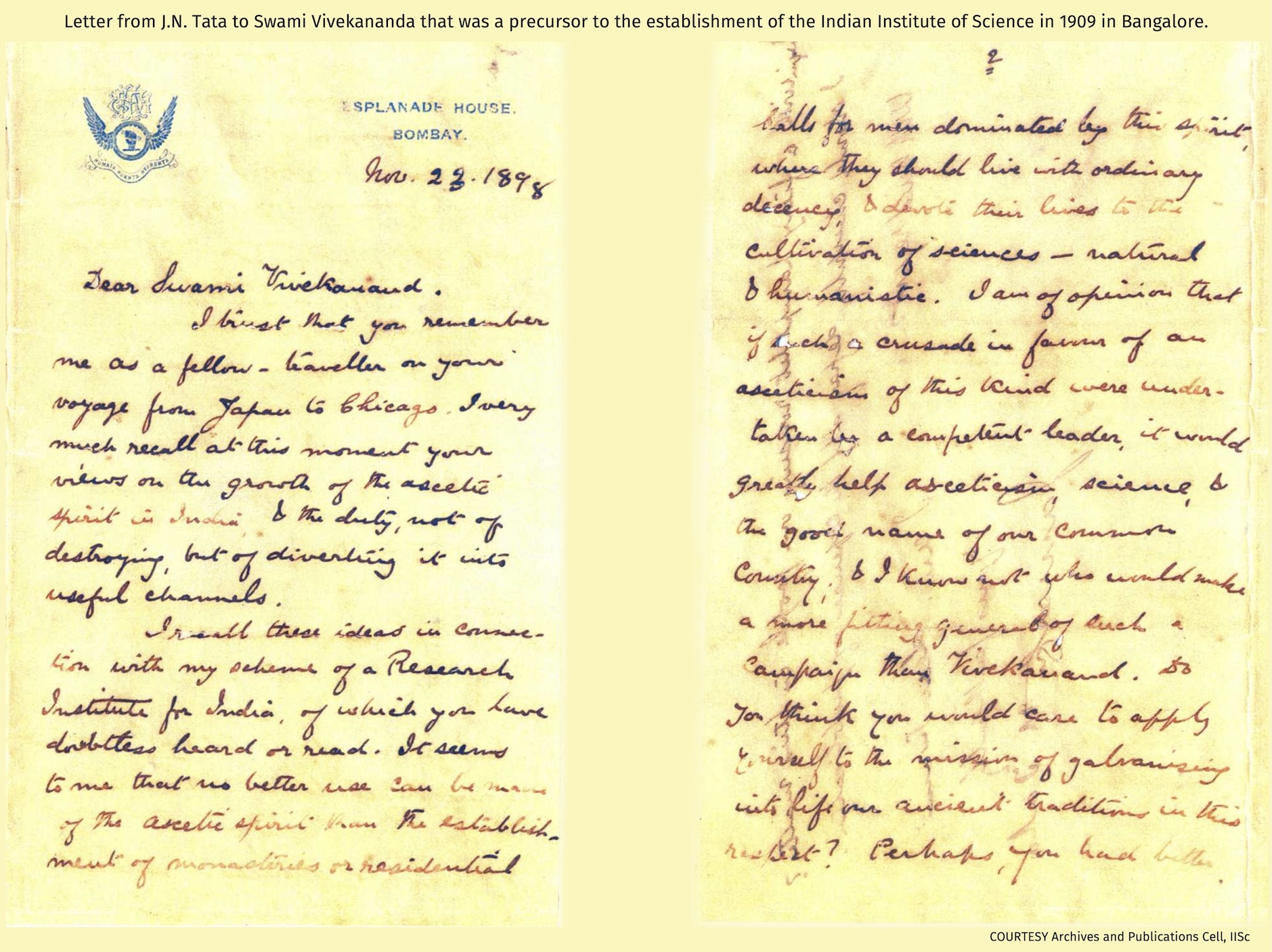
model, which is one of his most well-known contributions in applied mathematics. IISc, the stage for much of Narasimha’s life and research, and a part of Bhatnagar’s, being one of the threads that runs through this issue of Bhāvanā, the back cover features a photo (circa 1968) of one of the wind tunnels inside its campus. The idea of setting up this institution, which officially began functioning from 1909, traces its origin to a conversation between Jamsetji Nusserwanji Tata and Swami Vivekananda during a chance meeting on their journey by ship from Japan to Chicago. We are indebted to the Archives and Publication Cell of IISc for permission to reproduce both the photo of the wind tunnel and this letter that Tata wrote to Swamiji outlining his grand vision.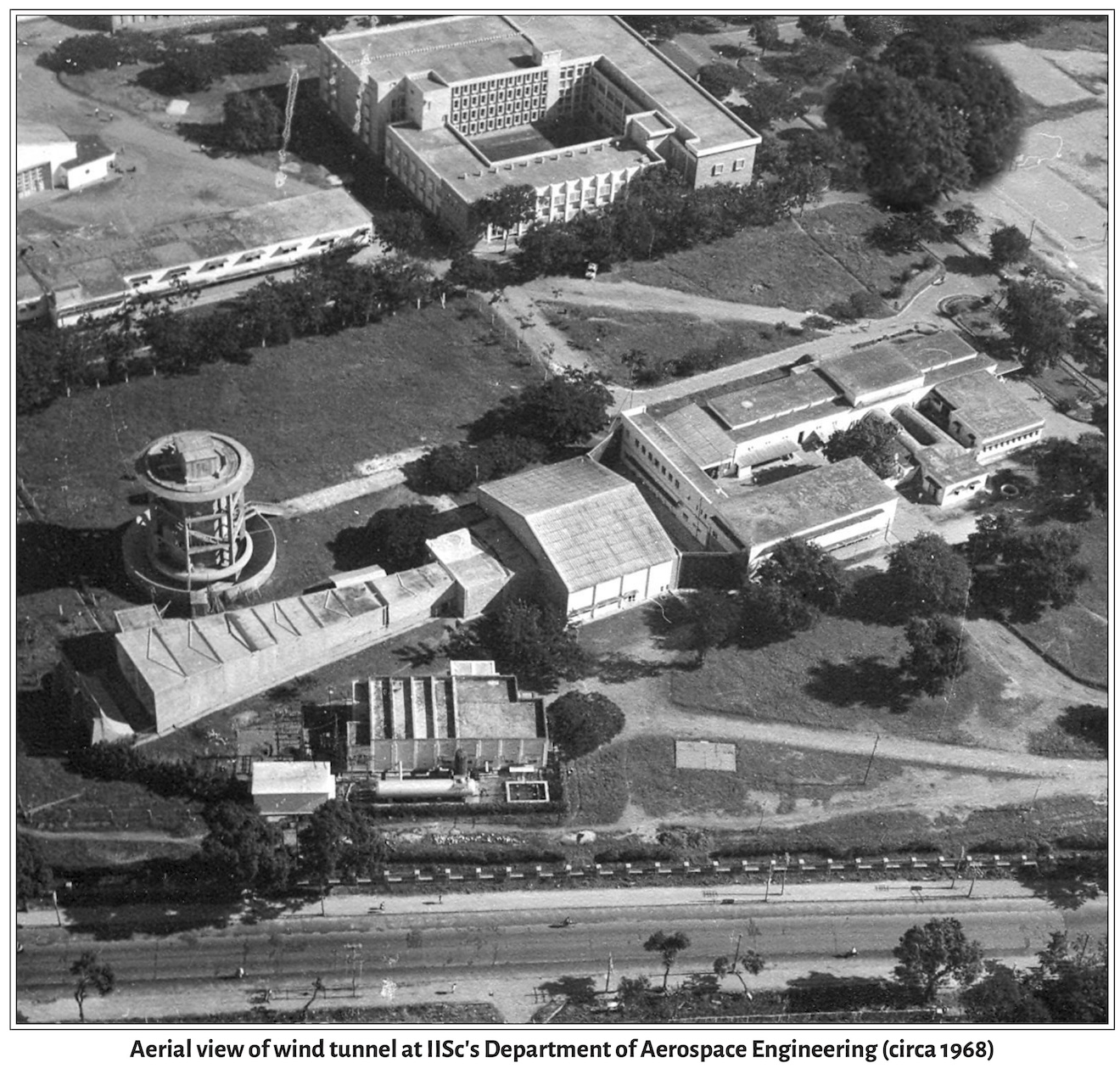
The months leading up to 2017 also saw a set of events unfolding in the world of computer science that neatly summarized the agony and ecstasy of proving a major result in mathematics. A proof that estimated the running time of an algorithm that checked if two graphs are isomorphic, which took the author nearly thirty years to develop, was shown to be flawed. The proof has since been corrected but it remains under review. The article “Two Steps Forward, One Step Back”, contributed by Sourav Chakraborty, documents this saga and explains the difficulties of designing efficient algorithms to determine if two graphs are isomorphic. In forthcoming issues of Bhāvanā, we will endeavour to carry more such articles about ideas and results in any discipline that uses mathematics as a language. \blacksquare
 In this third issue of Bhāvanā we present you a wide canvas of mathematical ideas, its talented practitioners, and a compelling story of a venerable academic institution which, through its many significant contributions, has made India proud.
In our April 2017 issue, Amanda Folsom poignantly touched upon the “finite nature of life” while reviewing Ken Ono’s book My Search for Ramanujan, when she noted the demise of the book’s co-author, Amir Aczel, before the book appeared in print.
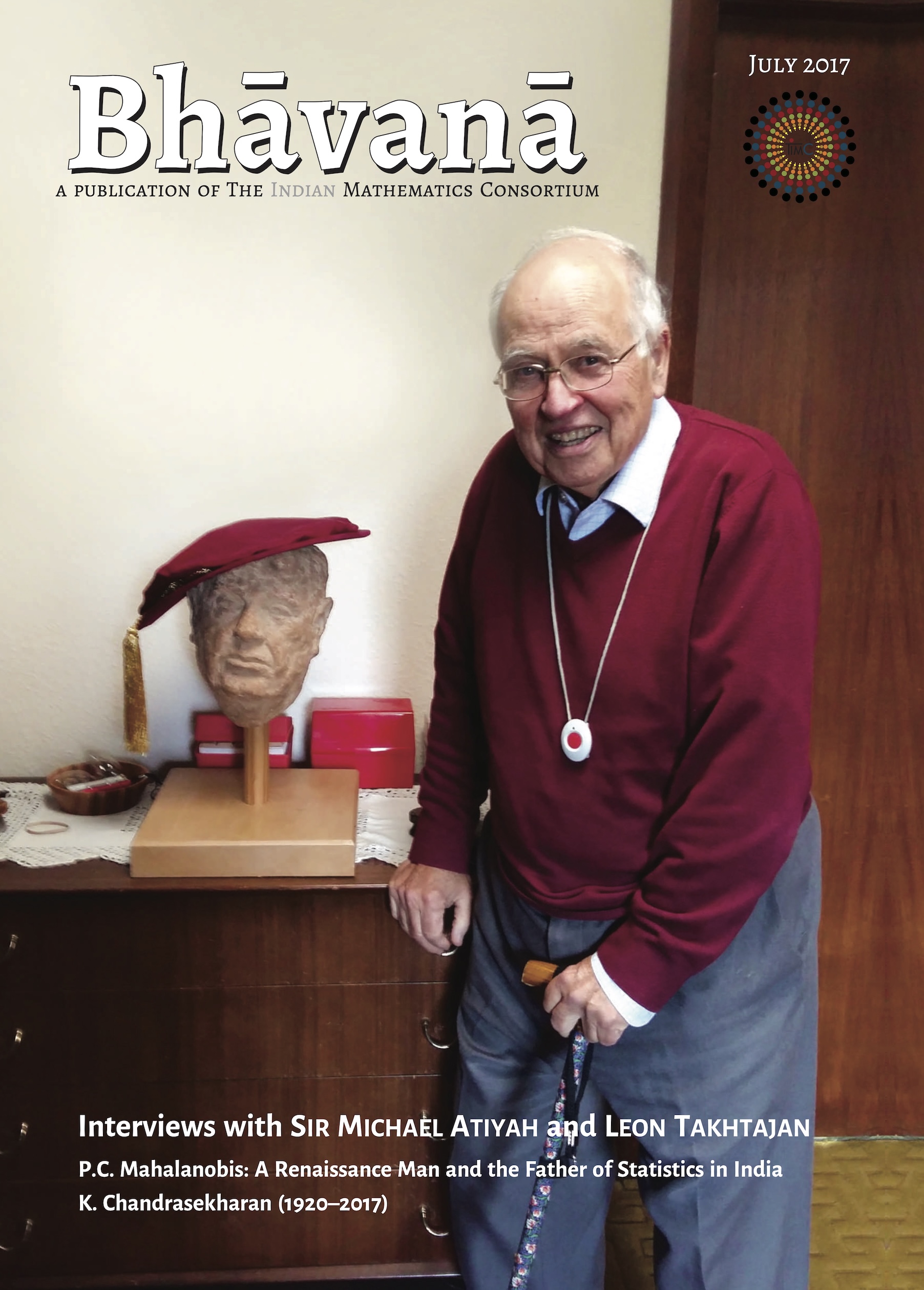
This stark reality has confronted the mathematics community more intensely these past few months, with a series of losses—Marina Ratner and Marjorie Rice in July, K. Chandrasekharan in April, and Ludwig Faddeev in February. The immensely tragic death, at the young age of 40, of Maryam Mirzakhani, the first ever woman mathematician to win the Fields Medal in 2014, is difficult to fathom. Her deep mathematical insights led her to achieve much in her short meteoric life.
The moving sentiments expressed in obituaries on these men and women in several forums all display a human appreciation of their contributions to the eternally growing body of mathematical knowledge. This issue of Bhāvanā carries an obituary of K. Chandrasekharan, popularly known as KC, by one of his celebrated students, C.S. Seshadri. KC represented a unique blend of mathematical prowess and extraordinary organizational skills. He played a crucial role in the coming of age of the School of Mathematics at TIFR in Mumbai, and donned several responsibilities at the International Mathematical Union with elan, including a stint on the 1958 Fields Medal Committee.
The interview with Leon Takhtajan, who was a Ph.D. student of Faddeev, touches upon the significant contributions of both Faddeev and the continuing tradition of mathematical physics represented by both Takhtajan and Faddeev. Team Bhāvanā spoke with Takhtajan during his recent visit to the International Centre for Theoretical Sciences, Bengaluru, on his life and his work on a mathematical approach that is widely known as the quantum inverse scattering method. Pioneered by his Ph.D. advisor Faddeev, this has been a major topic of study for the last four decades or so, and has been able to solve a whole swathe of physical problems, ranging from spinning tops and quantum spin chains to water waves and higher dimensional strings. Faddeev passed away just weeks after our conversation, and this article is dedicated to him.
Michael Atiyah talks about two Indian mathematicians he came to closely interact with – Harish-Chandra and Vijay Kumar Patodi
Carrying on another lasting tradition of mathematical thought, we carry a delightful conversation with Sir Michael Atiyah at his home in Edinburgh, Scotland. In a free-wheeling discussion that represents his wide interests, he eloquently shares his thoughts about those who continue to inspire him, particularly Hermann Weyl, and the conflicts and links between truth and beauty in mathematics. Atiyah represents a long line of work at Edinburgh, that stretches via his Ph.D. advisor W.V.D. Hodge all the way back to James Clerk Maxwell. He also talks about two Indian mathematicians he came to closely interact with, Harish-Chandra and Vijay Kumar Patodi. Of interest to keen students would be Atiyah’s views on the pathbreaking work of Patodi.
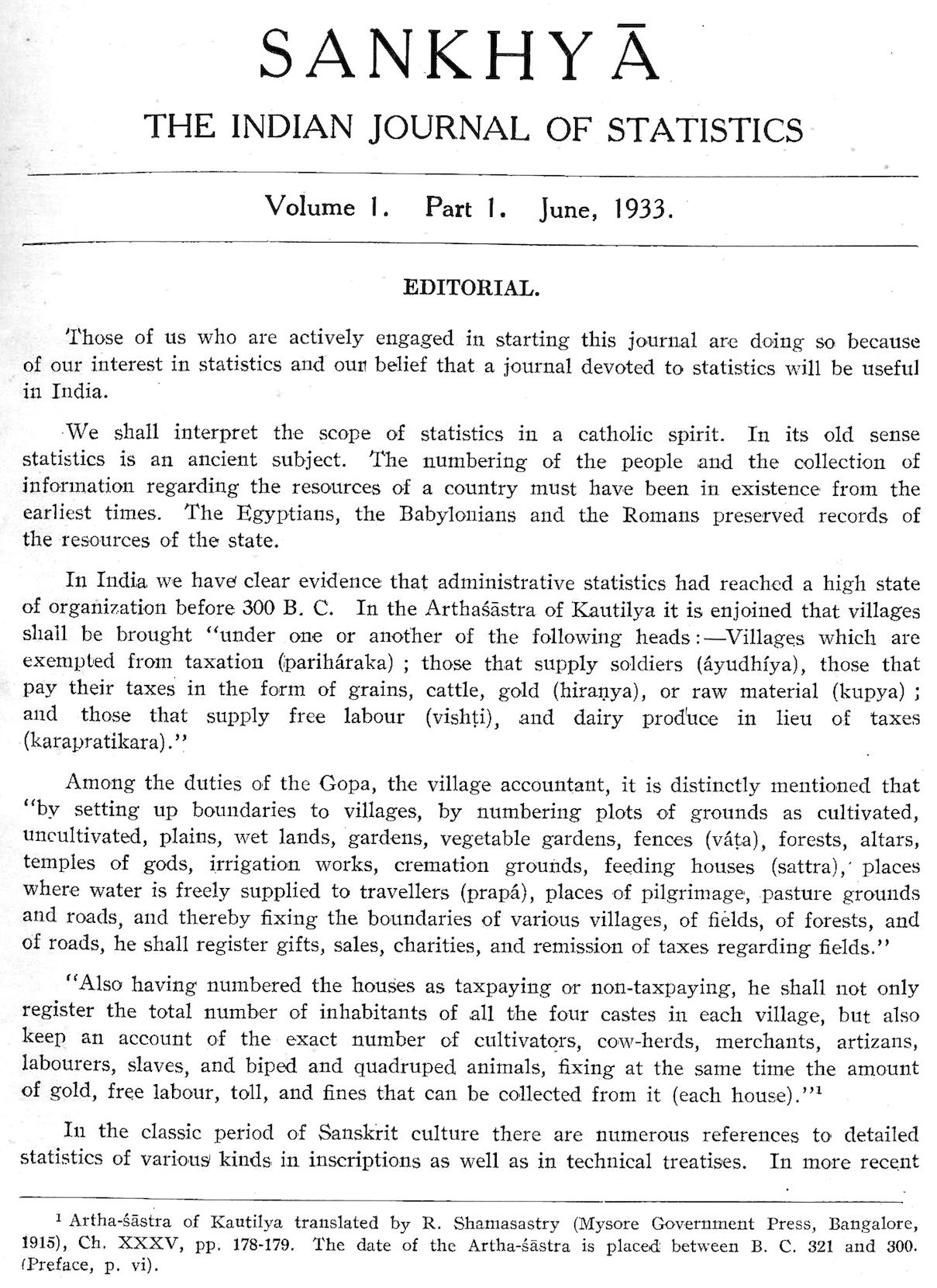
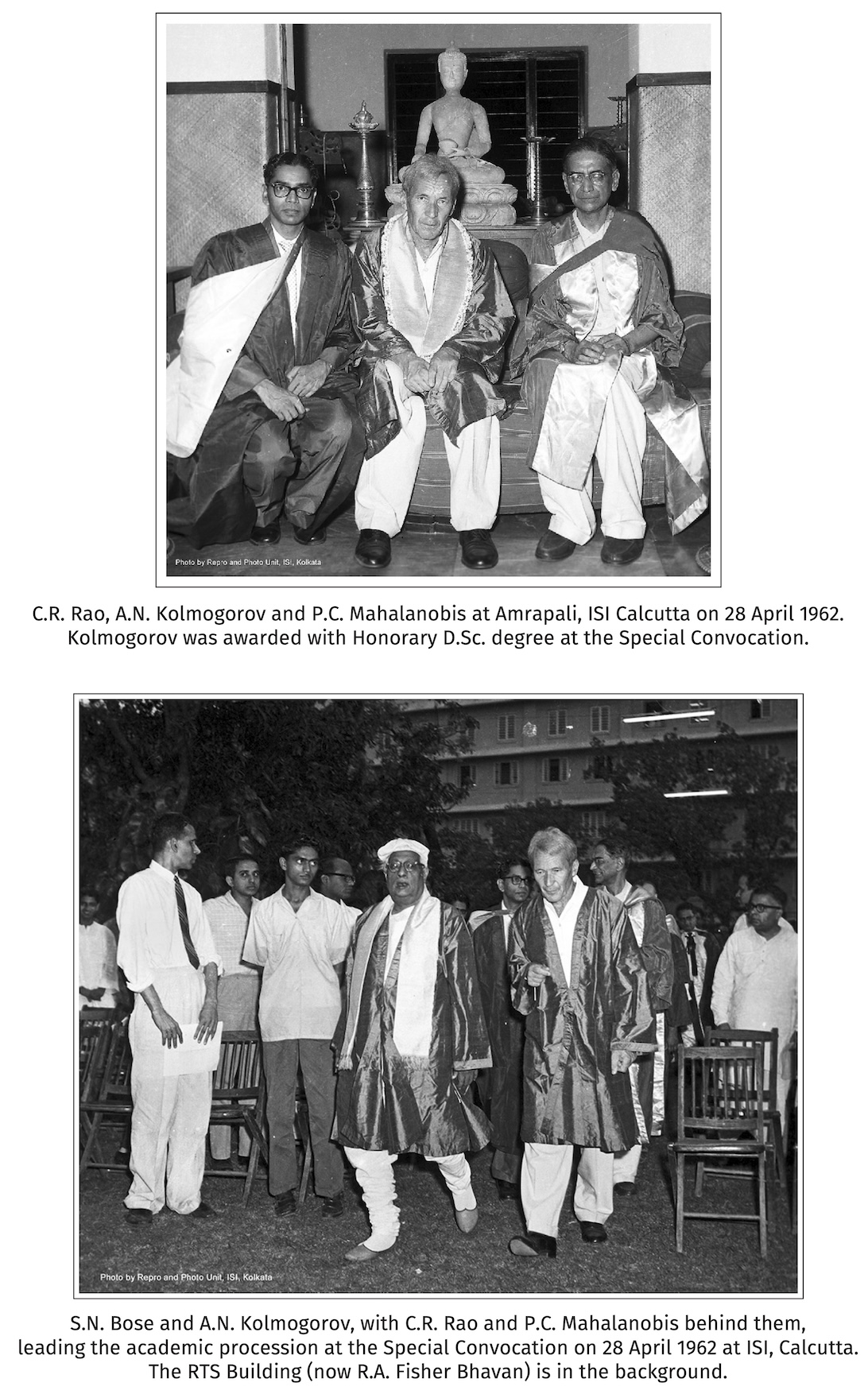 The life and times of P.C. Mahalanobis, the distinguished statistician who founded the Indian Statistical Institute (ISI), is the focus of an article by Anil K. Bera and Chang Lu. As is common in such stories, the early days and the evolution of ISI is inextricably welded with the life of Mahalanobis himself. Educated in Cambridge, and a peer of Ramanujan, Mahalanobis embodied those rare qualities that come so naturally to men who lead, build and leave a lasting legacy behind. The rich legacy of ISI is liberally interspersed by collaborations with, and visits to ISI Kolkata by, legendary figures like A.N. Kolmogorov—and this is captured by two rare photos on the back cover of this issue of Bhāvanā. Among other lasting contributions, his founding \textit{Sankhyā, the Indian Journal of Statistics}, which is now into its 84th year, is testimony to his vision of building a strong tradition of research in India. We present a peek into the mind of this visionary by reprinting, at the end of this issue, the first page of Mahalanobis’ editorial that appeared in the inaugural issue of Sankhyā in 1933.
Talking about publications, this issue of Bhāvanā carries two reviews of the Princeton Companion to Applied Mathematics. Two reviews of the same book in the same issue of any publication would usually be seen as either an editorial faux pas, or as a very unusual anomaly. But the book under review here is also some kind of a rarity in its own right. Like its pure mathematics sibling that was reviewed in the inaugural issue, the Princeton Companion to Applied Mathematics is a thoroughly edited and vetted tome that seeks to achieve an almost Sisyphean task. It is not easy to condense within one book, however large its size maybe, the entire gamut of the universe of applied mathematics. But credit to the authors and editors of this massive endeavour for having achieved this very important task. We have, therefore, Phil Wilson and Krishna Maddaly reviewing certain indicative parts of this mammoth enterprise.
We now invite you to explore the fare we present in this issue. \blacksquare
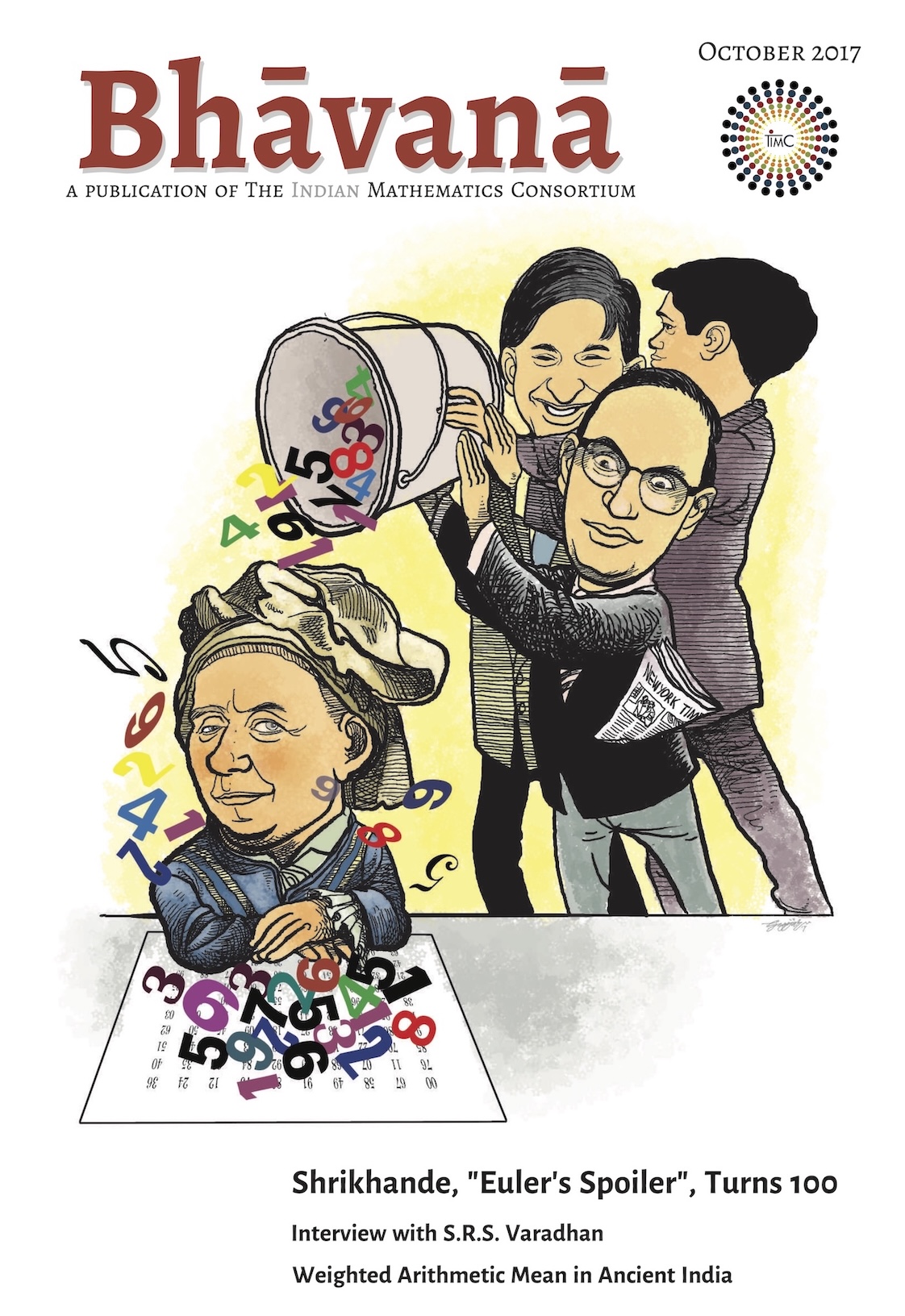
This fourth issue of Bhāvanā marks the culmination of our first year. We have had the good fortune to meet, interview, and write about the work of some of the leading mathematicians India has produced. As we turn an year old, we pay tribute to perhaps India’s oldest living mathematician, S.S. Shrikhande, who celebrated his one hundredth birthday in October 2017. We at Bhāvanā took part in the centenary celebrations of Professor Shrikhande, who has had an enduring influence on the growth of combinatorics and statistics in India. His students, many of whom are distinguished researchers themselves, attest to his role in founding academic departments and creating an open culture where they could work confidently.
Shrikhande is most famous for his work, in 1959, with his guru R.C. Bose and their colleague E.T. Parker in disproving Euler’s conjecture, showing that orthogonal Latin squares corresponding to oddly even numbers (except 6) do exist. The cover page carries a cartoon, by the award-winning artist B.G. Gujjar, of the famed threesome spoiling Euler’s party. And the story of their disproof of Euler’s conjecture is told in a tribute to Shrikhande written by Nithyanand Rao. Along with Shrikhande, there were many other eminent researchers who were, one way or another, associated with the unique institution founded by P.C. Mahalanobis, the Indian Statistical Institute (ISI). In our July issue, we had recounted the story of how ISI was established. In this issue, Mohan Delampady reviews the book Glimpses of India’s Statistical Heritage, which has essays by ten statisticians from India who have made major contributions. Many, like Shrikhande, were from humble backgrounds and overcame many hardships to achieve what they did. Much of the additional context provided in the review is made possible by Delampady’s own experiences at ISI Kolkata as an undergraduate student.
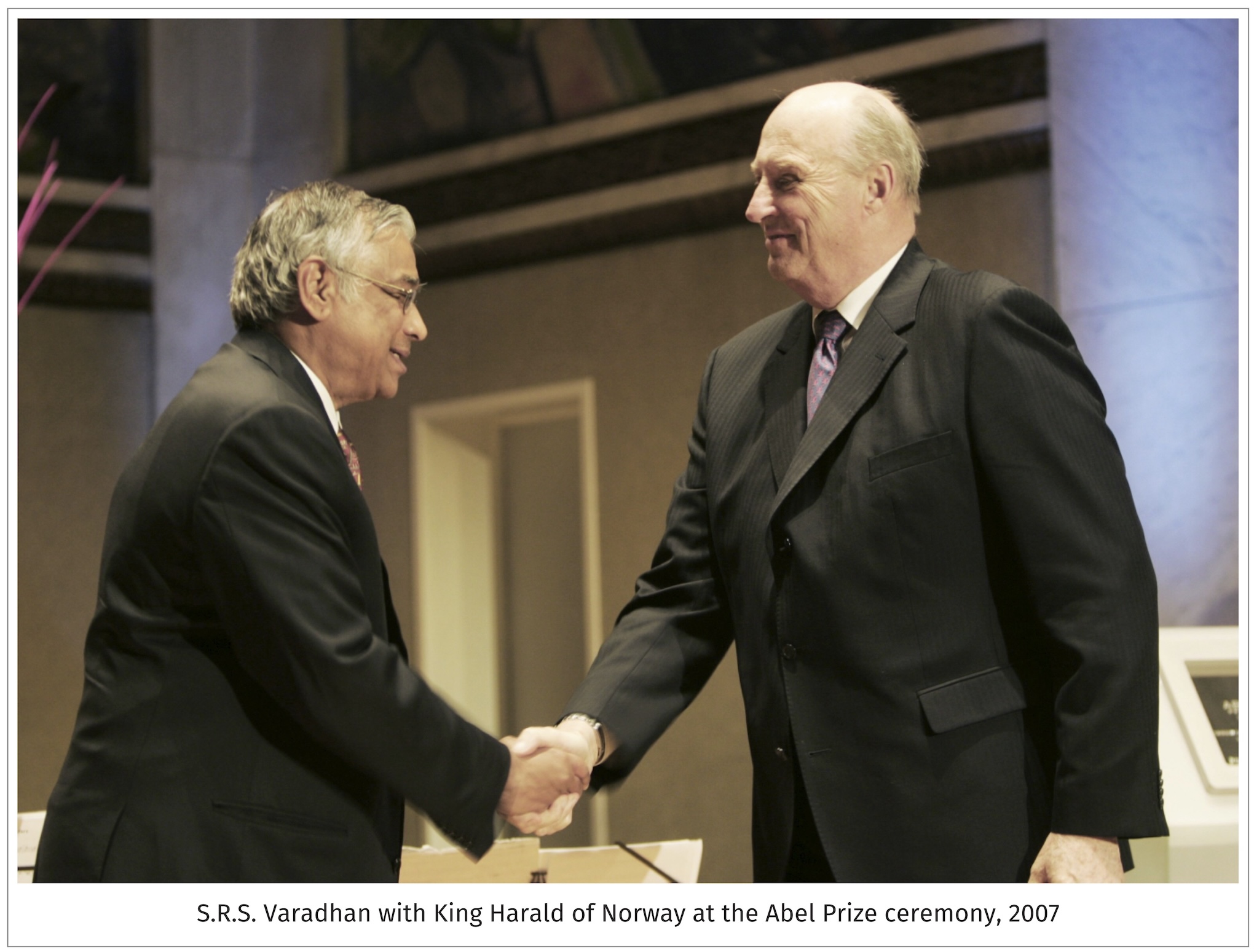
Amongst ISI’s hallowed roster of distinguished alumni is S.R.S. Varadhan. In a conversation that ranges in time from his early school days as a chess-loving bright kid, often to be found playing cricket on the sands of a dried up river bed in Tamil Nadu, to his present exalted status as an Abel laureate, Varadhan shares with us the story of his remarkable journey. Rich in its details on his hugely influential ISI Kolkata days, where the legendary Russian mathematician A.N. Kolmogorov noted Varadhan’s precociousness while examining his Ph.D. thesis, to the camaraderie and friendship he shared with his illustrious peers in the “famous four”, this account is as much a story of Varadhan, as it is of the academic environment as it existed then. Varadhan dwells also on several key concepts, and on personal insights gleaned from five decades of cutting edge research, and it is these rare nuggets from a man who is almost eponymous with the theory of large deviations, that makes this piece a valuable companion to both beginning students and experts alike.
Although statistics as an academic discipline is relatively new, an important statistical concept, the weighted arithmetic mean, is not. The article by Amartya Kumar Dutta on the Weighted Arithmetic Mean traces its roots to a strong tradition in ancient India and brings out an interesting aspect of this concept, namely, that it played a definitive role as a stepping stone towards the invention of calculus in India, sowing the seed of integral calculus. The article is replete with explicit examples illustrated by appropriate Sanskrit verses, some of the important ones illustrated using figures too. It clearly brings out how deep mathematical insights were coded in crisp but often terse verses composed in Sanskrit. One of the remarkable revelations is that the mathematical knowledge so developed was actually used in many practical problems arising in excavations, preparation of alloys and so on.
 The passing away of Marina Ratner in July 2017 was deeply condoled by the mathematical community in India, especially since much of her work had strong connections with the work done at the School of Mathematics of the Tata Institute of Fundamental Research in Mumbai, led primarily by M.S. Raghunathan, and later rigorously carried forward by S.G. Dani. In particular, in the late 1980s, Ratner settled the Raghunathan conjectures concerning orbits of certain flows in Homogeneous Dynamics, called the unipotent flows. A couple of years before her work on this, the resolution by G.A. Margulis of a weaker form of this conjecture helped completely settle a long-standing problem in number theory, namely the Oppenheim conjecture. The obituary article by Dani who personally knew Ratner for nearly four decades is a personal tribute reflecting on her life and placing her work in context. The parts where Dani describes her work on the Raghunathan conjectures serve to add historical value in terms of reflecting on the genesis and formulation of the conjectures, as well as informing a general mathematically aware cognoscenti as to what this work is actually about.\blacksquare
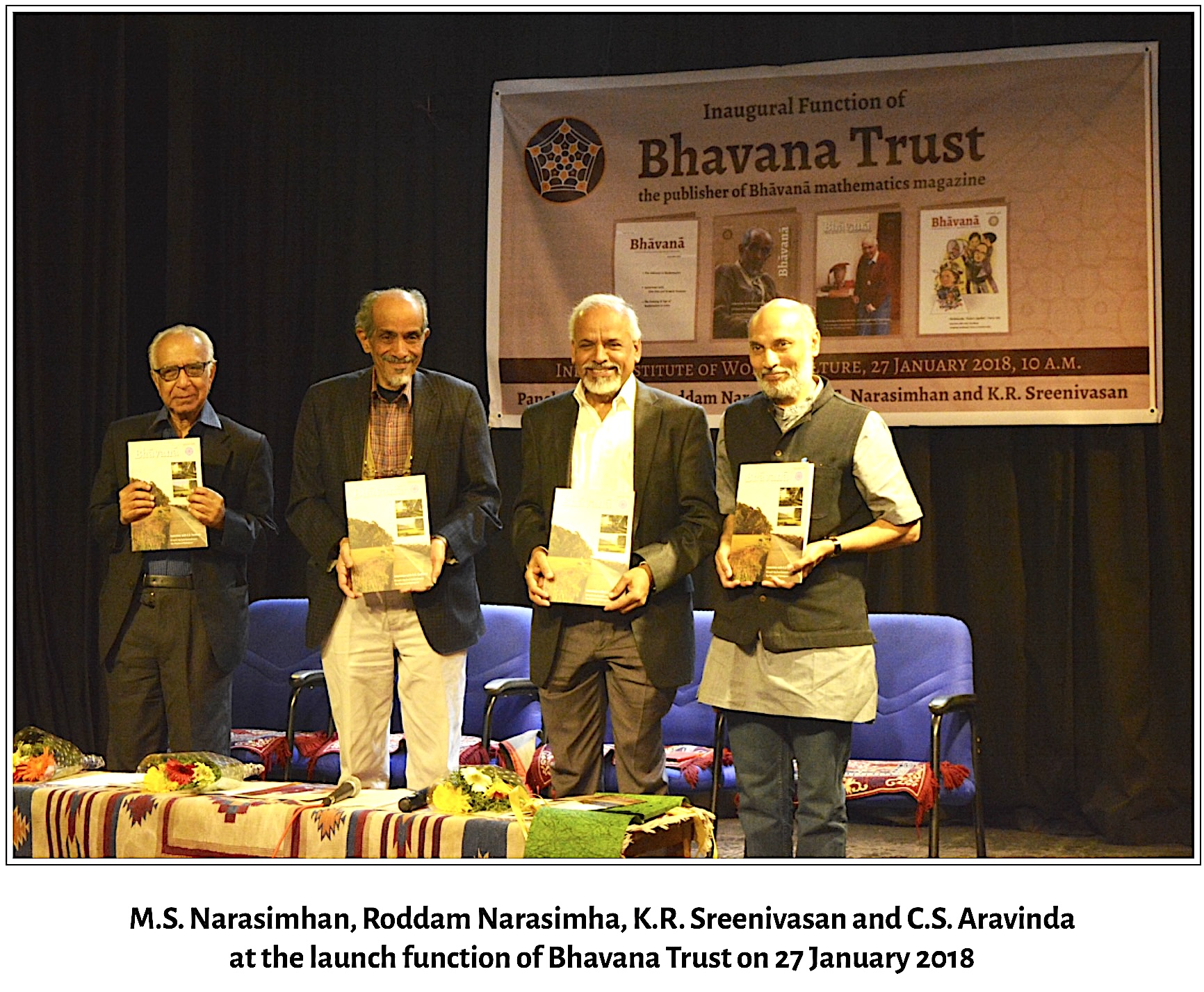
 It gives us great pleasure to wish our readers a very happy new year 2018 as we begin our second year’s journey. We are grateful to all our contributors over the last year for the warmth, love and care they have blessed us with. A significant change on the non-academic front is that, while expressing our deepest gratitude to TIMC for providing a platform all through 2017 and helping us stabilise academically, Bhāvanā, from the January 2018 issue onwards, will be published by the newly formed non-profit Bhavana Trust. This is also an effort to stabilise the initiative financially. In \mbox{particular}, we are now soliciting subscriptions—both individual and institutional—for the print version of Bhāvanā. We, of course, also welcome generous donations from well-wishers so that we can continue to focus on the academic aspects—the backbone of this initiative.
Even as we continue some of the threads we initiated in 2017, this issue of Bhāvanā initiates new ones. This January 2018 issue starts a new thread in the form of addressing formal mathematics education in schools and colleges, through a delightful story (translated from its Italian original). It was written close to 150 years ago by the great Italian writer Enrico Castelnuovo (1839–1915) who had a major contribution to mathematics, if only in the form of his son Guido Castelnuovo. Guido is famously known for his important work in algebraic geometry, a major and central topic of mainstream mathematics research, and for his signal contributions to mathematics education in Italy in the early twentieth century.
It is a common experience of mathematics students in schools and colleges to feel anxious and inadequate. One factor that contributes to this anxiety is that while a correct answer can fetch full marks, even an inadvertent error could prove costly—the difference between right and wrong is presumed so marked and thin. This is often fortified by the practices followed in educational institutions during exams, influencing a student to either embrace or stay repelled from the subject forever. The experience of Enrico in his short story “The Theorem of Pythagoras”, we believe, will easily resonate with most who have, unfortunately, turned away from the beauty and joy of mathematics.
One mathematician who, fortunately, discovered mathematics early and pursued it to great acclaim and success, was Maryam Mirzakhani. Born in Iran, her talent was noticed when she became the first female Iranian student to win a gold medal at the International Mathematical Olympiad held in Hong Kong in 1994. Her genius flowered, and she went on to become a professor at Stanford University. Non-mathematicians came to know of her as the first female recipient of the Fields Medal, in 2014. Mathematicians knew her as a trailblazer, and a warm and compassionate colleague. The world mourned her untimely death last year at the age of 40. One of her collaborators, Jayadev Athreya, writes of her work in an obituary in this issue of Bhāvanā.
Another mathematician who passed away recently, and whose warm and open nature was valued by all he knew, was R.R. Simha. In an obituary, Kaushal Verma writes of how he came to know of Simha through his papers which were “direct but demanded a focused engagement” and were “bound by a common thread of eloquent brevity”.
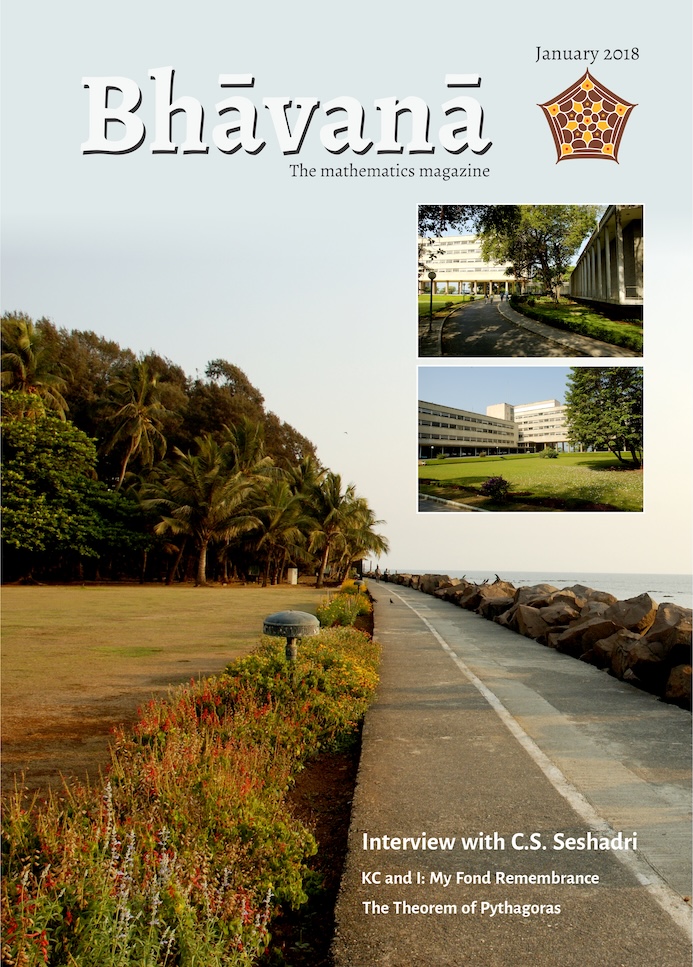
Simha spent most of his career at the School of Mathematics of the Tata Institute of Fundamental Research (TIFR), Mumbai, where his PhD advisor was M.S. Narasimhan. TIFR has played a prominent role in positioning India as a centre for mathematical research of the highest calibre. So much so that David Mumford, a 1966 Fields Medalist, once glowingly referred to it as “that unreal mathematical pleasure dome on the Arabian Sea”. (The front cover images of this issue of Bhāvanā are from the TIFR campus.) Mumford was referring broadly to TIFR’s School of Mathematics, and also in particular to the seminal works of one such pillar of its very edifice from the ‘60s onwards, C.S. Seshadri. This issue carries an interview that chronicles the life and works of Seshadri, a mathematician who has that rare honour—an eponymous mathematical theorem, which itself is more than fifty years old today. A consummate concert level Carnatic musician, Seshadri in some sense represents the era in TIFR that followed the sad demise of its founder Homi Bhabha, a difficulty compounded by K. Chandrasekharan (KC) leaving India forever. His own career is inextricably linked with the institutional challenges that TIFR was faced with in those days.
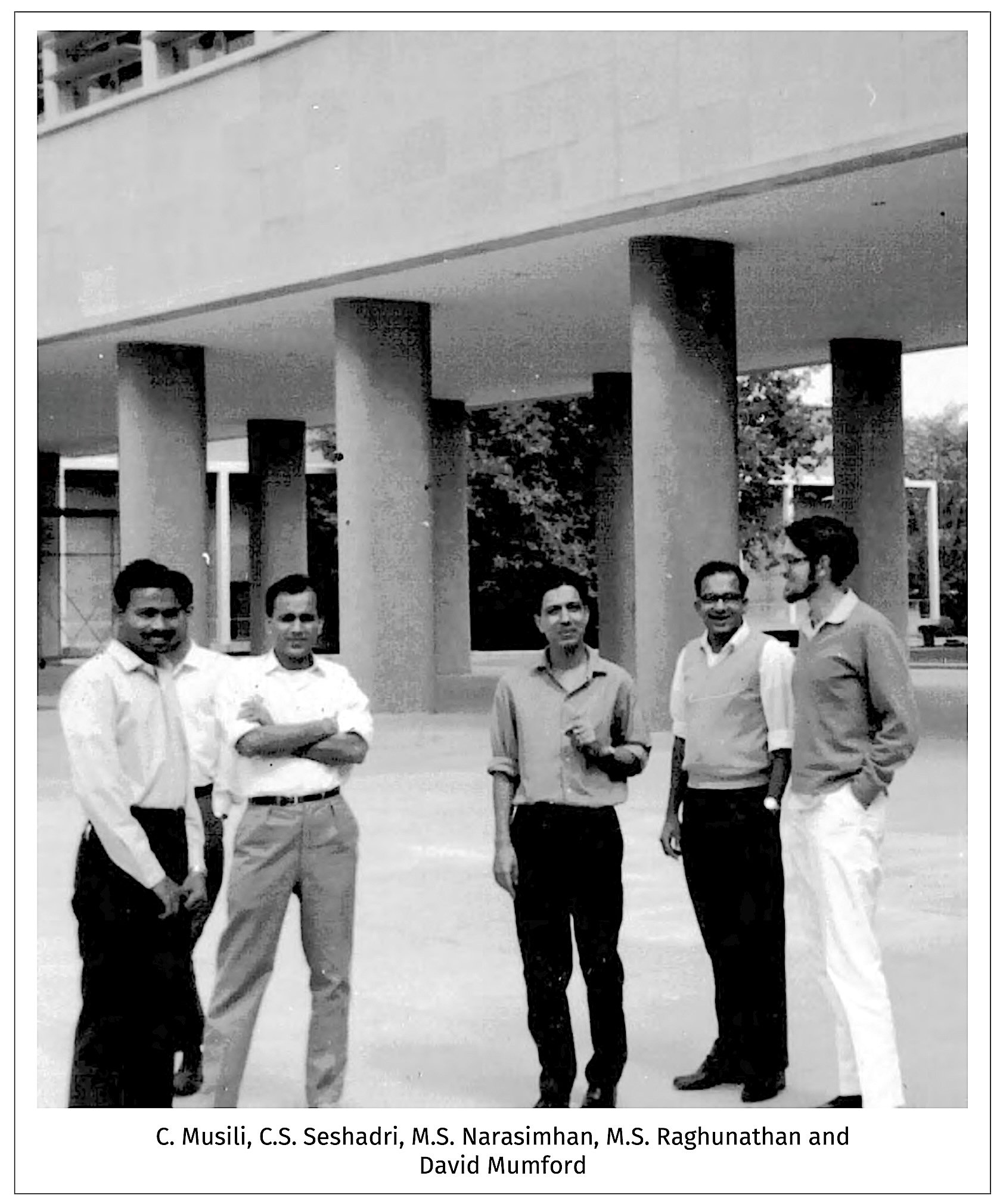
The obituary of KC in the July 2017 issue of Bhāvanā outlined his legacy through the institutions he helped nurture in India. R. Sridharan’s recollections of the role that KC played in his life as a graduate student at TIFR Bombay fills out this outline with a more personal portrait of the man. Sridharan’s candid storytelling brings out a tale of redemption, starting with his early experiences as a TIFR student that led him to earn KC’s disappointment, his growth as a mathematician upon meeting and working with Samuel Eilenberg, and the start of a friendship with KC that lasted until the latter’s death. Sridharan’s story reminds us of the simple truth that no student’s talent goes undiscovered, if paired with the right academic mentor.
Yet another article in this issue which has a certain connection with KC is the review of the book The G.H. Hardy Reader by Ken Ono. KC, being a student of K. Ananda Rau (who, in turn, was a student of Hardy), is thus Hardy’s academic grandson. Ono’s review of the book is truly a compelling read, providing a fair reflection of the unique personality of Hardy on the mathematical firmament. Talking of Ramanujan brings us to a brand new endeavor spearheaded by a dear friend and an esteemed colleague of many years, the very accomplished mathematician Sujatha Ramdorai. Sujatha, in association with the Agastya Foundation, is organising a summer internship program in 2018, for students and teachers interested in mathematics and its myriad applications, all under the aegis of the newly inaugurated Ramanujan Math Park (see last page for details) in Kuppam, near Bangalore. \blacksquare
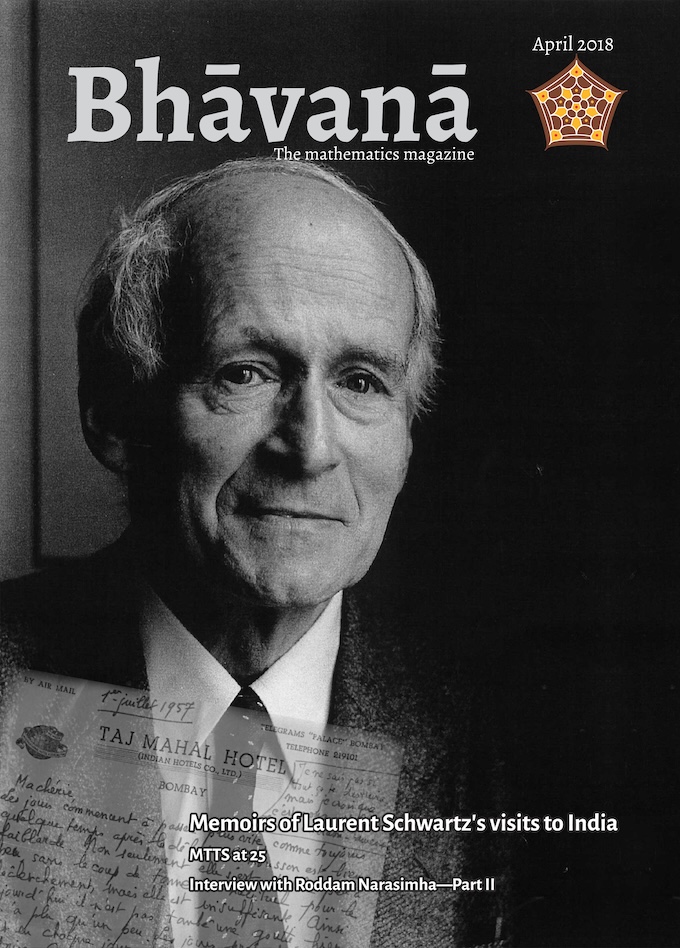
In this issue of Bhāvanā, we bring you a novel feature: a meticulously recorded travelogue by the 1950 Fields Medalist Laurent Schwartz, of his four hugely impactful trips to India, mainly to the School of Mathematics of TIFR. This hitherto unpublished account touches upon a wide variety of topics, and was compiled by Schwartz from the letters he wrote to family and friends while in India. This memoir was kindly offered to Bhāvanā by his daughter Claudine Schwartz.
Laurent Schwartz is most famously known for his theory of distributions, the seminal work that handed a mathematically official credence to the notions of the Dirac delta and Heaviside functions effectively used by physicists earlier. Besides providing a theory of generalised functions ideally suited for the general theory of partial differential equations, his work also paved the way for a rigorous treatment, in the 1950s and ’60s, of the representation theory of Lie groups by Harish-Chandra. Schwartz’s contributions are special because they are equally indispensable to both pure and applied mathematicians.
The mathematics community across the world very well know that his personality went farther and deeper into whatever activity he undertook, be it guiding a generation of mathematicians including the very distinguished but reclusive Alexander Grothendieck, or being a part of the core of the mathematics movement famously known as Bourbaki that had such a deep impact on twentieth century mathematics, or his active involvement in various political causes to the extent of being dismissed from his job, or carrying on a long and abiding interest in butterflies—an inheritance from his mother—discovering species that now bear his name and building one of the largest butterfly collections in Europe.
In all, he is most remembered for his deeply humane considerations. The two accompanying articles—reprint of a review by K. Chandrasekharan (KC) of Schwartz’s autobiography and the reprint of a homage article by Schwartz’s apprentice M.S. Narasimhan—together help in placing Schwartz’s incredibly active persona in perspective. KC’s article brings out Schwartz’s humanitarian efforts, and his global interactions in the context of war-politics, which even resulted in setbacks in his career. Schwartz had a huge influence on the TIFR School of Mathematics, and on the young Narasimhan. “His inspiring lectures not only introduced young mathematicians at TIFR to important topics and techniques which were hardly studied in India at that time,” writes Narasimhan, “but also introduced them to a whole new way of thinking about, and of doing, mathematics.”
TIFR being the setting for this flowering of mathematics in post-independence India, N. Mohan Kumar reviews the book Growing the Tree of Science by Indira Chowdhury, which examines what went into making TIFR such a unique research institute in India.
 Also featured in this issue of Bhāvanā is an education programme of a different kind, one that is perhaps unparalleled in the history of India. S. Kumaresan has led the Mathematics Training and Talent Search (MTTS) programme right from its initial days, with a commitment to quality and a sense of purpose that is worthy of emulation. In the twenty five years of its uninterrupted existence, 4,500 students have been taught and mentored, and nearly 300 of them have gone on to earn doctoral degrees in mathematics. Many of them have returned not only to India, but also to the very programme that had launched their careers. Team Bhāvanā caught up with this teacher par excellence, spending time at the Regional Institute of Education, Mysuru, recording every fact and nuance of this bold and noble endeavour. This article is our tribute to the yeoman service that Kumaresan and his inspired team have rendered to India, and to Indian mathematics.
Another stalwart whose service to Indian science we document in this issue is Roddam Narasimha. This is the second and final part of his interview. The first part, which focused on his upbringing, his stay at IISc, and his readings on ancient Indian science and philosophy, was published in the April 2017 issue of Bhāvanā. Part two of the interview focuses on his work on fluid mechanics at Caltech, and later at IISc after his return to India. His experience with picking fundamental scientific problems that are neglected outside India, but very much relevant for India, should be of special interest to young scientists returning to India in the coming years. \blacksquare
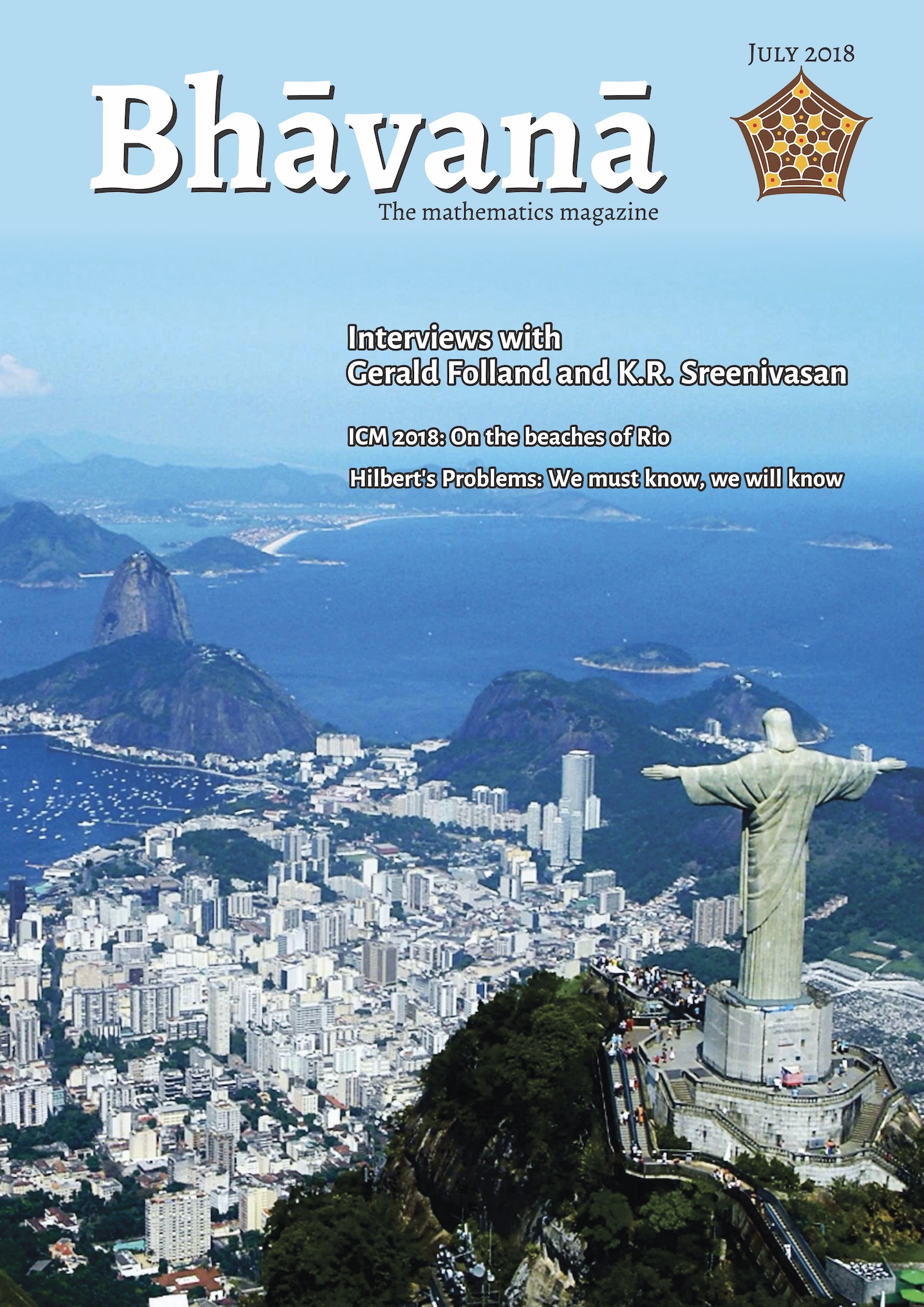 The singular occasion of the International Congress of Mathematicians (ICM), held once every four years, is about to begin on 1 August 2018 in the picturesque city of Rio de Janeiro, Brazil. Travelling to different corners of the world each time, exposing mathematicians to the richness of the various cultural traditions, the ICMs have come to symbolise the universality of mathematics, thus fortifying the sentiment expressed by Paul Adrien Maurice Dirac: “It is quite clear that beauty does depend on one’s culture and upbringing for certain kinds of beauty, pictures, literature, poetry and so on… But mathematical beauty is of a rather different kind. I should say perhaps it is of a completely different kind and transcends these personal factors. It is the same in all countries and at all periods of time.”
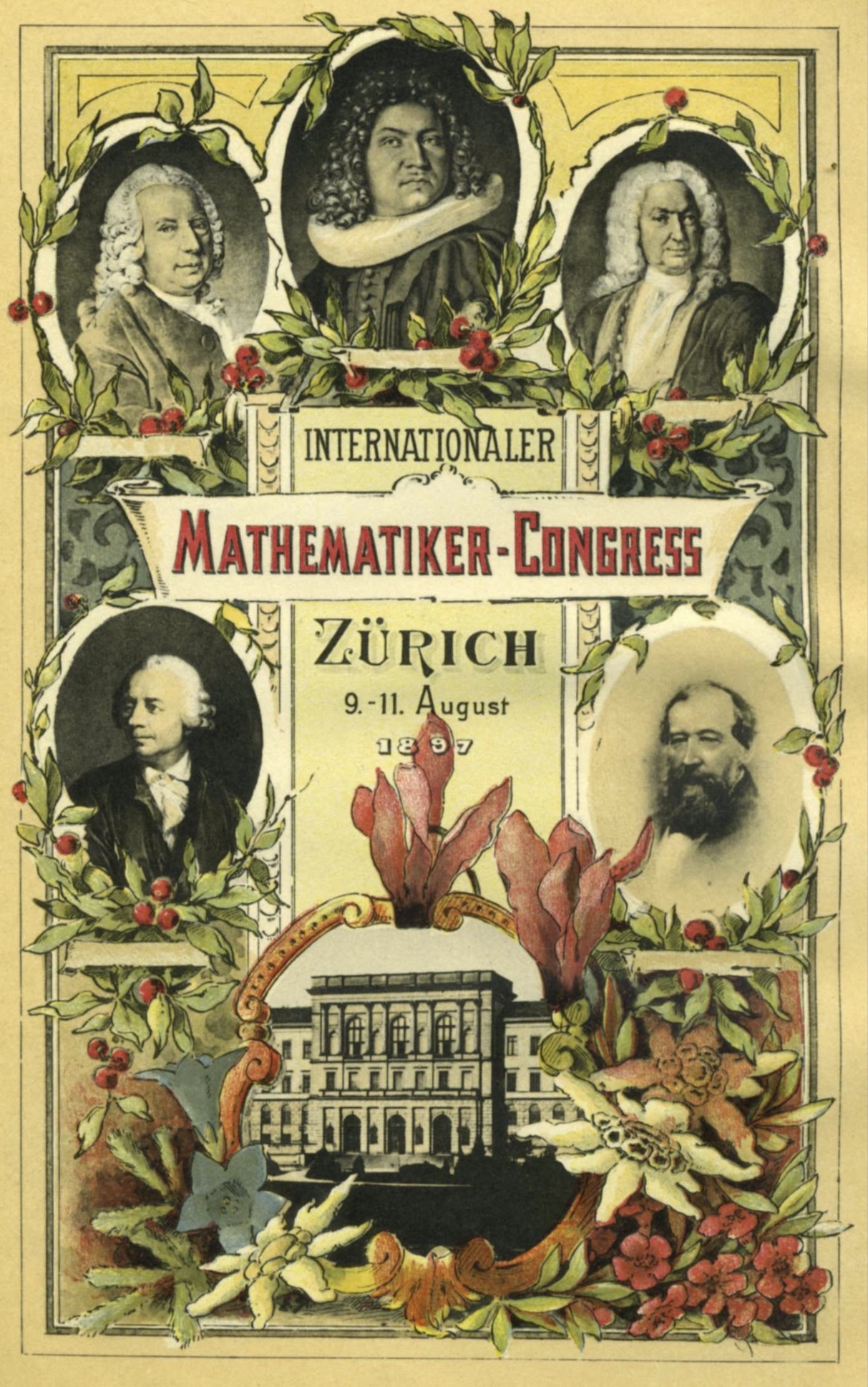
The article on the ICMs in this issue of Bhāvanā conveys some of the defining aspects of this initiative that’s more than a century old, giving an idea of what it can offer to a practicing mathematician. We try to capture this spirit on our front cover with Rio’s iconic statue of Christ the Redeemer, and on the back cover with a beautiful poster from the inaugural ICM held at Zurich in 1897.
the ICMs have come to symbolize the universality of mathematics
At the second ICM in 1900 at Paris, David Hilbert’s address saw him outline a set of questions that would drive key developments in mathematics over the coming century. We carry a translation of an article by Étienne Ghys, written for Images des Mathématiques, that carries excerpts of Hilbert’s thoughts on the nature and role of problems in pure mathematics, and their connections to the real world.
One of the scientists who has worked all his career on this interface between pure and applied mathematics is K.R. Sreenivasan. Continuing with our tradition of engaging in conversation with leading researchers, we meet Sreenivasan, one of the finest fluid dynamicists of our times, in this issue of Bhāvanā. In a panoramic interview, he shares with us the story of his life, starting from a small village in Kolar, to becoming a world-renowned expert on the intricacies of fluid flows. Sreenivasan, steeped as he is in the culture and philosophies of the land of his birth, gladly admits that the influence of great souls like Adi Shankara and Vidyaranya have not just educated him about the richness of an ancient past, but has also fundamentally shaped his view of the world.
For someone who has carefully studied the intricate dynamical evolutions of flows, and who also strongly believes in the Indic tradition of souls that progressively and dynamically evolve for the better, the notion of a flow is beyond the mundane, transcending to the spiritual.
 We also have an interview with Gerald Folland, a renowned analyst. Like Sreenivasan, Folland too was profoundly influenced by his mentors and peers in his formative years. His interests have been wide-ranging, spilling over into mathematical physics, in particular quantum mechanics and quantum field theory. He is the author of many well-regarded textbooks, and is an insightful reviewer of books too—as evidenced by two book reviews that we republish in this issue, originally published in the American Mathematical Monthly.
But these two articles are exclusive to the print version of Bhāvanā, not available on online on our website. So please do circulate your copy of this issue of Bhāvanā amongst your friends and colleagues and urge them to subscribe at http://bhavana.org.in/subscribe .
erratum In the interview with C.S. Seshadri that was published in the January 2018 issue of Bhāvanā, one of the questions mentioned that there were four invited speakers from India at the International Congress of Mathematicians held in Nice, 1970. However, it turns out that there were only three speakers from India: M.S. Narasimhan, M.S. Raghunathan, and C.S. Seshadri. Raghavan Narasimhan was not an invited speaker at this event, unlike what was claimed in the article. We regret the error. \blacksquare
 In this October 2018 issue of Bhāvanā, as we complete two years of publication, we bring to you a conversation with a living legend who has, literally, been at the centre of the coming of age of mathematics in post-independence India. M.S. Narasimhan, groomed, like so many of his generation, by Fr. Racine at Loyola College, Chennai and then trained at the Tata Institute of Fundamental Research in Mumbai, left in the 1950s for Paris, which by general consensus was the global headquarters of mathematics at the time. There, he quickly came to be influenced by the Bourbaki. His own work has intersected strongly with that of David Mumford, Michael Atiyah, Alexander Grothendieck, André Weil, Armand Borel among other pioneers, and has resulted in lasting personal friendships with these giants of 20th century mathematics. His strong rapport with many of these trailblazers, including from the Bourbaki, has also provided the much needed glue to connect India to the major centres of mathematical excellence, across continents. We caught up with him while he reminisced on his remarkable journey.
One of the mathematicians Narasimhan deeply admires is Hermann Weyl. The German mathematician’s life and work is profiled in this issue of Bhāvanā by Christopher Eckes, translated from the French and originally published in Images des Mathématiques. The article is a scientific and intellectual biography of Weyl (1885–1955), who was a key contributor to the advancement of mathematical sciences in the first half of the 20th century. Most of Weyl’s illustrious career was spent at three institutions: the University of Göttingen (1904–1913, then 1930–1933), ETH Zürich (1913–1930) and the Institute for Advanced Study in Princeton (1933–1951). Eckes’ article brings out Weyl’s attachment to the intellectual and scientific environment of Göttingen beginning with his formative years (1904–1908) at the same university until his exile to the United States in 1933 following the rise of Hitler to power in Germany. The article also sheds light on his views about constructive mathematics, as well as the complementarity between scientific activity and philosophical reflection, to which his intellectual career bears testament.
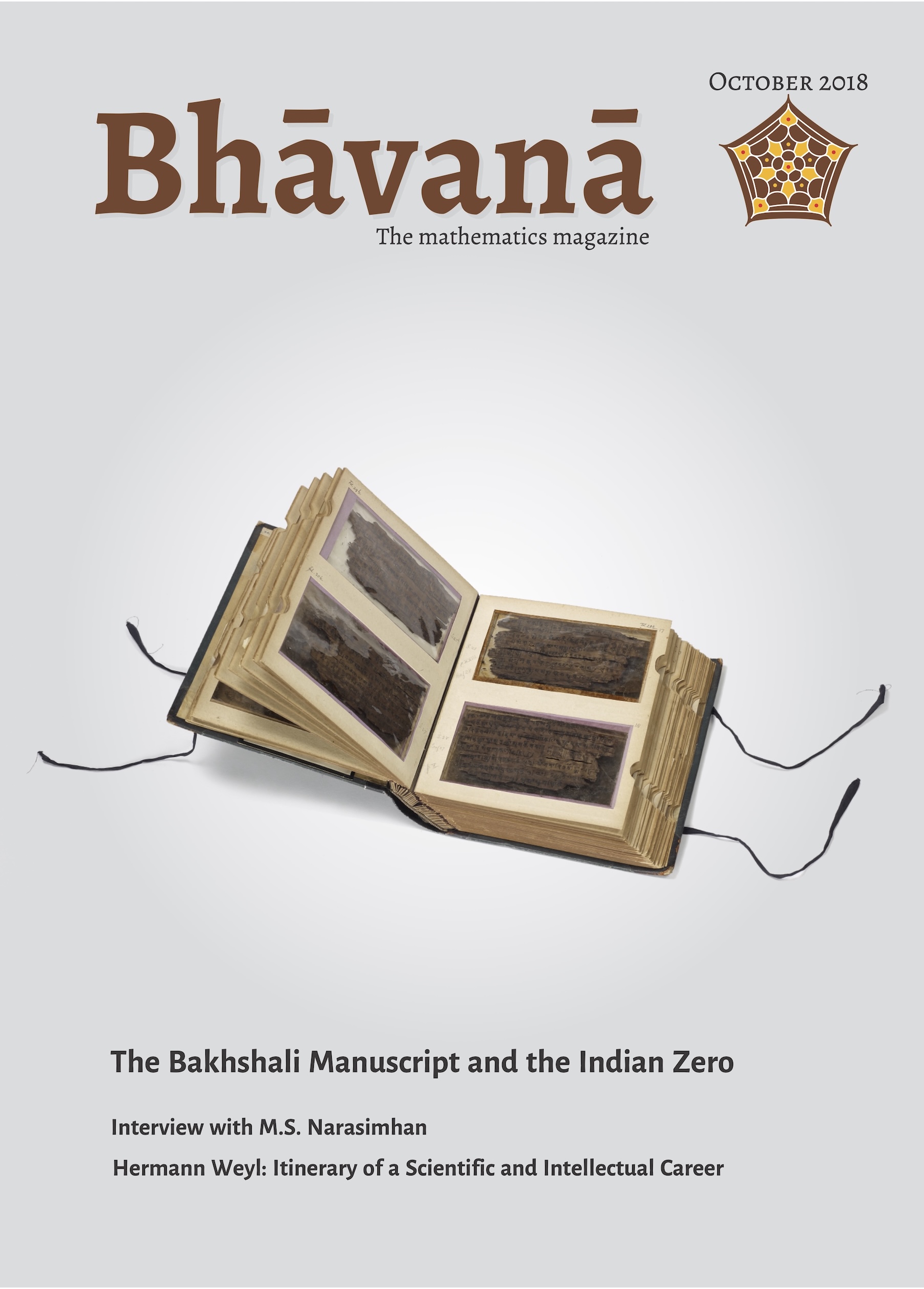
Front cover displays one of the delicate folios of the Bakhshali manuscript, made of the bark of the Himalayan birch tree
 When it comes to work on the history of mathematical ideas, one needs not just reflection but careful assessment of the evidence, from as many lines of argument as one can marshal. The article by P.P. Divakaran on the famous Bakhshali manuscript, unearthed in 1881 from a field by a peasant in the village of Bakhshali situated in present-day Pakistan, addresses the ongoing discussions after its radiocarbon dating last year made headlines. The dating of this manuscript, which is a mathematical text, has assumed great significance because of the use of a dot as a symbol for the number zero in some of its folios.
Village Bakhshali is situated about 100 km northeast of the city of Peshawar and about 130 km northwest of the ancient university town of Takṣaśila, in the region of Gandhāra, historically an epicentre of cultural diversity and learning.
While most of the discussions so far may have focussed on the dating of the physical evidence of this important manuscript, presently housed with great care in the Bodleian Libraries at the University of Oxford, Divakaran’s article places it in the context of both the evolution of decimal counting as evidenced in the verbal nomenclature of numbers in the long-running oral tradition of the Ṛgveda as well as the established dates of mathematical texts like the Āryabhaṭīya.
Divakaran’s article places zero in the context of decimal counting as evidenced in the verbal nomenclature of numbers in the long-running oral tradition of the Ṛgveda.
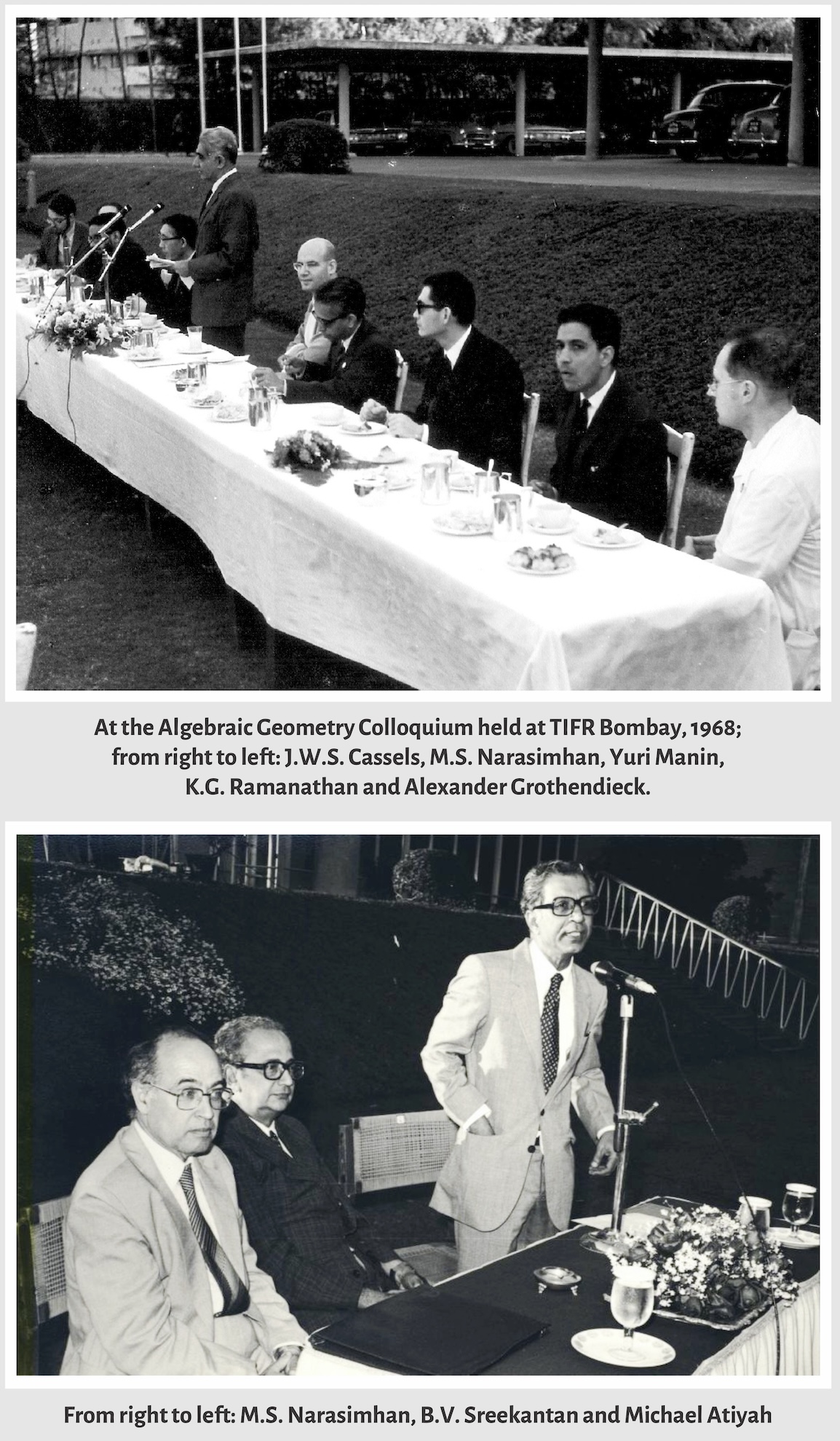
Our front cover for this issue displays the special care given by the Bodleian Libraries to preserve the delicate folios, made of the bark of the Himalayan birch tree, on which the text is written in ink. One may note that by placing the folios between two transparent sheets in the specially designed book, both sides of the folio texts are made visible for reading. The back cover image for this issue has two photographs from the TIFR Archives chronicling some of the major events organised by the School of Mathematics, where M.S. Narasimhan played an important role. \blacksquare
 In the October 2018 issue of Bhāvanā, P.P. Divakaran wrote about the Bakhshali manuscript, which records the first known usage of zero, and argued that the proposed dating of the manuscript must be revised. The Bakhshali manuscript, he wrote, must be evaluated keeping in mind the general background of the numerical culture of Indian mathematics, in particular the evolution of decimal place-value enumeration.
Divakaran, a long-time student of the history of mathematics in India, has written a book, The Mathematics of India: Concepts, Methods, Connections, which expands on this and other milestones. The book is reviewed in this issue of Bhāvanā by Avinash Sathaye, who believes it “is in a class of its own”. Divakaran, writes Sathaye, discusses the “how and why”, in addition to the “when, who and what”, and addresses controversies and presents his own views about the feasibility of others’ arguments, all without being dogmatic.
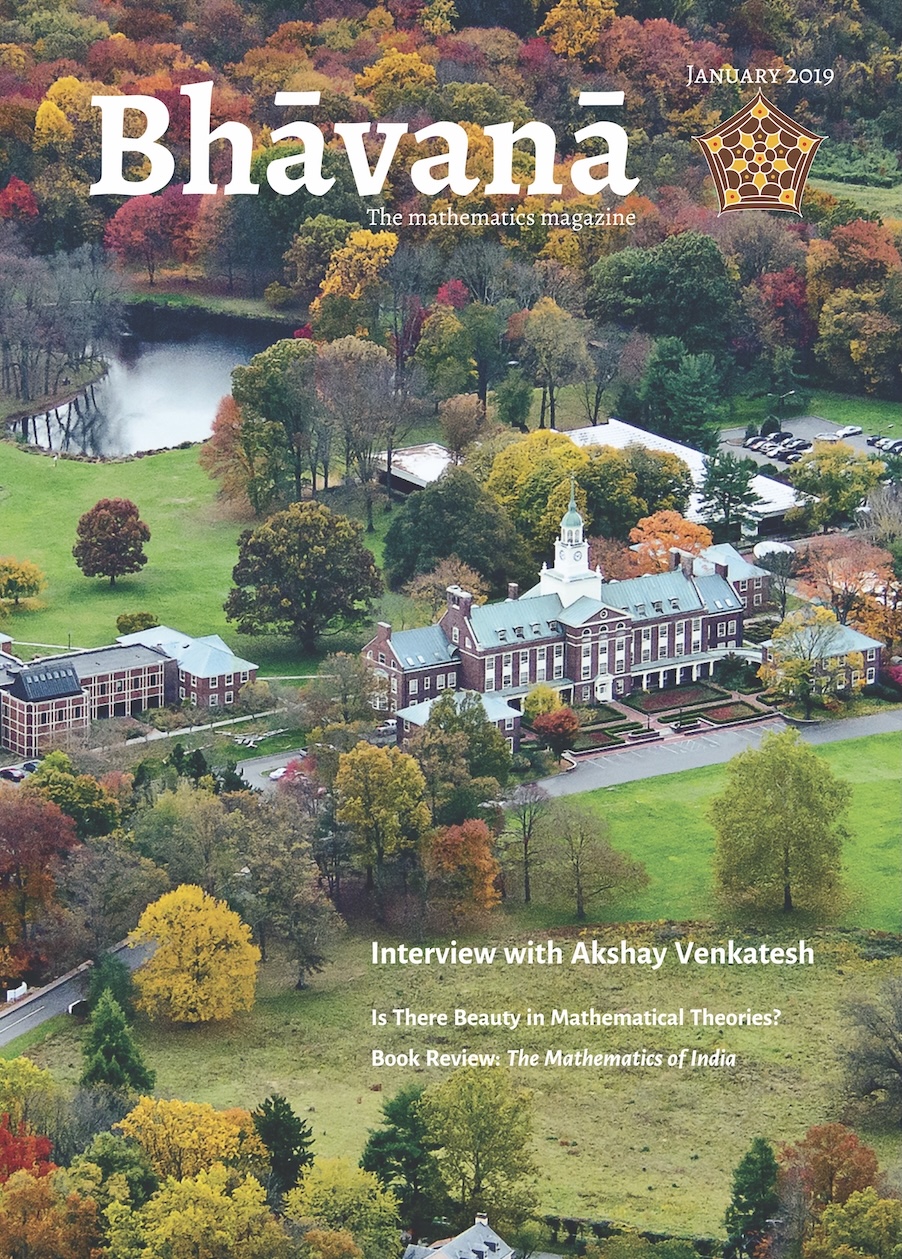
Renowned mathematicians of Indian origin are not in short supply today either, and Bhāvanā interviews one such mathematician in this issue. In August 2018, at the International Congress of Mathematicians held at Rio de Janeiro, four mathematicians were awarded the prestigious Fields Medal. For the second time in the last four years, a mathematician of Indian origin was chosen for this top honour. Akshay Venkatesh, a child prodigy and a trailblazer ever since, spoke to us from his abode in the pristine environs of the Institute for Advanced Study, Princeton. In a detailed account of his own life, we see his steely resolve which, coupled with a rare and precious talent, are indispensable in order to make a mark at the highest levels of scientific research.
Another illustrious member of the Institute for Advanced Study in Princeton to grace this issue of Bhāvanā is Robert P. Langlands, whose brainchild, the Langlands program, reshaped the mathematical world in the late 1960s and early ’70s. Langlands is the recipient of the 2018 Abel Prize for his groundbreaking work on the Langlands program, which has left an indelible imprint on the mathematical canvas.
In an invited talk at the “Facets of Beauty” conference which was held at the Notre Dame Institute for Advanced Study in 2010 with the central theme of “Beauty in Being”, Langlands presents a mathematician’s perspective of this seemingly ineffable and elusive topic. His treatment draws on instances from his own abstract discipline of study and provides a unique interpretation of “beauty” in the realm of mathematics. The first of this three-part article is being republished here.
Beauty of a more earthly nature, that of fluid flows, is the subject of another talk that we re-publish here. Our century-long, yet incomplete, mathematical quest to understand the origins of turbulent flows are documented in Roddam Narasimha’s article “Fluid Mathematics”. Based on his address to the graduating class of the Chennai Mathematical Institute in 2008, Narasimha takes us through the highlights of nearly two centuries of fluid dynamics. He argues for a new kind of mathematics to handle the Navier–Stokes equations, and points out that a solution to the turbulence problem, the greatest unsolved problem of classical physics, would possibly impact pure mathematics more than the field of fluid dynamics itself.
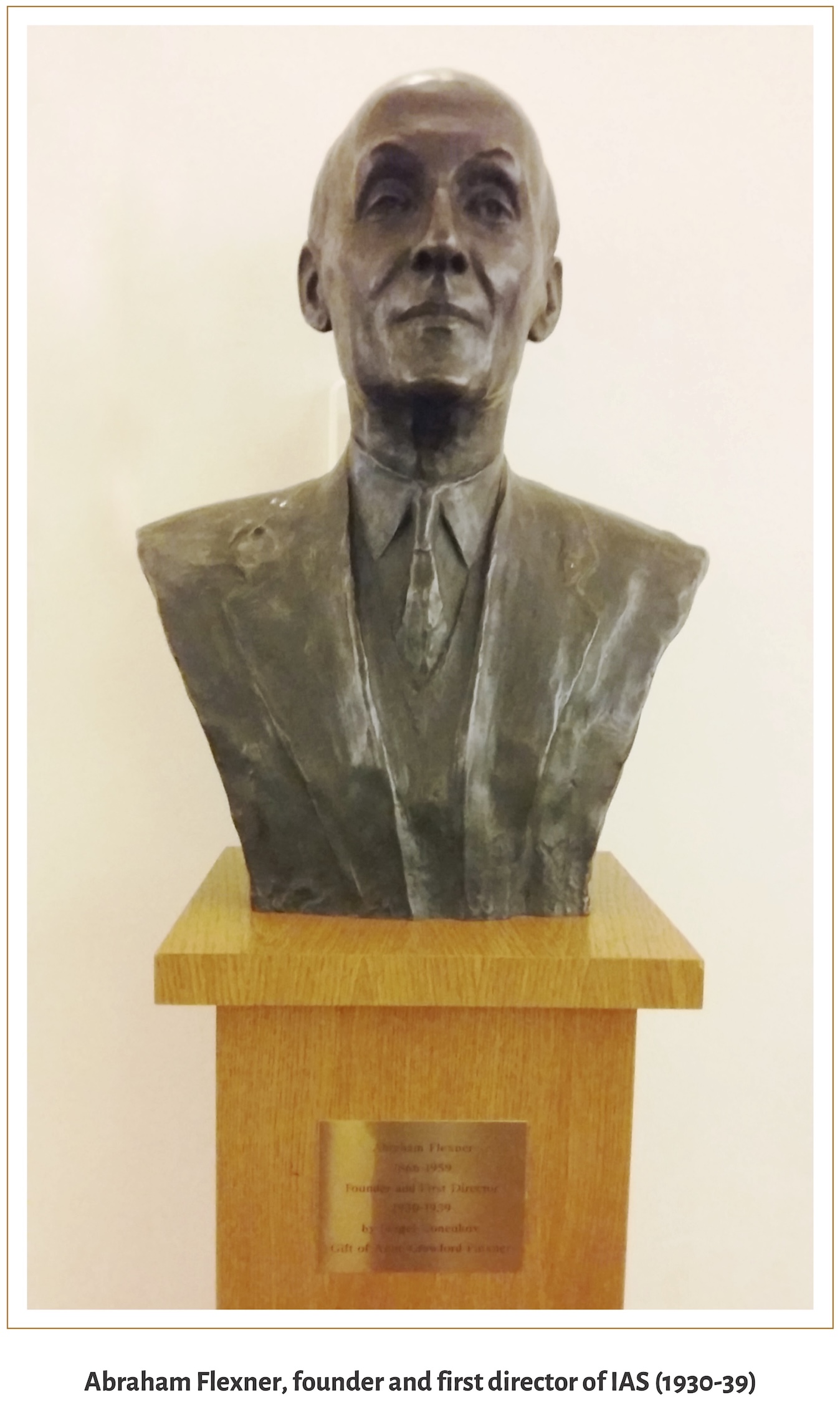 Some 95 years before the Langlands program first appeared, there was Klein’s Erlangen program which ushered in a new and exciting era in geometry by connecting it with group theory. Klein was also an influential figure in the life of another great German mathematician, Hermann Weyl. The other two personalities that shaped Weyl’s perspectives in mathematics vis-a-vis its philosophical and epistemological underpinnings were Hilbert and Zermelo. The impact of these three people on Weyl in his formative years at Göttingen as evinced by his works at the time is discussed in a translated article we carry in this issue, originally published in the French magazine Images des Mathématiques by Christophe Eckes. Following the first-part article “Hermann Weyl: Itinerary of a Scientific and Intellectual Career”, that appeared in the October 2018 issue, this sequel also dwells at length on the conflicts that lay at the heart of the foundations of mathematics in that period and the impressions it left on Weyl.
Featuring three prominent personalities—past and present—associated with the Institute for Advanced Study in Princeton, we felt it appropriate to feature images highlighting the role of this venerable institution on the cover pages. We are particularly grateful to Lee Sandberg, Erica Mosner and Pinky Goyal for their kind help with some of the images from IAS that we have made use of in this issue. \blacksquare
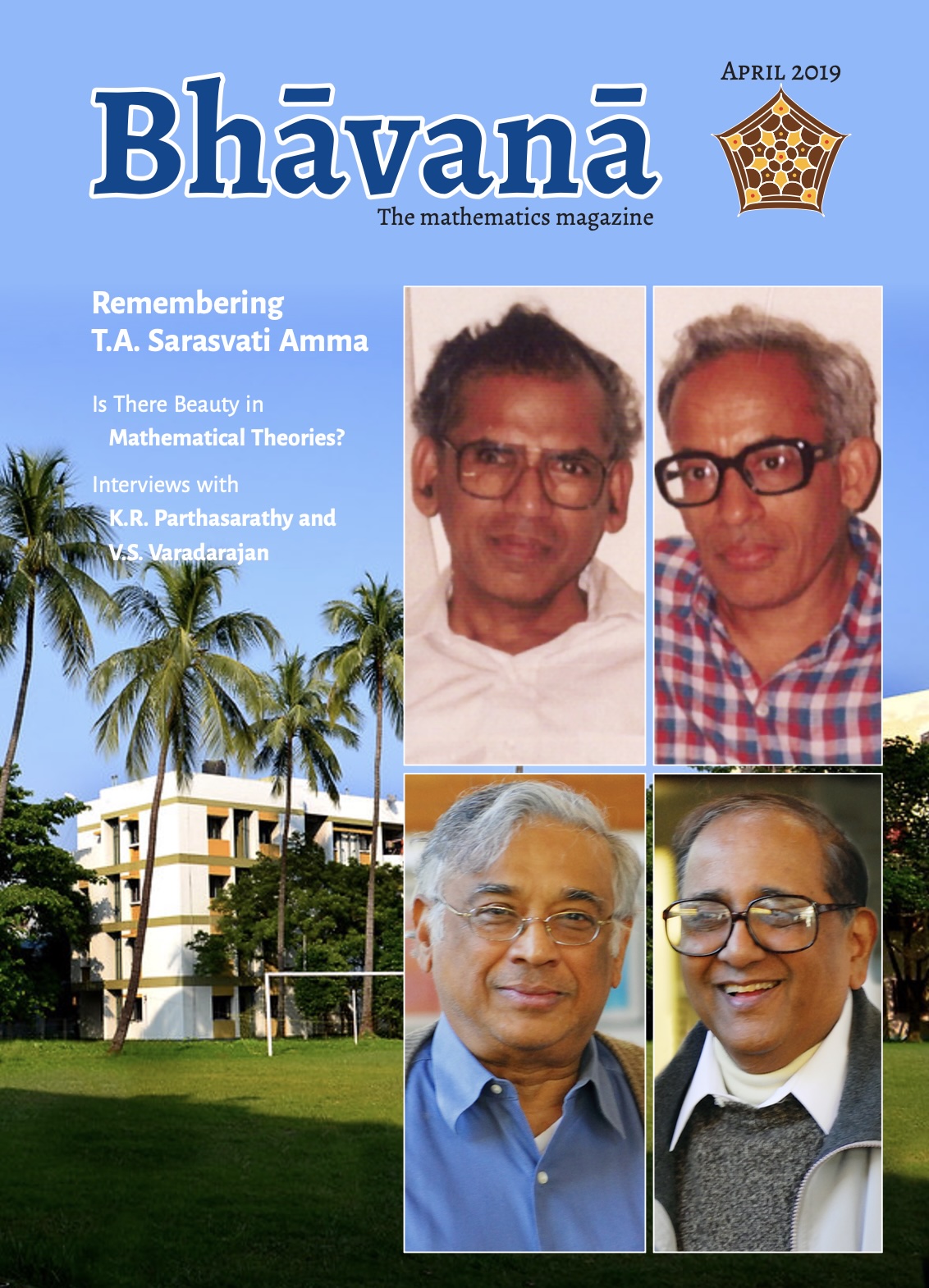 This issue of Bhāvanā carries the second part of Robert P. Langlands’ musings on beauty in mathematics, based on a talk he had given in 2010. Langlands talks about algebraic numbers, and the notion of a group, which, he says, “penetrates mathematics far more broadly, far more deeply than Galois theory itself”. He connects the works of Euclid, Galois and Gauss, remarking, in particular, that “the more one penetrates Gauss’s writings, the closer one comes to mathematics”.
Two of the other articles in this issue are interviews that provide a window on the early days of the Indian Statistical Institute (ISI) in Calcutta (now Kolkata). The far-sighted vision, meticulous planning, and an abiding trust in the potential of its aspiring entrants shines through in the warm recollections of two of the “famous four”, K.R. Parthasarathy and V.S. Varadarajan. ISI appears to have fostered a lively atmosphere while these now-famous alumni were engaged in their own research, which also resulted in an endearing sense of close kinship that continues to this day. Accordingly, the front and back cover pages of this issue of Bhāvanā attempt to capture this spirit, as recapitulated by Parthasarathy and Varadarajan.
Starting with his earliest recollections of childhood and student days, Varadarajan reflects eloquently on his early mentors and the inspiring presence of C.R. Rao, who headed ISI after P.C. Mahalanobis, literally leading his “boys” from the front. He is also candid when he talks about the then acute infrastructural shortcomings at ISI that prompted him to make a hard decision, heeding his inner voice to move to UCLA, a celebrated centre of academic excellence. And he recalls—with warmth and reverence—his nearly two-decade-long association with Harish-Chandra.
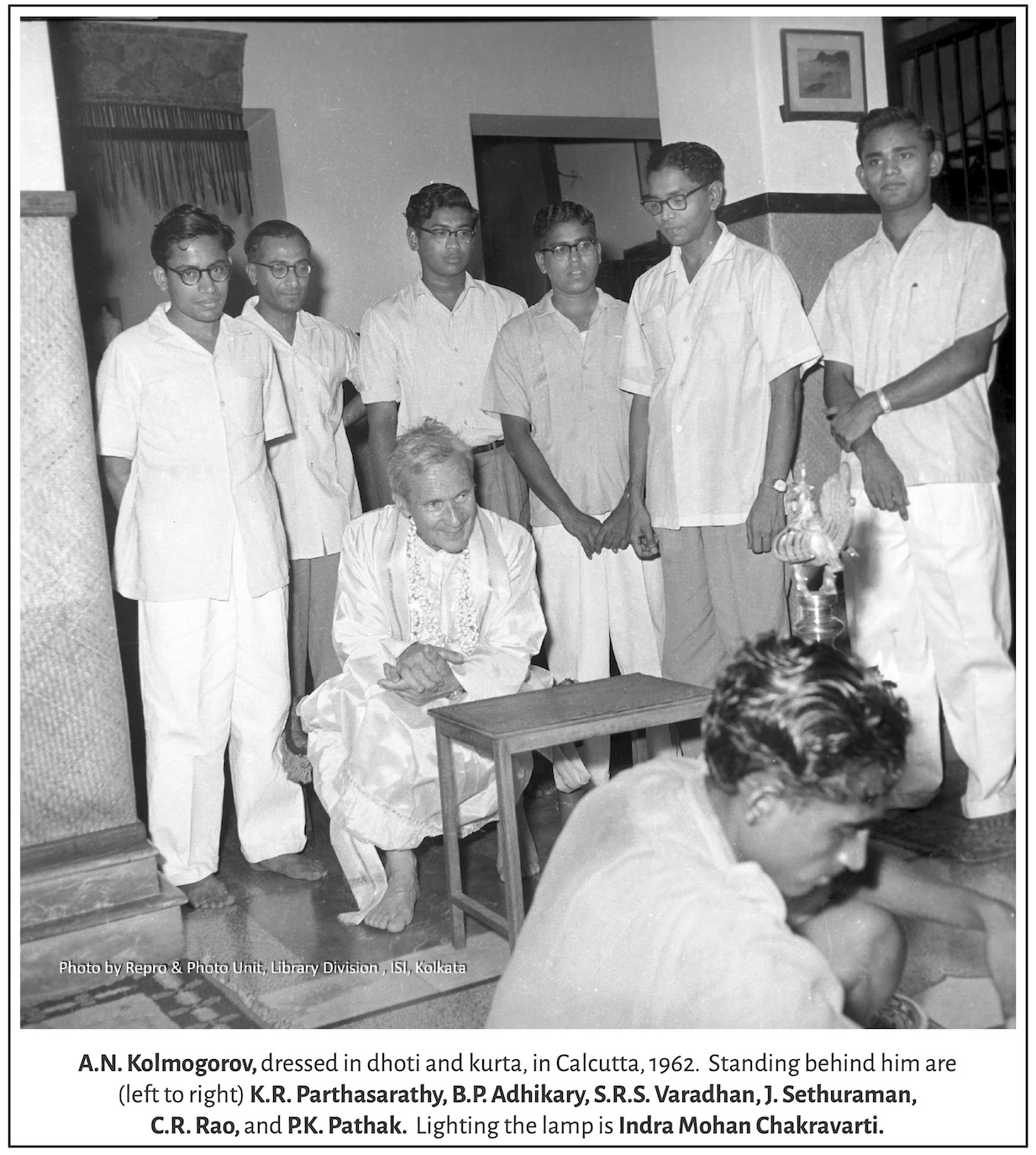 In the second interview, Parthasarathy fondly recalls learning mathematics along with Varadarajan, and makes a case for students organizing seminars amongst themselves as a way to learn mathematics at the research level. Parthasarathy points out that most of the books authored by him originated in seminars he gave on those topics. He also details the evolution of his research interests from information theory early in his career, to his later work on quantum stochastic calculus and quantum information theory, as he moved between various institutes, both in India and abroad.
The concluding piece in this issue of Bhāvanā is a portrait of an eminent scholar of history of Indian mathematics, T.A. Sarasvati Amma, sketched meticulously by Radha Charan Gupta, himself a well-known authority on the subject. Sarasvati Amma’s research on geometry in ancient and medieval India, encapsulated in a book of the same title, is one of the few and most panoptic references available on the subject; a fact acknowledged even by David Mumford. Her life and work are traced in an article affectionately penned by her student.
Finally, it is with pleasure and gratitude that we acknowledge the highly opportune financial help provided to \mbox{Bhavana} Trust by Shri Dr. Rohan Murty, for the year 2019. Thank you, Dr. Murty! \blacksquare
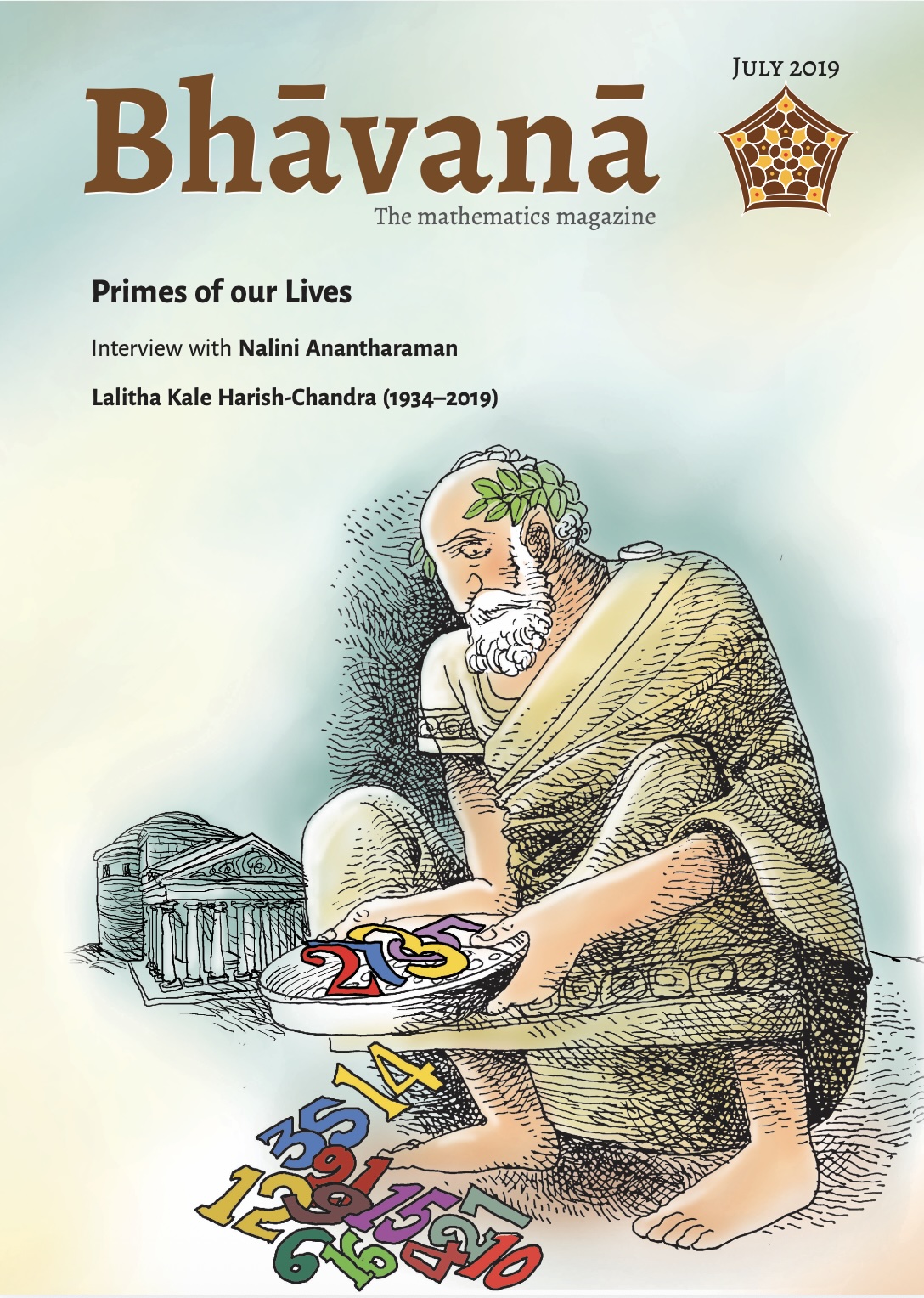 It is with a profound sense of loss that we mourn the sad passing of V.S. Varadarajan in April, just days before his interview appeared in the April 2019 issue of Bhāvanā. A towering mathematician, Varadarajan embodied the genuine passion to both engage in original mathematics research as well as share his perspective, through numerous writings, of mathematics and mathematicians, that left a lasting impression.
As Varadarajan knew well, mathematics requires more than just mathematicians. The passing of Lalitha Harish-Chandra (also known as Lily) in January 2019 was a loss to the mathematics community. Lily was married to Harish-Chandra for over thirty years until his death in 1983. Nearly every mathematician from the Institute of Advanced Study (IAS) that has featured in Bhāvanā had known Lily, and the reminiscences carried here bear testament to what a treasured privilege it must have been. Each reminiscence tells us of a different quality that drew people to Lily. We learn of her warmth towards not only her immediate family but also the larger mathematical community in IAS that she helped build. Widely read and well informed, it is our privilege that Lily enjoyed reading the articles in Bhāvanā too, and was one of our subscribers.
One of Harish-Chandra and Lily’s friends from their time at IAS contributes the third and concluding part of his article on “beauty in mathematical theories”. (The first two parts of Robert Langlands’ musings were published in the January and April 2019 issues.) Langlands first unveils the intimate relationship between algebraic number theory and spectroscopy. In particular, he discusses the mathematical significance of the emission spectrum of the hydrogen atom, and its associated quantum states. He then traverses into a more abstract realm where certain interesting relations between the algebraic and the geometric/topological properties of plane curves in relation to the theory of integration are discussed, and finally concludes with his pursuit of extending Abelian class field theory such that it relates the representations produced by the Weil–Grothendieck principles to automorphic forms.
In an illuminating expository article, Kaneenika Sinha sheds light on the ubiquitous nature of prime numbers, both in mathematics and in the real world. She discusses the rich history of primes starting from the works of Euclid and Eratosthenes to the pioneering works of Fermat, Gauss and Riemann; the repercussions of the modern day primality testing AKS algorithm put forward by the Indian mathematicians Manindra Agarwal, Neeraj Kayal and Nitin Saxena; and finally an application of primes to cryptography in the form of the RSA encryption method.
 This issue also features an interview with Nalini Anantharaman, recipient of the 2018 Infosys Prize in Mathematical Sciences. Nalini, a daughter of mathematician-parents, recollects her years growing up in France, the difficulties she faced as a girl, and her PhD years in Paris. She then discusses her own work, stressing on the subtle connections between geometry and dynamics, while outlining the history of the major developments in the field. She goes on to provide a lucid explanation of the differences between integrable and chaotic systems, especially in their respective quantum avatars, invoking the idea of ergodicity in the mathematical study of quantum chaos. Finally, she discusses the relevance of Anderson localisation, and of random graphs in her recent work.
The final article in this issue of Bhāvanā dwells on an imaginary, yet highly influential mathematical personality, Nicolas Bourbaki. Bourbaki is the collective pseudonym of a group of highly accomplished mathematicians that was originally formed in 1934 in France. Its founding members included greats like André Weil, Jean Dieudonne, Claude Chevalley and Henri Cartan, to name a few. Often functioning as a secret society, the Bourbaki brought in a paradigm shift, laying down a formalism that permeates the foundational structures in mathematics to this day. The Bourbaki influence also made its presence felt in the Indian mathematical landscape, which S. Ramanan dwells on in his short and succinct article.
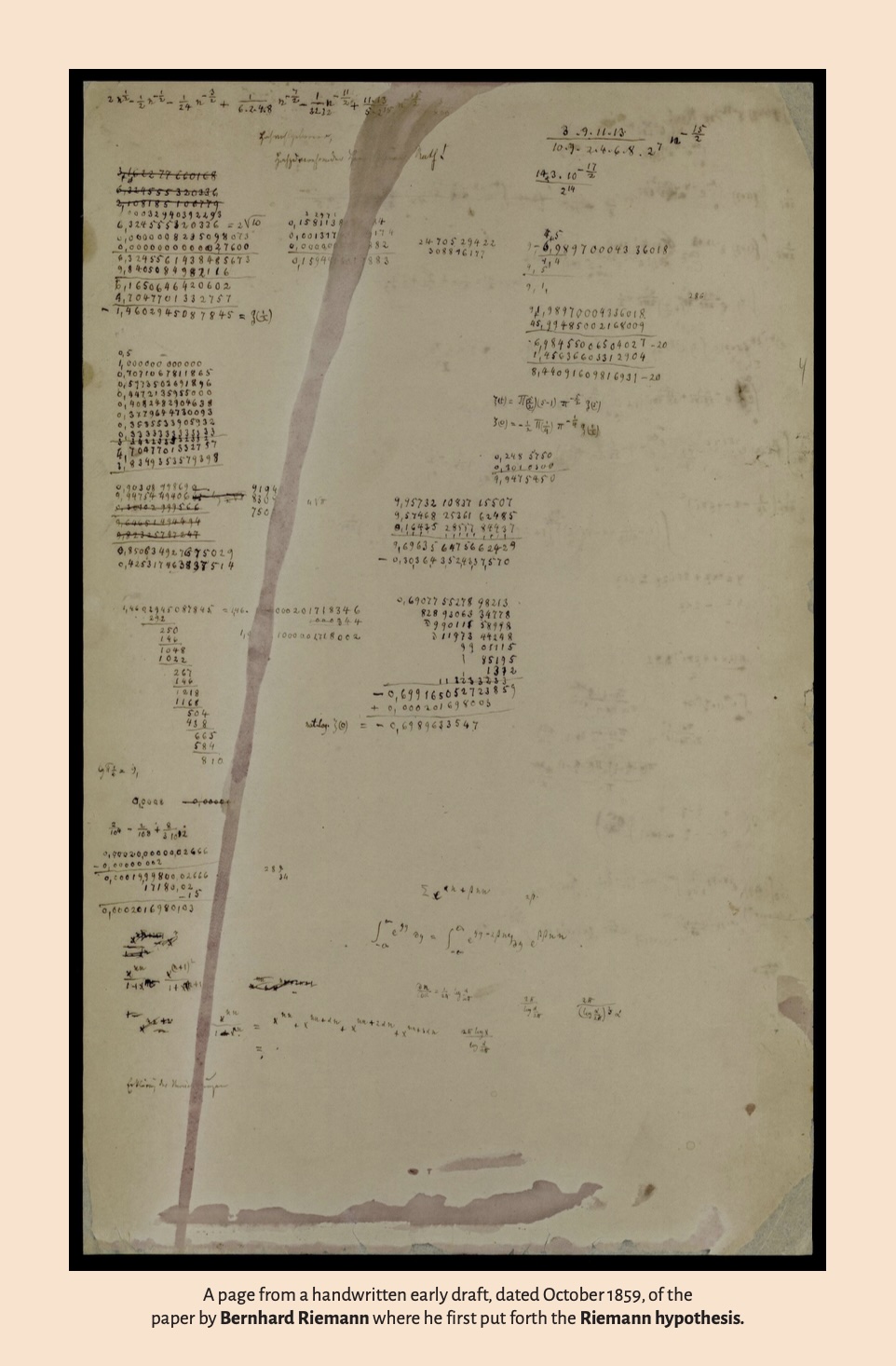
The cover page of this issue features an artistic depiction of the ancient Greek mathematician Eratosthenes. Here he is shown “sieving” the positive integers, separating the “primes” from the “composites”. Kaneenika Sinha’s article on primes provides both the inspiration and the backdrop for this sketch. The back cover is a page straight out of history, from a handwritten early draft of the paper Ueber die Anzahl der Primzahlen unter einer gegebenen Grösse by Riemann. \blacksquare
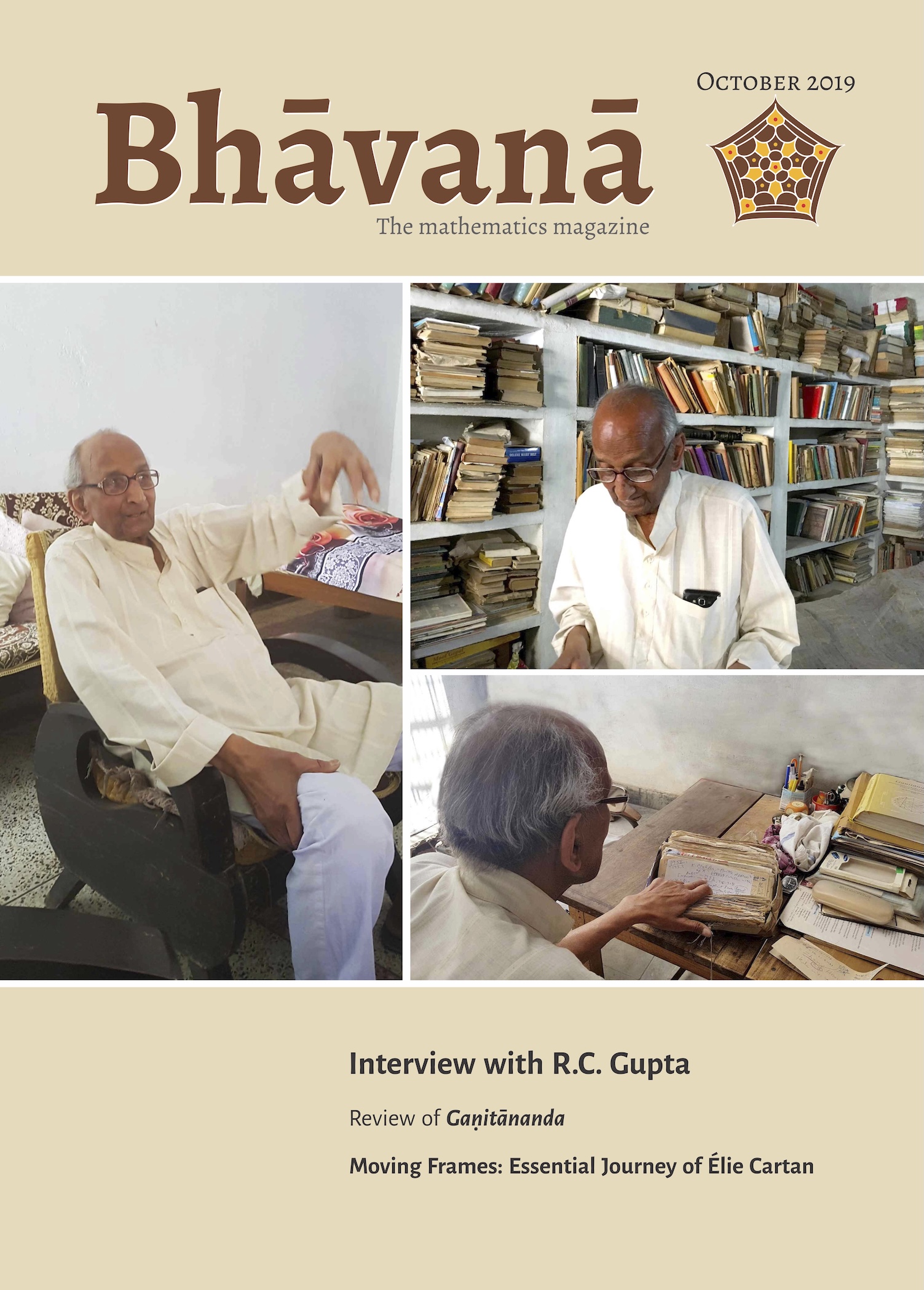 Our interview of Radha Charan Gupta in this issue of Bhāvanā highlights some of the significant figures who have contributed to the study of the history of mathematics in ancient and medieval India. Upon reading an unfavourable review of one of the standard reference books on Hindu mathematics, RCG, as he is often referred to, was spurred onto what would be his life’s work on decoding and unveiling the mathematical results hidden in millenia-old Sanskrit texts and their later commentaries. He also tells us a remarkable story of how the origins of the Indian Society for History of Mathematics, and its journal, Gaṇita Bhāratī, were closely linked with the launch of India’s first satellite, Aryabhata. RCG penned several articles on various aspects of the history of mathematics under the pen-name Gaṇitānand. RCG, who received the highest honour for work on the history of mathematics, has donned important roles in the International Commission on the History of Mathematics.
The book Gaṇitānanda, a representative compendium of selected papers of RCG’s works, is reviewed by S.G. Dani in this issue of Bhāvanā. Dani begins with a brief profile of RCG and brings forth the scholarship, meticulousness and objectivity in RCG’s work. He tells us that Gaṇitānanda makes the subject of history interesting with numerous “small details’’, akin to listening to tales from the past from a grandparent. The review also reflects the erudition of the reviewer, who gives a brief background of the various topics in ancient Indian mathematics covered in the book and beautifully connects them to weave a comprehensive narrative of the history of the topics involved. Worthy of mention here is the section “On people and their work’’ concerning articles in the book on historians of mathematics. The reviewer gives a very brief account of the five Indian historians chronicled by RCG and three foreigners, and notes that this would be a valuable asset for a student of the history of mathematics.
This year, 2019, happens to be the 150th birth anniversary of the legendary French mathematician \’Elie Cartan. Cognizant of both the breadth and depth of Cartan’s contributions, we pay him our tribute through an article by Alberto Cogliati, who presents a panoramic account of the life, times, and works of this recondite, and modest mathematician. His works in geometry even inspired his illustrious peer Albert Einstein, whose own work in relativity intersects strongly with some of Cartan’s deepest ideas. The two enjoyed a decades-long friendship, one that was marked not only for its deeply empathetic humane side, but also for the rigour in its discussion of relevant scientific ideas.
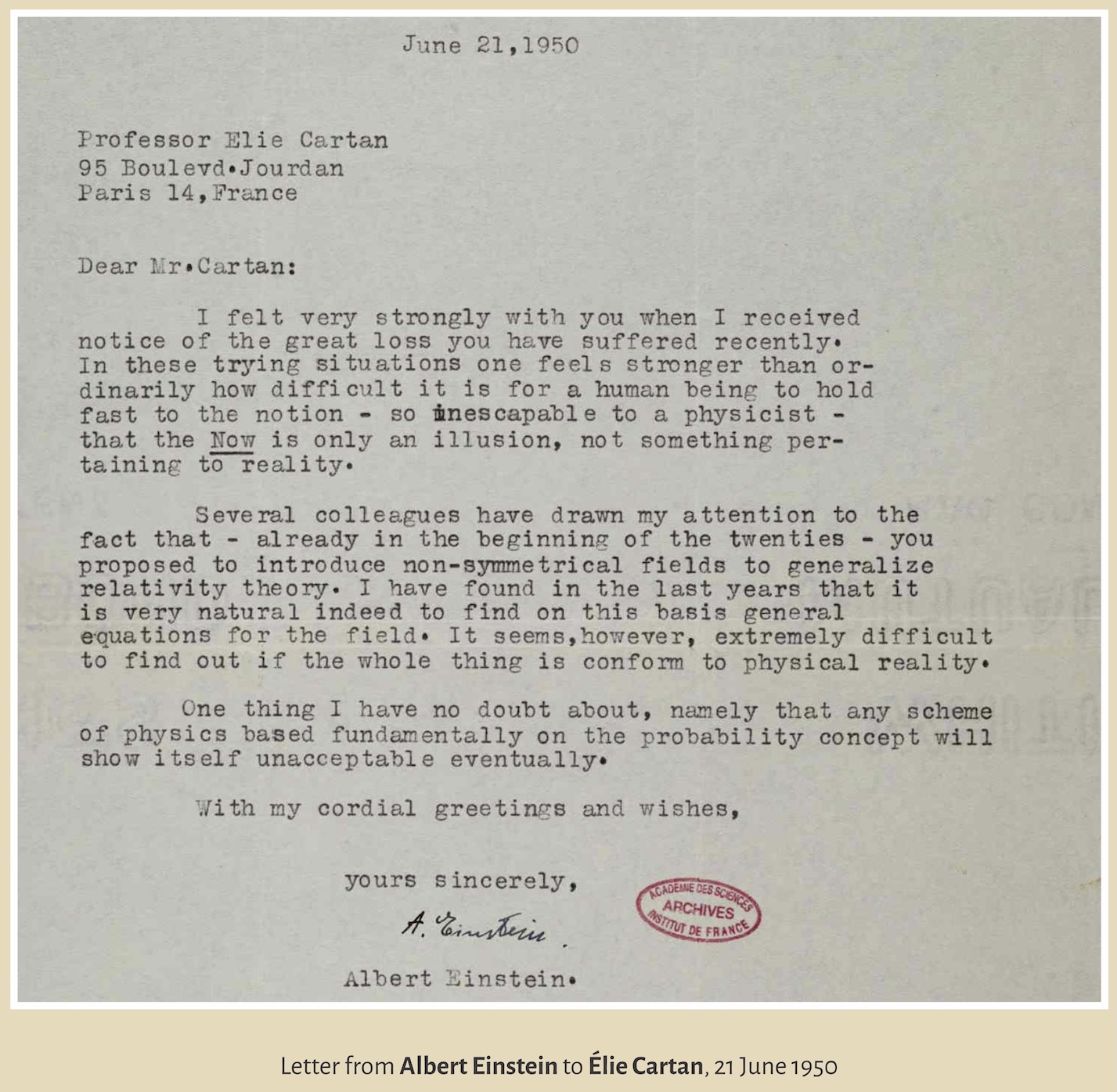 In line with the homage to \’Elie Cartan and his work, the final article of this issue carries a review by Athanase Papadopoulos of Cogliati’s book Writing Small Omegas, which chronicles the monumental mathematical achievements of \’Elie Cartan. Athanase begins by saying that “Alberto Cogliati’s book offers a magnificent historical panorama of \’Elie Cartan’s work …”. The review itself provides a succinct yet panoptic discussion of the material covered in the book, complemented with Athanase’s insightful remarks about the life and work of Cartan, particularly on his role as a geometer. The article also aims to place the book in the context of other similar treatments and is thus replete with many historical and mathematical tidbits.
errata In the article “Lalitha Kale Harish-Chandra (1934–2019)’’ in the July 2019 issue of Bhāvanā, her grandson’s name should have been Bryn, not Brinn. Also, Ramaa Raghunathan recalled light-hearted anecdotes about the Institute in Princeton, in the book Absolute Zero Gravity, about Raghunathan, not Harish-Chandra. The errors are regretted. \blacksquare
 Karanbir Singh Sarkaria, a retired professor from Panjab University, likes to convey mathematical ideas especially from geometry and topology in simple terms accessible to a wider audience. This passion of his found visual expression in the designing of his home `213, 16A’ in Chandigarh. His article in this issue of Bhāvanā, the first part of a two-parts, is a captivating tour through his house, along with simple, yet profound, mathematical commentary. Welcoming coloured panels depicting the golden ratio, polyhedral structures elucidating notions of Euclidean geometry, floor tilings and wall paintings evoking yet another beautiful sentiment are all seen here as aesthetic presentations of certain deep mathematical truths.
Any mention of mathematics at Panjab University brings to mind Ram Prakash Bambah, who, along with Hansraj Gupta, is credited with nourishing and growing a vibrant and thriving Department of Mathematics there. Continuing our series of conversations over the last three years about mathematics, its history and practitioners, we feature Bambah, an Indian number theorist of international repute. As a graduate student, Bambah was taught and mentored by two mathematicians, both of stellar credibility—Sarvadaman Chowla and Louis Mordell. As a young school lad, his peers even gave him the funny nickname “theta”, acknowledging his early aptitude for mathematics. Known for his lightning speed right from his student days in the Lahore of undivided India, wherein he also firmly anchored a fondly cherished, life-long friendship with Abdus Salam, who would later become a Nobel laureate in Physics, Bambah went on to solve a host of problems from a variety of areas in number theory, many among them with refreshing originality. The sprightly nonagenarian takes us along nearly a century of recollections and events, dwelling on the traumas arising from the Partition of India, and on the pursuit of mathematical truths in a career spanning six decades, across three continents.
We pay tribute to two more Indian mathematicians of international repute in this issue. Calyampudi Radhakrishna Rao turned 99 on 10 September 2019 and is now running 100. C.R. Rao did pioneering work in both theoretical and applied statistics from the middle of the 20th century onwards, much of which can be found in any undergraduate textbook in statistics today. Our tribute to Rao, a version of which previously appeared in Current Science, takes the reader through his childhood and early education, his years at the Indian Statistical Institute and details some of his most famous work such as the Cramer–Rao bound, the Rao–Blackwell theorem, generalized matrix inverses, and the formalization of parameter spaces as Riemannian manifolds, which set the ground for the field of information geometry. As remarkable as the breadth of his contributions is the duration of his research career, which began in his early twenties and went on well into his nineties, and spanning across different geographical locations. Rao is also amongst that rare breed of scientists who excelled as much in an administrative role as an academic one, given his setting up of the statistics curriculum at ISI, and in the creation of various statistical bodies of national repute in India.
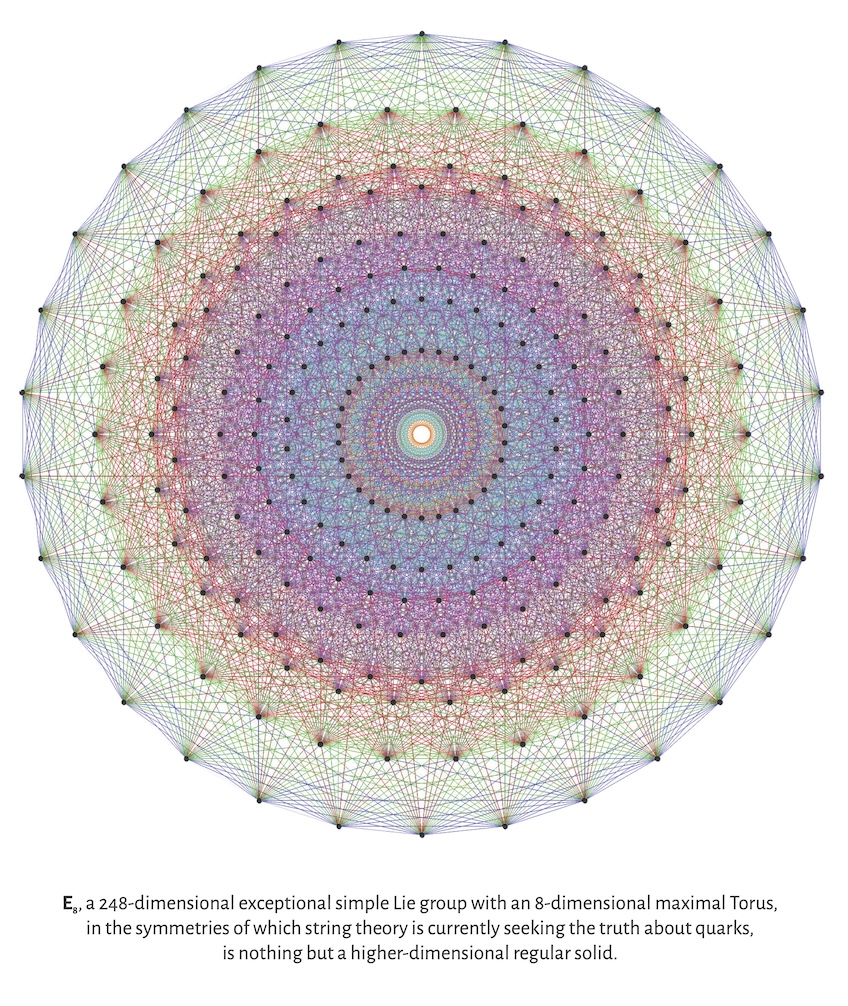 R. Vaidyanathaswamy was a pioneering mathematician of the early 20th century, and 2019 happened to be his 125th birth anniversary year. Though mostly known for being the author of the very first textbook on topology in India, Vaidyanathaswamy’s contributions towards building the Indian mathematical edifice have been substantial as evinced by our featured commemorative article with reverential words by C.S. Seshadri and a short piece by V. Balaji showing his multifaceted persona. As a mathematician and a teacher at the University of Madras, he was largely responsible for bringing many modern mathematical ideas to Indian shores, borrowing from his substantially diverse mathematical background, a large part of which was sculpted during the course of his doctoral studies in England. The article traces his life as a remarkably open-minded and dedicated teacher and also as an acclaimed mathematician admired by both peers and students alike.
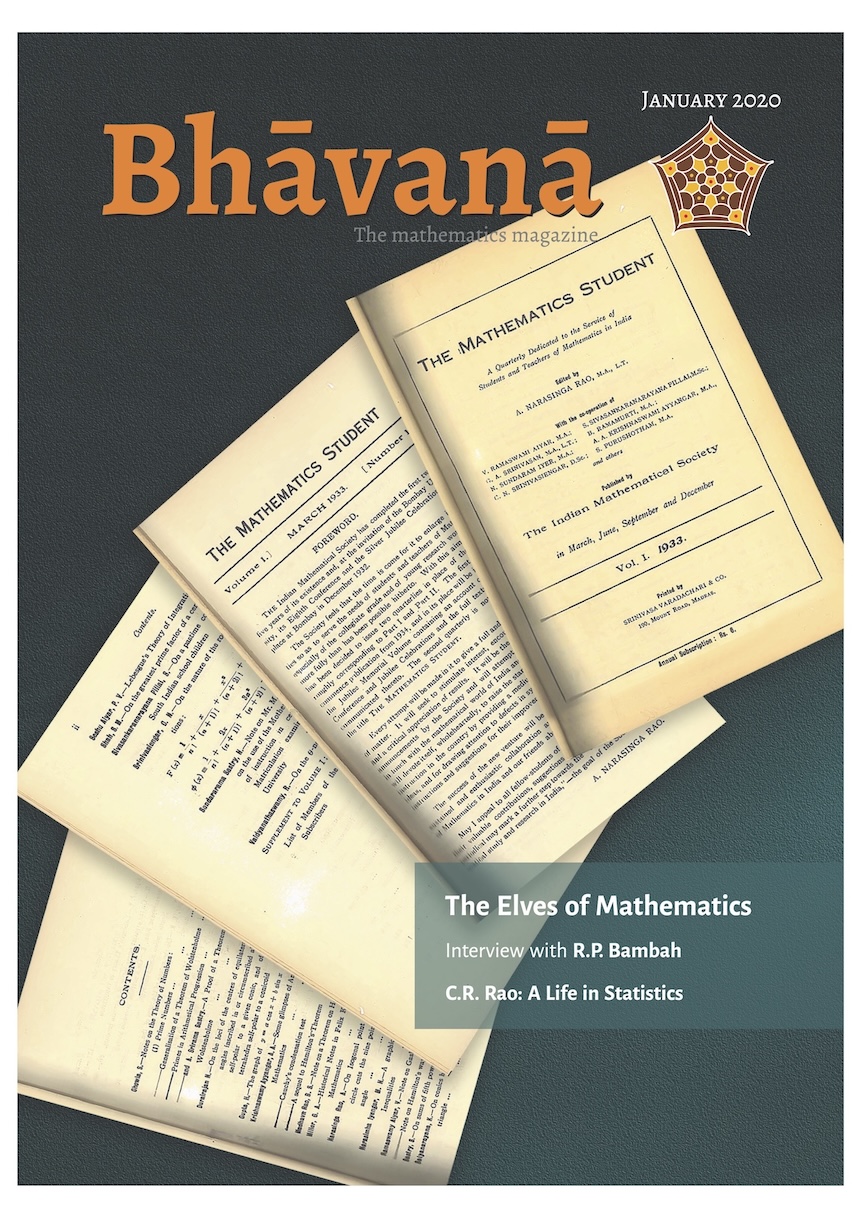
Going through the pages of this issue of Bhāvanā, our discerning readers will not fail to notice the silent role of a guiding spirit—not any teacher but The Mathematics Student, a publication of the Indian Mathematical Society that is over a century old—and which has played a significant role in the evolution of many of the mathematicians featured in this issue. Born in 1933, it has nurtured the careers of C.R. Rao, R.P. Bambah and Abdus Salam by publishing their first creative works when they were still students. We celebrate the lasting impact of this venerable forum that has entered its 87th year in the service of a large community of aspiring students. We are grateful to Bruce Berndt for providing the images from its inaugural edition. \blacksquare
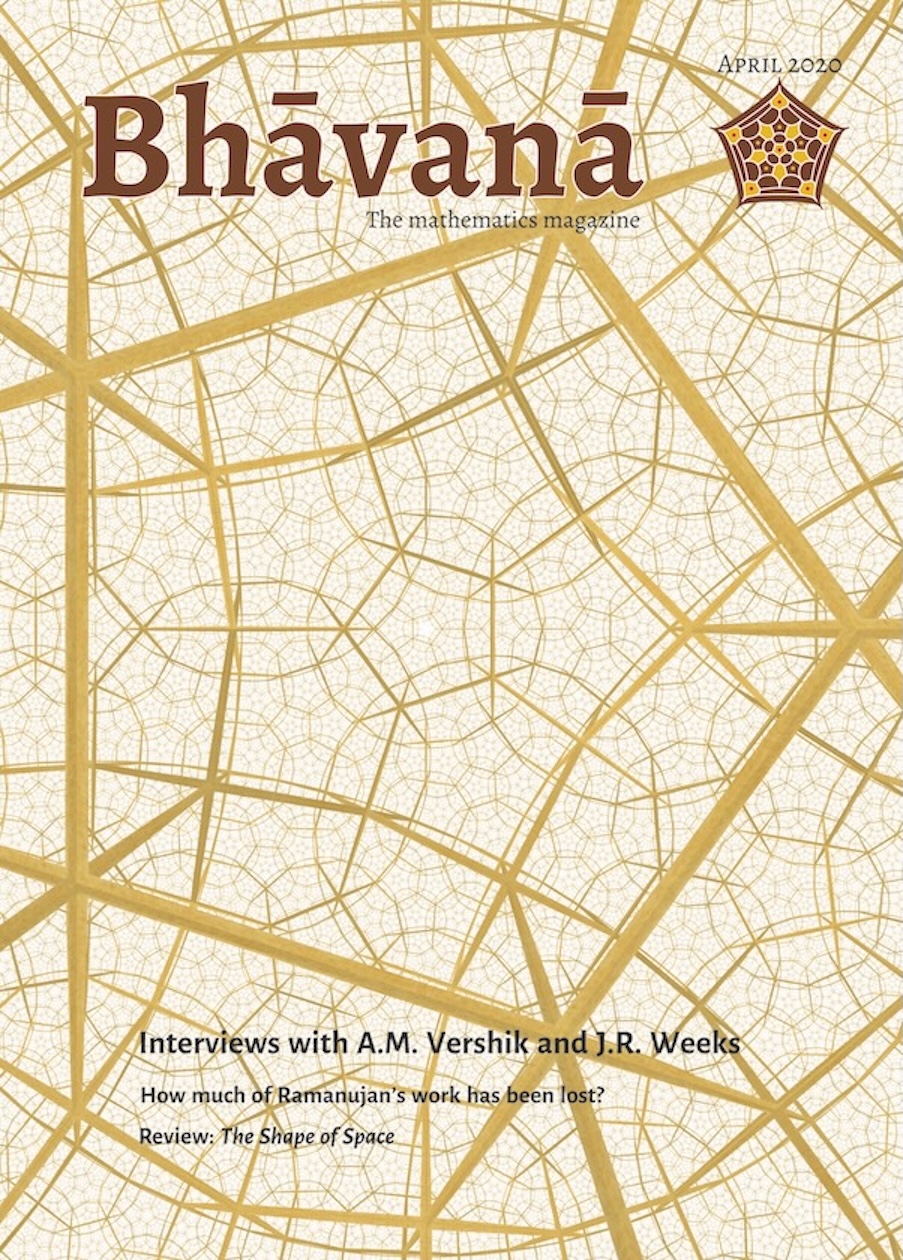 On the one-hundredth anniversary of Srinivasa Ramanujan’s passing away, we have a distinguished mathematician from the University of Illinois at Urbana-Champaign, Bruce Berndt, informing our readers on some miraculous events from recent history that helped salvage Ramanujan’s working papers. Via a tortuous route that takes the readers from Ramanujan and Hardy’s Cambridge days in the period 1914–19, and moving to the cluttered attic office of George Neville Watson up until the 1960s, the narrative weaves a story across half a century, rich in its portrayal of human experience and quality. Starting from a tale of genius on one hand, and moving on to highlight certain aspects bordering on deceit and neglect, followed by a serendipitous discovery, which all luckily ended with both relief and epiphany, he reminds us that while it’s natural to debate on what has possibly been lost forever, we also need to be grateful for what has been preserved; and more so, sincerely acknowledge the roles of all those unsung players who played their own roles with both care and dutiful diligence.
Speaking to us in another episode of “In Conversation” is the prominent Russian mathematician Anatoly Moiseevich Vershik. Vershik grew up in the Soviet Union of the Stalin era, during very troubled times, having barely managed to survive the horrors of WWII. A student of Vladimir Rokhlin, Vershik counts the who’s who of Soviet-era mathematics as his teachers or collaborators. He later went on to blaze a trail in mathematics, establishing a reputation for exploring a diverse range of topics, while simultaneously contributing to each of those at considerable depth. In doing so, he along with a large and talented bunch of students, and collaborators worldwide, have helped identify, build and strengthen hidden bridges and connections between far flung areas of mathematics that were hitherto thought of as unconnected.
In another “In Conversation” article, we chat with Jeff Weeks, a topologist and geometer by training, a popular math educator and by extension, a game developer and also an occasional cosmologist all rolled into one, not to mention the author of the much admired book The Shape of Space. In a delightful conversation, Weeks reminisces about his unexpectedly adventurous days as a doctoral student of the famous Fields medallist William Thurston at Princeton, the rather unusual circumstances that led to the writing of his book, his experiences in math education—particularly in developing numerous computer games to build geometric intuition, his research in the areas of hyperbolic geometry and knot theory and his current and past projects.
Complementing this conversation with Weeks, this issue of Bhāvanā features a review by Subhojoy Gupta of the recently published third edition of Weeks’ widely recommended book, The Shape of Space. Quoting Thurston, Subhojoy emphasizes the main recurring theme in Weeks’ book—the art of imagination, a trait that the book seeks to encourage and imbibe in the reader. Subhojoy gives us a brief glimpse of the many intuitive and visual arguments that pervade the book while simultaneously tracing the rich history of geometry, from Gauss’ early results to Riemann’s monumental work, moving on to Henri Poincaré’s topological insights. He also looks at Bill Thurston’s key ideas, culminating with Perelman’s breakthrough proof of the long-standing Poincaré conjecture. Praising the vivid illustrations that can be found on almost all pages of the book, the review concludes that Weeks’ book is a “timeless classic”.
 In this issue of Bhāvanā, Karanbir Singh Sarkaria concludes his two-part series, a unique mathematical exposition via a visual tour of his house, the architecture of which embodies fundamental topological and geometric concepts. This captivating journey of his house resumes with Grecian origami, elucidating its treatment in a group-theoretic framework, then steers the reader through the `Pythagoras drive’, subsequently meandering through elements of curved geometry, tiling of hyperbolic spaces and other fundamental topics, through yet another captivating visualization. The article indubitably motivates both advanced practicing mathematicians as well as beginners to visit this mathematical-architectural wonder `213, 16A’, in this concluding part.
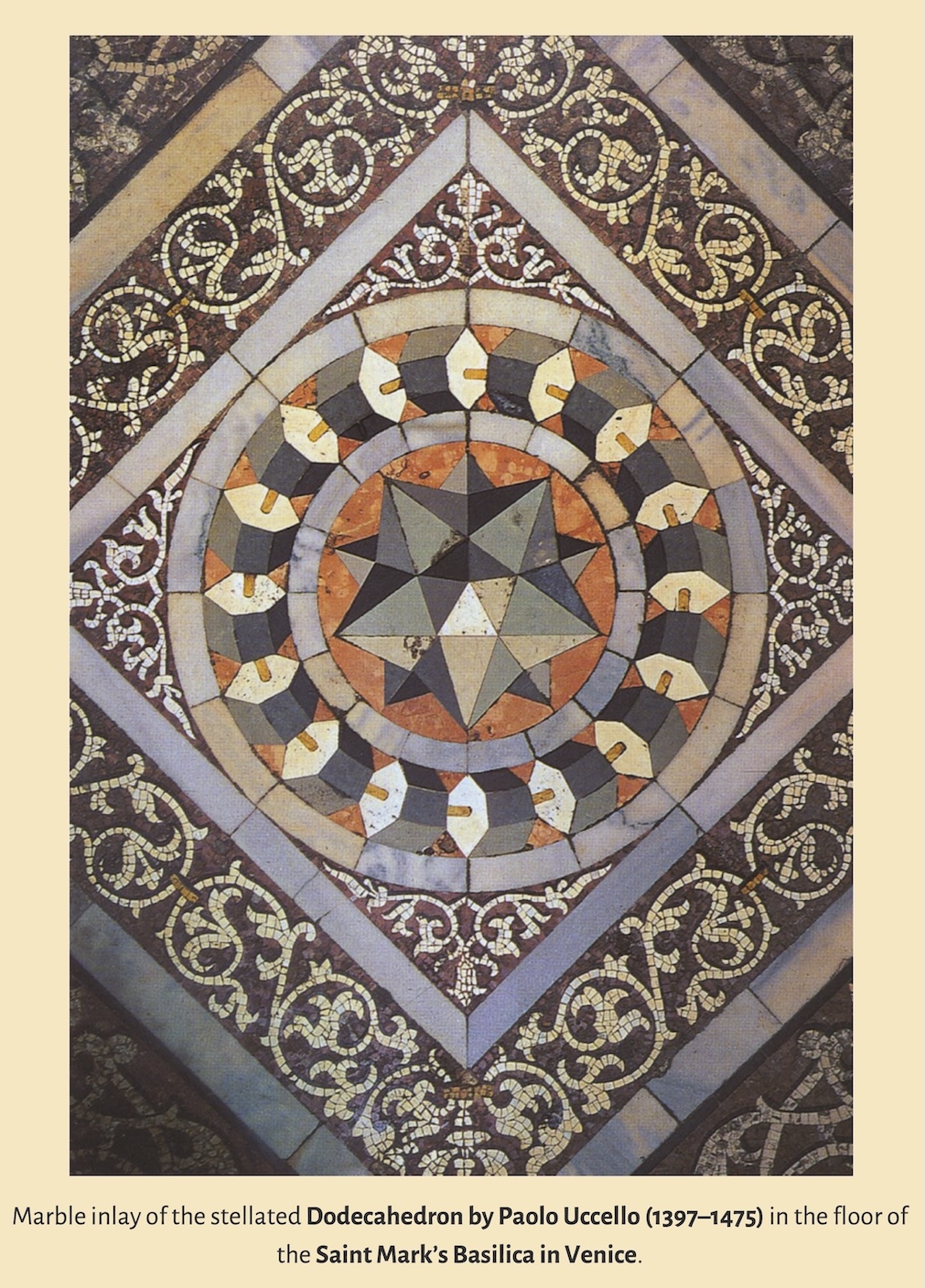
Talking about tiling, the cover pages reflect some of the visual sentiments implicit in Sarkaria’s article and the interview with Weeks. Indeed, we are indebted to Weeks for providing us with the intriguing image used on the front cover which represents a tiling of three-dimensional hyperbolic space by right-angled dodecahedra, containing many two-dimensional hyperbolic planes tiled by right-angled pentagons. The back cover is a gem of an art by the 15th-century Italian artist Paolo Uccello. \blacksquare
 Following the article by Bruce Berndt on the work of Srinivasa Ramanujan in the April issue of Bhāvanā this year, one which marks the death centenary of the legendary mathematician, this issue features an updated account of the Ramanjuan legacy. The article, penned by Parthasarathi Mukhopadhyay, takes a look at some “socio-cultural’’ and “mathematical’’ events that have transpired since the publication of The Man Who Knew Infinity, the seminal biographical account of Ramanujan written by Robert Kanigel, published in 1991. Parthasarathi Mukhopadhyay draws on his experiences stemming from the time he spent in translating Kanigel’s book into Bengali, and provides a fresh peek into both the human and academic facets of the short life of a mathematical genius.
Dwelling on these sentiments, some of the images in this article subtly record the silent roles in the lives of individuals and the society played by newsmedia. The Hindu, a leading daily newspaper from India that is more than a century old, witnessed such key moments in Ramanujan’s life. It carried a note when, in September of 1905, Ramanujan, then unknown to the world, went missing from home; it celebrated Ramanujan’s momentous boarding of the ship Nevasa in 1914 to England accepting Hardy’s invitation; and it also reported his sad passing away one hundred years ago. Bhāvanā is grateful to The Hindu, particularly to N. Ram, for the kind help with the several images reproduced from its archives.
The Hindu, chronicled key moments in Ramanujan’s life
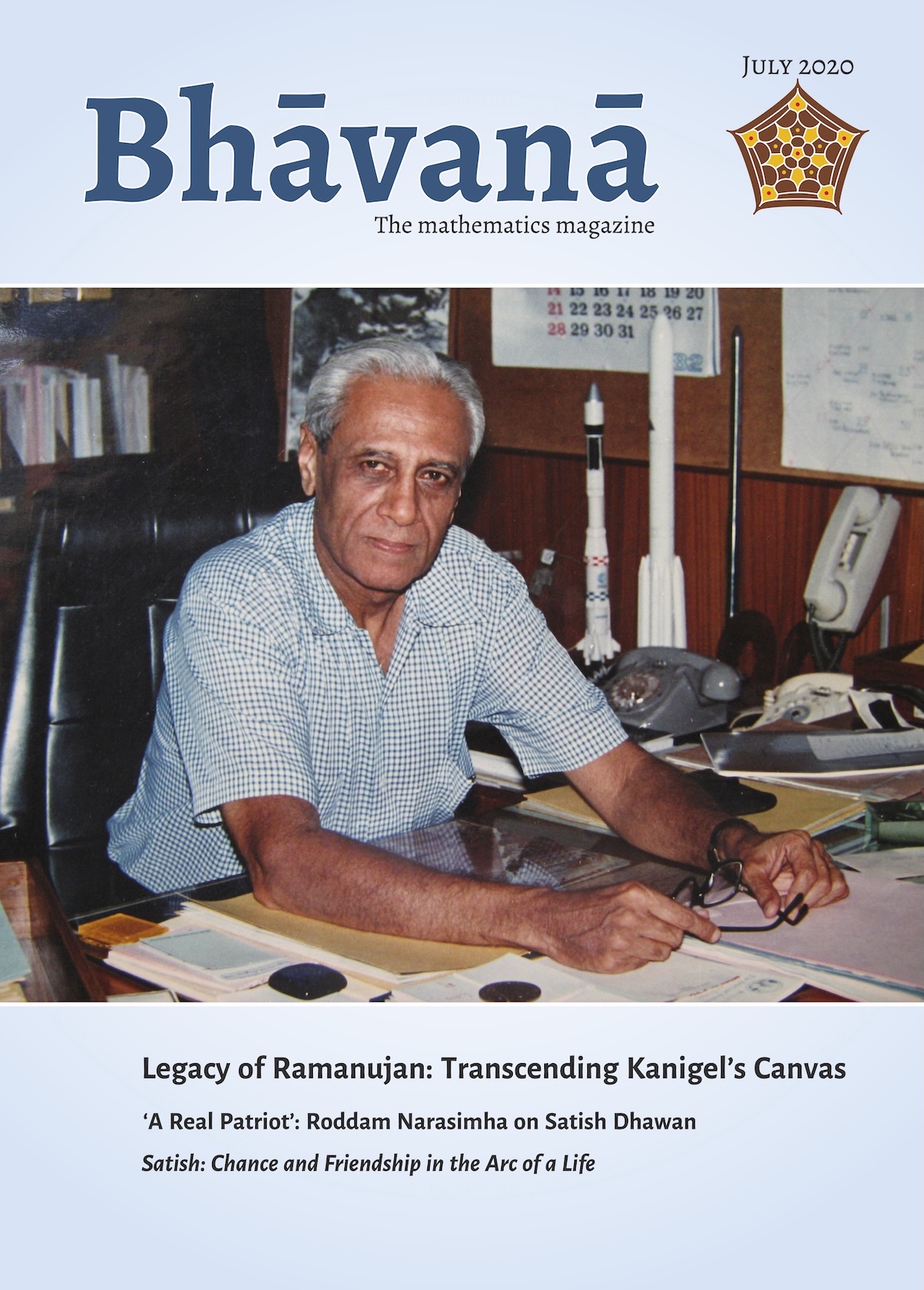
This year marks another centenary, namely, the birth centenary of Satish Dhawan. Mathematics and engineering—mathematics provides the language to describe the motion of fluids while engineering provides the means to study them in experiment—came together in the aeronautics and space pioneer that was Satish Dhawan. We catch glimpses of “Satish”, as his daughter, Jyotsna, reminisces about how a personality like his came to be made during the early years after Indian Independence. Her recollections of how Indian science was practiced in those days, and of Dhawan’s close friendships with his peers and colleagues, tells us of the founding ideals of some of the leading science institutions in India today.
Narasimha brings out the transformational impact Dhawan had on IISc, and his role in making ISRO the grand success
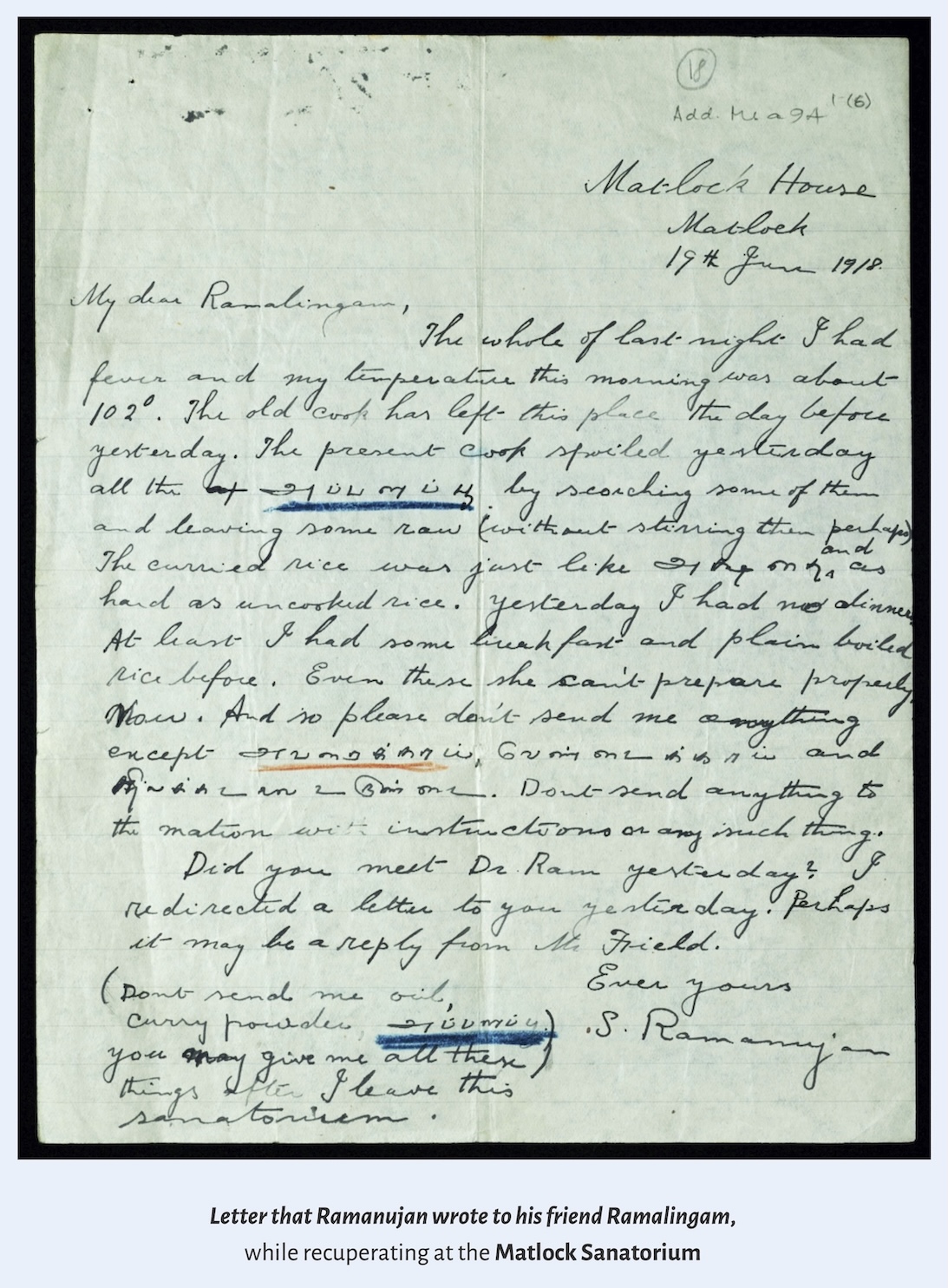 K.R. Sreenivasan, who himself is well-known for his contributions to fluid mechanics, also writes about Dhawan in this issue of Bhāvanā. The article brings out several of Dhawan’s accomplishments towards research in India, beginning with his role as the Director of the Indian Institute of Science (he was appointed at the age of 41!) where he also set up India’s first supersonic wind tunnel, due to which he is also referred to as the `father of experimental aerodynamics in India’. Subsequently, Dhawan’s leadership of the Indian Space Research Organisation is also brought out, including his mentoring of eminent scientists such as A.P.J. Abdul Kalam and K. Kasturirangan. Sreenivasan shares interesting personal interactions with Dhawan and his resulting gleanings into the scientist’s character, which explain the mechanics of his leadership and scientific success.
This issue also features an insightful interview of Roddam Narasimha on his association with his mentor, Satish Dhawan. Narasimha reminisces on the personal influence that Dhawan had on him, especially in helping him decide on pursuing a scientific career. He recalls Dhawan’s knack for identifying young talents like Kalam and his vision and leadership as an institution builder. In a delightful narration, he brings out the transformational impact Dhawan has had on IISc during his tenure as its Director and his role in making ISRO the grand success that it is today. This is a must-read for the scientist, the student and the scientific administrator alike. We at Bhāvanā are honoured to present this interview, with grateful permission from the Archives of the Indian Institute of Science, to our readers. \blacksquare
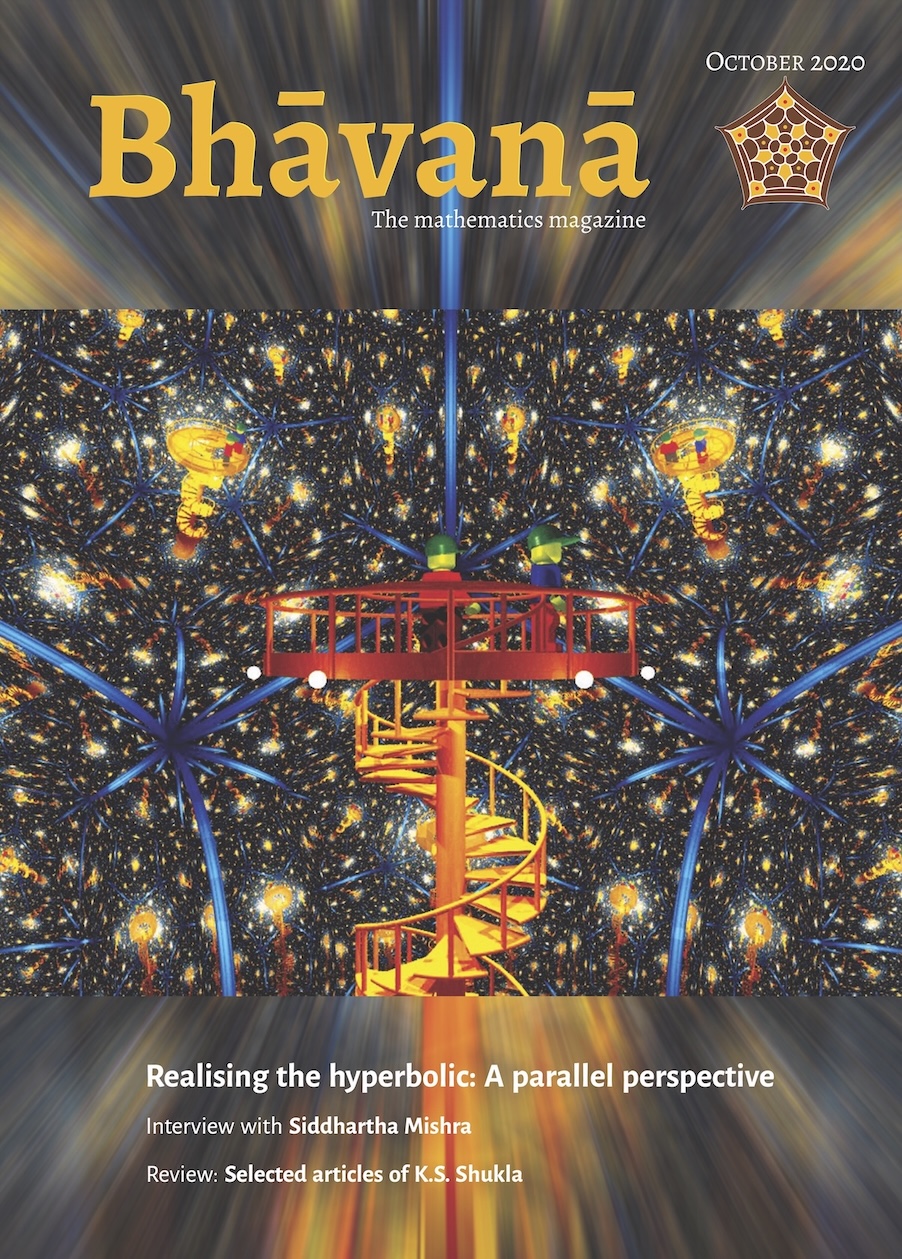 In this issue of Bhāvanā, and in our `In Conversation’ series, we feature a pioneering and young computational scientist, who has already stamped his authority on the topic of the design and analysis of numerical algorithms routinely employed to tackle the hard problems of fluid flow. These classical problems, which typically tend to be both nonlinear and intractable, are now being tackled via brand new methods, and by even more novel philosophies—the continually growing use of ideas from machine learning being a noteworthy example here. Siddhartha Mishra, an accomplished expert in these matters, spoke to us about his academic journey so far, and also on his own work in this subject, which lies at a fertile intersection of modern ideas emerging from mathematics, physics and computing.
This issue features an interesting approach to the exposition of hyperbolic geometry by Jos Leys. With the aid of beautiful illustrations, Leys wonderfully describes the world of hyperbolic geometry by imagining the construction of a `hyperbolic room’ in a science museum. This very intuitive introduction to hyperbolicity, while being accessible to students at the high school level, will also be an enriching read for mathematicians, and we hope that our readers will enjoy it as much as we did. The short explanatory appendage by Étienne Ghys as to why this idea is a mathematically supported one as well, is both enriching and encouraging for innovative museum curators to try realising it. It is worthwhile bringing to our readers’ notice that Ghys and Leys are well-known for co-producing the educational movie Dimensions: A walk through mathematics! (http://www.dimensions-math.org/Dim_E.htm), addressed to a wide audience.
Jos Leys describes the world of hyperbolic geometry by imagining the construction of a ‘hyperbolic room’ in a science museum
“Glimpses from the Life and Work of Dr. C.R. Rao’’ is a timely reminiscence of C.R. Rao by his former graduate student, Anil Bera, who had extensively documented his mentor’s life and work in an interview in the journal Econometric Theory in 2003. In this issue of Bhāvanā, the humorous anecdotes recounted by Bera showcase Rao’s humility and decades-long intellectual drive that saw him set up several statistical institutions in India while he continues to remain an active figure in statistical research today. Perhaps the most remarkable example of Rao’s foresight are his seemingly prophetic statements in the 1950s about the looming impact of computers and programming on statistical science and the emergence of remote-working. These seem strikingly relevant in today’s pandemic-hit world that has seen statistics researchers, working from their homes, play a key role in understanding the evolution of the SARS-CoV-2 virus.
C.R. Rao’s foresight are his seemingly prophetic statements in the 1950s about the looming impact of computers and the emergence of remote-working.
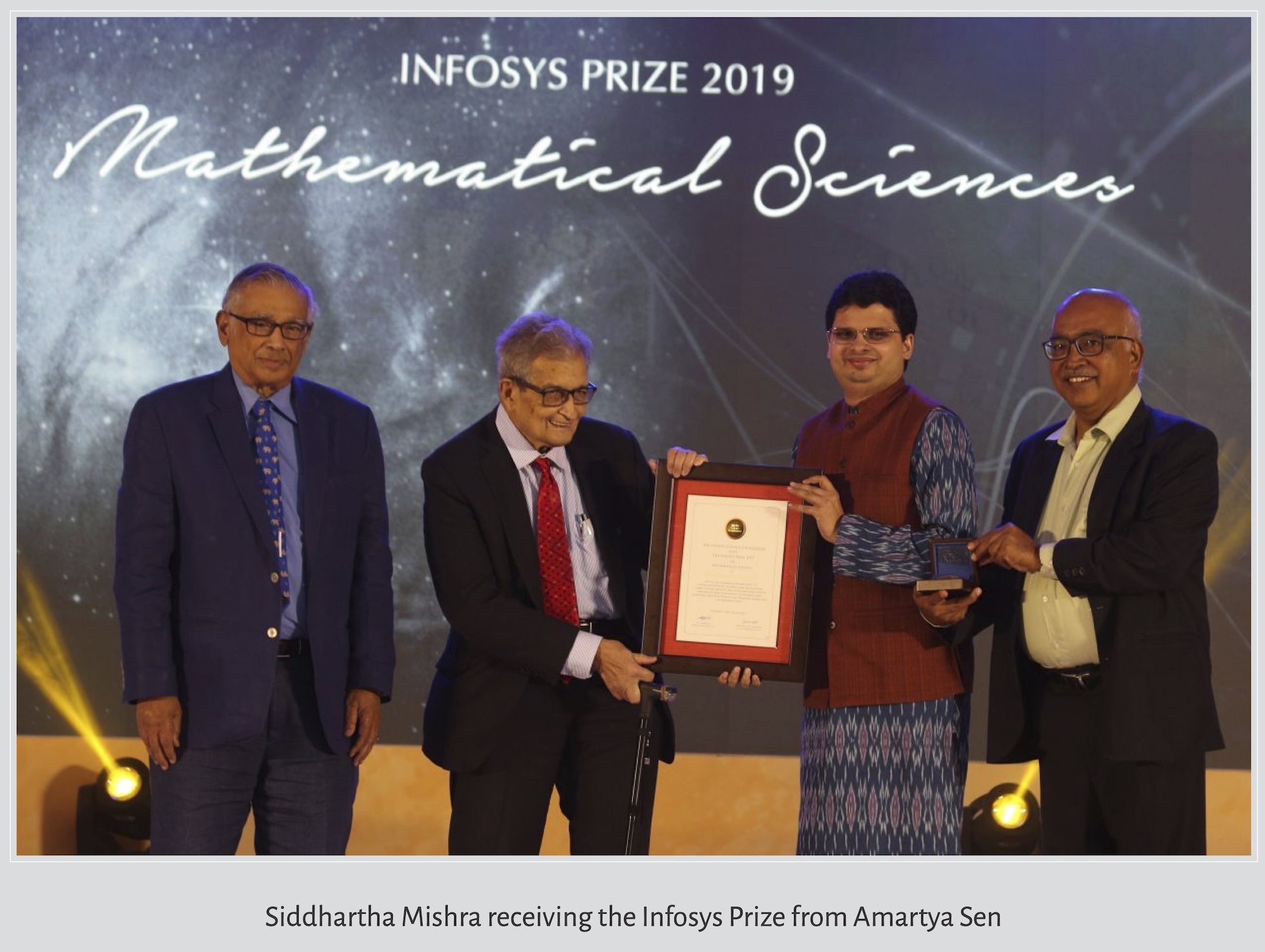 Following on from the book review of Gaṇitānanda in the October 2019 issue of Bhāvanā, this year’s final issue puts the spotlight on the works of another eminent historian of Indian mathematics and astronomy, the late Professor Kripa Shankar Shukla, a contemporary of Sarasvati Amma, whose extensive contributions have greatly furthered the understanding of the rich mathematical traditions prevalent in ancient and medieval India. The collected works of K.S. Shukla published under the title Studies in Indian Mathematics and Astronomy: Selected Articles of Kripa Shankar Shukla is reviewed by Avinash Sathaye. Sathaye lauds the meticulous research and attention to details as a highlight of Professor Shukla’s works. Interspersed with observations about the many varied points of view that form the crux of such historical works, the reviewer takes us back in time to offer intriguing glimpses of mathematical scholarship in Indian history. \blacksquare
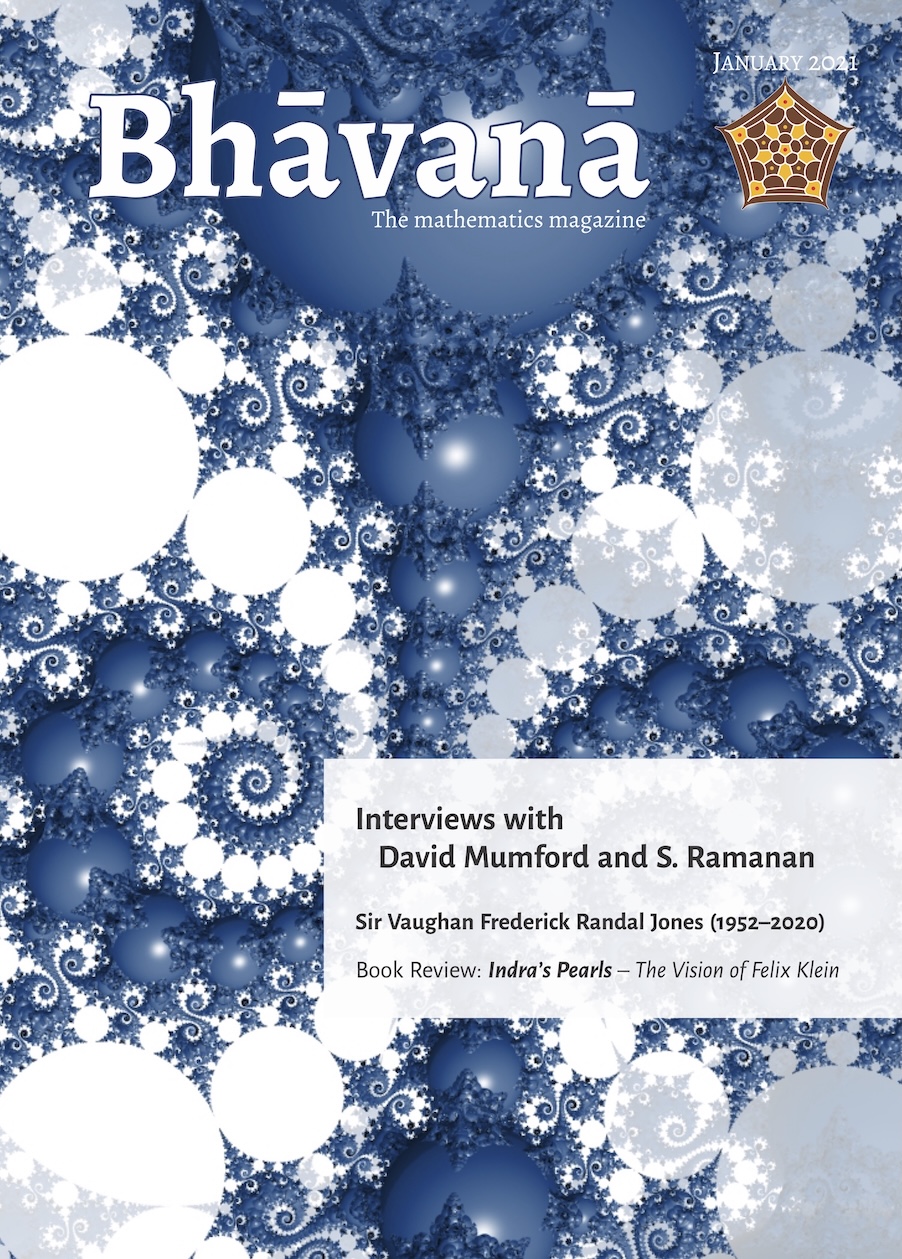 This issue of Bhāvanā brings us face to face with one of India’s leading mathematicians, S. Ramanan. From being a doctoral student at TIFR, learning from the likes of K. Chandrasekharan, Jean Louis Koszul, M.S. Narasimhan and others, crossing paths with Sir Michael Atiyah and Raoul Bott at Oxford and Princeton as an upcoming mathematician, to finally mentoring other promising mathematicians such as Vijay Kumar Patodi at TIFR, Ramanan’s remarkable mathematical career has indeed come a full circle in the truest sense of the phrase. In an engaging conversation, Ramanan remembers his childhood days spent in erstwhile Bombay and Madras in the pre-independence era, followed by a struggling stint as a clerk in the Indian Railways when he had almost given up hope on a mathematical career to his eventual homecoming to TIFR.
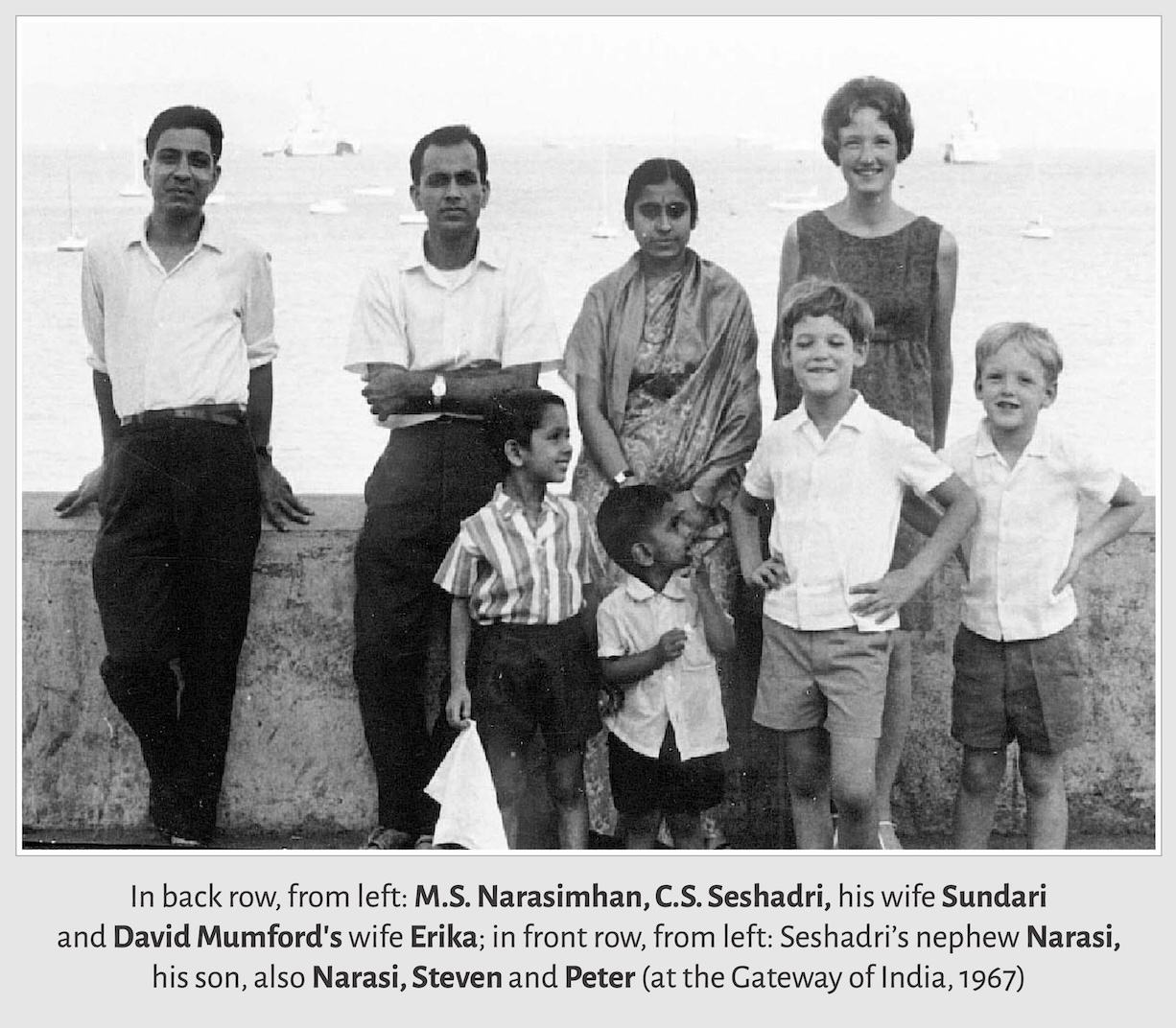
TIFR would also play host to another mathematician born a month apart from Ramanan, to David Mumford, whose successful forays in tackling some of the hardest topical problems of mathematics, are subject folklore. If lending one’s name to a pivotal theorem or an entire sub-area is a gold standard of mathematical excellence, then David Mumford owns a mint. No less than ten separate, and deeply consequential ideas spanning Algebra, Geometry and Computer Vision are named after Mumford and his many collaborators, signalling his wide-ranging contributions and establishing his reputation as a fountainhead of fertile ideas. Mumford recalls his younger days, his relentless pursuit of mathematics, and reminisces about his dear friends at TIFR Mumbai over his many visits there, particularly noting C.S. Seshadri, who passed away in 2020.
Mumford is one of the authors of Indra’s Pearls: the vision of Felix Klein, which is reviewed by Amritanshu Prasad in this issue. The book is a refreshing and enjoyable read for a general audience that also elucidates advanced concepts from differential geometry such as Möbius maps and fractals. The review highlights the significant mathematical ideas contained in the book, their historical development, and sheds light on the mathematicians behind the math. The book reminds us that experimental curiosity, and not just (albeit necessary) razor-sharp rigor, is an essential component to impactful and beautiful mathematics. In this spirit, the review provides the motivation and precursors to read the book and join the authors on the mathematical explorations themselves, using extensive illustrations and easy-to-implement algorithms, with hints provided to exercise one’s own grey-matter and discover the mathematics for oneself!
 We begin 2021 noting the passing away of Fields medallist Sir Vaughan Jones last September. As a tribute to this towering mathematician, we feature in this issue a piece about his life and achievements, another about his connection to India, and a 2012 interview where he had spoken about the highlights of his career and his favourite pastime, kitesurfing. We hope that these three pieces bring to light the various facets of an extraordinary mathematician who had endeared himself to the mathematical community with his openness and generosity.
Roddam Narasimha, whose life and work was extensively covered in early issues of Bhāvanā, passed away in December 2020. We are grateful to the Office of the Principal Scientific Adviser to India who has organised efforts to translate our interviews of Narasimha into Indian languages. \blacksquare
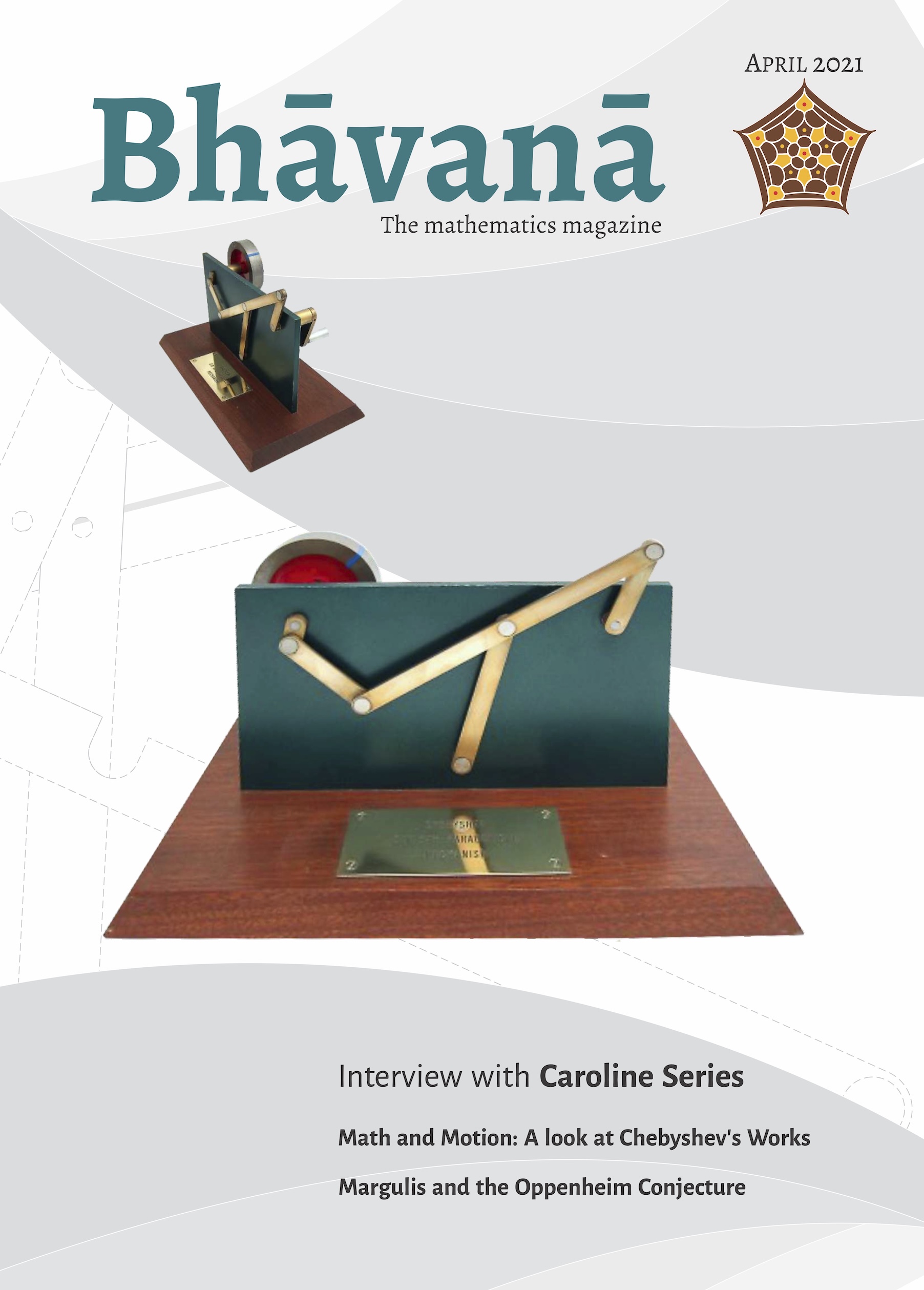 In this issue, Bhāvanā marks the bicentenary of the birth of Pafnuty Chebyshev, the Russian polymath. Regarded as one of the founding fathers of the Russian school of mathematics, Chebyshev’s notable works in probability, number theory and analysis, have not only stood the test of time, but in some cases have even been the foundational works on which entire theories have been erected in the ensuing centuries. His work on mechanical linkages, digital filters and scientific toys could be viewed as precursors of modern robots, showing once again that mathematicians need not only revel in the abstract.
Athanase Papadopoulos chronicles his life and work while carefully placing his contributions in a historical framework. Alena Zhukova writes in detail about the fresh mathematical perspectives that Chebyshev brought to the study of mechanical linkages. Published seventy years after James Watt’s work on linkages, Chebyshev’s ideas on linkages brought in insights from geometry, and lent a new dimension to what was till then essentially seen as an engineering domain. The connection between planar linkages and algebraic curves, exemplified by William Thurston’s statement that “there is a linkage that signs your name”, is a testimony to Chebyshev’s pioneering work in that area.
We carry an interview of Caroline Series, originally published in a newsletter of the Institute of Mathematical Sciences, National University of Singapore. Series is well-known for her important contributions in the area of Kleinian groups, hyperbolic manifolds and dynamical systems. The interview touches upon her motivation for her choices in mathematics education and her graduate research, before delving into her celebrated work, Indra’s Pearls, co-authored with David Mumford and David Wright. This article is a good read for both general and mathematically-inclined readers as concepts from hyperbolic geometry are explained in simple manner while still conveying a sense of their profundity.
Continuing along this theme of dynamics, S.G. Dani, in an insightful article, recalls his association with Gregory Margulis, an Abel Prize laureate of 2020. Beginning with the Oppenheim Conjecture, Dani describes Margulis’ approach to solve the conjecture, and recalls how difficult it was at that time to get his hands on the proof. He then reminisces on his visits abroad to collaborate with Margulis and how the latter’s simplicity put him at ease. This resulted in fruitful collaborations and led to many highly-cited joint papers. An illuminating and inspiring account, this article gives a unique perspective on the impact of Margulis’ work in ergodic theory and dynamics.
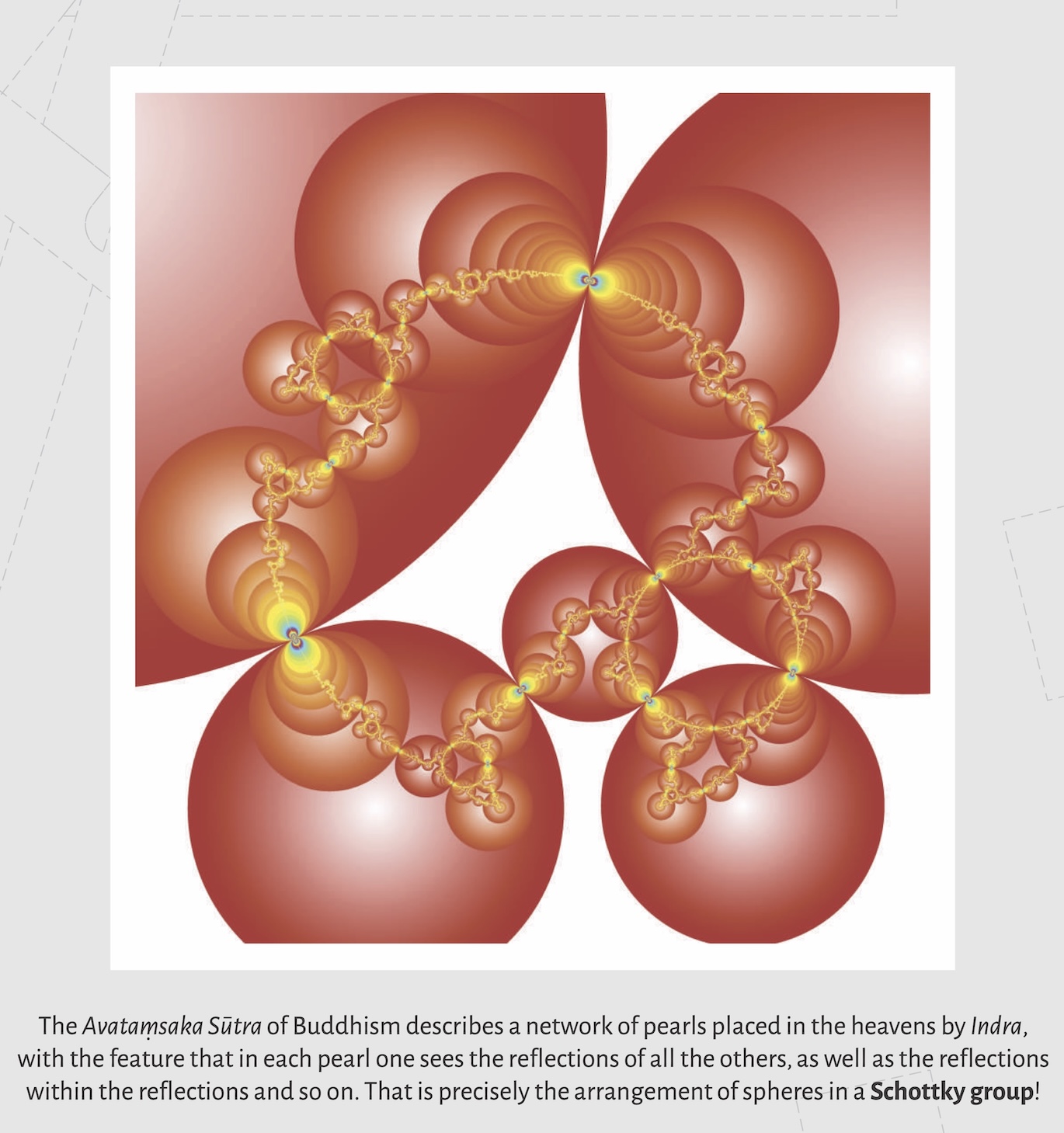 Both cover images of this issue lay bare the beauty of mathematics in both its pure and applied forms. The front cover features Chebyshev’s paradoxical linkage, a most intriguing and counter-intuitive mechanism, where one revolution of the crank handle corresponds to two revolutions of the flywheel in the same direction, or to four revolutions of the flywheel, but now in the opposite direction. We thank Chris Sangwin for permission for this image from his work, “How Round is Your Circle?”, written with John Bryant.
The back cover shows an arrangement of nested spheres, called the limit set, for a particularly symmetric Schottky group. A Schottky group is generated by transformations which map the outside of one sphere onto the inside of another. Such an arrangement of spheres is reminiscent of the Avataṃsaka Sūtra of Buddhism, which describes a network of pearls placed in the heavens by Indra, with the feature that in each pearl one sees the reflections of all the others, as well as the reflections within the reflections and so on. The particular image is due to David Wright, one of the three authors of Indra’s Pearls. \blacksquare
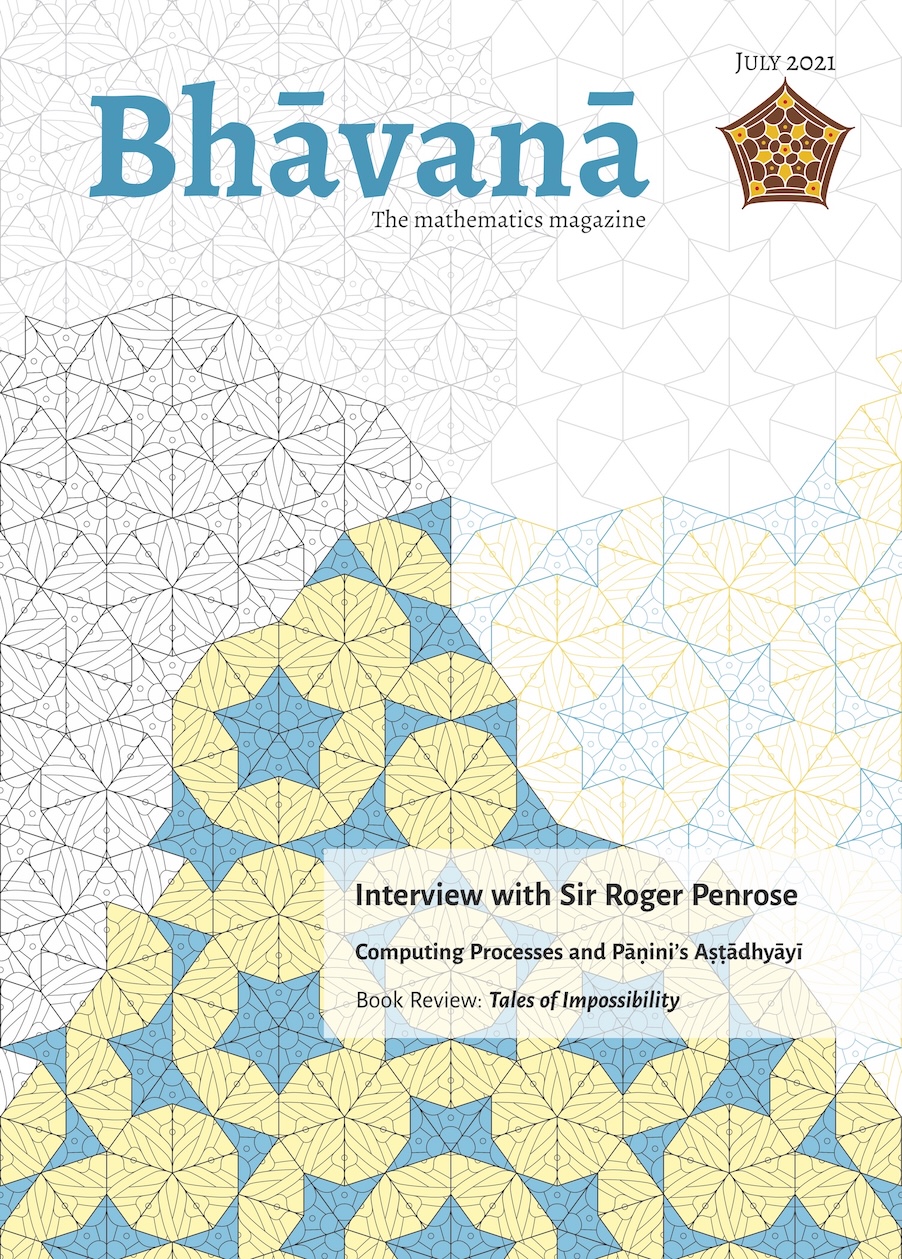 In our first coverage of a Nobel laureate in Bhāvanā, we reprint an interview of Sir Roger Penrose, who was awarded the 2020 Nobel Prize for discovering aspects of black hole formation that substantiate the general theory of relativity. The conversation with Oscar García-Prada delves into the early years of Penrose’s career and the intellectual influences from his family and teachers that paved the way for his long and illustrious career. There are several insightful discussions covering a large breadth of his work ranging from his collaboration with Stephen Hawking, his discussions with the artist M.C.\, Escher, and a variety of topics touching upon his philosophical views detailed in the book The emperor’s new mind.
The article by R.K. Shyamasundar discusses the achievements of the great Sanskrit grammarian Pāṇini from the standpoint of modern computing. The author points out precursors of computational thinking involved in Pāṇini’s Aṣṭādhyāyī and elucidates how modern linguistic concepts find resemblance in Pāṇini’s brilliant work. His masterful skill lies in the fact that his grammar provides a near-exhaustive analysis of Sanskrit, all the while adhering to the principle of lāghava, or brevity of expression, which makes his grammar as concise as possible. The article details all this and more, shedding light on the connections between Pāṇinian grammar, Kāraka theory, modern logic formalism and modern knowledge representation schemes.
The review of David S. Richeson’s entertaining new book Tales of Impossibility: The 2000-Year Quest to Solve the Mathematical Problems of Antiquity is another article taking the reader far back in time. The review opines that the book is a refreshing take on a well-known topic in the history of mathematics, and does an impressive job in expounding some ground-breaking results that organically changed the mathematical landscape. With a fine balance of mathematics and historical details, Richeson traces the evolution of some fundamental ideas in algebra and geometry, centuries in the making. With the feel of an adventurous novel, the review concludes that Richeson’s book is a must-read for the mathematically inclined audience.
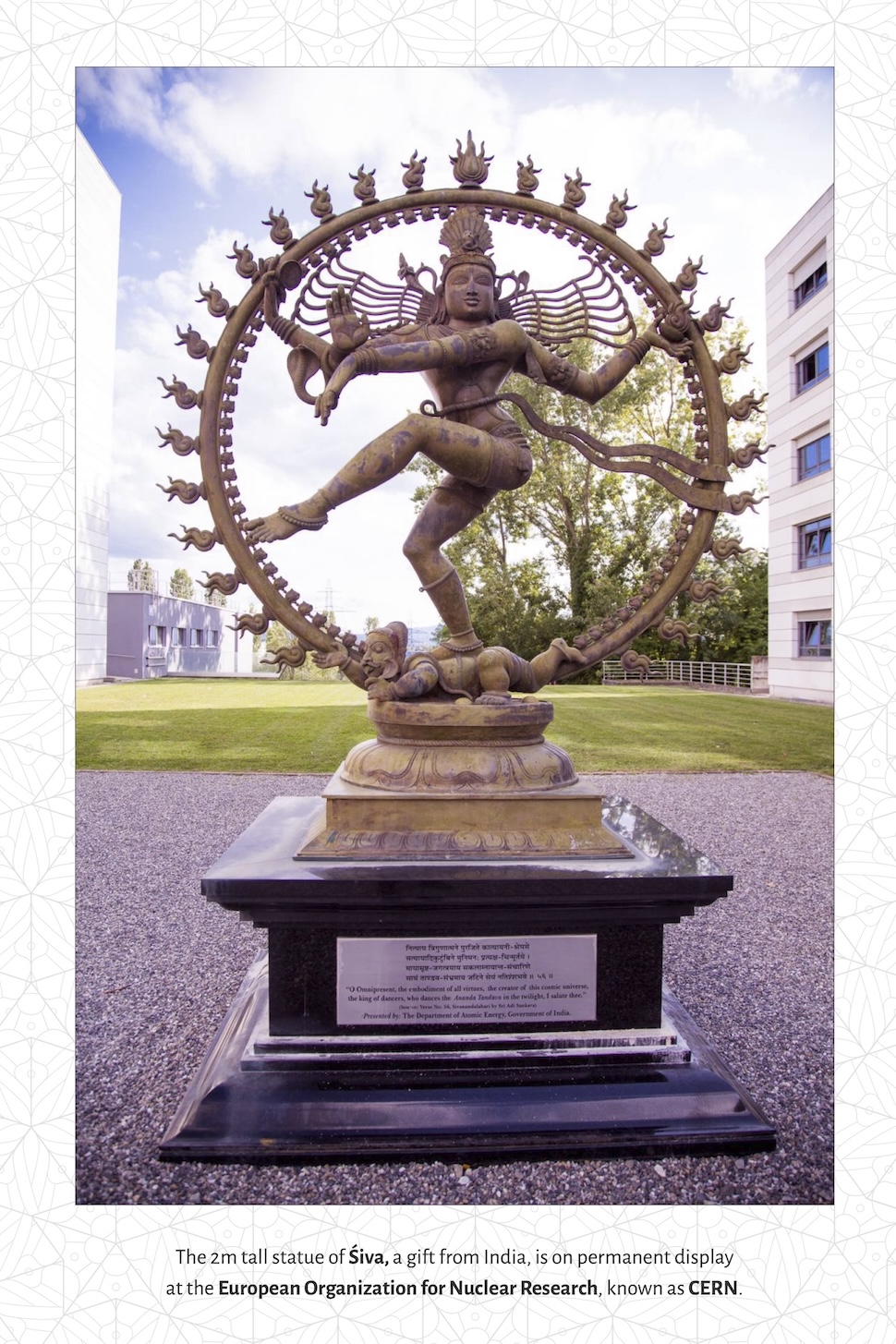 That it is impossible to tile a floor with regular pentagons is an easily observed fact, where squares and hexagons abound. Despite the logically evident absence of pentagons in floor tilings, most flowers in nature display five exquisitely arranged petals, each beautiful in form and colouration—one place where beauty and truth are revealed at once.
How does one reconcile the natural and the vivid with the abstract that is logical insight? Deviating from the trodden path, Sir Roger Penrose made an amazing discovery in the 1970s. He found a pair of polygons—a carefully handpicked dart and a kite—whose collection would cover a plane without gaps or overlaps, and in a mathematically rigorous pattern different from the regular, for they do not display the translational right-left, up-down symmetry of the common floor tilings. Can this be natural as well? Lo and behold, the 2011 Nobel Prize in Chemistry, awarded to the Israeli scientist Daniel Shechtman, was for his discovery of a type of strange and unusual crystal that upset the prevailing views on the atomic structure of matter. These quasicrystals display a diffraction pattern akin to the Penrose tiling. The front cover illustrates Penrose’s discovery, blending with the pentagonal symmetry of the Bhāvanā motif.
The Ḍamaru in one of Śiva’s arms on the back cover relates to the Māheśvara Sūtras of Pāṇini. \blacksquare
 Daina Taimi ņa discovered a remarkably innovative method to visualize and explain ideas in the geometry of the hyperbolic plane with the help of crocheting models. In an engaging conversation with Vishesh Bhat, she shares her mathematical journey right from her school days to her PhD in theoretical computer science in Latvia, and her eventual move to the USA. She hit upon the idea of crochet hyperbolic models upon seeing Thurston’s paper model of the hyperbolic plane. She met her future husband, the geometer David Hendersen, in an invitation-only workshop in Italy On the teaching of Geometry for the 21st century, from where ensued a great collaboration inspired by their consonant approach to teaching. Taimi ņa speaks of all this and more, offering precious insights into Latvian culture in her lively recollection.
The theme of using visuals to disseminate mathematical knowledge also finds itself in the chronicles of the life and works of Maryam Mirzakhani, the first ever woman to win the prestigious Fields Medal in 2014. Despite the accompanying fame she remained her modest self, affable and approachable. Sadly, she succumbed to cancer in July 2017, when she was barely 40. George Csicsery captures her extraordinary life in an hour-long documentary, which is the topic of two review articles in this issue. While Nikita Agarwal gently touches upon some aspects of Mirzakhani’s life and works along the way, Ramin Takloo-Bighash, who knew Mirzakhani since her school days in Tehran, gives a first-hand account of his own interactions, thus affording another peek into her unique persona. The two reviews celebrate the never-say-die spirit of someone who literally lived mathematics, and pursued the opportunity to explore it with creative abandon.
Another woman whose mathematical achievements are rightfully celebrated is Sofya Kovalevskaya who, in the 19th century, was the first woman in modern Europe to gain a doctorate in mathematics, the first to join the editorial board of a scientific journal, and the first to be appointed professor of mathematics. She made remarkable contributions, particularly to the field of partial differential equations. Eva Kaufholz-Soldat’s article recounts the challenge that Koveleskaya’s achievements, along with those of Marie Bashkirtseff and Charlotte Brontë, posed to several preconceptions at that time about women being incapable of independent creative achievement. The article also uncovers the origins of the myths that these women were unrequited and lonely in their personal lives due to their professional success. Most surprisingly, we learn that the writings of Paul Mobiüs, grandson of the mathematician August Mobiüs, and a famous physician, attempted to scientifically argue for the superiority of men over women in mathematical achievement.
Sofya Kovalevskaya was the first woman in modern Europe to gain a doctorate in mathematics, and the first to be appointed professor of mathematics
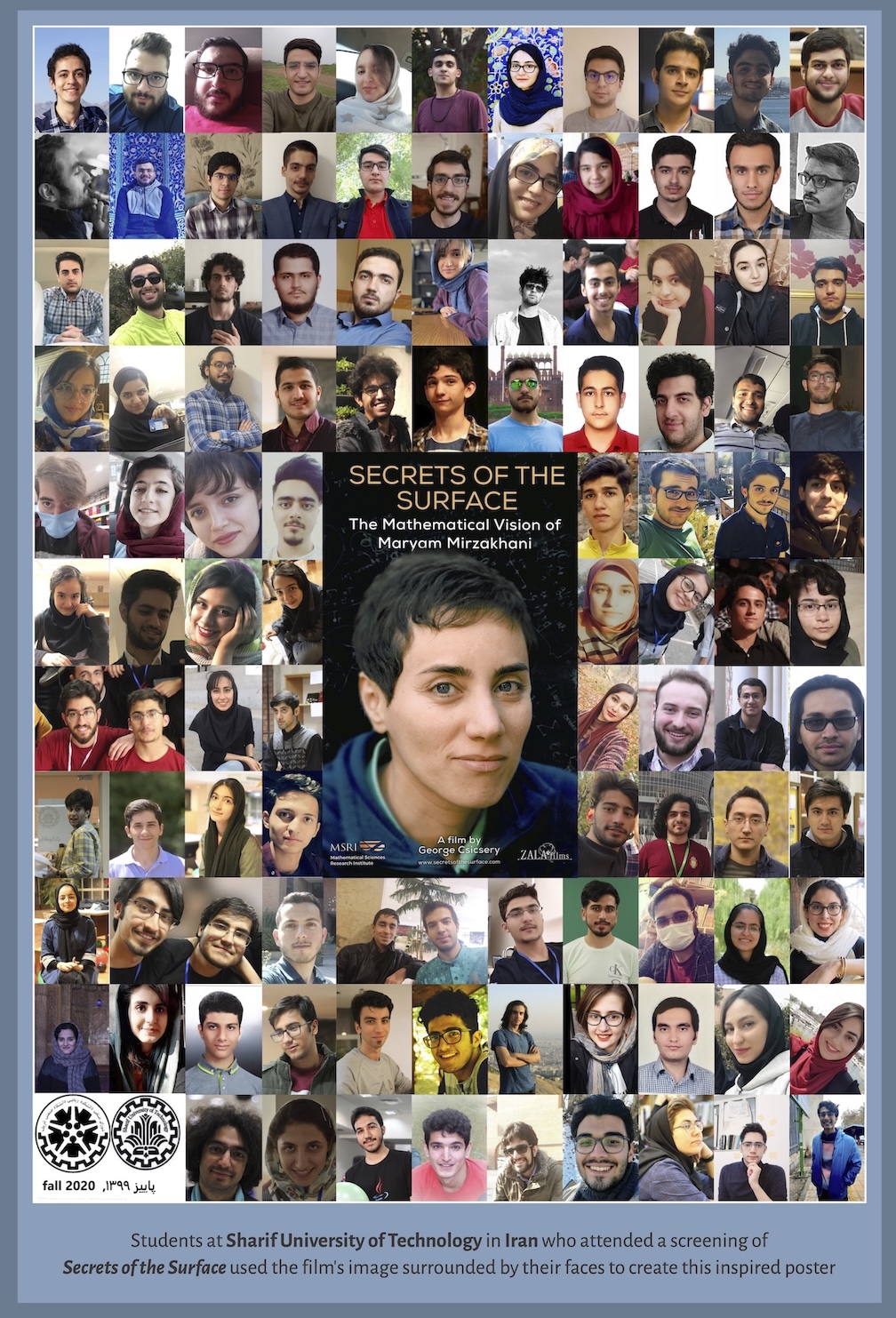 Another eminent woman mathematician of the times following Kovalevskaya, is Emmy Noether. Celebrated as the “mother of modern algebra’’, her life and achievements, presented three years ago in a delightful set of 30 cartoons by Constanza Rojas-Molina under the twitter hashtag #Noethember, is reproduced in this issue.
The front cover showcases Daina Taimi ņa’s demonstration of the surprising connection of a hard-earned mathematical truth via her special skills with crocheting, a creative entry into the realm of the mathematical world. The discovery of a consistent geometry – the non-euclidean hyperbolic plane – different from that learnt in high school, had held generations of mathematicians at bay for over two millennia, who described it in several different but equivalent formulations over the next century. Yet, perhaps not many would have expected modelling hyperbolic planes by crocheting objects. Daina’s unusual work is delightfully captured in the book Crocheting Adventures with Hyperbolic Planes.
The back cover – an inspired poster created by the students of the Sharif University in Iran – is a striking celebration of joy and excitement in the young college going minds, who find in the first ever female Fields Medalist Maryam Mirzakhani an icon and a yardstick of high achievement—a role model for their forays into an unknown future. \blacksquare
 We are delighted to offer this special issue, collaborating with the timely project initiated at IIT Gandhinagar, devoted to the history of mathematics in India.
Quite a few modern mathematicians over the years have been fascinated by the rich mathematical history of India and some have also chosen to turn this fascination into a worthwhile pursuit, thus doing their bit to relay the fertile ideas spawned by this vast tradition to subsequent generations. This special issue of Bhāvanā features an insightful tête-à-tête with Avinash Sathaye, whose fascination for the Sanskrit language, growing up, ended up as a serious tryst with the mathematics of ancient India in later years. Sathaye recalls his early schoolboy interest in Sanskrit and mathematics, his years as a doctoral student at Purdue University under the tutelage of the famed algebraic geometer, Shreeram Abhyankar, his pursuit of a solution to the still unsolved Jacobian conjecture influenced by Abhaynkar’s own interest, as also his self-enriching study of mathematical works in Sanskrit and his efforts to understand the nuances present in them, an undertaking which continues to this day.
In the coming editions, we plan to feature a series of articles by Amartya Dutta on Mathematics in India from the Vedic age to the sixteenth century in the Common Era. This series will explore our knowledge of fundamental mathematical principles discovered in India during this period and also delineate the primary source materials describing them. In this issue, we carry the first installment of this series that covers key texts from the Vedic and Sūtra periods. The mathematical results in these texts were explained either indirectly, such as describing geometric principles pertaining to altar construction, or directly as in the case of the decimal nomenclature and fundamental arithmetic operations. Further, this article goes on to present several interesting examples of geometric knowledge from these texts, such as the Baudhāyana-Pythagoras theorem first mentioned in the Śulba Sūtras of Baudhāyana. The interested reader will gain a comparative understanding of the Śulba Sūtras and Euclid’s Elements.
The Kerala school of astronomy and mathematics, founded by Mādhava in the 14th century, represents another golden phase of Indian mathematics. It is now widely recognized for its discovery of calculus and non-geocentric planetary models a couple of centuries before Europe. Unfortunately, the history and contributions of the Kerala school was ignored by modern historians due to the prevalent Eurocentric approach to such studies. Two articles by Bibhutibhushan Datta and Avadhesh Narayan Singh on Mādhava’s study of infinite series (in particular, for \pi), published respectively in 1926 and 1936, brought back the Kerala school into the limelight of scholarly discourse, and motivated serious historians of mathematics to rediscover and present the wide-ranging contributions of this school. Today, the history of the Kerala school is a flourishing topic of study. In a detailed and copiously referenced article, M.D. Srinivas presents important milestones in the historiography of the Kerala school of astronomy and mathematics between 1820 and 2021. This article covers all the highs and lows of this historiography, including the phase between 1825 and 1925 when the work of the Kerala school was impugned, the phase of resurrection between 1926 and 1952, initiated by the the efforts of Datta and Singh and carried forward by many others, and finally, the grand phase brought into motion by the comprehensive and phenomenal study by Krishna Venkateswara Sarma.
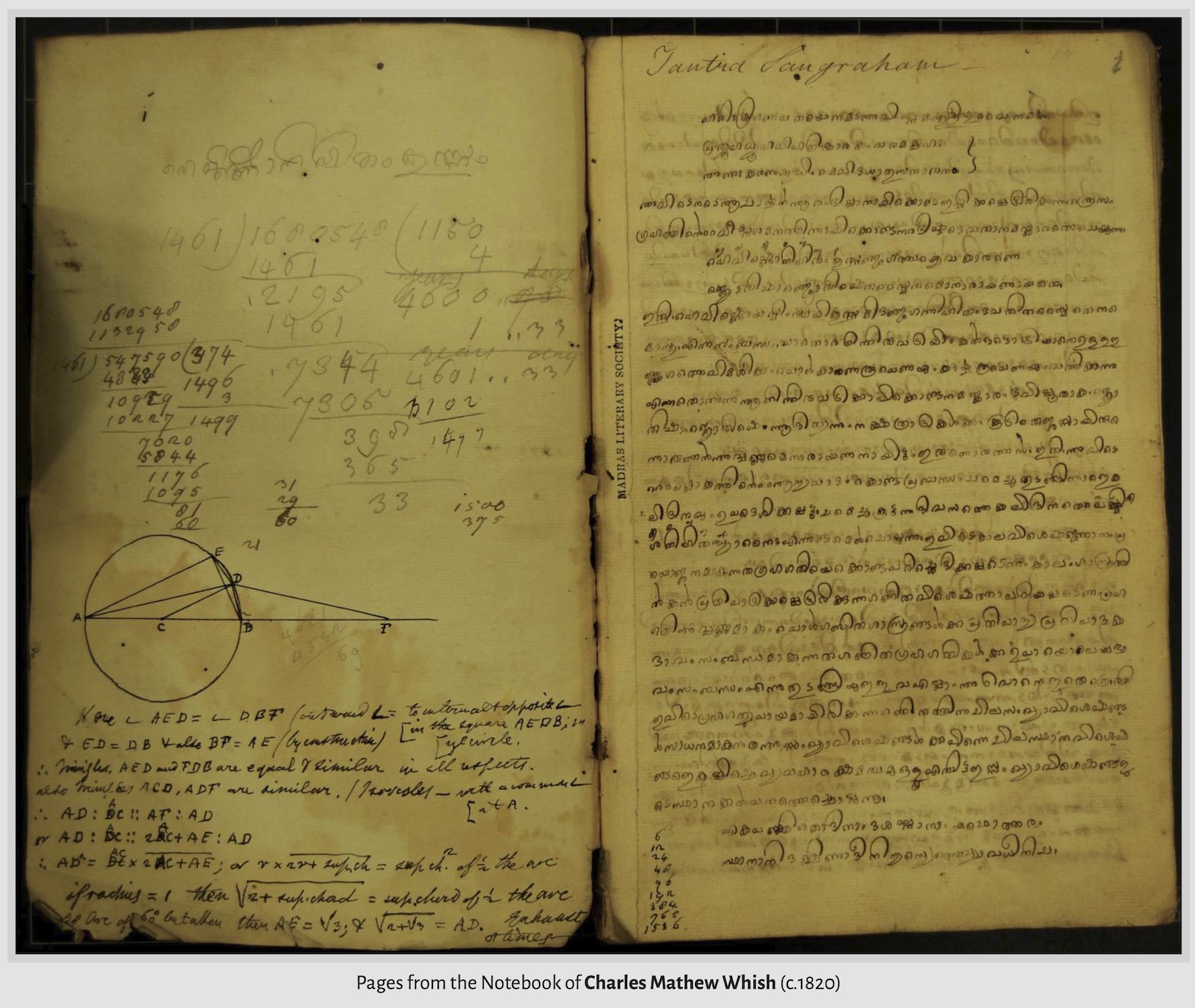 Contrary to popular perception, centuries-old mathematical ideas were also originally recorded in other non-Sanskritic regional languages. This issue of Bhāvana features a piece that explores the extant mathematical literature, prior to the 20th century, in the regional language of Kannada. The author, B.S.\,Shylaja, discusses the existing archival collection housed in various places, and provides an overview of the mathematical and astronomical contents of these sources, while succinctly detailing their origin and history. A notable pick among the works discussed is the text Gaṇitagannaḍi, which at more than 400 years old, is available in its original form as a palm leaf manuscript and still surprisingly well preserved.
The front cover image is inspired by the sentiment that in the Indian tradition, the crest of the Peacock symbolises the beauty of mathematics. The peacock is also the official National Bird of India. The back cover is a page from a 200-year-old document from the notebook of Charles Whish deposited in the archives of the Royal Asiatic Society of Great Britain and Ireland.
The issue offers a memorial tribute by Team Bhāvanā, to Roddam Narasimha, who contributed much to the theme of the issue through his insightful research. \blacksquare
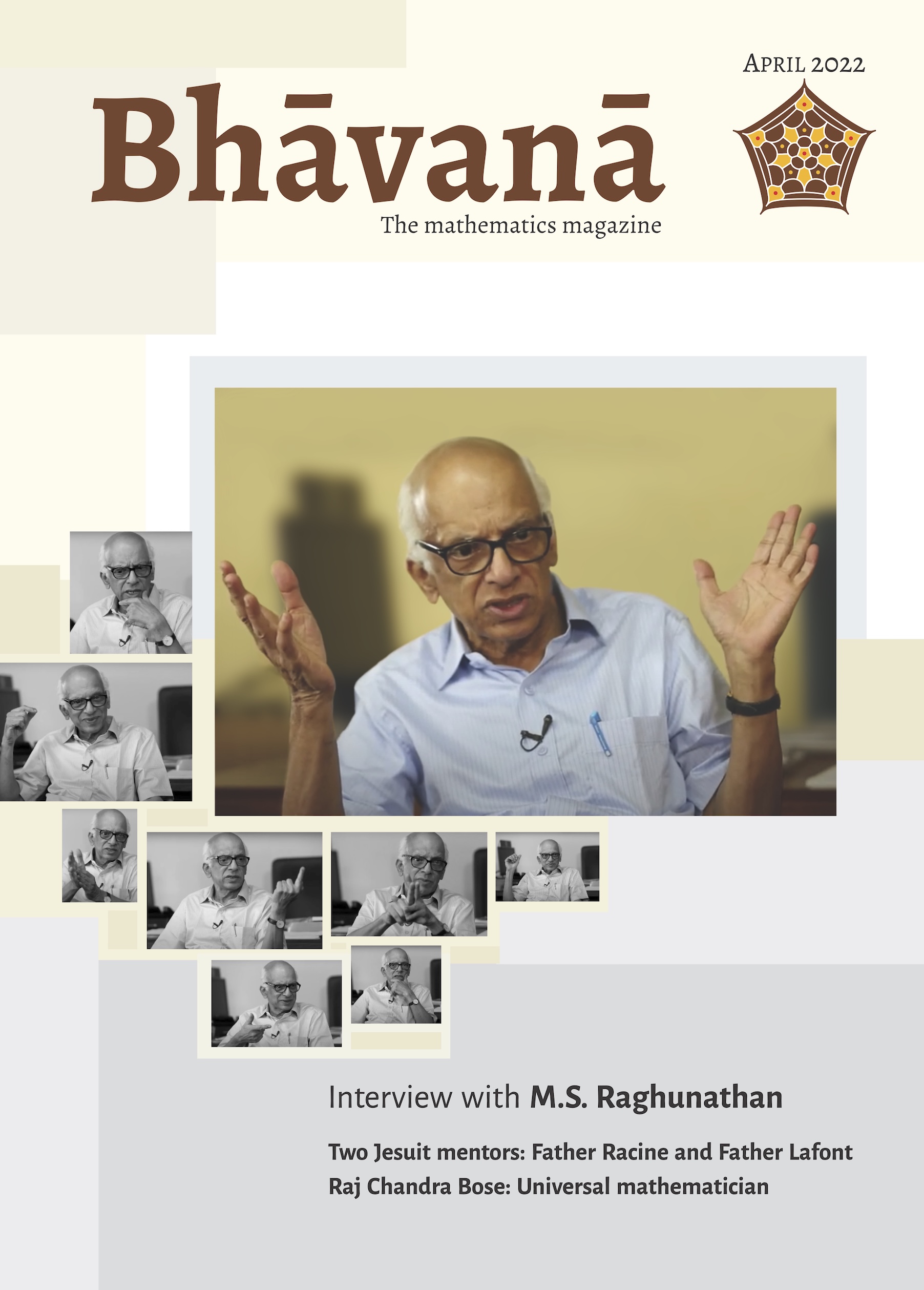 This issue of Bhāvanā continues its documentation of India’s rich statistical heritage with a feature on the life and work of Raj Chandra Bose. The article chronicles the remarkable journey of R.C. Bose from Kolkata to North Carolina in the US and his rise as a major figure in 20th century statistics, not just as a researcher, but also as an inspiring mentor to many, including S.S. Srikhande. R.C. Bose’s versatile interests in different areas of mathematics and statistics, from differential geometry to number theory and his scholarship in these topics spurred Howard Frisinger, the writer of the republished article, to call him as a rare example of a “universal mathematician”. The republished article is followed by an original essay by Indranath Sengupta that serves as a tribute to Bose with fond recollections by his friends and family.
Two key driving forces of mathematics education in India in the late 19th and the 20th century were Fr. Eugène Lafont and Fr. Charles Racine. While this is the first time that Fr. Lafont, who was the guiding force behind luminaries such as Jagadish Chandra Bose, is featured in Bhāvanā, Fr. Racine’s role has earlier been highlighted in the recollections of M.S. Narasimhan and C.S. Seshadri in moulding their mathematical interests. On his 125th birth anniversary, we get a glimpse into the unconventional mathematics teacher that was Fr. Racine, who’s kind-heartedness is all the more remarkable given his lifelong injury from his stint as a soldier during WWI. Fr. Lafont, for his part, was instrumental in setting up one of the first scientific societies in India, as well as the nearly 150-year-old rooftop observatory at the St. Xavier’s College in Kolkata, which has a meticulously maintained logbook of visitors that boasts of historical figures such as the Maharajas of Gwalior and Mysore.
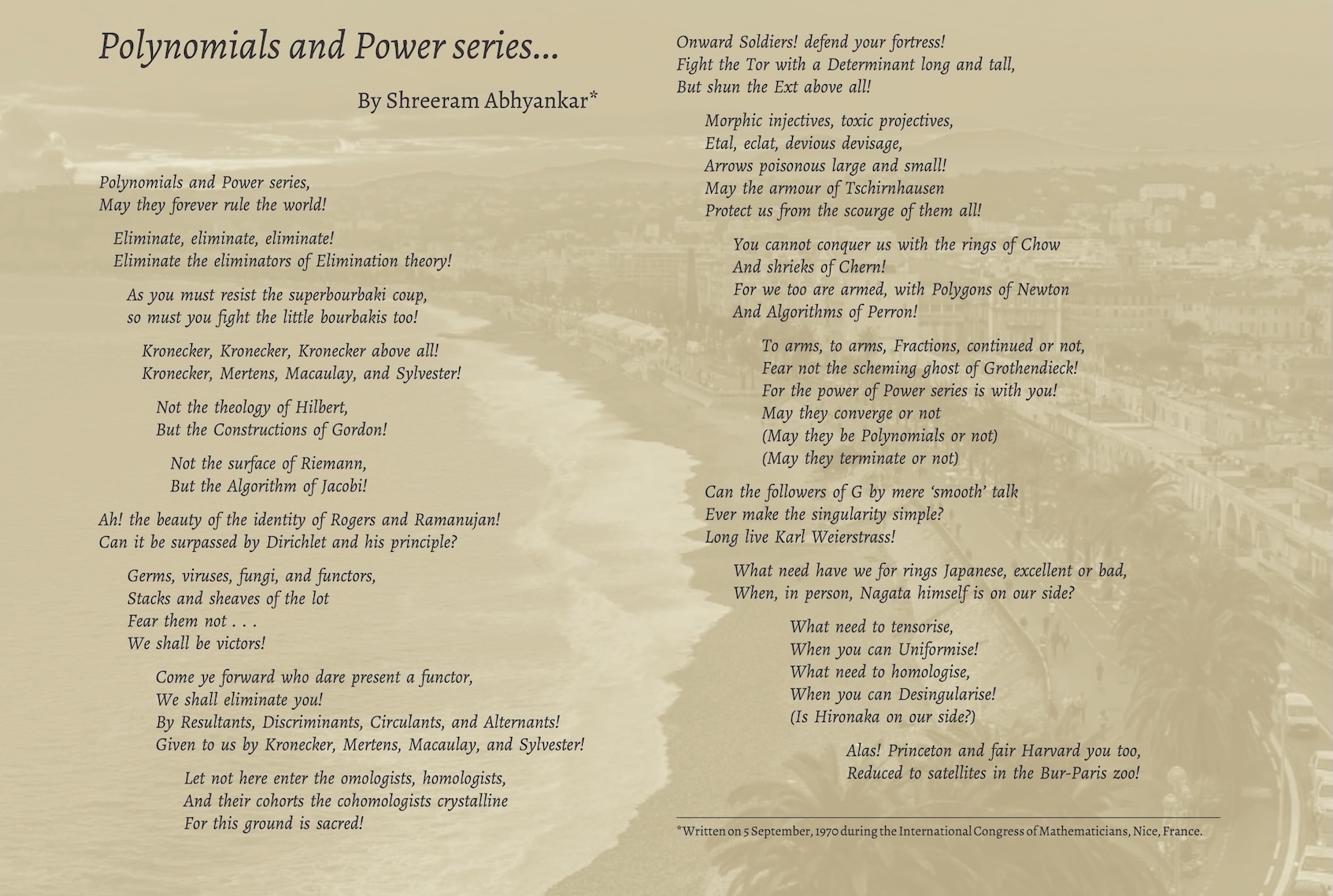
Among the towering figures of 20th-century mathematics in India, one counts the sharp intellect and deep scholarship of M.S. Raghunathan. In this collated interview article, he candidly recounts the childhood influences that shaped him and his life predicaments before his five-decade stint at TIFR. Our young readers may be amused to learn about his attitude towards understanding over academic metrics. With his decades’ experience as a mathematician, academic, and mentor, Raghunathan highlights the importance of recruiting domain experts in academic institutions to improve teaching, research and provide a scholarly atmosphere that encourages fresh ideas.
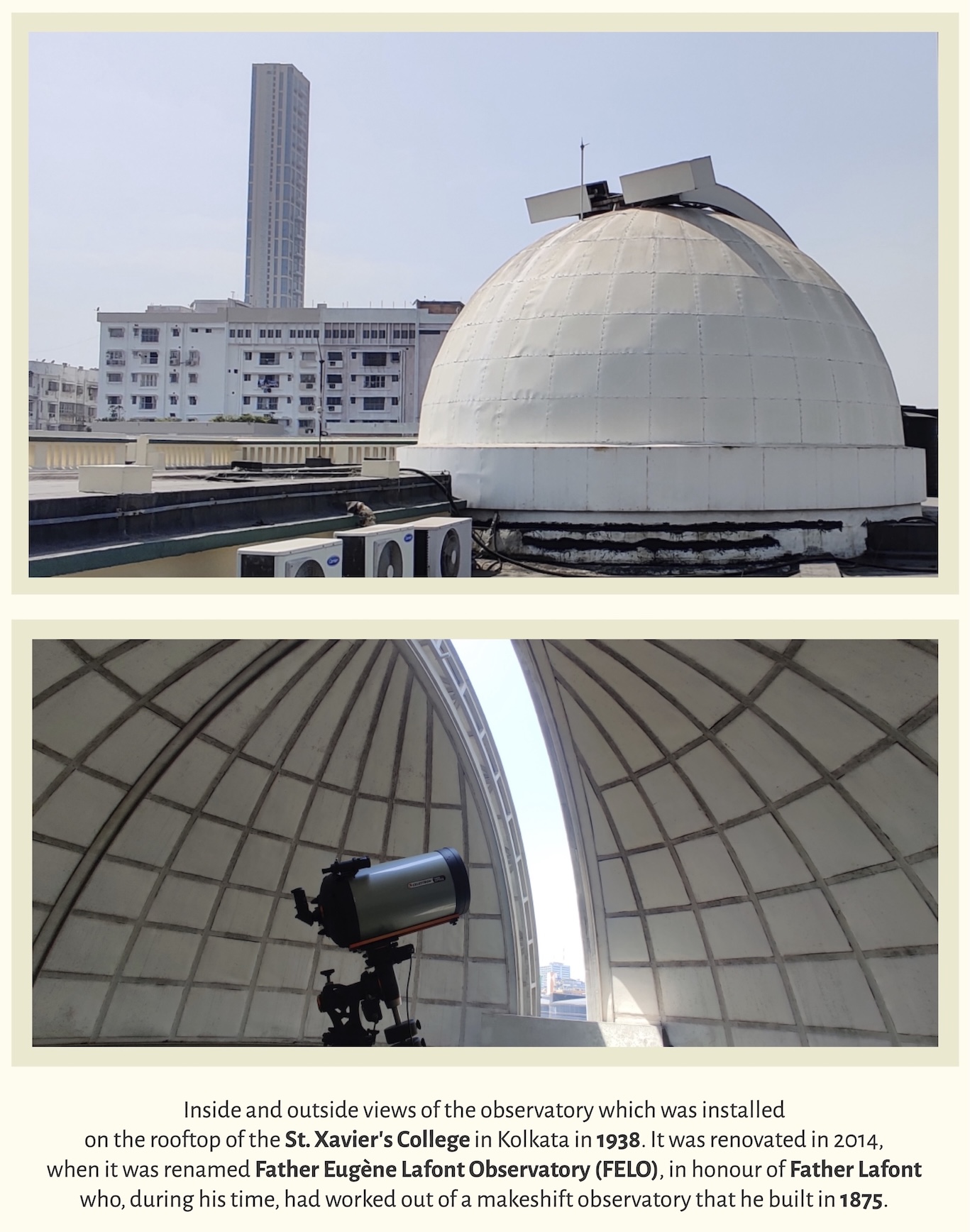 We also continue an ongoing series of articles by Amartya Kumar Datta on mathematics in ancient India. The article in this issue discusses the verbal decimal nomenclature and the decimal place-value notation in the Vedic treatises. In particular, the single-word terms for numbers that are used today in several languages, for example, eka (one), dvi (two), tri (three) and so on, were already known when the Ṛgveda was compiled. The genesis and development of the decimal place-value notation in the Samhita and Brāhmaṇa texts is further discussed. The knowledge of polynomial-like decimal expansion of numbers led to efficient methods to perform not just basic arithmetic operations but also compute square roots and geometric progressions, with examples provided from the Śatapatha Brāhmaṇa. Finally, in its discussion of the Chandaḥ-sūtra of Pi\dot{n}galācārya, we learn about the combinatorial ideas that were applied to answer mathematical questions arising from an analysis of metres, the chandas.
The front cover captures a variety of expressions of Raghunathan during an interview session, shot by the Robin Reels Production, to whom we are grateful for the permission to use. The back cover is a remarkable tribute to the visionary initiative of Fr. Lafont, which has evolved into a full-fledged modern observatory. \blacksquare
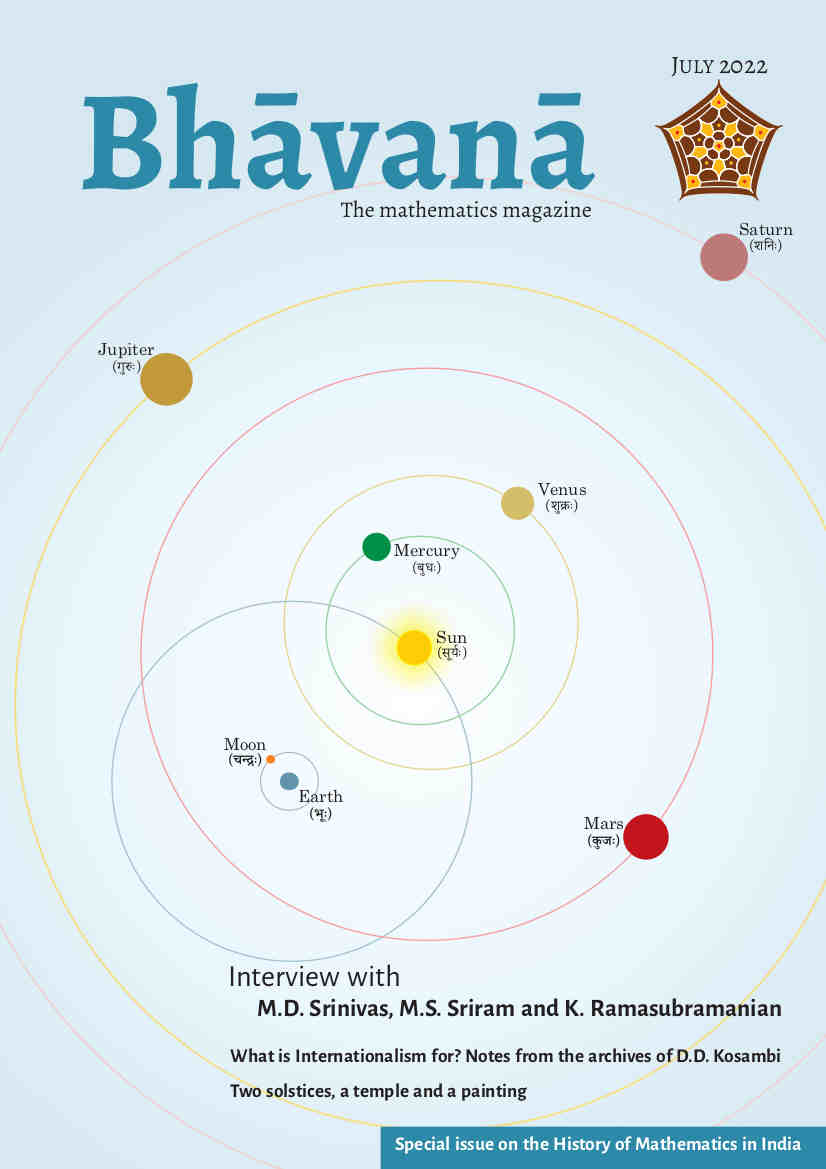
In the first instance in our six-year journey of Bhāvanā, three distinguished Indian scholars are interviewed in this issue. What brings them together on this common platform is their shared passion for going directly to the original works of the remarkable guru-śiṣya paraṃparā initiated by Mādhava, that lasted for over two and a half centuries, spanning six or seven generations of mathematical astronomers; the source-texts were composed in two languages transiting from Sanskrit to Malayalam, the state language of Kerala where the Mādhava school prospered intellectually. Journeying together for over three decades thus far, M.D. Srinivas, M.S. Sriram and K. Ramasubramanian delved deep into their study to bring out authentic translated editions of some of these works. With insights gained from their hands-on research scanning archival documents, the trio continue to engage in their teaching efforts as well, via giving courses on the history of mathematics in India. A singular recognition of their work is the invitation that Ramasubramanian received, as an invited speaker, at the International Congress of Mathematicians held this year.
Talking of the international stage, the concept of internationalism today is fraught with a broad meaning, given the domination of virtual communication and at the same time the prohibitive restrictions present across physical borders, particularly in light of the COVID-19 pandemic. However, in the mid-20th century, the significance of the notion was evident in many disparate fields of human interest, even in intellectually driven vocations like mathematics, despite the relatively lesser technological resources at hand. Michael Barany’s article takes a distinctive look at internationalism in the mathematical arena from the vantage point of a particular period of Indian mathematical history. Barany positions the famous Indian polymath D.D. Kosambi, a mathematician, statistician, philologist and historian all rolled into one, as the central figure in his essay, picking up important episodes from his life to depict the slow but sure rise of the Indian mathematical community as a noteworthy part of the larger international network of mathematicians. With the help of access to Kosambi’s personal archives, the article deftly describes how Kosambi helped in making the Indian mathematical landscape truly more `global’, while at the same time taking note of some of his missteps. His life also marks another interesting chapter in the illustrious history of the Tata Institute of Fundamental Research, a history that has been discussed at length in previous issues of this magazine.
Marking this special issue, we feature a reprinted article that unravels the mathematical, or more precisely the geometrical, underpinnings of a rock-cut Indian architecture whose intriguing construction allows for a visual experience of an astronomical event, i.e., the solstice. A large number of people flock to the famed Gavi Gangadhareshwara temple in Bengaluru, India, every year on the 14th of January to witness the bathing of the main idol of Shiva by the Sun’s rays for a few minutes. With this striking phenomenon as the focus of the article, the authors contend that this is one of the unique temples in the country that records both the solstices, although only one is observable now in practice. Drawing from a close and discerning study based on observational details taken over a couple of years and from clues in paintings drawn by the Daniells in the 18th century, the article concludes that while the two solstices were observable back then at the time of the two paintings, the presence of tall trees, the spanning foliage and the heavy constructions at the time of the writing of the article make it almost impossible to comfortably view the solstices today. But the exact nature of this historical construction nevertheless continues to inspire awe and admiration.
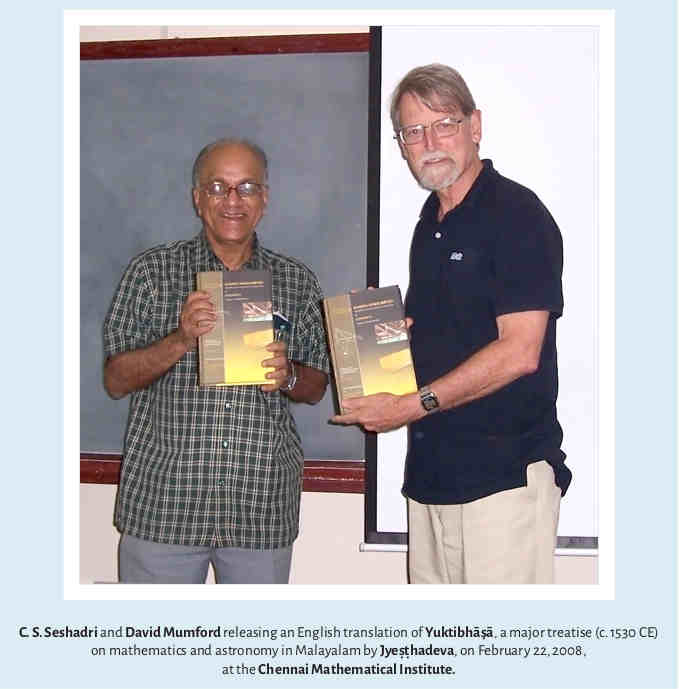 The third part in an ongoing series of articles by Amartya Datta on mathematics in ancient India takes us further back in history, picking up from the discussion of the decimal notation in the previous article. The present article delves into the history of one of the chief ingredients in this notation, namely the zero-symbol, and recalls the occurrence of the decimal notation in the Jaina texts, the Bakhshali manuscript, Āryabhaṭa’s exposition and several inscriptions dated between the sixth and eighth centuries CE. One of the most profound ideas emanating from Indian mathematics is the conceptual leap of the notion of zero as a place-holder in the decimal notation into an abstract algebraic conception. The conceptualisation of zero is intimately connected with the emergence and development of algebra as a distinct branch of mathematics, and we get a detailed historical exploration of such connections and developments in this article.
Nīlakaṇṭha was perhaps the first Indian astronomer who explicitly stated, in his work Tantrasa\dot{n}graha dated 1500 CE, that the five planets, Mercury, Venus, Mars, Jupiter and Saturn, go around the mean Sun in an eccentric orbit, while the mean Sun itself goes around the Earth. The front cover is inspired from an image of this description in an English translation of the work by Ramasubramanian and Sriram.\blacksquare
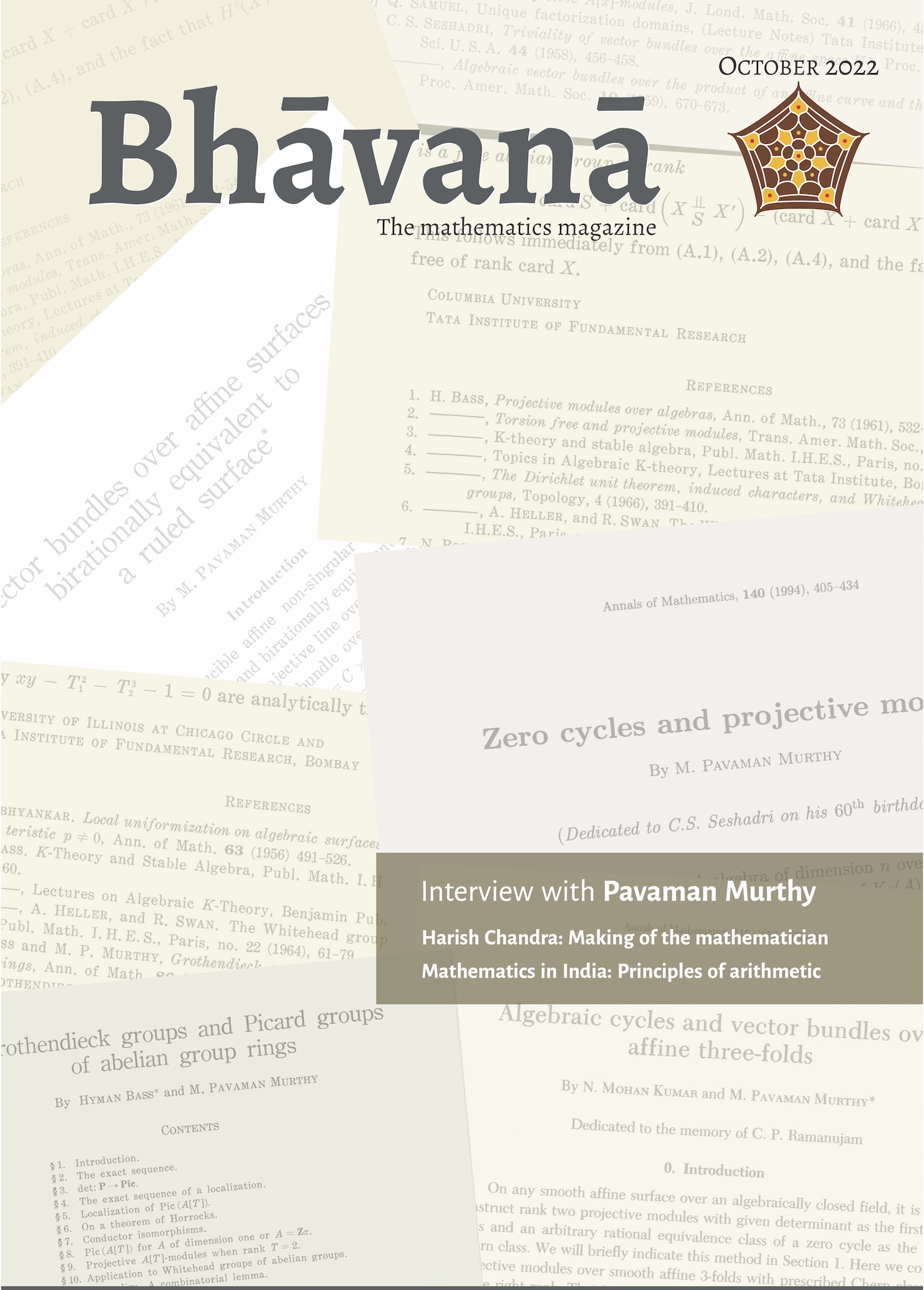 Counted among the most distinguished mathematicians of the twentieth century, whose birth centenary year has just begun, Harish-Chandra was initially trained as a physicist. However, he showed a predisposition for mathematics from his earliest days as a student at Allahabad, as evidenced by the 15-page long note presented here in his impeccable handwriting, titled “Algebra of operators’’ which, we believe, was composed by him during the first year of his M.Sc. at the University of Allahabad. The introductory article sheds light on the unmistakable insight of an intensely mathematical mind, his early training as a physicist, and the influence of his Ph.D. mentor, Paul Dirac, in his life. We also tell you about the surprising source where this handwritten note had been carefully preserved all these years.
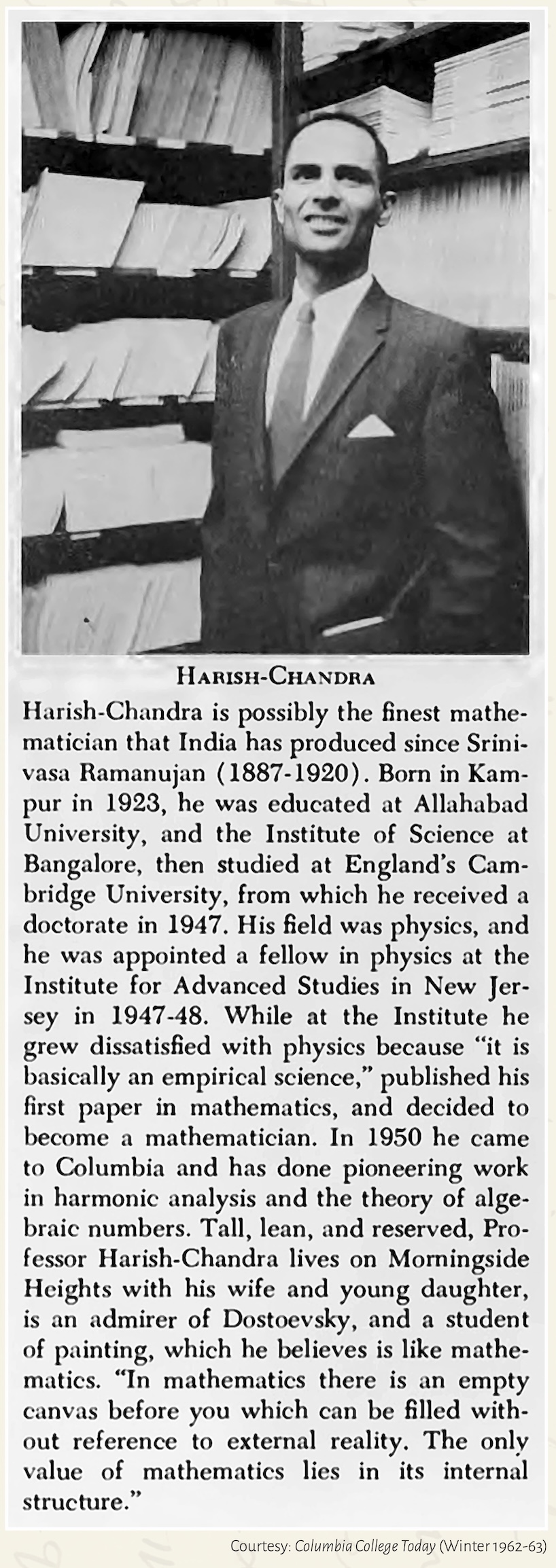 In a delightfully engaging conversation, Purnaprajna Bangere from the University of Kansas speaks to Pavaman Murthy, a well-known mathematician from India who spent a significant part of his career at the University of Chicago. Starting from his early days in Hyderabad studying in an Urdu-medium school, and later at TIFR Mumbai for his Ph.D., the conversation ranges over his many varied interests and experiences. An early tryst with campus activism in Hyderabad led our protagonist to a serious study of Karl Marx, and the radical streak he picked up in his late teens has stayed with him, to date. While relating to his mathematical friends and colleagues with joy and camaraderie, he is known to enjoy running, Urdu poetry, and political economy, all in equal measure, and a glass of scotch. Known to be an entertaining raconteur, Pavaman invites our readers to join him on an eight-decade-long jog from sultry Hyderabad to windy Chicago, with a stopover at Bombay.
The fourth of a series of articles by Amartya Dutta starts with exploring methods developed in ancient India for error-checking arithmetic computations. The author describes the simplicity of rules such as `casting out nines’, which can be understood even by young kids, though deep algebraic insights are required for their invention. He then describes rules of computation for fractions and arithmetic and geometric series, many of which were studied by ancient Indian mathematicians centuries before they were studied in Europe. The article concludes by highlighting the value of computational mathematics for young minds to gain mathematical insights at a very early stage.
The background collage on the front cover, culled out of some of Pavaman Murthy’s influential papers, reflects his self-effacing disposition as captured by Mohan Kumar in his recollection. The back cover is an image from a 1962–63 edition of Columbia College Today, an alumni magazine of Columbia University in the city of New York, where Harish-Chandra was a faculty member of the mathematics department. We are grateful for the kind permission accorded to us.\blacksquare
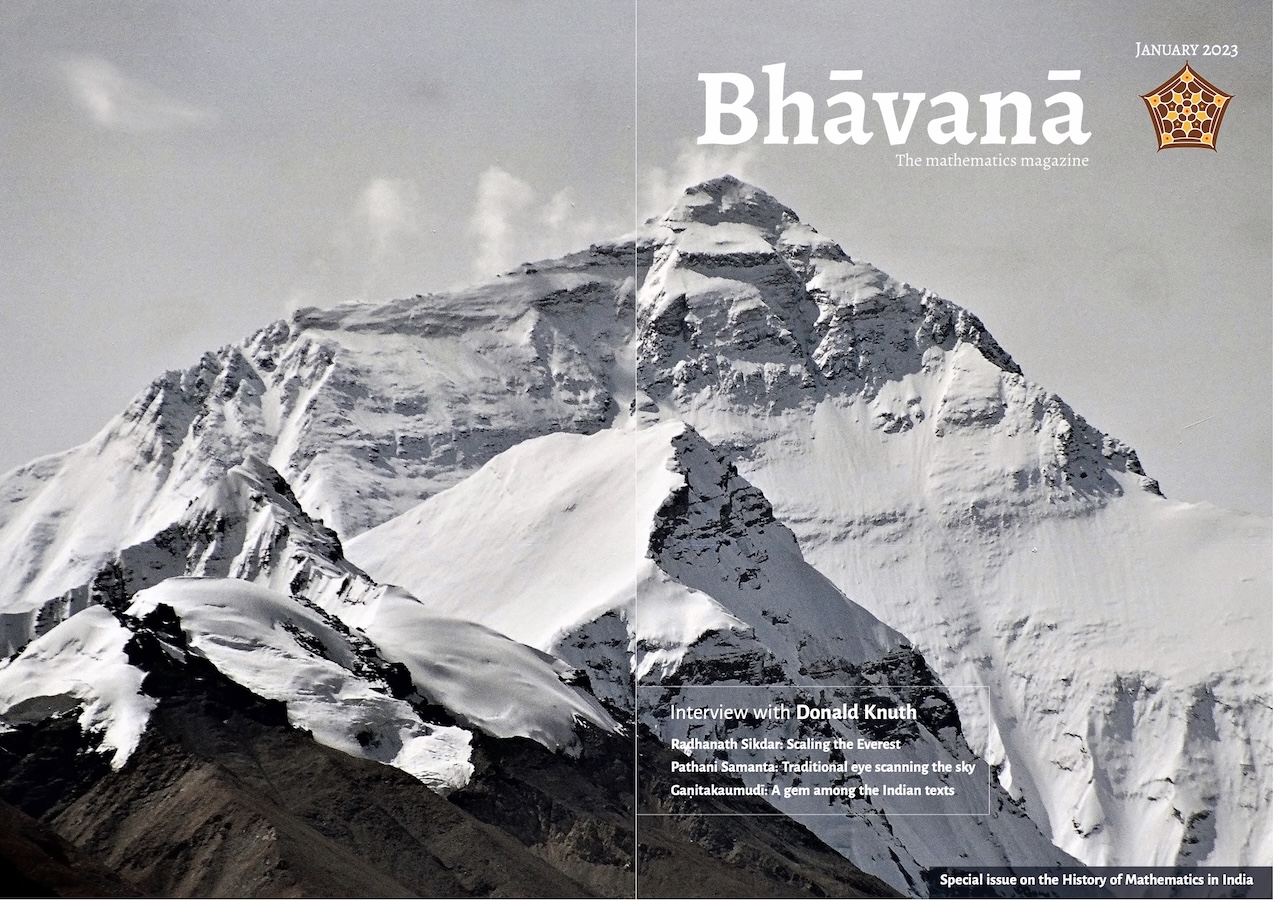
Speaking to us in this issue is among the most distinguished computer scientists of our era, Donald Knuth. Credited with many pioneering contributions, Knuth personifies the adventure, opportunities and challenges posed by a still fledgling field of computing, back in the 1960s; and whose algorithmic landscape he has since helped shape in his own inimitable ways. His replies to all our 40 questions are exactly 280 characters long, perfectly blended reflections of his scholarship, depth of thought, and wit. Complementing his crisp responses, the biographical sketch by Sudhir Rao preceding the interview captures certain highlights of Knuth’s lifelong fascinating engagement with the art of programming.
Knuth reveals feeling a strong kinship with the fourteenth century Indian mathematician Nārāyaṇa Paṇḍita, when he came across the latter’s Gaṇitakaumudī, a work that had anticipated the same concepts that Knuth played with, about six centuries before him. Presenting a succinct summary of Gaṇitakaumudī in their essay, three scholars who have closely studied the work in its original, provide striking snapshots of some twenty verses from it, together with their prosaic translations, which also cover a spectrum of mathematical topics. Nearly one-fourth of the verses in this work deals with geometry, including a detailed treatment of cyclic quadrilaterals, in which is introduced the notion of “third diagonal’’. Of further particular interest is their discussion of a rule-based algorithm for building all possible combinations of a 4 \times 4 pandiagonal magic square, and placing numbers only through horse moves.
Travelling five centuries further in time in the history of Indian mathematics, the article by Madhuri Katti brings to light the life and work of a 19th Century torchbearer of observational astronomy, popularly known as Pathani Samanta. The innovative naked-eye astronomer, and the author of Siddhānta-Darpaṇa (possibly the last extant work composed in the Siddhantic tradition), devised ingenious simple instruments constructed with bamboo and wooden sticks to literally touch celestial limits for his observation! Reflecting his reverential sentiment to tradition, the culturally and linguistically correct form of his name Chandrasekhara is used in this article, though in some places, in recent years, it appears split as Chandra Sekhar.
This issue features an insightful article on Radhanath Sikdar, the mathematician credited with measuring the height of the highest peak on earth – Mount Everest. Among the first generations of English-educated Bengalis in the 19th century, Sikdar was an extraordinary talent whose services were much sought after in the Great Trigonometrical Survey of India, where he was employed as a `Computer’. The article explores various aspects of his life and sheds light on the controversy regarding the naming of Mount Everest.
In the fifth part of his series on the mathematics of India, Amartya Kumar Dutta explores the long and impactful evolution of the kuṭṭaka algorithm for finding integer solutions to certain indeterminate equations, tracing its journey from Āryabhaṭa’s original crisp treatment all the way through to modern times. Needless to say, Āryabhaṭa is one of the most celebrated Indian mathematicians, and the images used to complement the narrative in the article stand as testimonials to this fact.
The cover page features the mighty Himalayan peak – Mount Everest. Soaring in altitude as the highest peak in the world, the indomitable spirit of the human mind is beholden to it from time immemorial both as an inspiration and a challenge. Symbolically overseeing the Indian subcontinent, the opening verse of the epic poem Kumārasambhava of Kālidāsa perhaps best captures that quintessential Indian sentiment.
pūrvāparau toyanidhī vagāhya sthitaḥ pṛthivyā iva mānadaṇḍaḥ\Vert
We owe an especial gratitude to Harish Kapadia for his kindness and generosity of sharing with us pictures of Mount Everest taken by him during his years of exploration of the Himalayan terrain. \blacksquare
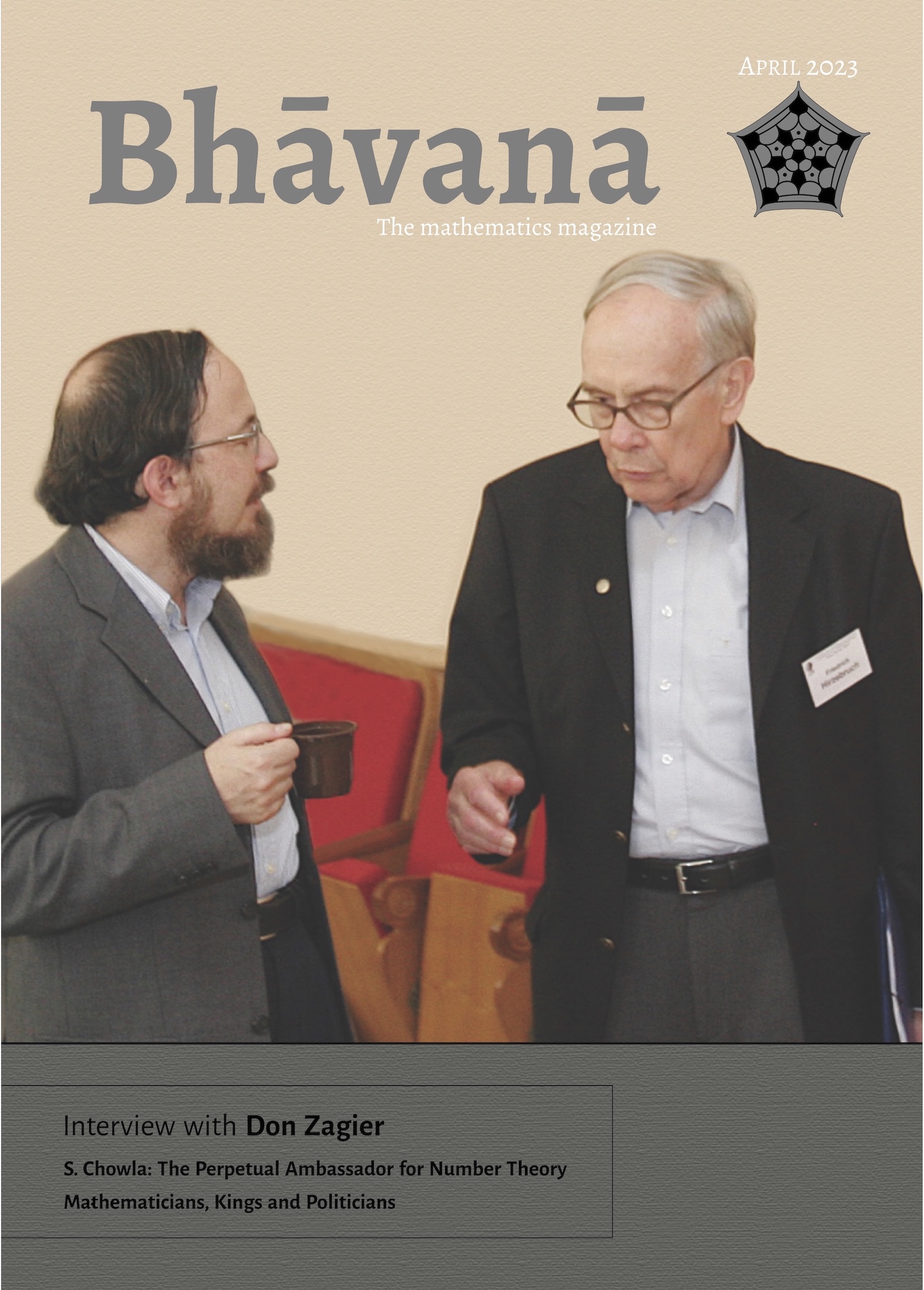 In his article on internationalism in mathematics in the July 2022 issue of Bhāvanā, Michael Barany states that while “the international scale is decidedly large, the scale of internationalism is rather more personal”. Our interviewee in this issue is Don Zagier, a mathematician of a truly international scale and for whom mathematics has been a deeply personal endeavour. Both through his work and persona, Zagier has played the role of a sturdy “bridge” between two generations of mathematicians, being mentored by the likes of Friedrich Hirzebruch, his thesis advisor, and Sir Michael Atiyah, and mentoring talents such as Maryna Viazovska and Maxim Kontsevich both of whom went on to win the Fields Medals.
The interview begins with Zagier talking about his and his parents’ visits to India. Thereafter the story unfolds from the first decade of the twentieth century during which his polyglot father grew up in a European Jewish shtetl, then turns to a recounting of his own precocious talents, constant movement, and insatiable appetite for mathematics as well as learning new languages. Culminating with a discussion of the work of his student Sander Zwegers, propelled by the content in the last letter of Ramanujan to Hardy, Zagier’s story is a rare peek into a life of hard work, passion, creativity, facility with computing and more.
Zagier’s story is a rare peek into a life of hard work, passion, creativity, facility with computing and more
Going back a bit in time, the present issue reflects on a college essay by Harish-Chandra, a towering mathematician of our times born a hundred years ago. Notes and essays written by him during his student days give us a glimpse into his rich intellectual world, especially his love and reverence for mathematics. The October 2022 issue of Bhāvanā published a 15-page note hand-written by him in the first year of his MSc. Here, we present an essay composed by him in the second year of his BSc at the University of Allahabad. In this essay, curiously titled “Mathematicians, Kings and Politicians” and drawing inputs and inspiration from E.T. Bell’s famous book Men of Mathematics, he shares his thoughts as to why it is unlikely for someone with a love of mathematics to evince an interest in a political career and vice versa. He provides interesting historical examples of people who had an interest in both. In Harish-Chandra’s beautiful essay, we learn about brilliant minds making inspired discoveries while in the midst of challenging public duties and fighting battles.
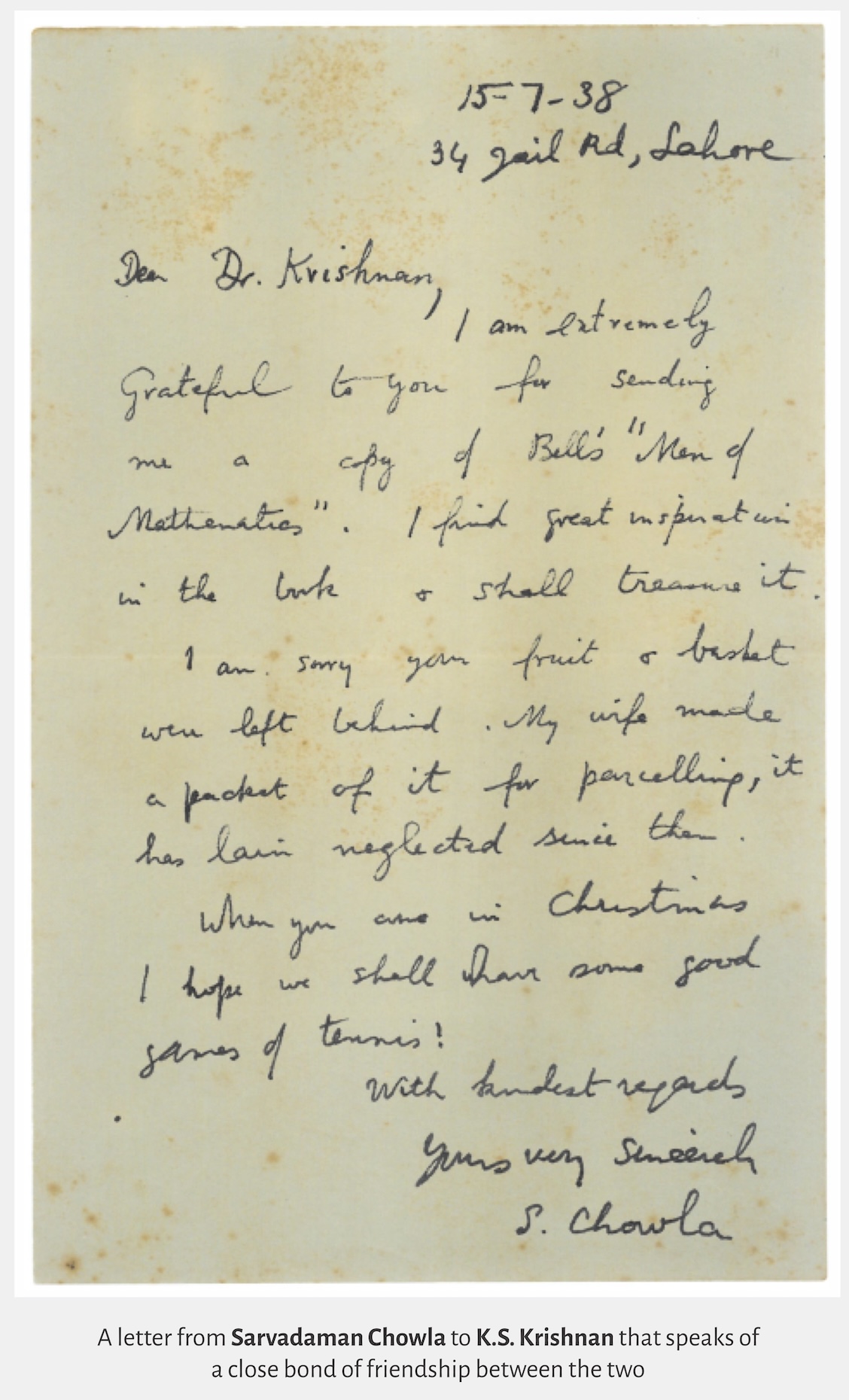 The next article, on the life and work of Sarvadaman Chowla, born in 1907, depicts the travails of a triumphant mathematical career that blossomed during the times of politics and war. A close witness to the effects and consequences of the Second World War, Sarvadaman too found great inspiration from the same book of E.T. Bell, as evidenced by his letter to K.S. Krishnan that appears on the back cover. His love of mathematics, passion for sharing ideas, and striking lasting friendships kept him going all his life. The poignant image of his final days—his eyes staying glued to the Chowla–Selberg formula in André Weil’s book Elliptic functions according to Eisenstein and Kronecker—perhaps captures the quintessential persona of Chowla.
In the sixth part of his series, Amartya Kumar Datta continues to explore the ceaseless wonders of mathematics as seen in ancient Indian texts. Here, his focus, triggered by the words of David Mumford, is on “algebra as we know it’’, and how Indians may be regarded as the founders of this branch of mathematics. The journey spans across Proto-Algebra, Classical Algebra, and Proto-Modern Abstract Algebra. He corroborates this article with the seminal work of Brahmagupta. An engaging exercise would be to step along with the author as he explores the usage of letters for denoting the unknowns, of unique symbols for arithmetic operations as can be seen in Bakhshali manuscripts, and of the formation of linear and quadratic equations.
The front cover is of a moment frozen in time in the beautiful teacher-student relationship. A lucid portrayal in the interview, of the impact Hirzebruch and Zagier had on each other mathematically, could be seen as a role model for this long revered bonding, generations across. \blacksquare
 The simplicity and humbleness of the interviewee—the unassuming theoretical physicist Ashoke Sen—in this edition of Bhāvanā are hardly a clue to his stellar achievements. One of the first winners of the “Breakthrough Prize in Fundamental Physics’’, in its inaugural year 2012, Ashoke Sen has strode across the august portals of almost every leading centre of science in the world, carrying all the laurels lightly on his shoulders. It was a joy for team Bhāvanā to sit engaged in conversation with the friendly-natured Ashoke, listening to his distinguished academic journey thus far, in his quiet office at the International Centre for Theoretical Sciences, located in the remote outskirts of the bustling city of Bengaluru.
String theory and duality conjectures are almost synonymous with his name, with his discoveries offering insights into the hitherto unexplored domains of possibly the only available consistent theory so far, that tries to explain the fundamental forces of nature under one single theoretical framework. Dileep Jatkar, his former colleague at the Harish-Chandra Research Institute, captures the essence of Ashoke Sen’s overall work in his exposition. Accessible to a college going student, Jatkar traces the path to the duality phenomena starting from the celebrated Maxwell equations of classical electrodynamics. Originally appearing ten years ago in the journal of science education Resonance, around the time Ashoke Sen was awarded the Breakthrough Prize, this article is reproduced here with kind permission, to portray the man and his work alongside each other.
The Tata Institute of Fundamental Research (TIFR), situated right at the tip of the peninsular city of Mumbai, away from the hustle and bustle of its ever busy populace, is the institution to which Ashoke Sen first returned after his postdoctoral years in the US. The inviting campus of TIFR has been a silent witness to several discoveries and significant research accomplishments in mathematics and the sciences. Conceived around the time of Indian independence by the visionary scientist Homi Jehangir Bhabha, with seeds sown at the Indian Institute of Science in Bangalore in its nascent months, TIFR soon moved its working quarters to Mumbai (then Bombay), the hometown of Homi Bhabha. Eloquently mirroring Bhabha’s passion for the arts and the sciences, the Colaba campus of TIFR provided a nurturing shelter to the blossoming of a remarkable mathematical achievement at the turn of the 21st century—a full proof of Serre’s modularity conjecture—a statement that subsumes the case of Fermat’s Last Theorem, proven about a decade earlier by Sir Andrew John Wiles. Chandrashekhar Khare, one of the architects of this milestone accomplishment in modern mathematics, ruminates on this important period of his life, presenting a view from the trenches as it were, while working towards proving the Serre conjecture. The article is unique in that it records the perspective of a mathematician who was a part of the institution TIFR, who did some of his best work here, and who, in his own words, “derived sustenance’’ from the prevailing environment “to do ambitious work’’.
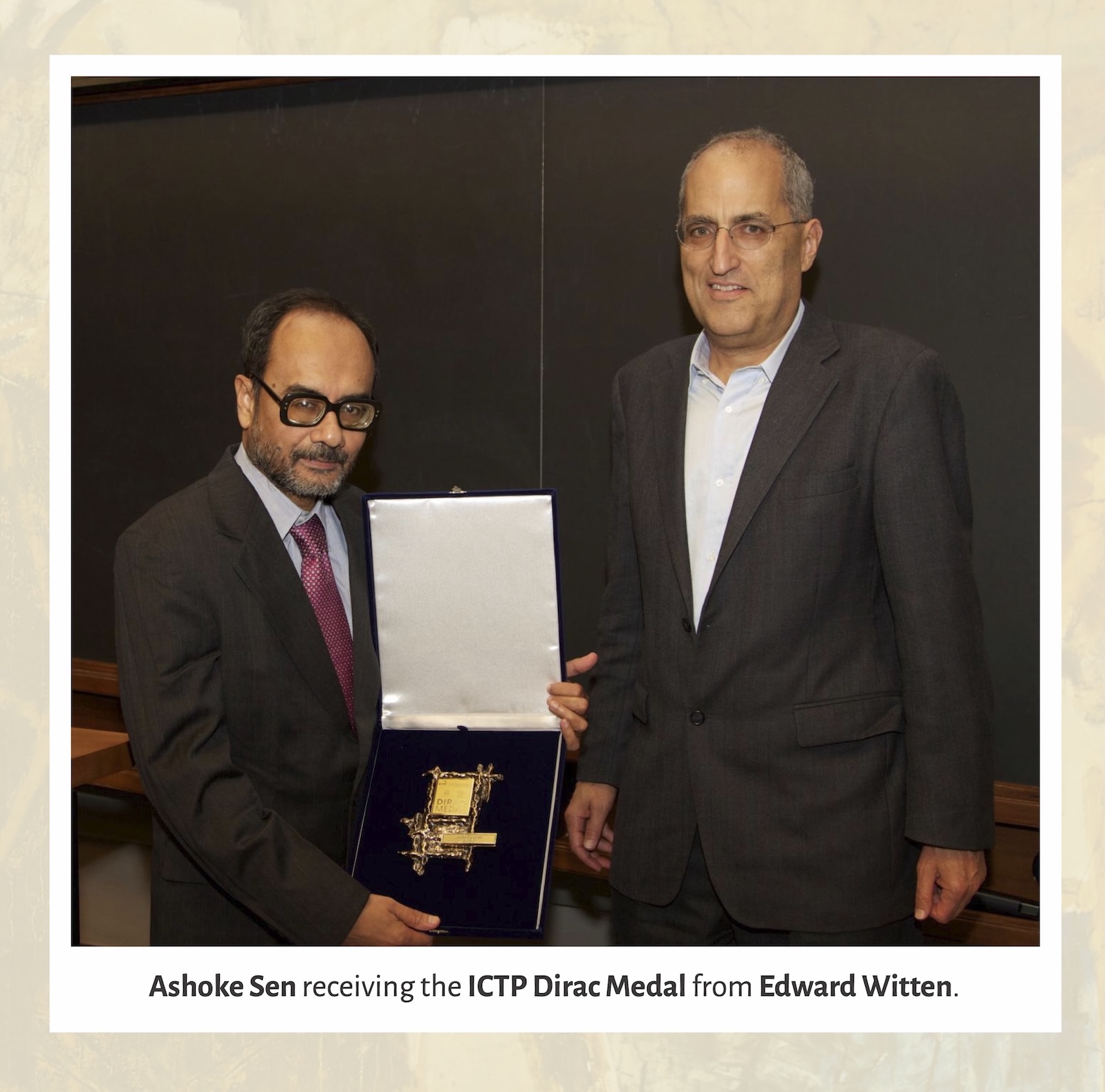 After firmly laying down the thesis that Brahmagupta, prevailing on the work of his predecessors, is the real harbinger of the creation of algebra as we know it today, with his work taken effectively forward by subsequent mathematicians like Bhaskara II, it is but natural and imperative that their discussion of zero-divided numbers comes into sharp focus in this series of articles on mathematics in ancient India by Amartya Kumar Dutta. Viewing it against the backdrop of certain algebraic perspectives widely prevalent in modern mathematics, and certain recent efforts to gain an understanding of the convention adopted by ancient Indian mathematicians, the author advocates exercising caution that it may not be desirable to arrive at hasty conclusions about the validity of any concept or construct belonging to a different era on the basis of present-day conventions and notation. It is with that thought of keeping an open mind that we invite the reader to go over this article, which necessitates a gentle introduction to certain notions from modern algebra.
The front cover image is an illustrative detail culled out of the M.F. Husain classic 45-foot long mural adorning the entire wall on the mezzanine floor leading to the entrance of the TIFR library. And, the back cover displays Ashoke Sen, our interviewee of this edition of Bhāvanā, receiving the prestigious ICTP Dirac Medal from the 1990 Fields Medalist Edward Witten.
\blacksquare
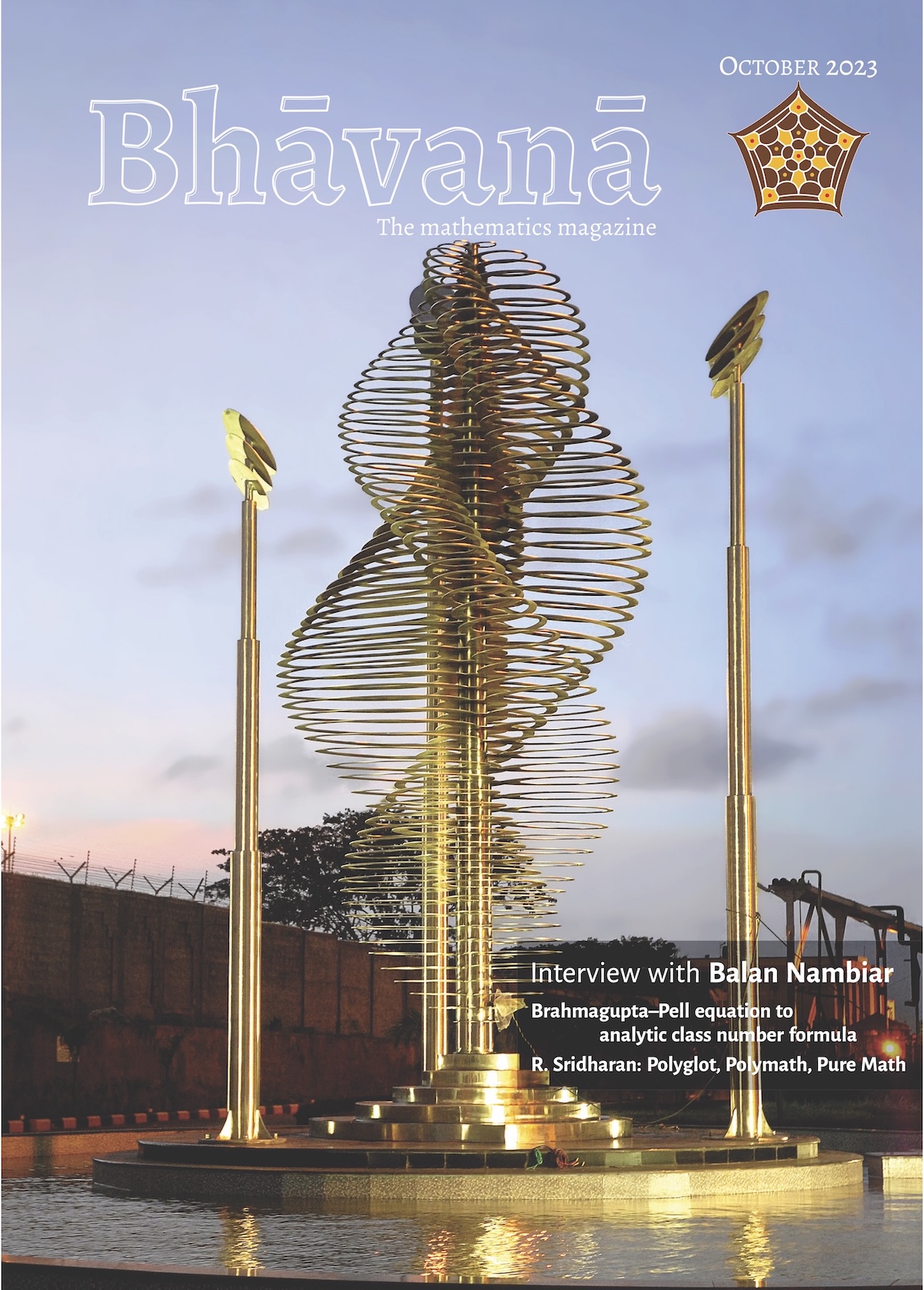 We are delighted to bring to our readers an interview of Balan Nambiar, an artist in the real sense – painter, photographer, sculptor in different mediums from clay to stainless steel, enamelist, and academic researcher. Having been exposed to the Kerala ritual art Theyyam right from his childhood, he is a born artist. `Intuitive artist’ as he describes himself, his natural passion for art led him from a modest family of farmers in a village in Kerala to being an internationally acclaimed artist. As a tribute to the gift of his art he has mentored a spectrum of students, free of fees. The interview documents his continued curiosity, his early years understanding sculpting and enamel painting and the inculcation of mathematics in his sculptures. It was a particular pleasure to watch Balan work on his enamel paintings as he helped us understand the process – a first hand glimpse into his inspiring life.
Moving from the world of art to maths, this issue features another multifaceted personality. In the larger firmament of the Indian mathematical sky in the post independence period, the TIFR constellation can lay claim to housing some of the brightest stars. There have been many names from this illustrious school that have left an indelible mark on the mathematical landscape. And the several interviews and articles of these influential personalities in previous issues of this magazine only seek to reiterate this fact. Interestingly, one such article in the January 2018 issue, a tribute to K. Chandrasekharan, was penned by the protagonist of an eight year old article reprinted in this issue, Ramaiyengar Sridharan. Bhāvanā celebrates the multifarious accomplishments of this much admired scholar.
As a tribute to the gift of his art, the acclaimed artist Balan Nambiar has mentored a spectrum of students, free of fees
Sridharan’s expertise in many languages and contemporary literature is widely reflected in his articles and lectures. His competency in Sanskrit led the production crew of the first Sanskrit movie titled Adi Shankaracharya (directed by G.V. Iyer) to approach him for help with English subtitles, which he carried out with elan. An ardent P.G. Wodehouse fan known for his dry wit, Sridharan’s interests and talents range from being well-versed with Sanskrit poetry to arcane English literature summing up a truly multi-dimensional intellect. The back cover is a sample of Sridharan’s delightful writing.
Continuing his series on Mathematics in India that began in the January 2022 edition of Bhāvanā, tracing the evolution of algebraic ideas right from the genesis of the verbal nomenclature of the decimal system in the earliest extant text Ṛgveda Samhita, Amartya Kumar Dutta revisits Brahmagupta’s composition law Bhāvanā – the concept to which this magazine owes its very name. In this issue, he provides a natural motivation to the study of the Brahmagupta–Pell equation, and begins a detailed historical exploration of its study. Pitching it as the single greatest original idea in ancient Indian mathematics, he delves into its nitty-gritties by providing illustrative examples, of Brahmagupta himself, to demonstrate as to why it was far ahead of its times.
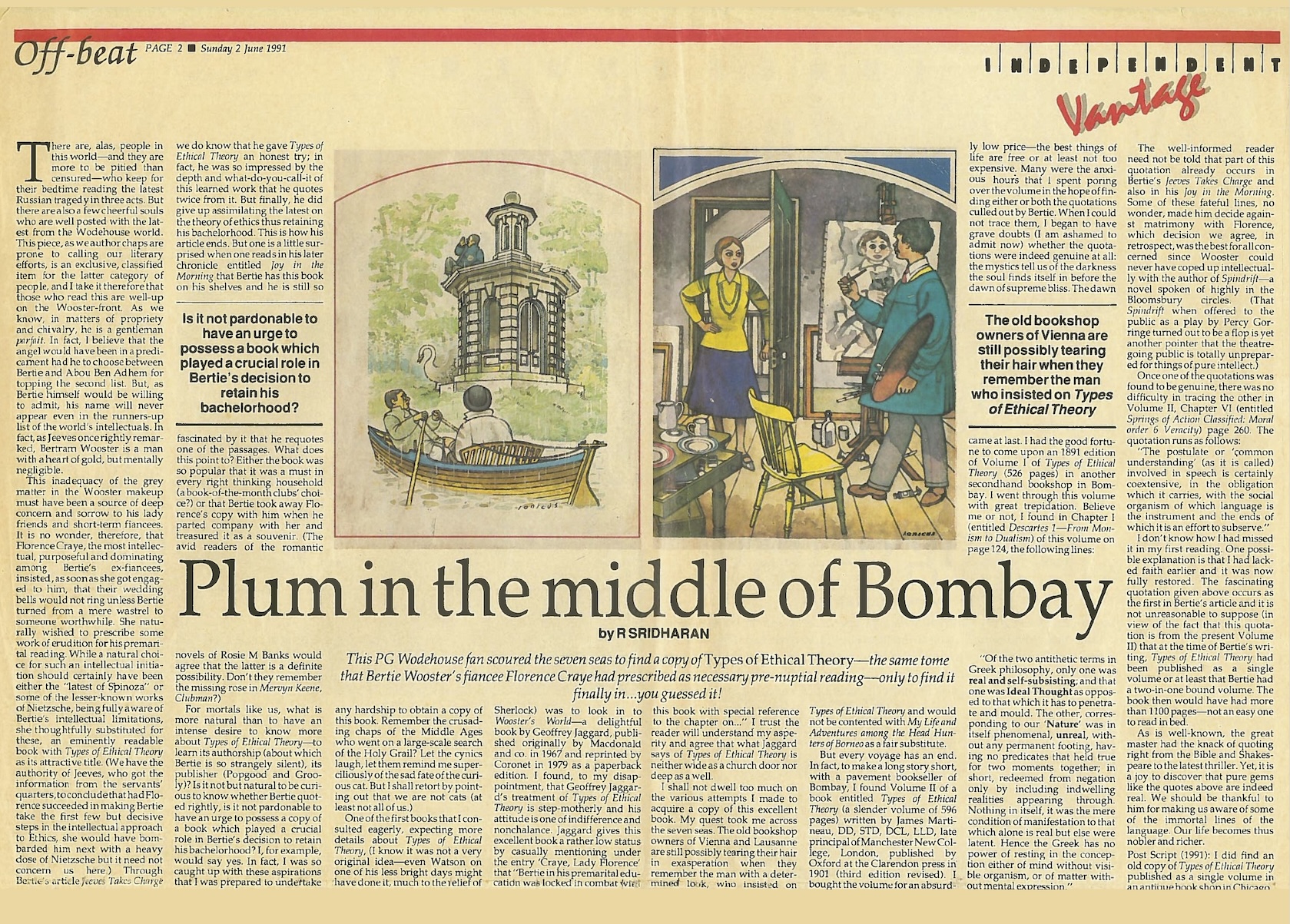 As a principle of composition, bhāvanā is a precursor to the notion of group operations in modern mathematics. In terms of the generation of solutions of a certain equation that, due to a labyrinthine set of reasons, has come to be called the “Brahmagupta-Pell’’ equation, the last article in this issue by Arshay Sheth explores the rich history of this equation, its primary mathematical underpinnings, and its growth over fourteen centuries into a vital part of the study of what are called special values of the zeta function. Through this article, we hope that our readers will experience, first hand, how the seed of a mathematical idea grows in meaning, and creates a deep impact through dedicated efforts over a course of several centuries.
The front cover is an image of the imposing seven metre high sculpture by Balan Nambiar titled Reach to the sky. Made of stainless steel and commissioned by the Bank Note Paper Mill in Mysore in 2016, this sculpture, in a way, also symbolizes the personality of the interviewee of this edition of Bhāvanā. \blacksquare
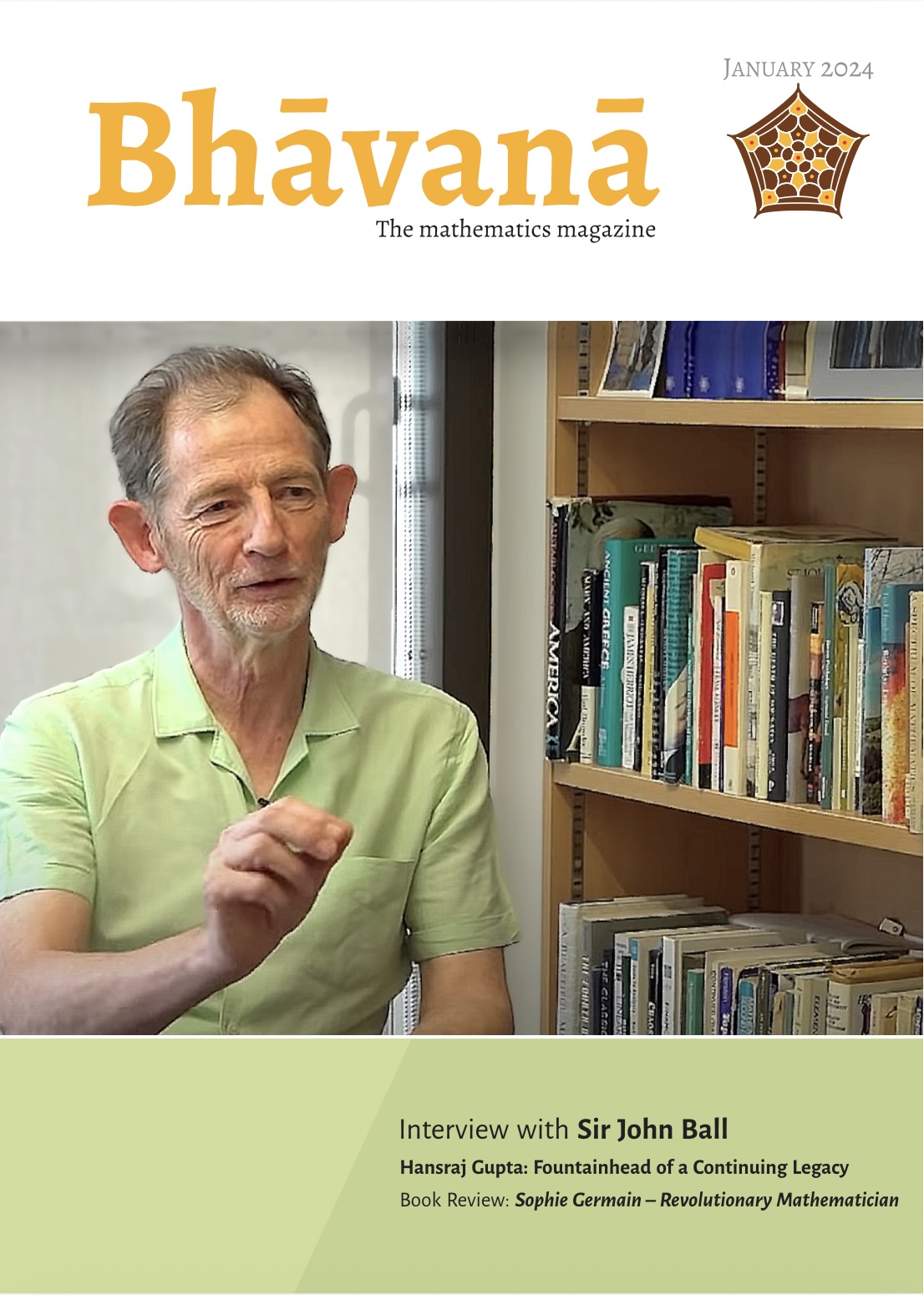 Continuing our conversations with mathematical personalities whose work, in more ways than one, fits the “international scale” as Michael Barany defines it, this issue of Bhāvanā puts the spotlight on Sir John Ball. A mathematician whose work has paved the way for a deeper understanding of the mathematics underlying the mechanics of materials, and a former president of the International Mathematical Union (IMU) who has strived for the betterment of mathematics research and education across the globe, John Ball, at 75, continues to be a leading and guiding figure in the international mathematics community.
In a leisurely conversation, John Ball recounts his initial uncertain years in research which with some element of fortune he navigated successfully, while dwelling a bit about the nature of his multifaceted work. He discusses the distinction (or lack thereof) between pure and applied mathematics. Indeed, the deep insights afforded by his own work is a testament to the superficiality of this distinction.
Discussing the mathematical activity during the first half of the twentieth century in several centres on the larger landscape of India, the article “The coming of age of Mathematics in India” by Raghavan Narasimhan, published in our inaugural January 2017 issue, mentions Hansraj Gupta as a well known number theorist to come out of Punjab. This issue features our tribute to Hansraj Gupta. Preceded by a short introductory preamble describing some of his works, the tribute is a compilation of three earlier published articles. The first of these is a biographical sketch by S.D. Chopra which walks us through his life and education starting in pre-independence India, of his being the first PhD in fifty years to be awarded by Punjab University in Lahore after his beautifully handwritten thesis was reviewed by none other than G.H. Hardy and J.E. Littlewood. The second article, penned by Hansraj Gupta himself, is a homage to the people who deeply influenced and facilitated the path of his life. It is a praiseworthy recollection by a mathematician who gratefully remembers every person who helped him become the person he grew up to be. The third and final piece in this tribute is the text of Hansraj Gupta’s presidential address in 1963 at the annual conference of the Indian Mathematical Society held in erstwhile Madras. Dwelling on some of the problems plaguing the Indian education system of the day, particularly the system of examinations in our universities, he shares his candid thoughts without holding back. With their evident relevance even to this day, his speech is an eye-opener holding important lessons for all educators in India and something we would all do well to read and introspect.
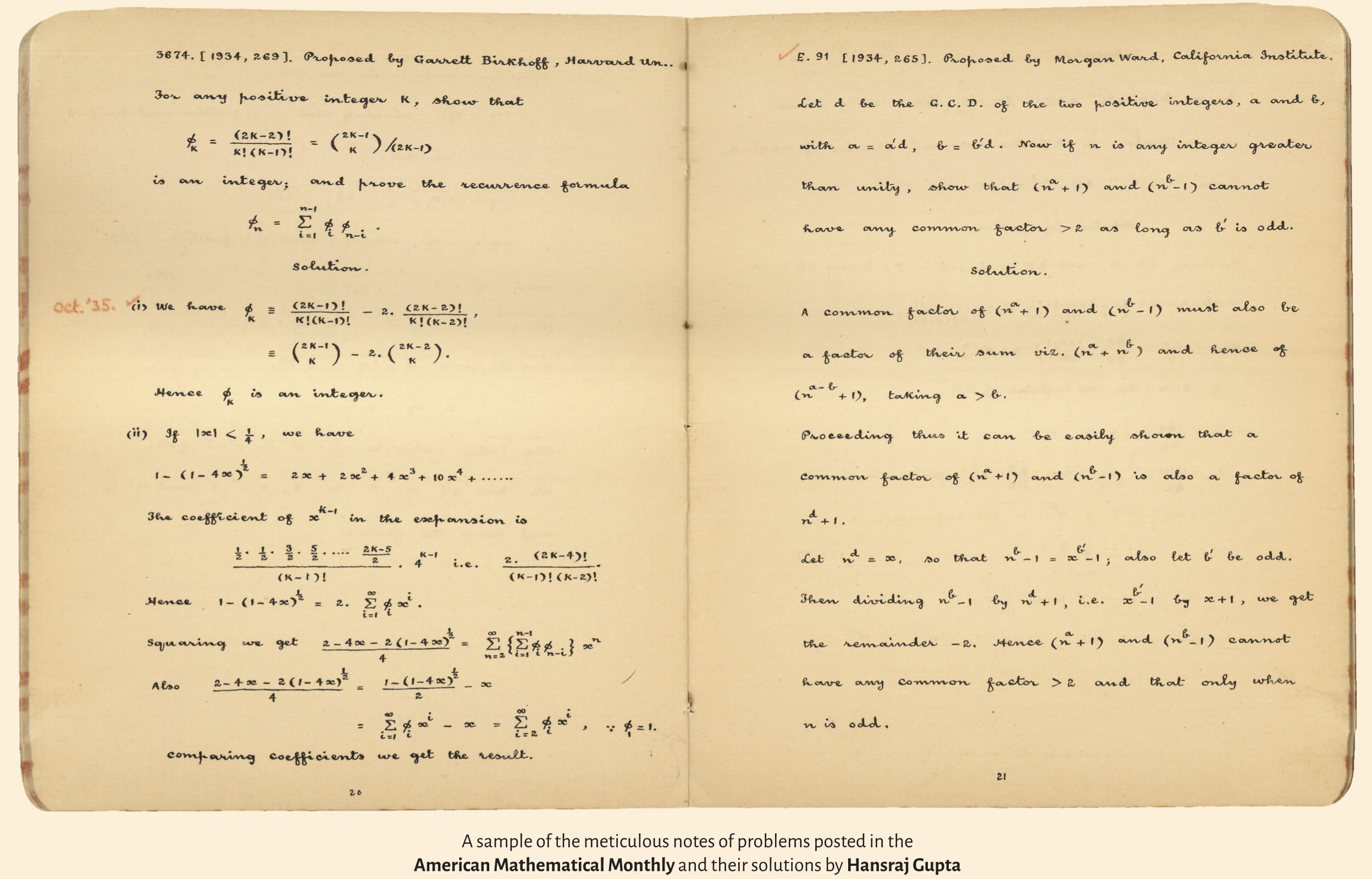 Going back another century and a half in time, the mathematician Sophie Germain lived through some of the most turbulent phases in the history of France: the French Revolution, the reign of terror, and the ascent and descent of Napoleon. This was also a time when it was next to impossible for a woman to receive an education, especially in the sciences. Through all these circumstances, Sophie developed an interest in mathematics, pursued it on her own and went on to make original contributions to certain problems of fundamental importance. She corresponded with leading mathematicians of her times, such as Gauss, Legendre and Fourier. Her life, work and correspondence have been documented by Dora Musielak in her book “Prime Mystery: The Life and Mathematics of Sophie Germain’’ published in 2015. This was later expanded into a second edition, renamed “Sophie Germain: Revolutionary Mathematician’’, and published by Springer in 2020. Siddhi Pathak presents a review of this book in this issue of Bhāvanā. Besides summarizing all the important events of Germain’s life as presented in Musielak’s biography, she describes aspects which make it a unique and excellent reference for those who wish to delve deeply into Germain’s life and mathematics. For readers who may not have the time to read the whole book, this review serves as a brief and succinct introduction to the remarkable life and work of Sophie Germain.
the review serves as a succinct introduction to the remarkable life of Sophie Germain
The front cover features Sir John Ball, our distinguished interviewee of this edition of Bhāvanā. The back cover is an image from the personal notebook of Hansraj Gupta showcasing his ready-to-print beautiful handwriting; we are grateful to his grandson Uday Gupta for both preserving his notebooks carefully, and giving us the unique opportunity to access them.\blacksquare
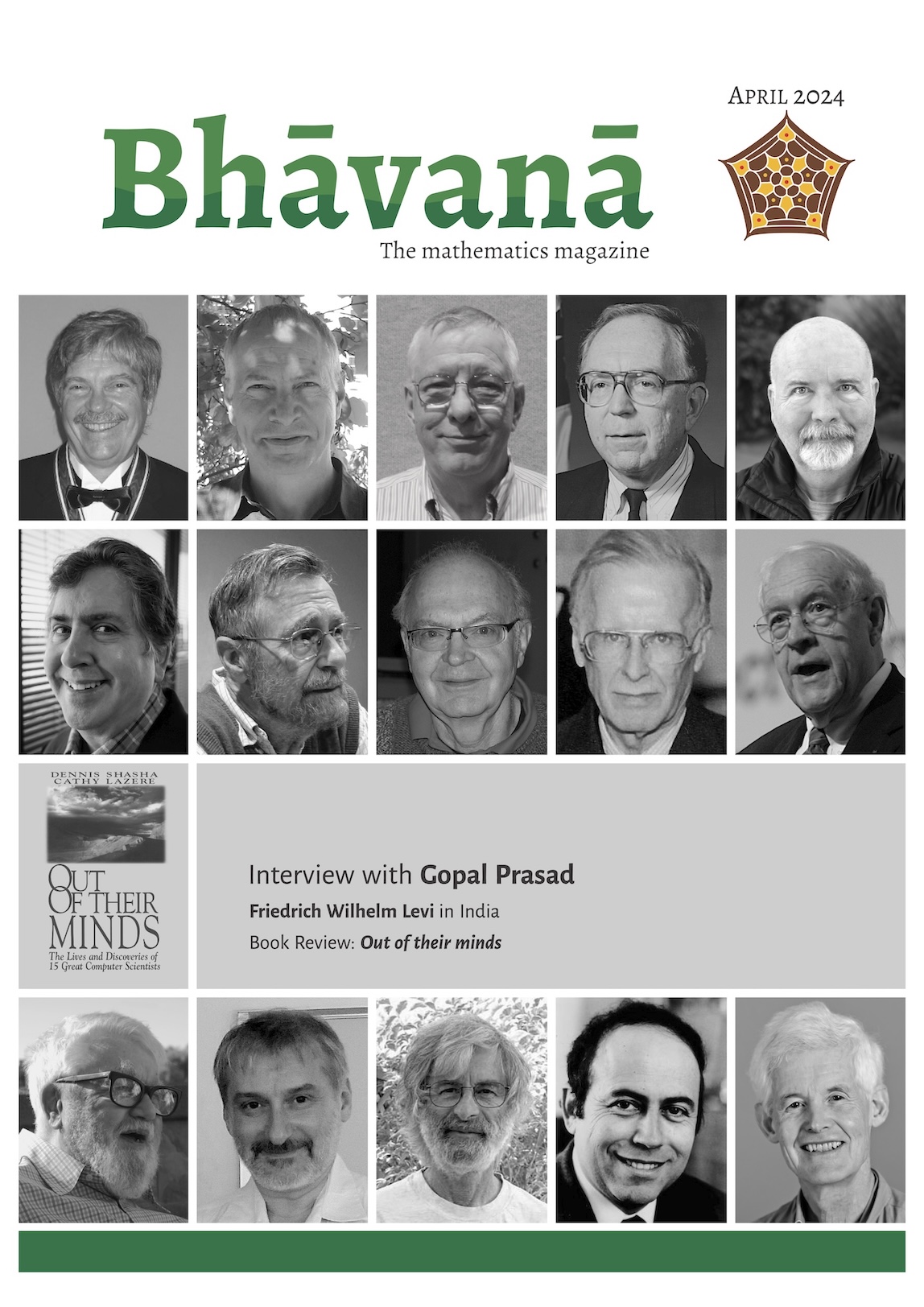 The distinguished interviewee of this edition of Bhāvanā is the mathematician Gopal Prasad, whose prolific career blossomed at the famed School of Mathematics of TIFR. From being the first person hailing from a family of businessmen to study mathematics, to being one of the first few mathematicians to work and contribute to the understanding of some of the deepest ideas of mathematics that lie at the intersection of number theory, representation theory and geometric topology, Gopal Prasad has been a trendsetter in more ways than one. In an insightful conversation with Bhāvanā, Gopal Prasad reminisces about his long and stellar career in mathematics that has involved working with some of the best minds in mathematics. He dwells on the memories of his father, a trader by profession but also a freedom fighter by passion who even braved prison for a while, his own gradual foray into the mathematical world as a bright young student learning under the tutelage of M.S. Raghunathan at TIFR, and interactions with several of his collaborators, including those in the hallowed halls of the IAS, Princeton. In a conversation enlivened by anecdotes and the inevitable deciding moments in the life of an academic, Gopal Prasad unravels an engaging chapter of Indian mathematical history.
The second article, which unravels an earlier facet of Indian mathematical history, is a tribute to Friedrich Wilhelm Daniel Levi, a German mathematician who, by a twist of fate, landed in India and contributed significantly to the teaching and practice of mathematics in India. The tribute begins with a short introduction delving into the time Levi spent in India, in which we learn how he was a key player in the inclusion of algebra in the university curricula across India. We also get to see some delightful snippets of history in Levi’s own handwriting through his letters to Homi Bhabha and even an indulgent poem penned by him, appreciative of the week he spent at a conference in Oberwolfach. Scouting for images to embellish this narrative surprisingly connected us to Levi’s grandson and his wife who kindly shared the photos of the family. What follows the introduction is a biographical essay originally written in German by Otto Kegel and Volker Remmert, translated into English and republished here. One gets a comprehensive picture of Levi’s career in Germany and how circumstances in Nazi Germany forced him to leave his home country after months of uncertainty, to take up an offer at the University of Calcutta. After retirement from there and a brief stint at TIFR Bombay during its early years, Levi eventually found his way back to Germany, not without difficulties though. The final piece of the tribute is the text of Levi’s presidential address Why Mathematics? at the annual conference of the Indian Mathematical Society in 1943, in which Levi provides a fascinating perspective on some perpetual debates in mathematics education. He opens his address by making a case for the value of practising mathematics for its own sake without burdening it with the responsibilities of modern life, and closes it with his definitive conclusion regarding whether mathematics should be classified as a subject belonging to the arts or the sciences, a conclusion that is hard to argue against.
An unmistakable aspect of mathematics is its inextricable role in computing technology
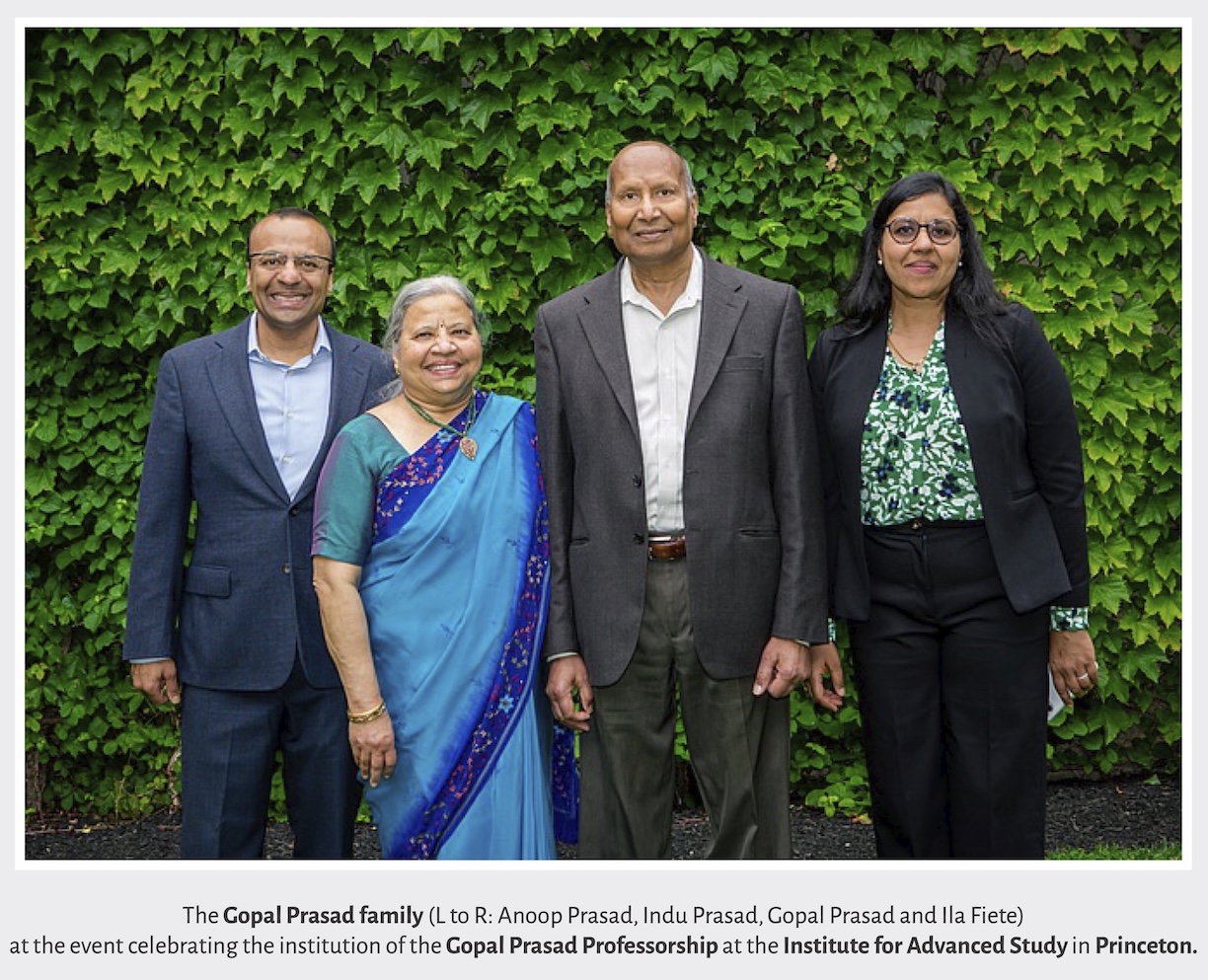 An unmistakable aspect of mathematics is its inextricable role in computing technology; not only has computing percolated into many spheres of life in the modern world, but its influence is expected to increase even further in the days ahead. Even as humanity stands on the cusp of an impending revolution powered by the advent of intelligent machines, it is time to look back and record the contributions of pioneering computer scientists—especially those upon whose foundational contributions rest today’s machines and algorithms. Reflecting on this topic, our corresponding editor Amit Deshpande reviews a gem of a book titled Out of their minds, published in the mid-’90s, that chronicles the lives and achievements of 15 computer scientists. Spanning across the disciplines of algorithms, architecture, linguistics, and machine intelligence, the review provides an invaluable bridge that links the present to a not-too-distant past. It is humbling to learn about the pioneering efforts of these scientists and the challenges they faced. They hold valuable lessons for mathematicians trying to push the envelope of a synergetic approach to proving mathematical theorems. Looking back and learning from these masters may inspire future advances. And that should make this book an invaluable read for its documentation, through oral history, and in-person interviews of the pioneers.
The front cover features the 15 computer scientists portrayed in the book review article. The back cover captures a happy moment from the celebrations on the day the Gopal Prasad Professorship at IAS Princeton was solemnized. \blacksquare
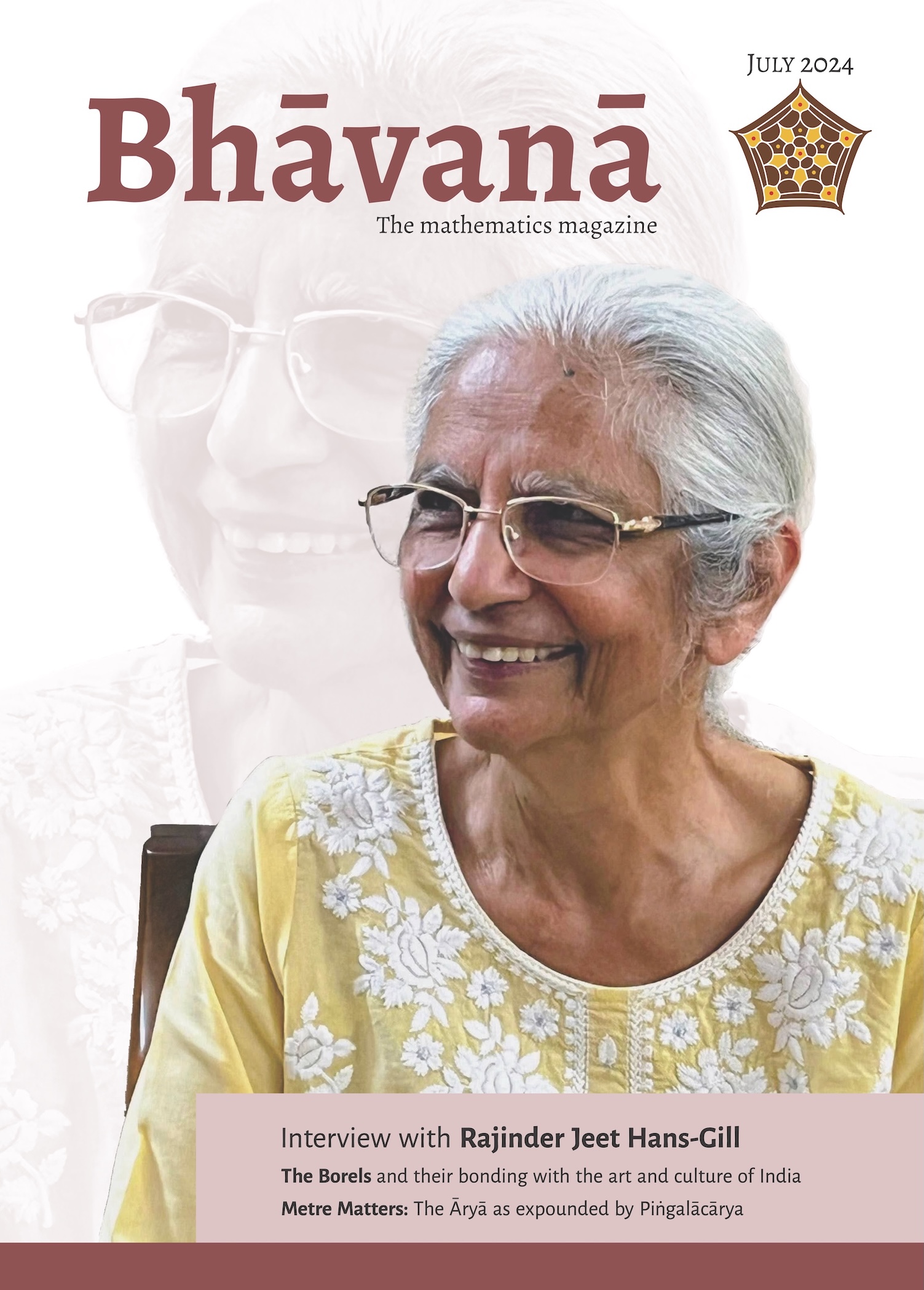 Through conversations with distinguished personalities, Bhāvanā endeavours to present the joys and challenges of each individual’s unique journey behind building their body of work. These conversations give us an idea of the educational and cultural context of their times, and how these evolved over time. In this issue, we are pleased to present a conversation with Rajinder Jeet Hans-Gill, an emeritus professor of mathematics at Panjab University. Her life’s journey parallels the changes that our country went through from its pre-independence days to its current times. We learn about her long years of service at the Panjab University, where the department of mathematics was lovingly built up by a dedicated team, nurtured and guided by early mentors and sustained by a succession of teachers, including her, who derived pleasure from working in a collective and shared academic environment. She humorously narrates her early years when her parents had to take drastic and adventurous steps to provide a meaningful education for her before recounting her inroads into mathematics, and her contributions to important problems such as a conjecture of Watson on indefinite quadratic forms. She also shares her thoughts on the importance of universities in building a healthy academic community, over and above the small, isolated silos that an institute-centric academic culture can lead to.
The second article is a tribute to the mathematician Armand Borel in this birth centenary year of his. An acclaimed mathematical giant of his era, Borel’s disposition towards several of his avocations were as devoted and intense, as to mathematics. Travelling to India for the first time in 1960 opened up a world of new experiences for him and his wife Gaby who accompanied him wherever mathematics took him. Complementing each other in their outlook and approach, the Borels went about systematically exploring the cultural treasure trove that India offered to their senses. The following excerpt from a personal email of the physicist P.P. Divakaran, who knew them well, best conveys the essential spirit of Borel’s inquisitiveness:
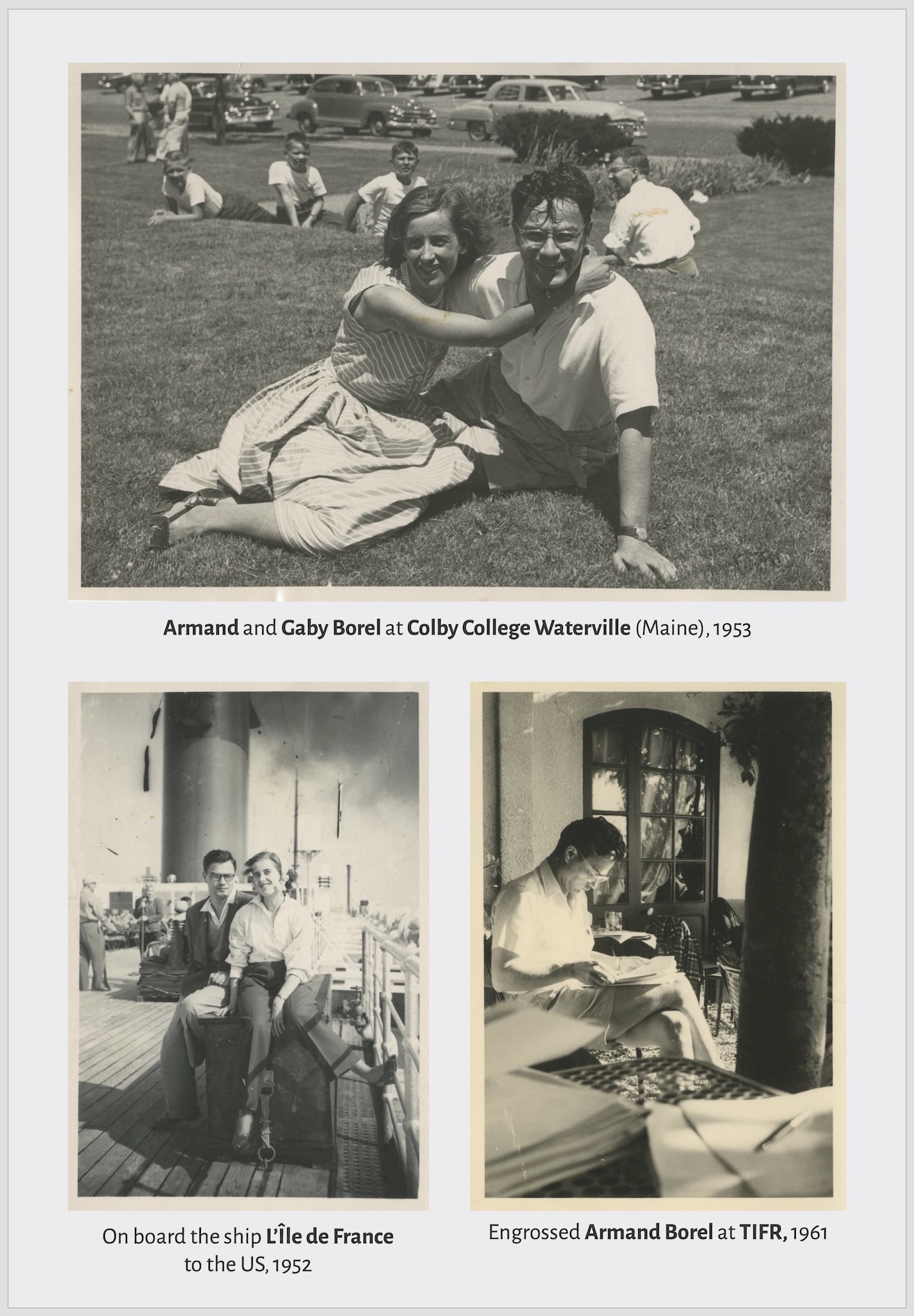 An important aspect of mathematical literature in Sanskrit texts is prosody, the study of versification or metrical structure, which is usually thought of in the context of poetry and similar literary pursuits. Metrical compositions, due to their rhythmic nature, help memorize verses. Such compositions are seen in many cultures across the world, and likely helped make memorization and propagation of these works easier at a time when written works were rare and the printing press not yet invented. In India in particular, metrical compositions were not limited to literary works, but extended to technical works too. This combination of prosody with scientific literature is something unique to the Indian tradition. In this context, the āryā metre is an important metre in which some of the earliest surviving astronomical and mathematical Indian works like the Āryabhaṭīya and the Brāhma-sphuṭa-siddhānta are almost exclusively composed. In this issue of Bhāvanā, Mahit Warhadpande and K. Ramasubramanian present an exposition of the rules of the āryā metre as set forth by Pi\dot{n}gala in his treatise, the Chandaśśāstra. They then go on to illustrate the application of this metre and its variations in the verses of the Āryabhaṭīya through several examples. They further demonstrate how apparent violations of the rules of the āryā metre in some of the verses are actually indicators of transcription or editorial errors having crept into the verses over time! Those ancient authors thus had to be experts in both their subject matter and the rules of prosody to be able to compose their technical works. We hope this article will help our readers appreciate the ancient Indian technical texts from this new perspective as well.
This combination of prosody with scientific literature is something unique to the Indian tradition
The front cover features a moment during our conversation with the interviewee protagonist Rajinder Jeet Hans-Gill. The back cover portrays a couple of rare moments from the lives of Armand and Gaby Borel. We are immensely grateful to Dominique Borel for enthusiastically providing all the help we needed. \blacksquare
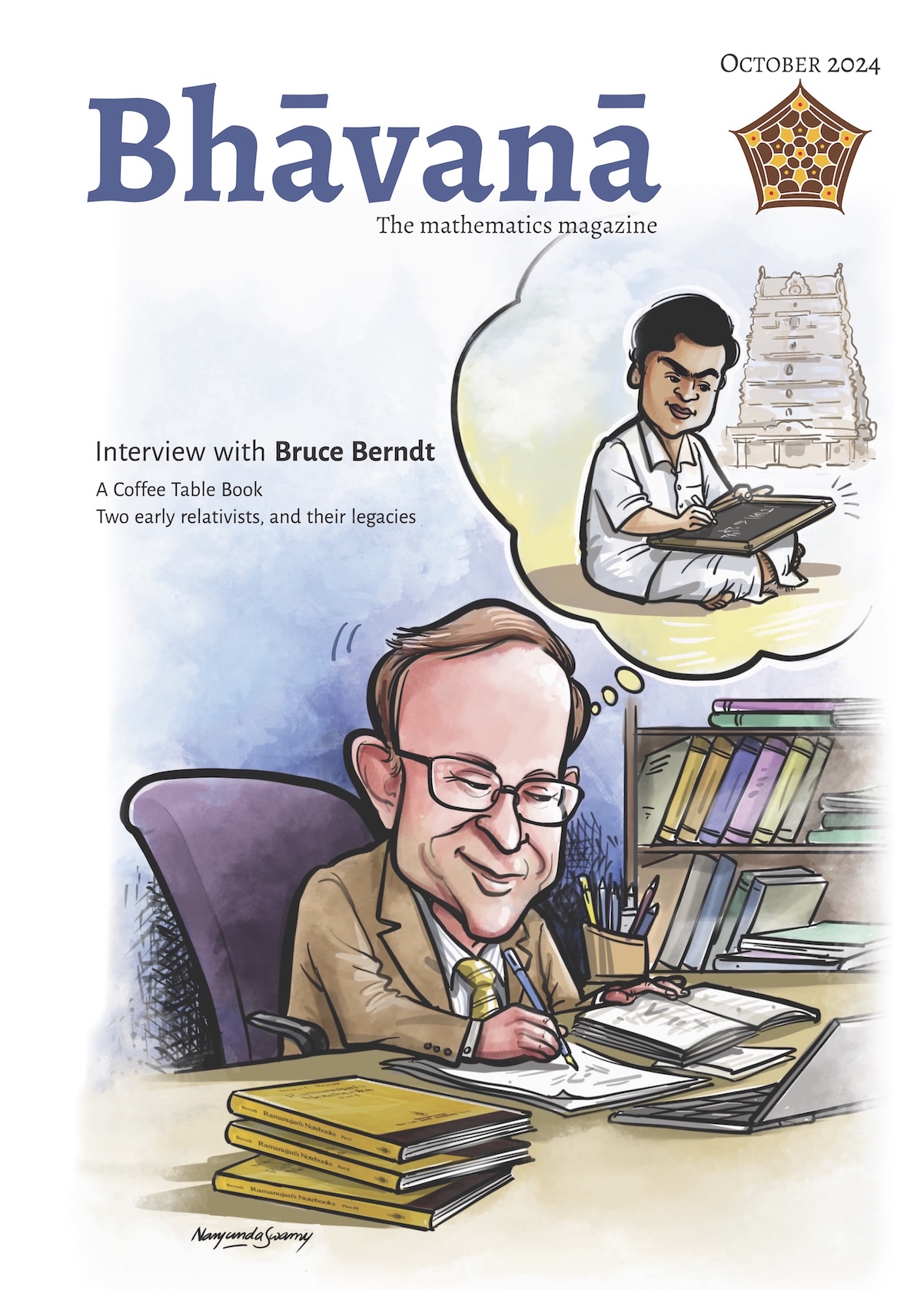 Sometime in 1974, a young number theorist from the University of Illinois Urbana-Champaign, visiting the Institute for Advanced Study in Princeton, happened to be reading two papers which contained proofs of some formulas from the famous Notebooks of Ramanujan. He realized that he could prove them another way, using a theorem he had already proven. The feeling of wonder at having proved formulas of Ramanujan prompted him to order a copy of the Notebooks from the Tata Institute (TIFR) in Bombay (now Mumbai). These notebooks contained over 3000 theorems. In what became a life-long study of the work of Ramanujan, Bruce Berndt, our interviewee of this edition of Bhāvanā, swung himself to a systematic editing of these notebooks that seemed like a treasure trove, providing proofs of many of the formulas and theorems contained in them, either by himself or with collaborators. This work was eventually published in five volumes that constitute a window to the beautiful mathematics of Ramanujan.
Berndt’s unfailing interest in the work of Ramanujan led him to a similar study of the so-called Lost Notebook of Ramanujan, along with his friend and fellow number theorist, George Andrews, with whom he published a second set of five volumes providing proofs to the results contained therein.
At a conference in June 2024 to jointly celebrate the 85th birthdays of Berndt and Andrews, Berndt spoke to his former student, Atul Dixit (now a faculty member in mathematics at IIT Gandhinagar), recalling his journey that came to be deeply linked with the life and work of Ramanujan. This issue presents before you this conversation – a fascinating elucidation of 50 years of living with Ramanujan – trying to understand (sometimes without success) how Ramanujan could have derived his “creative, clever, beautiful” formulas.
The second article in this edition of Bhāvanā looks at the stereotypical image of a bunch of mathematicians huddled together in front of a blackboard in a classroom, churning out an important piece of mathematics, by moving the setting from the classroom to a cafe, and replacing the blackboard with marble table-tops. The result, as the article on the Scottish Book shows, stays the same.
The feeling of wonder at having proved formulas of Ramanujan prompted Bruce Berndt to order a copy of the Notebooks from TIFR
Focusing on the Polish Lwów school of mathematics, the article by Chris Zielinski, with a preamble by Vivek Borkar, gives a snapshot of the lives of various mathematical luminaries such as Banach, Steinhaus, Mazur, and Ulam who gathered together at the “Scottish Cafe” in Lwów, run by Zielinski’s grandfather in the 1930s till the Second World War broke out. The cafe became a mini mathematics school in itself as the gathered experts discussed various mathematical problems. These problems made up the contents of the eponymous Scottish Book, some of which continue to drive modern mathematical research. Zielinski’s article is a tribute to the many mathematicians who contributed to the Scottish Book, some of whom met with tragic endings during the Second World War. The book itself stands as a testament to the ultimate triumph of mathematical truth, and also provides an obvious answer to the question of what a bunch of mathematicians would do in a cafe.
the back cover features images showcasing the intense mathematical activity at the Scottish Café around WWII
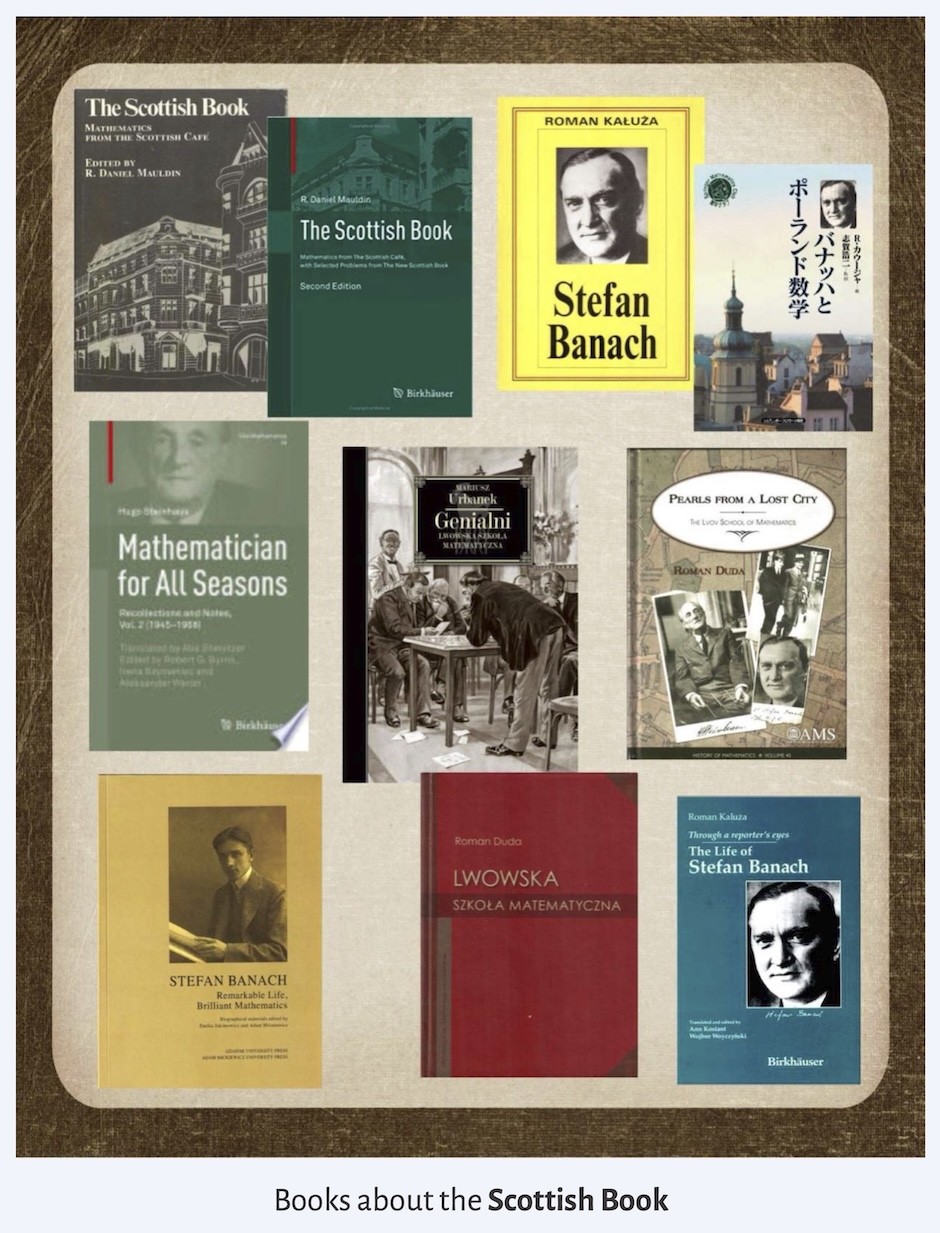 The Cambridge dictionary defines a “relativist” (partially) as: someone who believes that[…] nothing can be true or right in all situations. In the context of our third article though, we refer to people working in the field of General Relativity as relativists. Given that Einstein’s theory of General Relativity (GR) seriously put into question our understanding of space-time and gravity that had been built up over the centuries, perhaps the literal meaning is not too far off the mark either about these relativists! In this issue, we pay a tribute to two relativists whose seminal work in the field of General Relativity led to the formation of two thriving schools for research in this area in India. We are first introduced to Nikhil Ranjan Sen (NRS) who set up the Kolkata school, and then to Vishnu Vasudev Narlikar (VVN) who set up the Banaras school, by Rajinder Singh and Aragam R. Prasanna respectively. The third and concluding piece of the tribute is Jayant V. Narlikar’s account of the progress of GR and in particular the work done in GR in India by these two schools from their inception in the late 1920s and early 1930s, up to the time of India’s independence.
Our interviewee Bruce Berndt’s lifetime of dedication to uncover several aspects of the life and work of Srinivasa Ramanujan is legendary. In his own words, he has lived in constant association with Ramanujan ever since he was drawn to his mathematical creativity fifty years ago. That Ramanujan himself attributed his creative powers to the goddess of Namakkal is too well-known.
The front cover is an artistic portrayal of these unique sentiments and more, in one frame. The back cover is an assemblage of the cover pages of various publications arising out of the intense mathematical activity, around the time of the Second World War, at the Scottish Café in the Polish city of Lwów.latex]\blacksquare[/latex]
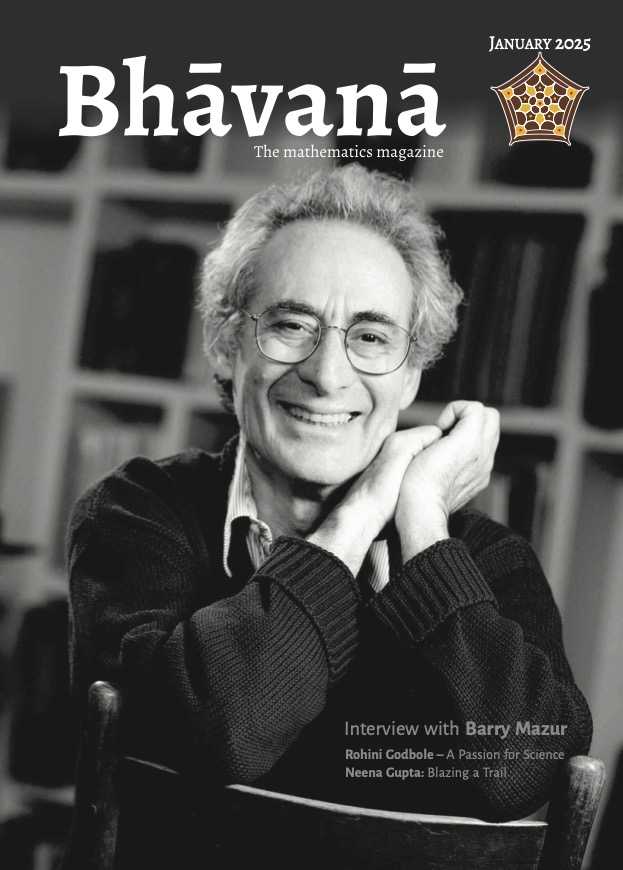 In our first interview of 2025, we bring to our readers an engaging conversation with mathematician Barry Charles Mazur. Starting off his career in geometric topology, Mazur then switched to number theory via algebraic geometry, and is today well-known for his remarkable contributions to all of these fields. Conducted by Vijay Patankar in the familiar Bhāvanā format, the interview captures various facets of Mazur’s life and career. Discussing aspects of his mathematical contributions for a wide audience, the interview also explores the philosopher, the mentor, and the poet, in him. Besides, it carries several nuggets of wisdom that are captivating as well.
On October 25, 2024, the science community was deeply saddened to hear about the demise of Rohini Godbole, a distinguished scientist in the area of high-energy physics. Over the last five decades and more, she made significant contributions to fundamental areas of research, but her impact on the scientific community extends in deeper ways. She was a passionate teacher and a committed mentor of students. She touched the lives of innumerable young scientists while they were struggling to find their way forward. Her commitment to the advancement of science as well as gender equity for women in science led to her serving on several committees and policy-making bodies. Through her energy and resourcefulness, she was able to initiate action that had deep and long-lasting consequences on science, some of which are still unfolding.
the interview with Barry Mazur explores the philosopher, the mentor, and the poet in him
We at Bhāvanā magazine, whose endeavour has been to reflect mathematics in its broadest reach and outreach, were honoured to have her in our team as a corresponding editor. With her unique perspectives, she brought great energy and meaning to this quest. In personal correspondence with friends and colleagues, she expressed pride and joy in being associated with our team, which we cherish deeply.
In a touching obituary, Sunil Mukhi, her fellow-physicist and friend of five decades, shares with us an overview of her life, her scientific contributions, and the sheer determination through which she overcame struggles in her early-career days. He also narrates memorable anecdotes from their interactions, which further reveal the strong, feisty personality of this exceptional scientist.
With her unique perspectives, Rohini Godbole brought great energy and meaning
Sometime in the summer of 2012, a young postdoctoral fellow at the Tata Institute of Fundamental Research solved a famous problem in algebraic geometry which had evaded the most brilliant minds for the last several decades – the Zariski cancellation problem. She quietly wrote to two senior mathematicians (including her former doctoral advisor), who verified the proof before she submitted the paper to the prestigious journal Inventiones Mathematicae and announced the result to the wider mathematical community. Neena Gupta’s accomplishment won her worldwide recognition and admiration. Soon enough, she presented a powerful, unified treatment of several fundamental problems, out of which the Zariski Cancellation Problem is one. She went on to win several accolades for her work. As a celebration of this young, stellar Indian mathematician, we present to our readers an account penned by her proud doctoral advisor, Amartya Dutta. As a first hand witness of her growth through the various stages of her career, he describes Neena Gupta’s transition from a young, incoming MMath student who wondered if she would be able to cope with the challenging programme at the Indian Statistical Institute, Kolkata, into an outstanding mathematician who is now a faculty member at the same institute. We believe that this account will inspire our young readers to believe in themselves, build their knowledge with full sincerity and dedication, and forge ahead through their unique perspectives.
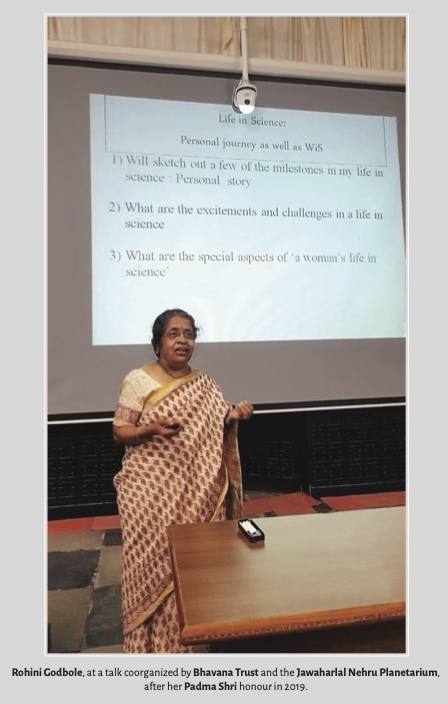 In his second article in this issue, resuming his series on mathematics in India, Amartya Dutta travels back in time and picks up on further exploration of Brahmagupta’s bhāvanā. Making a clear distinction between this and what is usually referred to as his identity, he demonstrates how bhāvanā is a crucial ingredient in a celebrated result of Legendre, thus highlighting one of its far-reaching impacts on modern number theory. It is hoped that the necessitated theorem-proof format adopted to describe this will not be intimidating to our general readers. In fact, some of these undercurrent thoughts, propelling some of the future developments of the subject, all the way up to the modern impact, appears also in the article Special values of zeta functions by Arshay Sheth in the October 2023 issue of Bhāvanā.
The striking photograph, by Jim Harrison, of Barry Mazur, our distinguished interviewee featured in this edition of Bhāvanā, graces the front cover. The back cover features a moment captured during the talk by Rohini Godbole on 22 October 2019 at the Bangalore Planetarium. In this talk, organized by Bhavana Trust to felicitate Godbole on her receiving the Padma Shri, she shared some of the defining moments in her life dedicated to science. \blacksquare
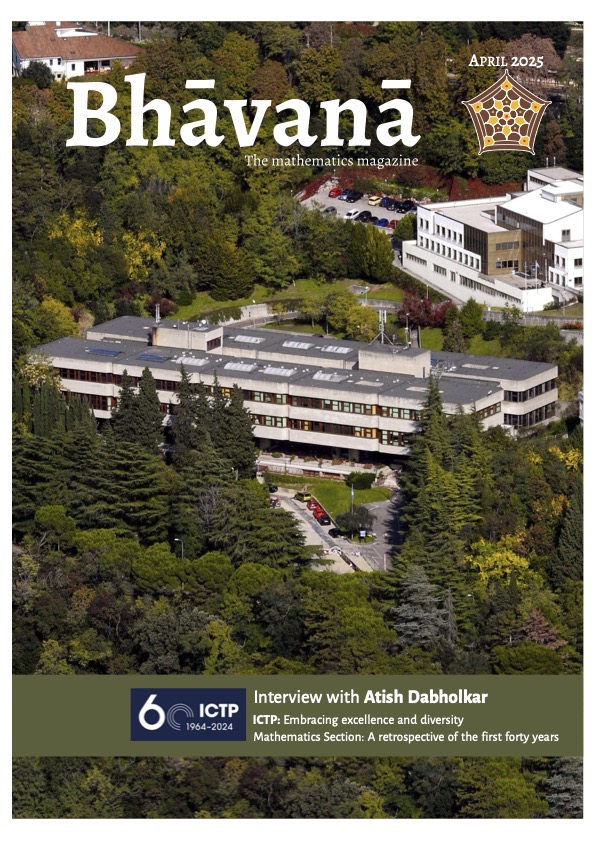 In the January 2020 issue of Bhāvanā, our interviewee Ram Prakash Bambah shared some memories of Abdus Salam—the 1979 Nobel Laureate from Pakistan—from their overlapping time at Government College, Lahore, and at St. John’s College, Cambridge. In the current issue, we reproduce an article in which Bambah writes in detail about that early association. This memoir not only informs us about Salam’s legendary academic brilliance at all stages of his early to postgraduate education as witnessed by his friend, but also recreates touching and inspiring moments from their mutual interaction. We learn about the advice and support that Salam received from his friends while contemplating a difficult choice between returning to Pakistan and staying on at Cambridge for his studies in the early 1950s. The thoughts and insights shared during these conversations must have contributed to Salam’s motivation to build the International Centre for Theoretical Physics (ICTP).
The article by K.R. Sreenivasan, former director of ICTP, discusses the dual roles of an institution like ICTP to be able to upkeep its core sentiment of scientific excellence, catering to an international community, and, to keep it inclusive in the wider expanse of diversity that exists in the world. Situating it in the framework of UNESCO on one hand, and realizing it in a place that is both accessible and conducive on the other, ICTP assumes its significance in the strategic location of Trieste. The article touches upon aspects that an accomplished scientist, sitting at the helm, has to contend with while making game-changing decisions.
With the idea of featuring ICTP—which celebrated its 60th anniversary in 2024—in this issue, Bhāvanā spoke with its current director, Atish Dabholkar, a theoretical physicist whose journey with ICTP began long before he stepped foot there. As a master’s student at IIT Kanpur, Atish was deeply inspired hearing about Salam’s Nobel Prize winning work. That spark would eventually grow into a gravitating association with ICTP. Here, Atish reflects on the values instilled in him by his parents, both of whom dedicated their lives to the dissemination of science, and how those ideals nudged him toward accepting the directorship despite initial hesitation. He opens up about the challenges of heading an internationally renowned research institute, operating under the aegis of the United Nations, with a mission rooted both in scientific excellence and scientific diplomacy. He outlines his vision for ICTP, in keeping with the spirit of Salam, while responding to the rapidly evolving scientific and geopolitical landscape. He talks about ICTP’s commitment to staying relevant in a changing world. The discussion seamlessly segues into his own research on quantum black holes and their fascinating connection to the mock theta functions of Ramanujan, ending on a charming note about how an unused corner in the building was transformed into a lively discussion lounge, wittily called “Hilbert Space’’.
Due to unprecedented advances in frontier areas of physics taking centre stage already in the early twentieth century, with geopolitics entering the scenario and assuming its own role in the game, perhaps it became imperative that
ICTP exclusive April 2025 issue showcases Bhāvanā’s first official international assignment in its own journey into the ninth year
Abdus Salam established ICTP in 1964, in that idyllic city of Trieste. The powerful role of theoretical physics notwithstanding, it became even more imperative that mathematics had to make its inevitable entry into its fold, some 20 years later. The article on the mathematics section at ICTP traces back to the very beginning, touching upon its defining moments, and taking the reader all the way to the present – described passionately, in their own words, by some of the part players traversing its path.
Scientists stay abreast with the latest research in their field and the library is a silent key enabler for this. The ICTP library, renamed the Marie Curie Library in 2008, has been serving this purpose providing access to the best and latest journals and books. With content being available, and consumed online increasingly, the dedicated library staff are reimagining their pledge to serve its users in innovative ways. Not confined to its isolation in Trieste, they are gearing towards becoming a `lighthouse’ for libraries the world over – just as the institution of ICTP is for the world of physics and mathematics. The fifth article showcases their dedication and service, being duly rewarded in 2019 with the Spirit of Abdus Salam Award.
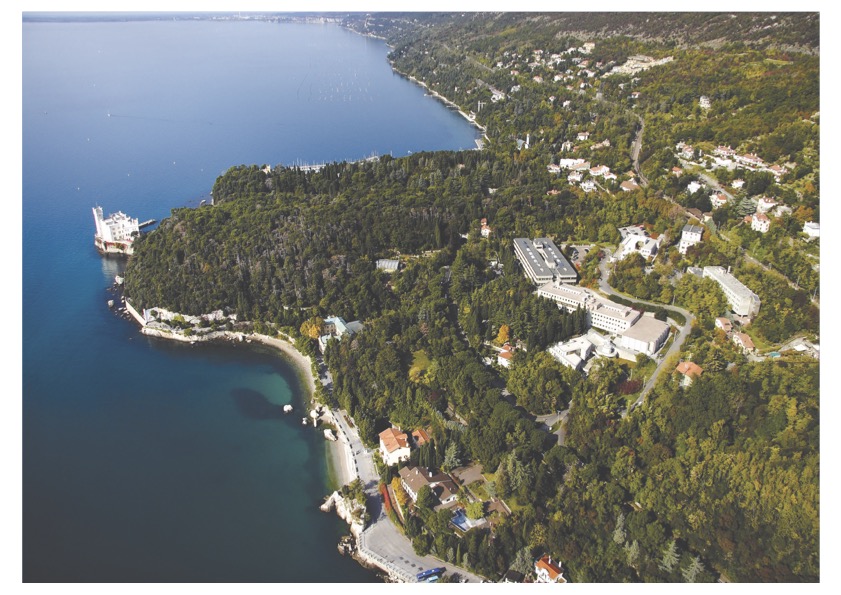 In the last article of this issue, Rajesh Akkihal and Mahit Warhadpande, who travelled to Trieste during the first two weeks of September 2024, recount their interactions with people at ICTP. The travelogue takes you through the ICTP environment, observing the efficient functioning of committed personnel, talking to them, and hearing about key aspects of their work. It also features discussions with young and aspiring students and postdocs there. Interspersed with personal experiences, the article draws to a close by portraying the beauty and the culture of the people of Trieste. In that, it showcases Bhāvanā’s first official international assignment, and outing, as one of the centrepieces in its own journey into the ninth year.
The cover pages show an aerial view of the location of ICTP buildings, with the back cover also showing a part of the city of Trieste with its own diverse allure from the sea to the mountains. \blacksquare
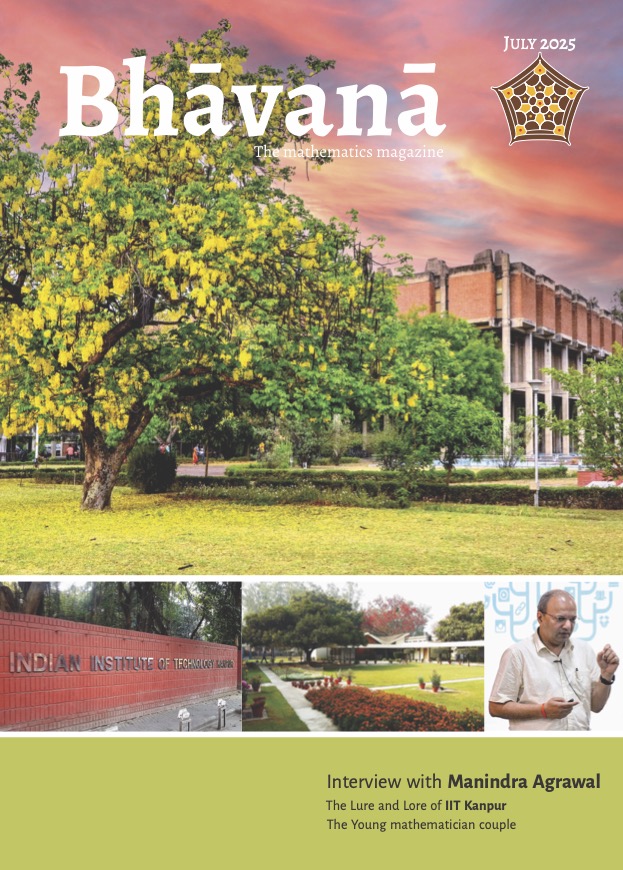 The passing away of Padma Vibhushan Jayant Vishnu Narlikar, the eminent Indian astrophysicist who enthralled generations of young and aspiring students with delightful science stories, is a sad event in the annals of the scientific movement in India. As the founding director of the Inter-University Centre for Astronomy and Astrophysics (IUCAA) in Pune, he played a significant role in the development of scientists in the field, and the field itself. Equally so, if not more importantly, he engaged the interest of the general populace in science through his popular science writings, public programmes, and, of late, through his blog. This issue of Bhāvanā celebrates the life and memory of Jayant Narlikar through personal recollections of his daughters, peers, students, and associates. These heartwarming glimpses of the family man, the scientist, the mentor, and the colleague clearly show that he will remain an inspiration for generations to come.
It is not every day that an educational institute features in a New York Times headline for a scientific discovery. Well, IIT Kanpur did, on August 8, 2002, thanks to Manindra Agrawal, who was then a young professor in its computer science department. The story was that he, along with two bachelor’s students, had discovered a deep yet accessible algorithm to determine primality in polynomial time. Manindra is through and through IIT Kanpur: after his bachelor’s and PhD there, he joined it as a faculty member in 1996 and now serves as its director. In a wide-ranging interview, Manindra Agrawal details the research journey that led to his eureka moment on that August day, a journey that shares many characteristics with the great scientific discoveries of our times, such as persistence, serendipity, and, of course, an unprecedented insight. He talks about his influences during his school days and why he chose to study computer science at IIT Kanpur, shedding light on how those days shaped him as a person. Touching on topics like postdoc experiences, family, and his approach to being a PhD advisor, he subsequently recalls the events that culminated in him getting a most thankless job of developing a Covid-19 prediction model for policy implementation, which was widely featured in the press, for both good and bad reasons. Toward the end, he reflects on the challenges he faces as the director of IIT Kanpur, especially in the context of having been associated with the institute for nearly two-thirds of its existence. It is no surprise, then, as he admits that IIT Kanpur is his home now, and that his childhood home is gone.
The article “The Lure and Lore of IIT Kanpur’’ by Sankalp Tiwari, an alumnus of IITK, brings to life his own time on campus, gleaning from a reading of the book The Fourth IIT. He takes us through the book, offering vivid descriptions of the authors’ chronicling of IITK’s history, interspersed with accounts from his 13-year association with the institution. We get to know about the history behind the setting up of the four initial IITs, and how Kanpur was chosen as the place for the IIT of the north. The review highlights the thoughtful design of the open and unhindered campus, the many innovations in the design of the curriculum and the promotion of merit in creative ways. He also discusses the establishment of the Kanpur Indo-American Program (KIAP), which allowed IITK to be mentored by a consortium of nine leading American universities. This collaboration resulted in the setting up of one of India’s first high-speed computers at IITK. The review also brings to light some of the challenges faced by the institute and how they were overcome. Sankalp ends the article on a reflective note, touching on aspects that would have made the book even more of a wonderful read.
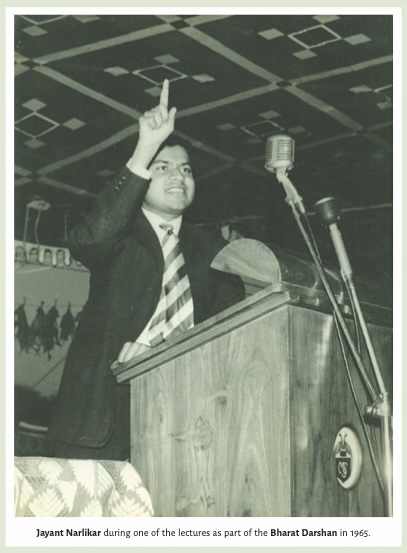 In the article on the Young couple—William and Grace Young—we take a peek into a moment in the mathematical history of India which came about with the formal creation of the Hardinge Professorship at the University of Calcutta. The inaugural appointment of William Henry Young in 1913 to this post had interesting implications in two different ways. As Michael Barany’s insightful preamble and the subsequent republished obituaries of the mathematicians William Young and his wife, Grace Young, reveal, the former’s tenure, while putting Calcutta on the global mathematics map, inadvertently catalyzed a transformative period for Grace. It provided the unique conditions under which Grace began to achieve distinct recognition. Until then, her considerable mathematical contributions had often been credited to her husband. This episode of a notable British mathematician’s tryst with the University of Calcutta, while contributing to India’s burgeoning mathematical scene, also seeks to shed light on the broader dynamics of gender recognition in early 20th-century mathematics.
The dominating skyline in the main image, resembling a painting, with the Amaltas tree in the foreground, must truly be the work of that magical artist, nature! The bloom on the Amaltas, known as Indian Laburnum, perhaps \mbox{figuratively} conveys the blooming of our interviewee’s academic career on the campus, like those of several accomplished personalities who strode on there. The back cover features a 26-years-young Padma Bhushan awardee Jayant Narlikar, who burst into fame in the international scientific arena by quietly taking on the Big Bang. \blacksquare
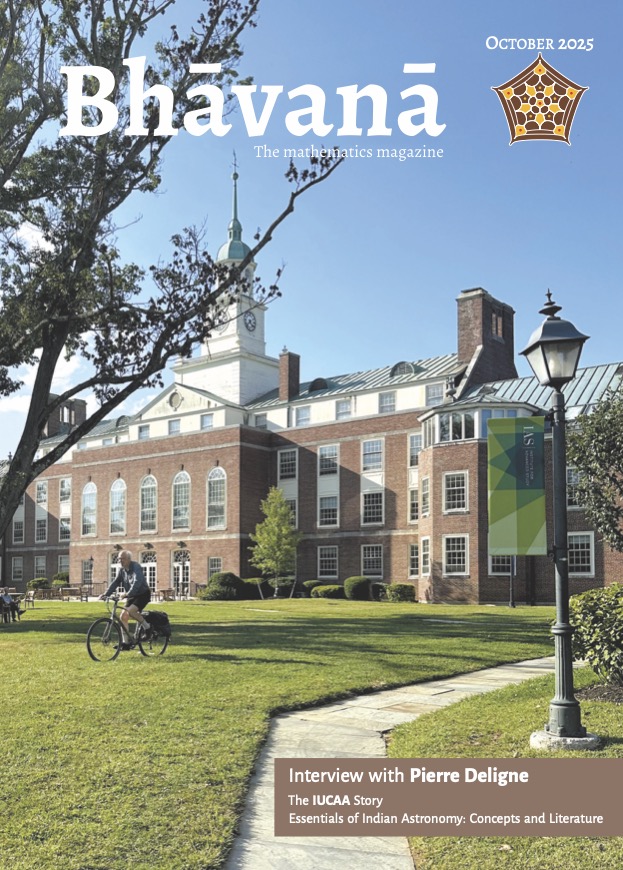 This edition of Bhāvanā features a relaxed conversation with Pierre Deligne, a member of the elite club to have been awarded both the Fields’ Medal and the Abel Prize. Amidst such achievements, Deligne’s grounded nature shines through as he answers all our questions with disarming simplicity. He talks nonchalantly about things like digesting Bourbaki’s textbook on set theory while still in school, and of building igloos for the obvious purpose of sleeping in them, as though these were commonplace occurrences.
Deligne’s interest in mathematics started through discussions about his elder brother’s maths lessons at school. Later, Deligne would attend lectures of Jacques Tits at the university. He also counts Grothendieck and Serre among his mentors as he leads us up to his work on the Weil conjectures and subsequent fruitful collaborations with Mumford, Luzstig, Weil, Langlands, and Zagier to name a few. In between, he also found time to chase eclipses in Siberian wildernesses and Libyan deserts and to work on designing his own coat of arms when ennobled as a viscount by the Belgian king.
Throughout the interview, we get glimpses of his simple tastes, perhaps acquired during his early years. His preference for cycling to the grocery store as opposed to driving there “in a metal box’’, finding relaxation in gardening, building igloos, as well as an anecdote about sleeping under the open skies amidst the ruins of a fort during his visit to India, gives us a peek into Deligne as a person, even as we trace his career as a mathematician.
The second article, a short autobiographical note by Jayant Narlikar, written originally for the book One Hundred Reasons to be a Scientist and being republished here, is a trailer to his first-hand account The IUCAA story, one of the spotlights in this issue, that unfolded in his series of blog posts. In The Excitement of Doing Science note, Narlikar radiates the infectious enthusiasm he feels towards science. He talks about the influential role played by his father, who helped create a conducive environment for the young and curious Jayant and his brother, about his maternal uncle who challenged them with mathematical problems beyond the school syllabus and about his PhD advisor, Fred Hoyle, who treated him as an equal colleague right from his early studentship days, all of which would have helped him mould into a great scientist of our times and a delightful science story-teller.
Talking of blog posts, social media has been used effectively of late by scientists to communicate with people interested and invested in science. In one such endeavour, between December 2024 and March 2025, Jayant Narlikar wrote a 9-part series in his blog on the establishment and development of the Inter-University Centre for Astronomy and Astrophysics (IUCAA). As the founder-director of this centre, who has been associated with it in the entirety of its functioning, his retelling of the IUCAA story holds great value. The blog series, now combined collectively into an article in this issue, together with a crisp supplement carrying recollections by two of his unfailing colleagues, Naresh Dadhich and Ajit Kembhavi, contains insights and perspectives that a frontline scientist who evolved into the role of an institution-builder is uniquely equipped to provide.
In the next expository article, M.S. Sriram traces the mathematical development of Indian astronomy from its Vedic beginnings to modern times, highlighting its distinctive methods and contributions. Expertly managing to provide numerous technical details while keeping the article accessible, he discusses how the concepts of day, lunar month, and year were tied together in the Vedic texts dating back to as early as 2300 BCE. Within this framework, we get to know that the mathematics presented in these texts was algorithmic, providing explicit formulas for estimating quantities like daytime length as a function of time of the year. Sriram then argues that in the early Middle Ages, Indian astronomy became more systematic and refined, addressing non-uniform motion of celestial bodies, eclipses, and planetary models. In particular, he emphasizes how the modern sine and cosine functions played a prominent role in Indian astronomy. Sriram then outlines the structure of a typical Indian astronomy text and discusses further corrections and developments of the late Middle Ages, concluding with efforts since the nineteenth century to clarify, edit, and compile ancient texts. In this ethereal journey, we get to learn, among other things, the meanings of oft-heard terms such as muhūrta, nakṣatra, and tithi, and also get a peek into how the ages of the featured texts are estimated.
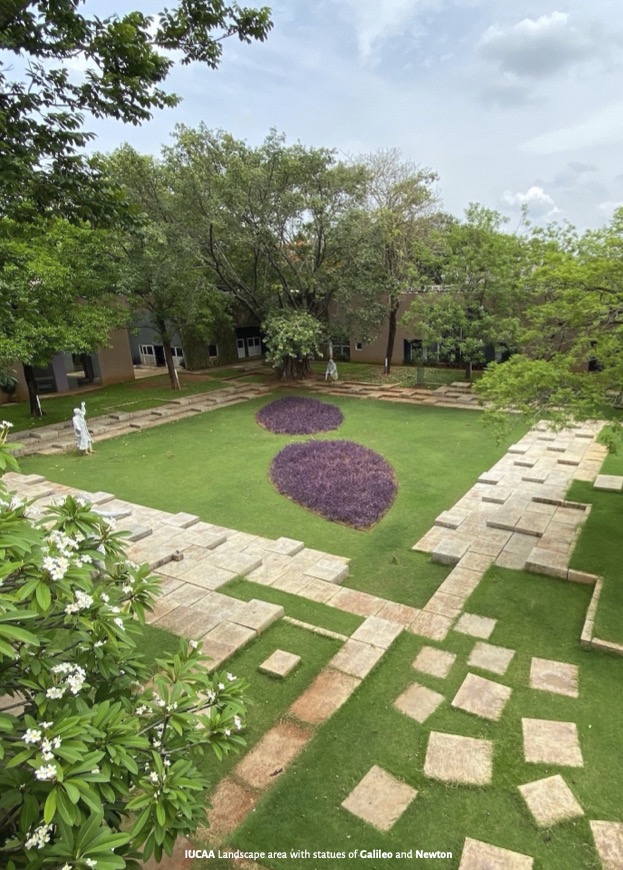 In the final article, an obituary tribute honouring the life and works of Balachandra Rao who passed away on 14 May 2025, at the age of 80, Shrikrishna Dani fondly remembers his many interactions with Rao over the years. Thanks to his natural aptitude for both science and Sanskrit, Balachandra Rao was uniquely placed to unravel impactful works of ancient Indian astronomy. His passion for research, teaching and scholarship ensured that the considerable body of knowledge that he investigated and wrote about, was also transferred to his students. His enthusiasm to communicate mathematical ideas in his mother tongue Kannada is amply evident in the number of pedagogically accessible books he authored.
The front cover showing Pierre Deligne riding a bicycle with saddlebags on the IAS greens, with the iconic Fuld Hall in the background, an IAS banner on the right hand side, a perfectly blue sky, and a part of an old tree, graphically captures Deligne’s love of outdoor. The back cover showing the beautifully laid out landscape area of IUCAA with statues of Galileo and Newton, sitting under an apple tree, portrays an alluring and inspirational aspect of being connected with history—a sentiment that runs through the articles appearing in this issue, that marks the completion of Bhāvanā’s own ninth annual cycle. \blacksquare
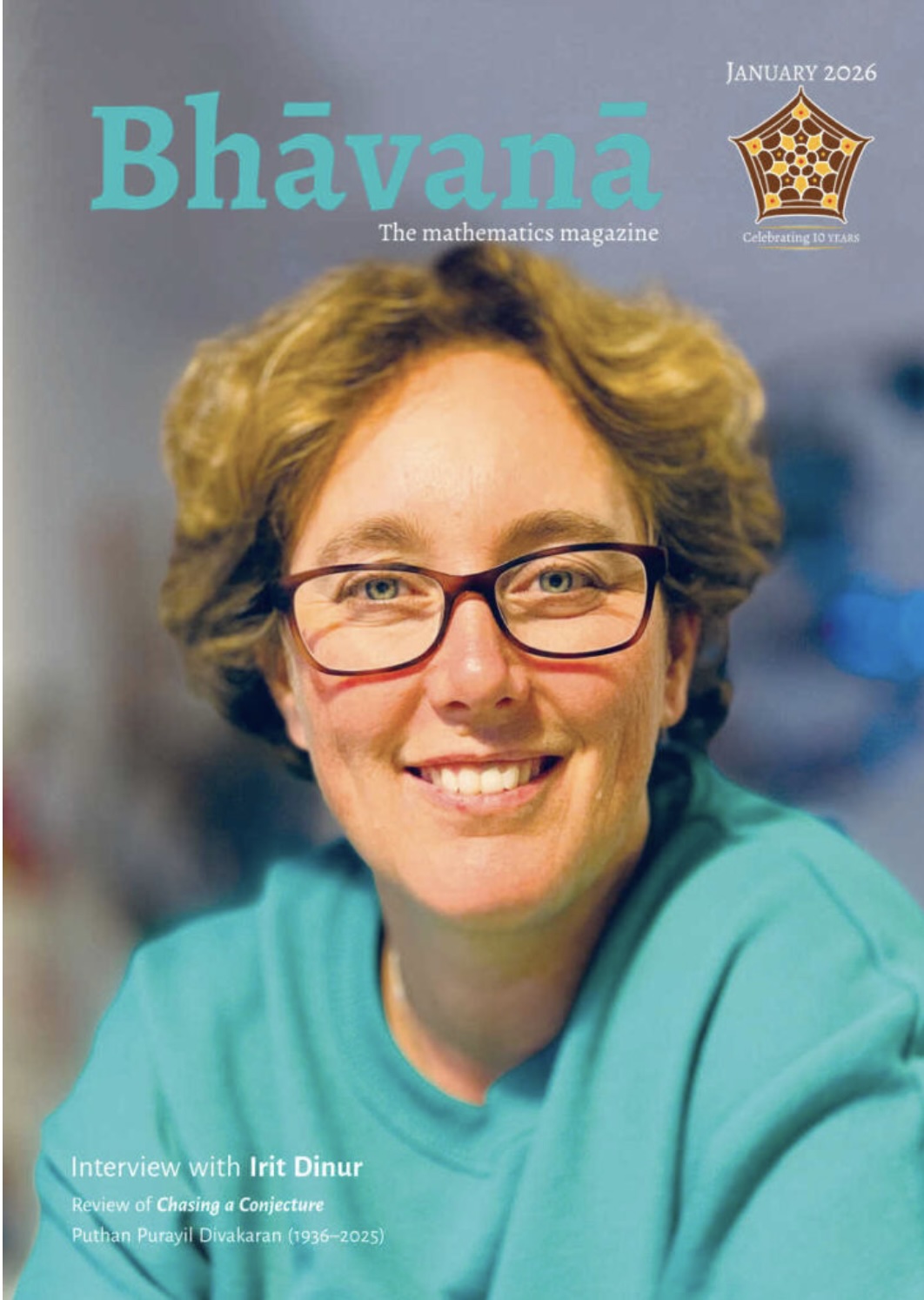 Bhāvanā’s entry to the tenth year, into double figures in the parlance of the game of Cricket, highlights a first of its kind in its interview section – Irit Dinur, the interviewee featured on the front cover is the first woman to be accorded the honour of permanent professorship at the famed Institute for Advanced Study School of Mathematics.
In this brilliant conversation, she relates her early influences and her entry into the world of research. Describing fundamental ideas in her work, she tells us how she visualizes different areas in her explorations, and the philosophical framework of her work in her own mind. We get a grand tour of the journey of her contributions, in which she highlights the role played by parallel developments and her interaction with peers, including their own deligthful “discovery over a cup of coffee” story.
Irit’s story has several takeaways. It makes us reflect on several aspects that motivate a young person. As a student, she observed several scientists in her area displaying great camaraderie. She read well-written papers in her field that employed simple examples, while motivating powerful ideas. She learnt to think about ideas abstractly without necessarily thinking of concrete applications, following intuition. The reader will be fascinated to learn how she proved a deep result simply because she wanted to teach PCPs better to her students.
The life of a mathematician is often at odds with the frenetic pace of the modern world. To the casual observer, very little seems to happen for a long time. But like the tectonic shifts that mould continents, the mathematical landscape is shaped by decades of quiet contemplation and invisible hard work, culminating in a seismic breakthrough. The excitement of this meditative, yet outwardly nondescript process underpins Chandrashekhar Khare’s autobiographical memoir, “Chasing a Conjecture”, reviewed for Bhāvanā by Amritanshu Prasad. Tracing Khare’s monumental pursuit of a proof of Serre’s modularity conjecture, the review underscores the fact that hidden behind the elegance of a published proof are hundreds of scribbled pages, an outcome of years of relentless perseverance.
Khare’s recollection in the book highlights the inevitability, or the inescapability, of a collaboration that resolving a mathematical problem can bring about, as if predestined. The lure of the Serre Conjecture, possibly arising also from its overarching coverage of the so-called Fermat’s Last Theorem (resolved 350 years after its formulation), meant that there had to be many who were after it simultaneously. The back cover portrays two excerpts from the book. The first one places Khare’s own fascination in that larger backdrop. The second one, recalling how the particular joint effort came about, graphically describes it as a treasure hunt of sorts, with the two protagonists’ possessing crucial clues, unknowingly of each other.
With the passing away of some of the prominent mathematical personalities, whose obituaries were carried in the past couple of issues of Bhāvanā, the past year 2025 may have been a sad year for the subject. The present issue features two – P.P. Divakaran and Naresh Dadhich – who showered immense sadbhāvanā and generosity for our endeavour.
The life of a mathematician is often at odds with the frenetic pace of the modern world.
P.P. Divakaran, a former Professor of Physics at TIFR Mumbai and an eminent historian of Indian mathematics, passed away on 23 August 2025. Divakaran is familiar to the readers of Bhāvanā through his incisive article on the Bakhshali manuscript, written around the carbon dating of its millennia old birch folios. In fact, many came to be aware of our effort through this article.
 The compilation of memoirs in this issue by those close to Divakaran reveals the many facets of his life across his roles as a brother, father, colleague, friend, and mentor. The collection opens with his younger brother’s fascinating recollections of growing up in Tellicherry, including anecdotes—such as walking to school together and calling out names—that are immediately relatable. His son portrays an intriguing side of Divakaran through two of his most cherished non-academic passions: music and tennis. Colleagues and mentees share vivid accounts of time spent in Divakaran’s vivacious presence at TIFR, particularly in its famed “West Canteen’’, shedding light on both his research pursuits and his wide-ranging interests. Several memoirs also reflect on his life after TIFR, especially his work on the Kerala school of mathematics. Interspersed among these are personal messages and letters, in which his clarity of thought and unshakable confidence stand out unmistakably.
Naresh Dadhich figured prominently and contributed his perspectives on The IUCAA Story article by Jayant Narlikar, published in only the previous issue of Bhāvanā. His sudden passing on 6 November 2025 following a heart attack, while on an academic visit to China, was a great loss to the scientific community, especially the astrophysics community in India. He played a key role in the establishment of IUCAA (Inter-University Centre for Astronomy and Astrophysics) and also served as the director there after Jayant Narlikar, who also passed away just a few months ago. In this obituary tribute, Ajit Kembhavi – himself a fellow founder and former director of IUCAA – recalls some key moments in the life of Naresh Dadhich, including their long collaboration during and since the formation of IUCAA, and his commitment to social and intellectual causes beyond his work. \blacksquare
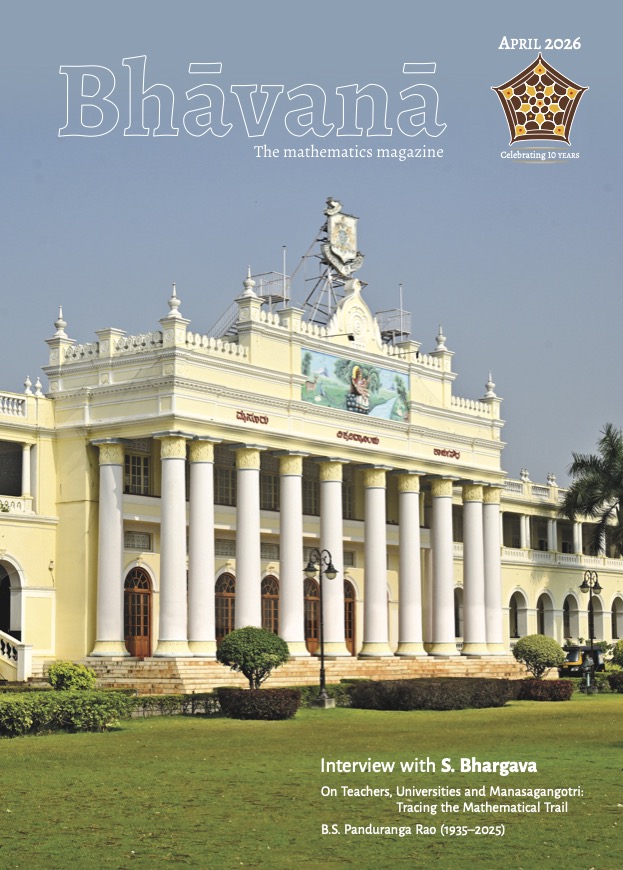 The three articles appearing in this edition of Bhāvanā serve to offer a retrospective look at the mathematics department of the University of Mysore (UoM). The fact that UoM was the first university to be established outside British India, gives it a distinct identity from those that came up before it. And, talking about the dedicated teachers who graced the portals and the classrooms of the maths department, and who left their distinct footprints on the sands of time as guiding signposts, is one possible way to capture a living history of the activities that shaped futures.
The first article seeks to shed light on that history in two ways: first, by setting a contextual backdrop to touch upon signal contributions of some of these personalities who led the department; and second, by supplementing this narrative by two appendices – one, reproducing in full, Sir Asutosh Mookherjee’s 1918 Convocation Address at the University of Mysore; and, two, an updated bibliographical account by Bruce Berndt of his interaction [concerning Ramanujan] with K. Venkatachaliengar, the first head of the maths department. Mookherjee’s address, which posits that a university cannot progress by remaining tied to its past glory but must continually evolve and renew itself to avoid stagnation and irrelevance, is itself a fascinating read.
It is perhaps worth recalling in this context that the idea of the university admits of more than one articulation within Indian traditions. The usage of sarvakalāśāla for “university”, as found commonly in Kerala, for instance, gestures toward a space for the integrated cultivation of the arts, and of the human heart thereof, in their widest sense that includes the sciences, even as terms such as viśvavidyālaya or viśvavidyāpīṭha foreground the domain of knowledge and its transmission. Such distinctions, though subtle, quietly invite us to a more expansive imagination of education—one that resonates with the ideals articulated in the early years of pioneering institutions such as the UoM.
The lives of the teachers that figure reveal the character of a regional university in an earlier era—one that stands in sharp contrast to the rapidly evolving ethos of the present day. They were largely unsung figures who nevertheless moulded and inspired generations of students, many of whom later became doyens of Indian mathematics. Taken together, they form a coherent narrative of excellence—one that arose from modest beginnings yet spread far beyond its local setting. This article also provides a companion setting to the other two articles presented in this issue.
In a delightfully engaging conversation, Srinivasamurthy Bhargava, who headed the mathematics department of the University of Mysore in the 1980s, reflects on the people who shaped his atypical career trajectory: the teachers who inspired him, the students he guided, and the colleagues who became lifelong friends.
The fact that the University of Mysore was the first university to be established outside British India, gives it a distinct identity
Frequent movements from place to place during his school years notwithstanding, Bhargava recalls that he always had great maths teachers. Gleaning from the way his mathematical precociousness blossomed into a distinguished career of academic excellence, a quiet retrospection suggests that this may not be the case of a singular happenstance but a reflection of a certain level of mathematical sagacity among teachers, even in remotely located institutions. Apart from the mentorship by eminent teachers, he recalls how he was also helped by the free board and lodging facilities, during his college years, at the Sri Ramakrishna Students Home run by benevolent administrators. The conversation traces his journey through engineering at the Indian Institute of Science and doctoral work on optimisation and control at Carnegie Mellon University, eventually leading him to the mathematics of Srinivasa Ramanujan. Along the way, he reflects on the role of mentorship, collaboration, and serendipity in a life guided, as he often says, by an unseen destiny.
 The several contributions of the mathematics department of the University of Mysore towards building and sustaining an ecosystem of excellence in higher mathematics in India would not have been possible without a dedicated faculty. Among these stalwarts, a notable name is that of B.S. Panduranga Rao, remembered by many as BSP. Prioritising his family over advancing his own mathematical career, BSP spent almost his entire working life at Manasagangotri, nurturing young mathematicians, providing them with access to the latest developments in mathematics, and helping them overcome their self-doubts and realize their true potential. BSP passed away in September 2025 and this issue of Bhāvanā provides an opportune setting for paying our tributes to this remarkable student and teacher of mathematics. Through the fond reminiscences of his students and his own children, we discover and admire this man whose life exemplified his own adage, “Take care of mathematics, and mathematics will take care of you.”
The depictions on the cover pages speak for themselves, that a true acquisition of knowledge alone must take pride of place in any learning environment. \blacksquare
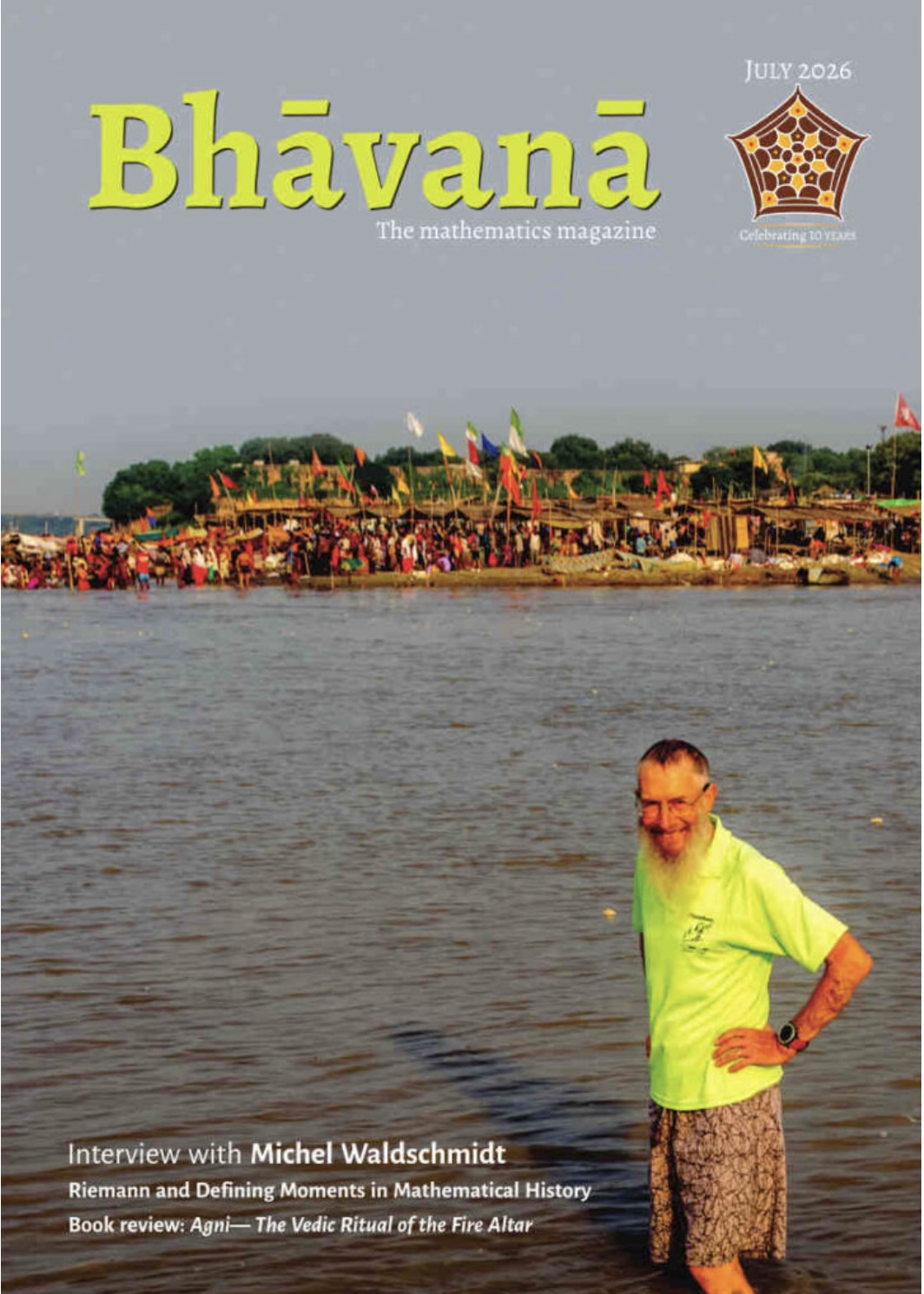 Michel Waldschmidt is a French mathematician who has made significant contributions to our understanding of transcendental numbers. A conversation with him, which we present in this issue, offers a panoramic view of major developments in the area through his own mathematical journey. As a renowned scholar who believes in the importance of helping people understand the strategy behind the technical details, Waldschmidt invests a large amount of time in preparing and delivering courses and lectures. His love for mathematics and sharing his knowledge has taken him to over eighty countries across the globe, including India, where he has travelled frequently and extensively. We learn of his first visit to India fifty years ago, and the meaningful connections he has formed here over the years. The kindness and warmth of his personality shine through as he expresses his joy in doing mathematics and his appreciation of celebrated mathematical developments in his lifetime. An extremely fit and active person at 80, he also talks about his love of running and hiking. There are several takeaways from this conversation on matters that we all think about: dealing with rejections, finding good problems to work on, and learning to communicate clearly.
On the occasion of the 200th birth anniversary of the German mathematician Bernhard Riemann, Devadatta Hegde provides an accessible summary of some of Riemann’s most important works with the lightest of touches. Born in 1826, Riemann got the chance to learn from many of the leading mathematicians of the time, such as Jacobi, Dirichlet, and Eisenstein, thanks to the German university system of that era in which students were free to move between universities. Beginning with his profoundly influential doctoral dissertation, completed at the age of twenty five, the article traces Riemann’s most important contributions and places them in the context of their lasting influence on mathematics and physics, particularly in topology, geometry, number theory, and relativity.
Devadatta’s expository article is complemented by a nearly hundred-year-old article on Riemann’s life by Ganesh Prasad in a book that he wrote about six mathematicians including Riemann. While Devadatta’s exposition focusses on the mathematical, Ganesh Prasad’s abridged article is biographical. Both articles are interspersed throughout with quotes and anecdotes that serve to provide a fuller appreciation of Riemann’s extraordinary genius and enduring legacy.
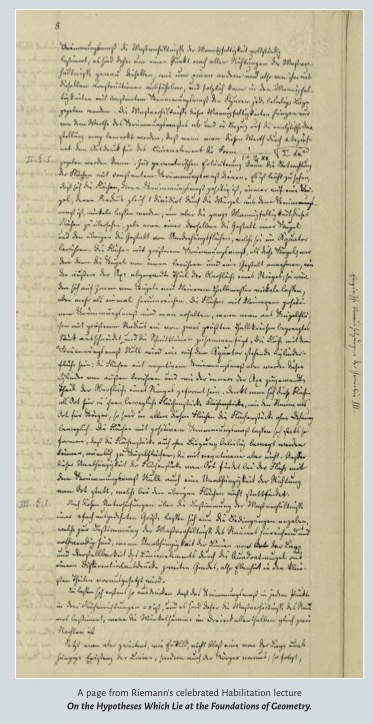 Organized teaching and research in the sciences started taking roots in Indian universities through the efforts of able administrators and talented researchers in the early twentieth century, enabling an environment favourable for teaching, learning and research. In his article on Ganesh Prasad, Rajesh Akkihal traces the life and times of one such visionary. Born in 1876 in Ballia, a small town in Uttar Pradesh, and earning masters degrees in mathematics from both Allahabad and Calcutta Universities, Ganesh Prasad spent a few years in Cambridge and Göttingen, where he worked and discussed with the academic elite. Returning to India, he served on the Ras Behari Ghosh and the Hardinge Chairs in mathematics in Calcutta. Attracting the best students through his own fundamental research, lectures and writings, he strove to make available to an aspiring researcher the best ideas from across the world.
The mathematical underpinnings of ancient Vedic rituals have found repeated mention in previous Bhāvanā articles, most notably in Amartya Kumar Datta’s January 2022 feature on “Geometry in Vedic and Sutra literature’’. This sets the stage for our present focus: the seminal 1983 work of Frits Staal, Agni: The Vedic Ritual of the Fire Altar, which stands as a priceless documentation of both the ancient agnicayana act and the geometry that is integral to its conduct. In his review of the book, Aalok Thakkar identifies the mathematics as transcending contemporary characterizations of pure and applied, existing at once as both. Exploring this seeming duality, Thakkar highlights multiple perspectives, prominently that of A. Seidenberg who interprets the early geometry as born from a ritual source and the intricate procedural construction of the altar as a tangible demonstration of deep underlying mathematical principles – the interpretation sitting well with the Indian tradition of upapatti, or constructive justification. Staal considers the ritual’s internal architecture purely as a syntax of ordered, generative rules. The review bridges the two views by echoing the ancient texts, reminding us that the fire altar is, fundamentally, both knowledge and act.
The front cover is a snapshot from one of Michel Waldschmidt’s visits to India. The back cover showcases Riemann’s handwriting from one of his most important contributions. \blacksquare
Footnotes
- Andrei Nikolaevich Kolmogorov (1903–1987), Bull. London Math. Soc. (1990) 22 (1): 31–100, http://dx.doi.org/10.1112/blms/22.1.31 :↩