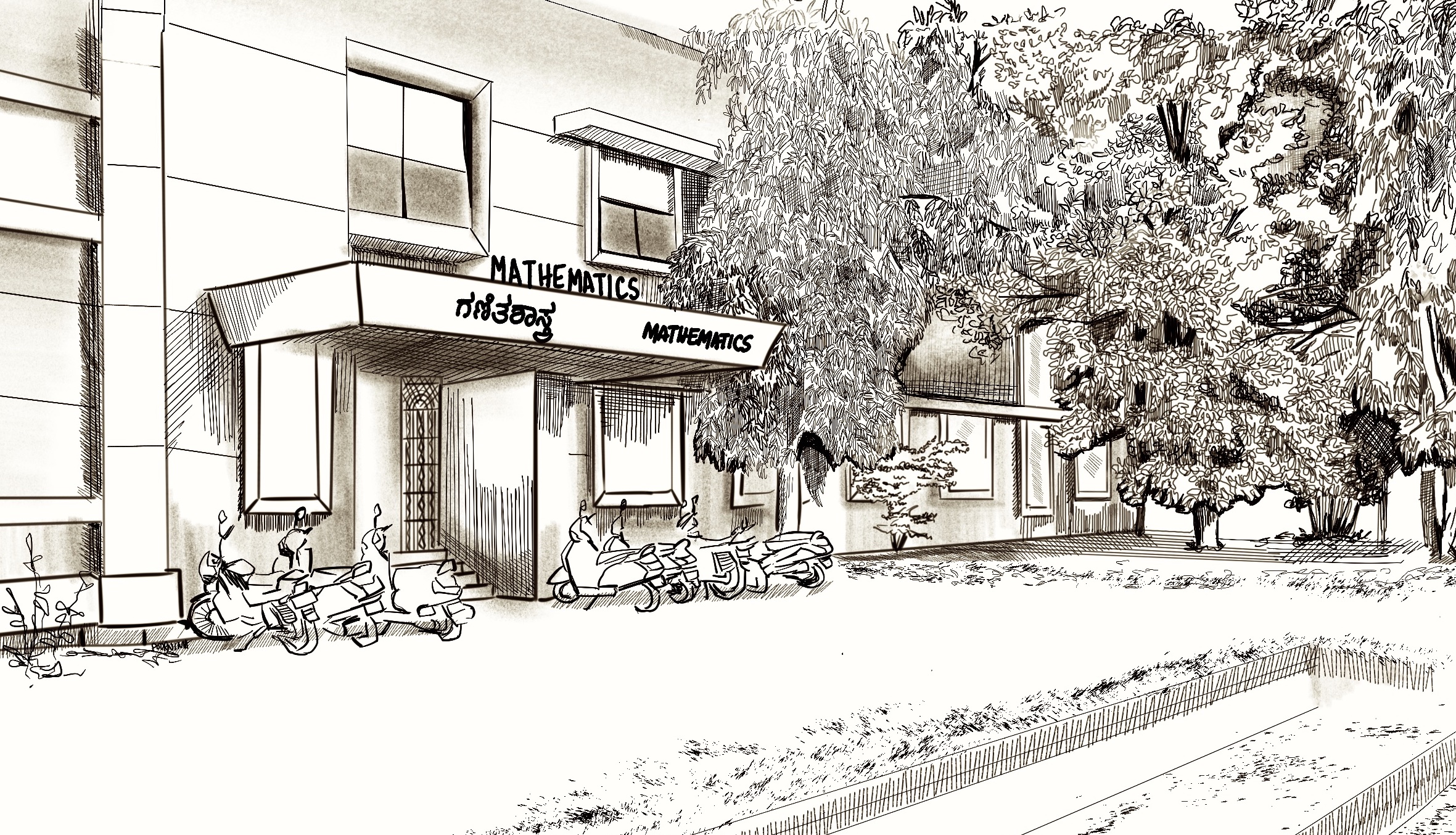
If the narrative of modern Indian mathematics is often recounted through the “high peaks” of specialized research institutes—the TIFRs, the ISIs and the IIScs—there exists a quieter, yet foundational chapter written in university departments that once served as the catchment areas for this intellectual talent. To understand the trajectory of mathematical summits in India, one must turn one’s gaze from the peaks back to the plains, specifically to the universities that nurtured the early ecosystem of scientific inquiry. Among these, the Department of Studies in Mathematics at the University of Mysore stands as a testament to an era when the university was not merely an examination body, but a vibrant sanctuary of thought.
Established in 1916 through the visionary efforts of Sir M. Visvesvaraya, the university sought to carve out an identity distinct from its predecessors. Neither conceived as a narrowly professional training ground nor as an elite research enclave, it emerged instead as a broad academic habitat: a space where teaching, inquiry, and cultural life were meant to flow together, much like the metaphor the name itself evokes. Christened Manasagangotri—the “Fountainhead of the Mind”—by the poet laureate Kuvempu, the campus was envisioned as a space where knowledge would flow perennially. To reflect on Manasagangotri today is therefore not merely to recall an institution, but to revisit an idea of the university—one that shaped generations of teachers and students, often in ways that remain under-acknowledged.
Reflecting on the contributions of the dedicated teachers who helped shape the mathematics department of the University of Mysore, this article is intended as a contextual frame for two companion pieces in this issue of Bhāvanā: an interview with S. Bhargava, former Head of the Department of Studies in Mathematics at the University of Mysore, and an obituary tribute to the mathematician and teacher B.S. Panduranga Rao who taught in the department. The present essay seeks to situate these two narratives—asking what kind of university culture made possible such lives of teaching, learning, and quiet influence—in the longer timeframe and trajectory of the system of the universities in India. The interview with Bhargava, meanwhile, offers a vivid recollection of the educational milieu that shaped many of the figures associated with the department—particularly the formative role of institutions such as Central College in Bangalore and the Indian Institute of Science, and of teachers such as K. Venkatachaliengar and T.S. Nanjundiah. It was the first university to take shape outside the confines of British India in 1916.
The emergence of the University of Mysore must also be viewed against the broader history of modern universities in India. The first three universities—Calcutta, Bombay, and Madras—were established in 1857, largely as examining bodies modelled on the University of London. In the decades that followed, additional institutions gradually appeared, including Panjab University in Lahore (1882) and the University of Allahabad (1887). These early universities played a crucial role in expanding higher education, but their geographical reach and institutional structure also meant that many regions remained dependent on distant centres. It was within this evolving landscape that the idea of a university in Mysore took shape, reflecting both regional aspirations and broader debates about the purpose and structure of higher education in India.
The founding of the University of Mysore marked a significant moment in the evolution of Indian higher education. Until then, much of the region’s academic life was tied to the University of Madras, even as institutions such as Central College had already begun to flourish locally. The creation of a university at Mysore was thus both an assertion of intellectual autonomy and an experiment in educational vision. It is no accident that questions about the purpose of a university—its obligations to society, to knowledge, and to the cultivation of minds—were being actively debated during this period.

Over the decades that followed, the mathematics department at the University of Mysore grew into a space where these ideals found concrete expression. Its strength did not lie primarily in institutional prestige or spectacular visibility, but in the cultivation of teachers whose influence was measured in students they shaped rather than accolades accumulated. There are quite many who exemplified this tradition. Not all such teachers possessed the formal markers of academic success that later came to dominate the profession; some were not PhDs, some published sparingly, and many remained largely invisible beyond their classrooms. Yet their classrooms were sites of genuine intellectual awakening.
Accounts by former students repeatedly return to a common theme: mathematics encountered not as a forbidding abstraction, but as an invitation to think.
Reading from some of the recollections of the students he fostered, B.S. Panduranga Rao emerges as one such energetic teacher whose decision not to leave Mysore stemmed from his desire to look after his ageing parents. The deep imprint he left on his students, who cherished their associations with him even long after moving out to pursue their own academic paths, is evident in the tributes they have offered in the obituary article carried in this issue.
They speak of an atmosphere during their studentship that was one of patience, seriousness, and care—where hesitation was met not with dismissal but with encouragement, and where confidence was built slowly through sustained engagement. In such settings, the university functioned as it was perhaps meant to: as a place where minds were trained to attend, to question, and to persist.
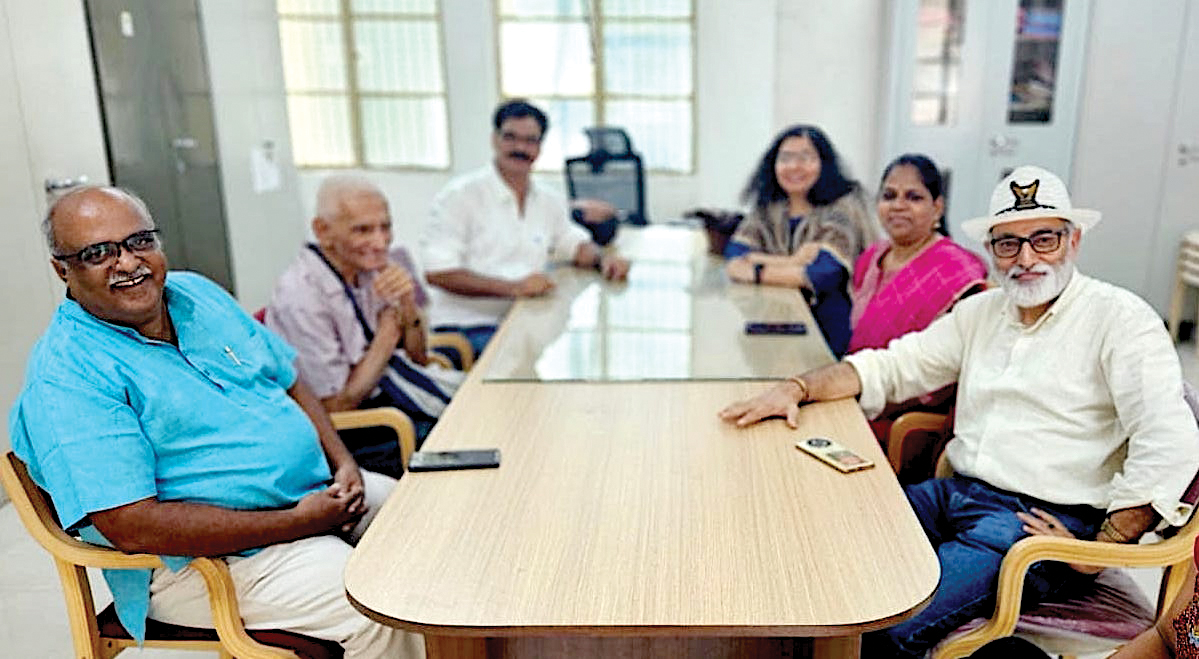
The department’s influence extended beyond the classroom, serving as a hub for broader mathematical organization. It played an important role in the establishment of the Ramanujan Mathematical Society (RMS) in the mid-1980s, anchoring a national platform for the discipline.
As one of the founding members of RMS, founded in 1985, E. Sampathkumar’s participation in its activities was total and dedicated. Then working at Karnatak University in Dharwad, he moved to Manasagangotri a couple of years later in 1988. The following excerpt from their webpage illustrates the circumstances under which he took charge of running its flagship publication—Journal of the Ramanujan Mathematical Society (JRMS)—right from its inception:
Embar Sampathkumar had a penchant for thinking of the larger picture and going about his tasks in earnest, setting up a functioning platform for the mathematical community in India as can be gleaned from the webpage of JRMS:
Hailing from a modest village called Doddamallur, located on the Bangalore–Mysore highway about 65 kilometres from Bangalore, Sampathkumar’s foray into active mathematics and an impactful academic career has a compelling story of its own, beginning with what was anything but an impressive studentship at the local school.
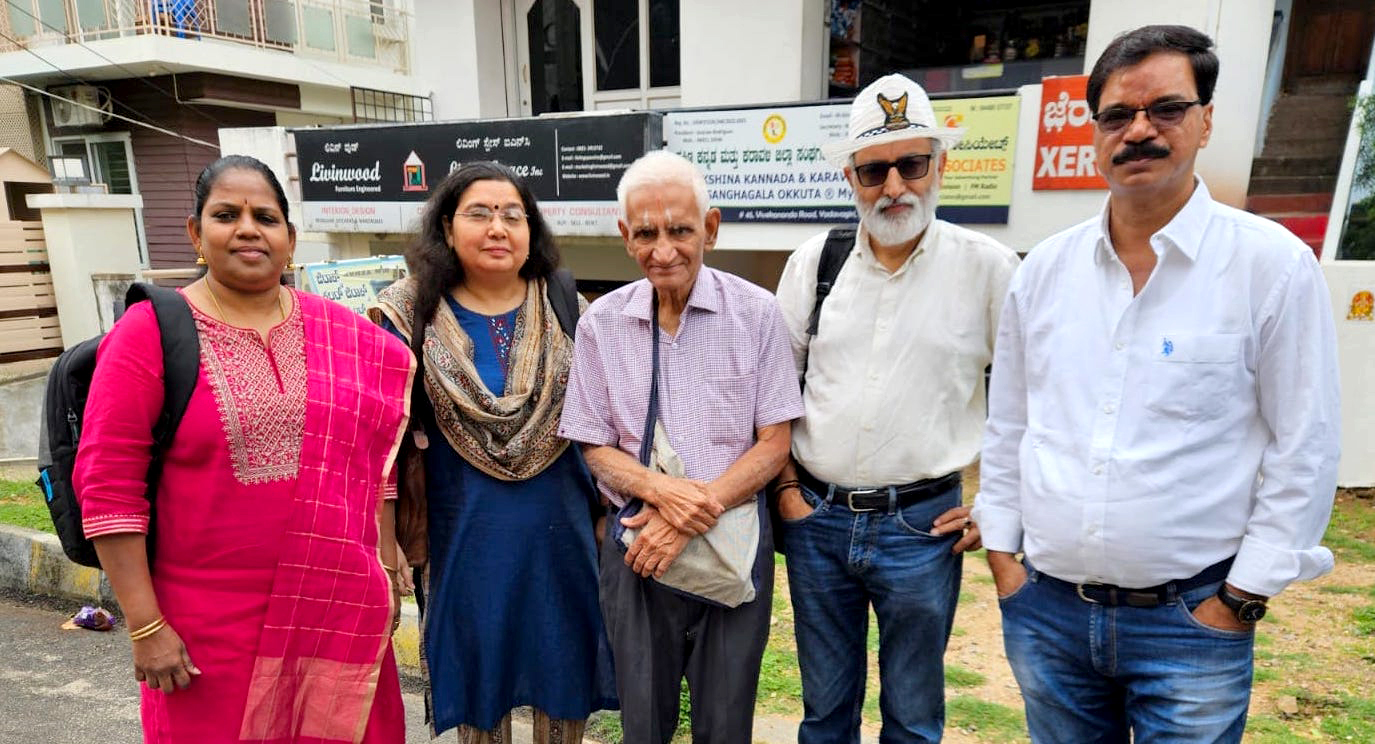
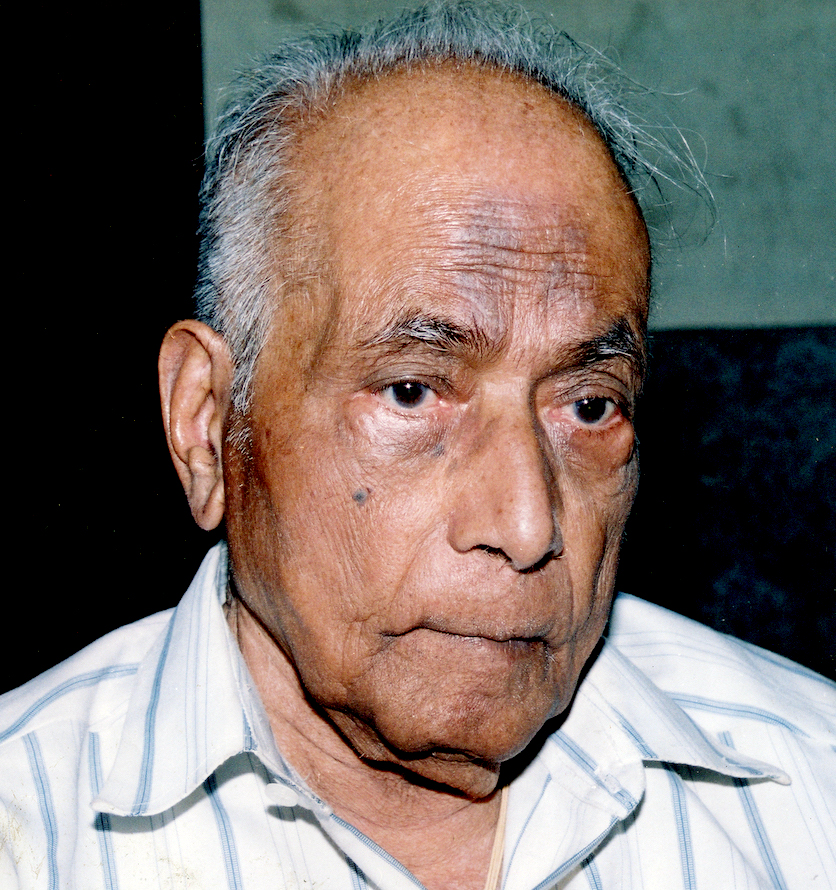
When it was time for him to look for a job, he had two teaching offers to choose from—in the Sarada Vilas College in Mysore and in a rural college in Kanakapura, not far from Bangalore. Sampathkumar opted for the latter where he served for a year. Though the job was easygoing, he decided to move to a teaching position at the Karnataka Arts College in Dharwad, following the advice of a well-wishing friend. This turned out to be another decisive turning point in his life. His insatiable thirst for knowledge took him to the library of Karnatak University in Dharwad one day where, coming across a paper of Marshall Stone,1 his interest in Boolean algebra was kindled, resulting in his first paper2 on the topic in 1963.
 |
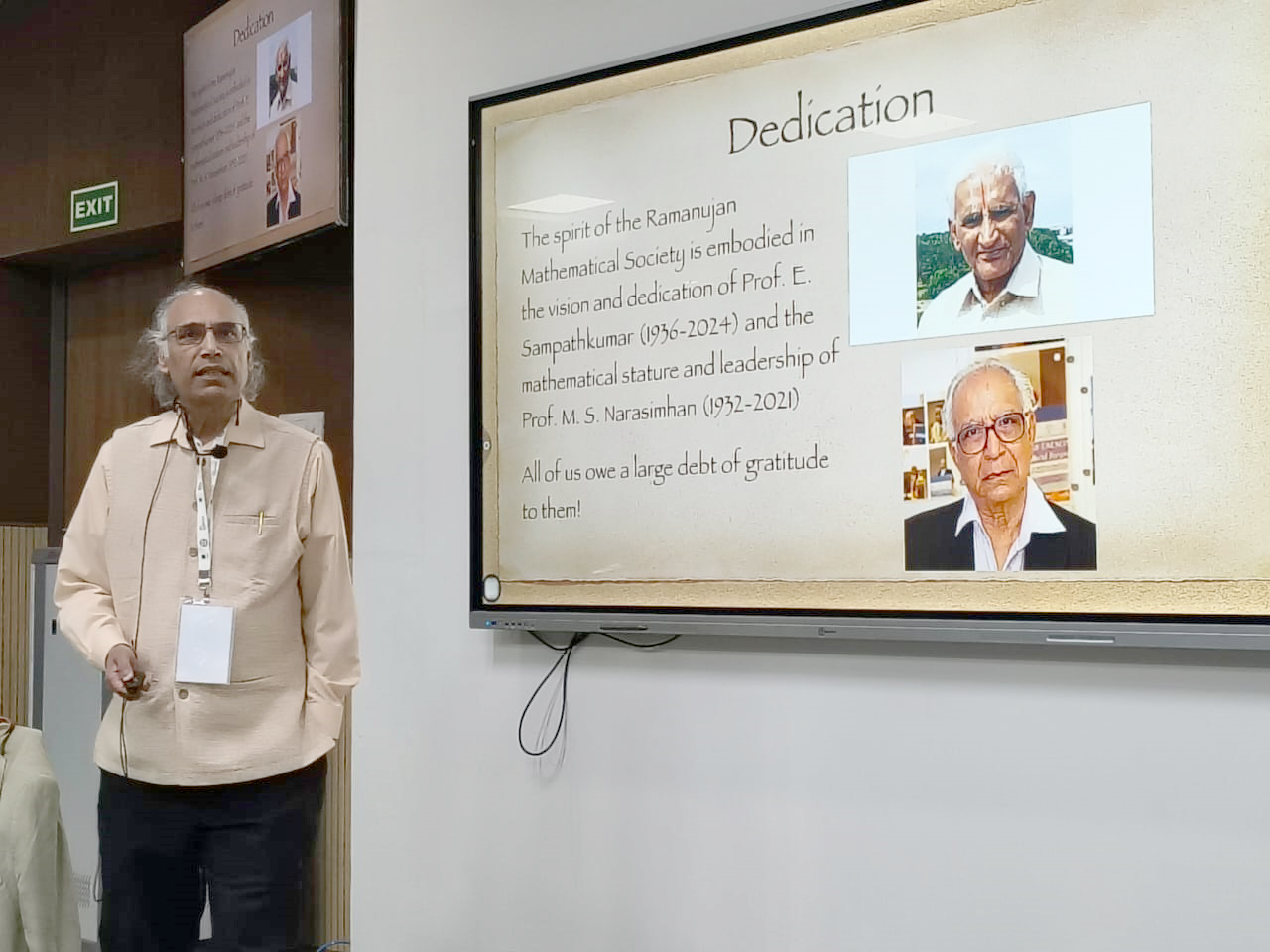 |
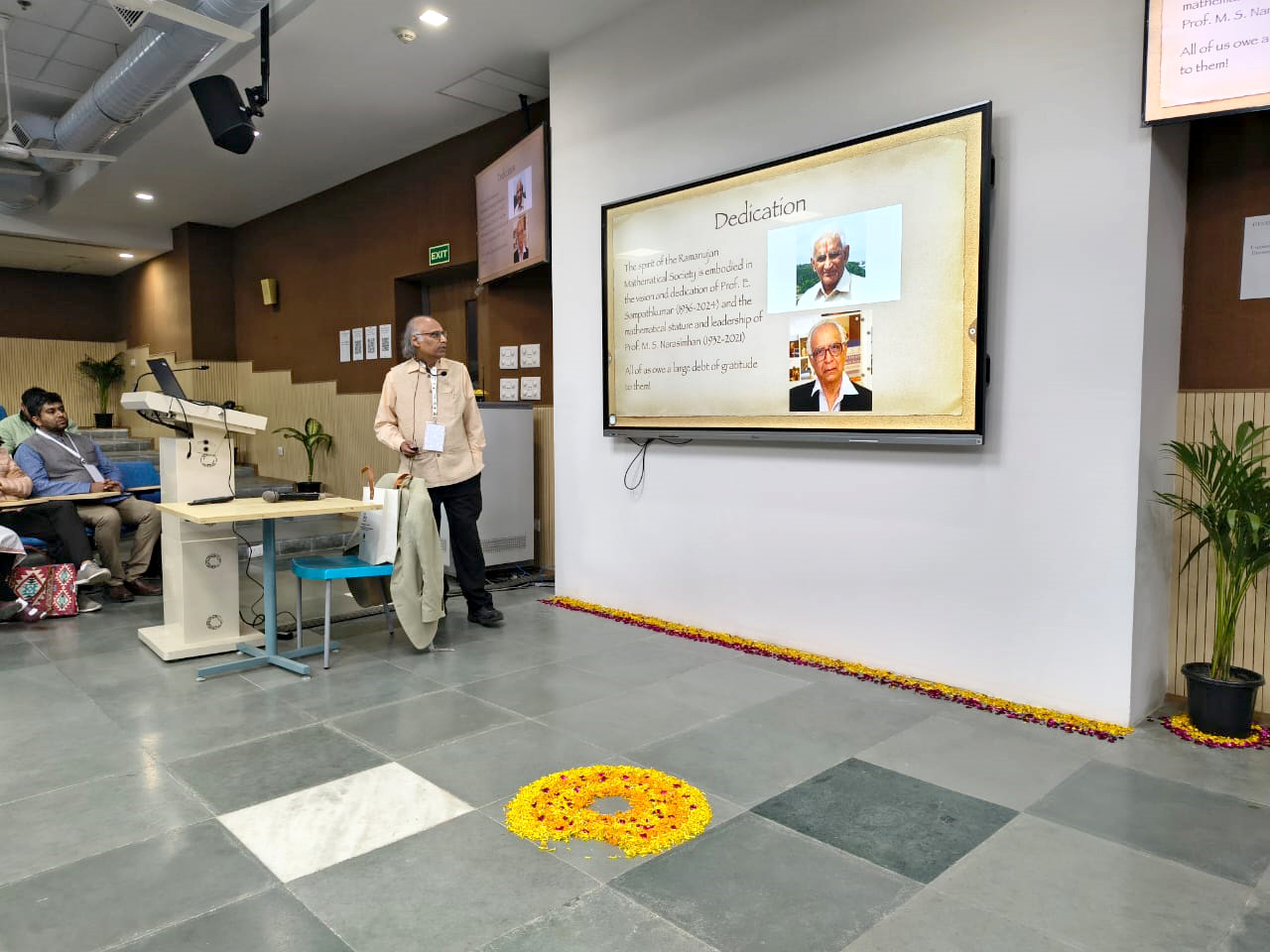
| V. Kumar Murty in his plenary address at the 2025 annual conference of the RMS, displaying the statement of Dedication. Kotyada Srinivas | |
Thus embarking on the research scene, it was natural that Sampathkumar went on to complete his PhD in mathematics, greatly facilitated by the help he received from the visionary Vice-Chancellor D.C. Pavate3 and the founding head of the department of mathematics of Karnatak University, C.N. Srinivasa Iyengar,4 both of whom recognized the academic acumen and integrity that Sampathkumar had in him. In fact, Srinivasa Iyengar was his PhD advisor.
After serving on the faculty of Karnatak University for a little over two decades, Sampathkumar moved to the University of Mysore in 1988. There he mentored a number of students until his official retirement from service in 1996. It is also from there that he operated the publication of JRMS until his demise in 2024, after nearly four decades of devoted engagement with it as an inseparable part of his soul.5
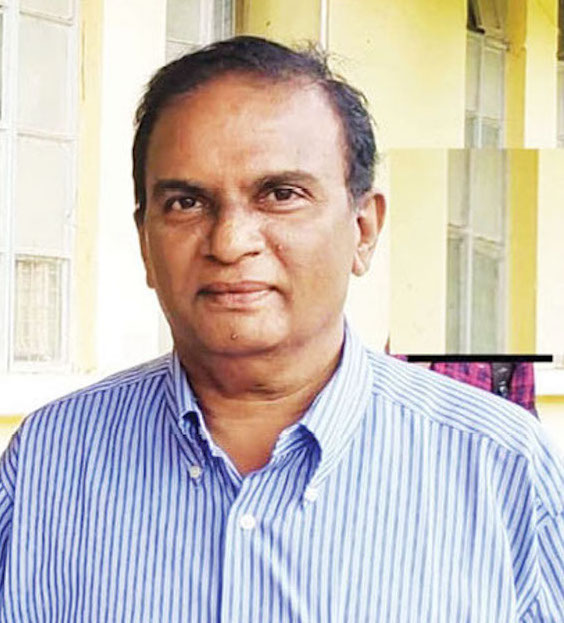
Adiga’s main research interests were in the area of number theory, with special focus on q-series and special functions, while he also worked in combinatorics and algebraic graph theory. With a prolific output of research papers, authoring with a number of collaborators and students as well, Adiga is one of the authors—along with Bruce Berndt, S. Bhargava and G.N. Watson—of the book Chapter 16 of Ramanujan’s Second Notebook: Theta functions and q-series published in the Memoirs of the AMS series.
Adiga is remembered as a cherished member of the department who took part in all of its activities with meticulous care, and organized well-run seminars and conferences.
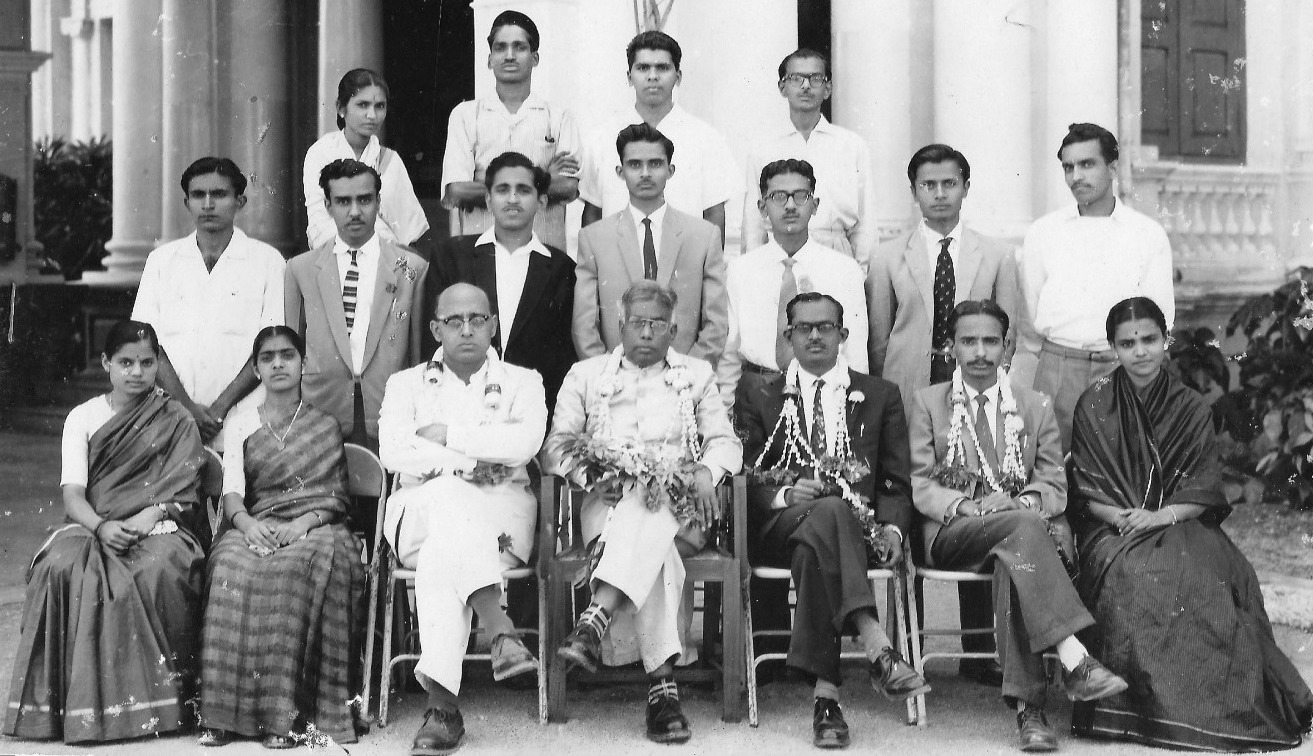
Moving now to the other remarkable teachers who charted the academic excellence of the department from the very beginning, sitting at the helm as its heads, we try to provide an essence of their work with brief biographical sketches. The first head of the department, K. Venkatachaliengar, was followed by S.V. Keshava Hegde and T.S. Nanjundaiah before S. Bhargava (the interviewee of this issue) took charge.
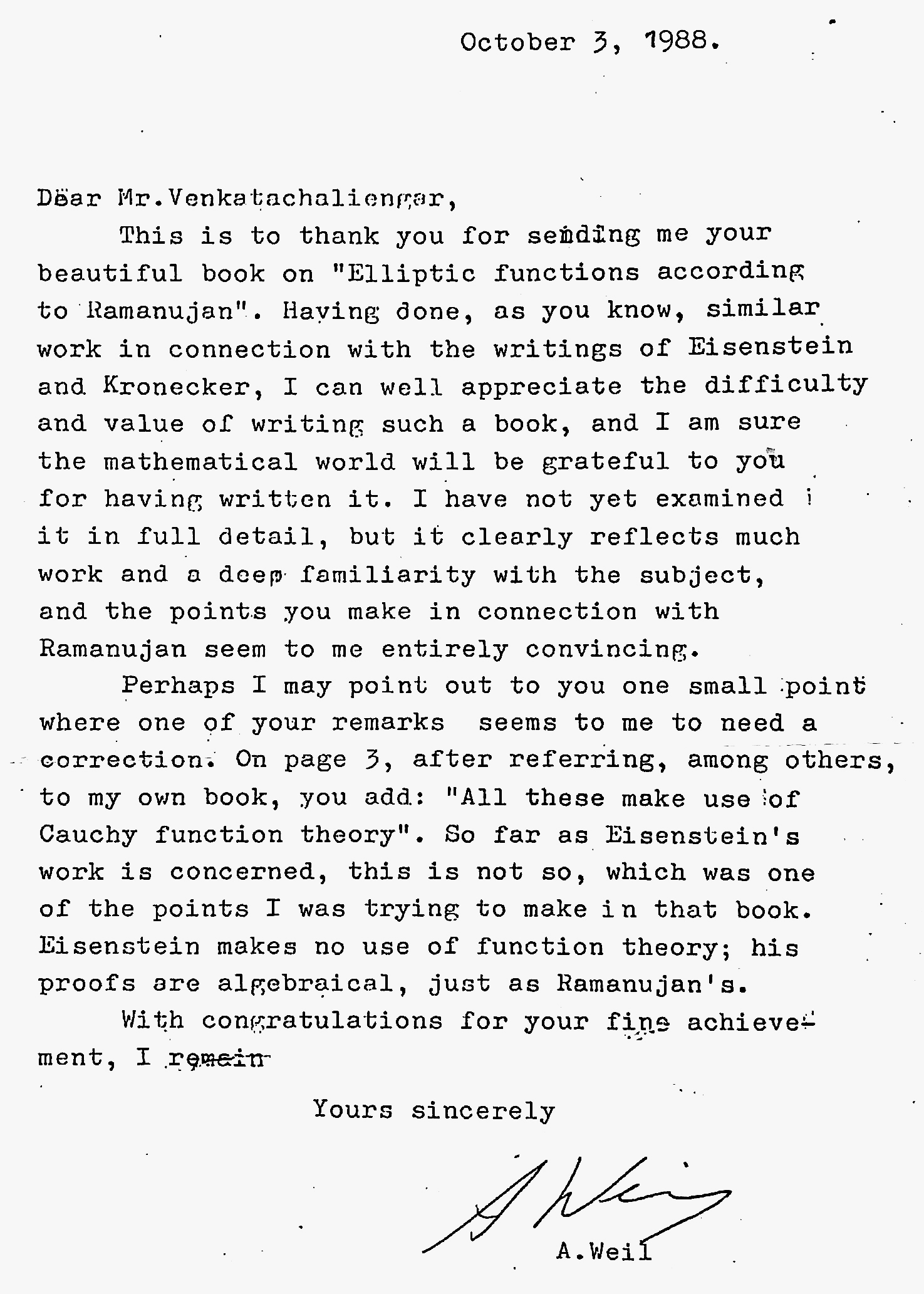
Born on December 8, 1908, in a modest village, Kadaba, located about sixty kilometres northwest of Bangalore, academic trail of K. Venkatachaliengar is marked by a high degree of excellence in scholarship and teaching, and an absolute dedication to mathematics.
Like most students of the time aspiring to a scholastic pursuit, Venkatachaliengar too studied at the Central College in Bangalore for his BSc (Hons). Thereafter, he went to Calcutta University for his master’s and, excelling in his studies, went on to complete his DSc thesis for which the examiners were none other than Herman Weyl, Garrett Birkhoff and F.W. Levi, all of whom were highly impressed.
Born in 1922 in a remote village in Chikkamagaluru district named Shankakodige, and early schooling in the neighbourhood, S.V. Keshava Hegde completed his BSc at the Central College in Bangalore and MSc at Calcutta University. He then went on to do his PhD at Zürich under the guidance of Bartel Leendert van der Waerden, a Dutch mathematician well-known for his text-book Modern Algebra. His PhD thesis, suggested by the title of his 1956 paper “The associated form of a variety over a field of prime characteristic p” in the journal Commentarii Mathematici Helvitici, appears to be in the field of algebraic geometry.
Returning to India, Keshava Hegde taught for a while at his alma mater, Central College, before assuming the principalship of Yuvaraja’s College in Mysore. With an acumen also in administrative skills, he first became the Registrar of the University of Mysore and then, following the retirement of K. Venkatachaliengar, became professor and head of its mathematics department. He was loved and respected by his students for his passion and dedication to teaching, until his life came to a premature end at age of 54 while still in office. An endowment lecture series in his honour, held annually, was later instituted by his brother.
Born on August 25, 1920 in a lesser-known town near Bangalore, T.S. Nanjundiah‘s keen mathematical aptitude was observed by his teachers early in his high school and college years. The general topic of `Inequalities’ seems to have been a favourite theme occurring in his works.
A case in point is how his proof of certain trigonometric inequalities impressed his teacher, K.S.K. Iyengar, in Central College, who read it out in the class and later encouraged him to publish. This later inspired the problems that he discussed in his PhD thesis written under the guidance of B.S. Madhava Rao. He wrote papers in collaboration with both of these teachers. Nanjundiah’s proofs of mixed geometric-arithmetic mean inequalities, with his novel use of inverse means, published in Journal of the Mysore University has received wide attention. There is, in fact, a paper titled “Inequalities due to T.S. Nanjundiah’’, by one P.S. Bullen.
Joining Mysore University in 1960, along with K. Venkatachaliengar, and especially admired for his ingenious skills in problem-solving, Nanjundiah was a greatly respected teacher and colleague in the department. Mysore was his home until his demise in March 2014, at the age of 94.
With such an overreaching sense of service and impact on the larger mathematical firmament of the Indian landscape, it should not be a surprising fact that the history of the mathematics department of Manasagangotri is also marked by “what might have been’’—such as the proposal by B.V. Sreekantan, the Director of TIFR during the 80s, to establish a dedicated undergraduate mathematics centre on the campus—an initiative that, while unfulfilled, highlighted the recognition the university commanded from premier research establishments. The interview with S. Bhargava, who headed the department at that time, touches upon Sreekantan’s visit and meetings with the vice-chancellor in this connection.
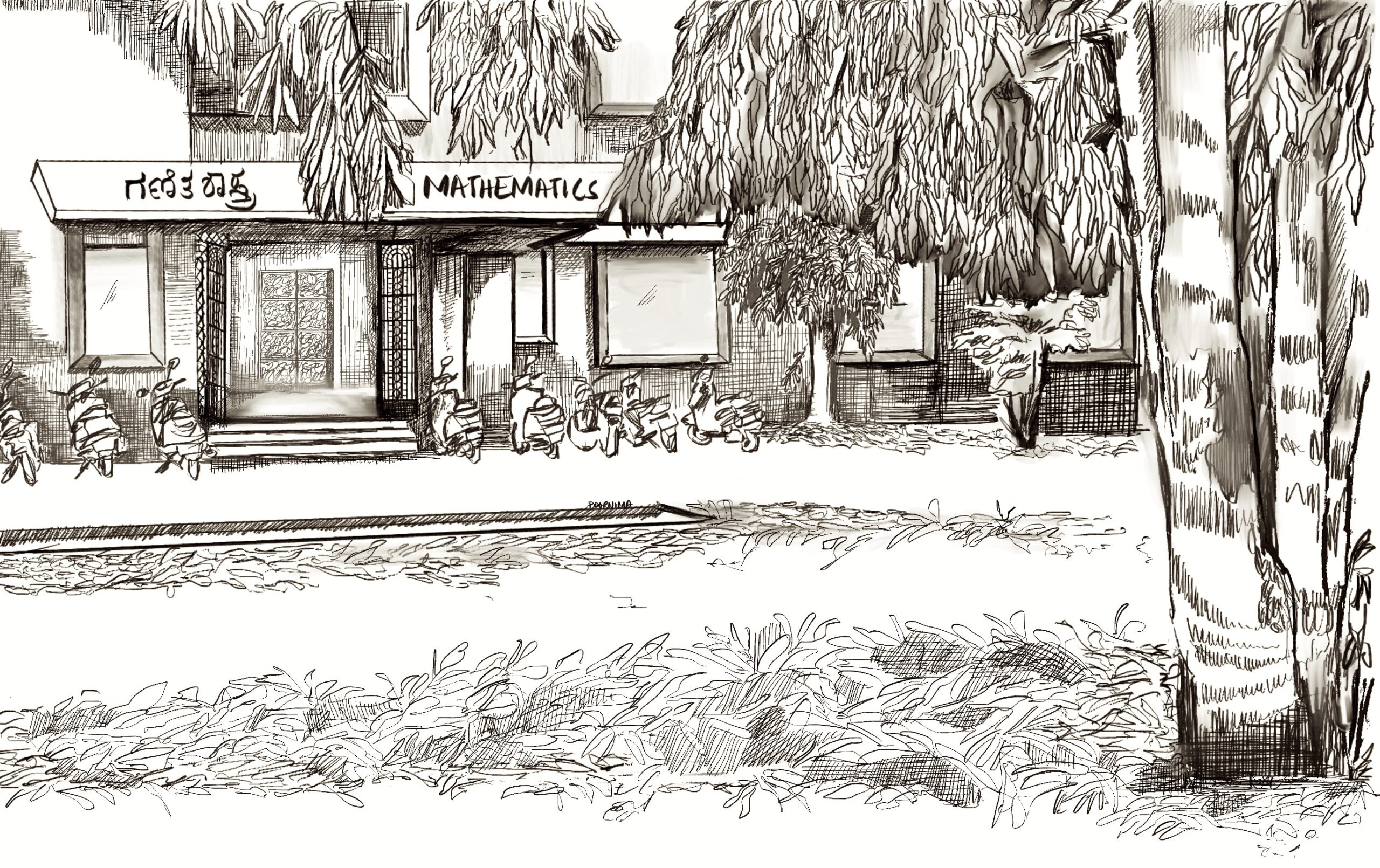
From this period lingers the sense of a university campus as a living, breathing world—one in which classrooms, corridors, and long conversations after lectures quietly shaped minds and futures. Universities such as Mysore once fostered mathematicians and scholars of lasting influence through these everyday rhythms of academic life. Remembered teachers, shared spaces, and the slow accumulation of intellectual habits suggest a form of vitality that has not vanished so much as receded from view. What it might mean for such campuses to recover that atmosphere, in altered yet recognisable forms, remains a question that gently accompanies these recollections.
The early vision of the university also carried with it a strong insistence on intellectual freedom. In his address, Asutosh Mookherji urged:
“Let me plead […] for freedom in the University—freedom in its inception, freedom in its administration, freedom in its expansion; surely this is the very condition of vigorous existence in an institution engaged in search after Truth.”
Manasagangotri, in its legacy and in its potential, gestures toward a conception of knowledge as something that flows, gathers, and renews itself across generations. To recall that vision today is not to retreat into the past, but to recover a sense of what universities have been—and what they might yet become.
The aspirations with which the University of Mysore began its journey were articulated with remarkable clarity in the convocation address delivered by Sir Asutosh Mookherji in 1918, barely two years after the institution’s founding. His reflections on the purpose of universities—on their relationship to society, the interplay of teaching and research, and the freedom necessary for intellectual life—capture the spirit of an era when Indian universities were still actively shaping their identities. In order to place the reader in closer contact with this formative moment, we reproduce below the full text of his address.
Appendix A
Sir Asutosh Mookerjee’s Convocation Address at the Mysore University (19 October 1918)7
Your Highnesses, Mr. Vice-Chancellor, Ladies and Gentlemen,
I feel deeply embarrassed as I look round this distinguished gathering of representatives of the intellect and aristocracy of the most progressive of Indian States beyond the limits of British India. The invitation to address you, issued under the direction of His Highness the Chancellor, by your first citizen, whom it is a privilege to know and respect, was couched in such terms of courtesy and cordiality that ready acceptance was inevitable. Apart from this, refusal was really inconceivable, as the invitation had emanated from a Ruling Prince, whose high character, judged by the most exacting standards, had called forth the deepest feelings of reverence and admiration from all who had ever the good fortune to come into contact with him, and who so fittingly enjoyed the unique distinction of uniting in himself the dignified office of Chancellor in two Indian Universities. I am not ashamed, however, to make the frank confession that ever since my acceptance of your kind invitation, I have regretted my rashness, and have repeatedly wished that I had not shouldered so serious a responsibility. But as duty once undertaken, even though thoughtlessly, can never be declined, I can only claim your generous indulgence, while I detain you with a few brief observations on the question now foremost in the mind of every member of this assembly—what should be the guiding principles of this newly founded University, which will be consecrated in years to come by the loyal and loving allegiance of successive generations of Mysoreans, how will her imperative needs be met so as to place and keep her, the equal of the greatest, the peer of the noblest, in the progressive world of science, letters and art?
Do not imagine for a moment that I shall be so unwise as to hazard a definition of a University, a task which has baffled many an acute scholar and cultured administrator. They have asked, from time to time, what is a University, and have found themselves at sea. Is it a set of fine buildings? Is it an educational institution which has beneficent patrons and has secured the gift of a million? Is it an aggregate of four Faculties? Is it a scholastic guild? Is it a society of masters? Is it an assembly of students? Is it an examining body authorized to grant degrees? Is it a corporation of individuals who investigate the unknown, but neither teach nor test? Is it a combination of colleges without religion? Is it an association of teaching institutions without a curriculum? Must it possess all or any of these characteristics? Or is it, as Samuel Johnson inspired, perhaps, by his boundless knowledge of things ancient and modern, boldly enunciated in the first edition of his famous Dictionary, a school where all the arts and faculties are taught and studied, or is this merely a stimulating but impossible ideal formulated by that profoundly learned Doctor? Blame me not, if I deem it needless, for our present purposes, to seek a definitive solution of these puzzles.
Do not imagine for a moment that I shall be so unwise as to hazard a definition of a University
Let us provisionally assume as correct the description that a University is a corporation of teachers and students, banded together in the pursuit of learning and for the expansion of the bounds of knowledge. A University thus constitutes the visible manifestation of the activities of the State in the domain of the highest grades of education for the benefit of the people. From this standpoint, we realize the supreme importance of two fundamental principles. In the first place, a University can achieve the complete fulfilment of its purpose, only if at the time of its foundation, it is adapted to the special needs and circumstances of the people whom it is designed to serve. In the second place, a University will retain its vitality and usefulness unimpaired, only if it ever continues to be wisely articulated to the true requirements of the community, if its governors sedulously watch the ever varying needs of the people from time to time, from generation to generation, and mould and develop their institution accordingly. These principles, so formulated, cannot be successfully challenged, and may almost bear the semblance of unimportant platitudes.
But though it has been often asserted that all Universities cannot be expected to be uniform in character and cast in the same mould, yet, in this continent, when a new University is created or an existing University is reconstructed, the attempt is repeatedly made to model it on the pattern of a University in another country, organized under very dissimilar conditions and flourishing in entirely different surroundings. The oft-repeated axiom is, in this sphere, apt to be ignored or overlooked, that you cannot completely westernize the East any more than you can fundamentally easternize the West. The demand may thus legitimately be made that when Universities are constituted in India—and we anxiously look forward to the day when they will multiply in number and increase in vigour—they will not be unintelligent and uncritical imitations of educational institutions elsewhere. Explore the conditions patiently, sympathetically, dispassionately, and then your constitution with courage, even though the frame result be unlike ancient and venerable foundations which shed lustre on other climes.
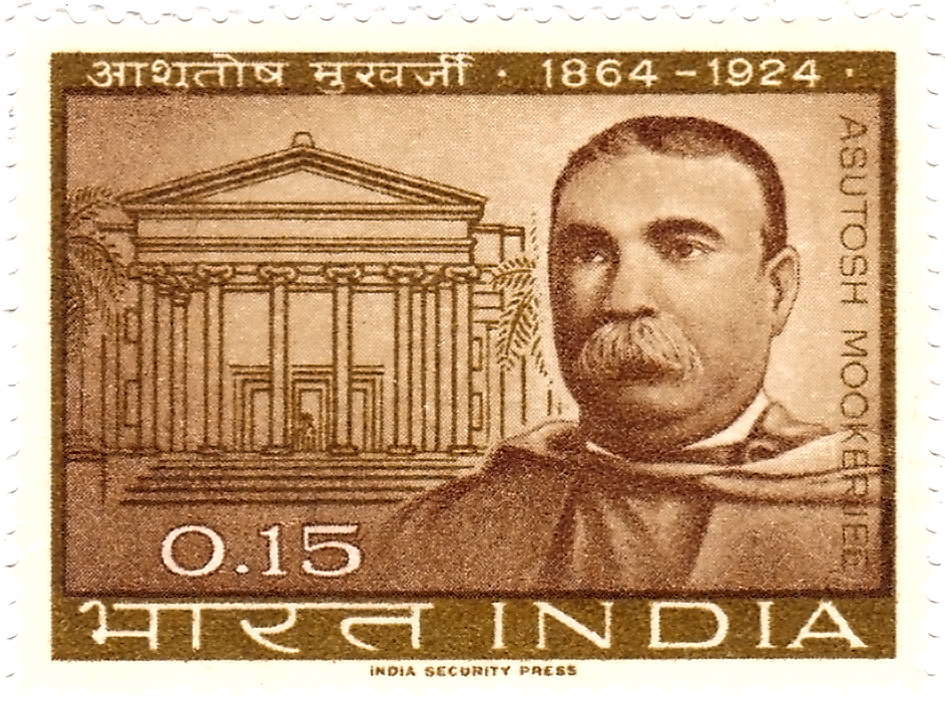
I trust some gifted historian of education will narrate the romantic story of the usurpation of the academic territory by the wise schoolmen of the Middle Ages, their displacement by the learned professors of the Humanities, the unwelcome intrusion of the iconoclastic devotees of the physical and natural sciences on the scene, and the entry, almost in our own generation, of the sturdy adherents of applied science, the resolute champions of technical and commercial instruction, who seem determined to fight undaunted to the finish the battle of “practical” against “liberal” education, of “useful” against “useless” knowledge. Let me plead, consequently, for freedom in the University, freedom in its inception, freedom in its administration, freedom in its expansion; surely this is the very condition of vigorous existence in an institution engaged in search after Truth. Keep your University, therefore, free from the baneful influence of Dogmas; their domination is equally deleterious whatever their source, whether they be official, political, religious or academic. Indeed, the corporate repressive action of a University which fails to link by a golden thread the experience of the past with the aspirations of the future may be as potent a factor for mischief as external, non-academic interference with its activities.
a student should in the first place have a thorough command over his Vernacular
Will you now patiently bear with me for a while, as I rapidly sketch a very imperfect outline of an educational policy which it is my dream may be deemed worthy of trial, at no distant date, in an Indian University? The time at my disposal will not allow me even to touch the fringe of the vast area of secondary education, elementary and advanced, and I shall premise the existence of a network of well-organized schools training pupils for real University, education, which is a development, an amplification, and, in many respects, a complement of school education. Such pupils, when they seek admission into the University, should be required to pass a fairly searching test, but the standard need not be ideally exacting, and undoubtedly neither capricious nor arbitrary. It is requisite at this stage of the career of the student; that his powers of expression, reasoning and observation should have been adequately developed. He should in the first place have a thorough command over his Vernacular, which, under normal conditions, would be, up till then, the chief, if not the exclusive, medium of acquisition of knowledge; he may be reasonably expected to possess an accurate knowledge of its grammatical structure, and a fairly wide acquaintance with the best specimens of its literature; he should also have regularly cultivated the art of composition and be able to express his ideas with ease and elegance, clearness and precision. In addition to this, he should, for obvious reasons, have acquired a sound working knowledge of English language, as distinguished from English literature, and his critical faculty should have been sharpened by a comparison and contrast of the idiom, diction, method and manner of the two languages. In the second place, his power of reasoning should have been developed by a prolonged training in Arithmetic, Algebra and Geometry, experimental as well as theoretical. In the third place, his power of observation should have been developed by a practical study of select branches of the experimental sciences, including, if possible, experimental mechanics.
an institution of university rank must aim at a sphere of study as wide as the whole domain of human activity
Finally, his mental vision should have been widened by a study of a classical language, the geography of the world, the histories of India and England, and, if possible, also by a rudimentary knowledge of modern history. A student of average ability and industry, who has had proper training in such a course—in a large measure through the medium of his Vernacular—has, by the age of seventeen, been equipped with the elements of a liberal education and should be fully qualified to receive the benefits of a three-year course for the first degree at a University.
Here comes the all-important point that a student of this description, on his entrance into the University, should have the choice of a rich variety of courses. All sources of knowledge must be open to all students as they want them. Ample provision should be made for liberal, for professional and for so-called useful studies, under the guidance of first-rate teachers, the most eminent, the most earnest, the most independent in their work, for it is the eagle alone that is fit to teach the eaglets. We must realize that an institution of University rank must aim at a sphere of study and of consequent influence as wide as the whole domain of human activity; we may profitably take a lesson from the momentous decision of an Asiatic Potentate in the land of the Rising Sun, half a century ago, that knowledge shall be sought for throughout the world. In this progressive age, a University cannot with safety confine its activities to some special department, and degenerate into a school of letters, or a college of commerce, or an assemblage of laboratories and workshops. It must frankly recognize the kinship of the arts and sciences and the inherent interdependence of all study and research, supplement theoretical by practical studies, and liberalize technical and professional instruction by organic connection with arts and letters. I can imagine no step more unwise for an Indian University to take than to give exclusive prominence to studies peculiarly Indian. Do not misunderstand me. Indian History, Indian Antiquities, Indian Literature. Indian Philosophy, Indian Religion, Indian Mathematics, Indian Astronomy, Indian Medicine, Indian Sociology, Indian Economics, Indian Administration, Indian Art, indeed, all the monuments of Indian culture imperatively demand critical and comparative study in an Indian University. But while I appreciate the value of adequate provision in these departments and regard them as essential factors in the organization of our University, I cannot but emphasize the paramount need for fully equipped technical institutions of all grades, with courses of scientific study, theoretical and applied; for in this age—brand it as materialistic, if you please—the trained special expert is at least as indispensable to society as the most accomplished theoretical scholar.
The past is of value only insofar as it illuminates the present, the present only insofar as it guides to shape the future
Review for a moment the characteristics of this age, though I have no desire to appraise the relative value of the different civilizations, competing in the great struggle to lead humanity. During the last half a century, the civilized world has witnessed with admiration the gigantic strides made by the intellect of man in the conquest of Nature; the developments have been as astonishing in character as they have been rapid in multiplication. The discoveries and appliances of the physical and natural sciences have facilitated the establishment of technological institutions and the promotion and enlargement of all departments of industries. To them we owe those remarkable inventions, which substitute the sinews of nature for the muscles of men and animals in the works of production; that wonderful facility of transport and distribution which makes the most precious products of each clime the source of comfort of every people; and that ever marvellous system of communication which has almost annihilated time and space and which enables each living man to sit in his chamber and converse with all other men in whispers. But these achievements of physical power, whether we regard them as means of destruction or as instruments for preservation, are but the product of the educated mind; they are under the absolute control of ideas, and whether they shall really promote or destroy civilization depends entirely upon the wise or unwise discretion of that omnipotent commander, the human mind. It is consequently a hundred-fold truer in the present than in any previous age, that ideas rule mankind, and it is not individuals, not kings, not emperors, not armies, not fleets, but ideas which overturn established systems and revolutionize social forms.
Let me ask, then, what course shall we choose while the world all around us is making such gigantic strides in the path of progress, ever seeking to gain mastery over the forces of Nature. We cannot disentangle ourselves, even if we wish, from irresistible world-currents, and sit on the lovely snow-capped peaks of the Himalayas absorbed in contemplation of our glorious past. It is most emphatically true that the community, the people, the nation, the race, which like the Greek philosopher will live in its own tub, and ask the conquering powers around it to move away from its sunshine, will soon be enveloped in eternal darkness, the object of derision for its helplessness, and of contempt for its folly. We cannot afford to stand still; we must move or be overwhelmed. We cannot waste precious time and strength in defence of theories and systems which, however valuable in their days, have been swept away by the irresistible avalanche of world-wide changes. We can live neither in nor by the defeated past, and if we would live in the conquering future, we must dedicate our whole strength to shape its course and our will to discharge its duties. The most pressing question of the hour for the people of every race is, not what they have been hitherto, but what they shall determine to be hereafter, not what their fathers were, but what their children shall be. The past is of value only insofar as it illuminates the present, the present is of value only insofar as it guides us to shape the future. Let us then raise an emphatic protest against all suicidal policy of isolation and stagnation.
The answer involuntarily springs to my lips, let us expand our universities
If we thus realize the full significance of this world-wide struggle of civilized man to secure ascendency over the forces of Nature, what effective measures shall we devise to make our people worthy of an honourable place in the contest. The answer involuntarily springs to my lips, let us expand our Universities; that is the first step in upward progress; from them will flow an irresistible stream of educational facilities for the elevation of the masses. Our own sons must be taught to build and operate machinery. Furnaces and foundries, studios and workshops, must be deemed as honourable and made as abundant as the offices of the learned professions, and they must be filled with our own children, made experts in our own schools of science. Then and then alone shall we be able to make adequate provision for the full utilization of our raw materials. I feel humiliated when I realize the enormous extent to which the products of our inexhaustible natural resources are carried away to foreign shops by adventurous exploiters, the masters of educated industries elsewhere, who apply to them their skill and art, freight them back as manufactured articles, resell them for our use, and profit by the multifold increase in value. What more telling illustration could one imagine than the manufacture of sandal oil which, to the infinite credit of your Government, is now carried on within your territory and under the supervision of the children of the soil. This, however, is not a solitary, isolated example. When my countrymen have been adequately trained and have been afforded free and full opportunity to employ their talents, what they can accomplish in the way of utilization of our boundless natural resources of diverse descriptions, is amply illustrated by the achievements of Sir Seshadri Iyer and Sir Visvesvaraya who have played a distinguished part in the organization of gigantic works of public utility which have extorted the admiration of unfriendly critics. It may consequently be asserted without fear of contradiction that if we are to live, if we are to survive this age of struggle, we must keep pace with the rest of the world in scientific pursuits. We must realize that it is a fatal mistake to make ignorance the primal law of labour, for there is no labour which skill cannot elevate and improve. Let us honour and educate labour, and train our children to business and callings other than those that have hitherto monopolized the appellation of “learned professions”.
I earnestly entreat you to make tuition free in every department of your University
I have emphasized this aspect of the subject from the deep conviction that the beginning of all real improvement in your State lies in the wise and steady development of your system of education. Education is like water; to fructify it must descend. Pour out flood at the base of society and only at the base, it will saturate, stagnate and destroy. Pour it out on the summit; it will quietly and constantly percolate and descend, germinate every seed, feed every root, until over the whole area from summit to base will spring
And then the full corn in the ear.
The struggle for national existence and progress is so keen that I earnestly entreat you to make tuition free in every department of your University. Offer education free of charge to your students. Lay no tax upon the acquisition of knowledge. Demolish the toll gates which bar the passage of light; let knowledge reach the ignorant mind, as air goes to the tired lungs and water to the parched lips. Let every father in Mysore feel and be made to rejoice in the conviction that his son has a patrimony in the University of his State. Be not alarmed at this ideal; I urge you further to arrange for the proper selection, from every corner of the State, of the promising children of orphanage and indigence, who will find here that parental kindness and smile of fortune which would secure food and raiment with education. Establish systems of scholarships and fellowships and require their recipients to distribute throughout the State the blessings they receive from the State. In the desperate struggle for existence, in the present age, it is incumbent upon you to educate each of your citizens to the utmost of his capacity. Believe me, you cannot afford to ignore the needy and the indigent; let intellectual deficiency, let moral obliquity, but let not poverty be the bar to the acquisition of knowledge. Resolutely refuse to be frightened by the assertion that a system like this would require immense means. Forget not that education is the one subject for which no people has ever yet paid too much. The more they pay, the richer they become, for nothing is so costly as ignorance, nothing is so cheap as knowledge. Explore the history of civilization, ancient and modern; you will find that the people who provided the greatest educational opportunities were always the most wealthy, the most powerful, the most respected, the most secure in the enjoyment of every right of person and property. This truth will be a hundred-fold more manifest in the future than it has ever been in the past, as the struggle for existence grows keener and keener. The very right arm of all future national power will rest in the education of the people. Power is leaving thrones and is taking up its abode in the intelligence of the subjects. Modern science is writing many changes in the long-established maxims of economics. Capital no longer patronizes labour, but enlightened labour takes capital by the hands and directs it where, when and how it should be invested. Educated industry has taken possession of the inexhaustible stores of Nature and of her forces, is filling the earth with her instruments of elevation and improvement, is bidding kings and rulers, empires and republics obey. The wealth, power, security and success of existing nations are accurately measured by the standards and extents of their educational systems, and those nations possess the highest standards and the most efficient and widely diffused systems of education which have taken the greatest pride in the endowment and advancement of their Universities. Bold, indeed, must be the man, who will venture to characterize these nations as wasteful, unwise or oppressive upon their people, because they liberally maintain their seats of learning.
beyond the things which are seen and temporal, are the things which are unseen and eternal.
I do not propose on the present occasion to detain you with the examination of another highly controversial question, the burning question indeed of the age, namely, whether University training so develops the character as really to befit men for their work in the momentous conflict of life. It is sufficient to state that in my judgment it is impossible to emphasize too strongly the elementary truth that the formation of character is of infinitely higher consequence than the absorption of knowledge. Though the circumstances of the time have compelled me to devote the main portion of my address to what may be called the intellectual and material side of our activities, I do not under-rate the supreme value of the spiritual element. But I feel convinced that in an Indian University, addressing an Indian audience, it is superfluous for me to impress upon my young friends the paramount importance of the lesson that whether we turn our eyes to the unfathomed depths of the sea or the boundless regions of space, beyond the things which are seen and temporal, are the things which are unseen and eternal. First graduates of the University of Mysore, take to heart this fundamental truth, and never forget that you shall be responsible for the future of your State. That future will be anything you command; herein lies your grave responsibility. You have promised to your University, symbolized in your Chancellor, that to the utmost of your opportunity and ability, you will support and promote the cause of morality and sound learning, and that you will, as far as in you lies, uphold and advance social order and the well-being of your fellowmen. These are not idle forms, but words of deep import and great solemnity, deliberately uttered by you as men of honour. Realize the full significance of the obligation under which you have placed yourselves, towards your University, your State and your fellow-subjects. Remember that it is not enough to be a good man and to achieve success in life. There is a loftier ambition than merely to stand high in the world; it is to stoop down and lift mankind higher. There is a nobler character than that which is merely incorruptible; it is the character which acts as an antidote and is preventive of corruption. Fearlessly speak the words which bear witness to righteousness, truth and purity. Patiently do the deeds which strengthen virtue and kindle hope in your fellowmen. Generously lend a hand to those who are endeavouring to climb upward. Faithfully give your support and your personal help to all efforts to elevate and purify the social life of the world. That is the way to make your life savoury and powerful. The men that have been happiest, the men that are best remembered are the men that have worked for the redemption of Society. Good men are not like trees, planted by rivers of waters, flourishing in their own pride and for their own sake, but they are like eucalyptuses, reared in the marshes, diffusing a healthful tonic influence and countervailing the poisonous miasma. They are like the tree of Paradise whose leaves are for the healing of nations. Be not content, therefore, merely to avoid evil and the forces of corruption. Society requires, not passive resisters but active helpers. It lies in you to illustrate the inefficacy of an education which produces learned shirks and refined skulkers. It lies in you to illuminate the perfection of an unselfish culture with the light of devotion to humanity. It is for you to prove that you are able to use all that you have learnt for the end for which it was intended, to enable you to lead the life of active benefactors of your community. Choose then as the motto of your life the noble sentiments of a poet beautifully expressed:
For those who know me true,
For the heaven that bends above me,
And the good that I can do,
For the wrongs that need resistance
For the cause that lacks assistance
For the future in the distance
And the good that I can do.
If the nobility of your souls rises to this height, I feel no doubt as to your future. From every corner of this State, there comes this day an earnest anxious voice to you enquiring, will you rise higher or fall yet lower, will you live or will you die, will you command or will you serve. Gathering in my own the voices of you all and with hearts resolved and purposes fixed, I send back the gladsome response, you shall rise, you shall live, you shall command.
Appendix B
K. Venkatachaliengar8
Bruce C. Berndt9
During the period from 1985 to 1994, the author received at least nine lengthy letters from Venkatachaliengar. The first, written on 15 July 1985, came in response to receiving a copy of the author’s first book on Ramanujan’s notebooks [4] that the author had earlier sent to Venkatachaliengar. In order to set the context of a long passage that we are going to quote from this letter, we need to recall a brief history of Ramanujan’s Quarterly Reports.
On 26 February 1913, Sir Gilbert Walker, Head of the Meteorological Observatory in Madras, sent a letter to Francis Dewsbury, Registrar at the University of Madras, exhorting the University to provide Ramanujan with a scholarship. On 1 May 1913, Ramanujan was granted such a scholarship with the stipulation that he write Quarterly Reports on his research. Before departing for England in March of 1914, Ramanujan wrote three reports, dated 5 August 1913, 7 November 1913, and 9 March 1914. An account of these reports may be found in the author’s book [4] or his papers [2], [3]. A complete transcription of the Quarterly Reports has also been prepared by the present author [5]. In his first letter to the author, Venkatachaliengar provided an account of the deliberations that took place before the scholarship was approved. In the quote below, S.R. is an abbreviation for Srinivasa Ramanujan.
Descriptions of events leading to Ramanujan’s scholarship vary somewhat; see for example, [18] and [4, p.295]. Venkatachaliengar’s account highlights the objections of English mathematicians, in particular, Littlehailes. In one of the two Presidential addresses [21] that Venkatachliengar gave before the Indian Mathematical Society, he pointed out that this was the first research scholarship awarded by the University some 50 years after the British Parliament had passed the Act. Sir Francis Spring was the Chairman of the Madras Port Trust Office where Ramanujan served as a clerk, and was one of Ramanujan’s earliest and most devoted supporters. Ranganathan was Librarian at the University of Madras and wrote the first thorough biography of Ramanujan [18]. He is also famous in the field of library science and is considered to be one of the founders of modern library science. Littlehailes was Professor of Mathematics at Presidency College in Madras and later became Vice-Chancellor of the University of Madras; more information about him can be found in [7].
In his visits to India, the author can recall three long conversations with Venkatachaliengar. Although our conversations were chiefly about mathematics, in particular, about modular equations, he would often relate interesting facts about Indian mathematics and mathematicians, including Ramanujan, over a broad expanse of the twentieth century. It is unfortunate that portions of these conversations were not recorded for posterity.
An examination of the bibliography of Venkatachaliengar shows a broad stretch of interests. For roughly the first half of his career, Venkatachaliengar’s interests were algebraic, covering a wide variety of topics. In the second half of his career, his interests took on a more analytic bent, and he became fascinated with the work of Ramanujan. Although he published few papers on Ramanujan’s work, his passion for Ramanujan was evident in his two Presidential addresses to the Indian Mathematical Society [21], his highly original monograph on Ramanujan’s discoveries in elliptic functions [22], and his monograph on selected results from Ramanujan’s work, which he coauthored with his close friend V.R. Thiruvenkatachar [20]. We offer a few remarks about some of Venkatachaliengar’s publications.
Venkatachaliengar’s originally published monograph [22] has been edited by S. Cooper. This more widely distributed edition was published by World Scientific Publishing Co.
Readers might be interested in the origin of the author’s paper [8] with Venkatachaliengar. In early 1999, the author visited the University of Mysore, and one of his hosts, Professor S. Bhargava, accompanied him to the home of retired University of Mysore Professor T.S. Nanjundiah, who presented the author with a handwritten partial manuscript that he had once started to write with Venkatachaliengar. Although the Dedekind eta-function \eta(\tau) was not mentioned in this partial manuscript, the authors had very cleverly derived the transformation formula for \eta(\tau). Nanjundiah demurred about his own contributions to the paper, and so eventually with the gracious accedence of both Nanjundiah and Venkatachaliengar, the present author added a few minor contributions of his own and coauthored [8] with Venkatachaliengar. Readers might turn to the paper by the author, C. Gugg, S. Kongsiriwong, and J. Thiel [6], where they will find Venkatachaliengar’s ingenious idea used twice again.
Venkatachaliengar supervised the doctoral dissertation of only one student, V. Ramamani [13]. In her beautiful thesis, she extended some of the ideas from Ramanujan’s epic paper [15]. Two of the author’s doctoral students, Heekyoung Hahn and Tim Huber, in turn used her work in their own research, [9], [10] and [12], respectively.
Let A_k(n) denote the number of partitions of the positive integer n into odd parts such that exactly k different parts occur. Let B_k(n) denote the number of partitions \lambda=(\lambda_1,…, \lambda_r) of n, where \lambda_i\geq\lambda_{i+1} and 1\leq i\leq r-1, such that the sequence (\lambda_1,…, \lambda_r) is composed of exactly k noncontiguous sequences of one or more consecutive integers. Then A_k(n)=B_k(n), for all k and n.
As intimated above, Venkatachaliengar served as President of the Indian Mathematical Society for two years. In his two addresses to the Society [21], he urged Indian mathematicians to study Ramanujan’s (earlier) notebooks [16] and lost notebook l[16]. In particular, he focused on particular examples from the lost notebook and his proofs of them. He also discussed the manuscripts of Ramanujan that were found in the library at Oxford University and published with Ramanujan’s lost notebook [17].\blacksquare
References
- G.E. Andrews, The Theory of Partitions, Addison–Wesley, Reading, MA, 1976; reissued: Cambridge University Press, Cambridge, 1998.
- B.C. Berndt, The quarterly reports of S. Ramanujan, Amer. Math. Monthly 90 (1983), 505–516.
- B.C. Berndt, Ramanujan’s quarterly reports, Bull. London Math. Soc. 16 (1984), 449–489.
- B.C. Berndt, Ramanujan’s Notebooks, Part I, Springer-Verlag, New York, 1985.
- B.C. Berndt, Ramanujan’s quarterly reports, Hardy–Ramanujan J. 45 (2022), 1–41.
- B.C. Berndt, C. Gugg, S. Kongsiriwong, and J. Thiel, A proof of the general theta transformation formula, in Ramanujan Rediscovered, Ramanujan Mathematical Society, Lecture Notes Series, No. 14, Mysore, 2010, 53-–62.
- B.C. Berndt and R.A. Rankin, Ramanujan: Letters and Commentary, American Mathematical Society, Providence, RI, 1995; London Mathematical Society, London, 1995.
- B.C. Berndt and K. Venkatachaliengar, On the transformation formula for the Dedekind eta-function, in Symbolic Computation, Number Theory, Special Functions, Physics and Combinatorics, F.G. Garvan and M.E.H. Ismail, eds., Kluwer, Dordrecht, 2001, pp. 73–77.
- H. Hahn, Convolution sums of some functions on divisors, Rocky Mt. J. Math. 37 (2007), 315–344.
- H. Hahn, Eisenstein series associated with \Gamma_0(2), Ramanujan J. 15 (2008), 235–257.
- M.D. Hirschhorn, Sylvester’s partition theorem and a related result, Michigan Math. J. 21 (1975), 133–136.
-
T. Huber, Zeros of Generalized Rogers–Ramanujan Series and Topics from Ramanujan’s Theory of Elliptic Functions, Ph.D. thesis, University of Illinois at Urbana–Champaign, Urbana,
2007. - V. Ramamani, Some Identities Conjectured by Srinivasa Ramanujan Found in His Lithographed Notes Connected with Partition Theory and Elliptic Modular Functions – Their Proofs – Interconnection with Various Other Topics in the Theory of Numbers and Some Generalisations Thereon, Ph.D. thesis, University of Mysore, Mysore, 1970.
- V. Ramamani and K. Venkatachaliengar, On a partition theorem of Sylvester, Michigan Math. J. 19 (1972), 137–140.
- S. Ramanujan, On certain arithmetical functions, Trans. Cambridge Philos. Soc. 22 (1916), 159–184.
- S. Ramanujan, Notebooks (2 volumes), Tata Institute of Fundamental Research, Bombay, 1957.
- S. Ramanujan, The Lost Notebook and Other Unpublished Papers, Narosa, New Delhi, 1988.
- S.R. Ranganathan, Ramanujan: The Man and the Mathematician, Asia Publishing House, Bombay, 1967.
- J.J. Sylvester, A constructive theory of partitions arranged in three acts, an interact, and an exodion, Amer. J. Math. 5 (1884), 251–330; 6 (1886), 334–336.
- V.R. Thiruvenkatachar and K. Venkatachaliengar, Ramanujan at Elementary Levels – Glimpses, edited by B.C. Berndt, A. Dixit, V.J. Reuter, P. Xu, and B. Yuttanan, Ramanujan Mathematical Society, Lecture Notes Series, No. 24, 2016.
- K. Venkatachaliengar, Ramanujan Manuscripts, I, II, Presidential Addresses given in December 1979, 1980 to the Indian Mathematical Society, Math. Student 52 (1984), 1–4; 215–233.
- K. Venkatachaliengar, Development of Elliptic Functions According to Ramanujan, Tech. Rep. 2, Madurai Kamaraj University, Madurai, 1988; second and revised edition prepared by S. Cooper, World Sci. Pub., Singapore, 2012.
Footnotes
- Marshall H. Stone, “The Theory of Representations of Boolean Algebras”, Transactions of the American Mathematical Society 40 (Jul. 1936), 37–111. ↩
- Negative operation and ideal theory in a Boolean algebra, Proceedings of the Indian Academy of Sciences-Section A 57 (6), 379-389. ↩
- Dadappa Chintappa Pavate was a Cambridge Mathematical Tripos wrangler. After his return from England he was appointed Educational Commissioner of Bombay-Karnataka. In 1954, he became the vice-chancellor of Karnatak University, Dharwad and continued until 1967 when he was nominated as the Governor of Punjab, where he served till 1973. He was awarded Padma Bhushan from the Government of India in 1967. He has authored two books, My days as Governor and My days as educational administrator. ↩
- C.N. Srinivasa Iyengar received DSc from Calcutta University and served as a professor of mathematics for a number of years at the Central College in Bangalore. He joined the Karnataka University, Dharwad when the mathematics department was started there in 1956 and retired in 1965. He worked in the field of differential geometry. He authored the book History of Indian Mathematics published in 1967 by the World Press, Calcutta. An acclaimed scholar of Sanskrit, he translated the Rāmāyaṇa of Vālmīki into Kannada. ↩
- See https://www.ramanujanmathsociety.org/Obituaries.html#image2. ↩
- See https://www.ramanujanmathsociety.org/Obituaries.html#image1. ↩
- This article was originally published in Addresses Delivered at the Mysore University Convocations 1918-1929, (1930), pp. 9 – 30 (https://archive.org/details/mysore-university-convocation-addresses), and is republished here. ↩
- This article was originally published in volume number 24 in the Lecture Notes Series of the Ramanujan Mathematical Society, with the title “Ramanujan at Elementary Levels – Glimpses by V.R. Thiruvenkatachar and K. Venkatachaliengar’’, edited by Bruce C. Berndt, Atul Dixit, Victoria J. Reuter, Ping Xu and Boonrod Yuttanan, and is republished here, with updated edits by the author, with permission. ↩
- Bruce Berndt (berndt@illinois.edu) is a mathematician at the University of Illinois at Urbana-Champaign, where he has been since 1967. He is on the editorial board of at least ten mathematical journals, one of which is solely dedicated to understanding the influence of the work of Srinivasa Ramanujan in all areas of mathematics.↩